Colossians 2.11ff teaches us that Jewish customs from the old system are no longer valid. Our relationship with Jesus was initiated in a totally different way. No flint knives were necessary — he made us his special people by freeing us from the power of our sinful selves. Rather than going through a painful procedure, we go through the painless act of immersion. Immersion buries us with Jesus and allows us to access the same resurrection he did. Our faith in God’s power makes that possible.
Notice the emphasis in Col 2.11-15 on the passive nature of our forgiveness! Judaism was all about doing stuff for the purpose of being forgiven of bad actions. The whole purpose of the old law was to show us that we’re incapable of working off our existential debt. We are completely powerless by ourselves.
Verse 11 — not done by human hands, you were made free, this is circumcision Christ does
Verse 12 — you were baptized, you were buried with Christ, you were raised up, God raised Christ
Verse 13 — you were spiritually dead, you were not free from the power of your sinful self, God gave you new life together with Christ, he forgave all of our sins
Verse 14 — we broke God’s laws, we owed a debt, God forgave that debt, God nailed that debt to the cross
Verse 15 — God defeated the ancient ruling powers of earth through the cross, they are now defeated and powerless prisoners
God was and is responsible for our status. We can’t dig ourselves out of any sin-debt, but he can and does forgive. God’s grace through Jesus’s sacrifice is how we’re immortal!
These are some of the positive actions God wants to see, taken from Colossians chapter three:
Show mercy to others — This was originally two words: σπλαγκνα οικτιρμου (sp-longk-na oik-tear-moo). The first describes that powerful gut feeling of compassion when you see someone’s awful situation. The second means something like pity or mercy. So this is an emotional response to someone’s plight, followed by actually doing something about it.
Be kind — This word is very closely connected with the concept of helping others. It’s a catch-all that means, “Be someone who benefits other people.”
Be humble — This is someone who doesn’t think more highly of themselves than they should. It can be taken too far (as in Col 2.18, 23) in the form of “pious self-denial” or asceticism. God wants his people to have a balanced view of self. We are the heirs of his kingdom, but we are no more important than any other Christian.
Be gentle — This is closely tied to humility, and it means “not being overly impressed by a sense of one’s self-importance.” A humble, gentle person recognizes their own position as someone who serves God and must therefore serve other people, and view them as being more important.
Be patient — This word is also closely tied to humble and gentle in this context. While we serve other people with a balanced view of self, we have to be willing to put up with their shenanigans. People can be really hard to love, but patience puts up with their weakness while we try to show them God’s love.
Don’t be angry with each other — This would be better translated “put up with each other.” In other contexts, it’s used to mean putting up with something draining or difficult without giving in. This word is a participle in the original text, so it tells us to what extent we’re supposed to live out the qualities of kindness, humility, gentleness, and patience. That extent is limitless. God expects us to be good to our Christian family, even when that’s the last thing we want to do. We might even say, “Fake it til you make it.” Be good when you don’t want to until God’s love perfects your mindset.
Forgive each other — Greek doesn’t have the word normally translated “forgive”. Instead, it seems to be similar to the kind of language Jesus used when he said, “If someone slaps you on the cheek, give them your other cheek to slap.” When our Christian family wrongs us, our reaction should be to go out of our way to do something good for them. Forgiveness is an element of that mentality, but this word really seems to stress having a positive reaction in the face of mistreatment from our Christian family, rather than a passive forgiveness. Paul even says here, “Be good to them because Jesus was good to you first.” Yes, Jesus forgave and forgives us! But more than that, he was good to us when we didn’t deserve it at all.
Love each other — This is the most important element of all of the ones listed here (“επι πασιν δε τουτοις την αγαπην”). Paul says, “This is the most important thing,” and, “Love holds everything together the way it should be.” It’s safe to say that all of the other positive things we’re supposed to adopt from this list are practical ways to express this godly love.
It’s a new year. For many it’s an opportunity at a new beginning – a fresh start, a second chance. I want to begin tonight with a lighthearted story about how a couple of second chances helped me.
When I was about 5 or 6 my older brother unintentionally tried to kill me, at least twice. The first time, we were outside playing, and we found these large bushes, pokeweed. These plants and the berries are poisonous, but we didn’t know that. I read that if you cook the leaves and berries properly, you can eat them. However, what you shouldn’t do, especially as a small child, is convince your younger brother to eat a handful of these berries. I googled for curiosity’s sake how many berries were dangerous, and it said that as few as 10 would make the average adult sick with all kinds of symptoms or some reports even said death. We went to the house and my mother knew exactly what I had done, the evidence was smeared all over my hands and my face. She called poison control, and they told her to give me this syrup that would make me sick to my stomach and I’d throw up the berries. Sure enough about 45 mins later – no more berries.
The second time was a little more serious. We had this storage building out back, it had a small lean-to shed on the back side. One of the sides was perfect for climbing on. Since we were expert climbers my brother had the idea – let’s get up on that roof so we can see everything better. We shimmied our way up the side and made it up onto the roof. If that had been the end of the story that would’ve been great…but wait, there’s more. My brother noticed something coming from the side of the building. He was referring to the electrical service, and the power lines that were coming off the pole and into the side of the storage building. “I wonder what happens if you touch those?” Listen guys I’m smart it just hadn’t kicked in yet. So yeah, I walked over and grabbed them and believe me when I say they grabbed me right back. I’ve told this story 100 times and everyone seems shocked and surprised, but I can assure you, not nearly as much I was!!
Second chances are given to us all the time and come in a variety of ways. They happen in our everyday lives, our careers, our marriages, relationships with our families our friends, and our relationship with God. God gives us second chances because he loves us, and he knows us and knows we need them.
God is a God of second chances. Throughout the Bible we study about people who have sinned or made mistakes, altered their courses in life but are still given a second chance by God.
1. For example, Jonah had fled from what God had commanded him to do yet was given a second opportunity to go to Nineveh and spread His word to the people. (Jonah 3:1-10).
2. David was a man after God’s own heart, yet he turned away from Him when he committed adultery with Bathsheba, had Uriah killed, then his son died because of the evil he had done (II Samuel 11 and 12) but still God loved him, and he was a great king.
3. Rahab was a prostitute. She didn’t live a wholesome life, but she changed the course of her life when she did something for good. She hid the spies in Jericho. When the city was destroyed, she was rewarded. Only she and her family were saved. (Joshua 6:22-23)
4. Paul once was a persecutor of Christians (Acts 8:1-3). He was converted into a Christian and baptized (Acts 9:18). He became one of the most influential missionaries, authors, and apostles of the first century.
5. Onesimus was once deemed useless. After being given a second chance Paul describes him as beloved servant, and brother to him. He was willing to do anything for him, even pay his debts. (Philemon 11-17)
The list could go on and on. The point is that God’s love, his mercy, and by His grace through faith, we can all be saved (Eph. 2: 4-8). God forgives our sins and gives us a fresh start. “If we confess our sins, he is faithful and just to forgive us and cleanse us from all unrighteousness.” (I John 1:9) Every day we wake up is another chance to make changes. God’s steadfast love never ceases, his mercies never come to end, they are new every morning. (Lamentations 3:22-23)
As important as it is that we don’t forget about God giving us second chances, Let’s not forget we are to extend second chances to others. We all have family, friends, coworkers, even sometimes church family that we don’t always see eye to eye with. We don’t need to settle for division, we need to strive for unity. (1 Peter 3:8) As Jesus taught, we are to forgive others as we have been forgiven (Matthew 6:14-15). We are also encouraged to show kindness, love, and grace to others – just as God has shown us (Ephesians 4:32).
God’s second chances are such a blessing to us. We need them, he knows that we do. He’s not a mean God, “He doesn’t treat us as our sins deserve, or repay us according to our iniquities” (Psalms 103:10). He doesn’t want us to fail, but second chances aren’t meant to be free passes for us to keep returning to sin. (Romans 6:23) “ For the wages of sin is death, but the gift of God is eternal life in Christ Jesus our Lord.” He sent his son to die for us so that we could have as many chances as we need to make things right and grow closer to him before its too late.
Each new morning the sun rises, God is giving us a second chance. A chance to improve our lives, mend broken relationships, work on those New Year’s resolutions – that I hope we haven’t already broken. This year let’s not squander our second chances, but instead savor them. Let’s make the most of those opportunities to do good, to do things that glorify God, and that will help us walk closer to him. If 2023 just wasn’t the year for whatever reasons, then begin this year on the right foot. Let 2024 be your second chance.
For the next couple of weeks, I’ll attempt to condense biblical truths into easy-to-understand sentences. These truths have lifted my own spirit, stimulated thought, caused me to praise God, and fortified confidence in him. These will just be thoughts I’ve found interesting or helpful:
God’s visible form (Logos) created the earth from water (Col 1.15; Jn 1.1-4; II Pt 3.5).
Logos became human to give us a second, permanent life (Col 1.15; Jn 3.17, 11.25, 20.31).
Jesus will save humanity when earth is destroyed (II Pt 3.7, 10; I Thess 4.14-17; Jn 20.31). He will take us to a new, perfect world without any possibility of evil (II Pt 3.13, Mt 19.28).
Jesus defends us when we sin, and forgives every sin (I Tim 2.5; I Jn 1.7; Hb 4.15).
God is more powerful than our guilty consciences (I Jn 3.20).
Logos became human, lived a perfect life, was illegally executed, and came back to life (Jn 1.14; II Cor 5.21, 15.4). This message — and his promise to come back for us — is the core of our faith.
Jesus gives us new life through our faith in him; he freed humanity from a rules-based religious system (Gal 3.11-14, 21).
On a totally unrelated note, exercise and selfless acts are the best cure for seasonal depression (and many other issues). This is by no means a requirement for godly living, but exercise makes it much easier to help others, help self, and discover more about God’s amazing nature!
We usually lie to ourselves more than we do to others. However, repentance in and of itself is being open and honest with God. It’s recognizing sin, and turning from it.
The prodigal son took his inheritance, left home and blew all his money. He waisted his money fulfilling his every desire. But after a while, the money ran out and he was forced to get a job working with pigs. He was so hungry the pig slop looked appetizing.
Jesus tells us this parable in Luke 15:17-24,
“But when he came to his senses, he said, ‘How many of my father’s hired men have more than enough bread, but I am dying here with hunger! ‘I will get up and go to my father, and will say to him, “Father, I have sinned against heaven, and in your sight; I am no longer worthy to be called your son; make me as one of your hired men.” ’” So he got up and came to his father. But while he was still a long way off, his father saw him and felt compassion for him, and ran and embraced him and kissed him. “And the son said to him, ‘Father, I have sinned against heaven and in your sight; I am no longer worthy to be called your son.’ “But the father said to his slaves, ‘Quickly bring out the best robe and put it on him, and put a ring on his hand and sandals on his feet; and bring the fattened calf, kill it, and let us eat and celebrate; for this son of mine was dead and has come to life again; he was lost and has been found.’ And they began to celebrate.”
Notice that the son said to himself, “I have sinned against heaven, and in your sight.” Do we really want to know ourselves? Be honest. Not a single human on earth is without sin. When the son was honest, the Father was forgiving.
If you’re a Christian and there’s sin in your life, the worst thing you can do is ignore it.
1 John 1:9 says, “If we confess our sins, He is faithful and righteous to forgive us our sins and to cleanse us from all unrighteousness.” God is READY and FAITHFUL to forgive…but we MUST confess! God doesn’t want you to bury them deep down; confess and get it over with! He’s waiting. He already knows what you’ve done, but we act like we can hide it from Him.
You owe it to yourself to be honest, not just to others but in the conversations you have in your head. Be honest in the decisions you make, the sins in your life and you’ll be closer to knowing who you REALLY are.
We are sinful, we are human, but God gives grace to those who come to Him. Let’s be honest, and a truthful examination will show us that we need God in our lives.
October 2, 2006, was a terrible day for several families among the Amish in Lancaster County, Pennsylvania. A deranged man, Charlie Roberts, took an Amish schoolhouse hostage and tragically killed five girls. It was also a terrible day for Charlie’s very religious family members who lived near the Amish. The Roberts were absolutely shattered by their son’s and husband’s actions. Friends and church members came to comfort them. But the first visitor they had was Henry. Why is that remarkable? He was the father of one of the victims! He went to the Roberts’ home and consoled this shooter’s grieving parents and wife. The entire Amish community sent a clear message that they forgave Charlie and showed them love and mercy.
Charlie’s family used words like redemption and restoration to describe what the Amish did as an illustration of what God did. Paul writes to a church while in prison for preaching Christ (Col. 1:19-23). Try to imagine the emotions those Amish families went through on their way to consoling the family of the man who took their children and permanently changed their lives. Then try to imagine a perfect, all-powerful and all-knowing God, whose perfectly innocent Son died because of us. What kind of people were we? Paul says we were enemies, separated from Him by our evil thoughts and actions. We may not have been a Charlie Roberts, but our sin separated us from God (Isa. 59:2). But we weren’t just related to a sinner; We were the sinner.
But God did not sit back and wait for us to grovel and beg. He had a plan before the first person ever sinned. Paul discusses this plan in Romans 5:6-10. God reached out to us and justified and reconciled us. Paul begins that discussion in verse one by saying, “We have peace with God through our Lord Jesus Christ. That is what Paul says to the church in Colosse. And he spells out the price of peace, “The blood of the cross of Christ.” What does this gift show us?
It shows us how much He wants a relationship with us (Col. 1:18-21). The Father held back nothing to heal the fracture our sin caused in our relationship. What steps did He take? God became flesh (19-20), He experienced the pain and suffering we rightfully deserved (20; 2 Cor. 5:21), then He gave us the roadmap home through the gospel (23). It’s absolutely true that the response of the Amish reflected God’s response to our spiritual crimes.The offended took the first step to mend a broken relationship. Charlie’s dad was an Amish taxi driver and who knew these folks.
It shows us how much potential He sees in us (Col. 1:22). There’s a powerful phrase here: “In order to.” This is a purpose statement. Why make peace through the blood of Christ’s cross?Christ wants to present us before God with three important qualities–holiness, blamelessness, and being beyond reproach. The devil would like us to stay stuck in our sin and guilt. To let that beat us down and keep us from our potential. But Paul says the cross overcomes what we were and makes us more than we ever thought we could be.
It shows us how much it should effect us (Col. 1:23). The way the Amish treated the Roberts profoundly effected them. It changed their life! They repeatedly spoke of how blessed they felt to have experienced that lovingkindness. While they would have desperately wished never to have gone through such shame and loss, the grace they felt changed them. Paul is saying that’s what the cross should do for us. He says, “Plant your feet in the concrete of Scripture.”Don’t let anything move you away from the hope of the gospel. Let it make you so resolved to love and follow God that no trial, temptation or teaching can succeed in making you abandon Jesus.
Steven Curtis Chapman wrote, “How do you explain? How do you describe a love that goes from east to west and runs as deep as it is wide? You know all our hopes, Lord, you know all our fears, and words cannot express the love we feel but we long for you to hear.” Try to put yourself in Charlie Roberts’ parents’ and wife’s place, watching members of the Amish community, whose daughters were taken by your son, walking up your sidewalk, coming in your house, hugging you and praying with you. How would you describe that to other people? By a life lived in appreciation for that incredible gift. There’s no comparison to what Christ did through the blood of the cross. It brings instant harmony in our relationship with God, making things right with Him. It’s hard to describe that feeling, so the best thing we can do is live lives that show everyone how much we appreciate it!
Saul had a bright future full of potential. When we first read of him he’s portrayed as a likable underdog who doesn’t see his own potential. He even stated that he’s just a nobody from the small insignificant tribe of Benjamin (1 Sam. 9.17-21). God anoints him as king and like every anointed king that we read of in the Old Testament, he influenced the nation’s relationship with God. In hindsight, we’re able to see God’s wisdom. A judge who spoke on behalf of God would carry out God’s will. A king would always be more susceptible to various forms of corruption with the great power given to him. No matter how the rulers would live their lives, good or bad, we can learn much. Sadly, Saul is one of those kings who taught us how not to live. Here’s a list of the many spiritual dangers we should avoid today.
Saul’s Seven Deadly Sins
I SAMUEL
The sin of lacking patience – 13.8
The sin of excuse-making – 13.11, 12; 15:15, 20, 24
The sin of half-hearted service – 15.1-26
The sin of Glorifying self – 15.12
The sin of fearing men rather than God – 15.15, 24
The sin of desiring forgiveness from man rather than God – 15.25
The sin of jealousy – 18.6-9
While there are other mistakes and shortcomings that lead to Saul’s physical and spiritual demise, we can be strengthened by them. His failures serve as warning signs and that’s exactly why they’ve been recorded in the only book God ever wrote.
Jesus came back to life after he died. In his new body, he spent time with his apostles and ate with them (Acts 10.41). Clearly this resurrection body was a real, physical body (though different in ways we don’t yet understand, cf I Cor 15.44). God the father used his power to bring Jesus back to life (Acts 2.32), and will do the same for us after we die.
The bible gives us some pretty clear information about where we’ll be going after we die, and it’s amazing. We have life now, and we don’t seriously question its reality. Death is just a blip from our perspective (cf I Cor 15.52). We’ll have life then, and it’ll be just as real. So where are we going? Our citizenship is in “the heavens” (Phil 3.20). For some reason, most translations have it singular — “in heaven,” even though this is dative plural in Greek. Jesus is going to come back from the heavens too (3.20). The plural form of ουρανος (“heavens”) is also found in Col 1.5, 16, 4.1; II Cor 5.1; Eph 1.10, 3.15, 4.10, 6.9; I Thess 1.10, Hb 1.10, 4.14, 8.1, 9.23, 10.34, 12.23, 25; I Pt 1.4, II Pt 3.5, and many other passages. It can mean “skies”, but in many contexts it means “space”. This makes perfect sense in light of II Pt 3.13 and Rev 21.1-2 (cf Is 65.17; use of παλιγγενεσια in Mt 19.28).
After our death, we’ll be given a body and source of life that cannot be killed (I Cor 15.42-49; I Pt 1.3-7). This applies to good people and bad people. The difference for good people is that we’ll get to leave Earth with Jesus, while everyone else will suffer forever. We want to avoid everyone else’s fate, so we do our best to follow God as he gives us constant forgiveness.
Ephesians 1.3 says, “In Christ, God has given us every spiritual blessing in the heavenly places.” What does that mean? We hear “spiritual blessings” and might gloss over it as another Christianese phrase. Here’s a short list of what those spiritual blessings are.
1.4 — God chose us before Christ made the world.
1.4 — He chose us out of love to be his special people.
1.5 — He chose us to be his own children through Jesus Christ.
1.6 — God gives grace liberally.
1.7 — We are free because of Jesus’s sacrifice.
1.7 — We have forgiveness because of God’s grace.
1.8-9 — God told us how we can get that grace. He didn’t set up a system that we would have to look super hard for, he made sure to preserve the information needed to find him.
1.10 — He is bringing the heavens and the earth together through Jesus.
1.12-13 — He made grace available to every country on earth, not just one group.
1.13-14 — He gave us his spirit as a downpayment on our reward.
While we won’t fully appreciate these spiritual blessings until later (Paul says these riches are “too great to fully understand” in 3.8), we’re still extremely grateful that God has done so much to give us hope for eternal life.
Do you have a “debt problem”? According to credit service, Experian, the average credit card debt per household is $5,315 (Wallethub puts it at $7,849). Renting money comes at a high cost with exorbitant interest. Perhaps you or a loved one have faced an enormous debt, medical costs, business or student loans, or a mortgage that made for uncomfortable living? Most of us know how that feels, to one degree or another. We don’t like the thought of owing someone. It gives them power and control over us (read Prov. 22:7). Perhaps you are one of those who can say that you don’t owe anyone–not the credit card companies, the mortgage company, the automobile dealers, etc. But you are still in debt! So am I.
Luke reveals a dinner party with a very diverse cast of characters (Luke 7:36-50). There’s Simon, a Pharisee, who plays host (36). There are several dinner guests (49), but sinless Jesus, God in the flesh, is the guest of honor (36). Then, there was a woman who crashed the party, whose name Luke doesn’t give us but who instead is identified by her lifestyle–“a woman in the city who was a sinner” (37). The Pharisees were the custodians of the Old Law (Mat. 23:2). Simon would be a man of great reputation, one who we’d think would not be the indebted type. This unnamed woman was the opposite.
Such is the setting that allows Jesus to drive home a powerful point about debt. The woman, with a visibly enormous, spiritual debt, spends money (Mark and John record a similar incident where the contents were worth as much as 300 denarii, or almost a year’s wages), sacrifices dignity, submits humble service, and shows significant emotion (37-38). Apparently, “who” she was was well-known and she had nothing to lose and everything to gain. She is the picture of transparency and need.
Apparently, Simon is at the other end of the spectrum, physically, socially, and, at least on the surface, spiritually. In fact, he sits in judgment of Jesus for allowing the woman to be so familiar with Him, thinking to himself, “If this man were a prophet He would know who & what sort of person this woman is who is touching Him, that she is a sinner” (39).
Jesus, able to read Simon’s thoughts, uses them as a launching point to teach that vital point about spiritual indebtedness. He shares the parable of two debtors. There was a disparity between the two debts, but neither could repay what they owed. The lender forgives both debts, no strings attached. Who would feel the greater depth of gratitude and affection? The answer is obvious, and Jesus makes application.
He points to how humbly and freely the woman expresses her love and appreciation to Jesus, while Simon is negligent in all the ways she was demonstrative. Jesus points out that this is about faith and forgiveness (47-50). The Lord doesn’t deny that the magnitude of the woman’s sinfulness is enormous (47), but He fully and freely forgives her. Simon’s disadvantage is not as apparent, but is definitely serious. Was he prideful? Self-righteous? Judgmental? There are definitely signs of such struggles in his life.
It is dangerous to live a life of sin and rebellion against God’s will. Too many never come to grips with their need for faith and forgiveness. But, it is at least as dangerous to be blind to our sin problem or to rationalize and minimize its effect upon our lives. This woman teaches us to be transparent with God and others, to acknowledge our debt, to ask the only one capable of forgiving it to do so, and then to live with humble gratitude and renewed resolve and purpose. Because, whether we admit it or not, we all have an insurmountable debt we cannot repay without His help.
The world’s most powerful engine is mind blowing. It stands 44 feet tall, is 90 feet long and weighs 2,300 tons. It’s capable of producing 109,000 horse power, and over 5,000,000 foot pounds of torque. To say this is a powerful engine is an understatement.
You can take the most powerful engine in the world and it pales in comparison to the power of God. This engine could never speak a world into existence, this engine could never raise someone from the dead, and this engine could never forgive sins and give us the hope of eternal life.
Paul would tell us in Ephesians 1:19-20, “…and what is the immeasurable greatness of his power toward us who believe, according to the working of his great might that he worked in Christ when he raised him from the dead and seated him at his right hand in the heavenly places.”
Notice Paul’s description of this power:
It is “exceedingly great”
It is shown toward those who believe
It is the same power that raised Jesus from the dead and seated Him at the right hand of God.
Paul shows us how this power is given to those who believe in chapter 2:1-6. This power made us alive when we were dead. Colossians 2:12-13 tells us that those who were spiritually dead are now spiritually alive because of God’s power.
As Christians we must understand the power and might of God.
Do we understand what God could do to the world? Do we understand that God’s power is the only reason we are here today? Paul prays that we might know the power of God, and that that knowledge should shape our every thought and action here on earth.
For whatever reason, I have been fascinated with stories of maritime disaster. I have read about the Titanic, but have even read more closely about the Lusitania, the Edmund Fitzgerald, the HMS Hood (for more, click here), and more. Perhaps few things could conjure up more fear than the thought of being thrust into a cold, deep ocean with no way to stay afloat, subject to attack and almost certain drowning. Poets have drawn upon such imagery, but so do the psalm writers. Read Psalm 42:7 or Psalm 69:2, 14-15 or Psalm 88:7. It is also the way Psalm 130 begins.
It seems to me that the writer is depicting the rolling waves we encounter in life, the ups and downs and the good and bad. How will I respond when I am in the storm, whether a literal storm, a storm others bring upon me or a storm I bring upon myself? What will I do when the winds have subsided and the storm has passed? Let’s look at this psalm as depicting four successive waves.
APPREHENSION: Our Cries And Supplications (1-2)
(Wave One)
We find the writer in a watery valley, looking up at a high, but descending, wave. It causes him to cry out and voice his pleas and supplications. The crisis may be financial, medical, familial, personal, or spiritual. It may seem like the world is crashing in on top of you. Do you sink in waves of worry, fear, and doubt? Or do you cry out to God for help? The writer sets an example for us, when we feel like we will be buried by trouble!
TRANSGRESSION: Our Iniquities And Unforgiven Sins (3-4)
(Wave Two)
Though the writer moves away from the metaphor, the idea continues. When you wade in the ocean and reach a shelf, you can no longer put your feet on the bottom. You can sink or swim, but you cannot stand. Verse three asks, “If You, Lord, should mark iniquities, O Lord, who could stand?” The question is rhetorical, but a lifesaver is thrown! “But there is forgiveness with You, that You may be feared.” Perhaps better imagery is to see the Omnipotent Hand of God reaching into the deep, grabbing our outstretched, up- stretched hand! Perhaps self-inflicted trouble, our sins, cause us to sink deeper than any other trouble.
EXPECTATION: Our Waiting And Hoping (5-7a)
(Wave Three)
Perhaps we could envision this as one floating to the top or having their head come up out of the water. The writer uses two significant, connected words–“wait” and “hope.” Help is coming! Just wait. Hope. You’re trusting, praying, studying, serving, and enduring. Maybe you feel like you’re holding onto a splintered plank that’s separating in the aftermath of your shipwreck, but you hear the sound of the rescue vessel humming on the waters. You know Who is at the helm, so you hang on!
REALIZATION: Our Mercy And Redemption (7-8)
(Wave Four)
I don’t know about you, but I don’t think I could be coaxed off a massive barge onto a rickety rowboat. But, most of us would make the exchange in the opposite scenario. Yet, the world clings to the leaky carrier of lostness when the ship of salvation is within reach. The writer calls heaven’s help “lovingkindness” and “abundant redemption.” This is the way I want to view the tumultuous waves of this world, from the safety of God’s saving grace. Resting in His everlasting arms, I can experience confidence and assurance at life’s worst while keeping my focus on Him at life’s best!
You are probably facing, enduring, or looking back at one of those first three waves right now. We sometimes singing, “Jesus, Savior, pilot me over life’s tempestuous sea; Unknown waves before me roll, hiding rock and treacherous shoal, chart and compass came from Thee, Jesus, Savior, pilot me.” We are echoing the sentiments of the psalmist in Psalm 130. Wherever you are in life, be sure you are letting Him lift and lead you! It’s the only way to reach eternal safety (John 14:6)!
Hugh Glass decided to live the difficult and adventurous life of a fur trapper and pioneer. He embarked on an expedition to North Dakota in early August, 1823. The vast wilderness of the Badlands set the stage for the events that transformed him from a man to a legend. North Dakota, also known as the “Rough Rider State,” would not reach it’s statehood for another sixty five years. In these wild days thousands of buffalo still roamed the endless plains and were hunted by the Native American tribes, of which were the Mandan tribe. Hugh Glass and his men would encounter the Mandan early on in their expedition and a skirmish would ensue. Hugh would emerge alive, but not unscathed. Before his wound had time to heal, the largest predator on earth, the Grizzley Bear— nearly takes his life. The nature of his gruesome injuries were such that two men were ordered to remain with Glass until he met a seemingly inevitable end. Due to either their impatience or threatening weather, the two men hurriedly dig a shallow grave, lower Hugh inside— and leave. But Hugh wasn’t dead. He claws out of his grave and over the next two months he would make a grueling three hundred mile trek to Fort Kiowa near modern day Chamberlain. His will to live was matched by his determination to wreak revenge on the two who had prematurely laid him to rest. For the time being, however, Hugh found himself on his hands and knees making agonizingly slow progress but— he inches forward.
In the months to follow Hugh Glass would make a full recovery and in that time, he also forgives the wrongs that were done to him. He had buried his grudge and unlike him— it would remain buried (source).
While the long journey of Hugh Glass took a great deal of grit and resolve, the journey Jesus made from Jericho to Jerusalem is far more inspiring.
When we get to Matthew 20 the cross is already on our Savior’s mind. The following chapters will focus on the teachings of Jesus and the moments leading up to the His ultimate sacrifice. We won’t read about miraculous healings after this point, but the final healing that Jesus makes on that walk from Jericho to Jerusalem, is a special one.
Ahead of Jesus and one excited crowd, are two men intently listening on the side of the road. They’re blind. They survive off of the charity that’s shown to them by a minority. As Jesus draws ever closer they begin to yell in desperation for His attention. There are some in the crowd, perhaps those closest to them on their side of the road, who scold them.
Can’t these sad beggars see that Jesus has more pressing matters on His mind?
The rebukes don’t quiet the men from calling out; in fact, they raise their voices above the crowd. Christ wasn’t lost in any thoughts about a military takeover, but we can assume that Calvary was on His mind. Now Calvary— that was a pressing matter.
Nobody would blame Him for ignoring two blind men. After all, the crowd didn’t need to witness some miracle to solidify their belief in His power (John 6.30), and beggars on the side of the road were a common sight.
Even so, Jesus stops.
He calls out to them and then asks, “What would you like me to do for you?”
The blind men respond with, “Lord, we want our sight.”
These men should have been paying attention when the Rabbi’s read from the scrolls of Daniel or Isaiah. The Jewish people had hundreds of years to piece together the true nature of the Messiah’s mission.
Yet, the response of Jesus is compassion and it’s followed by His touch.
That masterful plan was set in place the foundations of the earth were waiting to be laid. A plan that involved Jesus trading heaven for earth in order to answer the call of two blind men. He created time for them and He proved it by making time for them a second time— so that they could see it.
When someone fades into my lane or is driving erratically with phone unashamedly in hand, I channel my inner Jeremy Clarkson with an encouraging, “Maniac!” There’s no denying that distracted driving is irresponsible and grossly negligent, but my attitude is far from where it needs to be. There’s little room for patience or grace with that mentality.
Shortly after soldiers drive stakes through his wrists and feet, Jesus says, “Father, forgive them because they don’t know what they’re doing” (Luke 23.34). Some early witnesses omit this verse, but the majority of witnesses include it. When reading these words it’s easy to think, “Jesus is so nice that He asks the Father to forgive people who are hurting Him.” It’s a nice gesture, or an example of how forgiving we need to be.
Jesus did not ask God to forgive those soldiers. He demanded it! Αφες (afes: forgive) is an imperative. This was so much more than a nice gesture. As one who had the power to forgive sins (Matthew 9.6),He told the Father to forgive them.
If anyone had the right to ban someone eternally, it was Jesus. We are going to be mistreated, and most can recall examples right away. How do we respond to people who mistreat us? II Corinthians 10.1 describes Jesus as gentle. That word means, “the quality of making allowances despite facts that might suggest reason for a different reaction” (Bauer επιείκεια).
He set the bar to maximum height. Are we willing to reach it? That mentality can only be achieved by having genuine love for everyone. “Let us continue to love each other, for love comes from God. Anyone who loves is a child of God and knows God, but anyone who does not love does not know God, for God is love” (I Jn. 4.7f).
“You’re the man” is what we say when someone comes through for us. It’s used as a compliment that helps us convey our gratitude. “You’re the man” means that the person you’re saying it to deserves to be praised for what they’ve done or will do. We find this same phrase in scripture, but it’s used in a completely different manner.
David was a man after God’s own heart, but he was still a man. He made mistakes and sometimes failed to live the way he should. There’s one instance in his life that we are all familiar with. 2 Samuel 11 records for us the time David committed adultery with Bathsheba and got her pregnant. In order to cover his tracks he had her husband killed. Chapter 11 ends with Bathsheba crying over her husband’s death, while David waits for her to get over it so he can move her into his house.
This chain of sins committed by David creates a rift in his relationship with God. The last phrase we read in chapter 11 is that “the things that David had done displeased the Lord.”
What I find interesting is that God doesn’t immediately punish David. He didn’t do anything when David first slept with her, He didn’t do anything when David killed her husband, and God didn’t punish him when he bore a son with Bathsheba. For what appears to be about a year, David seems to live without any consequences for his sins. But this lack of immediate punishment didn’t mean that God was overlooking David’s sin. Rather, God had a plan that we read of in chapter 12.
David found himself in a place that he wasn’t normally in. For a year he wasn’t a man after God’s own heart, but his own heart. For 12 months David didn’t walk with God, rather, he walked away. For 365 days David was no longer a friend of God, he was an enemy. Think about what was going through his head. He had sinned, and he knew it. After David spends a year living with the sin he had committed, God comes to him with a message. It is a message that is summarized with only four words: “YOU ARE THE MAN.”
From 2 Sam. 11:27-12:1, there seems to be a gap of about 12 months, a time where nothing is said about the sin David just committed. Just because nothing was said doesn’t mean everything was normal. After the awful sins David committed, God was silent. Why? I believe it was for two reasons:
So that David could think on his sinful actions. Think about what was going on in his head. He had to live with the guilt of sleeping with another man’s wife and then killing her husband in secret. Every time David looked into the eyes of Bathsheba he was reminded. No one knew except David and Joab (the one David used to get Uriah killed in battle). After the sins were committed, David was left to think about his sin and David knew that God knew. He lived for a year knowing that God didn’t approve and was angry with him. God was silent so that the noise in David’s head could be heard.
So that David would truly feel and experience the burden of his actions. Psalm 32 and 51 were both written after David had confessed his sin, but he writes about what his life was like (Psa. 32:3-4; 51:12). David was eaten up with guilt. He carried a weight that was destroying him and his life was void of hope and joy. God was silent so that David could think about what he had done and so that he could feel the weight of his sinful actions.
David chose to ignore his sin for a year, but that year was a time filled with stress and guilt. We can either fix the sin, or ignore it and face the consequences. If we ignore it and take God’s silence as a lack of punishment we WILL face the punishment that is promised on those who live in sin. We must choose the first course of action.
It was such a beautiful moment yesterday morning. A brother in Christ from our area who has been attending with us for a few months responded to the invitation. As Kevin and I took his confession, he spoke of sins in his past that fill him with regret. Though he was raised in the church, he has been away from the Lord for a long time. Among the things he expressed from his tender heart, he confessed, “Ive been toying with God all my life.” His point was simple. He felt doubt about God’s existence and concern for him, and it led him to make regrettable choices. But, recently, his study of God’s word and fellowship with God’s people led him to see how real God is and how much he needs Him in his life.
I wonder how many of us could confess that, at times and in ways, we’ve toyed with God in some way. Perhaps we appealed to Him only when we were in trouble that we couldn’t solve ourselves. Maybe we promised Him we’d be faithful if only He’d give us something we specifically prayed for or thought we needed, and when we got it we broke our promise. It might have been a time or season when we “played church” and acted the role of Christian in the building but acted like the world when around them.
This is not a tendency that started in our current generation. It is a human tendency. Bible writers exposed such thinking. God tells Ezekiel, “But as for you, son of man, your fellow citizens who talk about you by the walls and in the doorways of the houses, speak to one another, each to his brother, saying, ‘Come now and hear what the message is which comes forth from the Lord.’ They come to you as people come, and sit before you as My people and hear your words, but they do not do them, for they do the lustful desires expressed by their mouth, and their heart goes after their gain. Behold, you are to them like a sensual song by one who has a beautiful voice and plays well on an instrument; for they hear your words but they do not practice them” (Ezek. 33:30-32). This is similar to what Isaiah wrote (29:13) and Matthew (15:8-9) and Mark (7:6,7) quote. It’s playing with God to speak as though we desire His Word and even listen to it but be driven by desires and a heart that practice something different (cf. Jas. 1:21-25).
I need to have the good heart our dear brother expressed on Sunday morning. One who wants others to see and know how much He believes in God, loves Him, and intends to serve Him. May we all keep our hearts tender to God’s Word and let its power do its surgical work in removing what doesn’t belong and moving us to act on what does belong.
Most readers can hopefully state to themselves, “I haven’t murdered, stolen, committed adultery, etc.” While we know that forgiveness can be had for all of our sins, humans in general typically want to avoid practices that harm others.
We have brief encounters with others constantly. Most of those encounters will not leave much of a lasting impression on anyone involved. Two types of encounters definitely leave a lasting impression, though: good ones and bad ones. Bad ones seem to stick the longest.
So when people encounter us, do we leave a lasting impression? If we do, is it positive? If someone doesn’t walk away thinking, “Man, they were so nice!!!” we have room to grow. As an aside, I’m talking exclusively about normal interactions with others. The Christian and Self-Defense is a study for later.
While we avoid practices that bring physical harm to others, do we invest in being kind? How do we treat staff at restaurants, people who are obviously different from us, people who may be under us in an authoritative chain or over us?
It’s easy to be indifferent. For some, it’s easy to be rude and unlikeable in general. Christians must put energy into being kind to others. Give other people the benefit of the doubt. Don’t assume bad intentions. Even in the face of persecution, Christians are commanded to respond rationally and with meekness and fear (I Peter 3.15,16). If we’re supposed to be that composed in the face of persecution, shouldn’t we be all the more kind in everyday encounters?
“Anyone who claims to be in the light but hates a brother or sister is still in the darkness. Anyone who loves their brother and sister lives in the light, and there is nothing in them to make them stumble. But anyone who hates a brother or sister is in the darkness and walks around in the darkness. They do not know where they are going, because the darkness has blinded them” (I John 2.9-11).
In 1976, I was in first grade attending school in Barrackville, West Virginia, where my dad preached. One of my buddies was a black-haired kid named Carl. He got me in more trouble, wetting paper towels and throwing them on the bathroom ceiling in our school, exploring a filthy, condemned house across the street from the church building, and probably other acts of mischief I have chosen to repress. The worst Carl incident is probably still recalled in janitorial circles throughout the greater Fairmont area. Apparently, the school was replacing a lot of windows. There were sheets and sheets of panes of glass propped up against the school building. Carl, who looked a lot like Alfalfa from the Little Rascals, said he thought he could throw a pane of glass further than I could. The very suggestion made alarms go off in my head. This was wrong, dangerous, and I’m sure I threw in illegal. How I went from those thoughts to a sheet of glass- throwing-contest I honestly don’t remember. But I did and we did several times until an aforementioned janitor yelled at us to stop and stand still. I didn’t move but surprisingly Carl took off in a sprint. By the time the janitor made his way to my asphalt courtroom, I was feeling serious buyer’s remorse. I was arraigned and was told to report to the judge, better known as the principal, first thing in the morning.I remember two things about that next day. One was that this is the only incident of my childhood that merited two spankings from my parents. The other was how gentle and kind the principal was. I later found out that the principal had told mom and dad that they would not make us pay for the broken glass.I had no defense. Carl had hung me out to dry, but I forged my dastardly destiny the moment I cast my lots with that little rascal. I was at the mercy of one who could have made my life much harder, but he simply urged me to reform–the very thing I was eager to do. That was the last memory I have of Carl.
Have you ever been caught dead to rights–no excuse or mitigating circumstances (just plain guilty)? In John 8:1-11, there is a powerful lesson on forgiveness centering around a woman caught in adultery. We can look at this text from a variety of perspectives, but this very guilty woman was literally in the center of them all and at the heart of the text. Who was this woman to everyone present?
To all the people, she was an object of curiosity and possible amusement.
To one man, she was a sexual object to use.
To the scribes and Pharisees, she was a pawn for their use.
To the law of Moses, she was a sinner worthy of death.
But to Jesus, she was a person to defend, a soul to save, and a forgiven one to send.
This woman was viewed from every conceivable angle, from curious spectacle to sexual object, from contempt to compassion. The view that mattered most, Jesus’ vantage point, saw her not only for what she was but for what she could be. The example of her story helps us to appreciate that not only is sin bad, but it can be remedied. Jesus would say to every obedient one today what He told her. “Neither do I condemn you; go and sin no more.”
We’ve all had opinions and reactions in public that never made it from our brains to our mouths. Not all of these were positive, and perhaps that’s why they were never spoken.
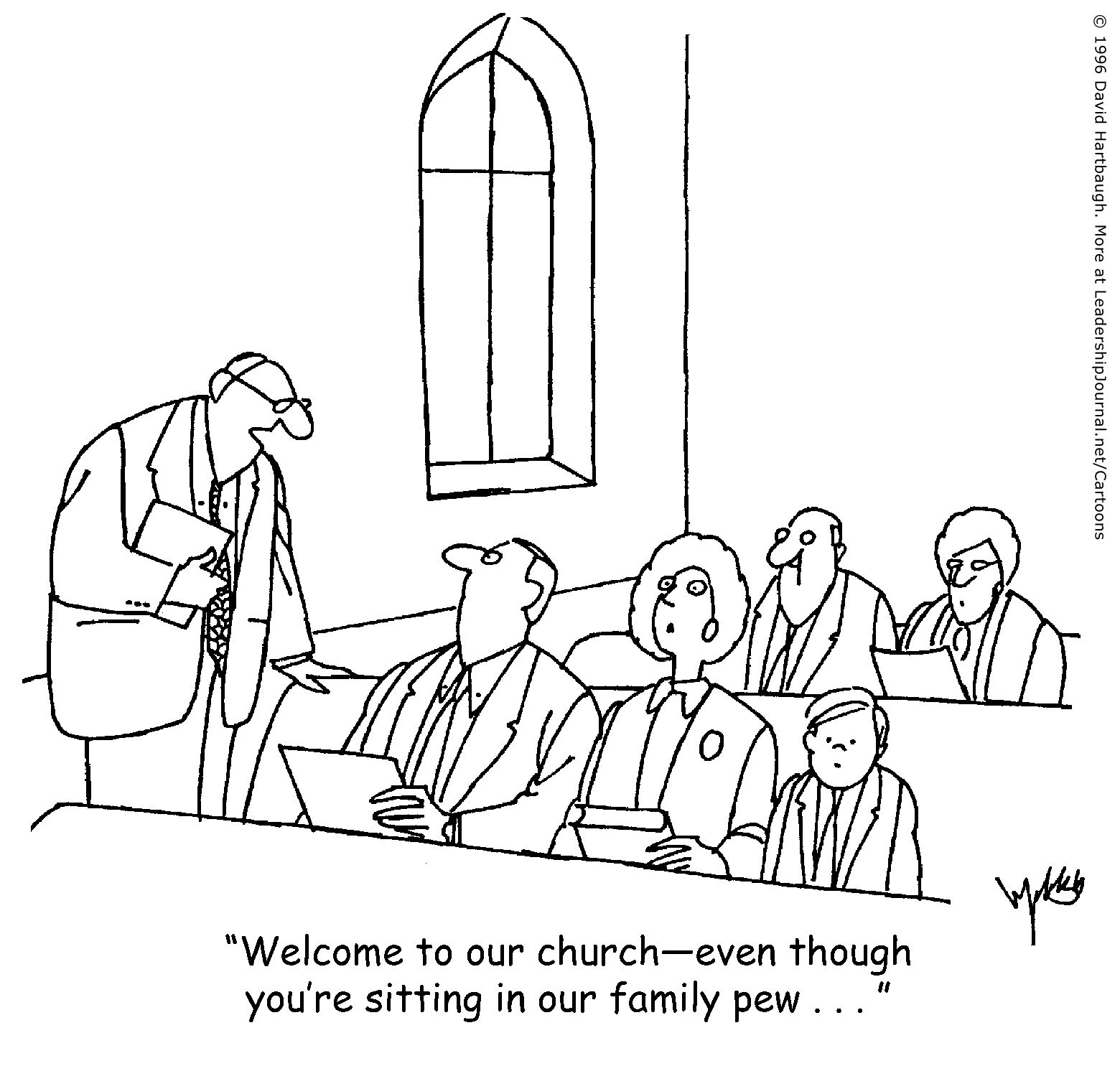
Have you ever wondered what visitors who come into our home congregation are thinking? What do they make of the worship service? How do they see the people who fill the building?
I’d like to dedicate this post to the young people I’ve had the opportunity to talk with and who have privately expressed their first impressions of the Lord’s church. These honest thoughts did not come from people who were trying to be disrespectful.
Here’s a list of TEN thoughts (some rephrased) that most visitors won’t openly say.
“I guess I came underdressed for this church.”
“Why do you stand for some songs and not the others?”
“Why are the communion plates gold?”
“I didn’t understand the purpose of the invitation.”
“Nobody smiled much until after the service.”
“I’ve got too much baggage for you guys.”
“I didn’t even know this church was here.”
“How much money was I supposed to put inside the plate?”
“It’s a nice congregation, but there’s not a lot of people my age.”
“Sorry for bringing my drink into the sanctuary.”
While these comments and questions may seem negative, I’m thankful that they’ve given us their perspective. As His church, we should be thoughtful about who we are, and what we’re engaged in when we come together.
We’re either involved in offering our Father praise and worship, or we’re enjoying the sweet fellowship that we have in Christ. God is our life, God is the One who gives every blessing, and God is the one who saved us from ourselves. With this in mind—
Here’s a list of FIVE things we can do to let visitors know what we’re all about.
We should carry ourselves with an attitude that expresses our joy and thankfulness. They may not understand everything about the service or the practical aspects of our traditions, but they see a group of people who have been given the greatest gift ever given.
Let’s not place too much emphasis on the location of worship, but the worship itself. There’s nothing holy about the “sanctuary” but there should be something holy about the acts being done and the people in the pews.
Even though we may have been to worship countless times, we shouldn’t assume that everyone completely understands what’s going on. There should be an effort put into briefly explaining why we’re participating in each act of worship, as well as who it applies to. For example, visitors are not required to give. We shouldn’t assume they already know this.
We’re all in need of Christ’s forgiveness, mercy, and grace. God is the God of second chances…and beyond! Do the visitors know this? We’ve all got varying amounts of baggage, but even a small pocketbook full of sin is enough to eternally condemn us.
No matter how odd things may appear to a first time visitor, if we can show them the love of Christ, what was once strange to them— just might become beautifully familiar.
A problem that each one of us as Christians face at one time or another, a problem that has been around since the establishment of the church, is the problem of a weakened love for Christ. This problem results from family crisis, various diseases, the death of a loved one despite our fervent prayers and crying out to God, different forms of persecution, or watching as a respected Christians loses his faith in God.
As Christians we will experience problems that will cause our love for Christ to fail.
Our faith and love for Christ are tied together as one. If you lose your faith, love is weakened and vice versa. The song, “When My Love for Christ Grow Weak” says this, “See His anguish, see His faith, Love triumphant still in death.” Love can be restored and faith can be strengthened if we would just dwell on the sacrificial love of Christ.
Since love is strengthened by increasing our faith in Christ, notice Revelation 2. The church in Ephesus had done well in many areas. They were hard working, patient, upright (they hated evil), noble minded (tested the claims of false prophets), they knew how to deal with evil men, and rather than growing weary, they persevered and had endurance (3). But they had one major issue…their love for Christ had grown weak.
Verse 4 tells us they were living the life of a Christian, but totally devoid of love. The Ephesians were doing a lot of good things, but out of obligation and duty rather than being properly motivated by a love for Christ. While they appeared to be righteous on the surface, they had no relationship with God. They were going through the motions but it was all done without love.
Sadly this is a problem that many face in the church today. They experience hardship and lose their love. They continue to live as a Christian out of duty and because it’s the “right thing to do.” Since the Ephesians fell into the same rut that we too can sometimes struggle with, it’s beneficial for us to look at what they were told to do in order to restore their relationship with Christ.
The solution is threefold. So let’s notice what we must do “when our love for Christ grows weak.”
Remember where you came from (Rev. 2:5). When our love for Christ grows weak, what must we do? Remember why you made the decision to become a Christian. Remember where you came from. A life filled with sin. A life devoid of hope. A time when you couldn’t call God your father. Remember the blessings of baptism. The sin that was wiped away. The relationship that was established with God, through Christ. Remember what you felt the moment you came out of the waters of baptism. The joy and relief in knowing that God now calls you HIS child. “When my love to Christ grows weak, When for deeper faith I seek, Then in thought I go to thee, Garden of Gethsemane.” Remember what makes our Christianity a reality. Remember what it cost for God to forgive your sin.
Repent (Rev. 2:5). Metanoeson means “to change ones mind.” I want you to picture yourself in your car, you’re headed to lunch with the perfect restaurant picked out. As you’re getting closer, your wife says, “I’d rather go to Chick Fil A. Step 1, your wife has changed her mind about where she wants to eat. And so…Step 2, you turn the car around, you change directions and head to Chick Fil A…making the right call to keep your wife happy. That, is repentance. “A change of mind that leads to a change of direction.” The Ephesians were told to first, remember where they came from, and then to repent. Change direction, go back to a time when they had both good deeds and a love for a christ. A change of mind, from heartless service to love filled devotion.
Return and “Do the things you did at first” (Rev. 2:5). When Our Love For Christ Grows Weak, return to the way we were living before sin ruined our relationship with God. We must confess (admit the wrong) to God, and to each other (James. 5:17). Acknowledge the presence of sin. And change, even if it costs us. Each one of us can remember the times where our Christianity was strong and growing, but since we are human, it’s easy to become:
Complacent (feeling satisfied with where we are, with no motivation to grow or change). Depressed (with current circumstances or personal trials).
Distracted (by work, family, hobbies, friends).
Emotionless (feeling so overwhelmed with sin that we just give up, lose hope).
There’s a cure for each one of these problems. Remember Christ. Dwell on the love that God has for each one of us.






















 The Preacher Pollard Blog