My God Is So Big

Dale Pollard

“My problems are so big, my worries so mighty, there’s nothing my anxieties can’t do.” Wait, that’s not how that song goes. It’s been said that the there are more stars in the known universe than all of the sand on earth combined. That being said, in just one grain of sand there are more atoms than all of the stars. That’s pretty amazing. Our planet is but a speck in the grandeur of space. Countless stars, planets, galaxies, lightyears and somehow God is well aware of the happenings of people.

Have you stood on the mountain tops? Have you observed the power of the oceans as the waves crash on the shore? Has your heart almost stopped after the vibrating sensation of a thunder clap resinates in your chest? The might of the Creator is everywhere in the world around us and at times it just demands to be noticed.

1 Kings 19:11-13 is a section of scripture that is mysterious and fascinating. The Lord of hosts is about to show Himself to a depressed and exhausted Elijah, but in a way that he would never forget. “The Lord said, ‘go out on the mountain in the presence of the Lord, for the Lord is about to pass by.’ Then a great and powerful wind tore the mountains apart and shattered the rocks before the Lord, but the Lord was not in the wind. After the wind there was an earthquake, but the Lord was not in the earthquake. After the earthquake came a fire, but the Lord was not in the fire. And after the fire came a gentle whisper. When Elijah heard it, he pulled his cloak over his face and went out to stand at the mouth of the cave. Then the voice said, ‘what are you doing here Elijah?’” In the hush of Horeb, Elijah seeks to avoid the troubles of his world. The acoustics of the mountainous area along with the time spent in silence must have made the shattering rocks, raging fire, splitting hills, and rumbling earth all but deafening and definitely a terrifying display of divine power. Then in sharp contrast, a still whisper comes. This gentleness, no doubt, is the reason Elijah decides to cautiously emerge from his hiding place. God is teaching His worn-out servant a lesson that holds true for us today.

The fact is, there is no more God, His wisdom, power, and presence in an earthquake than there is in the sweet breath of a blooming flower. The quiet ticking of a wrist watch reveals just as much intelligence and purpose as does the striking of a clock tower’s bell. One may walk out into an open field at night and stare up into the vast sky, lit up with numerous twinkling stars and declare, “I’ve found God!” But God is no more in the sky than He is in the blades of grass flattened beneath your feet. The question came to Elijah from that still voice, “What are you doing here?” To the prophet, his problems were too great and too large and his solution was to run and hide. God, in a magnificent way, is trying to remind Elijah of his place. Our place in life is not to take matters into our own hands or solve life’s many difficulties on our own. The answer is not to run away, but to walk humbly with our awesome God. He is strong enough to lift our burdens, wise enough to counsel us, patient enough to allow us to learn, and loving enough to constantly forgive. My God is so big, so strong, and so mighty, there’s nothing my God cannot do— for you, too. 

The Colossus of Jerusalem

1 Chronicles 21:16

Dale Pollard

In the conclusion of King David’s ill-advised military census, 1 Chronicles 21:16 hits the reader with one of the most terrifying visuals in all of scripture. Having already struck 70,000 Israelites with pestilence, the text records: “David looked up and saw the angel of the Lord standing between heaven and earth, with a sword drawn in his hand extended over Jerusalem.”

This unique phrasing—standing “between heaven and earth” (or “in midair”)—puts an immense angelic entity hovering above the landscape, positioned directly over the threshing floor of Araunah the Jebusite on Mount Moriah. The sheer shock was enough to make David and the elders of Israel immediately drop face down in sackcloth.

While the text doesn’t explicitly state the height of the Angel of the Lord in cubits or feet, we can speculate on its scale based on geographical vantage points described in the passage:

Visible Across the Topography:

To be seen cleanly by King David from the lower City of David, looking upward toward the higher elevation of Mount Moriah, the angel had to be floating high enough to clear the natural ridgelines.

The Midair Gap:

The Hebrew phrasing implies the entity populated the lower atmosphere—the space visible to the naked human eye. If the angel were human-sized, a figure floating hundreds of feet up would look like a speck in the sky. To terrify an entire royal court into immediate prostration, the figure had to be colossal in scale, easily towering hundreds of feet in apparent height to remain a distinct, detailed, and imposing figure against the clouds.

A Multi-Mile Vision:

The parallel account in 2 Samuel 24 notes that the angel was visible near the borders of the city. An entity occupying the horizon line between earth and sky suggests a titanic figure, comparable to later apocalyptic descriptions where angels have legs like pillars of fire spanning across land and sea.

The size of the weapon is even more telling than the angel itself. The drawn sword was “extended over Jerusalem.”

 Casting a Shadow Over a Capital:

During the Iron Age, the fortified city of Jerusalem spanned roughly 12 to 15 acres. For a weapon to be described as actively stretching over the city, it can’t be conceived as a standard 3-foot infantry blade.

A Weapon of Massive Proportions:

If the blade visually encompassed or pointed across the expanse of the capital, the sword would likely have been hundreds of yards (or even a mile) in length.

The Horizon-Spanning Blade:

To observers on the ground the sword would have looked like terrifying steel (or fire?) cutting across the sky—God’s impending doom suspended directly over their homes. Who wouldn’t fall on their face?

Almighty God

Thursday’s Column: Captain’s Blog

Carl Pollard

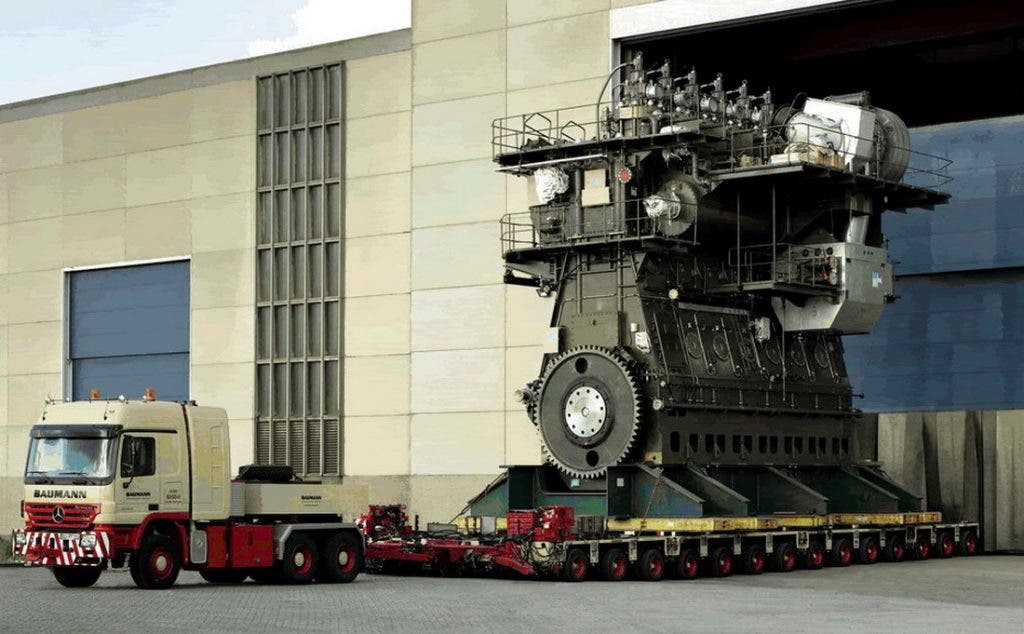
The world’s most powerful engine is mind blowing. It stands 44 feet tall, is 90 feet long and weighs 2,300 tons. It’s capable of producing 109,000 horse power, and over 5,000,000 foot pounds of torque. To say this is a powerful engine is an understatement. 

You can take the most powerful engine in the world and it pales in comparison to the power of God. This engine could never speak a world into existence, this engine could never raise someone from the dead, and this engine could never forgive sins and give us the hope of eternal life. 

Paul would tell us in Ephesians 1:19-20, “…and what is the immeasurable greatness of his power toward us who believe, according to the working of his great might that he worked in Christ when he raised him from the dead and seated him at his right hand in the heavenly places.”

Notice Paul’s description of this power: 

  • It is “exceedingly great”
  • It is shown toward those who believe
  • It is the same power that raised Jesus from the dead and seated Him at the right hand of God. 

Paul shows us how this power is given to those who believe in chapter 2:1-6. This power made us alive when we were dead. Colossians 2:12-13 tells us that those who were spiritually dead are now spiritually alive because of God’s power. 

As Christians we must understand the power and might of God. 

Do we understand what God could do to the world? Do we understand that God’s power is the only reason we are here today? Paul prays that we might know the power of God, and that that knowledge should shape our every thought and action here on earth. 

Wärtsilä RT-flex96C engine

“I Don’t Feel Good Enough”

Neal Pollard

How many times have you said that? You may project an air of confidence that would make it hard for anyone to think you felt that way or you may wear it on your sleeves. But, if honesty prevails, we’d all confess to wrestling with that thought. Daily! With Paul, facing the scope of our challenge, we exclaim, “And who is adequate for these things?” (2 Cor. 2:16). BDAG informs us that “adequate” means “sufficient in degree…large enough; pertaining to meeting a standard, fit…competent, qualified, able” (472). As Paul’s words are in the context of ministry, conscientious preachers who read that statement really get it. We’re fragile pottery entrusted with a perfect, eternal, and divine message (2 Cor. 4:7).  Oh, how we feel our own humanity as we preach the mind of God to others struggling with their humanity. We know our every weakness better than anyone else does.

Yet, the struggle I mention is not just the preacher’s burden. The best Christians I know live each day fully aware of their inadequacies and insecurities. No matter how many good works they do, how faithful in attendance and duty they are, or how actively they seek opportunities to serve God, they struggle at times. May I suggest that this is one of the biggest blessings of living the Christian life. No, we don’t want to live in a shroud of guilt. Not at all! But, consider what happens when we acknowledge our glaring insufficiencies.  We can see our utter dependency on God that much better.

Could Moses have really led the Israelites for 40 years on his own ingenuity and oratory? Could Jeremiah have really faced his audience on his own temerity? Could a renewed Peter have really preached that Pentecost sermon to Jesus’ killers on the merits of his own homiletic greatness? Could Paul have really transformed the first-century world on the foundation of his cosmopolitan experience and top-notch education from Gamaliel University?

Repeatedly, throughout His ministry, Jesus decries the Pharisaical tendency of trusting in self (Luke 16:5; 18:9). Ultimately, it’s a farce anyway. I may struggle with different weaknesses than you, but I still struggle. While that is never an excuse to give up and indulge in sin (cf. Rom. 6:1-2), it is a great, daily starting place to appreciate our need of God’s favor and friendship. We are not going to make it through this world on our own merits. As the beautiful old song suggests, “I need Thee, oh, I need Thee, every hour I need Thee….”

Here’s the beautiful thing that happens when we recognize our shortcomings and inabilities. We become an empty vessel that God can fill to accomplish His work. God will open doors of opportunity for us to do, by His might, what we could never have hoped to do without Him. Whether doors of service (teacher, elder, preacher, deacon, etc.), lives of holiness, or works of obedience, we will live in amazement of His power. Or, as Paul put it, “Now to Him who is able to do far more abundantly beyond all that we ask or think, according to the power that works within us, to Him be the glory in the church and in Christ Jesus to all generations forever and ever” (Eph. 3:20-21). Take heart, Christian! You’re not doing this alone. You can’t! But, what can God not do? That thought is exciting and thrilling. With that in mind, no mountain is too formidable. He’s got this!

pexels-photo-208151