SINGING WITH THE UNDERSTANDING: ‘TIS MIDNIGHT, AND ON OLIVE’S BROW

Neal Pollard

I love the poetry and melody of the William Tappan hymn, “‘Tis Midnight, and on Olive’s Brow.”  It is also so rich with meaning, but inasmuch as it was written 191 years ago it is possible that its wording gives younger worshippers, new Christians, non-Christian visitors, and a good many of the rest of us difficulty with comprehension.  Good worship requires not only proper actions, but mental engagement and a heart-connection with the lyrics.

The first verse begins, “‘Tis midnight, and on Olive’s brow.” Some may have no idea what that means.  The song is about Jesus in the Garden of Gethsemane the night He was arrested and ultimately led to the cross.  Tappan seems particularly influenced by Luke’s account of the events.  While scripture does not single out the hour of midnight, it does indicate Jesus was there at night (see Lk. 22:56, 66; cf. Jn. 18:3; Mt. 26:31, 34; etc.). Luke 22:39 indicates the garden’s location as the Mount of Olives.  “Brow” would be a poetic, late Middle English word for the top of a hill.  The phrase, “The star is dimmed that lately shown” would simply reinforce the idea of darkness and the anxiety such would add to Jesus’ suffering.

The second verse is pretty self-explanatory, though it might help some to remember that the phrase, “the disciple whom Jesus loved” (John 19:26; 20:2; 21:7,20) appears to be a humble term the apostle John uses to describe himself in his gospel.  “Heeds not” simply means “does not hear”; he had fallen asleep with the rest of Jesus’ inner circle of disciples (Mk. 14:37).

The third verse is also straightforward, though we have another allusion to Luke’s gospel, with “the Man of Sorrows weeps in blood.”  Luke 22:44 tells us that Jesus, “being in agony” was “praying very fervently; and His sweat became like drops of blood….” The second line of this verse speaks of Jesus’ kneeling in anguish, which Luke cites in the last part of Luke 22:44, saying Christ’s sweat was “falling down upon the ground.”

The last verse might cause some trouble, especially without consulting the footnote found under the song in the “Praise for the Lord” songbook.  “‘Tis midnight, and from ether plains is borne the song that angels know,” is, for many, incomprehensible.  “Ether plains,” as explained in the book, is a poetic way to reference “upper regions” or “heaven.”  The song seems to allude to that part of the garden experience where “an angel from heaven appeared to Him, strengthening Him” (Lk. 22:43).  While this verse of the song seems to strain the meaning of Luke’s words, it is a beautiful thought that angels or even the Father sang to comfort the suffering Son (cf. Heb. 5:7).

We should take the time to understand the words of the songs we sing in worship to God.  This keeps worship from being merely external, without heart, and a disconnection.  Perhaps, too, it serves as a notice that we should explain the meaning of older songs, especially those couched in language we do not use today.  It should also awaken the awareness that we need to incorporate songs in worship that are more contemporary in language and melody along with these beautiful, older songs.

THREE QUALITIES OF A FAITHFUL FOLLOWER

Monday’s Column: Neal At The Cross

preachingatPBL

Neal Pollard

Two parables and an incident in Luke 18:1-17 reveal three attributes Jesus is looking for in His disciples. As you read through these verses, ask yourself if you struggle with one or more of these. The examples Jesus holds up are all lowly characters–a defenseless widow, a sinful tax collector, and babies and little children. They were all either financially, spiritually, or physically dependent on others, yet these are the ones Jesus tells us to imitate. What are the qualities?

PERSISTENCE (1-8). The parable of the widow and the unjust judge is delivered to his listeners for a specific reason, “that at all times they ought to pray and not to lose heart” (1). A widow pleaded for legal protection from a judge who neither feared God or respected men (2). She wouldn’t stop coming to him and pleading her case until finally he relented and granted her request out of frustration and annoyance at her continual coming (3-5). Jesus’ point is that the perfect God will bring justice to His elect who faithfully pray to Him (7). He ties this persistence to faith (8). Jesus is giving us insight into God’s heart and desires. He wants to hear from us in prayer, and He is influenced by our prayers. Do we have faith in that? 

HUMILITY (9-14). Jesus launches into a second parable about prayer, to highlight another necessity in the practice of it. He focuses on an unlikely duo, a prominent religious leader and a contemptible tax collector. Both enter the temple, both for the purpose of prayer. Both prayers are recorded. Jesus evaluates them. The first prayer, uttered by the Pharisee, is self-directed (he prayed to himself), self-righteous (God, I thank You that I am not like other people: swindlers, unjust, adulterers, or even like this tax collector), and self-promoting (I fast twice a week; I pay tithes of all that I get). He shows no recognition of or need for God. He’s pretty self-satisfied. The second prayer, uttered by the tax collector, is selfless, self-indicting, and self-emptying. Jesus notes his hesitance (standing some distance away), abjection (even unwilling to lift up his eyes to heaven), emotion (beating his breast), and honesty (his entire prayer is, “God be merciful to me, the sinner”). Jesus’ analysis? The second man was the one who went home justified, not the first. Jesus’ point is explicit: “everyone who exalts himself will be humbled, but he who humbles himself will be exalted” (14). I may know more sophisticated ways to exhibit my pride and self-righteousness, but the response and result will be the same in heaven. Faithful followers humbly recognize their need of God’s favor. 

RECEPTIVITY (15-17). Parents were bringing their children to Jesus at this time so that He could touch them. We aren’t told why the disciples rebuke them for this, though it could be they were wrestled with pride of position or self-importance. Jesus corrects their course, telling them to let the children come to Him. In fact, He says, “Truly I say to you, whoever does not receive the kingdom of God like a child will not enter it at all” (17). He tells them that the kingdom of God belongs to those like these little children. How so? They were dependent on others (15). They were apparently willing (16). They were open (17). Certainly, this is a great exhortation to us as parents, to bring our children to Jesus in the impressionable years of life. But beyond that, there is an admonition to each of us to keep child-like faith and recognize our need to come to Jesus in order to have a place in God’s kingdom.

Often, we think that being in the kingdom is about us daring and doing great things for God. But, doesn’t it begin with our having the lowliness of heart to come to Him, persistent, humble, and receptive? These three qualities put the focus on His attractiveness, ability, and power. If we allow ourselves to be tools in His hand and recognize that it’s about Him and because of Him, then we’ll be faithful followers. 

We Can All Use Some Help

Friday’s Column: Learning From Lehman

candela

Steve Candela

Fun fact about myself…  I would be a whole lot more comfortable running into a burning building than I am standing up here speaking.  But just like any situation on a fire ground, the job will get done. 

James 5:19 says,  “My Brethren, if any among you strays from the truth and one turns him back, let him know that he who turns a sinner from the error of his way will save his soul from death and will cover a multitude of sins.”

There have been countless times in my life where help was not only desired or needed, but necessary.  As a Fireman I’d like to tell you that I’m made of iron, nothing can hurt me and I don’t need help from anyone, “I got this”. Problem is, this would be the furthest thing from the truth. In order to get the job done it takes a team. We have guys that fight fire, guys that search for victims, guys that drive the trucks, pump the water, we have guys in charge of the operational strategy, and so on.  We even have guys that their only job on a fireground is to go in and save a fellow firefighter in trouble if they get stuck, disoriented or hurt. This is called a RIT team.  We as Christians work in a similar fashion. Ok, so we don’t have the ranking system, but we all have duties. We all have jobs and responsibilities, right? 

Robert Muszynski was a fire chief in Chicago Ridge, Illinois. He had worked at multiple fire departments throughout his career but this is where he finally decided to retire in 2014 at the age of 58. I do not know specifically if he was a follower of Christ. I do, however, know of his dedication to his work and his firefighters. He was recognized several times in magazines and various fire department-related web articles for his encouraging quotes and respectable works in the fire service. I’d like to share with you a couple of his quotes and how I’ve related it not only to my job but my spiritual life as well. 

 Bob said, “Always stay hungry for the job, and you will never get full.” Complacency causes you to become bored, disengaged, and think that you know it all.  Keeping interest and staying engaged is very important.  You could say for us as Christians to always stay hungry for the word of God, read as often as you can and you’ll never get full. There is always more to learn from scripture. Create discussion among your friends or host a Bible study. Always Stay Hungry for the word. 

He also said, “Good firefighters will know their job. Great Firefighters will also know the job of the person above them as well as teach their job to the people below them.”  As an Engineer I am in between the ranks of firefighter and captain. I have a great relationship with my captain. He’s been a fantastic guide, teacher, mentor, and leader of our crew. I know his job and what it entails, and I strive to be in that position someday. As with the firefighters below me I try to be that role model that teaches them everything it takes to become an engineer and give them ample opportunities to come to me for guidance. A good Christian will know what it takes to be a good Christian, but is that where it stops? No. To be great Christians we need to be aware of what our elders and deacons have in the works. They do so much for us already; maybe there’s something you can help with? Take a task off their plate so they can work on the next important project. What about the people who need saving? You might not see yourself as a great teacher, but there is something inside every one of us that we have to offer to someone else. By creating conversation with our visitors you might reveal their needs. You could be the one to lead them to where they need to be and teach them something along the way. 

As hard as it is to admit, sometimes a Fireman can use a little help.  Christians can too.  Leading up to the scripture reading above, James has been talking to fellow believers in Christ, encouraging them to never give up faith. It’s so easy today for us to stumble and fall. We have people and priorities tugging and pulling us in every direction away from God. James knew this. He makes it clear that we are to help our fellow Christians who may wander from the truth and become worldly. It’s our job to help them get reconnected with God. Like addressing and correcting poor behavior in the firehouse this can be a difficult assignment. We need to be careful in how we complete this task so we don’t fall into the same sin or come across as too “high and mighty” (Galatians 6:1 says, “Brethren, even if anyone is caught in any trespass, you who are spiritual, restore such a one in a spirit of gentleness; each one looking to yourself, so that you too will not be tempted.”) This means be tactful not attacking. Genuine love and care must be the tactic. 

Steve interviewed last year by NBC about the walk to honor firefighters who died on 9/11.

Never Give Up

Thursday’s Column: Captain’s Blog

carl-pic

Carl Pollard

I ran across an illustration on Facebook the other day that went like this:

“During a BRUTAL study at Harvard in the 1950s, Dr. Curt Richter placed rats in a pool of water to test how long they could tread water. On average they’d give up and sink after 15 minutes. But right before they gave up due to exhaustion, the researchers would pluck them out, dry them off, let them rest for a few minutes – and put them back in for a second round.
In this second try – how long do you think they lasted? Remember – they had just swam until failure only a few short minutes ago…How long do you think? Another 15 minutes? 10 minutes? 5 minutes? 60 hours! These rats swam for another 60 hours before they gave up. The conclusion drawn was that since the rats BELIEVED that they would eventually be rescued, they could push their bodies way past what they previously thought impossible.
If hope can cause exhausted rats to swim for that long, what could a belief in yourself and your abilities, do for you?”

While this illustration was made to show the value of believing in yourself, as Christians it’s more than just a belief in yourself!  How much more could we endure if we hoped in the Almighty God?

As a Christian, remember what you’re capable of. Remember why you’re here. Remember the hope that is placed within us. Never give up. When you face ridicule for the godly choices you make, don’t give up. When you start to lose zeal and the fire begins to die. Don’t let it go out.
When life seems overwhelming and you’re drowning in stress, don’t quit. When health issues plague your body, don’t give up. Never give out, never give in, and NEVER give up. Remember the cross, remember the hope, remember the eternal home that will soon replace this temporary dwelling.

As a wise fish once said in a cartoon movie, “just keep swimming.” And we are given a beautiful reason why. In Philippians 3, Paul gives every Christian our motivation. Our reason why we should never give up. We stay motivated by pressing on (14).
What lies ahead? The goal, the prize, the upward call of God in Christ Jesus.
We press on by holding fast (16). Once you’ve got it, don’t let go. Look to those who have set the example (17).
Imitate the mindset of Paul and ignoring the enemies of the Cross. Paul pleads to them with tears (18). Don’t get distracted and don’t follow the wrong example. Finally we never give up by letting go (20). Let go of this world and what ties you to it. Our true home is in heaven.

We can find motivation and comfort in recognizing what we can accomplish and endure through Christ.

Much More Better

Wednesday’s Column: Third’s Words

IMG_3575

Gary Pollard

Jesus wants us to have a perfect eternity with him because he sees us as family (Heb. 2.11-14). He took drastic measures to make sure anyone who wants to could easily get a passport to heaven. 

  • He took a 33 year demotion to save us (Heb. 2.9). The engineer and fabricator of reality stepped down to an entry-level position so His own creation could abuse and kill him. 
  • An immortal being allowed Himself to die. He did this to experience what all of us have to experience (2.9). 
  • The best pulmonologists have a respiratory disorder (or a family member with one). They empathize and know from personal experience what works. Jesus was the perfect person to give out freedom because He personally experienced what we go through. If someone’s going to be in charge of handing out grace, who better than someone who can empathize with our struggles (2.10; 17,18)? 
  • He makes us perfect in God’s eyes (2.11). 
  • He brags on His family to the father and to the faithful dead who are hanging out with Him until judgment (2.11-13; 12.21-23). 
  • Death is scary and uncertain, but not for Christians. Satan used our fear of death against us (2.14; cf Rom. 8.15), but Jesus confiscated Satan’s power.  
  • He made God very accessible, which makes it easy to stay faithful (4.16). 
  • He’s better than ancient human priests – and even they were gentle/patient with ignorant and weak believers (5.1,2). If they were patient with ignorant, weak believers, He’s even more patient (5.5-10). 
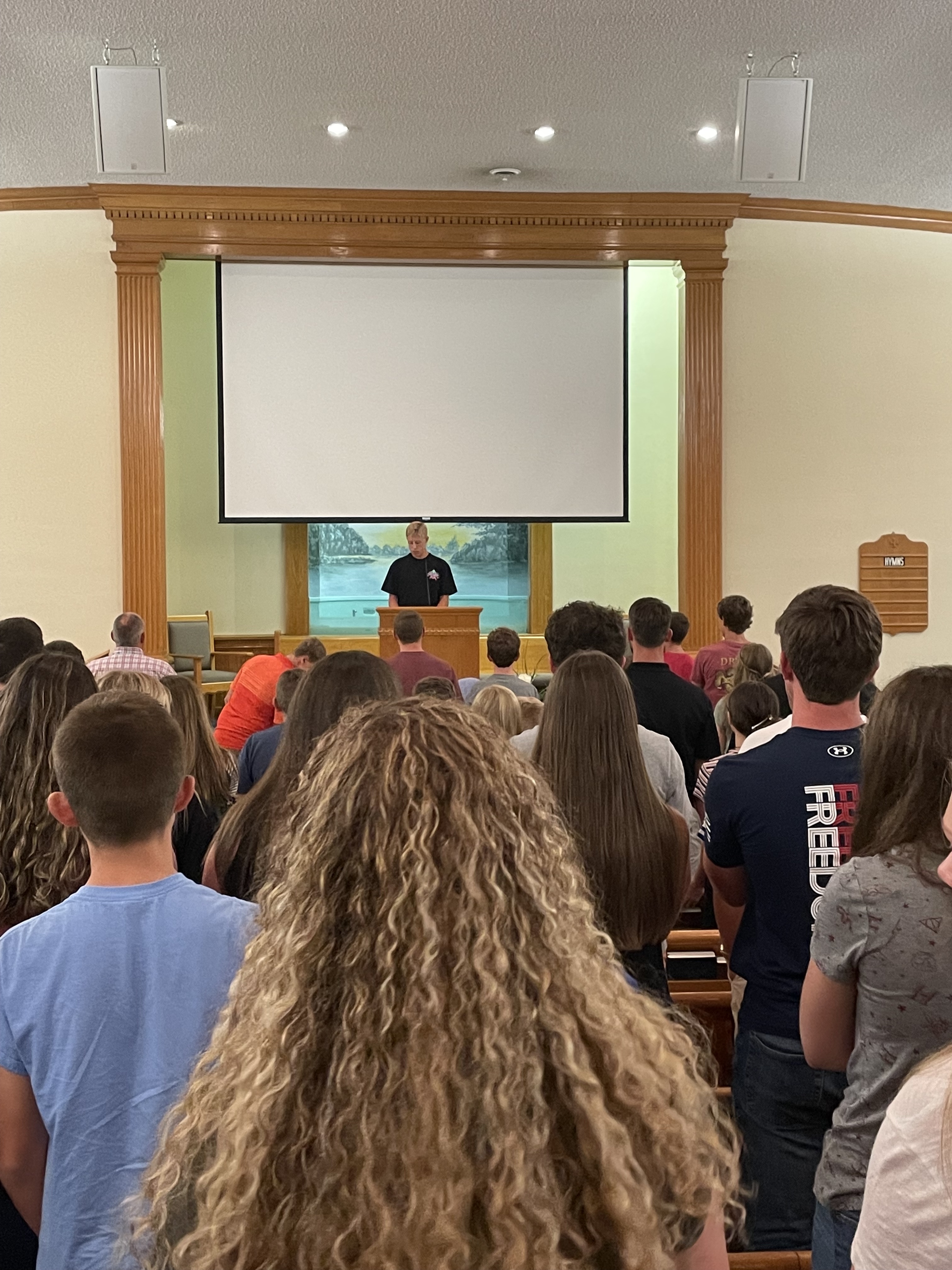
Teens stand for Scripture reading at recent Summer Youth Series (Chase Johnson reading)

Jesus Loves The Little Children 

Tuesday Column: Dale Mail

image

Dale Pollard

Those who lived on earth while Christ was here in the flesh would have described Him differently, depending on their experiences with Him. 

Many of the wealthy people would have called Him a “demanding person” (Matt. 19.22). 

The Pharisees, Sadducees, and most Roman officials would have labeled Him a “trouble maker.” 

All of the folks who were healed by Jesus would say that He was a powerful man, but I believe that a great many would say that He truly cared for children. 

He calls the peacemakers “children of God” at the beginning of His first recorded sermon (Matt. 5.9). He heals a boy with a particularly vicious demon inside him (Matt. 17). But in the next two chapters He will show this love toward innocent children in a way that can touch the heart. 

In chapter eighteen, the disciples of Jesus ask an ignorant question, “Who is the greatest in the kingdom of heaven?” 

It’s after this question that Jesus places a child in front of them. This must have been a little confusing for the disciples, but a powerful point is made. Jesus says, “Truly I tell you, unless you change and become like little children, you will never enter the kingdom of heaven. Therefore, whoever takes the lowly position of this child is the greatest in the kingdom of heaven.And whoever welcomes one such child in my name welcomes me.” 

In chapter nineteen, Jesus is teaching on the subject of divorce. It’s a lesson that didn’t sit very well with His listeners then, and it still doesn’t sit well with many people today. At some point in His lesson, women begin to bring their infants to Jesus so that He can bless them. This was a tradition done by Jewish people but the disciples started to rebuke the parents because they thought this was a job below their great leader. Again, Jesus shows us His love for children by saying, “Let the little children come to me and do not hinder them, for such belongs the kingdom of heaven.” He then goes on to lay His hands on them and then leaves. Did He have more to say to the crowd that had gathered to listen to Him? Was He finished with His lesson? Apparently this visual illustration was a great way for our Lord to end. 

The point is, Jesus loves children. Not just little children, but adult children, too. He compares the innocent nature of children to how we can be in the sight of God once we are added to the kingdom. It’s a beautiful picture and something we should all crave. Innocence. When Jesus lays “His hands on us” when we follow the plan of salvation, He has the power to change our sinful ways into something pure and holy. Jesus loves the little children, and the big children, of the world.  

Cast Down Your Bucket: the Key to Impacting Society

Great thoughts from our newest daughter-in-love! Enjoy this quick read.

Kathy Pollard's avatarLife and Favor (Job 10:12)

On September 18, 1895, Booker T. Washington addressed a crowd at the Cotton
States and International Exposition in Atlanta concerning racial progress in the South. In
what has been named one of the most influential speeches in American history, Booker
T. Washington talks to white and African Americans about how equality and progress
can be achieved peaceably. His proposed solution is summarized in one phrase, “Cast
down your bucket where you are.”
This statement comes from an illustration Washington recited in his speech, “A
ship lost at sea for many days suddenly sighted a friendly vessel. From the mast of the
unfortunate vessel was seen a signal, ‘Water, water; we die of thirst!’ The answer from
the friendly vessel at once came back, ‘Cast down your bucket where you are.’ A
second time the signal, ‘Water, water; send us water!’ ran up from the distressed vessel,
and was answered, ‘Cast…

View original post 377 more words

Giving To The Least, We Give The Most!

Monday’s Column: Neal At The Cross

Neal Pollard

He was eight years old when his parents divorced, leaving his mom with a total of eight children to take care of. The family needed financial help, so his mother contacted the church in the small town where they lived. The church provided them some assistance, and to show gratitude the woman and the children attended a few services. Soon, she took her family back to the denomination they were members of, but she had heard enough gospel preaching in that short period of time to become dissatisfied with the teaching she was now hearing. The preacher and an elder from that benevolent body of believers studied with and baptized the lady. Since this woman could not drive, different families from church would come and pick this large family up. This continued on. The boy and his siblings, nurtured in such an environment, were all influenced by gospel teaching and preaching. Many of them would also obey the gospel through time.

Then, he was a young husband and father, working for the Post Office, when he decided he wanted to attend a school of preaching and train to share the good news with others. Now, some decades later, he has spent years as a gospel preacher, professional counselor, missionary, preacher trainer, and professor. Not long ago, there was a vacancy in the pulpit of the church where he learned the gospel. The elders reached out to him and asked if he would consider taking the job. He did. Now, he is in the community preaching and teaching the lost and building up that body. Every soul he was won, every soul the countless men he has trained have won, and every one he has encouraged who has brought others to Jesus are all fruit to their account (cf. Phil. 4:17). 

The moral of this story is not to shame congregations into practicing the reactive “benevolence” they are solicited to provide by those “frequent fliers” who professionally panhandle. It is a reminder, though, that we all know people in our community who suffer losses and are in genuine need. God has always expected His people to be benevolent, individually and collectively. He tells the church at Galatia, “Therefore, as we have opportunity, let us do good to all, especially to those who are of the household of faith” (Gal. 6:10). James praises Christians as practitioners of pure religion who help those in need (Js. 1:27). Not everyone helped will obey the gospel, but when God’s people share the love of Jesus things like I’ve described will happen. Who knows how many will wind up on the Lord’s right side at the Judgment because we showed kindness and met needs, which opened people’s hearts to the gospel? Let’s find out! 

The Veiled Heart

Friday’s Column: Captain’s Blog

Carl Emily wedding

Carl Pollard

“Now the Lord is the Spirit, and where the Spirit of the Lord is, there is freedom” (2 Cor. 3:17).

Without the proper understanding of the context, this verse can be taken to mean many different things. With a little bit of digging we can know what Paul is saying. In reference to the Jews who read the Old Law, Paul says that they had a veil over their hearts (15). What veil is he referring to? The Jews failed to see the Messiah in the Old Law. They had preconceived ideas about what He would look like, talk like, and His mission. They dreamed up a Messiah that was completely different from the One prophesied about.

These Jews read the Old Law with a veil over their eyes. They failed to see the Messiah. Their heart and mind was made up about Christ. It was so much so that they failed to see the true Messiah. Paul says all of this to make a point, “But when one turns to the Lord, the veil is removed” (2 Corinthians‬ ‭3:16‬).

Those who turn to the Lord are able to see the Messiah for who He is. In Christ and being in the spirit of the Lord, we now have freedom from this veil. Rather than failing to see Christ, we can read and understand His Word for what it is, the Words of LIFE.

What happens when you wear glasses inside on a hot humid day? You can see just fine, but the second you step out of the AC and into the heat and humidity, the glasses fog up almost instantly. This is how the Jews read the Old Testament. With a pair of fogged over glasses. But those who are in Christ can see the story of the Bible. We can see the prophecies and their fulfillment. We can clearly see God’s plan for mankind, All of this is a direct result of the freedom God has given each one of us in His Son.

While we don’t have the same circumstances surrounding us today, we can still fall into a similar problem. Sometimes when we go to the Word we only search for the things we should or shouldn’t do. Instead of studying to learn more about our Savior, we get caught up in the rules and regulations of Christianity. While this isn’t necessarily a bad thing, if we only see the Bible as a rule book we will never have a deeper relationship with God. Studying like this effectively places a veil over our hearts and keeps us from finding that true, meaningful and love-filled relationship that God longs for us to have.

The Jews had a veil over their hearts that kept them from seeing Christ and the New Covenant. And we can sometimes do the same thing by treating God’s Word as a rule book rather than a Book that gives us a connection with God the Father.

These rules and guidelines are important, but there’s a lot more to Christianity than this.

Lessons Of The Past (2)

But Grow In Grace And Knowledge…

GUEST WRITER: Charlie Smith

smith20web20column_2

“But grow in the grace and knowledge of our Lord and Savior Jesus Christ. To him be the glory both now and forever. Amen.” – 2 Peter 3:18

Peter writes this letter knowing that he’s going to die soon (2 Peter 1:14), and he wants the church to remember his teachings after he’s gone (1:15). This illustrates how deeply invested Peter was in the church’s success:

  • He had been on the ground floor of Jesus’s ministry, literally walking off the job site, leaving everything behind, to become a fisher of men
  • He had seen the crucifixion, the empty tomb, and the pierced side of his resurrected savior
  • He had helped the church grow from 120 to untold thousands covering the entire known world in one generation

And now Peter realizes that he’s soon going to be gone and the church will not have the direct guidance of the apostles but instead will need their indirect guidance through the New Testament writings. What are the last words of this apostle, his final thoughts for the church that he loved so dearly, which continue to echo down to us today as the spiritual successors of those first-century Christians?

Always keep growing!

First, he asks us to grow in the grace of Christ. When we obey the gospel, our sins are completely forgiven; God forgets them; we are “saved to the uttermost,” according to Hebrews 7:25, and when we walk in the light, the blood of Jesus cleanses us from all sins (1 John 1:7). So how can we grow in something that is complete?

I think a key is found in 2 Cor. 12:7-9. Paul has been given this thorn in the flesh, a messenger from Satan, to torment him, and he prays three times that the Lord will take it away. But God tells Paul that His grace is sufficient. It was enough that Paul was a Christian; Paul did not need any particular problem taken away; God’s grace sufficed.

Likewise, no matter what we face in this life, it really doesn’t matter if we’re a Christian.  God’s grace is enough. It takes effort and maturity, though, to gain this perspective. We need to keep growing in the grace of Christ!

Second, Peter asks us to grow in the knowledge of Christ. This is an easier interpretation: We must go to The Book! In my experience, and from what I’ve observed in others, those who grow as Christians are those who study the Bible on their own, digging in to see for themselves what God says. The preacher who baptized me told me one time that, in addition to his other study, he read a chapter a day from Proverbs and the gospels because he wanted to remain connected to the wisdom of God and the heart of Jesus; this is the attitude of someone who, know matter how much they know about the Bible, is still striving to grow in the knowledge of Christ.

May we all have this desire to grow in the grace and knowledge of our Lord and Savior Jesus Christ.

We’ve been blessed to have the Smiths at Lehman since last August. Charlie begins work as an economics professor at Freed-Hardeman next month. We’re so sad for us, but very happy for them. What a wonderful family!

Lessons Of The Past

Apathy

Wednesday’s Column: Third’s Words

Gary III

Gary Pollard

It is a well-known fact that apathy destroys whole countries. Wealth lulls people into a state of complacency that avoids conflict at all costs. Government seizes the opportunity to gain power. Oppression always follows. “Hard times create tough people. Tough people create good times. Good times create soft people. Soft people create hard times” (loosely paraphrased from Those Who Remain by Michael Hopf). 

Faith is not immune. Hebrews 2.1-4 strongly warns us against apathetic faith. What happens when we lose interest in our awesome spiritual freedom? We put distance between ourselves and God. This isn’t without consequences. 

“How will we escape if we disregard our salvation?” (2.3). We won’t! Apathy is scary because the consequences arrive in plain sight and at a slow pace. We can easily see them coming, but choose to ignore them for a few more moments of complacent bliss. Once consequences arrive, they’re miserable on multiple levels. 

So, how do we get rid of apathy? Hebrews 2.5ff gives some hypes: 

  1. We’re in Charge of the World to Come (5)
  2. God Is Invested in Us (6)
  3. Jesus Is in Charge Now (7-8)
  4. Jesus Rescued Us (8-10)
  5. Jesus Sees Us As Family (11-16)
  6. Jesus Goes to Bat for Us (17-18)

Finally: “How much more severely do you think someone deserves to be punished who has trampled the Son of God underfoot, who has treated as an unholy thing the blood of the covenant that sanctified them, and who has insulted the Spirit of grace?” (10.29). 

The Good, The Bad, & The Lucky

Tuesday’s Column: Dale Mail

Dale Pollard

In 1951, two to three miles off the coast of Point Reyes, California, a military plane went down after battling faulty electrical issues and then eventually running out of fuel. The plane made a crash landing in the ocean and to make matters a little more terrifying, it was a Great White shark haven. There was one Army service man who managed to escape the aircraft, but once in the water he had no idea where to go. It was in the early morning and the fog was too thick to see through. Knowing he had to do something, he simply chose a direction and began to swim. After a couple of miles of swimming he finally, to his relief, reached land. Later on in life he’d go on to become the star of several Hollywood movies, direct his own movies, and even star in movies that he himself directed! His name was Clint Eastwood. 

He got lucky. Occasionally, that happens in life. We flip a coin, spin a bottle, or make a random turn and it all ends up working out in the end. Accidental fortune might happen in some areas of life, but not when it comes to our spiritual lives. There won’t be anyone in heaven who says, “I have no idea how I got here. I just randomly went through life and made the right choices, I guess!”

 If we’re looking for a deeper faith, a closer walk with God, or directions along the narrow way, we’ll have to be intentional about that. 

Psalm 25:5 reminds us that not only does God guide us into all truth, but that this is a path that must be taught. 

FIGHTING HAGRITES AND OTHERS

Monday’s Column: Neal At The Cross

Neal Pollard

1 Chronicles 5 devotes a relatively large amount of space to an incident that happened during King Saul’s reign. It involved the sons of Reuben, the Gadites, and the half-tribe of Manasseh waging war with a people identified as “the Hagrites, Jehur, Naphish, and Nodab” (18-19). The contested area of land was east of the Jordan River in the territory allotted to the Israelites mentioned in verse 18.  At least some of the people they fought seem descended from Hagar and Ishmael. The focus was on the large land grab made by these Israelites in battle. They won this war in terms of spoil (21) and casualties (21-22). 

Today, we wage war of a very different type. New Testament writers describe it. It is not according to the flesh, but is intense nonetheless (2 Cor. 10:3-5). It is a fight of faith (1 Tim. 1:18). It is against world and spiritual forces necessitating our adorning spiritual armor of God (Eph. 6:10ff). We can feel overmatched and overwhelmed by this enemy. What can help us stay in the fight? There are four statements back in 1 Chronicles 5:18-22 that we can legitimately apply to our spiritual warfare today. Will you remember these?

You Will Be Helped (20).

The chronicler says this of the Israelites. “They were helped against them,” and it is implied in this verse that their help came from above. There is no way we could overcome the world (1 John 4:4; 5:4) without Divine help. God gives His help generously, gently, and graciously (Jas. 1:5). He tells us that all we need to do is ask (cf. Mat. 7:7). God’s help is THE difference-maker! 

Cry Out To God In The Battle (20).

If we are striving to be faithful, we will be in a battle. What can be done? These Israelites were helped because they cried out to God in the midst of the strife. I love how Paul says it to the Philippians: “Be anxious for nothing, but in everything by prayer and supplication with thanksgiving let your requests be made known to God. And the peace of God, which surpasses all comprehension, will guard your hearts and your minds in Christ Jesus” (4:6-7). Don’t neglect prayer in the thick of the fight. Paul follows up his description of our spiritual armor, urging “all prayer and petition…at all times” (Eph. 6:18).

God Answers Those Who Trust In Him (20).

To me, nothing is more beautiful to consider than an army bowed in prayer to God to help them. As a citizen of this nation, it is wonderful to consider our military filled with men and women doing that. But, the most beautiful picture of all has to be of God’s Holy Nation (1 Pet. 2:9) filled with spiritual warriors who so put their trust in God that they are constantly before His throne in prayerful petition. Revelation 8 describes in beautiful imagery how carefully and preciously He handles the prayers of the saints brought unto His throne. It is likened to sweet-smelling incense. God is a loving Father who is pleased when His children demonstrate trust in His leadership and guidance. The promise of Scripture is that those who trust in Him are delivered and are not disappointed (Ps. 22:4-5). 

Understand The War Is Of God (22).

We often sing, “The battle belongs to the Lord.” This passage tells us why the enemy was slain. “The war was of God.” The result was that they settled in their place until the exile, which was over 300 years later.  As great as that was, we stand to experience a far greater victory. God disapproves of unworthy battles–“foolish and ignorant speculations, knowing that they produce quarrels” (2 Tim. 2:23), “foolish controversies” that “are unprofitable and worthless” (Tit. 3:9), or quarrels and conflicts that are fueled by our giving into the sins of our flesh (Js. 4:1ff). Be careful not to be a foot soldier carrying out the agenda of the foe. But if we are on the Lord’s side, we can be assured that He will gain the victory and we’ll be fighting on the winning side. 

Maybe we wonder why God recorded events like this in Scripture. It certainly shows His mind, nature, and power. But it also helps us understand His point of view and His desire in our lives today. The church has “Hagrites” to face. You and I have our own “Hagrites” to battle. How they won is how we’ll win. May the song on our hearts and lips ever be, “Faith is the victory that overcomes the world!”

It’s Time To Check Out

Thursday’s Column: Captain’s Blog

tempImagehquiDk

Carl Pollard

Several weeks ago I was told a sermon illustration with a very powerful reminder.

It begins with a scenario that each one of us is quite familiar with. You’re at the grocery store and you’re shopping for your weekly groceries. In this illustration we are introduced to two very different shoppers.

Shopper #1

This person can be summarized as an individual who is definitely NOT on a diet of any kind. They go through each aisle grabbing anything and everything that looks good to them. They aren’t concerned about health or nutrition, they get whatever they want. If it looks good, they grab it. If it tastes good, they take it.

Their shopping cart is filled with all kinds of unhealthy food. I’m talking Cheetos, Mountain Dew, Little Debbies, cake batter, and ice cream. Bottom line, Shopper #1 is an unhealthy individual who has only one desire, to eat what looks good to them with absolutely no consideration for nutrition or health. This individual is similar to those described in scripture who are trapped in several deadly sins. Shopper #1 through his choices symbolizes those in the world who choose to practice sins such as lusting (James 1:14-15), gluttony (Phil. 3:17-19), laziness (Prov. 6:6), anger (Col. 3:8), envy (Prov. 14:30), and pride (Prov. 16:18). The sins found in Shopper #1’s cart are by no means an exhaustive list, but they are examples of what to expect in this kind of person’s cart.

Shopper #2

This individual is a completely different type of shopper. They are on a serious diet. It’s almost depressing to look at wha’ts in their cart. It’s all healthy and beneficial to the body. It’s items like carrots, peas, broccoli, chicken breast, yogurt, fruit, and spinach. This person isn’t focused on the taste necessarily, but more on the nutrition and vitamins found in food. This shopper symbolizes the ones who Paul would call dedicated Christians.

1 Tim. 6:11, “But as for you, O man of God, flee these things. Pursue righteousness, godliness, faith, love, steadfastness, gentleness.” Who does Paul call a man or woman of God? The shopper who chooses: Righteousness, godliness, faith, love, steadfastness, and gentleness. The person who is dedicated to filling their cart with these things and other similar traits is a true Christian. Shopper #2 chooses to eat healthy no matter how gross or inconvenient the food may look. Both shoppers went to the same store and passed the same choices.

The illustration comes to a close as the two shoppers get to the checkout line.

Shopper #1 empties their cart at checkout and begins ringing up their grocery items. They scan their anger, their pride, their envy, and the rest of their life choices. They finish and pay what is due. Shopper #2 does the same. They scan their faith, love, gentleness and the rest of their godly choices. They empty their cart, but something unexpected happens.

As they reach for their wallet to pay the total on the screen says 0. Their groceries are paid for in full.

Shopper #1 lived his life however he pleased. He chose to do what made him happy and when checkout time came he was required to pay in full.

Shopper #2 lived their life according to God’s Word. They did their best to fill their cart with the things that pleased God.

Because of this decision, God has paid their bill in full. The one who has put on Christ and has devoted his life to serving God will find grace and mercy on that final day. Not out of his own good works, but through grace and salvation found in faith in God. This leads us to the all-important question, “What’s in my shopping cart?” Is it filled with the things I want? Is it junk food and sin? If so, one day I will pay for this decision. Or is it filled with the things that lead to eternal life? If your cart is filled with sin, there’s still hope (1 Cor. 6:9-11). If you have made the choice to fill your life with sin, it’s not too late to empty the cart and start over. And the time to do that is right now.

God’s Photons

Wednesday’s Column: Third’s Words

gary and chelsea

Gary Pollard

God is light. What does that mean? Before we get into that, it’s important to remember that we can’t understand everything about God. We know what he’s told us, but a lot of it is difficult to understand and/or accommodative language. It’s only appropriate that God can’t be adequately described with simplistic concepts. That said, spending a lot of time trying to understand who he is will only strengthen our relationship with him. 

God is light: 

  1. I Jn. 1.5 – This passage contrasts light with darkness. In this case, darkness is moral failure. Light is moral perfection. What makes this interesting is the use of a state-of-being verb (estin – is, exists, closely related to). He is light. God is morally perfect and totally immune to darkness. 
  2. I Tim. 6.16 – God lives in unapproachable light, no has seen him and no one can see him. If we were to see God in His true form, we would die (Ex. 33.20; cf. Jn. 1.8, 5.37, 6.46; Col. 1.15; I Jn. 4.12). We don’t fully understand what light is. Visible light is a tiny sliver of the massive electromagnetic spectrum, yet light interacts in some way with everything in creation. It can be harmless and it can be deadly. It can be mild and it can be powerful, depending on how it interacts with matter. Light (physical light) seems to be a glimpse into the nature of God (see Rom. 1.20; Jn. 1.9). 

There are many more passages (Ps. 76, 104; Jn. 1.9, 8.12; Acts 26; I Thess. 5). God is real. He thinks about us (Heb. 2). He’s personally invested in us (Rom. 8). We interact with reality the way we do because He designed it that way (Jn. 1.3-5). He is perfect love (I Jn. 4.8). He is terrifyingly powerful (Job 38). He wants humans to live with Him after time is dissolved (Jn. 14; I Tim. 2.4; II Pet. 3.9). All aspects of functional creation are extensions of His nature (love, patience, happiness, compassion, light, breathtaking beauty, empathy, companionship). God is amazing. 

8 Reminders For The Restless Mind

Tuesday’s Column: Dale Mail

dalejanelle2021

Dale Pollard

  1. Don’t carry burdens that aren’t yours (Proverbs 3.5-6)
  2. Remember the extraordinary times that God has carved out a path where there was no path before (Isaiah 43.16-19) 
  3. Don’t forget, God can see what you can’t see (Proverbs 16.9) 
  4. Even if you stumble, God won’t let you stay down (Psalm 37.23-24) 
  5. God’s vision is bigger and better than yours (Jeremiah 33.3) 
  6. God hasn’t forgotten about you (Proverbs 20.24) 
  7. Remember to be very specific when praying to God (2 Samuel 5.19) 
  8. Always be sure your will is His will (James 4.15) 

If you’re struggling with the anxieties that can come from making life’s difficult decisions, read these verses. Perhaps they will give you some insight that help you to answer that crucial question, 

“How should I be praying about this?” 

Give it to God and rest up! 

“When you lie down you will not be afraid, when you lie down your sleep will be sweet.” 

Proverbs 3.24 

OUR PROBLEM WITH AUTHORITY

Monday’s Column: Neal At The Cross

Neal Pollard

A researcher at the Royal Society of Medicine in the UK published a paper called “The Spoilt Generation.” He ties the alarming rates of child depression, teenage pregnancy, obesity, violent crimes by adolescents, and more to a basic lack of respect for authority (Daily Mail).  The Cato Institute published a study simply entitled, “Respect For Authority.” One of its most basic findings is that the public believes social instability follows  disrespect for authority (Cato). 

What do you think?  Have you noticed a decline of respect in society for parents, teachers, the police, employers, and  others in a position of authority? Most of us would agree it’s happening, and that it is not good.  Peter warns about it in the most sobering of terms, speaking of the unrighteous who face eternal punishment as those who, in part, “despise authority (2 Pt 2:10). Jude offers a very similar warning, describing those who turn God’s  grace into permission to do whatever they please (4), and this includes their “rejecting authority” (8).  So why do we often have a problem with authority?

We have a problem with rebelliousness. Saul, the earthly king, had a problem with rebellion (1 Sam. 15:23). Paul writes Timothy, discussing why the Law of Moses existed. It was for unrighteous people, and at the top of that list were the lawless and rebellious (1 Tim. 1:9). Rebellion is insubordination. It characterized the period of the Judges, when everyone did what they thought was right to them (17:6; 21:25). As we look at crime in our current society, we see the fruit of rebellion. CNN reports a 33% increase in homicides in major U.S. cities from 2019 to 2020, and now it is up another 24% since the beginning of 2021 (CNN). Yet, cities like Baltimore no longer prosecute drug possession, prostitution, and other low-level offenses. In California, shoplifting has in some places ceased to have any legal ramifications. How many looters in major U.S. cities have never served a day in jail or paid a penny in fines? Romans 13 clearly condemns this. Paul says “whoever resists authority has opposed the ordinance of God; and they who have opposed will receive condemnation upon themselves” (2). Most of us would condemn this nationally, but do we struggle with rebellion against authority closer to home? Do we struggle with it against employers, elders, and parents? Rebelliousness can be milder than murder and more limited than against government. Do we only submit if we accept what they lead us to do? Do we maintain meekness and gentleness only if we agree with them? Rebellion is not the mark of a disciple of Christ; such have a different master. 

We have a problem with respect. Paul says, “We ask you, brothers, to respect those who labor among you and are over you in the Lord and admonish you, and to esteem them very highly in love because of their work. Be at peace among yourselves” (1 Th. 5:12-13). Esteem, as a verb, is found 28 times and means to think, consider, or regard. Paul is telling the church how to regard their leaders (“very highly in love”) and why (“because of their work”). Interestingly, the noun form of this verbs is often tied to various types of leadership–“Ruler” (Mt. 2:6), “leader” (Lk. 22:26), “governor” (Acts 7:10), “chief” (Acts 14:12) and “leading men” (Acts 15:22). But in 1 Thessalonians 5:13, it is a verb and means to engage in the intellectual process of thinking of them with the highest respect. The word “esteem” deals with our character generally and not just how we treat elders and any other leaders. Philippians 2:3 says, “With humility of mind regard one another as more important than yourselves.” But Peter speaks of some who “count it a pleasure to revel in doing wrong” (2 Pet. 2:13). Respect is a matter of how you set your mind. If we don’t have it in our hearts to respect those in authority, it can’t help but show in the way we speak to them or about them. Our children learn how to treat authority figures by watching and listening to us. What are we teaching them?

We have a problem with our religion. “Religion” is only found  four times in the New Testament. It means appropriate beliefs and the devout practice of our obligations (Louw-Nida, 530). How do we properly express our religion? It is not just about worshipping the way God commands. That’s a vital part, but only one way. Paul tells us what his pre-Christian religion looked like (Acts 26:5). He tells us about the false religion of some, ruled by their fleshly minds (Col. 2:18). James uses the word “religion” twice, in James 1:26-27. He teaches that pure, untainted religion is proven or disproven by your thoughts, words, and deeds. When I show disdain toward those in authority in or out of the church context, I’m telling everyone who witnesses it about my religion. I am making an impression on them that will either lead them closer to God or farther away from Him. Whatever I tell them about the one(s) in authority, I am telling them far more about me. If they follow my lead, will they stumble (cf. Lk. 17:1-2)? 


Our problem with authority is ultimately a problem with God. When Paul tells Rome that those who resist authority oppose God’s will, he was talking about a government ruled by wicked Caesars who murdered Christians. When I disapprove of or disagree with those in positions of authority, in the nation, church, workplace or home, I must respond how God says respond. I must leave the rest to Him. 

Make God A Priority

Friday’s Column: Captain’s Blog

pollards10

Carl Pollard

There’s a story told of four men that went into the woods on a deer hunt one morning. The men split into groups of two and set out for the day. When evening rolled around, 2 of the 4 hunters had already returned and set up camp and were waiting on the other 2 men to return. Hours passed by when finally one of the hunters staggered into camp carrying a massive 8 point buck. The hunters asked where the other guy was, and the man answered and said, “He had a stroke earlier and is a couple miles up the trail.” The men are shocked and they say, “Why did you cary the deer back and leave your friend?” The hunter paused for a moment and said, “Well…I didn’t want my deer to get stolen.” 

Sometimes in life our priorities can get a little mixed up. Maybe not to the point where we would choose a deer over a person, but nevertheless, each one of use is prone to lose focus. The definition of priority is “something that is regarded as more important than another.” For example, when you choose “priority shipping,” it is regarded as more important by the postal service and reaches its destination quicker. The things that we prioritize are the things that take up the majority of our time, money, and effort. A student trying to get a good grade will make studying their top priority. A football player that is trying to be the best will make training, exercise, and memorizing the team plays a top priority. And so it is with any aspect and profession. 

There is revealed to us a top priority for us as christians in God’s Word. In Matthew six Jesus is just about halfway through His sermon on the mount when He turns His focus onto the subject of worry in verse 25. He says multiple times “do not be anxious.” And He goes on to give us a reason why. Jesus explains that God’s care for us is our reason for not worrying. We are more valuable than grass and birds. Therefore do not be anxious. God values us infinitely more than birds and flowers. It is at the end of this section that we find our priority. Verse 33 says, “But seek first the kingdom of God and his righteousness, and all these things will be added to you.” 

According to this verse, what is it that we should make a priority? What should we be putting our energy and focus into? The kingdom of God. “Seek first” literally means to “chase after.” Jesus tells us that we are to be in constant pursuit of the Kingdom. This means we are actively chasing and longing for it. Not just the kingdom of God, but also HIS righteousness. Not our own, but God’s. This is accomplished through constant prayer and daily scripture reading, continuous reflection and growth, caring for those around us and copying the mindset of Christ in everything. 

Make God a priority, and the worries of this world will be taken care of. Chase after God and He has promised to take care of us. 

kisspng-royalty-free-corporation-clip-art-light-priority-5add0df1b76503.0275899515244364657512