Throughout history, soldiers have been remembered for their courage and skill — but sometimes, a warrior stands out for their extreme endurance. In high stress situations, combatants have been known to grip their weapon so tightly that their fingers can’t release them— even after the danger is gone.
Dale Pollard
Throughout history, soldiers have been remembered for their courage and skill — but sometimes, a warrior stands out for their extreme endurance. In high stress situations, combatants have been known to grip their weapon so tightly that their fingers can’t release them— even after the danger is gone. This phenomenon is known as “grip lock” (or, in death, cadaveric spasm) and it appears in sources from the Biblical record to various other battle chronicles.
The Biblical Case of Eleazar
One of the earliest recorded examples comes from 2 Samuel 23:9–10 (10th century BC). Eleazar, one of David’s “mighty men,” fought the Philistines long after the rest of the army had retreated. His effort was so great that “his hand clung to the sword” after the battle — an epic but physiologically accurate description of “sustained tetanic muscle contraction” from hours of exertion and an extreme adrenaline overload.
More Military Accounts
Battle of Marathon (490 BC) – Herodotus records Athenian hoplites whose hands were “welded” to their spear shafts after the fight.
Battle of Cannae (216 BC) – Polybius describes Roman infantry unable to drop their shields or swords, even in retreat, with some death grips preserved in fallen soldiers.
Boudicca’s Revolt (AD 60–61) – Tacitus notes Briton warriors locked to their chariot rails or spears, requiring force to release them.
Battle of Stiklestad (AD 1030) – Norse sagas speak of hands “frozen to the sword like ice to iron.”
Physiology
Modern science explains grip lock as a combination of:
Adrenaline surge – The sympathetic nervous system floods the body with epinephrine and norepinephrine, boosting muscle contraction power.
Full recruitment of fast-twitch fibers – Grip muscles in the forearm contract at maximal force, overriding fine motor control.
Loss of inhibitory signals – The brain suppresses “release” commands in favor of survival-driven holding or pulling actions.
Muscle fatigue and tetany – After prolonged strain, the muscles seize in a sustained contraction, sometimes lasting minutes or hours.
Eleazar’s hand that refused to let go eliminates any chasm between a myth and medical reality. The Bible is accurate down to the finest details and it teaches us more than just history; it shows us the future (Rev. 22, 1 Thess. 4.16-18, Matt. 24.42-44).
“…..but Eleazar stood his ground and struck down the Philistines till his hand grew tired and froze to the sword. The LORD brought about a great victory that day. The troops returned to Eleazar, but only to strip the dead”
There’s a group of people who believe a dark alliance of nations will rise in the last days, and their sights set on one target: Israel. Among them stands Persia — known today as Iran.
For centuries, the prophetic words of Ezekiel lay dormant. But now, as Iran asserts its influence across the Middle East and sculpts its rhetoric against Israel, some Bible readers say we are watching prophecy awaken
Dale Pollard
There’s a group of people who believe a dark alliance of nations will rise in the last days, and their sights set on one target: Israel. Among them stands Persia — known today as Iran.
For centuries, the prophetic words of Ezekiel lay dormant. But now, as Iran asserts its influence across the Middle East and sculpts its rhetoric against Israel, some Bible readers say we are watching prophecy awaken.
Ezekiel 38 describes a future war led by a mysterious figure called Gog from the land of Magog, joined by a coalition including Persia. This alliance will launch a sudden attack on Israel, catching the world off guard. Yet, in a stunning twist, they will be supernaturally defeated — not by Israel’s army, but by divine intervention: earthquakes, hailstorms, and chaos among the invaders themselves.
According to these interpretations, Iran’s fate is sealed not by global politics, but by a divine script written long ago. Though the timeline remains uncertain, the message is clear: Persia, once a mighty empire, will play a pivotal — and ultimately tragic — role in the final act of history.
As tensions rise in the real world, some wonder: Is the stage being set? Let’s see what the Bible says about it.
The Bible does not mention “Iran” by name, but it refers to the ancient region of Persia, which is modern-day Iran. Biblical prophecy includes several references to Persia, both in historical and future contexts. Here’s the straight skinny on how Iran (Persia) is used in prophecy:
1. Persia In Context
Daniel 8:20 — “The two-horned ram that you saw represents the kings of Media and Persia.”
Explanation: This vision prophesies the rise of the Medo-Persian Empire, which historically conquered Babylon and ruled a vast territory. This is a fulfilled prophecy, not the future.
Ezra 1:1-4 / Isaiah 45:1 — The Persian king Cyrus is prophesied by name as the one who would allow the Jews to return from Babylonian exile and rebuild the temple in Jerusalem.
The God and Magog War
The most significant passage many refer to when discussing Iran’s prophetic future is Ezekiel 38–39, known as the Gog and Magog War.
Ezekiel 38:5
“Persia, Cush and Put will be with them, all with shields and helmets.”
This passage describes a future invasion of Israel by a coalition of nations led by “Gog of the land of Magog.”
While many view the Gog and Magog prophecy of Ezekiel 38–39 as a future apocalyptic war, several alternative perspectives argue it has already been fulfilled or symbolically represents historical events, check out this brief explanation of the major views.
· Post-Exilic Threats: Some see Gog as symbolic of foreign powers threatening Israel after their return from Babylon, with God’s protection preventing any major invasion—fulfilling the prophecy through divine preservation, not visible warfare.
· The Esther Parallel: Others connect Gog’s defeat to the events in the book of Esther, where Haman’s plan to annihilate the Jews was sovereignly overturned. God’s intervention and the enemies’ destruction parallel the reversal described in Ezekiel.
· Maccabean Revolt: Some scholars associate the prophecy with Antiochus Epiphanes’ attack on Israel in the 2nd century BC. The miraculous Jewish victory under the Maccabees is viewed as a historical outworking of divine deliverance.
· Symbolic Fulfillment in Christ: A theological reading sees Gog as representing all anti-God forces, with God’s ultimate defeat of them fulfilled in Christ’s victory on the cross and in spiritual judgment, rather than a literal battle. Homer Hailey refers to Gog and Magog as “symbolic names” and interprets Ezekiel 38–39 as a vision representing the ultimate enemies of God’s people, not literal nations (Hailey, Homer. A Commentary on the Book of Ezekiel. Baker Book House, 1972, 379-392). Robert Harkrider interprets the mention of Gog and Magog in Revelation 20 as symbolic of worldwide opposition to God’s people, culminating in their final defeat by God (Harkrider, Robert. Revelation. Truth for Today Commentary Series, edited by Eddie Cloer, Resource Publications, 2003, 377-383).
—————————————————————————
Key Takeaways:
The Bible doesn’t predict the rise and fall of the modern state of Iran specifically.
No prophecy singles them out or specifies its exact fate beyond the involvement with Israel in its post exilic state.
Latter day prophecies like this would have had no value for the original readers.
Communities began days of remembrance shortly after the Civil War to commemorate their fallen soldiers. Some of the first commemorations are said to have been held by former slaves in South Carolina. However, Waterloo, New York, was named the official birthplace of Memorial Day because it hosted an annual, community-wide event where businesses closed and the graves of the fallen were decorated with flowers and flags (more here). To me, it is one of the nobler holidays as it expresses appreciation for those who sacrificed so much for our freedom and continued existence in this nation.
God knows humanity needs remembrance. The rainbow was His first memorial for man (Gen. 9:12-17). In Deuteronomy, Moses repeatedly exhorts Israel to remember the covenant and commands of the Law. Later generations were in trouble when they forgot and blessed when they remembered.
In the New Testament, there are a couple of words for “remember.” One, mnēmoneuō, “Denotes the action of keeping in mind or thinking of something or someone; it can also mean to mention something in the past or future” (Jones, Lexham Theological Wdbk, np). The other, mimnēskomai, means to recall information from memory, think of and call attention to something, and give careful consideration to (BDAG, 652).
Walk through the New Testament and see all the circumstances where God wants us to remember. This is far from exhaustive, but God urges us to:
Remember an offended brother (Matt. 5:23)
Remember the words of Jesus (John 15:20; Acts 20:35)
Remember important spiritual influences in your life (Acts 20:31)
Remember Christ in the Supper (1 Cor. 11:24-25)
Remember the poor (Gal. 2:10)
Remember past spiritual defeats as motivation to serve (Eph. 2:11-12)
Remember the hurting (2 Tim. 1:4)
Remember past spiritual victories as motivation to keep serving (Heb. 10:32)
Remember the ill-treated for the cause of Christ (Heb. 13:3)
Remember the faith of your spiritual leaders (Heb. 13:7)
Remember the words of the prophets and apostles (2 Pet. 3:2; Jude 17)
Remember from where you are fallen (Rev. 2:5)
There are literally dozens of uses of these Greek words calling for us to remember. Age and disuse may rob us of remembering all the details of everything, but some things must be retained and reviewed for our own spiritual good. Abraham once told a rich, negligent man in torment, “Son, remember…” (Luke 16:25). For him it was too late, but for us it is not.
There are some things worth remembering. In fact, some things are essential. It is admirable and healthy to remember those who died fighting for our nation. What a price! In our daily, spiritual battle, memory is key to our ultimate survival! May God sharpen our minds to remember the things He values as most important to Him (and us)!
Genesis 14 is more than a Sunday morning Scripture-reader’s nightmare (though the first ten verses would intimate the most golden-tongued!). We are introduced to an obscure, enigmatic character whom David and the writer of Hebrews will compare to Christ. However, what is the background of this King of Salem and his important encounter with Abram?
There is a local war around the Salt Sea, “four kings against five” (9). The cause of the conflict is the rebellion of the kings of the valley (Sodom, Gomorrah, Admah, Zeboiim, and Bela) against Chedorlaomer, who had conquered all the nations in the region–the Rephaim, the Zuzim, the Emim, the Horites, the Amalekites, and the Amorites (4-7). The confederation of the valley kings “arrayed for battle against” Chedorlaomer and his allies (1) “in the valley of Siddim” (8). The kings of Sodom and Gomorrah, Bera and Birsha, died in the tarpits of Siddim as they fled from the invaders’ army, and the rest of the army of the five kings fled to the hill country (10).
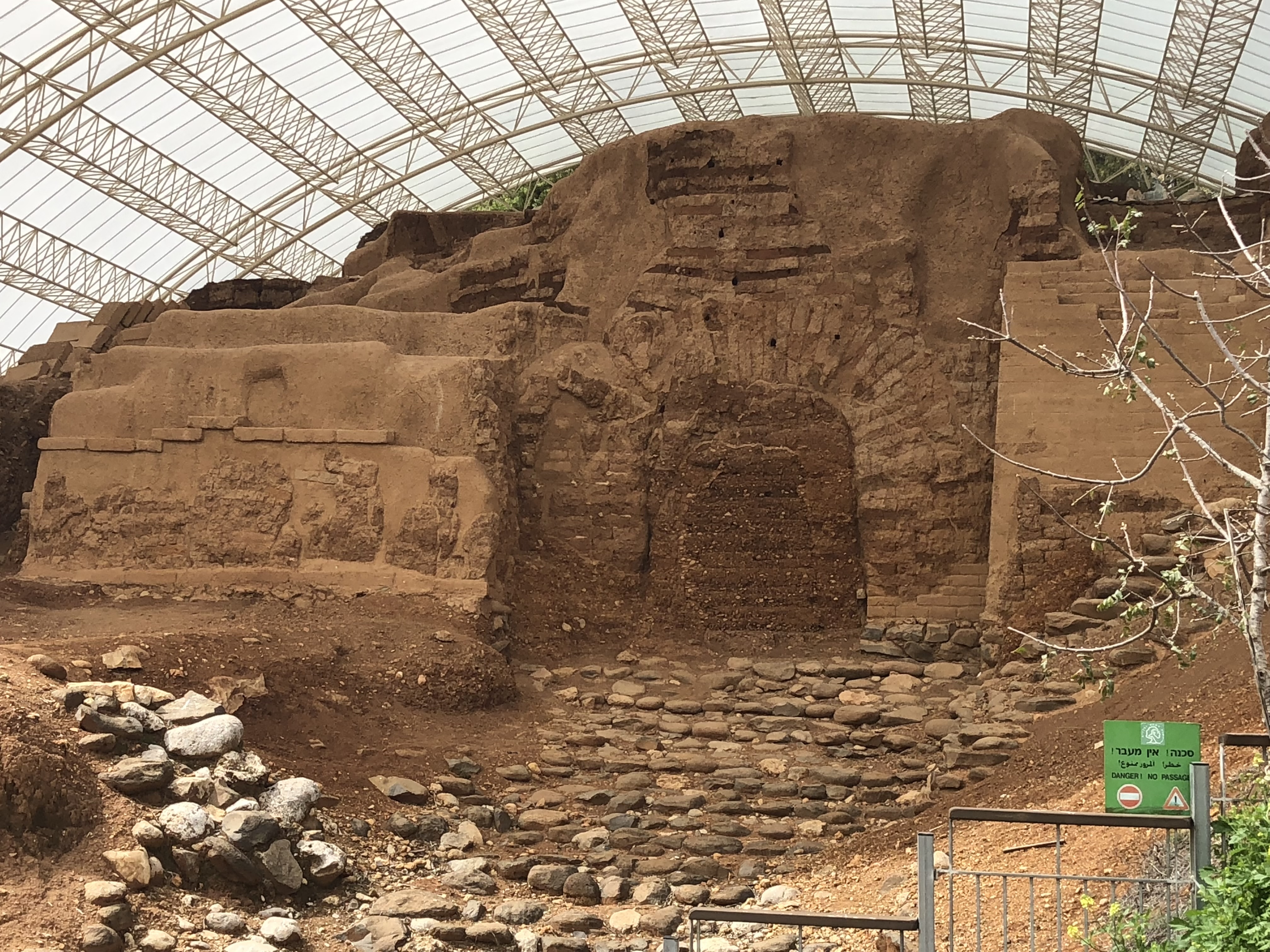
Chedorlaomer and his allies plunder all the goods of Sodom and Gomorrah and take Lot, the women, and the people of his house along with his possessions (11-12,16). An escapee tells Abram what happens, and the patriarch musters his allies and his own personal army to get his nephew and his house back safely (13-15). He has a battle plan, dividing his forces and attacking at night, and they defeat the invader in what is modern-day Syria (15-16). On multiple occasions, I have visited the ruins at Dan and have seen the so-called “Abraham Gate.” It dates back at least as far as Abraham’s day, almost 2000 years before Christ.
(My photo of the “Abraham Gate,” March 2018)
After rescuing Lot and his house and goods, Abram is met by a priest named Melchizedek (18). The Holy Spirit, through the author of Hebrews, uses Genesis 14:17-20 and Psalm 119:4, and this one incident with Abraham to drive home an incredibly powerful point. Jesus is a High Priest, not like the Levites who descended from Aaron, but like this obscure figure, Melchizedek.
The Bible uses a literary device called an antitype. “From the Greek antitupos, which occurs in Heb. 9:24 and 1 Pet. 3:21, where the AV translates it ‘figure.’ An antitype is the substance of which a type is the shadow, or the fulfilment of that which the type foreshadowed” (Cairns, Alan. Dictionary of Theological Terms 2002: 33). The antitype is always the greater; the type is always lesser and represents in some way the greater. So, Melchizedek is a type of Christ. He himself was greater than the Levitical priesthood in the ways we read in Hebrews 7, but the specific attributes we read about Melchizedek in this chapter are more fully and greatly found in Jesus.
What are the specific types?
His position (18; Heb. 7:1). He is the king and priest of the Most High God. As king, he is king of righteousness and king of peace (2).
His preeminence (20; Heb. 7:2,4-5). Abraham paid tithes to Melchizedek, signifying the greater prominence of the priest over the patriarch.
His perpetuity (Psa. 110:4; Heb. 7:3). “Without father, without mother, without genealogy, having neither beginning of days nor end of life, but made like the Son of God, he remains a priest perpetually.” None of Melchizedek’s ancestors or descendants filled this role, so in that way “he remains a priest perpetually.”
His purpose (19; Heb. 7:6-7). Melchizedek blessed the one who had the promises, an indication of his greater position and authority.
His precursory place (Heb. 7:8-11). Melchizedek lived many generations before Aaron, through whom the Levitical priesthood descended. Aaron was still in “Abraham’s loins,” meaning that Abraham did not have children yet. Much later, he would sire Isaac, who beget Jacob, etc., until finally Aaron was born through this genealogy.
In the way that Melchizedek served as greater than Levi, Jesus more fully and greatly serves as greater than Levi. If it were a math problem, we would say Levi < Melchizedek < Christ. Obviously, then, Levi < Christ. The writer of Hebrews, in chapter seven, draws some conclusions about this type of Christ. Because Christ is the antitype of Melchizedek,
It makes sense that perfection comes from His priesthood rather than the Levitical priesthood of Judaism (11).
There needed to be a change of laws (from Moses’ to Christ’s)(12).
It is right that this greater High Priest comes from a different tribe in which none had or could have served as priest (13-14).
Christ serves as priest “not on the basis of a law of physical requirement, but according to the power of an indestructible life” (15-17).
He sets aside the old law and brings in a better hope (18-19).
He was appointed High Priest by means of the oath of God (20-21).
He has become the guarantee of a better covenant (22).
He does not die, but continues forever as High Priest (23-24).
He is able to save forever those who draw near to God through Him (25-28).
It is this last truth, concerning His salvation, where the author draws out several incredible points for our consideration. It is the crescendo of his “Melchizedek argument.” His work is unparalleled–He always makes intercession for us (25). His character is unparalleled–He is holy, innocent, undefiled, separated from sinners and exalted above the heavens (26). His sacrifice and offering is perfect (27). His oath is unparalleled–He is a Son, made perfect forever (28).
Of all the ways the writer establishes the superiority of Christ over all rivals, this one is the most interesting to me. It shows the masterful way God weaves events and Scripture together. The writer of Hebrews is making the point that the Levitical priesthood has been replaced by something better. Why would you exchange the superior for the inferior?
After this encounter, which seems relatively insignificant until David and the writer of Hebrews later expound upon it, Abram refuses to enrich himself by the unsavory people of Sodom. The new King of Sodom only wants the people, but offers Abram to keep all the returned spoils from Chadorlaomer. Abram will have no part in that, taking only provisions necessary for the completed battle. Abram will continue to rely on God’s promises to take care of his needs, and he parts company with the king of this wicked domain.
(Picture taken on March 10, 2018, running at the Dead Sea with Keith Kasarjian)
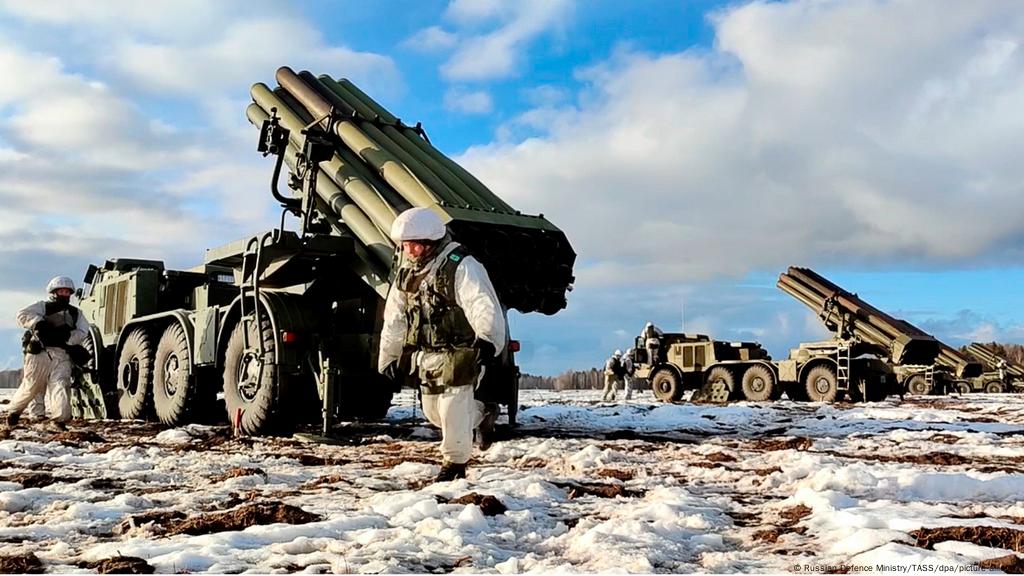
The war in Ukraine is tragic, with loss of life in the several thousands already. Families have been displaced. Untrained civilians fiercely resist invasion. NATO can’t make up its mind, leveling sanctions as though at war, but not declaring war formally. This – among other factors – is escalating an already volatile situation. A great many feel as though we’re at the brink of WWIII.
Maybe we are. Humans tend to show their very worst or their very best in times of crisis. When the pandemic started, millions forgot their humanity. Fights broke out in grocery stores, people forgot what patience, selflessness, and compassion were, and hoarding was the name of the game. Besides all that – as if we needed another polarizing issue – families, friends, and neighbors bitterly fought about masks and vaccines and social distancing.
But for many (most?) other people, it brought out their best. People checked on each other regularly. Personal feelings were put aside to accommodate the apprehension some felt. Resilience and benevolence was/is strong. The church was heavily invested in each others’ lives.
War is a tragic part of the human experience. Some may be fought for good reasons, but war itself is never good. We all hope the conflict in Europe will be resolved soon and with minimal loss of life. It might not, though. So what will we do?
Train the Brain – Determine to respond with levelheadedness and compassion, period. If it comes to war, we won’t forget our humanity. We will look out for others and act rationally. Our conditioned response will be, “How can I help other people?”
Be Like Jesus – He didn’t exploit weakness to gain an advantage. He didn’t stockpile supplies to the detriment of others. He wasn’t concerned about maintaining his standard of living. He fed people, healed people, gave them counseling, and gave them hope. That will be our response, whatever the future holds.
Be Cool – We might get scared, but it’ll never override our desire to look out for each other. We’ll demonstrate genuine faith in the creator by not acting like people who are controlled by fear.
Those are easier said than done. But we can do them, and I’m confident that we will. If the threat never exceeds high fuel prices or inflation, we’ll have made the best of a bad situation. If the threat becomes war, we’ll make the best of a bad situation. Dark days make it that much easier to shine God’s light. So that’s what we’ll do!
People all over the eschatological spectrum have been watching recent news events with bated breath. Putin’s invasion of Ukraine must be a sign of the “end-times.” To some, in the premillennial camp, Putin is an antichrist. Yes, he has military might and money. And he could undoubtedly become a global dictator ushering in “The Great Tribulation,” which those unlucky enough not to be raptured must endure before Christ sets up His earthly kingdom.
But, to postmillennialist Pat Robertson, Putin fulfills Ezekiel’s prophecy showing that “God is getting ready to do something amazing…”1Postmillennialism is more optimistic than premillennialism with its doom and gloom of the worst trials and tribulations the world has ever seen. So, first, the world will come to Christ, more or less. (Though Robertson believes it will involve warfare.) Then Jesus will set up a kingdom on earth, and we will enjoy a golden age.
There is a big problem with this thinking, though. We have been in the “end-times” since about the day of Pentecost A.D. 30 or 33. In Acts 2, Jesus fulfilled His promise to pour the Spirit upon the apostles (John 16.7; Acts 2.33). Thus filled with the Spirit, the apostles began speaking in tongues, languages they had never studied. We know they were languages rather than unintelligible gibberish because the people listening to them were from various places. The people wondered why they could hear these Galileans speak their native tongues. Peter told them that it was a result of the pouring out of the Spirit upon men, something the prophet Joel wrote would happen during the “last days” (Acts 2.16-21; Joel 2.28-32).
Hence, it has been the “end-times” for about 2,000 years. And what of the kingdom? It might surprise some to hear me say that the kingdom is here. Now, I hear even someone who has only dabbled in theological studies respond, “That just makes you an amillennialist.” No, that is a misnomer. That term means “no millennium” since the prefix “a” negates the following word. It is not a denial of a period of the kingdom’s reign; instead, the Scriptures demonstrate that we are not waiting for the kingdom’s establishment. Jesus told His disciples in Mark 9.1 that there would be those listening to Him who would not die until they had seen the kingdom arrive with power. Therefore, unless there are 2,000-year-old disciples, the kingdom is with us now.
And the kingdom’s present reality is what the Bible teaches. In Revelations, the beloved apostle John wrote that he was already in the kingdom (Revelation 1.9). Furthermore, Paul thanked God for rescuing us from the “domain of darkness” and transferring us to the “kingdom of His beloved Son.” (Colossians 1.13 NASB1995) And Jesus already sits upon His throne at the right hand of God. Note the penultimate verse of Mark’s Gospel: “So then, when the Lord Jesus had spoken to them, He was received up into heaven and sat down at the right hand of God.” (Mark16.19 NASB1995) Jesus will remain on His throne until His enemies are defeated, the last of whom is death (1 Corinthians 15.24-26).
I have only touched the hem of the garment on this issue. There is much more to be said. However, to paraphrase Jude, I had intended to write a different article but thought I should write this one in response to all the “end-times” talk caused by Putin’s invasion of Ukraine. Rather than fear the unfolding of events, take comfort in knowing that you have the ear of a King. Yes, Jesus now reigns and makes intercession for us (Romans 8.34).
For the past six days Russia has made significant advancements on several strategic locations in Ukraine. Every news outlet is showing photos and videos of devastation that has already occurred, and it’s predicted to escalate still. There are complicated foreign policies being discussed over topics like NATO, sanctions, and the effects on the rest of the world after Putin’s recklessness.
Many countries are mad, some indifferent, while some cheer on their favorite country like it’s their favorite sports team. It’s chaotic and it’s concerning, but it’s not the Christian’s long-term problem. If this earth was our eternal home then I would be biting my nails and losing my hair. However, Christians all over the world should take comfort in the fact that heaven is a place where there is no war. We should remind each other that in order to make it, we are not required to be Republicans or Democrats. There are two camps in this world, but those aren’t it. The two groups are those who are lost and those who are saved. When you look at your TV or maybe out of your window and you see the death and carnage, we aren’t witnessing the death of heroes and villains. We’re watching souls walk through the door of eternity.
Our focus is easily pulled away from the reality that is only seen through a spiritual lens but it’s the reality that matters the most. The lyrics of two hymns have been strung together in my mind this week, “There’s a Great Day coming and this world’s not my home.”
“Beloved, never avenge yourselves, but leave it to the wrath of God, for it is written, “Vengeance is mine, I will repay, says the Lord.”
Civil war has broken out in the kingdom after Saul’s death. David is a patriot who loves his people so he offers to treat Saul’s followers well after Judah crowns him as king. However, a man named, Abner, takes matters into his own hands and he defies God’s chosen king. He sets up Saul’s son, Ish-bosheth, as their new ruler instead. Abner, who was the general of Saul’s army, along with the servants of Ish-bosheth, make their way to the pool of Gibeon. This was a large pool carved out of rock by Saul’s father. Once they arrive they sit down. On the opposite side of the pool, Joab, David’s nephew, and his servants meet them and sit as well. Behind them, two armies stand in formation, ready for war— brother against brother. Abner, perhaps to prevent the death toll that a larger battle would bring, suggests that their servants fight for them. Joab agrees, but this idea quickly leads to a slaughter. Each servant grabs the other by the head, clinching hair in a tight fist, and cuts each other down simultaneously. This short altercation doesn’t provide a victor, so both armies charge each other. It’s a battle that is fought with so much passion, but God grants David’s army with the win. I imagine the Man After God’s Own Heart did not take joy in this victory. The chaos of war has already taken so much from him, including the life of his best friend, Jonathan.
After the battle of Gibeon has ended, David’s nephew, Asahel, takes off after the fleeing Abner. Asahel was known for his speed and agility, with it being likened to that of a gazelle. This speed allowed him to pass the others that were also in pursuit and he finds himself on the heels of Abner in no time. His swiftness will bring him a swift death. While Abner is not as quick, he is older with more experience. Twice Abner asks Asahel to stop this foolish attempt to take his life, but Asahel doesn’t take this advice. This is when Abner thrusts his spear behind him and the butt end of the spear goes through Asahel’s stomach and out the other side, killing the young warrior.
This is probably an account you never heard in Vacation Bible School, but there is so much we can learn from this event found in 2 Samuel 2:12-24. We notice how deadly pride can be. First, there is the pride of Abner in rejecting David as king, and then there’s the pride of Asahel. He was famous for being quick on his feet, but clearly slow in thought. Preachers and teachers can become well known for their ability to speak and proclaim God’s word. This fame can also be their own spiritual downfall if they begin to think more of themselves than they should. When we post scriptures, baptisms, or other good deeds on social media for our own praise and admiration, God may be the only One that sees your heart. Those are the only eyes that matter since they belong to the One that will be our final Judge.
We also learn from this story that serving a dead king is futile. As Christians we serve the King of Kings, God’s anointed son. Those standing with Him will always win. Those that chose to take matters into their own hands are fighting a losing battle.
When we read about events like this in the Bible it should also make us thankful for the day when we will enjoy a place where there is no heartache, bloodshed, or wickedness. Even David had to endure his share of trials, but now he’s with the God he modeled his heart after— and, we can assume, Jonathan. No matter what struggle we may find ourselves tangled up in, let’s place our focus on that heavenly reunion.
Peace conjures a number of different images in our minds; from hippies to nature’s beauty to inner calm to lack of anxiety. Nearly every group of people in the world craves peace as no rational human being wants to live in constant upheaval. We all want to have peace, but our world somehow is still getting worse and worse. Why is this? The prince of this world is not a being who desires peace (II Corinthians 4.4; Ephesians 2.2; John 12.31). His very existence is dedicated to bringing down anyone who believes in God (I Peter 5:8) and he has no care or concern for the fate or well-being of anyone on this earth. Total, lasting world peace will never be possible as long as time continues (see Romans 8.18-25: sin caused the earth to be subjected to futility).
Total, lasting world peace may not be possible in this life, but this does not mean the world cannot experience any peace at all. How can we experience peace in our lives?
Firstly, it has to come from us. The world will never act in a way that brings peace. Anytime the world wishes to better its conditions, it incites civil unrest in the form of riots, protests, and other not-very-peaceful behaviors. Christians, however, are called to be different. I Timothy 2.1ff tells us that praying to God on behalf of all men, for kings, and all who are in authority, will allow us to lead quiet and tranquil lives in all godliness and dignity. We can have peace by being obedient to government authorities – even if we do not agree with them politically – because God put them in place (Romans 13). If we want peace, we have to show that peace by how we live. Since man is naturally attracted to peace, our quiet, godly lives will draw others to Christ.
Secondly, even if our world is in chaos we can have inner peace. Philippians was written to break up a nasty fight between Euodia and Syntyche. To have the “peace beyond what we can understand,” they had to rejoice in the Lord, be reasonable, not be anxious, and reach out to God for their every need. The same applies to us today! Do we get our joy from God or from worldly pursuits? Are we worried about meeting personal needs or do we rely on God (see Phil. 4.19; Matt. 6.25)? Do we try to fix our own problems, relying on our own strength, or do we place them in God’s hands and work with His guidance and providence? The Christian life is not easy, nor is it always peaceful, but the inner peace that a faithful Christian experiences, knowing that his/her name is in the book of life and that nothing in this short life can disrupt God’s love for them makes every struggle in this life worth the pain.
If we want peace we have to be that peace. We have to live peaceful lives. We have to submit to governing authorities (as long as it is within the parameters of godliness). We have to be unified as a church. We have to look to God for all of our needs. We have to trust that He will take care of us, even if that isn’t in this life. If we can do these things, we will have peace.
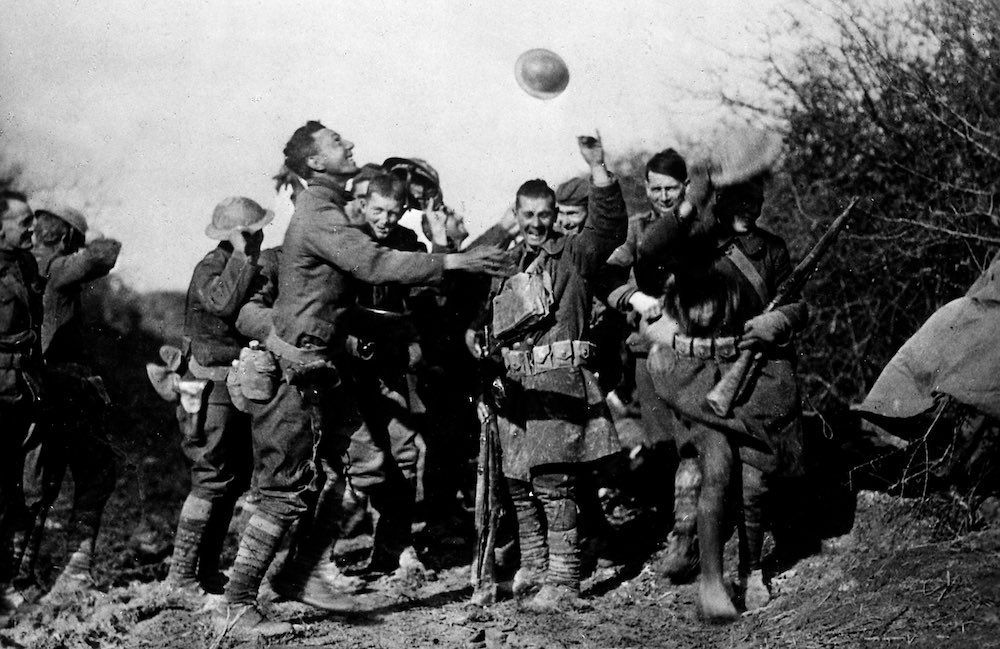
War historians have given notice to it. It is a tragic subplot to a war tragic beyond most all comparison. World War I was a senseless, repeated exercise in the mass killing of young men from around the globe. This went on from August, 1914, up to the cease fire ordered for the eleventh month, the eleventh day, and the eleventh hour of 1918. Offensives on especially the western front meant men from several nations either were ordered to attack or were put in the position to defend against them. Men from many nations woke up on 11/11/18, but as casualties of war never saw the end of that day. People were celebrating the end of the war in Paris, Berlin, London, Washington, and elsewhere while men, most having heard the rumor about the armistice, fought on and died. George Edwin Allison died at 9:30 AM, the last official British casualty. Augustin Trebuchon, a message runner, was killed by a single shot at 10:50 AM, the last French casualty. George Lawrence Price was the last official Canadian casualty, dying at 10:58 AM. The last American to die was Henry Gunter, who if he understood German would have heard the machine gunners of that nation plead for his division to stop their offensive. His time of death was 10:59, and divisional records indicate, “Almost as he (Gunter) fell, the gunfire fell away and an appalling silence prevailed.” If possible, one story is even more tragic. While historians cannot be absolutely certain, they believe the last casualty of this tragic war was a German officer named Tomas. Allegedly, he told Americans approaching a house that he and his men occupied that they could have the house since the war was over. No one had told the Americans who, not trusting the officer, shot him as he walked toward them right after 11:00 AM. Official records indicate over 10,000 dead, wounded, and missing men on the last day of World War I. Historians have found letters, interviewed fellow soldiers of these unfortunate men, and through such correspondence give chilling insights. These men were optimistic. Many felt charmed to have cheated death, some of them veterans whose service had spanned the entire length of a war that exacted staggering, daily death tolls. Others had a strong sense of foreboding, a fatalistic resignation that somehow, despite the cheerful optimism of comrades, they would not survive the day (much historical information gleaned from www.historylearningsite.co.uk).
It is extremely difficult to read this legacy from World War I of men doing their duty to the end, to come so close to escaping the clutches of death, only to be felled in the final hours. Armistice Day and the ending of World War I are the roots of one of our greatest National Holidays and observances, Veterans Day. We honor those living and dead who fought to keep us free from tyranny and evil. Even in that first world war, where war prosecution is much questioned and debated, mothers, fathers, family and friends are beholden to the men and women who risked everything to defend our beloved country.
With that in mind, please allow me to draw this spiritual parallel. How tragic for a child of God to follow for so much of the way only to fall away later in life (2 Peter 2:20-22). How tragic for one to come so close to the cross of Calvary and salvation, only to die short of that goal (cf. Mark 10:22). Jesus spoke of one not far from the Kingdom (Mark 12:34). Agrippa was “almost persuaded” (Acts 26:28). Only eternity and the Judgment Day will reveal the stories of those battling with themselves on the battlefield of Ephesians six, maybe close to obedience, who died outside of Christ. What a tragedy for anyone to die lost. Especially tragic are the examples of those who knew the truth, were convicted about it, but who died without having resolved the greatest problem known to man.
We honor the soldiers who fought and died, even in the “11th hour.” We pray for the souls who are living but will die, who have yet to come to the Captain of the Lord of hosts.
They fought a fight of sacrifice
On land, by air, and sea
Privation, starvation, an awful price
To guard our liberty
Some were cut down in prime of life
Others came home with scars
They faced great fears and perilous strife
For country, for stars and bars
We owe a debt of gratitude
We never could repay
May we have a humble attitude
This aptly named Memorial Day
And looking backward to a different nation
One more ancient, but still existent
We are humbled by their proclamation
Of their allegiance most persistent
They gave their lives in spiritual war
Fighting the wily adversary
Faithful unto death, this sanctified score
Wore their armor, though the battle was scary
We walk behind these noble groups
One in nation, the other in doctrine
Our lives should be changed by these gallant troops
We should be better because of this squadron
Each reminds us that freedom is not cheap
Each shows us the greatness of service
If fidelity is sown, then great honor we reap
Cowardice would do them both disservice
May we step forward, the church of our Lord
While these freedoms remain to us all
And share Christ boldly, with vigor restored
And answer our Chief Commander’s call!
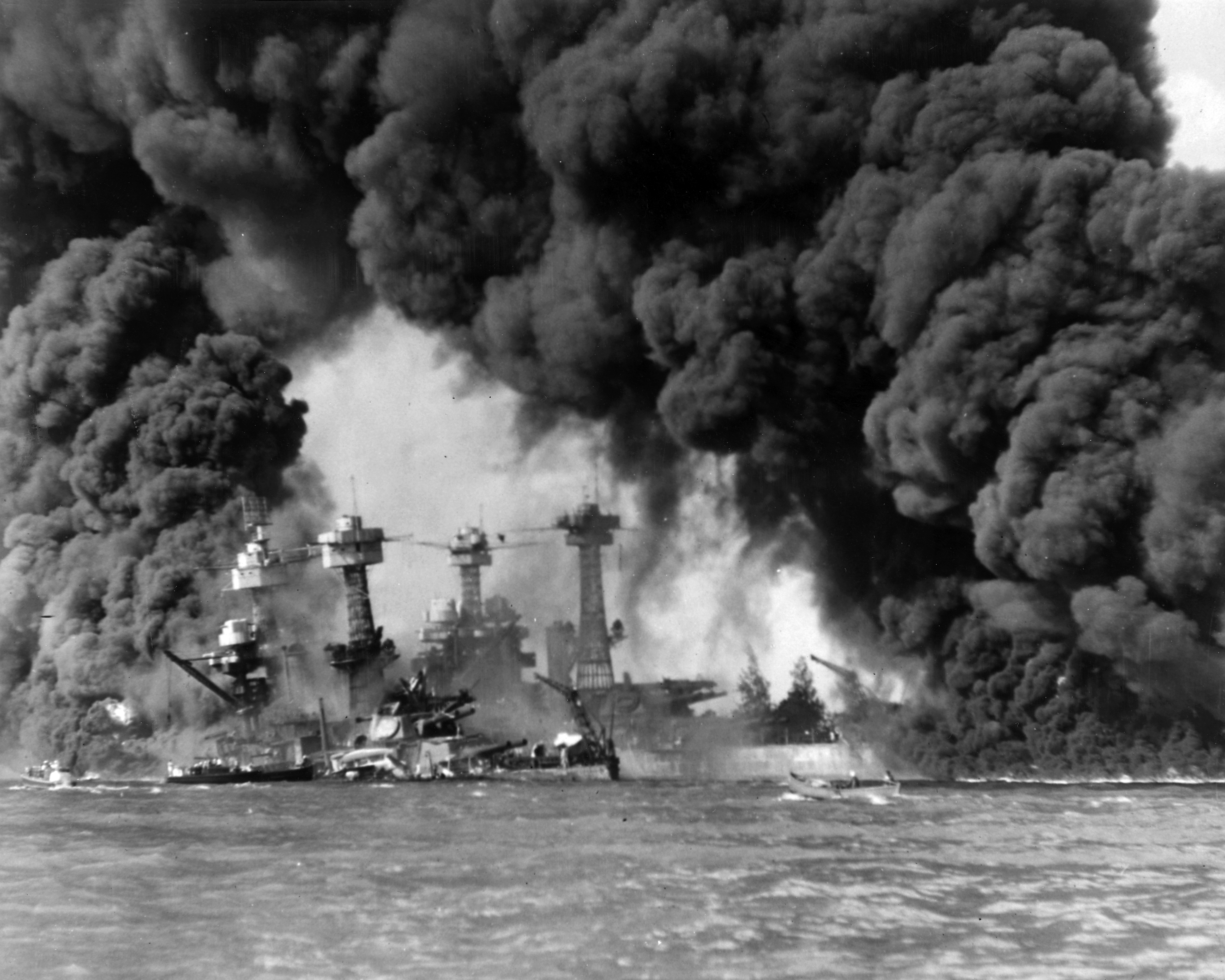
Today marks the 75th anniversary of the attack on Pearl Harbor, the event which drew our country into World War II. 2,343 men were killed, 1,143 were wounded, and 960 unaccounted for or missing. The Japanese chose Sunday to attack as it was the most relaxed day of the week for the servicemen. Many were still in their pajamas or having breakfast when the attack began at 7:55 that morning. Kermit Tyler, an Air Force lieutenant serving as the officer on duty that morning, told the radar operator not to worry about the large blip on the radar screen. He thought it was a flight of U.S. bombers coming from our mainland. Instead, it was the first wave of attackers. Captain Mitsuo Fuchida, the airstrike leader for the Japanese carrier force, could see that Pearl Harbor was totally unaware of the impending attack. He radioed back a coded message, repeating an abbreviated word three times—“to ra, to ra, to ra”—meaning “lightning strike.” The transmission began at 7:49, undetected by the soon-to-be victims of the attack that began a mere six minutes later (read more here).
Among so many significant facts, what we most remember about the attack on Pearl Harbor was how utterly surprising it was. No one stood vigil, considering the possibility of it. Like its later counterpart, “9/11,” and even natural catastrophes like Pompeii, the Galveston hurricane, the 2004 tsunami, or Mexico’s El Chicon volcano, serious and deadly events can occur without warning. With our most sophisticated technology and detection systems, we are without the ability to forewarn about the greatest surprise that will ever be.
Paul says that the resurrection of the dead of all time will occur “in a moment, in the twinkling of an eye” (1 Cor. 15:52). Paul and Peter both refer to “the day of the Lord” as that which will come “as a thief in the night” (1 Th. 5:2; 2 Pet. 3:10). Jesus warned that the day could be a disaster, a trap that comes on one “suddenly” (Luke 21:34). He taught that it will come at an hour unknown to everyone (Mark 13:32-33).
While it will surprise everyone, the coming of Christ will be a devastating event for the great majority of mankind. For them, it will infinitely exceed the loss of physical life. It will be an everlasting loss (Mat. 25:46; 2 Th. 1:9). Yet, God has made preparation eminently possible. He desires escape for everyone (2 Pet. 3:9). One can be prepared for that day and be saved from harm and for something inexpressibly superior. Those of us who have discovered the way of preparation must hold fast to it (cf. Heb. 3:6) and strive to share this vital information with as many as possible. The sudden coming of Christ need not be a defeat, but can instead be the harbinger of the greatest victory ever. May Paul’s inspired exclamation be our song of victory: “Death is swallowed up in victory. O death, where is your victory? O death, where is your sting?” (1 Cor. 15:54b-55). Amen. Come, Lord Jesus (Rev. 22:20)!
Recently, I was corresponding with Arthur Ohanov, a gospel preacher in Donetsk, Ukraine, who served as my translator on a couple of mission trips to eastern Ukraine in the early 2000s. In part, he wrote me, “As I am typing this letter I hear bombing in our city, but God is good! We continue our ministry of reconciliation of sinners with their Father!” Brethren like Arthur are heroes, facing difficulties we can only imagine in America. Walking the streets of Kramatorsk, Slavyansk, and Slavyanagorsk back then, I could not fathom that war, carnage, and death could possibly come to that region in so few years.
Periodically, people talk about how the immorality and unbelief in our nation will bring devastation to this nation. While that is undoubtedly a possibility, which we can see even with God’s special nation in Old Testament times, that belongs to the sovereignty and justice of God. Yet, nations throughout the centuries rise up and testify that national peace can quickly and dramatically give way to war and destruction.
Today, we wake up to calm and peace. At the throne of God, we can (and should) humbly thank Him for this tremendous blessing. Each day that begins like this represents a golden opportunity for each of us. Wherever we go, we encounter people who are alienated from God and who are heading for eternal catastrophe. We should consider this peace more than a privilege. It is an obligation. While we have time, we must try to reach as many as possible.
The deacons at Bear Valley have been working for several months, planning and strategizing to enhance our vision for the lost in our area. Many of our members have been approached and asked for help as we try to prepare ourselves as a church to more effectively carry out the Great Commission. That will continue to expand. We really need to feel the urgency expressed by Christ, who said, “We must work the works of Him who sent Me as long as it is day; night is coming when no one can work” (John 9:4). “Night” may come by virtue of how swiftly our lives are lived on earth. It can also come at the hands of dramatic changes in our nation and communities. Because the future is wholly unforeseen, act while you can!
“Lysychansk 16” by Ліонкінг – Own work. Licensed under CC BY-SA









 The Preacher Pollard Blog