“You’ve Got Mail”

I began preaching full-time in 1992 in a small west Alabama town near the Mississippi border. It was one year before Tim Berners-Lee released the code that became the world wide web, allowing images, video, and audio to be transmitted from servers to computers using existing phone lines. This was more commonly called “dial up.”

Neal Pollard

I began preaching full-time in 1992 in a small west Alabama town near the Mississippi border. It was one year before Tim Berners-Lee released the code that became the world wide web, allowing images, video, and audio to be transmitted from servers to computers using existing phone lines. This was more commonly called “dial up.” For the first three years of my preaching, I typed up Bible classes and sermons (if I didn’t hand write them) on a Brother word processor (it was a typewriter/keyboard attached to a computer monitor). 

Let’s just say that the past 30 years have brought a lot of change in the world of technology. During the ’90s and ’00s, email was king and texting was a complicated, time-consuming, and less desirable alternative. In those days, AOL was the emperor of email. Using a modem (Google it), your computer would connect through the phone and AOL would greet you with, “You’ve got mail” (if you had email). A 1990s movie by that title will give more context to what it was like.

Did you know that dial up internet access is still available? About 160,000 households in America still use it. But on September 30, it will cease. A critical chapter of internet history will be relegated to the museum of technology’s past, like the rotary phone (Google that, too).

I appreciate a few ways this illustrates the work of the church today. First, some changes are desirable and necessary. We can embrace new ways of doing things God preserved in Scripture (Matt. 9:17). As our elders are fond of saying, “We will think outside the box, but inside the Book.” Most of us embraced fiber-optics and satellite, then found dial-up tedious and time-consuming. Old truths can wear new clothes, so long as the truths are not altered (cf. Rev. 22:18-19). See Power Point, newly-written, Scriptural songs and hymns, live-streaming, etc.

Second, while what man creates, invents, and innovates is ever-changing, God’s Word is all-sufficient, timeless, and essential (2 Tim. 3:16-17; Matt. 24:35). No discovery will make it obsolete or irrelevant. It shall stand forever, a rock that cannot be broken or weathered by time or trends (John 10:35). See women’s role (1 Tim. 2:11-15), baptism’s role in salvation (Matt. 28:18-20), the nature of marriage (Eph. 5:31), marriage, divorce, and remarriage (Matt. 19:4-9), etc. 

Third, we should tenaciously defend and fight for truth (Jude 3), but we should take a different tack with tradition. We certainly should not elevate it to be on a par with truth. We must not put it above the truth (Mark 7:6-9). We should not strain relationships and fellowship over matters not “tied down” in Scripture (Romans 14). See Bible translations, modest, but less formal, worship attire, order of worship, etc. 

160,000 households are clinging to dial up until the last possible minute, but then it will be gone. Let’s avoid that spirit when it comes to God’s Word and His work. Where change does not violate God’s will, let us hold it as a matter of indifference. Where the change does violence to it, may we be found nowhere near it! 

Part 2: Moral Clarity in an Age of Antiheroes (continued)

Today’s society has adopted what the prophet decried: a deliberate shift in moral values. Our entertainment industry, educational institutions, and even certain religious circles increasingly emphasize personal comfort instead of moral integrity and individual authenticity, rather than divine guidance.

Brent Pollard

The Prophetic Warning Against Moral Relativism

In Isaiah 5.20, the warning critiques ancient Israel, denouncing any culture that forsakes divine moral truths. The Hebrew term hoy, meaning “woe,” indicates not just mild concern but a declaration of divine condemnation for those who knowingly distort the moral standards established by God.

Recognizing this context underscores Isaiah’s significance in contemporary entertainment and politics. Similar to how the Judeans rationalized their departure from God’s laws, our society creates complex narratives that validate ethical compromises. The reasoning that caused them to modify their moral standards now encourages us to admire fictional characters who engage in theft, deception, criminal partnerships, or political movements that justify violence as a form of justice.

Today’s society has adopted what the prophet decried: a deliberate shift in moral values. Our entertainment industry, educational institutions, and even certain religious circles increasingly emphasize personal comfort instead of moral integrity and individual authenticity, rather than divine guidance.

The Scripture’s Unwavering Standard

The New Testament reinforces Isaiah’s message. Romans 1.32 warns that those who practice sin “also give hearty approval to those who practice them.” 1 John 3.4 adds, “Everyone who practices sin also practices lawlessness; and sin is lawlessness.” The Greek anomia indicates a deep rejection of divine authority.

When society praises those who defy moral law, it fosters chaos and rebellion. No matter how admirable their intentions may seem, God condemns their deeds.

The Antihero Deception: A Pattern Throughout History

Individuals who defy societal norms for “noble” causes have been lauded throughout history—from Robin Hood and Batman to contemporary antiheroes like Disney’s Ironheart. She constructs her suit using stolen technology and collaborates with criminal organizations to achieve her objectives. Additionally, her character is portrayed as bisexual, a choice that mirrors the cultural agenda.

This highlights a more profound concern: the notion that good intentions can excuse immoral behavior. However, Scripture disagrees. Theft is still considered stealing (Exodus 20.15). Violence is inherently wrong (Matthew 26.52). Corrupt partnerships taint ethical values (1 Corinthians 15.33).

We must not confuse love with chaos. God’s law is rooted in love, and genuine compassion does not justify sin.

The Dangers of Celebrating Moral Compromise

Societies that glorify morally ambiguous figures participate in cultural catechism. This teaching influences hearts and minds with significant repercussions:

  • Moral Absolutes Decay: Entertainment or activism that makes exceptions to God’s commands undermines the concept of absolute truth.
  • Pragmatism Replaces Principle: Compliance is no longer mandatory when outcomes justify actions.
  • Resistance to Authority: Antiheroes frequently succeed by challenging authority, prompting viewers to scrutinize all types of it, including divine authority (Romans 1:18ff).

Scripture provides counterexamples. David refused to kill Saul, even when he could have justified it, since Saul sought to kill him (1 Samuel 24.6). Jesus rebuked Peter for drawing a sword in His defense (Matthew 26.52).

The Authority of Scripture vs. Cultural Trends

We must maintain the authority of the Bible (2 Timothy 3.16-17). This obligation stems from principle rather than tradition. We evaluate cultural trends through Scripture, rather than assessing Scripture against cultural norms.

Peter warned that mockers would pursue their desires (2 Peter 3.3). Likewise, Paul cautioned Timothy about individuals who would turn away from sound doctrine in favor of what satisfies them (2 Timothy 4.2–3).

Teaching Moral Discernment

Christian parents should instruct their children to evaluate media from a biblical perspective. Consider:

  • Is this character committed to following God’s commands regardless of the circumstances?
  • Are sinful acts being celebrated?
  • What if everyone followed this character’s moral logic?

Modeling Consistent Ethics

Children gain the most insights from their parents’ examples. If we justify our minor faults while criticizing similar behaviors in others, we convey that moral standards can be adjusted.

James 1.22 urges us to be doers of the word. That includes how we consume entertainment and participate in politics.

Providing Positive Alternatives

Don’t just say what’s wrong; point to what’s right. Scripture presents heroes who remained faithful under pressure:

  • Daniel in the lion’s den (Daniel 6)
  • Joseph, tempted yet faithful (Genesis 39)
  • Hebrew midwives, who feared God more than Pharaoh (Exodus 1.17)

These individuals suggest that following righteousness may require sacrifices, which is always rewarding.

The Church’s Role

The church must be a prophetic voice. Like Isaiah, we declare “woe” to moral confusion from a place of spiritual integrity, not political power.

Early Christians transformed Rome not through political activism but by living the Gospel (Acts 17.6). So must we.

Conclusion: Holding Fast to Truth

Paul’s charge remains: “Guard… the treasure which has been entrusted to you” (2 Timothy 1.14).

We should not adjust the Bible to fit contemporary views. Instead, we present the truth with love, even if it’s not well-received.

By upholding moral integrity in our heroes, we instill in the next generation the importance of righteousness. Though this narrow path is challenging, it ultimately leads to eternal life (Matthew 7.14).

Absolutely Subjective

Gary Pollard

Carl sourced several of the most commonly asked questions and gave me 70 of them to write about. So I’ll try to tackle a question or three every week for a while (or until something more interesting grabs my attention). This week’s question is, “Are all morals absolute? Where does morality come from?”

Morality concerns itself with the difference between right and wrong. Some things are always wrong: murder, sexual sin, theft, neglecting people in need, etc.

But are all morals absolute? 

Some things are wrong, but forgivable. Jesus used David as an example of this. Leviticus 24.9 said that a special kind of bread was for “Aaron’s descendants only.” In I Samuel, David (left with no other options) ate that bread. This was a sin. Jesus used this incident to prove God’s desire for “mercy over sacrifice” (cf. Mt 12.5-7). Rahab flat out lied about keeping Israelite spies in her home, but was praised as an example of faith because of her actions (Hb 11.31). Then, of course, there’s I John 5.16-17: There’s a type of sin that doesn’t lead to death, and a type that does.

The Bible also teaches — unambiguously — that some things are wrong for some people, and not wrong for others (Rom 14.23; I Cor 8.7-8). The message of those texts is: 1. “Keep your beliefs about these things a secret between you and God, because it’s a blessing to be able to do what you think is right without feeling guilty” (Rom 14.22). 2. “Never do anything that would cause a weaker Christian to mess up” (Rom 14.13, I Cor 8.9, cf. Mt 18.7). 

Where does humanity’s sense of right and wrong come from? 

Some things are self-evident to most people. Most people understand that killing someone for no good reason is morally wrong. Most people understand that taking something that belongs to someone else is wrong. Not everyone is this regulated, though — I Timothy 1.9 says that the law was made for people inclined to harm others. 

On the flip side, “sin gets its power from law” (I Cor 15.56, Rom 3.20, 5.20, 7.7-8), so we should be careful not to emphasize the regulation side of Christianity with people who are generally inclined to do the right thing. 

But some things are not second nature. Not everyone understands that chasing happiness (which is often conflated with euphoria, pleasure, and dopamine) at the expense of someone else’s character or feelings is wrong. Fornication and adultery fall into this category. There are many (often understandable) reasons someone might fall for these, but none of them are ultimately justifiable. Not everyone understands that ordering their lives around anything other than God, or giving immense adoration and respect to a human over God, is wrong (this is idolatry). Our understanding of what is morally right in these (and other related) areas comes from God. 

God’s standard of what’s right has always existed to benefit humanity, prevent abuse of the vulnerable, to give us the most fulfilling life here, and to make us eligible for rescue when Jesus returns. Morality is an extension of God’s existence. It is the first and last line of defense against darkness. This Earth is still around, so bad people and bad things still exist. God gave us a standard of right and wrong that we can’t always live up to, and that’s where grace comes in. But some things are always very wrong and can’t be practiced by anyone who wants to live forever. 

Jesus, Let Us Come To Know You (Part One)

Neal Pollard

What did He look like as a child or grown man? Isaiah 53:2 leads one to believe He had no remarkable, distinguishing physical characteristics. What earthly interests did He have? What was His favorite subject in school? Who did He spend time with the first 30 years of His life? Was He tall or short? How did He sound when He laughed?

These questions have long fascinated man, but they matter little. If they mattered to His contemporaries, they would have written about them. If they mattered to God, surely there would be a record of them. Yet, the physical things about Jesus tell one little about who He is. When little children sit on His knee, when the poor and hurting find comfort from Him, and when the enemies of truth are on the scorched end of His rebukes, He is teaching the things about Himself that mattered most. As we seek to know Jesus, here is what we learn.

He is Our Teacher

On 12 separate occasions, the gospels record somebody calling Jesus “rabbi”–never in jest or ridicule. In John 20:16, He is called “Rabboni.” The former term meant “my master” and the latter meant “my great master.” The terms were meant to rank a person’s ability and proficiency as a teacher of the Law. People marveled at Jesus’ teaching ability (cf. Luke 20:26; John 7:46; Matthew 7:29). He taught with so many different methods, whether object lessons, parables, questions and answers, or through questions. His teaching changed lives, from the apostles to strangers to even enemies. People may have debated Christ’s claims and doubted the power behind His miracles, but they could never answer His teaching.

Jesus is our teacher, too. Certainly, He teaches us through the Scripture (cf. 2 Peter 1:3). He left us everything we need to go to heaven, and He is holding us accountable for it (John 12:48).

But He also teaches us with His example. He practiced perfectly the things He taught, so that even His enemies could find no fault in Him (Luke 23:4; John 8:46). He had the perfect attitude toward truth, so that while He was never abusive or unkind He did set forth truth in plain, simple terms to make clear that if the shoe fit His listener should wear it. He loved His students with a perfect degree of love. He loved truth, but He also loved everyone. When people rejected truth, He sorrowed for them. He wanted all saved, even those who crucified Him.

He further teaches us with His approach. He had the widest of vision, intending everyone of every race and nation to hear the gospel (Matthew 28:18-20). He had the clearest of insight into His students. He set an incomparable moral standard. He did not just condemn sinful acts, but also the hearts behind such actions and so emphasized that we should act out of perfect love and faith.

He had a perfect method of teaching, teaching, as Franklin Camp might say, “old truths in new robes.” He adapted His methods to His audience, and He utilized the common things of life they knew. Jesus came to show us the Father. But, He also came to show us ourselves. His teaching also showed us so much about who He is!

Advocacy And Standards (1 John: Part Two)

Wednesday’s Column: Third’s Words

Gary Pollard

I’ll be repeating the book of I John in present-day terminology. It’s not a true translation of the book, as I am not qualified to do so. It will be based on an exegetical study of the book and will lean heavily on the SBL and UBS Greek New Testaments, as well as comparisons with other translations (ESV, NASB, NIV, ERV, NLT). My goal is to reflect the text accurately, and to highlight the intent of the author using concepts and vocabulary in common use today. 

This is not an “essentially literal” translation, and should be read as something of a commentary. 

Advocacy & Standards

My children, I’m writing all of this to you to help you avoid sin. But when we do sin, we have someone who came from God and who advocates for us: Jesus Christ, the morally perfect one who gets rid of every one of our sins. He doesn’t just take care of our sins, he does the same thing for the whole world! 

We can know for sure that we know him if we do what he’s told us. Anyone who claims to know God but doesn’t do what he’s told us is a liar. The truth doesn’t exist in them. 

If we do what he’s told us to do, the truth is in us and God’s love is, too. That’s how we know we’re with him. If we claim to be with him, we’re obligated to live by the same standard Jesus lived by. 

99 44/100% Pure

Friday’s Column: Supplemental Strength

81121814_2462862270639428_5746232403106463744_n

Brent Pollard

When Harry Procter first marketed his Ivory soap in 1891, he used the simple slogan, “It floats!” Within a few years, however, he conceived of a new angle he could use to peddle Ivory to the masses. He decided to have an independent laboratory analyze his soap along with Castile soaps also available on the market in the 1890s. The laboratory’s conclusions were used by Procter to declare that Ivory was “99 44/100% Pure.” And that was Ivory’s new slogan. 1

 The problem with that slogan is that there was no standard for comparison. Who defined what “pure” meant? Was it the independent laboratory that Procter paid to do the analysis? That does not pass the smell test. If paid to find a particular result, are you going to maintain your integrity and admit that there was no litmus test for soap purity? Thus, when you look at a package of Ivory soap today with its vaunted claim of being “99 44/100% Pure,” remember that is a subjective statement based on a clever marketing ploy. In other words, Ivory is pure only because it proclaims itself to be so.

If we are not careful, we can be guilty of doing something similar spiritually. That is, we might puff ourselves up, stating we are superior to those around us when we have no objective basis for our statement. Jesus cautioned us against such behavior. He told us not to do things to be seen of men in His Sermon on the Mount (Matthew 6.1-6). He gave the parable of the Pharisee and the publican to caution us that we should not seek to justify ourselves by looking upon others with contempt (Luke 18.9-14). The sobering truth is that even when we have done everything commanded of us, we are to say, “We are unworthy slaves; we have done only that which we ought to have done” (Luke 17.10b NASB). Indeed, Jesus calls us to second-mile service (Matthew 5.41).

Regarding the final judgment, Jesus warned that there would be some who would stand before Him and laud those works (of their devising) they had done. His response for them will be, “I never knew you; depart from Me, you who practice lawlessness” (Matthew 7.23 NASB). It is not as if the desires of God are unknown. He has declared them to us. And this constitutes the criteria for our judgment (John 12.48). Indeed, we must do the will of the Father (Matthew 7.21). As such, we have an objective standard by which to compare our lives. Beyond that, we are to show mercy. We must walk in the same love as Christ had for us (Ephesians 5.1-2). That was a generous love putting our interests ahead of His own. In like manner, we must avoid allowing the abuse of our Christian liberty to cause another to stumble (1 Corinthians 8.9). Only when doing such, can we begin to say that our righteousness is not like filthy rags (Isaiah 64.6).

Fortunately, we do not have to guess whether we are living lives pleasing to Him. Hence, even if we cannot quantify our purity with an exact number like 99 44/100%, we can still rest assured that the blood of Jesus Christ has us thoroughly cleansed (1 John 1.7). In the interim, we plead with David, “Create in me a clean heart, O God, And renew a steadfast spirit within me.” (Psalm 51.10).

 Reference

1 “Ivory (Soap).” Wikipedia, Wikimedia Foundation, 10 June 2020, en.wikipedia.org/wiki/Ivory_(soap).

1800s_blue_ivory

The Inevitable Standard

Neal Pollard

Everywhere, each generation tries to figure out the why and how of living. Most will not find the right path (Mat. 7:13-14). Almost all are convicted, even passionate, about the way they wish to live life. They may be fiery about politics, social issues, relationships, and even religious ideals, and to be consistent they must appeal to some ultimately, overarching authority that makes right right and wrong wrong whatever their point of view. Will it be feelings, friends, the majority, the minority, the church, family, a teacher, culture, or something else? The Bible claims to be the arbitrator by which all matters are judged. But if not the Bible, there has to be some universal absolutes with an adequate origin to compel people to follow it. Whether the issue is rape, murder, stealing, or similar norm that stands between order and chaos, there has to be adequate reason to submit to it. 

This inevitable standard helps us decide whether or not a Creator exists. If there is nothing (no One) greater, bigger, wiser, and stronger than us, why can’t we decide right and wrong as our whims determine? Why would we desire civilization and peace? Why would we wish good will or at least peaceful coexistence with each other?

The inevitable standard helps us decide which god (God) is to be followed. Do their alleged writings and teachings cohere and show consistency? Do they adequately answer the great questions of life?

The inevitable standard helps us decide whether or not Bible doctrines taught by men are consistent with and true to what the Bible actually teaches. How do we know how to worship, be saved from sins, what roles to play in life, what our purpose is, and how to reach a desirable destiny? The nonsensical claim that you have your truth and I have mine is unacceptable in every other discipline (building construction, medicine, physics, mathematics, etc.). Even falling back on “you have your interpretation and I have mine” is a dangerous slope since there are matters of life and godless ( Pet. 1:3). 

The inevitable standard helps us fulfill our roles in the home, the church, and the world. How should we live and how should we help our physical family, spiritual family, and communities live? It matters!

It may gall us to think we all must concede to a standard of right and wrong, of absolute truth. To say that all of us are accountable to the same standard may be construed as bigoted, small-minded, or narrow, but everything falls apart if each of us follows our own set of rules. Imagine an interstate where every driver followed whatever they thought they should and ignored whatever they felt they could or should. All of us are on the road of life heading somewhere. How will we get there? There is an inevitable standard, given by God to us through men He moved to write it down (2 Tim. 3:16-17). 

tape measure.jpg

THERE IS A PATTERN OF TEACHING

Neal Pollard

The Bible claims to hold the answer to your greatest problem. Not only that, but it helps you to identify what that problem is which you may or may not even know about. In Romans 6:16-18, Paul talks about a “form of teaching” given to those at Rome. 

Paul writes this powerful epistle to emphasize that salvation is by faith and not by works of law, but faith in what? One might say, “Faith in Jesus,” and Paul makes that point repeated in Romans (3:22; 3:26, for example). But how do we have faith in Jesus? He says, “So faith comes from hearing, and hearing by the word of Christ” (10:17). 

Elsewhere, Paul reminds us that there is “one faith” (Eph. 4:5), so a purely subjective faith (what we think we should believe) is not the faith commanded in Scripture. So, we’re looking a t a faith produced by reading, learning, and following God’s Word.

No wonder, then, that Paul emphasizes the importance of obedience in this text. Does God want you and me and everyone else to obey the same thing? Or can you pick what you want to obey while I pick what I want to obey and everyone else do the same? Paul talks about an objective standard of teaching that is for everyone, everywhere, for all time. Look closer at what he says in this brief passage of Scripture and what it means for us today.

THE FACT OF THE PATTERN (Rom. 6:17)

Paul talks about a form, a kind, class, or thing that suggests a model or pattern (BDAG 1020). It is the word used in the Greek Old Testament in Exodus 25:40 and quoted by Stephen (Acts 7:44). Translators chose the word form (“standard,” ESV, or “pattern,” NIV) in this verse. 

For those who pour concrete, you use “form boards” to cause it to conform to their shape in width, length, and height. Without some way to hold the concrete, what a waste of time and money! The concrete would be totally useless. It’s the same concept for those who bake and use cake moulds, muffin pans and cookie cutters. If you put dough or mix into a round pan, you don’t expect a rectangular finished product. 

Paul talks about a teaching that conforms to a certain form or pattern, having definite, identifiable structure. So, the Romans received teaching that was meant to produce the same result in every case. A growing number of people look at the Bible as basically shapeless and formless. They reject the idea of pattern theology, the very thing Paul appeals to in Romans 6:17. The alternative to there being a pattern for salvation, worship, church leadership and organization, sexuality, morality, gender roles, and all teaching is that we have no pattern.

Without a standard to appeal to, how do we determine right and wrong? Historically, when humanity rejects an absolute standard, we choose what we think is right and wrong (cf. Jud. 17:6). This is a fatal way to live (Prov. 16:25), and it destroys societies (Prov. 14:34). But everyone is going to appeal to something as the final say and authority, even if it’s only self. There is a “standard of sound words” (2 Tim. 1:13). It must be retained and it carries with it the authority of Christ Jesus.

THE FRUIT OF THE PATTERN (Rom. 6:17-18)

Since there is a pattern of teaching, what are the consequences? Paul implies that we must obey it and commit to it, just as the Romans did. The end result of such obedience is that we become slaves to the right master. Everyone will inevitably be enslaved, whether to sin or righteousness. This pattern shows us the right choice to make. We’re not just talking about information, but rather information which leads one to do something and become something. 

THE FREEDOM OF THE PATTERN (Rom. 6:18)

Ironically, those who reject the idea of pattern theology claim that such unfairly restricts and inhibits us. But, Paul draws a different conclusion. Obeying the form of teaching and committing themselves to it led them to be free from sin. Sin brings spiritual death (5:12), condemnation (5:16), enslavement (6:6), and deception (7:11). If we understand the true nature of sin (which biblical teaching defines), we will want to be free from the burden of it.  The form of teaching shows us how to do that. Anyone who wants freedom from sin can have it, but anyone who wants freedom from sin must follow the pattern. 

Obeying Christ’s teaching is not legalism. It is faith in His power, but also submission to His will. There is truth. We can know it (John 8:32). We must obey it (Rom. 6:17). It will free us (John 8:32)! 

fh07may_pourc_01-2

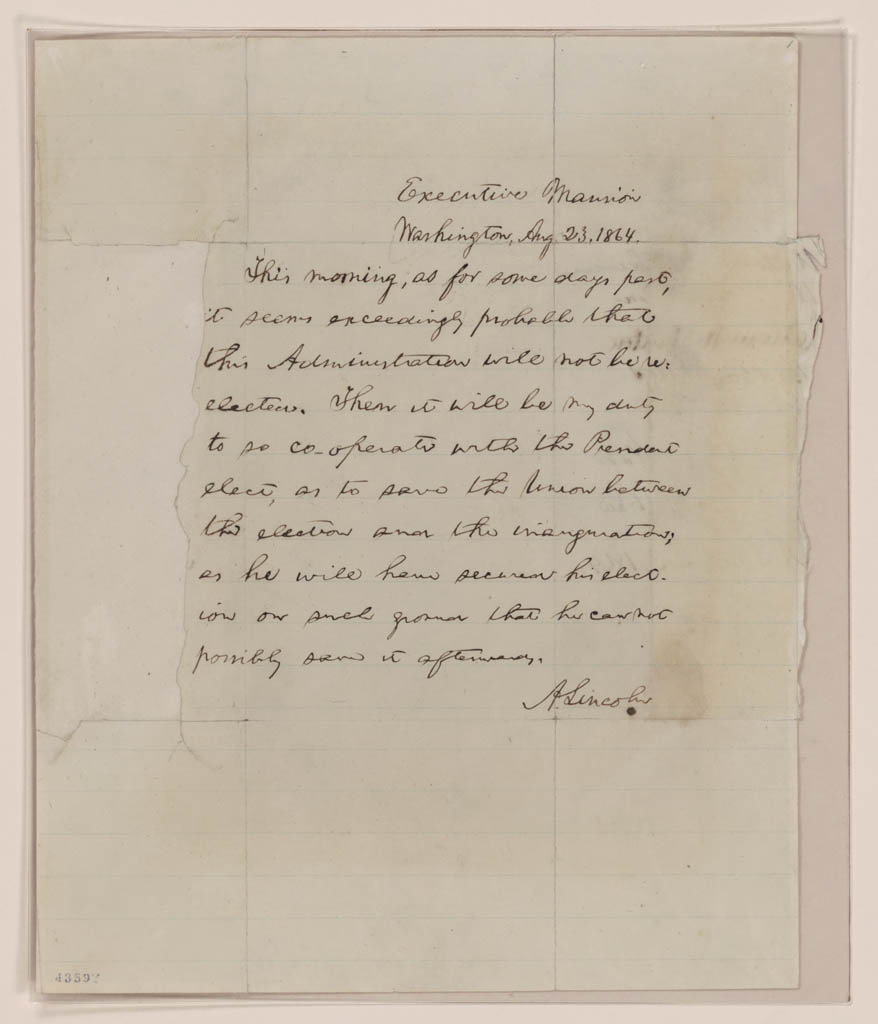
Abraham Lincoln’s Memorandum Of August 23, 1864

Neal Pollard

Somehow, I was unaware of the existence of a document which Abraham Lincoln drafted and had endorsed by every member of his cabinet, though unseen by them, and which remained sealed until November 11, 1864. These were not only dark times for the nation, embroiled in civil war for over three years at that point, but gloomy for the war-weary north which could not end the conflict against the greatly outmanned but tactically superior south. Politicians and citizens were unhappy with the perceived lack of success and progress at such high cost—the death and disabling of so many of her sons in the prime of their lives.  Lincoln detected that popular sentiment was such that he would not be reelected. Thus, he drafted his memo, which read, 

This morning, as for some days past, it seems exceedingly probable the this
Administration will not be reelected. Then it will be my duty to so cooperate
with the President-elect as to save the Union between the election and the
inauguration: as he will have secured his election on such ground that he
cannot possibly save it afterward (Coolidge 139). 

Lincoln seemed to think that the north had had enough of this war and would rather sue for peace and allow our sea to shining sea to be two nations rather than continue with such devastating effects a war they could see no end to. He appears dedicated to whatever he could do to preserve unity.

Of course, several things changed the course of Lincoln’s fate in his bid for reelection that swept him decidedly into office for a second term. There was the north’s victorious show in The Battle of Atlanta, Fremont’s withdrawal from candidacy, the Democrats internal division between the Copperheads—eager to end the war now—and the War Democrats, and the fact that no electoral votes were counted from the Confederate States of America.  But, Lincoln could not see the future. He was preparing for what he saw as the worst.

There is a well-worn battle taking place in our world. It is not technically between two factions. It might be framed as Christianity versus other world religions. It could be cast as New Testament Christianity versus so many individual denominations. Yet, internally, there are multiple stressors to the biblical unity Christ prayed and died for, too (John 17:20-21). 

Christians are soldiers (Eph. 6:10ff), but our battle is not with flesh and blood (Eph. 6:12).  Our war and weapons are not “of the flesh” (2 Cor. 10:3-4). All the same, many have grown weary of fighting the good fight and not a few feel as though we are fighting in a losing cause. The restoration ideal of doing Bible things in Bible ways seems archaic and impossible to growing numbers of saints. Some fight with equal vigor to preserve traditions not rooted in Scripture, and unnecessarily harm the great cause. 

As we strive at all costs to be true to the pattern of New Testament Christianity, let us do so going to whatever lengths we can to maintain unity wherever possible. Not for a moment does that mean sacrificing truth or compromising even one “thus says the Lord.” But it does mean embracing a spirit of love and protectiveness for the precious Bride of Christ, the church. That involves loving and working with those who are the members of it. 

Ultimately, the Lord’s cause will prevail. His victory is as assured as every other divine promise. We must be striving on His side to share in that. For now, we cannot give up the fight! Let’s cooperate wherever and however we can, standing unitedly on the foundation of Christ and His will. The rest (which is most of it), we will leave to our Great Commander In Chief!

Works Cited:
Coolidge, Louis A. American Statesman Ulysses S. Grant (New York: Chelsea House, 1983).

blind-memo-recto-al0204

HOW IS TRUTH DETERMINED?

Neal Pollard

Recently, I received some feedback on a recent article (Truth Is Truth, No Matter Who Disagrees With It). Negative feedback is not rare, but expected when we put ideas down on paper (or on electronic media like blogs). This feedback was not personal, nor unkind. Yet, it reflects the thinking of so many who shun the idea of absolute, objective truth. Consider the major arguments made by the one who wrote:

—No matter what you believe, the majority disagrees with you.
—You are no smarter or more sincere than those who disagree with you.
—Everyone is certain their religion is right, but this is a function of the brain and proof of nothing
—Conflicting views within the “Restoration Movement” shows the fallacy of being certain about truth
—Certainty is dangerous because it does not allow for change

The last three arguments seem more of a confrontation of certainty than arguments against truth, but consider each of these individually.

Does the inevitability of disagreement nullify the idea of absolute truth? If someone argues our answer that two plus two equals four, and were able to get a majority to side with them that the answer is five, does that nullify the truth of what two plus two equals?

If a person with demonstrable intellectual capacity and apparent sincerity nonetheless avers that two plus two equals five, do we rewrite the laws of addition and reprint the textbooks? If not, why not? Is it not because we can take two of something, add it to two more of the same something, like integers or apples or books, and find the inescapable, universal truth that now there are four?

Can any religion be certain that they are right, but be wrong? Universalists believe everyone will ultimately be saved. Those who believe that murdering those they deem “infidels” pleases their God and they teach others that this is truth. Cults often dub their leaders the Messiah. On what basis would we object or oppose any religious tenet, like these, without an objective standard of truth?

Does the imperfection of people in applying revealed truth impugn the reality of absolute truth? It will never be suggested that anyone is perfectly interpreting or applying the perfect standard of truth, including those trying to restore New Testament Christianity (which, incidentally, implies belief in a perfect, objective standard of truth). But, does that mean restoration can or should be rejected for ideas which clearly contradict what the New Testament says (i.e., “sinner’s prayer’ versus how the New Testament teaches people were saved)?

If there is a conflict between the certainty of New Testament teaching and the desire for change, which is to be preferred and chosen? The religious world has changed a myriad of things that the New Testament explicitly teaches must be done or taught a certain way. Isn’t it a faulty premise to choose change proposed by men, when it assaults a certainty revealed by God?

That there is religious confusion and division is indisputable. It is disheartening. The Bible warns that articulate, polished religious leaders would teach things contrary to the revealed truth of the New Testament (Gal. 1:6-9; 2 John 9-11; Rev. 22:18-19). Let us never put confidence in man, but let us ever put confidence in the truth of Scripture.

OLYMPUS DIGITAL CAMERA

The Rasputin Rule

Neal Pollard

Very little good can be said of Gregory Rasputin. Robert Goldston, in The Russian Revolution, writes that he “was, like his father before him, essentially a rowdy peasant. He soon developed a reputation in his hometown as a horse thief, drunkard, seducer of young girls, and general good for nothing. He had no education and remained largely illiterate all his life. His one apparent attribute was great physical strength. He was a coarse-featured man with a heavy black beard and strangely piercing eye” (82). Because times in Russia circa 1905 were desperate and grim, a rascal like Rasputin could rise. He went to Saint Petersburg, weaseled his way up the ranks of nobility, and eventually rose to become the most intimate advisor of Czar Nicolas II and especially the superstitious Czarina Alix. Many historians believe that, in the fateful, final years of the Romanov dynasty, Rasputin was the unofficial, yet undisputed, ruler of Russia.

He was grossly immoral and unscrupulous. At his words, jobs and even lives were spared or taken. Though he had abandoned his wife and children, Rasputin made his way as a self-professed prophet and “holy beggar.” The Czarina, in all her correspondence, simply called Rasputin “the Friend.” The royal family implicitly trusted Rasputin. Rasputin, in turn, urged the royal family to rule by absolute despotism. Many thought Rasputin to possess powers of hypnotism and the ability to do magic. Giving him the control of hundreds of millions of peoples’ lives, the Czar contributed to his own murder and that of the entire royal family in the revolution of 1917. For Rasputin’s part, he was murdered in 1914 by a small group of conspiring nobles who lured him to one of their houses and shot him repeatedly after poisoned food and wine did not do the trick.

The most amazing part of this story involves the irony of it all. A ne’er-do-well essentially becomes head of the largest country in the world. A grossly immoral man is viewed as a “holy man.” The head of a dynasty that had lasted hundreds of years put all its trust and hope in such a one. What incredible folly!

However, the majority of humanity has done the same thing from time immemorial. The prince of darkness, the king of ne’er-do-well, is their spiritual advisor. As foolish as it is, people stake their eternal destiny on his wholly corrupt guidance. They risk it all, mesmerized by his wiles. Consequently, they are duped into calling “evil good and good evil…who are wise in their own eyes and clever in their own sight” (Isa. 5:20-21). Yet, it is not a revolution but The Judgment that will undo them. They stand to lose more than physical life; they will lose their souls (Mat. 10:28). Beware of the pied piper of souls! Be careful who you make your spiritual counselor. It matters!

grigori-rasputin-4

PEWAUKEE’S DRESS CODE

Neal Pollard

Pewaukee is a small city in southeast Wisconsin, home to a high school whose most famous alumni is probably Houston Texan NFL superstar J.J. Watt. But the high school is not in the news due to the recent philanthropic gesture of Watt in the wake of Hurricane Harvey, but for another decision that resulted in a media tidal wave against the Waukesha County school district. Specifically, reaction is against a school policy “requiring all ‘dress-wearing’ students and guests to send photos of their attire before they can buy tickets to the Pewaukee High School homecoming dance next month” (Annysa Johnson, Milwaukee Journal Sentinel, 9/15/17). Though the policy actually was enacted in 2015, the email reminder to families  last week created a backlash from some students and parents. One mother complained, “The girls are essentially being held responsible for the wayward thoughts (administrators) think boys have” (ibid.).  There are policies aimed at boys, too, but the school superintendent “said it was girls who forced the district to impose the pre-dance check by pushing the boundaries of appropriate attire at school formals” (ibid.).  While some parents seem upset that the school district is not trusting their judgment, others seem not to want to be told what to do or to have arbitrary boundaries set.

Pewaukee High School has boundaries about clothing. Dads and moms, have you taken the time to consider what that is for yourselves and for your children? When Paul speaks to women about clothing and uses such words as “proper,” “modestly,” and “discreetly” (1 Tim. 2:9), have you thought about what that will mean within your family? We have such a golden opportunity as stewards of influence, godliness, purity, and modesty. The world benefits from distinctive Christian living that reflects itself in a variety of ways, including modesty. “Dress code” is a phrase often used in a pejorative, contemptible way, but all of us have one. May ours reveal a thoughtful premeditation toward reflecting the glory of our wonderful Redeemer.

hanger06

The Eye Of The Beholder

Neal Pollard

The theme of our recently completed lectureship was, “Every Man Did What Was Right In His Own Eyes.” This seems to be the summary statement of this entire period of Bible history. It is interesting that this idea shows up more than in just the two verses where the statement appears (Judges 17:6; 21:25). Samson wanted the woman of Timnah because “she looked good to” him (Judges 14:3,7; literally, “she was right in his eyes”). In reality, she was a loose, treacherous, and idolatrous woman, but she seemed right to him. In that dark story about the Levite man, the elderly Ephraimite man, the Levite’s concubine and the Ephraimite’s virgin daughter, the old man, seeking to placate the wicked Benjamites, offered the women to them “to do with them whatever” they wished (Judges 19:24; literally, “the good in your eyes”). Obviously, what was right in these men’s eyes was reprehensible and vile. It is one of the most extreme examples of wickedness recorded in the Bible.

Elsewhere, the Bible says, “The way of a fool is right in his own eyes” (Proverbs 12:15a), and “Every man’s way is right in his own eyes” (Proverbs 21:2a). We often think things seem right when they are far from it (Proverbs 14:12; 16:25; 18:17).  After talking about those who mix up right and wrong and good and evil, Isaiah tells us why they do this. He warns that they “are wise in their own eyes and clever in their own sight” (Isaiah 5:21).

In the world, the church, and our own lives, we are tempted to do what is right in our own eyes. We justify habits, relationships, desires, religious practices, lifestyles, and choices about which God warns in His Word by ignoring that and rationalizing, rewording, and reframing them. We use emotional arguments. We twist Scripture. In the end, when we do these things, we reject God’s authority and seek to become the standard ourselves. The book of Judges was written, in part, to show us what happens when we do it and how God feels when we do it.  The well-worn phrase goes, “Beauty is in the eye of the beholder.” That may be. But right and wrong is not such as is in the eye of the beholder. That is determined by the One who possesses “the all-seeing eye” (Proverbs 15:3).

eye-211610_640

“Wait Until Fall”

Neal Pollard

It was a beautiful experience, talking with our newest brother in Christ last night. It was beautiful watching him be bombarded with love and attention from member after member. Listening to him tell his story built my confidence in the simplicity of the Bible when a person reads it without prejudice or agenda. What an affirmation that God has a will for us and He made sure it was understandable to the seeker. As Jesus put it, “Seek, and you shall find” (Mat. 7:7).

Roberto has been seeking. As he has been attending a large, area Community Church, he has also been studying his Bible. He’s been a diligent student. Along the way, he read the repeated emphasis upon baptism as a necessity for salvation. This prompted him to approach his church and ask if he could be baptized. He was told that they baptize in the fall, and he could be baptized then. His immediate concern? What if I am killed in a car wreck or my phone blows up when I charge it? There was no manipulative or badgering teacher filling his head with such scenarios. Instead, he could make the connection between a command from God and the consequences of disobeying it.

He started Googling the importance of baptism and eventually found World Bible School. This led him to connect with Terry Pace, a Christian in Flint, Michigan, who studied with him. Roberto wanted to know if he could be baptized. Terry went to work. Terry’s son, Sam, happens to preach at the Northwest congregation in Westminster. One of the Northwest members, Allan Javellana, met him to study with him on Monday and found out he had sufficient understanding to be baptized. Since he lives close to Bear Valley, Allan brought him to our building where Wayne Nelson let him in. Allan stressed with Roberto the importance of working and worshipping with a group that is trying to answer Bible questions with Bible answers.

On Pentecost, they asked “What shall we do?” (Acts 2:37). They were told (Acts 2:38), and they acted that day (Acts 2:41).

On the road to Gaza, the eunuch asked Philip (who had preached Jesus to him, Acts 8:35), “Look! Water! What prevents me from being baptized?” (Acts 8:36). They stopped the chariot right there and then, and he was baptized (Acts 8:38).

At Cornelius’ house in Caesarea, this Gentile asked Peter to come over from Joppa (Acts 10:23ff). Cornelius knew Peter would be speaking words by which he could be saved (Acts 11:14). When it was clear that God wanted Gentiles to be saved (Acts 10:44-47), Cornelius and his household were baptized on the spot (Acts 10:48).

In the prison in Philippi, the jailor asked, “What must I do to be saved?” (Acts 16:30). He’s told to believe on the Lord Jesus Christ (Acts 16:31), Who they proceed to teach him about (Acts 16:32). Armed with this knowledge of the Savior, this jailor “immediately…was baptized, he and all his household” (Acts 16:33).

Nobody waited because God’s answer was “now.” What has changed from then to now? What would make a different answer acceptable today? Roberto is another, amazing example of what a receptive heart does when faced with God’s Word and will. Simply, humbly do what He says. Oh, that I will approach God’s Word the same way!

water-baptism

The Ever-Fixed Mark

Neal Pollard

This phrase is taken from Shakespeare’s Sonnet 116 to describe love. While it is an apt, poetic description of love, it also is the perfect modifier of God’s Word. If there is a word to describe the current culture, it is “change.” Our world is enamored with it, constantly changing its mind, its values, its standards of right and wrong, its worldview, and its priorities. Swept up in all of this are societal attitudes about so many things.

What was once right is now wrong. What was wrong is now right. And while not every instance of this is wrong, so many of them are the product of mankind pushing the envelope of previous norms and standards of decency. Let me cite some specific examples:

  • The definition of marriage
  • The definition of gender
  • Sexual mores
  • The sanctity and humanity of the unborn
  • The view of the inspiration and authority of Scripture
  • Male and female leadership roles
  • The move from monotheism to polytheism (one God to many Gods)
  • The existence of God and the deity of Jesus Christ
  • The ethics of honesty, hard work, and service

Our list could be much longer, but these representative items have all fallen victim to the world’s push for what it sees as greater freedom, satisfaction, and happiness. Those who rely on the Bible as their infallible guide already know how the story turns out for those who make themselves the standard. “I know, O Lord, that a man’s way is not in himself, nor is it in a man to direct his steps” (Jer. 10:23). More solemnly, Solomon says, “There is a way which seems right to a man, but its end is the way of death” (Prov. 16:25). In Paul’s day, suppressing, speculative, sensual, and subverting souls rejected God in deference to self-guidance with destructive results (Rom. 1:18ff). Thus it will always be when man builds upon the foundation of himself.

What happens with us, individually and collectively, when we build upon the rock of Scripture is survival in the severest tests (Mat. 7:24-25). When we see Scripture as something to change us rather than something subject to our changes, we have a sure standard by which to chart our lives. Antecedent societies have experienced the trauma of spiritual self-determination (cf. Prov. 14:34). In a world enamored with unrighteous change, may we determine to fix our gaze on the ever-fixed mark of Scripture!

harrows_bristle_board_bullseye

Five Facts About A Faithless People

Neal Pollard

The percentage of Americans who identify as atheists doubled from 2007 to 2014 (Michael Lipka, Pew Research Center). But that hardly tells the whole story. Our culture is drowning in a political correctness that stigmatizes Christian Values and that makes nearly any public stand or statement regarding what Scripture says about such things as homosexuality, objective truth, the sanctity of life, and creation a point of fierce contention and object of greatest scorn. A moral erosion and slippery slope has been in motion for several generations that has brought us to our current position. The Bible foresaw such decline as comes when a people turn their backs on God (cf. Prov. 14:34). In discussing the universal problem of sin, Paul points out five facts about a faithless people (Rom. 1:18-32):

  • Faithlessness ignites God’s fury (18). Wrathfulness is as much a part of God’s nature as graciousness. In fact, we appreciate grace so much because God gives it when we deserve His wrath. Paul says the object of His wrath is all ungodliness and unrighteousness. The unrighteous behavior Paul specifies is “men who suppress the truth in unrighteousness.” They don’t live the truth and they don’t want the truth to be told. Paul ends the section by pointing these out as those who practice ungodliness and heartily approve of those who do the same (32). It is clear that those who remain faithless are “sinners in the hands of an angry God.”
  • Faithlessness ignores the facts (19-20). Paul says that faithlessness is not due to an absence of facts, but a willful ignorance of them. He says that even the faithless can see God as they look inside themselves and outside themselves at the creation. It takes a deliberate effort to arrive at a position of unbelief. So much has to be continuously ignored.
  • Faithlessness includes futility (21). Faithlessness is built upon a flimsy foundation. It’s the slab of speculation. The faithless spend their lives running from the facts in favor of a worldview that makes no sense, gives no purpose, and instills no hope.
  • Faithlessness involves folly (22-23). It’s not just empty, it’s foolish. Paul’s words here are akin to David’s words in Psalm 14:1 and 53:1, that “the fool has said in his heart, ‘There is no God.’” Paul describes intelligent people who have made the most fundamentally foolish decision of all. They exchange faith in an infallible God for faith in fallible man.
  • Faithlessness instigates a fall (24-32). Paul pictures how a person arrives at wholesale immorality. One must first turn from God and run the other way. Then, God lets them go to find out what lies at the end of that broad way. He gives them over in the lusts of their hearts to impurity (24), He gives them over to degrading passions (26), and He gives them over to a depraved mind (28). The lusts led to the wrong object of worship and submission. The passions led to unnatural desires. The depraved minds led to every imaginable behavior, a long list of actions that have in common the fact that they lead to spiritual death. It encompasses both the perpetrators and those who validate them and tell them it’s OK to do them.

Why does Paul mention these faithless ones? It is proof of divine inspiration, because although this was written 2000 years ago it perfectly describes the current culture. But, there is a more important reason for Paul to write this. This horrible condition has a remedy. The theme of Romans is contained in the four verses prior to this section. The gospel has the power to save us from this. The solution is faith. Faith saves (1:16) and it gives life (1:17). The world is being swallowed by spiritual darkness, but God’s light is brighter. We who have faith have the light. We must share it. When we do, we help people have the most important possible commodity: faith!

birth_of_all_hope_by_mr_morph-d62i5un

“I Don’t Consider Myself Unfaithful”

Neal Pollard

An intelligent, independent young American man in his mid-20s showed up at the Siem Reap church building for mid-week services.  He not only grew up in the church, but he even attended a “Christian” high school and one of our brotherhood universities.  He is doing field research for an advanced degree in cultural anthropology, which brought him to Cambodia.  He is a decent, inquisitive person seemingly intent on bringing positive change to this world, but upon leaving his home state after graduating college he ceased association with the church.  When asked about his religious life, he said, “I don’t consider myself unfaithful, but I’m not attending the church right now.  I guess you could say I’m taking a break.”

Rather than being a “what’s wrong with young people is…” or “what’s wrong with the church is…” article, I want to think in terms of what faithfulness or unfaithfulness is.  Is it something we can gauge, and, if so, how?  Can we claim faithfulness but fail to demonstrate it?

The Bible speaks of the faithfulness of God, for example.  How do we know He is faithful?  Moses suggests we conclude such based on His work, ways, and attributes (Deut. 32:4). The psalmist points to His word and work (Psa. 33:4).  Faithfulness involved His working wonders and deliberately planning (Isa. 25:1).

In the same way, the Bible identifies faithfulness as something tangible and measurable, as visible as justice and mercy (Mat. 23:23), as demonstrable as love, joy, peace, patience, kindness, goodness, gentleness, and self-control (Gal. 5:22-23).  The very word refers to loyalty and trustworthiness (Utley, np).  In Galatians 5:22, it “describes the believer’s new relationship with people, especially believers” (ibid.).  In this list, it is more than trust or belief.  The other eight words indicate ethical qualities, so this should be interpreted as such, too.  In other words, being faithful is seen by how we live and what we do.  Can we be faithful to Christ and His church when we do not attach ourselves to a local congregation, provoking others to love and good works as a manner of habit (Heb. 10:24-25).  If we are not seeking to build up one another (1 Th. 5:11) or cause the growth of the body (Eph. 4:16), how is that not unfaithful?  Twice in the gospels, Jesus tells parables concerning faithfully accomplish our Christian responsibilities (Mat. 25:14-30; Luke 19:11-27). There could be no judgment and accountability without there being concrete ways to measure and determine faithfulness.

We do not get to define it for ourselves.  The Lord has already revealed what He considers faithfulness and unfaithfulness.  Ceasing to work for and worship Him, failing to encourage the spiritual family, and abstaining from such service as soul-winning and moral distinctiveness are tangible indicators that we have ceased from faithfulness.  Let us so live that in the end we can hear our Lord exclaim, “Well done, good and faithful servant” (Mat. 25:21,23).

Carl preaching at the mid-week service at Siem Reap church of Christ.

SOLA SCRIPTURA?

Neal Pollard

Pythagoras is said to have been the earliest outside of Scripture (Isa. 40:22) to contend that the earth is round. He did not make the earth round with his assertions, but identified what already was.  Sir Isaac Newton certainly did not create gravity, but he is credited for our modern understanding of it.  Likewise, the term “sola scriptura” is not found in scripture (similar to terms like “trinity” and “omniscience”), but it was coined during the “Reformation Movement” as part of Martin Luther’s protests against perceived corruptions of the Catholic Church.  It was a “Latin phrase (literally ‘by Scripture alone’) describing the Protestant theological principle that Scripture is the final norm in all judgments of faith and practice. Church traditions and customs, pronouncements of church officials, civil law or any other purely human source, including human reason, must yield to clear scriptural pronouncements” (Reid, Daniel G., et al.  Dictionary of Christianity in America, 1990: n.p.).  Did the Protestant Reformers, who, incidentally, got unfortunately got so many things wrong, originate that idea?  Because they were wrong on many doctrinal conclusions, does that automatically make the idea of “sola Scriptura” incorrect? It seems to me that at least three questions are in order regarding this subject.

What does “by Scripture alone” mean?

It means that the Bible does not share authority with anyone or anything else.  One author says it meant “’the freedom of Scripture to rule as God’s word in the church, disentangled from papal and ecclesiastical magisterium and tradition.’ It viewed the Word as supreme over tradition and the sacraments” (McArthur, John. Expository Preaching, 1992. Dallas: Word Pub., 47). A creed book, discipline, or annual church conference may vote and decide about what a religious group’s view on a matter should be.  They may even change their view from a previously held, correct view.  Or, a religious group may claim to have received latter day revelation and may produce a book they claim to be co-authoritative with the Bible.  Or, they may say “the church” and “church tradition” is co-authoritative.  The idea of “by Scripture alone” rejects competing or co-authoritative standards.

It does not eliminate the need to “handle aright” or involve hermeneutics (the science of interpretation).  That is a cognitive necessity.  You cannot read even the simplest of instructions or follow the most basic of tasks without employing logic, reason, and deduction.  That is not the same thing as a person, group, or book that claims to rival or co-authorize with Scripture.

What is the alternative?

That question has really already been answered.  The alternative is to suggest that Scripture alone is insufficient or inadequate, that is not the sole authority on matters of truth and right.  Some would even call the idea of following only Scripture as destructive heresy. Yet, the alternative to Scripture alone is Scripture along with something else, whether a man, group, council, church, or governing body.

Why is it so important?

This is the crux of the matter.  Scripture is God-breathed, making one spiritually complete (2 Tim. 3:16-17).  If Scripture is sufficient, what need is there for anything beyond it?  On what basis would we accept anything more or less than or different from the Bible?  How could fallible man be equal to or co-authorize with the perfect law of the Lord?  Let us accept no substitute or rival to the Bible!

The reader is encouraged to consider some excellent thoughts on this subject from here: https://www.christiancourier.com/articles/557-what-is-sola-scriptura