Noah did not speak his condemnation; he delivered it with a hammer.
Brent Pollard
“By this he condemned the world…” (Hebrews 11.7 ESV)
Noah did not speak his condemnation; he delivered it with a hammer.
The Paradox of Faithful Action
God warned Noah of what had never happened. No flood had come, maybe not even rain, but Noah believed. Here lies the essence of faith: trusting God’s word over visible evidence. Faith always looks foolish to those who measure reality by sight alone.
But Noah did more than believe—he obeyed. He built when building made no sense. For perhaps a century, every timber he shaped was a sermon, every nail he drove was a declaration: God has spoken, judgment is coming, salvation requires obedience.
Faith and obedience cannot be separated. You cannot say you trust God while ignoring what He commands. Abel offered, Abraham went, Moses led, and Noah built. Faith provides the motive; obedience supplies the evidence.
The Silent Sermon
How did Noah condemn the world? Although he was a preacher of righteousness (2 Peter 2.25), he didn’t have to preach fire and brimstone. Simply living differently —a lifestyle that caused him to gain God’s favor (Genesis 6.8) —was enough.
His obedience proved a devastating truth: men can do what God asks. Every person who watched Noah work and turned away chose their fate. They had a living demonstration that obedience was possible. Their rejection was therefore inexcusable.
Light does not condemn through accusation but through illumination (Ephesians 5.11-14). It simply shines, and darkness is exposed. Noah’s righteousness revealed his generation’s corruption. His faith validated God’s warnings and justified God’s judgment.
People often find holy living difficult to accept because it eliminates all justifications for their actions.
The Standard That Stands
The principle persists. Our world still measures itself by its own broken standards. It expresses surprise that God’s children refuse to join in sinful deeds (1 Peter 4.4). It ridicules divine authority (Jude 1.8) and promotes independence from God.
But when believers walk in obedience—when they love enemies, forgive debts, remain pure, speak truth, sacrifice comfort—they become living witnesses that God’s way works (Matthew 5.13-16). The faithful need not condemn with words. Their transformed lives speak louder (see 1 Corinthians 4.20).
Your obedience declares to the world: “It can be done. God’s commands are not impossible. Your disobedience is a choice.”
Obedience isn’t about pride; it’s about sharing a testimony. It’s not about judging others from a position of superiority, but rather facing the reality of the situation head-on.
The Reward of Response
Noah “became an heir of the righteousness that comes by faith.” His obedience saved his household—not because works earn salvation, but because faith receives grace on God’s terms.
We can relate to this as well. When we obey the gospel by believing, repenting, confessing Christ, and being baptized, we do not earn salvation through our actions; instead, we accept the gift. The very act that saves us sets us apart. By faith we walk differently, and by walking differently, we expose the world’s rebellion.
God’s sovereignty ordains both the gift and the response. He saves through obedient faith because it pleases Him to do so.
The Echo Continues
Noah’s hammer still sounds across the ages. Each blow proclaimed that faith builds while others mock, that obedience acts while others doubt.
Every soul who moves “with godly fear” becomes an unwitting judge—not through malice but through faithful contrast. The world may scoff, but God saves through obedient faith.
Your life is either a sermon or a silence. Which will it be?
We are still constructing the ark. The rain continues to pour down. And God saves those who believe in Him and choose to obey.
The Word of God provides so much comfort, consolation, encouragement, strength, hope, and excited anticipation. It is food and drink for the soul. David describes it as beautiful and beneficial (Psa. 19:7-10). It makes us alive and saves our soul (1 Pet. 1:22; Js. 1:18). It sanctifies (Jn. 17:17).
Neal Pollard
The Word of God provides so much comfort, consolation, encouragement, strength, hope, and excited anticipation. It is food and drink for the soul. David describes it as beautiful and beneficial (Psa. 19:7-10). It makes us alive and saves our soul (1 Pet. 1:22; Js. 1:18). It sanctifies (Jn. 17:17).
Yet, the Word, consistent with God’s perfect character, contains warnings, rebukes, and threats all backed by the unlimited power and perfection of God’s nature. Back when God instituted His special covenant with the Jews at Mt. Sinai, He made it clear that His promises and blessings were conditional. Moses reviews this promise of God at the end of his life, saying, “See, I am setting before you today a blessing and a curse: the blessing, if you listen to the commandments of the Lord your God, which I am commanding you today; and the curse, if you do not listen to the commandments of the Lord your God, but turn aside from the way which I am commanding you today, by following other gods which you have not known” (Dt. 11:26-28).
At the end of 2 Kings, the remnant of the Jews still in the land (remember, Israel was destroyed and carried off into captivity in chapter 17) had drifted into the curse Moses spoke of. The prophets, like Jeremiah, Obadiah, Nahum, Habakkuk, and Zephaniah, had warned Judah, but the kings, priests, false prophets, elders, and the people, shunned the message. After His perfect patience had been repeatedly tried and finally exhausted, He displays His wrath.
Wicked Jehoiakim’s son, Jehoiachin, mounted the throne in his father’s place. Though he only reigned three months, the record shows that “he did evil in the sight of the Lord, according to all that his father had don” (2 Ki. 24:9). The Babylonian Emperor, Nebuchadnezzar, besieged Jerusalem, carried Jehoiachin captive “his mother and his servants and his captains and his officials” (12), all the temple and king’s treasures (13), ” all Jerusalem and all the captains and all the mighty men of valor, ten thousand captives, and all the craftsmen and the smiths” (14–leaving only the poorest people in the land), and “all the men of valor, seven thousand, and the craftsmen and the smiths, one thousand, all strong and fit for war” (16). Nebuchadnezzar put a puppet king on Judah’s throne, Jehoiachin’s uncle, Mattaniah, who Nebuchadnezzar renamed “Zedekiah” (17). He did evil in the sight of the Lord, just as his nephew had done (18)! Even in the face of such punishment and defeat, Judah’s leadership refused to humble itself and repent. In fact, Zedekiah was not only rebel against God but also the instrument of punishment in His hand (Babylon’s king, Jer. 25:9)(20).
Why would God allow this to happen to His chosen people? The writer of 2 Kings explains it this way: “For through the anger of the Lord this came about in Jerusalem and Judah until He cast them out from His presence” (20). Perhaps the people convinced themselves that since God had not acted in punishment against their parents and grandparents, He didn’t care about how they were acting and they were going to get away with it. Peter tells us how that is part of human nature. Using the past (the days of Noah) as an illustration of the end of time, Peter says that mockers with their mocking will ask where the promise of God’s coming is. They’ll say, “Ever since the fathers fell asleep, all continues just as it was from the beginning of creation” (2 Pe. 3:4). They ignore what happened in Noah’s day (5-6). They ignore that God spares or destroys this world according to the word of His power (5-7). They ignore that God is not bound by time (8). They ignore that God’s perfect patience is at work right now, as He wishes for all to come to repentance (9). But, the day of the Lord will come (10a)! He will deal out retribution to those who do not know God and to those who do not obey the gospel of our Lord Jesus (2 Th. 1:8).
But, let us be convinced of this. God wants to pour out His blessings, approval, and incredible love upon all of us! Yet, He leaves the ball in our court. He wants nothing more than to hold us close to Him and have us spend our eternity with Him (2 Pe. 3:11-15). If we respond to that love in submissive obedience, we will feel the full force of His kindness. If we don’t, He’s loved us enough to show us what that will mean for us! May we be wise enough to avoid “the anger of the Lord”!
While skeptics might claim that the formation is made up of natural limonite, counter evidence such as the uncanny alignment/shape, subsurface architecture, ancient marine traces, and organic soil signatures prove to be an ensemble unlikely to occur by chance. Yes, I was looking for an excuse to use the word “ensemble.”
Dale Pollard
LATEST NEWS: NOAH’S ARK
Shrouded in snow and a little suspicion, the Durupınar Formation is a mysterious boat-shaped mound just over 18 miles south of Mount Ararat, is at the center of a groundbreaking (ha!) discovery.
CAPTURING THE PAST
Soil samples collected after 2021 by a collaborative team from Istanbul Technical University, Ağrı İbrahim Çeçen University, and Andrews University put its dramatic past on display. These samples contain clay-like sediments, marine deposits, and mollusk shells, dating between 3,500–5,000 years ago—coinciding with the biblical “Great Flood” era. Some coincidental findings, if you believe in coincidences.
MULTIPLE DECKS
At approximately 538 feet long, the formation mirrors the ark dimensions (300 × 50 × 30 cubits). However, the real juicy discoveries lie beneath the surface: re‑analyzed 2019 ground‑penetrating radar (GPR) scans reveal angular structures, central corridors stretching 234 ft, and a tunnel measured at 13 ft—features that align uncannily with the arks multi‑deck design (Gen. 6.16).
WE FOUND SOME WOOD
Inside the formation, the vegetation tells its own story—grasses grow with altered color and vigor, tied to elevated organic matter, higher potassium levels, and lower pH readings. These soil anomalies suggest the decay of ancient wood remnants. The author is no scientist, but old wood sounds good.
The project, led by Andrew Jones and William Crabtree of Noah’s Ark Scans, aims for a carefully controlled excavation—delayed until non‑invasive scans, thorough soil mapping, and site preservation methods are fully in place. When? Who knows!
SKEPTICS & EVIDENCE
While skeptics might claim that the formation is made up of natural limonite, counter evidence such as the uncanny alignment/shape, subsurface architecture, ancient marine traces, and organic soil signatures prove to be an ensemble unlikely to occur by chance. Yes, I was looking for an excuse to use the word “ensemble.”
What Comes Next?
• Continued GPR and radar surveys,
• Core drilling for deeper context,
• Last but not least, a permitted excavation under strict guidelines.
Perhaps Nimrod’s extraordinary ability to hunt was partly responsible for the reason why so many were inclined to stick close to him and construct a tower amidst the ruined site of early Babylonia (or Shinar, Genesis 11:2). He’s a hunter after all and apparently an excellent one (Genesis 10:8-12). There’s a phenomena that’s been observed in nature where carnivorous animals like lions and crocodiles develop a “taste” for human flesh. They’ll begin to actively hunt people for a number of reasons but it’s been known and documented in several predatory species. Since animals acted as they do presently after the flood (Genesis 9:2), then it’s logical to assume that all of that death caused by the deluge attracted numerous carnivores to settlement areas early on.
Theoretically, aquatic animals and eventually the land dwelling predators would have had ample opportunity to develop that “taste” for humans. If that were the case, it makes even more sense why earth’s population had a difficult time spreading out over the earth as earth would have been more of a challenge to subdue and dominate than it was before (Genesis 1.28). Mankind may have dominion over the animals, but Job knew there were at least a few exceptions to this (Job 41:1-4). Ferocious man-eaters would have made first settlements more vulnerable but sticking together under the leader of a great hunter makes perfect sense— at least on the surface.
After the birth of Babel the Bible sheds light on its death and lasting memory. Eventually, wild creatures would inhabit the ruins of Babylon and other cities after God’s judgment (Isaiah 13:21, Isaiah 34:13-14).
The specific animals mentioned in these passages and similar ones remain unknown, but are often translated as “ostrich” and “jackal.” Interestingly enough, the Hebrew word used for “jackal” is also used to refer to dragons in the same book of Isaiah. (Isaiah 27:1).
The following verses are even more haunting:
“Babylon shall become a heap of ruins, the haunt of jackals, a horror and a hissing, without inhabitant… The sea has come up on Babylon; she is covered with its tumultuous waves. Her cities have become a horror, a land of drought and a desert, a land in which no one dwells, and through which no son of man passes. And I will punish Bel in Babylon, and take out of his mouth what he has swallowed. The nations shall no longer flow to him; the wall of Babylon has fallen” (Jeremiah 51:37, 42-47).
It seems that the second destruction of Babylon was foreshadowed by the first destruction during the deluge. Tragically, the name of the once great city would nearly becomes synonymous with “the end,” especially in Revelation.
“And he called out with a mighty voice,“Fallen, fallen is Babylon the great! She has become a dwelling place for demons a haunt for every unclean spirit, a haunt for every unclean bird, a haunt for every unclean and detestable beast” (Revelation 18.2).
Babylon’s downfall serves as a true tale of caution for us today as God allows the rise and fall of every nation— even setting their boundaries (Acts 17:26). No matter how great a nation becomes it will never become greater than the One who allowed its very existence in the first place.
The Bible doesn’t say that Noah’s ark landed on Mount Ararat in Turkey, it states that the ark came to rest on the “mountains1 of Ararat” (Gen. 8.4). Ararat is a region which is nearly in the middle of Armenia, between the Araxes and the lakes Van and Urumiah (2 Ki. 19:37; Isa. 37:38) and it’s called by the Armenians Araratis even today.2 Some sources say that the ark is somewhere in the surrounding region, like The Book of Jubilees, which makes the claim that the landing location is on Mount Lubar.3 The very best guesses can be narrowed down by investigating the reliability of the original sources since there are many other mountains that are said to be the resting place of one of the most fascinating mysteries; lost to time or buried by nature.
There’s a bizarre and interesting link that’s allegedly connected to one of the most famous Assyrian kings mentioned in the Bible. The loud and proud Sennacherib successfully campaigned against seven cities on Nipur, today known as Mt. Judi, on a rampage before his attack on Jerusalem. To commemorate the victories he raised nine stone panels near the top of the mountain and one located at its base. The inscriptions on the stone panels reveal the ego of Sennacherib as he describes himself as “the great king, the mighty king, king of the universe, king of Assyria, and the exalted prince!” He goes on to describe himself as an ibex, spurring on the charge up the mountain, through gullies and mountain torrents and reaching the highest summits. The impression one gets from his inscriptions is that he ventured all over the mountain to destroy those seven cities. The inscription happens to be eerily similar to what God said about him through the prophet, Isaiah (Isa. 37.23-25). Friedrich Bender visited Mt. Judi in 1954 and obtained wood samples from an object that some believe to be Noah’s Ark below the summit.4 This location also happens to be near some of the inscriptions that were left by Sennacherib’s masons.
The Bible’s account of the Assyrian King’s death is brief but says,
“And that night the angel of the LORD went out and struck down 185,000 in the camp of the Assyrians. And when people arose early in the morning, behold, these were all dead bodies.
Then Sennacherib, king of Assyria went to his home and lived at Nineveh.
And as he was worshiping in the house of Nisroch his god, Adrammelech and Sharezer, his sons, struck him down with the sword and escaped into the land of Ararat. And Esarhaddon his son reigned in his place” (2 Kings 19.35-37).
The Babylonian Talmud commentator expounds on this by stating,5
“Sennacherib went and found a beam from Noah’s ark, from which he fashioned a god. He said: This beam is the great god who delivered Noah from the flood. He said: If that man, referring to himself, goes and succeeds, he will sacrifice his two sons before you. His sons heard his commitment and killed him…this interpretation is based upon the etymological similarity between neser, the Hebrew term for beam, and Nisroch, the god that Sennacherib fashioned from a beam.”
The leading theory and argument against this claim that Nisroch is an idol carved from a beam stolen from the ark is worth noting as it might be due to a simple scribal error. The short version of the argument states that some of the Hebrew letters that make up both Nimrod and Nisroch look similar to one another, so a mistake could have been made. Outside of a possible mention in the Bible, an Assyrian god that goes by Nisroch doesn’t show up in any Assyrian texts. However, if the word Nimrod were the true intentions of the biblical scribes, that doesn’t make the passage any less interesting.
————————————————————————————————-
1Ararat a region and not a mountain. Schroeder, Thes. Ling. Arm. p. 55.
2Araratis, “the curse reversed: precipitation of curse”
3CF. Jubilees VIII.21
4Bender’s samples are far from conclusive and even challenged by other creationist.
5Babylonian Talmud: Tractate Sanhedrin, folio 96a. Sennacherib inscribed his own image and an account of his ascent on the side of Mount Cudi (Judi).
Sennacherib’s death is the first time that the Bible mentions “Ararat” again since the account of Noah.
In a remarkable display of divine providence, a changing storm pattern guided Helene far to the east, sparing my cherished home in the north Georgia mountains from its fury. Though this may bring scant solace to those affected by the storms in western North Carolina and eastern Tennessee, I reflect on the profound insights that the sorrowful occurrences of late September 2024 have unveiled. Sometimes, extreme weather events’ catastrophic character justifies using terms like “biblical.” Indeed, WUNC’s Due South featured an article on the aftermath of Hurricane Helene, capturing the devastation with the phrase “biblical destruction.”
Channel shifts: Rivers and streams changed course, forming new channels or eroding existing ones.
Sediment deposition: Floodwaters transported significant sediment downstream, affecting riverbeds and water quality.
Landslides: Heavy rainfall created instability, resulting in landslides that blocked waterways and altered water flow.
Erosion: Increased water flow has accelerated erosion, particularly in areas with vulnerable soils, altering the shape and depth of river valleys.
From September 25 to 27, Yancey County, North Carolina, got hit with a remarkable 31.3 inches of rain in just a few days. This recorded amount is the highest in the region, surpassing all others with noteworthy distinction. But what if you were to multiply that number by forty days? What wonders might forty days bring if three days can transform a place beyond recognition? Noah constructed the Ark as a refuge amidst the deluge that engulfed the earth, resulting from relentless forty-day rain and the shattering of the planet’s vast aquifers (Genesis 7.11–12).
Anyone who survived Hurricane Helene’s destructive energy will find it more difficult to dismiss the idea of an angry God using water to cleanse the world’s surface of a creation that had become too pesky with its sin. Indeed, it is not difficult to believe that God could use a flood to inundate the world, but that in so admits that there is One to whom we must all account (cf. Romans 14.12). This admission is what the skeptic and scoffer seek to avoid.
The profound effects of Hurricane Helene stand as a poignant reminder of nature’s untamed strength and our enduring fragility in the face of forces that lie beyond our grasp. Though our technological advancements allow us to monitor, assess, and occasionally foresee these devastating occurrences, nature’s power reminds us of her power to transform our world in just a matter of days. The changing landscape of western North Carolina resonates with timeless stories of divine influence woven through the fabric of nature, inviting both the faithful and the doubtful to ponder deeper truths about our connection to the world around us and, perhaps, to its Maker. As communities rise anew and adjust to their transformed landscapes, the teachings of Helene—echoing the timeless story of Noah’s flood—persist in their relevance, urging us to honor the power of nature and recognize our limitations as we journey through the challenges of our ever-changing world.
In 1799, Conrad Reed discovered a seventeen-pound rock while fishing in Little Meadow Creek. Not knowing what it was made of, his family used it as a doorstop for three years. In 1802, his father, John Reed, took it to a jeweler who identified it as a lump of gold worth about $89,000. That lump of gold, which was used as a doorstop for three years in North Carolina, is one of the biggest gold nuggets ever found east of the Rockies. Until its composition was determined, its value was unknown.
Until the composition of our faith is determined, its strength is unknown. God will give you the opportunity to prove your faith. What kind of faith will we have? James 2:20-26, “Do you want to be shown, you foolish person, that faith apart from works is useless? Was not Abraham our father justified by works when he offered up his son Isaac on the altar? You see that faith was active along with his works, and faith was completed by his works; and the Scripture was fulfilled that says, “Abraham believed God, and it was counted to him as righteousness”—and he was called a friend of God. You see that a person is justified by works and not by faith alone. And in the same way was not also Rahab the prostitute justified by works when she received the messengers and sent them out by another way? For as the body apart from the spirit is dead, so also faith apart from works is dead.”
These two examples could not be any different to the Jewish mind. Abraham, the father of faith, and Rahab, a Gentile prostitute. Abraham was justified by works.
When was he justified? When he physically took his son to a physical mountain, and placed his physical son on a physical altar. HIS FAITH LED HIM TO DO SOMETHING IN THE WORLD AROUND HIM. What is your faith causing you to do? At some point your faith needs to move from your mind to the world around you. Rahab was justified through the “working of her faith.” Faith demands action.
It requires Intellect, Emotion, and ACTION.
Noah had a devoted faith so he believed and obeyed. God told him what was going to happen, and how to avoid the destruction of the world. And Noah believed and obeyed. God has warned us what is going to happen, and how to avoid the destruction of the world. Do you believe that? Then have a devoted faith. A belief that will lead you to devote your life to God. A faith that acts on the word of God. What is the designed end of faith? Why are we to have faith? Because true faith leads to justification (salvation)
Just like Noah obeyed, and Abraham and Rahab obeyed.
If Abraham didn’t offer Isaac, what kind of faith is that? If Noah didn’t build an ark, what kind of faith is that? God expects us to have a work of trust. Abraham didn’t know what would happen to Isaac, but he knew God made a promise to Him. Noah spent 100 years building a boat on dry land, but he knew that rain was coming. What will we do with our faith?
God has warned us of the destruction of our world with fire one day; are you gonna build a boat? He has told us how to be saved–through His son. Many will struggle with dead faith. All talk, no action. Many struggle with demonic faith, God has their intellect and emotion, but He doesn’t have their life. Some have a devoted faith. A trust that is seen through the life they live. What kind of faith do I have? If I don’t have works, if God doesn’t own my life, my faith is no good.
My belief in God is useless. The only thing that comes from that is regret, because one day we will know exactly why we aren’t in paradise with God.
We know that the water can be metaphorically muddied rather quickly when there are countless faulty interpretations of books like Revelation, Daniel, Ezekiel, Isaiah, and other prophetic or apocalyptic literature. Typology is another misunderstood, and often misapplied, method of Bible study. I’m convinced that if we can spend some time studying the different “types” found in scripture, we can see God’s message for mankind more clearly and have a more profound grasp of His Word. This also happens to be a great way to grow our knowledge of scripture more quickly!
So first, let’s try to clarify exactly what typology is. Summed up in one sentence it’s, “referring to Old Testament things which are prefigured or symbolized by events and characters of the New Testament.”
This may sound a little confusing, but let’s look at a few examples.
John 3:14: just as Moses lifted up the snake in the wilderness, so son of man must be lifted up. (Ref. Numb. 21:9) The Christ “type” is the bronze serpent; we know because of a specific New Testament reference.
1 Peter 3:20: “…God waited patiently in the days of Noah while the ark was being built, only a few people, 8 in all were saved through water,” this illustrating how in the same way baptismal water saves those who submit to Christ today.
Typology is not some mystic Bible code where we are free to translate events and characters in scripture as we please because God tells us exactly what He intended to say. 1 Corinthians 14:33 says that God is NOT the “author of confusion.” He has a message for us all— and it’s a message of hope.
With a global clean slate, the survivors emerged with a need for purpose and direction. As He had from the beginning, God gives just that. God issues a series of mandates:
Be fruitful and multiply, and fill the earth (1,7).
Reign over the living creatures (2).
Eat meat as well as plants (3).
Abstain from eating blood (4-5).
Do not shed man’s blood, as he is the image-bearer of God (6).
Before there was a written code, God spoke to the fathers as the book of Genesis and Job bear out. As He spoke to Noah before the flood, so now He gives he and his sons these basic rules of conduct for order and prosperity.
Along with instructions, God issues promises (8-17). That a sovereign, all-powerful, and eternal God would voluntarily desire to enter into covenant with man is not only humbling, but incredible! A covenant is a “treaty, compact, i.e., an agreement between two parties” (Dict. Of Bib. Lang., np). The Greek counterpart means “to make a solemn agreement involving reciprocal benefits and responsibilities” (Louw-Nida, 451; cf. Acts 3:25; Heb. 8:10). Here, God only speaks of what He will do. The now culturally-infamous rainbow was established by God as a signal of His promise never to destroy the earth with water again (11). Interestingly, it would not only serve as a reminder to man (12-13) but also, according to God, a reminder for Himself when He sees it (14-16). Have you considered that whenever you see a rainbow and remember what it represents that your Almighty Creator is doing the exact same thing?!
As a bridge to the next “toledoth” (generation) mentioned by Moses, he sets it up by explaining the role of Noah’s three sons in populating the whole earth (19). Along with this, Moses summarizes the last portion of Noah’s life. He became a farmer and planted a vineyard (20). Knowledge of fermentation and winemaking must have survived the flood or at least Noah learned the art. More than that, he imbibed in his product and got drunk (21). As so often accompanies drunkenness (read Prov. 23:29-35), Noah lost control of his faculties and did what he would not have done in sobriety.
The greater focus of the paragraph is on Ham’s response when he sees his naked father in his tent. What was Ham’s sin? “Both Jewish and Christian interpretation speculated that Ham’s deed was a sexual offense since the same language is found in the Pentateuch describing sexual transgressions. Further support was garnered from v. 25, which refers to what Ham ‘had done to him’” (Matthews, NAC, 418). However, we leave solid ground when we speculate, and there is no reason for this. At the very least, Ham’s action in seeing his father then telling his brothers was sufficient enough for Noah to curse his son. They imitate God’s compassionate response to Adam and Eve in the garden, clothing their naked father. They deliberately avoid looking at their father (23).
Moses’ underlying purpose in this event is to give the background of the descendants of Noah, which he will continue to develop in the next two chapters. Ham’s son, Canaan, is cursed and consigned to serve the lineage of Shem and Japheth (25-26). Then, he pronounces the prolific line that would proceed from Japheth, who would have fellowship with Shem and be enlarged (27). Here, Moses simply mentions the blessed state of Shem’s line and his sovereignty over Ham’s line (26). We will read more of Shem’s descendants as the genealogical forerunners of not only Abraham, but David, and ultimately Christ (Mat. 1; Luke 3).
Concerning any further descendants of Noah, Scripture is silent. It simply says he lives 350 years after the flood, making him 950 when he died (28-29). What can we apply from this chapter to our lives?
First, God keeps His promises. Often, He signifies them in some way. They may not necessarily be physical and tangible like a rainbow in the sky, but He promises to never leave nor forsake us. How often have we felt the full force of that through trials, difficulties, and temptations (Deut. 31:6,8; Heb. 13:5)?
Second, God cares how we treat our parents. This isn’t just true when we’re little children. Preserving this event in history, including Noah’s cursing of Ham, we see how God feels when children abuse, in any way, those who gave them life. Also, as Scripture repeatedly identifies God as Father and we are His children, we are taught a certain respect and honor for that relationship. To fail in this is not only unnatural, but unholy (Prov. 30:11).
Third, God is at work on His eternal plan. What begins as a promise in Genesis 3:15 is played out, day after day and year after year, through time and events. God is building a bridge that will lead to the Messiah, through whom man can be reconciled to God. There are dramatic moments in God’s “scheme of redemption,” but there are also multitudes of moments that unfold in mundane, ordinary ways–generation after generation, decision after decision.
On the 17th day of the second month in his 600th year, they entered the ark (7:11). This is followed by 40 days of rain and flooding. The water prevailed on earth for 150 days. The ark rested on the 17th day of the seventh month (8:4). From that day until the cover is removed on the first day of the first month of Noah’s 601st day (8:13), there were 163 days in which the water recedes. During that period, the mountains are seen on the first day of the 10th month of his 600th year (8:5) and the raven is sent on the 10th day of the 11th month (8:6). From the day the cover is removed until they exit the ark, there is 57 days spent waiting. The 27th day of the second month of his 601st year, they do finally leave (8:14). The total time of the flood, then, is 313 days and their total time in the ark is 370 days.
This past fall, we went on our first cruise as part of a Bibleland Passages tour. We spent 12 nights at sea in very comfortable accommodations, all the food you could eat, and even amenities like fitness centers and theaters. When we moved to Bowling Green, we stayed in the Hammers’ RV for a month in the KOA. Though the quarters were cramped, it was very comfortable and had indoor plumbing, running water, and air conditioning. Can you imagine spending just over a year in a floating barge without electricity, running water, climate control (apart from nature), and so many conveniences we simply take for granted today?
Noah and his family waited on the Lord as He, the great and original scientist (the very maker of the laws of science), not only destroyed the earth but provided a feasible timetable to make it habitable again (2) for the eight souls who would leave the ark up on Mt. Ararat (4). It was a gradual, but steady process (5) until the ground was dried (13-14).
Moses begins the chapter with a summary, including the idea that “God remembered Noah” (1). On His timetable, He affects the conditions necessary for Noah and the rest of his family to repopulate the earth. It is equally beautiful that Noah remembers God, sacrificing “of every clean animal and of every clean bird” (20). The Lord accepts Noah’s worship and vows never to duplicate this act, despite man’s evil inclinations (21). Instead, God would perpetuate “seedtime and harvest, and cold and heat, and summer and winter, and night and day” (22). No wonder Moses would encapsulate this great patriarch’s faithful life as a man who walked with God (6:9). And what a humbling truth that God walked with Noah, all the way through these cataclysmic events and brought them safely through the water (1 Pet. 3:20).
While you will not ever face any global floods, you will be deluged with difficulties in this short life. Do not think that God could ever forget you, even as you are tossed about in the sea of struggle! God will remember you, rescue you, and reward you as you keep walking with Him! The waters of weeping will dry up and you will again stand on solid ground–whether in this life or in the eternity which follows! Trust that!
God Brought A Flood Upon The World Of The Ungodly (7:1-24)
Neal Pollard
In Genesis 5:32, Noah was 500 years old when blessed with his sons. Here, in verse six, he is 600 years old when he and his family enter the ark. In that 100 years, he learns of God’s resolve to destroy the earth with water and receives his commission to build the ark. Peter says he also preached righteousness (2 Pet. 2:5) during an age of utter unrighteousness (6:5).
Noah: The Ideal Candidate (1-10)
Can you imagine a commendation like Noah receives? Already given a glowing tribute in Genesis 6:8-9, this chapter begins with this further compliment: “Enter the ark, you and all your household, for you alone I have seen to be righteous before Me in this time” (1). So, he is ideal because of his character. Apparently, his family shares at least the influence of his righteousness (7).
He is also ideal because of his obedience. This is how he proves his character. Three times in this chapter, Moses says Noah obeyed what God commanded (5,9,16). In the first reference, he puts it that “Noah did according to all that the Lord had commanded him” (5). See that as he fulfills what God calls for regarding taking clean animals (2-7), taking in the animals two by two (8-9). See it in what was previously observed, regarding the many commands he obeyed in constructing the ark (Gen. 6).
He is ideal because he seems to do everything without debate and resistance. This dutiful submission is unlike the response of even many of the Bible’s greatest heroes, including the inspired author of Genesis! Read through this entire account and every inspired reflection on his life and see if there is any questioning of God’s wisdom or His plan. Instead, “By faith Noah, being warned by God concerning events as yet unseen, in reverent fear constructed an ark for the saving of his household. By this he condemned the world and became an heir of the righteousness that comes by faith” (Heb. 11:7).
The Rest Of Humanity: Subjects Of Judgment (11-24)
After the graphic account of the wickedness of humanity (6:5-7), we have an almost matter-of-fact accounting of their destruction and that of the rest of creation. The rains and floods that saved the family of Noah (7,13,16) served to obliterate what was outside. Peter writes, “the heavens existed long ago, and the earth was formed out of water and through water by the word of God, and that by means of these the world that then existed was deluged with water and perished” (2 Pet. 3:4-5).
Moses tells us “the water” six times from verse 17 to 24. It prevailed and it increased and covered the earth. “The earth perished” as the result of that (21). All flesh (21)… died (22). “He blotted out every living thing…from the earth” (23). The “crime” is in chapter six and the “consequence” is in chapter seven. So it ever is (Rom. 6:23).
Chapter eight chronicles humanity’s reemergence from this destruction and judgment. God accomplishes this and preserves His promise through the hero of this account. He will not be a perfect man, but he will be a pliable man ready to do God’s will. First, though, God had to judge the iniquity of this world. He plans to do that one more time. Remember, “But by the same word the heavens and earth that now exist are stored up for fire, being kept until the day of judgment and destruction of the ungodly. But do not overlook this one fact, beloved, that with the Lord one day is as a thousand years, and a thousand years as one day. The Lord is not slow to fulfill his promise as some count slowness, but is patient toward you, not wishing that any should perish, but that all should reach repentance. But the day of the Lord will come like a thief, and then the heavens will pass away with a roar, and the heavenly bodies will be burned up and dissolved, and the earth and the works that are done on it will be exposed” (2 Pet. 3:7-10). We are encouraged to be Noahs in a world destined for destruction! Like him, we can be rescued through God’s plan.
Again, understanding that chapter divisions are man-made, we should appreciate that the individuals covered in the first seven verses of this chapter are part of the “toledoth” (generations/descendants) of Adam (4:1-5:1). Moses gives the genealogies of the first ten generations from Adam to Noah, and it is at Noah that the examination of lineages splits. Adam’s descendants, apart from Noah, give us the lamentable conditions we read about in the opening verses of chapter six. Noah is a stark contrast to all of that, as we will see. Also keep in mind that the problems we read about can be traced back to when men began to multiply on the face of the land (1). These circumstances had been building from early on and only came to a climax in the days of Noah.
The earthly wickedness (1-5)
The problem with man was not their procreating and proliferating (1,4). Neither was the problem the fact that women were beautiful and men were attracted to them (2). The problem was not their might or renown (4). The problem originated in their hearts (5) and permeated into their lives, which Moses dubs great wickedness (5).
Perhaps the subject of greatest fascination revolves around the identity of “the sons of God.” Maybe the oldest interpretation among Jewish scholars is that these are angels. “Sons of God” elsewhere in the Old Testament refer to angels (Job 1:6; 2:1; Psa. 29:1; 89:6; Dan. 3:25). Added to that is an apparent connection made by Peter and Jude to these circumstances in Genesis six, where angels are discussed (2 Pet. 2:4-5; Jude 6). We should be careful about putting too much on the meaning of “Nephilim,” which is difficult to precisely define and is as likely “warrior-like people” as the offspring of fallen angels and humans (see Peterson, Lexham Bible Dictionary, np).
There is also a good argument to be made that this is a spiritual designation rather than a reference to a literal cohabitation between angels who assumed flesh and Adam’s descendants. Saying it this way (sons of God and daughters of men), it lays a foundation for how Noah stands out from the wicked others of his time. The line of Adam (and Cain) spread their corrupting influence until the situation grew to the grim point we are reading about.
Whichever answer is ultimately correct, the point seems to be the impact of living enslaved to the flesh rather than pursuing righteousness. Moses describes a moral erosion that had reached its zenith. Something had to be done.
The heavenly sentence (6-7)
Moses shifts attention from the earthly iniquity to the heavenly response. This is evident before verse six. First, “the Lord said” He was not going to let this continue as it was (3). Second, “the Lord saw” the depraved condition in Noah’s day (5). This leads to the assessment in verse six: “The Lord was sorry that He had made man….” Thus, “the Lord said” He would destroy all flesh (7). Man was acting like a beast, driven by lust. Thus, God was going to destroy mankind along with the rest of all flesh (11-13). This is not some impetuous response from a petulant being. God is long-suffering, and He will show it for a century longer while Noah preaches and builds the ark (1 Pet. 3:20). He had patiently endured, but men had exhausted His patience. What a sobering thought, that there is a point where the all-powerful God’s patience is completely used up!
The righteous exception (8-22)
In light of the seeming promise to save mankind through the seed of woman (3:15), we are reminded of the character of God. As a perfect being, He will keep His word. Satan will be crushed! The vast majority of mankind would be judged and destroyed, “but Noah found favor in the eyes of the Lord” (8).
Noah had exceptional character (9). He is said to be “righteous” (innocent; in the right). He is “blameless in his time” (complete; having integrity). He walked with God, a phrase always indicating fellowship and harmony with God (see 5:24-26).
Noah had exceptional opportunity (13ff). God spoke to him directly, sharing His plans and intentions with this righteous patriarch. He was warned by God concerning things that had not happened, and the writer of Hebrews says he believed God (Heb. 11:7). He had access to God’s Word and he shared that word with others (2 Pet. 2:5).
Noah had exceptional faith (14-22). That faith is demonstrated by his obedience (22). “According to all that God had commanded him, so he did.” God gives Noah at least eleven commands: “make” (14), “make” (14), “cover” (14), “make” (16), “finish” (16), “set” (16), “make” (16), “enter” (18), “bring” (19-20), “take” (21), and “gather” (21). There was nothing God required which Noah failed to do. He was not perfect, but his faith was resilient and unwavering.
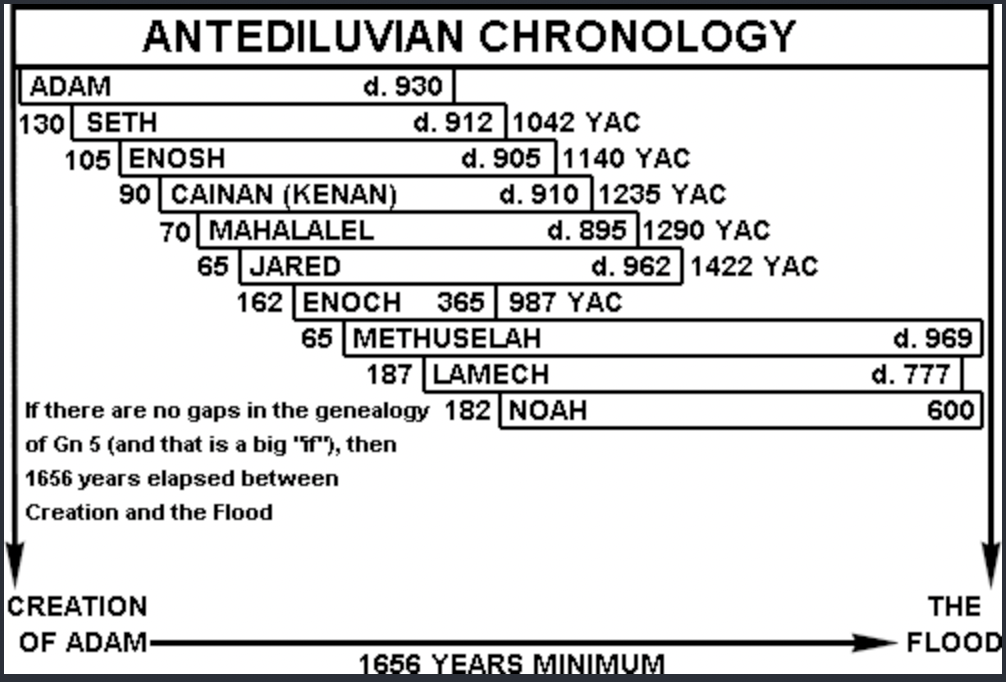
The men who are listed in the genealogies of Adam in this chapter have been called “the ten commitments,” trusting in God’s promise (3:15). There were spiritual giants among this group. Two of them were said to have “walked with God”–Enoch (5:24) and Noah (6:9). We probably know them most, as a group, for their longevity. In the pre-flood world, when the cursed earth was its youngest and least tainted, conditions were most ideal and genetics most favorable for long life.
James Smith gives us this chart:
In laying out the genealogies, Moses goes back and speaks of the theology and biology of creation. Man is made in God’s likeness (1), and God made them male and female (2). Adam becomes father to a son (3), and thus it goes through all the genealogies. Moses’ record follows the same formula in laying out these ten generations: the father lives so many years, has a notable son (in the Messianic Genealogies–Luke 3:36-38), lives so many years after that birth, and finally dies. As the chart suggests, there is vast opportunity to populate the earth as they live on for centuries.
There are some interesting insights among the Bible’s first look into a family tree. Furthermore, there are implications from this chapter that resonate throughout the rest of Scripture. Notice just a few of these.
“…And he died” (5,8,11,14,17, 20,27,31; cf. 3:19). While these men lived nine or ten times longer than any of us would dare to believe we could live (imagine your life overlapping the lives of Saladin, Genghis Khan, and Thomas Aquinas; see also 6:3), they could not escape the reality of the death sentence brought on by Adam’s sin. Hebrews 9:27 avers that death is an inevitable appointment. 1 Corinthians 15:21-22 reiterates that by a man came death and that in Adam all die.
“Enoch walked with God” (21-24). He is the exception to the rule just mentioned. Moses writes a beautiful truth about this man. He strove for intimate fellowship with God. This is indicated by the phrase that “he walked with God.” This phrase might be ambiguous and unclear, if not for subsequent Scripture. This is tied to his faith (Heb. 11:5). Therefore, “he obtained this witness that before his being taken up he was pleasing to God.” He was a prophet of God sharing the word of God (Jude 14). We are told nothing about his wife or any of his other children apart from the famously old Methuselah, but if he lived anywhere close to the others he would likely have been alive the year of the flood if not taken by God.
God defines what walking with Him should look like, as He speaks to His people at the end of the Old Testament. Speaking of the faithful Levitical priests, He says, “He walked with Me in peace and uprightness, and he turned many back from iniquity” (Mal. 2:6). His lips preserved knowledge and He was a devoted messenger of God (Mal. 2:7). That harmonizes with what Scripture says about Enoch.
“(Noah) will give us rest” (29-32). Lamech “became the father of a son” (28) he named Noah. Why? “This one will give us rest from our work and from the toil of our hands arising from the ground which the Lord has cursed” (29). As it turns out, Noah will give comfort not to those before him but to those who would come after him through Shem, Ham, and Japheth (32). The same word translated “rest” is found in a different form in Genesis 6:6,7 and is translated “sorry.” Because God was sorry for making man, who had become sinful, He resolved to destroy man and beast. But Noah will find grace in the eyes of the Lord (6:8). The ground would continue to labor under the curse (Rom. 8:20-21). But spiritual rest would be possible through Noah’s obedience (1 Pet. 3:20; Heb. 11:7).
With all this time that passed as recorded in Genesis 5, God’s eternal plan was still in motion. Salvation would ultimately come, starting with these ten generations. Through His sovereignty and providence, God would ensure that “the kind intentions of His will” (Eph. 1:5,9) would be accomplished despite man’s continual faults and failings.
According to the book of Genesis, the Antediluvian (pre-flood) humans once lived extraordinarily long. Adam was 130 when he had his first son Seth who lived to 912. Seth’s great-great-great-great-grandson, Methuselah, is the oldest man on the biblical record— dying at the ripe old age of 969.
For perspective, 969 years ago from the point of this writing (Monday, November 27, 2023) was Monday, November 27, 1054 A.D. If mankind had continued to live that long through the modern era, Christopher Columbus would still be alive today and wouldn’t die for another 400 years!
How The Ancients Aged
Some have speculated that a canopy made up of water vapor once surrounded the earth but then it collapsed at the time of the flood. Interestingly, five of the nine planets in our solar system have thick cloud canopies including Venus which is closest to earth in both size and distance. The water canopy before the flood could have been attributed to the long lifespans of early humans by blocking out harmful radiation and producing higher oxygen levels, much like a greenhouse.
This could also be the reason why people post-flood slowly began to live shorter lives like Terah, the father of Abraham, who lived for only 205 years.The atmosphere would not only have added many years to life, but it was also conducive for massive growth. Everything from plants to animals were larger versions of their modern counterparts. For instance, fossils of Glyptodons (ancient relative to the armadillo) could weigh around 4,000 pounds and reach lengths of 5 feet.
Non-Canonical Coincidences
The Sumerian King List records the lengths of reigns of the kings of Sumer. The initial section deals with kings before the Flood and it begins with their oldest rulers reigning for thousands of years but their later kings live significantly shorter. While the Bible doesn’t mention anyone living for thousands of years, it’s intriguing to find more ancients who have documented such lengthy lifespans— even if exaggerated.
In ancient Persian legend, the fourth king of the world was a man named Jamshid and he was said to have reigned for 700 years. He was a great inventor and during his reign people neither sickened nor aged.
I Pt 3.19 is a difficult verse on its face, but it’s easily explainable. It’s tied to 3.18, “His physical body was killed, but he was brought back to life in spirit.” 3.18 simply says that he also used God’s power to help Noah tell everyone that a global flood was imminent. All but 8 people were killed in the flood because they refused to listen. Those “spirits now in prison” are identified clearly as those who lived in the antediluvian world.
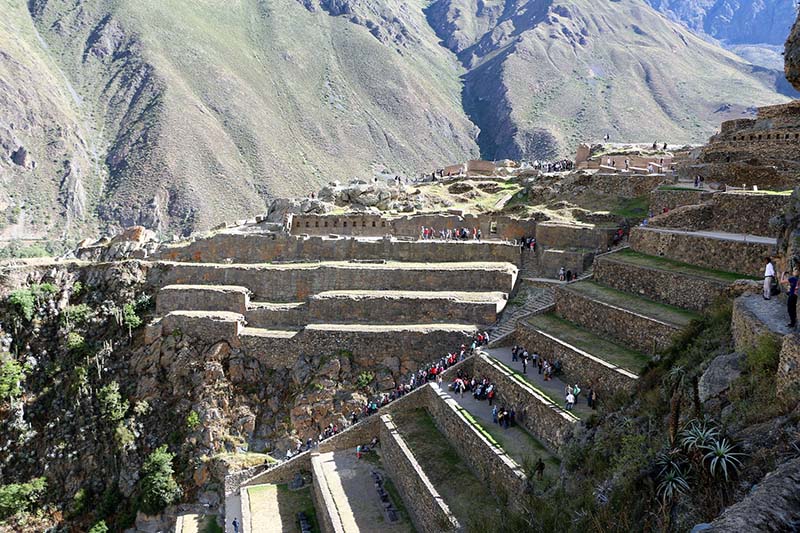
Interestingly, many megalithic structures around the world (Ollantaytambo, Barabar, Ajanta, Ellura caves, Puma Punku, the city of Petra, Derinkuyu, Saqsaywaman, the Great Pyramid of Giza, etc.) show strong evidence of having been built before the flood. Several of these seem to have been designed specifically to protect against a doomsday scenario. We know all people were warned about the flood, but it seems most preferred to put their trust in stone rather than a wooden boat.
3.21 is the crux of the matter. Just as Noah and his family were saved from evil because of the flood, we get a clean conscience through baptism. We only have hope because Jesus came back to life, proving that death is on borrowed time. If we want a life with Jesus in a perfect world after we die, we have to make a formal appeal to God for a clean conscience. According to this verse, the only way to make that appeal is through baptism.
Not long ago my wife and I went to visit the ark exhibit located in Williamstown, Kentucky. While exploring the decks you get to imagine what it may have been like to walk in Noah’s sandals. Half of one floor was dedicated to ancient legends that told of a worldwide flood as well as the religious beliefs and backgrounds of the various cultures. Two things resonated with me as I read the plaques and took in the artifacts on display. First, the similarities in the flood legends. The second observation was the fact that the further from Mesopotamia you traveled, both in time and distance, the more implausible the story seemed. While the inspired Genesis account gives a great deal of detail other legends lack the realism and plausibility factors. Genesis records construction of the ark giving us the material, water-proofing methods, dimensions, and labor period. It tells us where the flood waters came from and even the general area where the ark came to rest. Interestingly, the seaworthiness of the ark has even been tested in the modern era.
“…naval architects have confirmed that a barge with the Ark’s dimensions would have optimal stability. They concluded that if the wood were only 30 cm thick, it could have navigated sea conditions with waves higher than 30 meters”
(Hong, S.W. et al., Safety Investigation of Noah’s Ark in a Seaway.,Journal of Creation)
Known legends written closer to Noah’s time and neck of the woods like the Sumerian version (Epic of Gilgamesh) describe an ark as being cube shaped. A cube shaped ark would tumble and role in the treacherous deluge. Further evidence for the reliability of the Biblical account can also be seen in the date of writing. Noah’s flood was written earlier than the Sumerian version and the proof is in the religious practices depicted in these competing tales. Even secular scholars confirm that early mankind were monotheistic. In the Epic of Gilgamesh there’s a small pantheon of gods mentioned, and this pantheon grew as time passed. One character in the Sumerian version offers a sacrifice after the flood waters receded, but Christians will pick up on the language used to describe this offering.
‘The gods smelled the savor, the gods smelled the sweet savor, and collected like flies over the sacrifice.’
The gods also bickered amongst each other and showed incredibly human attributes. They were fickle and violent, often contradicting their own alleged virtues.
Two Concluding Thoughts About The Almighty
God is the only form of our imitation. His Holiness and righteousness is set apart from humanity— He supersedes the natural world.
God is the owner of absolute truth: To know Him is to know truth, to know love, to know forgiveness, to know honesty, to know perfection. God wants all of us to come to a knowledge of Him, because a knowledge of Him is to know Truth. This point is emphasized in the Book of John. It’s essential in the development of our relationship with Him. If one doesn’t know Truth, then one doesn’t know God.
Isaiah 65.17-25 is interesting. Some have mistakenly concluded that it is a prophecy of Christ’s “millennial kingdom” because it resembles passages in John’s revelation. However, we might agree that it refers to the millennium only if others use that term to describe the entire period between Jesus Christ’s two advents.
Contextually, this prophecy appears alongside others concerning the church or the kingdom. Paul summarizes the blessings God promised Isaiah in this passage: “Blessed be the God and Father of our Lord Jesus Christ, who has blessed us with every spiritual blessing in the heavenly places in Christ” (Ephesians 1.3 NASB1995).
And we’ve been in these final days since Pentecost (Acts 2.16-21). As a result, we should not be surprised by its longevity (i.e., more than two millennia and counting) because God metaphorically predicted that its cohorts would live a long time (Isaiah 65.20). Furthermore, this extension is advantageous because it provides opportunities for those who need to repent (cf. 2 Peter 3.9).
But what does Isaiah 65:25 mean by the wolf eating with the lamb? Because wolves and lambs are predators and prey, people assume it must refer to the millennial kingdom. Otherwise, the wolves would be the ones devouring the lambs. So, we can’t discuss anything current. Nonetheless, they fail to remember that there once existed a time when wolves and lambs ate together. They did so on the ark that God instructed Noah to build. The ark served as God’s refuge during His wrath.
Today, the church serves as that refuge. Even when wolves are nearby, lambs will still be able to eat within that place of safety. Some people believe God’s providence protects His children, so they have no fear despite living in a wolf-infested world. Others argue that because God changes the obedient’s nature through the Gospel, the wolves and lambs can eat together within the church because their personalities have changed. They are brand-new creatures (2 Corinthians 5.17). All of these interpretations are correct, but there is an intriguing corollary.
Who was the primary apostle to the Gentiles? Peter’s sermon converted the first Gentiles (Acts 10.34ff), but the Lord chose to send Paul to the Gentiles (Acts 26.17). Jesus tore down the dividing wall between Jew and Gentile (Ephesians 2.13-15), allowing those like Paul to welcome the Gentiles into Zion (cf. Isaiah 62.1-3). However, what do we know about Paul’s history? Paul belonged to the Benjamite tribe.
God allowed Israel to prophesy his sons’ futures as he lay dying (Genesis 49.1-27). According to Jacob, “Benjamin is a ravenous wolf; In the morning he devours the prey, And in the evening he divides the spoil” (Genesis 49.27 NASB1995). Paul was thus a ravenous wolf whose conversion caused him to eat with the lambs (Acts 20.7). No longer a church persecutor content to put Christians to death for their crime of faith in Jesus, Paul became Christ’s ambassador to increase the flock of Christ.
A true example of the wolf eating with the lamb is found only in God’s kingdom, the church.
The TL;DR (too long; didn’t read) version of this discussion is that when angels mated with human women, they produced abominable offspring whose spirits God refused to admit into the realm of the dead after He destroyed them in the Flood. The wandering spirits eventually possessed some people in the first century whom Jesus and the apostles were able to exorcise. These were the unclean spirits. Because of the power of Christ’s Gospel, they no longer have the ability to hijack our bodies today. If they are still present, they can only help to facilitate situations of temptation. But they cannot touch us or make us sin.
For those willing to understand how I arrived at the above summary, please keep reading.
Allow me to begin by indulging in a little inside baseball. In that case, I’ll start by highlighting one of the differences between my brother’s and my time at Faulkner University: two different godly men led the V.P. Black School of Biblical Studies. My brother had the opportunity to sit at the feet of the late Wendell Winkler, whose background was in preaching schools. Meanwhile, when I graduated, the late Kenneth Randolph was the dean. Brother Randolph decided he wanted students to build their libraries and encouraged instructors to assign textbooks to our classes whenever possible.
I studied hermeneutics under the late Martel Pace. When is an Example Binding? by Thomas B. Warren was the actual text. However, brother Pace insisted on us purchasing Gordon D. Fee and Douglas Stuart’s How to Read the Bible for All Its Worth. When the class began, brother Pace directed us to a sentence in Fee and Stuart’s book. That sentence stated that novel interpretations are incorrect. It is erroneous if no one has ever interpreted Scripture in a given way in over two thousand years of church history. With that clarification, brother Pace told us we could throw the book away as he didn’t want us to learn how to interpret the Bible from Fee and Stuart’s liberal hermeneutic.
Although I felt cheated at the time for wasting money on a book I wouldn’t use, brother Pace’s point has stuck with me. When I approach a Scripture or text and want to understand what it means, I first consult other Scriptures. Then, when I finally turn to human scholarship, I always look for the oldest interpretation of the Scripture. With this method, it is surprising how much of the doctrine taught in contemporary Christendom dates back less than 200 years. Other false doctrines may have origins in the 1500s, during the Protestant Reformation. Others emerged before 1000, eventually leading to the establishment of the first apostate church.
Despite being accurate regarding salvation, we sometimes see deviations from original thought in issues of Christian judgment. For example, I’ve been thinking about angels and demons. I’ve often said that much of what people believe they know about the subject finds basis in Milton rather than Scripture (e.g., the war in heaven). The Bible is silent on angels, including their orders and responsibilities. When asked who the archangels are, you will hear names other than Gabriel and Michael (i.e., Raphael and Uriel). According to some, an archangel by the name of Lucifer fell. From whence does this extra information come? The accepted canon of Scripture does not include it.
On the other hand, the apocryphal Book of Enoch is one source having a lot to say about angels. The Book of Watchers refers to the first thirty-six chapters of the Book of Enoch. The author of Watchers claims to explain things like how angels fell. Given that Jude quotes from the Book of Enoch, this source is more interesting than you might think. Jude quotes the apocryphal book in verses 14-15. This inclusion by the Holy Spirit does not imply that the Book of Enoch is anything other than apocryphal, but rather that this widely read book from before the first century AD still got a few things correct, precisely what Jude quotes. Although it is not a direct quotation, Jude verse six parallels ideas found in the Book of Watchers, namely that the “angels who did not keep their own domain but abandoned their proper abode” (NASB1995) refers to angels who chose to leave heaven to intermarry with human women.
It took a long time for me to accept this. I was of the school of thought that interpreted Genesis 6’s “sons of God” as the descendants of Seth, who began calling on the Lord’s name (Genesis 4.26). That was a more recent interpretation contradicting the phrase “sons of God,” which almost always referred to angels. Even so, I would never teach what I am about to discuss as doctrine because it may confuse some. However, if one considers the context of Jude, one will notice that the sin of verse six is akin to that of Sodom and Gomorrah (Jude 1.7). In other words, it was a matter of immoral sexual behavior. It was never in God’s plan for angels to have companions. They are presumably “complete,” lacking nothing in their distinct being. In response to the Sadducees, this is why Jesus stated, “…in the resurrection they neither marry nor are given in marriage, but are like angels in heaven” (emphasis mine—Matthew 22.30 NASB1995).
I’ve heard it preached that Jesus said angels can’t get married, but He said they don’t get married in heaven. It is not a giant leap to conclude that if angels took on a form with a digestive system (cf. Genesis 18.5ff), being able to eat, they could also take on a reproductive system commensurate with the masculine forms assumed in their interactions with humanity. Furthermore, Paul warns us that the devil can disguise himself as an angel of light (2 Corinthians 11.14). So, it appears God endowed angels with such abilities implied by taking on an assumed form.
But how does this relate to unclean spirits? What does this even have to do with Faulkner University and hermeneutics? Following the Scriptures, I will consult other scholarship sources; the earlier, the better. So, I went back and read what early Christian writers like Justin Martyr and Origen had to say about the subject. Justin, in particular, confirmed Jude’s message that the angels’ transgression was sexual. According to Justin, angels fell in love with human women and decided to copulate with them, the latter giving birth to the “mighty men of old, men of renown” (Genesis 6.4). These deviations resulted in conditions that caused God to regret creating man. One of the things that the Book of Watchers says that Justin seems to accept is that these fallen angels taught men how to make weapons of war and fight one another. Have you ever thought about Genesis 6.13? God saw the earth filled with violence. That is an intriguing coincidence.
As a result, God destroyed all except Noah, Noah’s family, and the animals aboard the ark with a Flood. But what became of those who died in the Flood? Would Ecclesiastes 12.7 not be applicable? Their “dust” was returned to the earth, while God received their spirits. But what if among the dead were spirits inhabiting bodies that God did not sanction, a cross between fallen angels and humans? Would He let those spirits into Sheol or Hades? Wouldn’t they be punished like the fallen angels for whom God created hell itself (2 Peter 2.4-10)?
It appears unlikely that the “unclean spirits” mentioned in the Gospels and the book of Acts are the spirits of evil, departed men. A teacher once told me that Legion hung out in the cemetery (Mark 5.1ff) to linger near their former bodies. In other words, whoever the Legion demons were, they were all former humans doomed to spend eternity in hell. But why would God choose to isolate the miraculous period of the first century to allow some evil deceased spirits to remain and not send them immediately into the realm of the dead, as Ecclesiastes 12.7 suggests? Of course, God could direct every such person into the path of Jesus or the apostles for exorcism, but it seems strange to defy nature just to read about a few exorcisms in the Gospels and Acts. Indeed, the ability to raise the dead alone could serve as the ultimate form of confirmation of the Gospel. Moreover, since the power of sin is death, raising the dead would still prove our Lord’s power of the kingdom of darkness (1 Corinthians 15.51-57).
Examine how Jesus interacts with these unclean spirits (aka demons). In Matthew’s account of Legion, another demon-possessed man accompanies Legion (Matthew 8.28). Both possessed men were violent and would not let anyone pass. The ones inside these men recognized Jesus as the Son of God and wondered if He had come to torment them ahead of time(Matthew 8.29). They asked Jesus to send them into an adjacent herd of swine if He was going to cast them out of those men (Matthew 8.31). When Jesus granted their request, the demons caused the herd of pigs to jump into the sea and drown (Matthew 8.32). Why not send them to Hades if these were the departed spirits of evil men? Why put them in pigs?
These unclean spirits knew God would destroy them, but they thought the time was too soon. Of course, we know that those in Tartarus, the place of torment within Hades, like the rich man, immediately knew their eternal fate, but how else would these possessing living men in the first century know such things? They had probably never experienced Tartarus’ torment because they were free to roam (cf. Matthew 12.43-45; Luke 11.24-26). Again, it would appear to be inconsistent with what we know about our existence following death. It makes more sense, however, if there have been spirits of grotesque angel-human hybrids roaming the earth since the Flood.
Let us look at some examples of demon exorcism in Acts to illustrate these fascinating phenomena further. First, Paul cast out an unclean spirit from a young woman who had been following him around Philippi, proclaiming him to be a servant of the Most High God and preaching the way of salvation (Acts 16.16-21). Paul became irritated with her and rebuked the spirit in Jesus’ name, causing the demon to flee. The event that led to Paul and Silas’ imprisonment in Philippi was this exorcism. When Paul expelled the evil spirit, he took away her divining ability that her owners exploited to make money. Then, in Ephesus, Paul exorcised demons without even being in their presence. People took handkerchiefs that Paul had touched, which were enough to heal and drive away the evil spirits (Acts 19.12).
This display of Jesus’ power prompted some of Paul’s opponents to try to imitate him. Finally, Acts 19.13-16 contains a humorous account of a failed exorcism. Sceva’s seven sons took it upon themselves to exorcise an evil spirit in the name of Jesus, whom Paul preaches. The demon said it recognized Jesus and Paul but wanted to know who these men were. The possessed man then leaped on them and thrashed them mercilessly. It caused quite a stir in Ephesus and inspired both Jews and Gentiles to exalt Jesus’ name (Acts 19.17).
There are no further references to unclean spirits after Ephesus. We know Paul told the Corinthians that the miraculous age would end when the perfect (i.e., complete) arrived (1 Corinthians 13.8-12). By the end of the first century, God had completed His revelation to mankind. And then there was the New Testament. But what about the spirits? Origen, a Christian who lived near the end of the second century, observed that the demons vanished along with the ending of the spiritual gifts bestowed by the apostles through the laying on of hands (cf. Acts 8.14-17).
In other words, Jesus Christ’s power defeated the kingdom of darkness. Those spirits, if still present, could no longer possess people or cause mischief as they did during the brief period described in the New Testament. This statement does not imply that Origen did not have some ideas. He did. Since, as James stated, our lusts entice us, allow our desires to conceive, and give birth to sin (James 1.14-15), the remaining unclean spirits serve as “midwives,” facilitating our sin. This truth does not absolve us of our guilt, but it may point to perpetrators in the unseen realm who are more than willing to assist us.
I’ll be repeating the book of II Peter in present-day terminology. It’s not a true translation of the book, as I am not qualified to do so. It will be based on an exegetical study of the book and will lean heavily on the SBL and UBS Greek New Testaments, as well as comparisons with other translations (ESV, NASB, NIV, ERV, NLT). My goal is to reflect the text accurately, and to highlight the intent of the author using concepts and vocabulary in common use today.
This is not an essentially literal translation, and should be read as something of a commentary.
The End Is Coming
Family, this is the second time I’ve had to remind you about this. You have the right motives, but you need to remember what the prophets said in the past. Your master and rescuer gave this same message through us, too. The message is this: at the end of everything, arrogant skeptics will make their way into the church. They’ll give in to every impulse they have. They’ll say stuff like, “Didn’t he say he was coming back?” and, “Nothing’s really changed since our ancestors died, we’re all still here.” They forget that God built the sky and planet with some words. He built everything out of water and used water to destroy the earth during the flood. Right now, he’s preserving the planet with a special fate in mind. At the end, the planet we’re on right now will be burned with fire. That’s when morally corrupt people will be judged and destroyed. You cannot forget that God doesn’t experience time the same way we do. He isn’t dragging his feet, like some are claiming. He’s holding off because he really doesn’t want anyone to die lost. He wants every person to be saved!
I’ll be repeating the book of II Peter in present-day terminology. It’s not a true translation of the book, as I am not qualified to do so. It will be based on an exegetical study of the book and will lean heavily on the SBL and UBS Greek New Testaments, as well as comparisons with other translations (ESV, NASB, NIV, ERV, NLT). My goal is to reflect the text accurately, and to highlight the intent of the author using concepts and vocabulary in common use today.
This is not an essentially literal translation, and should be read as something of a commentary.
The Liars
There have always been liars who claim to be speaking on God’s behalf, so you’ll encounter them, too. They’ll secretly teach things that will wreck your faith. They’ll even disown the one who saved them, but they’ll be destroyed soon. They don’t have moral restraint, so a lot of people will follow them. This will make the world think of us as hypocrites. They don’t even have your best interests in mind! They’ll take advantage of you and lie to you. They will face inescapable consequences. God didn’t even give angels a free pass when they sinned. He sent them to a dark place where they’ll stay until judgment. God didn’t give the ancient world a free pass. In fact, only Noah and his family survived the flood that destroyed everything else. God didn’t give Sodom and Gomorrah a free pass, either. He completely destroyed them as a warning to everyone who might be interested in living like they did. Lot was a good man and he was extremely upset by how everyone in his city was living. God rescued him from the bad conditions he had to live through, so he knows how to rescue us from temptation. He also knows how to take care of godless people who do whatever they want and reject authority. They’ll have to answer to him. These people don’t even get nervous when they insult angelic beings! Even though angels are considerably more powerful than humans, they wouldn’t ask God to condemn those liars with that kind of animosity! These liars are just like dumb animals. They act on every impulse, they insult in ignorance, and they will be destroyed. They’ll gratify their passions in broad daylight. They drag you down with them, and they’re excited about that! They’re a cancer. They are obsessed with gratifying their impulses and they won’t stop. They drag down people who aren’t strong in their faith. They only care about themselves and they’ve abandoned the right path. Remember Balaam? He enjoyed living by his own rules, too. He was reprimanded by a donkey, of all things, so that he’d get a grip on himself. Donkeys aren’t even supposed to talk, but God did whatever it took to make sure he’d get back under control. These liars are like wells that don’t have water. They’re like rain that gets blown around by the wind. They’re destined to spend forever in the darkest place. They lie with confidence and bring down people who have a hard enough time staying pure as it is. They promise freedom, even though they’re slaves. After all, we’re slaves to whatever controls us. This is really bad for them. If you learn about God and escape the influence of worldliness, but fall right back into your old ways, you’re much worse off. It’s better to not know God at all than to know him and then reject him. You’ve heard the old saying, “Dogs eat their own puke,” and, “Pigs get right back into the mud after they’ve had a bath.” That’s what these liars have done.









 The Preacher Pollard Blog