THE MOUNTAIN OF MYSTERY

Dale Pollard

Where is mount Sinai? It’s an important mountain in the Bible but today there’s several different peaks that claim to be the real deal. Let’s dig a little. 

In Galatians 4:25, Paul states:

“Mount Sinai is in Arabia.”

Here’s the thing though. 1st century Arabia did not mean the Sinai Peninsula of Egypt. It was the vast area of Arabia Petraea that included:

• Northwest Saudi Arabia

• The land of Midian

Well now, that last one is a juicy detail because Moses actually lived in Midian for decades (Exodus 2–3). If God met Moses “at the mountain of God” while he was in Midian, the most natural place for Sinai to be is near where Moses had been, not hundreds of miles away. 

There’s more! 

The Bible repeatedly ties Sinai to Midian. Here’s a quick recap: 

  1. Moses flees Egypt, then settles in Midian. 
  2. God appears to Moses at the mountain of God while shepherding there. 
  3. Jethro (a priest of Midian) later visits Israel at Sinai.

If Sinai were deep in the Egyptian Sinai Peninsula, Jethro’s involvement doesn’t make much sense. 

If Sinai were in or near Midian (which is in Arabia), the narrative flows nice and cleanly.

For these reasons, and more— many early Jewish and Christian traditions placed Sinai east of the Gulf of Aqaba.

Sinai had some strange things happening on its peak— just read Exodus 19. There’s thunder, lightning, trumpets blasting, and fire. It’s hard to wrap our minds around exactly what was taking place. 

With all of that history in mind, there’s a site called Jabal al-Lawz. It’s an odd name but it’s a real interesting Candidate.

This mountain seems to have it all, including: 

• A darkened summit

• Nearby ancient stone structures

• Rock art that appears to depict cows 

• Large open plains suitable for a massive encampment

Is it the one? Who knows. Seems like a great place to do more investigation though. 

The Egyptians, Baptism, And Rebirth

Gary Pollard

The practice of immersing someone in water for ritual purposes may go all the way to 3,150 BC at the very beginning of Dynastic Egypt, perhaps 2,000 years before Moses was born. It was for sure a common practice in the Old Kingdom, as we find it mentioned in the Pyramid Texts (which date to about 2,350 BC, or close to 1,000 years before Moses, though parts of it seem to be much older). 

The ancient Egyptians believed that the sun “died” every evening, had to swim through the depths of the cosmic ocean, and was reborn every morning at sunrise. There’s ample evidence from the earliest of their writings that this was not originally believed in a literal sense, but was used as a simplified means to communicate information about the movement of celestial bodies. The meaning devolved later into a worship of a sun-god, and every other planet’s representative “deity”. 

Either way, there was profound symbolism in the “death” of the sun every evening as it dipped below the horizon of the sea, and its resurrection in the morning as it appeared to come up from the watery horizon to new life. The most important through-line in the practice was ritual death and rebirth. The initiate was washed by water, just as the sun appeared to be every evening. They were no longer the same person that went into the water, just as the sun was renewed every morning. It was death to the old self and rebirth. 

Plutarch wrote about baptism in his book On Isis and Osiris (which was published around the same time as John’s writings). In the Roman Era in Egypt, they associated baptism with purification, rebirth (as Osiris rising from the Nile), and initiation into divine mysteries. Water was considered to be the primordial source of all things, and baptism was how one was purified. Plutarch did not apply any of this to Christianity or Christian practices, as far as I know. He was mostly interested in talking about the cycles of the sun as they were represented in Egyptian myths about Osiris. 

The important thing is that ancient cultures universally associated baptism with rebirth, and saw a physical analog for this in the rising and setting sun. Many other ancient cultures practiced this in some form, though not all used water — some used blood. The Jewish people used water for ritual cleansing, and John used it to let everyone know that the old system was about to die and be reborn in a superior “body” through Christ. 

So seeing baptism as merely an “outward sign of an inward faith” does not appear to have any historical or cultural precedent. For thousands of years before Christianity, it was understood to be a rebirth ritual. You had to have water (or blood) before you could experience new life. 

Snakes, Saraphs, and Salvation

Herodotus casually mentions that there were snakes that would fly from Egypt every year from the Sinai wilderness (Herodotus 2.75-76). This may strike fear in the heart of any snake-fearing person, but it sure is interesting. Marco Polo would also write in his travel log about flying venomous “birds” as well as snakes of gigantic proportions as he explored Asia. 
The Bible records several strange serpents and one passage in particular is especially fascinating.

Dale Pollard

Herodotus casually mentions that there were snakes that would fly from Egypt every year from the Sinai wilderness (Herodotus 2.75-76). This may strike fear in the heart of any snake-fearing person, but it sure is interesting. Marco Polo would also write in his travel log about flying venomous “birds” as well as snakes of gigantic proportions as he explored Asia. 

The Bible records several strange serpents and one passage in particular is especially fascinating. 

In the book of Numbers there’s an account that’s made many readers scratch their heads as they wonder what these fiery serpents are (6-9) that God sent to plague the Israelites. 

The Lord sent fiery serpents among the people and they bit the people so that many people died in Israel. So the people came to moses and said “we have sinned because we have spoken against the Lord and you; intercede with the Lord, that He may remove the serpents from us. And Moses interceded for the people. Then the Lord said to Moses make a fiery serpent and set it on a standard, and it shall come about that everyone who is bitten when he looks at it he shall live. And Moses made a bronze serpent and set it on the standard and it came about that if a serpent bit any man, when he looked at the bronze serpent he lived.”

Some commentators have suggested that perhaps the strange description is of a particular kind of venomous snake. Others have made the observation that the Hebrew word for serpent here (Saraph) could be symbolic to indicate their color since it means “burning ones.” Interestingly enough there are bronze colored serpents around today in Australia that are incredibly poisonous. Perhaps there’s something to this based on the Lord’s instruction to Moses to fashion a serpent made of brass. Of course this description could also literally be taken to mean snakes which either breathed fire, or were somehow on fire. God was, after all, punishing a people who had complained of their miraculous meals of manna. 

Though the identity of these fiery serpents may always be a mystery, the lessons taught to us through this event are powerful. The connections John will make (Jn. 3.14-15) as well as the Hebrew writer (12.2) focus on the crucifixion and the concept of looking to Jesus for our salvation. 

The relationship between belief and action here are also telling. Those Israelites that believed were led by that same belief to look— then were healed. If we believe Jesus can and will heal us of our sins, then that belief must lead us to the water (Act 2.38, Mk. 16.16). 

The Anger Of The Lord

The Word of God provides so much comfort, consolation, encouragement, strength, hope, and excited anticipation. It is food and drink for the soul. David describes it as beautiful and beneficial (Psa. 19:7-10). It makes us alive and saves our soul (1 Pet. 1:22; Js. 1:18). It sanctifies (Jn. 17:17). 

Neal Pollard

The Word of God provides so much comfort, consolation, encouragement, strength, hope, and excited anticipation. It is food and drink for the soul. David describes it as beautiful and beneficial (Psa. 19:7-10). It makes us alive and saves our soul (1 Pet. 1:22; Js. 1:18). It sanctifies (Jn. 17:17). 

Yet, the Word, consistent with God’s perfect character, contains warnings, rebukes, and threats all backed by the unlimited power and perfection of God’s nature. Back when God instituted His special covenant with the Jews at Mt. Sinai, He made it clear that His promises and blessings were conditional. Moses reviews this promise of God at the end of his life, saying, “See, I am setting before you today a blessing and a curse: the blessing, if you listen to the commandments of the Lord your God, which I am commanding you today; and the curse, if you do not listen to the commandments of the Lord your God, but turn aside from the way which I am commanding you today, by following other gods which you have not known” (Dt. 11:26-28). 

At the end of 2 Kings, the remnant of the Jews still in the land (remember, Israel was destroyed and carried off into captivity in chapter 17) had drifted into the curse Moses spoke of. The prophets, like Jeremiah, Obadiah, Nahum, Habakkuk, and Zephaniah, had warned Judah, but the kings, priests, false prophets, elders, and the people, shunned the message. After His perfect patience had been repeatedly tried and finally exhausted, He displays His wrath.

Wicked Jehoiakim’s son, Jehoiachin, mounted the throne in his father’s place. Though he only reigned three months, the record shows that “he did evil in the sight of the Lord, according to all that his father had don” (2 Ki. 24:9). The Babylonian Emperor, Nebuchadnezzar, besieged Jerusalem, carried Jehoiachin captive “his mother and his servants and his captains and his officials” (12), all the temple and king’s treasures (13), ” all Jerusalem and all the captains and all the mighty men of valor, ten thousand captives, and all the craftsmen and the smiths” (14–leaving only the poorest people in the land), and “all the men of valor, seven thousand, and the craftsmen and the smiths, one thousand, all strong and fit for war” (16). Nebuchadnezzar put a puppet king on Judah’s throne, Jehoiachin’s uncle, Mattaniah, who Nebuchadnezzar renamed “Zedekiah” (17). He did evil in the sight of the Lord, just as his nephew had done (18)! Even in the face of such punishment and defeat, Judah’s leadership refused to humble itself and repent. In fact, Zedekiah was not only rebel against God but also the instrument of punishment in His hand (Babylon’s king, Jer. 25:9)(20).

Why would God allow this to happen to His chosen people? The writer of 2 Kings explains it this way: “For through the anger of the Lord this came about in Jerusalem and Judah until He cast them out from His presence” (20). Perhaps the people convinced themselves that since God had not acted in punishment against their parents and grandparents, He didn’t care about how they were acting and they were going to get away with it. Peter tells us how that is part of human nature. Using the past (the days of Noah) as an illustration of the end of time, Peter says that mockers with their mocking will ask where the promise of God’s coming is. They’ll say, “Ever since the fathers fell asleep, all continues just as it was from the beginning of creation” (2 Pe. 3:4). They ignore what happened in Noah’s day (5-6). They ignore that God spares or destroys this world according to the word of His power (5-7). They ignore that God is not bound by time (8). They ignore that God’s perfect patience is at work right now, as He wishes for all to come to repentance (9). But, the day of the Lord will come (10a)! He will deal out retribution to those who do not know God and to those who do not obey the gospel of our Lord Jesus (2 Th. 1:8). 

But, let us be convinced of this. God wants to pour out His blessings, approval, and incredible love upon all of us! Yet, He leaves the ball in our court. He wants nothing more than to hold us close to Him and have us spend our eternity with Him (2 Pe. 3:11-15). If we respond to that love in submissive obedience, we will feel the full force of His kindness. If we don’t, He’s loved us enough to show us what that will mean for us! May we be wise enough to avoid “the anger of the Lord”! 

Chaos

The argument is often made that biblical writers ripped off much older myths and adapted them for a monotheistic faith. The problem with this is that, while creation order and chaos are indeed reflected in many of these legends, that’s basically where the similarities end.

Gary Pollard

“Chaoskampf” is a prominent theme in the myths of Babylon, Egypt, Canaan, Greece, and even the Norse sagas. It’s also in our Bible, but with obvious differences. In the Babylonian tablets collectively called the Enuma Elish, creation begins with a great battle. Marduk defeats Tiamat, a sea goddess who represents chaos. He fashions the heavens and the earth from her remains after defeating her in battle. In Canaanite myth, Baal battles Yam, the sea god, also a symbol of chaos. In Egyptian stories, Ra must overcome the serpent Apep every night—a coiling monster of darkness and disorder (and don’t forget Osiris/Seth). In Norse mythology, at the edge of the world lies Jörmungandr, the world serpent, who they said will one day rise in Ragnarök, the day of final chaos. In Greek mythology, the Titans battle the Olympians and the victors reorder the destroyed world. 

The pattern is the same: a divine being, representing order and stability, faces the chaos of the sea, often personified as a serpent. Genesis 1 is greatly simplified and much cleaner — “In the beginning God created the heavens and the earth. The earth was formless and empty, and darkness covered the deep waters. And the Spirit of God was hovering over the surface of the waters.” The great patriarchs were raised in these traditions: Abraham was from Ur of Babylonia, and Moses was raised and educated in Egypt. Asaph wrote, “With your great power you split open the sea and broke the heads of the sea monster. Yes, you smashed the heads of Leviathan and left his body for the animals to eat. You make the springs and rivers flow, you make the rivers dry up. You control day and night. You made the sun and moon. You set limits for everything on earth, and you created summer and winter” (Ps 74). 

The argument is often made that biblical writers ripped off much older myths and adapted them for a monotheistic faith. The problem with this is that, while creation order and chaos are indeed reflected in many of these legends, that’s basically where the similarities end. Unlike other cultures, whose myths are all about cosmic battles between gods, Moses and Asaph speak of the unchallenged power of the God who tamed the seas and chaos with just his words

Revelation ties this theme up nicely. John says, “Then I saw a new sky and a new earth. The first sky and first earth had disappeared. Now there was no sea. And I saw the holy city, New Jerusalem, coming down from God, down from the sky.” The detail about the sea might seem out of place, but it’s not. “Sea” was often synonymous with chaos, violence, death, and fear. It was personified as a great enemy that had to be defeated. On New Earth, tehom — chaos, the abyss, Tiamat, Leviathan, the sea — is finally gone forever.

Three quick things: 

  1. Chaos is nothing to panic over. We serve the God who calmed the seas with a word (Mk 4). 
  2. God can and does bring order from chaos. Our life might feel “formless and void” but God will ultimately bring order and beauty (Rom 8). 
  3. God has already won — the sea is on borrowed time, Leviathan has lost. 

The Split Rock Of Horeb

Rising stark and solemn from the barren Saudi wilderness, the Split Rock of Horeb stands like a silent sentinel of ancient power. Towering nearly 60 feet high, the colossal granite monolith looms over the desolate plain, its weathered and tan flanks are etched by wind and time. But what sets it apart, what seizes the imagination…

Dale Pollard

 —————————————————

It’s not just a rock. 

It’s a rock surrounded by empty silence and scorched earth. It appears, not as a mere geological feature, but a thunderstruck altar where the desert drank. A place where a miracle met stone. 

Rising stark and solemn from the barren Saudi wilderness, the Split Rock of Horeb stands like a silent sentinel of ancient power. Towering nearly 60 feet high, the colossal granite monolith looms over the desolate plain, its weathered and tan flanks are etched by wind and time. But what sets it apart, what seizes the imagination—is the cleft. A prodigious vertical split that is so unnaturally straight it’s as though it were torn by an invisible hand. 

The two halves, still joined at the base, are separated by a gap so wide a man could walk between them. Where is the magic sword from heaven that must have struck it so cleanly? 

At its base, the rock bears smooth channels and grooves—as if torrents of water once burst forth, carving trails into the stone that in wild obedience submit itself to divine command. Light filters through the divide, casting shadows that whisper about that day even to this day.

Yes, the rock still stands. 

Despite centuries of exposure to harsh desert winds, sand, and temperature extremes, the massive split rock remains tall and intact. It has an imposing presence, seemingly sliced vertically in a way that defies typical erosion patterns. The site receives occasional attention, but not too much and rarely up close. 

It’s in a remote, restricted area which is often under military control, and access has historically been limited or even outright prohibited by Saudi powers. 

NO TRESPASSING?

Many of the widely circulated photos and videos of the rock come from unauthorized expeditions, but here’s a couple  stand outs (Ron Wyatt won’t get any attention here). 

Jim and Penny Caldwell

 (1992) 

They were just the average American oil workers living in Saudi Arabia, but with a neat twist.

On numerous occasions they took considerable personal risk by sneaking into restricted areas to document the rock and other sites, including:

  • The Split Rock 
  • The blackened peak of Sinai 
  • Altar-like structures and petroglyphs of bulls (linked to the golden calf story)

Oh, and they had to smuggle all  pictures and footage out of the country. 

Bob Cornuke 

(Late 1990s-Early 2000s)

He was just your average former police investigator, but with a neat twist! 

He collaborated with the Caldwells and visited the site to gather photographic and testimonial evidence. His trips were perfectly reasonable, just slightly (ok, entirely) unauthorized and clandestine.

Other explorers have faced interrogation, arrest, or deportation by Saudi authorities and the government has since built a fence around Split Rock. Access is now heavily restricted or off-limits to the public. 

                      ————————-//————————

Bonus Neat 

Local Bedouins have called it the “Rock of Moses” for generations and their oral traditions speak of how water once flowed from it. Some Bedouins avoid the site entirely. 

Bread Facts 

“And the LORD said to Moses, ‘Pass on before the people, taking with you some of the elders of Israel, and take in your hand the staff with which you struck the Nile, and go.

I will stand before you there on the rock at Horeb, and you shall strike the rock, and water will come out of it, and the people will drink.’ And Moses did this in the sight of the elders of Israel.”

Exodus 17:6-7 

(see also, Numbers 20:1–13) 

Joshua The Conqueror

The writer of Hebrews compares our desire to have eternal life to the work of Joshua in leading Israel into Canaan (Heb. 4:8). For those who lead the church in the various ways, parents in Christian homes, elders, deacons, preachers, and teachers, mature Christians, etc., the same factors are at play in our mission to conquer for Christ.

Neal Pollard

The book of Joshua begins with an understated transitional statement, one that signaled perhaps one of the most pivotal events in Israelite history. “Now it came about after the death of Moses the servant of the Lord…” The Lord now looks to Joshua, Moses’ servant, to accomplish the task first given to Moses, to lead the nation into the land promised to Abraham centuries before (Gen. 15:18). Can you imagine being in Joshua’s sandals, trying to follow only the greatest leader the people have ever had? And even he wasn’t able to get the people into the Promised Land before his death. 

It is not surprising, then, that having so great a task and following so great a leader Joshua needs encouragement for this work. Notice how the sixth book of the Bible opens, addressed to the man saddled with the responsibility of getting the people of God across the finish line of their purpose. There are at least five truths Joshua needed to keep in mind.

  • He should remember how he would be victorious (2-3). God emphasizes that He is giving the land to Israel. Israel is going to have to obey and work according to God’s commands, but the victories would come through and because of Him. 
  • He must understand the scope of his mission (4). God lays out specifically the mission, stating in broad terms to boundaries of the territory. The mission would not be a success until all of it had been taken.
  • He could have blessed assurance of God’s help (5). God fortifies Joshua with promises like, “I will be with you” (5), “I will not fail you or forsake you” (5). He reminds Joshua that He was with Moses, and He offered Joshua the same help. 
  • He would have to be a man of strong character (6-7). God calls Joshua to be strong, courageous, unafraid, and obedient. With such a lofty objective, God needed and expected leadership that was trustworthy and reliable. 
  • He had to rely on the Word of God (8-9). Not surprisingly, after a generation was denied the promise land through unbelief and disobedience, this would be critical! God says, “This book of the law shall not depart from your mouth, but you shall meditate on it day and night, so that you may be careful to do according to all that is written in it; for then you will make your way prosperous, and then you will have success” (8). God promises to be with him if he would follow Him! 

The writer of Hebrews compares our desire to have eternal life to the work of Joshua in leading Israel into Canaan (Heb. 4:8). For those who lead the church in the various ways, parents in Christian homes, elders, deacons, preachers, and teachers, mature Christians, etc., the same factors are at play in our mission to conquer for Christ. God gives the victory, the mission, the promises, the word, and the guidelines for our daily living. He is counting on us to partner with Him to gain the victory! 

Ghostly Apparitions

How do you talk to a people about spiritual reality and was takes place in the invisible realm who can watch CGI, have AI, and experience things (like flying and global communication) which most of history never experienced? The Bible is a timeless book…

Gary Pollard

Our technological advancements over the last two or three centuries (particularly the last century) have distracted many from a fundamental truth: What we call “spiritual” is an inseparable part of reality. We have been able to rely on means of transportation, subsistence, medical care, and exploration that would’ve historically been considered supernatural (eg. flight, drought and famine-resistant farming, robotic surgery, genetic manipulation, space exploration). We can travel in airplanes. We drive cars. We communicate instantly across vast distances. Organ transplants are a thing. These no longer exist only in our imaginations, they are right in front of our eyes. For many people the spiritual has become something either to reject or to relegate to an entirely different reality (often called the “spiritual realm”). 

As I have mentioned (perhaps ad nauseam) before, the way “spiritual” is used by the world and by many believers does not necessarily reflect the understanding our ancient believing predecessors had. It could mean wind, influence, message, teaching, breath, manifestation of power, etc. It was used of people whose concerns transcended earthly pursuits. It was used of a class of beings who inhabited the air. Its conceptual meaning seems to be something like, “Invisible force with visible effect.” Concepts are not visible, as they exist only in our minds. But bringing a concept into “reality” means making visible what existed only in our minds. Our minds are still part of this physical universe, and we don’t banish them to a parallel realm or universe because of their invisibility. In the same way, God and his servants are invisible (except for Jesus, Col 1.15), though they can and have certainly taken visible forms. I have yet to encounter any compelling evidence of these invisible powers occupying a reality outside of our own (though I’m open to the possibility if any such evidence appears). They may not be visible to our physical senses, but they are no less a part of our world. 

It may be helpful to see how many of the ancients viewed our relationship with the invisible powers of this world. I will include quotes from non-biblical writers after some New Testament passages. This is not to communicate a teaching but to get an idea of how these were understood by believers in the past. 

“You should pray this way: ‘Our father who is in heaven…” (Mt 6.9). 

“Be careful. Do not disregard these little ones. I tell you, their angels in heaven always have the attention of my father in heaven” (Mt 18.10).

“When you are praying and remember that you are angry with another person for something, forgive them. Forgive them so that your father who is in heaven forgives you” (Mk 11.25).

“When it says ‘he went up’ what does it mean? It means that he first came down low to earth. So Christ came down, and is the same one who went up high above to fill everything with himself” (Eph 4.9-10). 

“Masters, in the same way, be good to your servants. Don’t say things to scare them. You know that your master and theirs is in heaven and he treats everyone the same” (Eph 6.9).

“Our fight is not against people on earth. We are fighting against the rulers and authorities and the powers of this world’s darkness. We are fighting against the spiritual powers of evil in the heavenly places” (Eph 6.12).

“And you began waiting for God’s son to come from heaven, the one God raised from death. He is Jesus, the one who is rescuing us from God’s coming anger” (I Thess 1.10).

“Those beings, whom other philosophers call demons, Moses usually calls angels; and they are souls hovering in the air. And let no one suppose that what is here stated is a fable, for it is necessarily true that the universe must be filled with living things in all its parts, since every one of its primary and elementary portions contains its appropriate animals and such as are consistent with its nature — the earth containing terrestrial animals, the sea and rivers containing aquatic animals, … It is therefore necessary that the air should be full of living beings. And these are invisible to us, inasmuch as the air itself is not visible to mortal sight. But it does not follow, because our sight is incapable of perceiving the forms of souls, that for that reason there are no souls in the air” (Philo: On the Giants II.6-9).

“Go, say to the watchers of heaven, who have sent you to petition for them: ‘You should petition for men, and not men for you. Why have you left the high, holy, and eternal heaven, laid with women, defiled yourselves with the daughters of men? … But you were formally spiritual, living the eternal life, and immortal for all generations of the world. So I have not appointed wives for you, because the spiritual ones of the heavens belong in heaven.’ Now the giants, who are produced from the spirits and from flesh, will be called demons on the earth, and on the earth shall be their dwelling. Evil spirits have come out of their bodies, because they are born from men; yet from holy watchers is their beginning and primal origin. They will be evil spirits on the earth and they will be called demons. As for the spirits of heaven, in heaven will be their dwelling, but as for the demons of the earth, that were born on the earth, on the earth will be their dwelling” (I En 15.2-10).

The Hornets Of God

Did God actually send hornets against the Canaanites? What do you think is meant by God sending a hornet before Israel?

Dale Pollard

God not only told the Israelites that He would give them the land of Canaan, He also told them how He would do so. Moses records the very words of God as He explains what the initial steps of the conquest was going to look like and it’s as fascinating as it is strange. 

Angelic (Conditional) Assistance 

“Behold I send an angel before you to guard you on the way and to bring you to the place I have prepared. Pay close attention to him and obey his voice; do not rebel against him, for he will not pardon your transgressions, for my name is in him” (Ex. 23:20-21). 

We’re told that the angel would “go before them” and bring them to pagan armies and peoples such as the Amorites, Hittites, Perizzites, and of course, the Canaanites— to name a few. (V.23). 

The Terror & The Hornet 

After this the reader is thrown a curve ball as two additional names are introduced. 

“I will send my terror before you and will throw into confusion all the people against whom you shall come…” (v.27). 

“…I will send hornets before you, which shall drive out the Hivites, Cannanites, and the Hittites before you” (v.28). 

The angel, terror, and hornet are each different Hebrew words but share a commonality— they go before the Israelites. 

It sounds like these terms could describe three separate beings or forerunners that were meant to accomplish separate tasks. It’s an interesting idea so that’s reason enough to dive in and investigate. Hopefully by the time we come up for air it’ll make more sense. 

Hornets In The Bible 

First, let’s deal with “the hornets.” Only three other times in the Old Testament do we find passages with hornets. Exodus 23:28 is the first time it’s used and here Moses is quoting what God told him that He would do. 

The next occurrence is in Deuteronomy 7:20 where Moses reminds the Israelites just before they storm the Promise Land about those hornets God said he would send ahead of them. 

Finally, the last mention is the most elucidating. In Joshua 24:12 there’s a subtle hint found in most English translations. It says, “And I sent the hornet before you, which drove them out before you…”. All three passages about hornets refer to the conquest event. More importantly, Joshua seems to recall a single hornet rather than multiple hornets. 

Make It Make Sense 

Joshua is the only passage in most translations that describes a singular hornet but the other two passages actually use the same Hebrew word. Meaning, the translators chose to make the hornets plural in two passages but chose to make it singular in Joshua’s account. 

Well, now it’s time to revisit Exodus. Here the angel is mentioned in the singular and then what the angel does to the Lord’s enemies. The angel will bring the Lord’s “terror” on the pagan people which will “throw them into confusion.” The terrified and confused people will “turn their backs” and run from the Israelites. Like a hornet, the angel will literally put the fear of God in them and chase them. Anybody who’s been chased by a hornet will know that fear and madness all too well. 

The guardian angel of the Israelites is mentioned several more times throughout the Old Testament but this particular event showcases the role that their angel played in the conquest of Canaan. It’s probably not talking about literal hornets or even just one nasty hornet that buzzed into battle. You could even argue that Exodus 33:2 further attests to this. It states, “I will send an angel before you and I will drive out the Cannanites, the Amorites, the Hittites…” God explains how He’s going to assist them and then what His assistant is going to do. God’s  angel is going to run off the bad guys like an angry hornet. 

Could God accomplish His will with just one little hornet? I think every believer knows the answer to that— absolutely. 

Idol Worship And YAHWEH Coin

Dale Pollard

Israel first heard Exodus 20.4 spoken by God from heaven in an audible voice.

“You must not make for yourself an idol of any likeness of what is in heaven above or on the earth beneath or in the water under the earth…” 

Obviously this wasn’t enough to keep humans from doing the exact opposite. 

“They (Israel) forsook all the commandments of the LORD their God and made for themselves molten images, two calves, and made an Asherah and worshiped all the host of heaven and served Baal. Then they made their sons and their daughters pass through the fire, and practiced divination and enchantments, and sold themselves to do evil in the sight of the LORD, provoking Him. So the LORD was very angry with Israel and removed them from His sight; none was left except the tribe of Judah.

Also Judah did not keep the commandments of the LORD their God, but walked in the customs which Israel had introduced. The LORD rejected all the descendants of Israel and afflicted them and gave them into the hand of plunderers, until He had cast them out of His sight” 

(2 Kgs 17.16-20). 

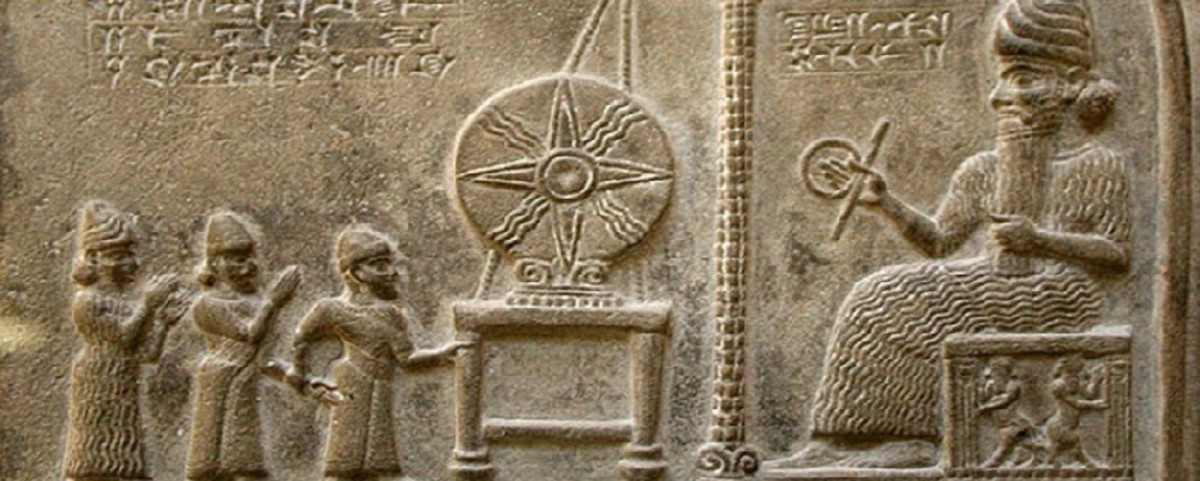
Both the Egyptians and the Babylonians assigned stars to their many gods. The practice of star worship was common place among the Assyrians— and especially the Chaldeans.

IMG_2312.jpeg

“…beware lest you raise your eyes to heaven, and when you see the sun and the moon and the stars, all the host of heaven, you be drawn away and bow down to them and serve them, things that the LORD your God has allotted to all the peoples under the whole heaven” (Deut. 4.19). 

Were there any depictions of Israel’s (and our God), Yahweh? The evidence is sparse, but here’s a possible example. 

IMG_2279.jpeg

An Achaemenid period coin inscribed with the word Yehud depicts a supreme deity as a seated figure riding on a winged wheel. 

IMG_2280.jpeg

Images of Ezekiel’s wheel (Ophanim) or Elijah’s “flying chariot” also come to mind. These motifs are seen depicted not only in the ancient middle and near East, but throughout the entire ancient world. Orthostats (foundation blocks with artistic impression), stone stele, reliefs, and a plethora of artifacts all share a striking resemblance. While these artistic depictions and their character identities aren’t entirely accurate to biblical accounts, many aspects mimic and even seem to acknowledge true Divinity. 

“He bowed the heavens and came down;
thick darkness was under his feet.
He rode on a cherub and flew;
he came swiftly on the wings of the wind.” Ps. 18.9-10 

One Theme, Two Writers, And Three Lessons

Neal Pollard

      David says, about 1,000 years earlier, the same thing Paul says. They had the same source, of course–the Holy Spirit breathed out the words through them both. In Psalm 4:4, David wrote, “Be angry, and do not sin. Meditate within your heart on your bed, and be still. Selah.” Paul wrote, “Be angry, and do not sin. Do not let the sun go down on your wrath, nor give place to the devil” (Eph. 4:26-27). A Bible with good footnotes and referencing will show you that Paul is quoting David, applying the scripture to the purpose of his own writing. So, each wrote for a different purpose, David to demonstrate who is the blessed man and Paul to show who is the new man. David’s writing is of the poetic genre. Paul’s writing is epistolary. Each wrote under a different covenant, meaning their priesthood, worship, and religious constituency were all different. Yet, for all the contrasts that can be made, there are three distinct similarities in these passages beyond the phrase that it is the same.

      These writers show us that anger is a timeless issue. When Israel was autonomous or under the thumb of a world power, they were subject to feelings of anger. When Moses was the lawgiver and when Christ was, the issue confronted them. Time, geography, status, or race have nothing to do with a passion that can be stirred to anger. Wherever man wrestles himself and has to contend with others, it is an issue.

      These writers show us that anger can be sinful. Though each covenant had different laws to respond to sinful anger, the very existence of such rules and commands shows man’s aptitude to let his anger get away from him. The ramifications of not reigning in self’s response to anger are ultimately the same, whenever and wherever one lives.

      These writers show us how to avoid sinful anger. The meat of both passages is a divine strategy to stave off the inclination to sin in our anger. David’s suggests two things–meditation and stillness. Spend some time internally sifting through the issues that would provoke you. Don’t simply stew on it. Rationally think out the matter. Then, be still. Be careful about what course of action you take. Don’t be rash and hasty. Paul suggests resolution and self-mastery. He counsels against “stewing on it,” too. Don’t let anger fester like a sore. Regroup then confront the problem, and remember that this is not the same as being confrontational. You are confronting self more than the cause of the anger. Then, keep self protected from submitting to the devil. That may seem like a dramatic way to say it, but Paul is saying that you are giving yourself over to devilishness when you allow your anger to cross the line into sinfulness. What a hard pill to swallow, yet how helpful to understand that before we foolishly react.

      God is looking out for us, seeking to save us from our worst enemy in anger–ourselves!

Typology: There’s More To The Story

Dale Pollard

We know that the water can be metaphorically muddied rather quickly when there are countless faulty interpretations of books like Revelation, Daniel, Ezekiel, Isaiah, and other prophetic or apocalyptic literature. Typology is another misunderstood, and often misapplied, method of Bible study. I’m convinced that if we can spend some time studying the different “types” found in scripture, we can see God’s message for mankind more clearly and have a more profound grasp of His Word. This also happens to be a great way to grow our knowledge of scripture more quickly! 

 So first, let’s try to clarify exactly what typology is. Summed up in one sentence it’s, “referring to Old Testament things which are prefigured or symbolized by events and characters of the New Testament.”  

This may sound a little confusing, but let’s look at a few examples. 

 John 3:14: just as Moses lifted up the snake in the wilderness, so son of man must be lifted up. (Ref. Numb. 21:9) The Christ “type” is the bronze serpent; we know because of a specific New Testament reference. 

 1 Peter 3:20: “…God waited patiently in the days of Noah while the ark was being built, only a few people, 8 in all were saved through water,” this illustrating how in the same way baptismal water saves those who submit to Christ today. 

 Typology is not some mystic Bible code where we are free to translate events and characters in scripture as we please because God tells us exactly what He intended to say. 1 Corinthians 14:33 says that God is NOT the “author of confusion.” He has a message for us all— and it’s a message of hope.

Deuteronomy: The Second Giving Of The Law (XXXIV)

Moses Blesses The Tribes (33:1-29)

Neal Pollard

The very last words of Moses recorded in the Bible are his reassurance to Israel that God will take care of them. Smith puts it, “In Deuteronomy 31 Moses was the statesman, and in chapter 32 the singer; now in chapter 33 he is the seer” (Pentateuch, 531). The preamble to this prophetic projection concerning each tribe consists of his declaration of God’s power and love (1-3a). The people respond with an acknowledgement of God and pledge of submission to His revealed will through Moses (3b-5). The next 20 verses are devoted to blessings upon the individual tribes.

  • Reuben (6): A prayer that they continue to exist but be few in number (cf. Gen. 49:3-4).
  • Judah (7): A prayer that the tribe which was first to fight (Num. 10:14) and renowned for its military might would be successful in battle through God’s hand. He records the fuller blessing through the voice of Jacob (Gen. 49:8-12). 
  • Levi (8-11): First, note the absence of Simeon. He and Levi are the second and third sons of Leah. Where is Simeon? Eugene Merrill suggests, “Simeon had already become involved in idolatry at Baal Peor (cf. Num 25:6–15), a sin that brought such devastating population loss that the whole tribe eventually became assimilated into Judah (cf. Josh 19:1–9)” (NAC, 438). Levi is reminded of their forefather’s transgression, depriving them of a territorial allotment (8-9). Yet, Moses cries out for a blessing and protection on them as they discharge their God-given duties in leading worship (10-11). 
  • Benjamin (12): A simple prayer that God will protect and preserve them.
  • Joseph (Ephraim and Manasseh)(13-17): A prayer for their prosperity and productivity of the land in mountains, hills, bushes, and pastures, and well as the multiplication of these tribes. 
  • Zebulun and Issachar (18-19): A prophesy that they will worship correctly and prosper generously from the mountains to the seas.
  • Gad (20-21): A call to this tribe to praise God for expanding their territory and rewarding them for their conquest.
  • Dan (22): Interestingly, this is an echo of the animal metaphors used by Jacob (Gen. 49:16-17). In both analogies, he springs on adversaries–here as a lion cub, in Genesis as a serpent. 
  • Naphtali (23): This tribe is affirmed and encouraged, as one satisfied with favor and full of blessing as they possess their territory. 
  • Asher (24-25): A foreseeing of prosperity, blessings, and peace for time to come. 

After the blessings upon the individual tribes, Moses sums up with an overarching blessing for the whole nation. What comes next for Israel will be wonderful. Why? They have a matchless, majestic God who helps with everlasting arms and impenetrable refuge (26-27). They will enjoy security and prosperity (28). They are chosen and saved by God, who will guard and protect them before their cowering enemies (29). The parting encouragement of Moses is that the future could not look brighter, but they must keep looking to the God who makes these conditional pledges to them.

Israel has nothing on the church. What lies ahead for us eclipses what they were told. Our task is to embrace God’s conditional promises in Christ, realizing we are a chosen people most blessed (1 Pet. 2:9-10). May we never reject our inheritance. 

Navigating the Complexities of Worship

Biblical Examples of Obedience and Error

Brent Pollard

 Comparing the post-exilic Jews criticized in Malachi, David, and Nadab and Abihu provides a holistic picture of the connection between human deeds and divine expectations in worship and obedience. Each scenario represents distinct facets of human engagement with divine decrees and religious rituals.

The Jews who returned from exile did not exert much effort in following God’s decrees during Malachi’s time. God accused them of robbing Him because they withheld their offerings (Malachi 3.8–12). Even when they did bring offerings, they only brought God their leftovers, which God considered disrespectful since it showed a lack of reverence and sincerity toward Him (Malachi 1.6–14). Consequently, their lack of reverence and sincerity undermined their worship and strained their relationship with Him.

It is essential to refrain from viewing worship as a mere duty and instead approach it sincerely, reflecting deeply on God’s holiness and His expectations.

David’s unauthorized census, influenced by Satan during a time of divine displeasure with Israel, exemplifies a grave judgment error by disregarding Exodus’s instructions for conducting censuses (Exodus 30.11–12). Despite his general Joab’s objections, David proceeded, only to recognize his sin swiftly. God presented three punitive options, with David choosing a three-day pestilence. At Araunah’s threshing floor, divine mercy stopped this pestilence. God instructed David to make a sacrifice there to atone for his sin. Araunah offered his livestock, crops, and farming implements as fuel for the sacrifice. However, David insisted on purchasing the necessary items for the sacrifice from Araunah, emphasizing that true sacrifice must come with a personal cost, reflecting his repentance and adherence to divine instructions (2 Samuel 24.24; 1 Chronicles 21.24).

David’s insistence on offering to God only what costs him personally emphasizes the value of sacrifice and personal investment in worship. Similarly, our worship and offerings to God must be meaningful and require personal sacrifice. David’s actions demonstrate the value of sincerity, individual responsibility, and acknowledging God’s worthiness in worship. We should not assume God expects less of us.

In Leviticus 10.1, we read about Nadab and Abihu, who offered a “strange” fire that God had not authorized. Their lack of sober judgment might have made things worse. The story serves as a warning about the significance of following God’s commands regarding worship. The severe punishment given to Nadab and Abihu shows how seriously God takes obedience and the dangers of presumptuous or innovative worship practices.

What comparative insights can we glean from examining these three examples of worship?

David sincerely adheres to divine commands, while Nadab and Abihu and the post-exilic Jews act presumptuously or complacently.

David demonstrates a profound reverence for God and deeply understands His nature. He acknowledges the importance of making meaningful sacrifices. Nadab and Abihu, on the other hand, failed to show reverence or a complete understanding of the sacred nature of God’s specific instructions. The actions of the post-exilic Jews imply a detachment from the importance and meaning of their worship practices.

The narrative of David underscores the crucial value of genuine and heartfelt worship. Nadab and Abihu’s story warns those who disregard God’s commands. Additionally, the account in Malachi calls for reevaluating our approach to worship. It urges us to move away from complacency and towards a more heartfelt and obedient practice. These stories emphasize the consequences of our actions and highlight the valuable lessons we can learn from them.

The central theme derived from these examples underscores the importance of approaching God with sincerity, reverence, and unwavering obedience. Worship transcends mere human actions for personal satisfaction; it is a divine mandate that demands meticulous adherence to God’s commands and a heart devoted to honoring Him. Each of these narratives offers valuable perspectives on the nature of worship, the significance of obedience, and the consequences of diverse attitudes and actions in response to divine directives.  

Deuteronomy: The Second Giving Of The Law (XXXIII)

The Song Of Moses (31:30-32:52)

Neal Pollard

John sees a sign in heaven which he calls “great and marvelous,” a sign involving angels, a sea of glass mixed with fire, victorious saints standing beside that sea, “And they sang the song of Moses, the bond-servant of God, and the song of the Lamb” (Rev. 15:1-2). Then, in Revelation 15:3 he quotes Deuteronomy 32:2-3. In one of our hymns, “On Jordan’s Stormy Banks,” there is a line that anticipates that as we rest in that fair and happy land, we will “sing the song of Moses and the Lamb, by and by.”

This song comes from God (cf. 31:19) and is first spoken by Moses (31:30) and then, of course, ultimately written down. It reminds us that Moses was not only familiar with Hebrew poetry, but he was the first to write it down (cf. Psa. 90). What can we learn from this inspired song, composed for Israel’s good?

It praises (1-4).  He proclaims the Lord’s name, and calls for others to ascribe greatness to Him (3). He calls God “the Rock” (cf. 15,18,30,31), indicating His steadfastness and dependability. He upholds God’s character as perfect, just, faithful, righteous, and upright (4). How many songs have followed this pattern, declaring to God in song in many different words, “How great Thou art!”?

It admonishes (5-6). Given the integrity and greatness of God, we certainly should not act corruptly, deny our heritage, and become crooked and perverse (5). Yet, this song charges, or at least warns, that such a response is never far away from us. This kicks off a big part of this song that could not have left the singers feeling warm and fuzzy. Notice the admonition: “Do you thus repay the Lord, O foolish and unwise people? Is not He your Father who has bought you? He has made you and established you” (6). For being a great and giving God, how could we repay Him with anything less than gratitude and obedience?

It reminds (7-14). The song is historical, looking back to an event that is still in the future for the first singers of it. The lyrics were for their descendants, to remember the giving of Canaan. This part of the song carries them through the deliverance and provision in the wilderness all the way through the conquest. It also contains a reminder of how choice and plentiful the resources are in this land. Don’t we need reminded, not only of the Lord’s substitutionary sacrifice through events like the weekly observance of the Lord’s Supper? Don’t we need reminders of past blessings, especially our salvation from the wilderness of sin? As the song urges, “Roll back the curtains of memory now and then, show me where you brought me from and where I could have been; Remember, I’m human, and humans forget, so remind me, remind me dear Lord.”

It warns (15-27). The largest portion of this song is borne of divine love. It is a warning against forgetting! It foreshadows future apostasy and God’s inevitable response to it, in keeping with His perfect nature and character. The warning centers around the folly and destructiveness of idolatry, how God would respond to it with omnipotent punishment. We do not like warnings, but we benefit from them. They are deterrents from a God who supplies all our needs (cf. Phi. 4:19). 

It laments (28-33). Following this lengthy rebuke, there is the emotional response of a fallen, punished people. Note the lyrics, “Would that they were wise, that they understood this, That they would discern their future!” (29). The future defeat of apostate descendants was not the result of a God who lacked ability (31), but because they chose to plant and harvest unrighteousness (32-33). Weeping always follows wickedness, whether in this life or the next! 

It hopes (34-38). How does one respond and rebound from such a grim picture? Focus on God! The song shifts from earth to heaven. After their reaping the harvest of their unrighteousness, Israel could anticipate divine intervention: “For the Lord will vindicate His people, And will have compassion on His servants, When He sees that their strength is gone, And there is none remaining, bond or free” (36). In His deliverance, He would point out the futility of serving any rival (37-38). He points out that hope is only found in Him, and these singers would audibly say so. 

It highlights (39-43). From the hope springs the ending that connects back to the beginning. Remember the character of that praiseworthy God? He is unique (39)! He is able (39). He is eternal (40). He is just (41-42). He brings joy (43). He atones (43). What better way to end this momentous song than by pointing the worshipper to heaven? 

Following the song which followed the preceding instruction (essentially, the first 31 chapters, as we know it), Moses ends it this way: “Take to your heart all the words with which I am warning you today, which you shall command your sons to observe carefully, even all the words of this law. For it is not an idle word for you; indeed it is your life. And by this word you will prolong your days in the land, which you are about to cross the Jordan to possess” (46-47).  The song was to touch their emotions, put their guard up, guide their descendants, bring them life, prolong their days, and fuel their mission. 

The chapter ends with God’s instructions that Moses ascend Mount Nebo, reminding him that he could not enter the Promised Land with the people because he “broke faith” with God and did not “treat Me as holy in the midst of the sons of Israel” (51). That mountain would be the place of his death after he had glimpsed that Promised Land (52). Though this is the fate of the great leader of Israel, this song is a vital part of his lasting legacy. We do well to study this song and be reminded of how God wants us to think when we worship Him in that way today. Our song service should be filled with all these elements, and our hearts should be tuned in to the God described in this powerful song! 

Deuteronomy: the Second Giving of the Law (XXXI)

Choosing Life (30:1-20)

Neal Pollard

What better way is there to preach a climactic conclusion than to put a powerful emphasis on God? In these last 20 verses, Moses mentions “the Lord your God” a stunning 15 times (“Lord” 19 total times and “God” 17 total times). He makes a full court press for these travel-worn wanderers to be totally committed to “return” (2), “obey” (2,8,10,17,20), “love” (6,16), “observe” (8,12-14), “keep” (10,16), “turn” (10), “walk” (16), “choose” (19), and “hold fast” (20). This is the divine expectation. He punctuates it with the repeated use of the word “all”–all your heart (2), all I command (2,8), all your heart and all your soul (6,10)!

Yet, in response to their commitment, look at what God would do. He would “restore” (3), “have compassion” (3), “gather” (3,4), “bring” (4,5), “prosper” (5,9), “multiply” (6), “circumcise their hearts” (6), punish their enemies (7-8), “rejoice over you” (9), and “bless” (16). He wanted this for them and their descendants (6, 19). 

In the absence of obedience, Moses has repeatedly reminded them of how painful, counterproductive, and defeating life would be. Serving a substitute god would be unfulfilling, and its end would be divine rejection. In the humble practice of obedience, God would bless them beyond their comprehension. Through Moses, God encourages them to see this choice as one they were fully capable of making. In the heart of this chapter, Moses says these commands to obey were not out of reach or too difficult (11-13). It was near to them (14)! They could do this!

So, what’s the bottom line? Much like Joshua will do at the end of his tenure as Israel’s leader, Moses says “choose.” But understand what you are choosing between– “life and prosperity” or “death and adversity” (15), “life and death” (19), and “the blessing and the curse” (19). In case it was not abundantly clear, Moses final word is, “So choose life in order that you may live, you and your descendants, by loving the Lord your God, by obeying His voice, and by holding fast to Him; for this is your life and the length of your days, that you may live in the land which the Lord swore to your fathers, to Abraham, Isaac, and Jacob, to give them” (19b-20). The blessings of choosing God, when summed up, are life, legacy, love, length of days, and a land of promise. While the particulars have changed under Christ, it is only because they are better. They are parallel to these, only superior! We face the same contrasting choices, framed by New Testament writers as the world or the Lord (Js. 4:4; 1 Jn. 2:15-17). It’s really not much of a choice, is it? 

Deuteronomy: The Second Giving Of The Law (XXX)

Moses’ Last Sermon (29:1-29)

Neal Pollard

The sermon actually spans two chapters, ending at 30:20. It is delivered “in the land of Moab” (1). It bears the concluding remarks you would expect from a man who is summing up all that he’s already said. Notice the “you have” statements (2,6,17) and the “I have” statement (5) which serves to review where they have been under the steady hand of Moses’ leadership. 

They were delivered by God’s power (2-3), preserved and provided for by God’s benevolent hand (4-5), and protected by God’s wisdom (6). They were enabled to defeat their enemies by God’s help (7-8) and endowed with the privilege of entering covenant with God from their greatest to their smallest citizen (9-13). God is establishing this covenant not only with those present, but for those who would come to know of it who were not there that day (14-18). Moses warns that no one could coast on the righteousness of the nation, being stubborn in heart, without facing the wrath and judgment of a God who would not forgive such rebelliousness (19-21).

In fact, future generations were going to need to have this covenant refreshed for their understanding (22-29). If they lived in the wake of Israel’s unfaithfulness and felt the brunt of the curses outlined in Moses’ previous sermon, then this sermon would provide the answer to their questions: “Why has the Lord done thus to this land? Why this great outburst of anger?” (24). They would have to say, “Because they forsook the covenant of the Lord, the God of their fathers, which He made with them when He brought them out of the land of Egypt. They went and served other gods and worshiped them, gods whom they have not known and whom He had not allotted to them. Therefore, the anger of the Lord burned against that land, to bring upon it every curse which is written in this book; and the Lord uprooted them from their land in anger and in fury and in great wrath, and cast them into another land, as it is this day” (25-28). 

It is in this context that we read a passage often-quoted out of its context, that the secret things belong to God and the things which are revealed are to be observed and obeyed (29). Only God knows the future, but He has revealed the Law for them. Predictably, if they keep what God has revealed they would enjoy blessings unimaginable. If they rebelled against God’s written revelation, they should anticipate wrath and punishment that they could not predict or fully anticipate. It is true that we should not overly speculate about things God has chosen not to reveal to us, but Moses’ point here is that the future is foreknown only by God (Isa. 46:9-10). We have no reason to fear it because of what God has revealed. There are no surprises on the final exam! 

Deuteronomy: The Second Giving Of The Law (XXIX)

The Blessings And Curses (28:1-68)

Neal Pollard

The end of the blessings and curses sermon is more brief on the former and more voluminous on the latter. This is not because serving God is more about threats and warnings than promises and enjoyment, but because in His love and foreknowledge God knew what was in man (Gen. 8:21). He has been seeing the heart of this people turn from Him during the 40 year wandering and He knew what lay ahead from the period of the judges all the way to the end of the northern kingdom and the 70 year captivity of the southern kingdom. 

But in both sections, the point is the same. Israel was to diligently obey and carefully do all that God commanded (1,15). To bring this point home, Moses specifies 14 blessings accompanying obedience (1-14) followed by 32 curses (16-48). Yet, the blessings were as powerful and the curses were dreadful. Moses describes the blessings as overwhelming (2), and “this vivid language portrays the blessings as living and active; for the second verb has ‘and take effect,’ and ‘and light on you.’ Perhaps something like ‘come and remain with you’ or ‘will always be yours'” (Bratcher and Hatton, UBS, 444). 

God wanted to bombard them with blessings that would stay and never leave. But note the conditional, “If you obey” (2). The blessings were not for Israel to selfishly consume in earthly pleasure, but to use as a tool in their keeping covenant with God. Every aspect of their individual and community life would be blessed (1-14). God establishes this with three “if, then” statements (2,9, 13-14). Moses punctuates the blessings portion with a reminder of how matchless God is compared to any rival (11-14).

But what if they breach their covenant with Jehovah? In minute detail, Moses speaks of the consequences of disobedience. With six conditional statements, noted in English with either “if” or “because” (15,20,45,47,58, and 62), God drives His point home. Contemporary documents, whether Hittite or early Assyrian treaties, follow the same formula of being heavily weighted toward the curses over the blessings. “The reason presumably (as here in Deuteuteronomy) was to underscore the seriousness of covenant violation by describing its consequences in long and graphic detail” (Merrill, NAC, 357). 

The last 20 verses serve as a warning, foreseeing a time in which Israel would indeed turn away and through disobedience place themselves under the weight of these curses (49-68). Notice that he actually precedes the prediction of captivity by writing, “Because you did not serve the Lord your God with joy and a glad heart, for the abundance of all things; therefore you shall serve your enemies whom the Lord will send against you, in hunger, in thirst, in nakedness, and in the lack of all things; and He will put an iron yoke on your neck until He has destroyed you” (47-48). He then proceeds to describe what that would look like. 

The enemy would eat their food and oil, drink their wine, besiege their cities, and cause severe famine reducing them to animalistic behavior (49-57). The Lord would cause plagues and diseases (58-62). They would be scattered among the nations, uncertain about their lives, corrupted in their worship, despairing of their living conditions, and desperate for survival (63-68). God could not have painted a grimmer picture, all in the hopes that Israel would take warning and never turn from Him. 

Deuteronomy: The Second Giving Of The Law (XXVIII)

Commandments And Curses (27:1-26)

Neal Pollard

This chapter constitutes the start of the third discourse of Moses, a short sermon covered only in chapters 27-28. Moses’ third sermon, to the delight of homiletics’ teachers, has three points: (1) Covenant Renewal (27:1-26), (2) Blessing And Curses (28:1-48), and (3) The Threat Of Captivity (28:49-68) (Smith, 526). Here, Moses tells God’s people to write the law of God on large stones and coat it with lime (plaster) (2,5). Why? “The specific instruction here was to set up a large stone monument once Canaan had been reached, a stele coated with plaster on which “all the words of this law” could be inscribed (v. 3). Such techniques are well attested in the ancient world. The monumental form and size were to provide ready public access, a rallying point around which the community could gather to more easily recall its commitment as a people” (Merrill, NAC, 342). 

Assembling At Mt. Ebal (1-13).  Merrill divides this section into three parts: (1) Instruction (1-8), (2) Exhortation (9-10), and (3) Preparation (11-13)(ibid.). The people are told to gather at Shechem to set up the stones (1-5,8) and the altar (6-7).  One would be for perpetual remembrance and recall while the other would be for perpetual reverence and rejoicing. God is setting them up for spiritual success, commanding to put in place those matters that would keep their hearts and minds bound to Him.

The exhortation, led by Moses and the priests, was to listen, understand, and obey (9-10). Knowing who they were and who God was should make this a natural consequence. He was giving them a “land flowing with milk and honey…as the Lord, the God of your fathers, promised you” (3b). 

The preparation for the ritual or ceremony on the mountains of blessing (Gerizim) and cursing (Ebal) is outlined in verses 11-13. The tribes were to be divided in half, with Simeon, Levi, Judah, Issachar, Joseph, and Benjamin on Gerizim and Reuben, Gad, Asher, Zebulun, Dan, and Naphtali on Ebal. Why divide the tribes in this way? It has been suggested that the tribes on the mount of blessing are Rachel and Leah’s natural born sons, while those on the mount of blessing are their concubines’ sons (Driver, Deuteronomy, 298). There are obvious flaws in that supposition. What makes better sense is a division based on where the territories are in the promised land. The map below shows that the southwestern tribes are those responsible for gathering on Gerizim and the northwestern and eastern tribes are those responsible for gathering on Ebal. If the map is enlarged, one can see those mountains situated in West Manasseh northwest of the Dead Sea. 

(Via LOGOS Biblical Places Map)

Twelve Curses (14-26). It is not hard to connect the number of curses with the number of tribes (15-26). It has been suggested that these curses are also tied to sins outlined in the law and already condemned (notice Spence-Jones’ analysis, The Pulpit Commentary, 421):

Ver. 15.—(Cf. Exod. 20:4; Lev. 26:1.)
Ver. 16.—(Cf. Exod. 21:17.)
Ver. 17.—(Cf. ch. 19:14.)
Ver. 18.—(Cf. Lev. 19:14.)
Ver. 19.—(Cf. ch. 24:17.)
Ver. 20.—(Cf. Lev. 18:8; ch. 22:30.)
Ver. 21.—(Cf. Lev. 18:23; 20:15.)
Vers. 22, 23.—(Cf. Lev. 18:9, 17.)
Ver. 24.—(Cf. Exod. 20:13; Numb. 35:16, etc.)
Ver. 25.—(Cf. Exod. 23:7, 8.)
Ver. 26.—(Cf. ch. 28:15; Jer. 11:3, 4.)

The last curse is a general and summary one, while the others strike at specific behaviors leveled against God and man. This ceremonial act, which we will see practiced first in Joshua 8:33-34, had to have been a sobering act of warning and reminder about the power of God and His law. They were submitting themselves to divine curse if they committed these transgressions. 

God has no such tactile or tangible ceremony to remind us of our obligations to Him and His Word today. Or maybe He does. Doesn’t worship, including the weekly memorial to Christ’s suffering, death, and resurrection, serve as an anchor point and highlighting of the blessings of obedience and the curses of apostasy? That is certainly not its sole function, but it is a part (1 Cor. 11:26-29). We are priests positioned in the assembly to stimulate one another to love and good deeds (Heb. 10:24-25). Thank God that He keeps us grounded through the assemblies as well as the other touch points we have throughout the week (Acts 2:42; 1 Pet. 4:9)! 

The Duty Of Courage And Strength

Brent Pollard

The Book of Joshua is a powerful account of the Israelites’ conquest of Canaan and subsequent settlement in the Promised Land under God’s leadership. This account is woven with a resounding call for courage and strength as God exhorts Joshua and the people five times (Joshua 1.6-7,9,18; 10.25). These admonitions emphasize the importance of these virtues in a life of faith, obedience, and service to God.

Though Christianity emphasizes the virtues of humility, gentleness, and forgiveness, it does not minimize the importance of courage and strength. On the path of faith, we must exhibit courage and strength to confront the inevitable challenges and adversities. Our responsibility is to be resilient and brave in the face of these hurdles.

Believers consider fear a greater sin than non-believers because faith provides them with greater motivation for courage (1 John 4.18). Thus, discouraging fear is a comfort and a call to action, encouraging believers to confront danger, responsibility, pain, loss, and even ridicule without succumbing to fear. Avoiding the path of risk may lead us astray from our divine calling while shying away from duties that appear daunting and fail to honor our commitments.

Therefore, strength is a desirable trait and a requirement for overcoming sin and fulfilling our mission. Believers must confront their inner sinful desires and external evils by facing and overcoming moral weakness, which often stems from spiritual deficiencies. Believers, like the Israelites in Canaan, must deal with these and life’s general uncertainties. 

Grave dangers and the completion of difficult tasks emphasize the importance of bravery and strength. To claim their spiritual inheritance, resist sin and temptation, and expand God’s Kingdom, believers must actively engage and struggle, just as the Israelites confronted their enemies.

Fortunately, Joshua’s pages contain the secret to courage and strength. We must recognize that these characteristics are divine gifts that, through faith and reliance on His power, even the most naturally timid can obtain. As Moses handed over the reins to Joshua, he told the people, “Be strong and courageous, do not be afraid or tremble at them, for the Lord your God is the one who goes with you. He will not fail you or forsake you.” (Deuteronomy 31.6 NASB95).

Personal and communal victories serve as reminders of God’s faithfulness and power. They strengthen our courage to face future challenges. For example, the conquest of Canaan by the Israelites not only reinforced their faith in God’s promises but also empowered them to confront future battles. Nevertheless, the journey of developing courage and strength is ongoing, demanding the active application of divine grace. We can expand our capacity for these virtues by stepping out in faith and obedience. While developing courage and strength requires practice, individuals can enhance these traits through dedication and effort, becoming stronger and more courageous. The synergy between courage and strength equips believers with the spiritual armor needed to face life’s battles with resilience confidently.

Viewed through the Book of Joshua, God reminds us that courage and strength are virtues for the battlefield and integral aspects of the Christian life. These virtues require our continual attention and cultivation as we maneuver through the intricacies of faith, obedience, and service. Likewise, as God equipped Joshua and the Israelites for their challenges, He provided us with the same divine resources to be courageous and strong in our spiritual journey.

“Have I not commanded you? Be strong and courageous! Do not tremble or be dismayed, for the Lord your God is with you wherever you go.” (Joshua 1.9 NASB95)