Meek Like Jesus

How can we respond to a world that encourages us to lift ourselves up and put others down? To bristle when corrected or to justify and rationalize our actions rather than to listen and consider? As often is the case, we need to visit with Jesus.

Neal Pollard

Meek Like Jesus

Neal Pollard

We live in an age where we are not conditioned to take correction humbly. Instead, we can quickly become full of defensiveness and self-justification. We may even become indignant at the approach of someone, especially if we find ourselves in some way superior to them. It is also an age where humbling and lowering ourselves for the good and benefit of another is not particularly attractive, especially if it is not wallpapered on a social media platform. We may be quick to let others know our value and importance, but to praise and uphold someone else is undesirable. This can often lead us to be impatient with the perceived shortcomings of people that annoy us and put us out. How many do not know or have forgotten these words, that “pride and arrogance and the evil way and the perverted mouth” God hates (Prov. 8:13).

In contrast, consider a statement Jesus makes about Himself and a similar statement Paul makes about Jesus. First, think about Jesus’ words in Matthew 11:29: “Take My yoke upon you and learn from Me, for I am gentle and humble in heart, and you will find rest for your souls.” Look especially at the words “gentle” and “humble.” Gentle, quoting the NASB, is “meek” in the KJV. It is an adjective here, and Paul uses the noun form in 2 Corinthians 10:1. “It is a condition of mind and heart which demonstrates gentleness, not in weakness, but in power. It is a balance born in strength of character” (Zodhiates, WSNTDICT, np). This is one of the beatitudes Jesus calls on us to have (Mat. 5:5; 1 Pet. 3:4). He exhibits it Himself as He enters Jerusalem the last week of His life (Mat. 21:5). Both times it is used of disciples, it is either rewarded or highly esteemed by God. The noun form (gentleness/meekness) gives us a fuller understanding. It is a “gentleness of attitude and behavior, in contrast with harshness in one’s dealings with others” (Louw-Nida, 748).

The second word there in Matthew 11:28 is “humble,” which when used literally spoke of a person who was short in stature. It was the word for the lowly and the poor, one with no social standing. It speaks of insignificance. But, Jesus combines this word with gentle to say that this is how He saw Himself. Paul uses the same word in 2 Corinthians 10:1, when he says he is “meek” when face to face with those Christians.  He was unpretentious in behavior (TDNT). 

The last word, the one Paul uses in 2 Corinthians 10:1 along with Jesus’ word meek (gentle), is “gentleness.” The word suggests “the harmonious disposition of character and frame of mind…” that “becomes, in relation with neighbors, an accommodating attitude, a happy harmony” (Spicq and Ernest, TLNT, np). Consider this explanation of the word. Trench ties this word to God’s grace, retreating from strictness against sinful men, making allowances for our imperfect righteousness, and His refusal to exact extreme penalties when He has every right (cf. Synonyms, 155). It is gracious forbearance, granting clemency or pardon. Paul urged Corinth “by the meekness and gentleness of Christ.”

Let’s put all this together. What Jesus possessed and demonstrated, what we are called to imitate, is a gentleness in attitude and action when dealing with others. This comes from not thinking too highly of ourselves and our talents, intelligence, and influence (Rom. 12:3,16). Out of this we cut people slack and give them the benefit of the doubt. If the perfect Son of God was characterized this way, I need to walk in His footsteps. This will help me when someone corrects me or if I need to correct someone else (2 Tim. 2:24). I look honestly at myself, knowing that I have strengths but I also have weaknesses–just like those I deal with each day. Gentle, humble, meek, and forbearing. That was Jesus. That should be me, too. 

Isaiah: The Holy One Who Rules The World (XLVII)

“Our God Reigns” (52:1-15)

Neal Pollard

Chapter 52 is a dramatic call for the southern kingdom (and Jerusalem specifically) to awaken themselves at the deliverance and assurance of a God who is on their side. As we see this brief chapter, which leads in the better known 53rd chapter, there are a few significant details which build hope. Why? Because it centers around the God we serve.

God, The King, Values Us (1-5). Protectively, God calls to His people to be clothed in strength and beauty (1). It is a call to arise from captivity, having been bound by Egypt and Assyria (4). God arises like an advocate, pleading the case of His people (5). He does so from the standpoint of the personal cost He feels and the blasphemy it brings on His name (5). He does not want to see His people enslaved or humbled another moment.

God, The King, Redeems Us (6-10). This section is by far the most familiar to not only Bible readers, but those who recognize its words in a song we sing in worship. Especially note verse seven: “How lovely on the mountains Are the feet of him who brings good news, Who announces peace And brings good news of happiness, Who announces salvation, And says to Zion, ‘Your God reigns!’” God anticipates the day when His people would know His name and recognize His voice (6). That would be possible through the heralding of His messengers (7-8). The result would be celebration–shouts of joy (8-9), comfort (9), redemption (9), and salvation (10). But, by God’s might (10), it would be a salvation accessible to all nations (cf. Mat. 28:19; Acts 1:8). 

God, The King, Challenges Us (11-12). The call is for separation and purification. As they left captivity, they were not to take its spiritual influence with them. Despite the terror they faced going into bondage, they would come out with peace and security. God not only calls for righteousness, He pledges His help as they pursue it. 

God, The King, Visits Us (13-15). These verses actually seem to begin the fourth and final “Servant Song” that continues through the next chapter. Each song begins, “Behold, my Servant” or a similar phrase (42:1; 49:1; 50:4). While chapter 53 will focus on His suffering, the Messiah is introduced with His being “high and lifted up and greatly exalted” (13). Philippians 2:9-11 says that glory would follow suffering. Here, we are reminded of how glorious this one who came to be the Servant is. These verses are a prelude to the awful picture of suffering that follows, especially verses 14-15. Notice that this Servant will astonish many with what He suffers, just as the Jewish nation suffered in the captivity. He would be marred and disfigured beyond human likeness (14). Oh, how the gospels will portray that on the day of His crucifixion. This servant will also atone for many by His sacrifice, implying His blood by the mention of “sprinkling” (15). This servant will disclose the truth of His identity to those in high places (15). Paul quotes Isaiah 52:15 and applies it to Jesus, when he reveals in Romans 15:21 that he shared Jesus in places where he had not been. This verse is cited as biblical defense for such. The Jews rejected or minimized Old Testament passages that portrayed the Servant as sufferer rather than sovereign. But, the message of Scripture is that we must Christ, all of Him, as the one exalted but first executed, as the one triumphant but only after He was threatened, tortured, and terminated. 

Succeed In Everything

2 CHRONICLES 31

Dale Pollard

Hezekiah “prospered in everything” (2 Chron. 31.21) because…

HEZEKIAH WAS DETERMINED TO PUT GOD BACK WHERE HE BELONGED (v.2)

”Hezekiah assigned the priests and Levites to divisions—each of them according to their duties as priests or Levites—to offer burnt offerings and fellowship offerings, to minister, to give thanks and to sing praises at the gates of the LORD’s dwelling.”

HE DEDICATED HIMSELF TO SERVICE (v.3)

“The king contributed from his own possessions for the morning and evening burnt offerings and for the burnt offerings on the Sabbaths, at the New Moons and at the appointed festivals as written in the Law of the LORD.”

HE DEVELOPED HIMSELF AND OTHERS (v.4)

“He ordered the people living in Jerusalem to give the portion due the priests and Levites so they could devote themselves to the Law of the LORD.”

HIS DEVOTION WAS DESIRED BY OTHERS v.5-6) 

Israel gave generously until there were heaps of their offerings piled up. 

HE DIRECTED ALL THE GLORY TOWARD GOD (v.8) 

When Hezekiah and his officials came and saw the heaps, they praised the LORD and blessed his people Israel.

He Wasn’t Perfect But… 

What’s written about him in the summation of his life declares that Hezekiah was the last time Israel, or the world, would know a righteous king until Jesus appeared on earth (Matt. 1.10ff). 

“Hezekiah trusted in the LORD, the God of Israel. There was no one like him among all the kings of Judah, either before him or after him. He held fast to the LORD and did not stop following him; he kept the commands the LORD had given Moses” (2 Kgs 18.5-6). 

Good Stuff To Do

Gary Pollard

These are some of the positive actions God wants to see, taken from Colossians chapter three:

Show mercy to others — This was originally two words: σπλαγκνα οικτιρμου (sp-longk-na oik-tear-moo). The first describes that powerful gut feeling of compassion when you see someone’s awful situation. The second means something like pity or mercy. So this is an emotional response to someone’s plight, followed by actually doing something about it.

Be kind — This word is very closely connected with the concept of helping others. It’s a catch-all that means, “Be someone who benefits other people.” 

Be humble — This is someone who doesn’t think more highly of themselves than they should. It can be taken too far (as in Col 2.18, 23) in the form of “pious self-denial” or asceticism. God wants his people to have a balanced view of self. We are the heirs of his kingdom, but we are no more important than any other Christian. 

Be gentle — This is closely tied to humility, and it means “not being overly impressed by a sense of one’s self-importance.” A humble, gentle person recognizes their own position as someone who serves God and must therefore serve other people, and view them as being more important. 

Be patient — This word is also closely tied to humble and gentle in this context. While we serve other people with a balanced view of self, we have to be willing to put up with their shenanigans. People can be really hard to love, but patience puts up with their weakness while we try to show them God’s love.  

Don’t be angry with each other — This would be better translated “put up with each other.” In other contexts, it’s used to mean putting up with something draining or difficult without giving in. This word is a participle in the original text, so it tells us to what extent we’re supposed to live out the qualities of kindness, humility, gentleness, and patience. That extent is limitless. God expects us to be good to our Christian family, even when that’s the last thing we want to do. We might even say, “Fake it til you make it.” Be good when you don’t want to until God’s love perfects your mindset. 

Forgive each other — Greek doesn’t have the word normally translated “forgive”. Instead, it seems to be similar to the kind of language Jesus used when he said, “If someone slaps you on the cheek, give them your other cheek to slap.” When our Christian family wrongs us, our reaction should be to go out of our way to do something good for them. Forgiveness is an element of that mentality, but this word really seems to stress having a positive reaction in the face of mistreatment from our Christian family, rather than a passive forgiveness. Paul even says here, “Be good to them because Jesus was good to you first.” Yes, Jesus forgave and forgives us! But more than that, he was good to us when we didn’t deserve it at all. 

Love each other — This is the most important element of all of the ones listed here (“επι πασιν δε τουτοις την αγαπην”). Paul says, “This is the most important thing,” and, “Love holds everything together the way it should be.” It’s safe to say that all of the other positive things we’re supposed to adopt from this list are practical ways to express this godly love. 

Understanding The Parable Of The Mustard Seed Through The Story Of Kudzu

Brent Pollard

I found an old commercial promoting kudzu for groundcover while researching my family’s history on Newspapers.com, an Ancestry.com extension. Given the plant’s current status as an invasive species plaguing the southeastern United States, this revelation made me laugh. This year, particularly, has seen a remarkable increase in the kudzu crop.

Looking through historical documents, I discovered that kudzu first appeared on American soil in 1876 during the Centennial International Exhibition. This exotic vine proudly displayed in the Japanese pavilion at the World’s Fair in Philadelphia, captivated spectators so much that it was quickly renamed the “Jack and the Beanstalk vine.”

Early twentieth-century newspapers like The Boston Globe recommended kudzu for backyard gardeners, praising its rapid growth, pleasant aroma, and low maintenance requirements. By the 1950s, however, the federal government was forced to acknowledge the drawbacks of kudzu’s rampant spread, a species they had promoted for decades for erosion control. The USDA designated kudzu as a weed in 1970 and was redesignated as a “noxious weed” in 1997.

This story of kudzu—initially celebrated, then reviled—resembles the Parable of the Mustard Seed, which appears in Matthew 13.31–32, Mark 4.30–32, and Luke 13.18–19. Jesus uses The mustard seed in this parable to demonstrate the profound potential that can emerge from humble beginnings. 

In the parable, Jesus compares the Kingdom of Heaven, God’s divine rule, to a mustard seed. Though it is the smallest of all seeds, when planted, it grows into the largest of garden plants, even becoming a tree. This tree then becomes a haven for birds, providing shade and a place for them to nest in its branches.

The mustard seed’s growth, from small to great, signifies how God’s kingdom begins as a tiny seed in our hearts and develops into a powerful influence. Similarly, kudzu started as a tiny seed in the United States and grew into a major ecological force. Instead of providing a haven, it became an uncontrollable pest, engulfing large areas of the southern United States.

So, what can we learn from the Parable of the Mustard Seed and the story of kudzu? Both teach us about the potential consequences of small beginnings and remind us to consider the possible long-term impact of our actions. We have the free will to choose our efforts. Let’s aim to plant excellent seeds that enrich our environment through activities that align with the divine and benefit the world (as taught in Luke 8.11).

The Post That Used “Love” 25 Times

Tuesday’s Column: Dale Mail

blond man with goatee smiling at camera with blazer on
Dale Pollard

Jesus loves us and that truth is found all through the Bible. The Bible teaches us to love others like Jesus loves us, but that’s only helpful if we understand the implications. 

“God is love. Whoever lives in love lives in God, and God in him. In this way, love is made complete among us so that we will have confidence on the day of judgment, because in this world we are like him. There is no fear in love.” 

I John 4.16 

Piecing Together Bible Principles 

  1. Unnatural? This love calls us to live in a way that’s completely unnatural since it involves living through the eyes of everybody else. It’s the proper placement of “self” on the bottom shelf (John 3.30). 
  2. Rejection? In some circumstances, this love may demand the rejection of warm and friendly feelings for the call to act in a Christ-like sacrificial way. That love can prove to be a painful practice at first, but those pleasant feelings of gratitude and joy come when we learn to appreciate what He did first. Our selfless Savior was unbiased in His death for all mankind and that’s difficult to imagine. 
  3. Discipline? Love means discipline. When it comes to our personal dedication to the practice of that love, we must be disciplined. When God disciplines us, He means to refine so that we can enjoy a more intimate relationship with Him. 

Love Looks Like This 

If we wish to love like God we must put others before ourselves. We must call out sin. We must speak boldly in the defense of Him. Love means proclaiming to the lost the message about the God who made Heaven and Hell. 

Putting The Summary On Simmer 

To love Jesus and to love like Jesus are two connected ideas.

“But anyone who does not love does not know God, for God is love.”  I John 4.8 

You can’t say you love Jesus if you don’t love like He does. You can like Him, and He’ll still love you— but only loving Jesus leads to life after death. 

P.S. 

Loving someone occasionally means begging them not to make poor decisions, but allowing them to do so. If and when the pleas are ignored, it pains us to see those we love hurt themselves. 

P.S.S 

The ability to understand and experience emotions of such complexity must be part of our godly imaging. That’s something which is ingrained within all of us. 

I Want To Be A Lipizzaner

Friday’s Column: Brent’s Bent

Brent Pollard

The majestic Lipizzan horse is a sight to behold. One of its dressage gaits is called the levade. If you’ve seen a horse in a heraldic setting, you’ve likely seen something akin to this pose. The horse raises and draws in its forelegs, balancing its bodyweight on its bent hind legs. Lipizzaners are relatively few today, with about 3,000 of them in the world. However, owners prize them for their docile and highly obedient natures. These characteristics are something I wish to emphasize as I consider Jesus’ appeal for us to be “meek” or “gentle” (Matthew 5.5).  

The history of the Lipizzan breed goes back to around 800 A.D. Muslims invaded the Iberian peninsula and brought their Arabian and Berber horses with them. The Muslims bred their Arabians and Berbers with local Spanish horse breeds. One of the resulting horse breeds was the Andalusian. Fast forward to the late 1500s, and you find Archduke Charles II establishing a stud in Lipizza, Austria, known today as Lilica. He bred this Andalusian with Arabian, Berber, Baroque, and the now-extinct Neapolitan horses. The horses produced in Lipizza were equally at home on the battlefield and in aristocratic riding venues.  

In the same latter half of the sixteenth century, the Spanish Riding School began in Vienna. This school has trained these Austrian bred horses for over 450 years using the classical dressage, which the Greek, Xenophon, described. And that is the glue that brings this entire discourse together. Xenophon referred to properly trained horses, ready for battle, as praus. That is the Greek word used by Jesus in Matthew 5.5. So, if you want to see a horse that has been meeked, look at the Lipizzaner during its performance.  

Interestingly, with time’s passage, meekness has been equated to weakness or timidity. Surely weakness or timidity would not be a mindset needed for those wishing to enter the Kingdom. If a horse acted as the modern conception of that word, it would be useless. Is this desirable trait watered down due to its probable source of Psalm 37.11? David wrote: “But the meek shall inherit the earth; and shall delight themselves in the abundance of peace” (KJV).  

Newer translations of that passage, like the NASB1995, will substitute “humility” for the word meek. However, if you look to the original Hebrew, the term employed is anav. The Brown-Driver-Briggs Hebrew and English Lexicon suggests that within this context, anav means “poor, weak, and afflicted Israel.”1 If you read the entire thirty-seventh Psalm, you note that David describes the destruction of evildoers, which creates a void to be filled by the anav (meek or humble) persons (Psalm 37.7-11). 

The problem with bringing David’s meaning to Jesus’ Sermon on the Mount is the Septuagint would have likely influenced Matthew as he recorded the words of our Lord, and it uses praus. Of course, it may be that Jesus quoted the Septuagint, too. Christ seems to do so on several occasions. As Koine Greek was the lingua franca, why wouldn’t He use the Septuagint in His public teaching? Ultimately, it matters little whether Jesus quoted from the Masoretic Text or the Septuagint since we must deal with the Greek in which the Holy Spirit wrote it for you and me today.  

As a quick aside, the church or Kingdom is not an institution that Jesus’ meek will be inheriting from defeated evildoers, as were David’s meek. Instead, Jesus built this institution Himself and now adds the saved to it (Acts 2.47). These saved may be sin-weary and spiritually afflicted upon entry (cf. Matthew 11.28-30), but Jesus adds them to a spotless church without blemish (Ephesians 5.27). Even if Psalm 37.11 was in the mind of our Lord when He preached, He made an entirely different application of it centered on the idea of the “meeked man.” 

Aristotle said that a meek man was one remaining between the extremes of cowardice and recklessness. In other words, a courageous man. 2 That takes us back to Xenophon and our Lipizzaners, the descendants of the Greek war-horse. What kind of a horse would Alexander the Great ride to glory on the battlefield? We know because historians have written much about him. The horse’s name was Bucephalus. Plutarch said Alexander perceived that Bucephalus was spooked by his own shadow and so situated the animal to face away from his source of fear. 3 No man could ride Bucephalus but Alexander. Alexander brought Bucephalus’ power under control. Following the body of knowledge passed down by such men as Xenophon, young Alexander meeked Bucephalus.  

So, what virtue was Jesus urging us to adopt? Naturally, we cannot physically become Lipizzaners. Still, we can discipline ourselves to become docile (i.e., ready to receive instruction) and highly obedient (i.e., willing to carry out those orders) as that magnificent horse. As such, we are equally as fit for service in the war against Satan as being a Barnabas to fellow Christians. Hence, a meeked Christian is far from poor and weak. He knows who holds his reins. As such, he enjoys what is his and what the Lord has promised him. Doesn’t that make you want to be like the Lipizzaner too?   

Sources Cited and Consulted 

1 “Strong’s Hebrew: 6035. עָנָו (Anav) — Poor, Afflicted, Humble, Meek.” Bible Hub, Bible Hub, biblehub.com/hebrew/6035.htm

2 Chaignot, Mary  Jane. “Definition of Meekness.” BibleWise, Biblewise.com, www.biblewise.com/bible_study/questions/definition-meekness.php

3 Wasson, Donald L. “Bucephalus.” World History Encyclopedia, World History Encyclopedia, 2 Feb. 2022, www.worldhistory.org/Bucephalus/

Kawsar, Iffat. “Lipizzan Horse: A Horse Dedicated to Spanish Riding School in Vienna.” The Vet Expert, The Vet Expert, 11 June 2021, www.thevetexpert.com/lipizzan-horse-a-horse-dedicated-to-spanish-riding-school-in-viena/.  

Photo credit: Max Pixel (Creative Commons)

Greatest In The Kingdom Of Heaven

Monday’s Column: Neal At The Cross

pollard

Neal Pollard

I stood at the doorway of her humble apartment in a small Kentucky town. This Christian woman in her mid 80s, mother of three and newly-widowed, was adopted by the local church and seen after especially by a son who lived in the same town. I had received a sweet letter from her, expressing her appreciation for the great work being done by especially World Video Bible School. Her former preacher in the 1990s had introduced it to her, and she told me that she gave their DVDs away all the time.

Between the time I received her letter and dropped by her home, I talked to another lady in that same, small congregation. She praised the character and good works of the woman who wrote me the letter. I was told of the various hardships and challenges faced by my penpal. She was raised in religious error, but learned the truth from her husband’s family. The husband never obeyed the gospel and did not encourage her faith. Despite being subject to cruel treatment, she was not only a faithful, submissive wife, but she was full of righteous works. She became a walking Bible, the fruit of tenacious daily Bible study. She has written, supported, and encouraged missionaries all over the world for over 40 years. For decades, she has graded Bible Correspondence Courses

The woman I met had the humility and sweet spirit of a child. She bore the marks of hardship, having undergone hip replacement and other maladies of aging and falls. But the thing that struck me was the twinkle in her eye and the genuine joy she has in being a Christian. As she talked about her life and as I had ultimately heard about her life from a few of her church family members, I could not help but think that this woman has suffered so much physically and emotionally. But you could not tell it from her attitude and disposition. The gentle enthusiasm I first read in her writing translated to a winsome smile and zeal face to face. 

She had been weathered and battered by life, yet she had all the marks of a triumphant overcomer. Still faithful to meet with the saints every time the doors are opened, she lives Christ in her daily life. I could not help but think of the woman Mark tells us about in his gospel, the one who anointed Jesus’ head with “an alabaster vial of very costly perfume of pure nard” (14:3). In praising her “good deed” (14:6), Jesus summed it up by saying of her, “She has done what she could” (14:8). No one knows this dear sister across our brotherhood. She’s not an author, public speaker, gospel writer, or appointed church leader. But she epitomizes greatness as defined by Jesus.

I left my visit doing some serious self-examination. How’s my attitude? What am I doing with what God has given me? How am I blessing the lives of others? When others have been around me or speak about me, what characteristics come to mind? Every life is given a variable amount of resources and opportunities (Mat. 25:14-30). We will account for how we used them. Have we tried to tell others about Jesus? Have we reminded others of Jesus? Helen reminded me of my Savior! I left resolved to be more like her, trying to imitate her as she so clearly imitates Him (1 Cor. 11:1)! 

MAKING GOD AN ADVERSARY

Monday’s Column: Neal At The Cross

img_5670

Neal Pollard

The word frequently translated “opposed” and “resist” is a compound word that means to “arrange against” (Zodhiates, np).  It was a military term describing “to set an army in array against, to arrange in battle order” (ibid.). Louw-Nida tell us it means, “to oppose someone, involving not only a psychological attitude but also a corresponding behavior” (491). This word is found in some form five times in the New Testament. Three of the occurrences refer to a person resisting another person, when the Jews in the synagogue of Corinth “resisted” Paul’s teaching about Christ (Acts 18:6), when people resist governing authorities (Rom. 13:2), and when the poor man did not resist his rich oppressor (Jas. 5:6). The other two occurrences both quote the same Old Testament passage, Proverbs 3:34, which speaks of God opposing and resisting a man. What man? Peter and James quote the proverb, writing, “God is opposed to the proud, but gives grace to the humble” (Jas. 4:6; 1 Pet. 5:5). 

Perhaps you have made someone powerful your enemy–the principal at school, the boss at work, or someone else who had the power to make your life unpleasant. If you have, you know how difficult it is to thrive and succeed under such circumstances. But the Bible says it is possible to make God opposed and resistant to you. That’s unparalleled unpleasantness! Thankfully, God tells us what triggers such a response in the omnipotent God.

These two inspired writers could have written that murder, adultery, lust, lying, stealing, greed, or hatred draws His active opposition, but both single out “pride.” It goes with insolence and boastfulness in Romans 1:30, arrogance in 2 Timothy 3:2, and blasphemy and folly in Mark 7:22. Each of those passages reveals a dangerous state of mind that comes from turning away from God. 

Arrogance keeps us from admitting wrong, makes us have an inflated sense of self and a lowered view of others, leads to a feeling of self-importance, and is at the heart a self-centered point of view. All of that will damage earthly relationships, friendships, marriages, with fellow church members, and those we deal with on the job and at school. But, even beyond those negative repercussions, sinful pride makes God an enemy! Think about that. When we allow pride to take root in our lives, God arranges Himself against us. Imaging God in battle order against me conjures an image of the most uneven fight possible. Pride may cause misery and damage in my relationship with others, but more than even that it effects my relationship with Him!

The antidote is the same in both Peter’s and James’ writing–“humility.” Not pretentious, but modest and obedient to His will. It’s being lowly in heart, able to see and admit wrong and guilt, having a fair and realistic view of self that acknowledges when we are wrong. Is it easy? No! Is it fun? Not at all. But, when we actively work at being humble and eradicating pride, God will fight for us and not against us. I get to decide which way I want it! 

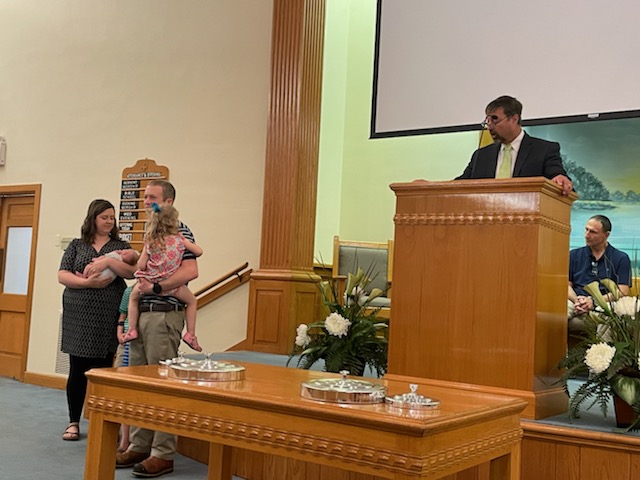
It is our custom for the elders to give the parents of our newborns a Bible. No wonder God uses children to illustrate humility! Here is just the latest couple of presentations, with several more to come in ’21!

Jesus Loves The Little Children 

Tuesday Column: Dale Mail

image

Dale Pollard

Those who lived on earth while Christ was here in the flesh would have described Him differently, depending on their experiences with Him. 

Many of the wealthy people would have called Him a “demanding person” (Matt. 19.22). 

The Pharisees, Sadducees, and most Roman officials would have labeled Him a “trouble maker.” 

All of the folks who were healed by Jesus would say that He was a powerful man, but I believe that a great many would say that He truly cared for children. 

He calls the peacemakers “children of God” at the beginning of His first recorded sermon (Matt. 5.9). He heals a boy with a particularly vicious demon inside him (Matt. 17). But in the next two chapters He will show this love toward innocent children in a way that can touch the heart. 

In chapter eighteen, the disciples of Jesus ask an ignorant question, “Who is the greatest in the kingdom of heaven?” 

It’s after this question that Jesus places a child in front of them. This must have been a little confusing for the disciples, but a powerful point is made. Jesus says, “Truly I tell you, unless you change and become like little children, you will never enter the kingdom of heaven. Therefore, whoever takes the lowly position of this child is the greatest in the kingdom of heaven.And whoever welcomes one such child in my name welcomes me.” 

In chapter nineteen, Jesus is teaching on the subject of divorce. It’s a lesson that didn’t sit very well with His listeners then, and it still doesn’t sit well with many people today. At some point in His lesson, women begin to bring their infants to Jesus so that He can bless them. This was a tradition done by Jewish people but the disciples started to rebuke the parents because they thought this was a job below their great leader. Again, Jesus shows us His love for children by saying, “Let the little children come to me and do not hinder them, for such belongs the kingdom of heaven.” He then goes on to lay His hands on them and then leaves. Did He have more to say to the crowd that had gathered to listen to Him? Was He finished with His lesson? Apparently this visual illustration was a great way for our Lord to end. 

The point is, Jesus loves children. Not just little children, but adult children, too. He compares the innocent nature of children to how we can be in the sight of God once we are added to the kingdom. It’s a beautiful picture and something we should all crave. Innocence. When Jesus lays “His hands on us” when we follow the plan of salvation, He has the power to change our sinful ways into something pure and holy. Jesus loves the little children, and the big children, of the world.  

GOD’S RECIPE FOR GREATNESS

Monday’s Column: Neal at the Cross

IMG_1922

Neal Pollard

Traditionally, people have pursued greatness by achieving prominence in politics, athletics, entertainment, business, and the like. The names of such stand outs live on through the records the world keeps–halls of fame, history books, registers, even buildings and monuments that “immortalize” them after they’ve gone. Every community has its men and women who are held up as paragons of greatness. 

How often do we stop and how much do we focus on what God considers greatness? Interestingly, He has quite a bit to say on the subject. The word is found 49 times in the New Testament and is a word from which we get our English word “mega.” As it is used in the Bible, it refers to a state of greatness and preeminence in quantity, quality, intensity, importance, and excellence (BDAG 623-625). You have God through His inspired writers trying to get our attention, saying, “Here is how you grab My attention and stand out in My eyes.” It is important to know what makes God’s list because “that which is highly esteemed among men is detestable in the sight of God” (Luke 16:15). Surely, the opposite is true, too (1 Cor. 1:26-28). 

God lists the ingredients that, when incorporated into one’s life, renders her or him truly great. Do you want to be great?

Obey God’s Commands (Matthew 5:19)

While Jesus is speaking of the Old Law in context, the application lives on. Jesus ties greatness to having a righteousness that exceeds that of the scribes and Pharisees (20). Without that, one cannot enter the kingdom of heaven. He goes on to demonstrate the difference between their righteousness and true righteousness. How do I handle what God’s Word tells me to do? By submitting to His authority in my life, I will become great.

Be Humble  (Matthew 18:4)

Ironically, the point of discussion in this context is, “Who then is greatest in the kingdom of heaven?” (1). Surely, Jesus blows their mind by placing a little child in their midst and saying, “Whoever then humbles himself as this child, he is the greatest in the kingdom of heaven” (4). They were “little ones,” dependent upon others for their care, looking to others for guidance and instruction, and not concerned with status. Do I see my utter dependence upon God? If so, will I be arrogant and haughty in my dealings with those around me?

Serve Others (Matthew 20:26)

Those frivolous disciples were frequently looking for prominence and recognition. It’s a good thing we don’t fall prey to that today, huh? These very men who walked with Jesus every day, seeing His power and greatness, succumbed to the temptation to want others to esteem them as great. In Matthew 20, James’ and John’s mother comes asking for places of distinct greatness (20-23). The other ten “became indignant” (24; was it because they struggled with the same tendency, Luke 22:24?). Jesus explodes their idea of greatness by saying that “whoever wishes to become great among you shall be your servant.” About this time, Jesus models this principle by washing their feet. He does so to give them an example, then says, “A slave is not greater than his master, nor is he who is sent greater than the one who sent him” (John 13:15-16). 

Let’s make that practical, especially in the church context. Who’s the greatest in the Lord’s church today? You’ll find them steadfastly, conscientiously striving to follow Scripture. It’s what brings them “through the doors” to assemble, but it’s also what drives them out into the community and into the lives of others leading righteous, godly lives against the tide of the culture. You’ll find them respectfully listening to others ideas and concerns, not having to be the center of attention or constantly propped up and petted. You’ll find them doing for others, looking for ways to encourage, help, and support them. Obedient, humble, unselfish servants make great elders, deacons, preachers, teachers, soul-winners, parents, children, and disciples! Fill a church with great people and it will turn the world upside down (Acts 17:6). 

Let’s be great, God’s way!

pexels-photo-1083855

I Am Not Irreplaceable 

Neal Pollard

It is said to have housed between 400,000 to 700,000 scrolls containing essentially everything that had been written up to its point in time. But the Royal Library of Alexandria, Egypt, was eventually destroyed. The first residential university, home to perhaps 2000 teachers and 10,000 students from the fifth to the 12th century in Nalanda, India, was destroyed by the Turks and never rebuilt.  In the heart of Germany was an opulent room, a thing of beauty so incredible some called it an eighth wonder of the world and said to be worth $142 million in today’s money. But the Nazis destroyed The Amber Room. The same can be said of Herod’s Temple, the first library of Japan, the first Byzantine encyclopedia, and countless other artifacts, buildings, and writings (via historyofinformation.com). 

How many considered these institutions and items that which would endure forever? Of course, Jesus warned that the things of this world cannot last (Mat. 6:19-20; cf. 2 Pet. 3:10ff). 

Most Christians understand that principle. We know material things cannot and will not last, being eventually effaced by the hands of time. But what about us? We rightly preach how the church needs us and that each of us fills a unique, needed position in the body of Christ (Eph. 4:16; 1 Cor. 12:18). As long as we have health and opportunity, we need to leverage our talents for the good of the Lord’s kingdom. Wherever we’re planted, preachers, elders, teachers, deacons, professors, directors, presidents, house parents, custodians, secretaries, counselors, etc., we need to give the Lord the best we can for as long as we can. 

But, no matter how effectively we are doing our work and what results we are seeing, we are not irreplaceable. What a horrible day it must have been for the church when Paul and Peter were martyred. Yet, the church continued its work (cf. Dan. 2:44). The same is true today. This will prevent any of us from feeling too big for our britches. It’s also a good reminder for the church itself, who may place too much importance on a single individual. Truly, some people leave big shoes and large holes to fill. But, it shall stand until Christ comes again. Perhaps one’s leaving a work (however that occurs) will force someone (or several someones) to step up and carry on the work. So much good can come from that!

Let’s do our best for as long as we can and trust that God can continue to work through men and women to continue his work after we no longer can!

16281785391_6dd2d073ae_b


Would Jesus Scrub Grape Juice Stains?

Neal Pollard

Bob Russell tells the story of Dwight Day, a UPS pilot who had come back to church after many years away. Russell walked into the auditorium one day to catch Day scrubbing grape juice stains off the pews. This pilot was an important man with sufficient money to hire someone to do the job, but there he was scrubbing. He “wasn’t too important to clean the pews” (When God Builds A Church, 178).

Who visits the elderly members in the nursing home? Who participates in the workday? Who takes the poor, ill member to a doctor’s appointment? Who prepares the communion? Who teaches the cradle roll class? Who grades the correspondence courses? Who gives a lift to someone who needs a ride to church? Who does the many “invisible,” thankless tasks that must be done for the church to grow and meet its many responsibilities? The servant!

The serving Christian is not necessarily the one-talent, lower-class, uneducated person ill-equipped to do something more “sophisticated” and “important.” These are the kinds of things anyone can do, but only the servant does them. Lest we consider such tasks too menial and such people meaningless, we reflect on John 13. That chapter records the all-knowing, all-powerful Creator of the universe (you can’t one-up that) pouring water into a basin, washing the disciples’ feet and drying them with a towel he had put around Himself (v. 5). They had to have been baffled, this group who had been jockeying for a seat on His left and right hand in the vision of Kingdom greatness they had imagined (cf. Mat. 20:21). What were they thinking as Jesus tells them, “Do you know what I have done to you? You call Me Teacher and Lord; and you are right, for so I am. If I then, the Lord and the Teacher, washed your feet, you also ought to wash one another’s feet. For I gave you an example that you also should do as I did to you. Truly, truly, I say to you, a slave is not greater than his master, nor is one who is sent greater than the one who sent him. If you know these things, you are blessed if you do them.” (12b-17).

This was a gut-punch to them and to so many of us. We can be more interested in getting the good seat than stooping to wash the dirty foot (or scrub the grape juice-stained pew). But we will miss the heavenly definition of spiritual greatness unless we lower ourselves. Jesus told the Sons of Thunder and their mother to remove the worldly gauging of greatness out of their thinking (Mat. 20:25-28). Perhaps He’d have that conversation with you and me, too. May God grant us the humility to see the opportunities and serve as stain scrubbers and every other, similar task that allows Him to use us for His glory. If that spirit permeates a congregation, it will turn the whole world upside down (cf. Acts 17:6)!

broom_sponge_and_towel