“Coarse Jesting”: Jokes That Cross The Line

Neal Pollard

The word εὐτρᾰπελία (eutrapelia) is only found in a single New Testament verse, where Paul says, “But immorality or any impurity or greed must not even be named among you, as is proper among saints; and there must be no filthiness and silly talk, or coarse jesting, which are not fitting, but rather giving of thanks” (Ephesians 5:3-4). Notice that Paul’s warnings are against immoral behavior in verse three (immorality, impurity, and greed) and immoral speech in verse four (obscenity, foolish talk, and “coarse jesting”).

In classic Greek literature, especially Aristotle and Plutarch praise clever wit as a social grace. It seems εὐτρᾰπελία indicated a quick witted and charming conversationalist. It was predominantly a positive trait in the ancient world. Yet, in the New Testament, it is speech “involving vulgar expressions and indecent content” (Louw-Nida, 392). Many lexicons define it as “ribaldry” (referring to sexual matters in an amusingly coarse or irreverent way). So, what is Paul’s point?

In essence, Paul seems to be warning about misusing that gift of intelligent and clever speech. Given the verbal vices Paul includes with this word, it seems that coarse jesting points to jokes that contain sexual innuendo or suggestiveness–especially what will cause others to laugh or be amused. There are comedians and actors who are associated with this kind of humor. Perhaps we think of classmates, coworkers, or friends who come to mind, too. But Paul says that this is going too far to get a laugh or impress the people we are speaking to. In fact, he calls it improper and not fitting!

So what does that mean for you and me? Watch those words and phrases with double meanings, that are open to two interpretations one of which is risqué or indecent. Avoid jokes where you depict ideas and thoughts which cross the line of decency. If in doubt, don’t say it. Such words and conversations are unnecessary to have a good time. Laughing and humor are extremely enjoyable, but never should we resort to ungodliness to generate it. As His ambassadors, God wants our speech to be decent, pure, and wholesome. No one should ever leave our company feeling any further from Christ, and jokes and sentences that rely on sexual suggestiveness will not accomplish righteous representation of our Redeemer!

The Weight Of Words

Words carry a lot of power, revealing the core of who we are. Each year, the average person speaks about 11 million words—roughly 30,000 daily, enough to fill a short book every two days. If your words were laid bare for all to see, would they reflect a story you’d stand by?

Carl Pollard

Words carry a lot of power, revealing the core of who we are. Each year, the average person speaks about 11 million words—roughly 30,000 daily, enough to fill a short book every two days. If your words were laid bare for all to see, would they reflect a story you’d stand by? In Matthew 12:36-37, Jesus delivers a warning: “Everyone will have to give account on the day of judgment for every idle word they have spoken. For by your words you will be justified, and by your words you will be condemned.” The Greek term for “idle,” argos, refers to useless, fruitless words that fail to honor God. Luke 6:45 reinforces this: “The mouth speaks what the heart is full of.” Our words expose our hearts and will one day testify for or against us. Every word we speak is directed toward God and those made in His image. To move from empty speech to words that give life, we can follow three steps: tighten your lips, tame your tongue, and transform your heart.

The first step is to filter what comes out of your mouth. Psalm 141:3 says, “Set a guard over my mouth, Lord; keep watch over the door of my lips.” David recognized that words can escape before we think, often causing harm through gossip, complaints, or lies. Consider Job, who, despite losing everything, refused to curse God (Job 2:9-10). His restrained speech reflected deep faith, unlike the Israelites in Exodus 16:3, who grumbled at minor hardships, saying, “We should’ve stayed in Egypt!” Their careless words revealed weak trust and cost them greatly. With about 20% of our day—4 to 5 hours—spent talking, we have millions of opportunities for idle words. A simple test before speaking: Is it true? Is it kind? Is it necessary? By guarding our lips and seeking God’s help, we can ensure our words build up rather than tear down.

Guarding your lips is a start, but the tongue itself is a force. James 3:7-8 calls it a “restless evil,” capable of sparking destruction like a wildfire. Peter’s life shows this vividly. In Matthew 26:74, under pressure, he denied Jesus, even cursing to make his point—words that exposed his fear. Yet, after Pentecost, his tongue preached boldly, leading 3,000 to salvation (Acts 2). The difference was divine transformation. A 2018 incident proves the point: a single 50-word social media post from a well known figure tanked a company’s stock by 20% in hours, costing billions. One reckless word can destroy; one intentional word can build. To control your tongue, ask: Will this honor God? Will it uplift or harm? With the Spirit’s guidance, replace fruitless words with those that speak life.

Words don’t start at the tongue—they flow from the heart. Matthew 15:8 says, “The things that come out of a person’s mouth come from the heart, and these defile them.” When life’s pressures hit, your words reveal what’s inside. David’s heart transformation in 2 Samuel 12:13, after his sin with Bathsheba, led to honest repentance: “I have sinned against the Lord.” Unlike Saul, who deflected blame, David’s words reflected a renewed heart, restoring his relationship with God. A 2021 study found 64% of online comments carry negative or hostile tones, often from unrenewed hearts. To speak purposefully, ask God to transform your heart, as David did in Psalm 51:10: “Create in me a clean heart, O God.” Through prayer, scripture, and worship, fill your heart with God’s truth, and your words will reflect His love.

You speak 30,000 words daily, 11 million yearly—each a seed that bears fruit, good or bad. Matthew 12 and Luke 6 remind us our words will judge us, revealing our hearts. This week, commit to intentional speech: guard your lips like David, control your tongue like Peter, and renew your heart through Christ. Careless words can destroy relationships and hinder the gospel, but purposeful words can heal and point to eternity. 

What do your words say about you?

Good Quotes

New Testament writers quote frequently from the Old Testament. Especially Paul was even fond of quoting secular poets. It is interesting to see Jesus, The Word, quoting His Word.

Dale Pollard

I don’t remember creating a collection of “good quotes” but that was the header of a file on my computer I didn’t recognize. I opened it up to find exactly three quotes; all of which were made by my dad. I wasn’t surprised that they lived up to the rather boring but factual file name. 

Dad on the discipline he received growing up: 

“Mom used nothing bigger than a flip flop, dad used a rod of correction that was floppy.” 

On the key ingredient to sacrifice: 

“When we love God more than anything else, what will we not give Him?”

On the first reference of love in the Bible (Gen. 22.2):

 “The first time love is mentioned in the Bible it’s not a love of country, it’s not the love  of a spouse, but it’s of a father’s love— towards his son.”

Perfect Quotes

Jesus quotes from the Book of Psalms more than any other part of the Old Testament. It’s interesting to think that Jesus wasn’t really quoting, He was just repeating Himself. A quote is defined as (and I quote), “..a group of words from a text or speech with an indication that one is not the original author or speaker.” 

Everything Jesus says is worth quoting but anything Jesus says twice deserves our special attention. 

Watch Your Mouth!

Neal Pollard

When a people are described with “everyone did what was right in his own eyes” (17:6), they are apt to say whatever comes out of such a heart and mind. We cannot be surprised to see the hero as well as the villains in this account getting in trouble through their words. Back at the very beginning of Judges eleven, the Gileadites foolishly speak words rejecting Jephthah because of his unseemly origins (11:2). They would eventually have to eat those impetuous words (11:7-8). The events involved in turning back the Ammonite oppression would lead to words with deadly consequences!

Jephthah spoke reckless and rash words (11:30-31). On the one hand, his vow demonstrates a faith in God that made him throw all caution to the wind. He so desperately wanted victory over God’s enemy that he vowed to sacrifice the first living thing that passed through the door to meet him. While many ancient cultures, including Israel, frequently kept livestock in their houses (cf. 2 Sam. 12:3), Jephthah at least ran the risk that it would be a loved one or at least a servant who met him upon his return. Yet, in apparent passion, he vowed to offer whatever it was as a burnt offering to the Lord. God did not ask for or expect human sacrifice; in fact, His strongest words of condemnation were reserved for false worship that included it (Deut. 12:31; 2 Ki. 17:17; Jer. 7:31). God granted this deliverer victory and upon his return home, his only child, a daughter, came out to greet him celebrating his great victory (34). Both the daughter and her father understood the absolute seriousness of his vow (Num. 30:2; Ecc. 5:4-5). There was no breaking it, so Scripture says he “did with her according to his vow that he had made” (39). How many words have been spoken in the heat of passion, anger, or zeal that were not carefully thought through and went on to hurt God, ourselves, and others? How many promises have been made that proved costly to keep? We ought to taste our words, chewing on them before we say them, to make sure they are words thoughtfully and wisely spoken. Otherwise, they may prove to be bitter! 

The Ephraimite spoke words that betrayed them (12:5-6). This started with their threatening and taunting speech, viciously (and apparently dishonestly, 12:2-3) accusing Jephthah, “Why did you cross over to fight against the Ammonites and did not call us to go with you? We will burn your house over you with fire” (12:1). They also insulted the Gileadites, whom Jephthah led, calling them “fugitives” rather than brethren (12:4). The Gileadites took control of the Jordan River, monitoring all who sought to cross it. Any Ephraimite who tried to cross, they killed. In the end, they killed 42,000 Ephraimites. How could they distinguish them from everyone else? Their speech. The Ephraimites’ speech led to their downfall. They could not pronounce “Shibboleth.” They said “Sibboleth.” It was literally a dead giveaway! What about our speech, on the job, at school, at home, or out with our friends? Do those words proclaim to others that we are followers of Christ, or do we sound just like the world? We are wise to listen to Jesus’ words of warning about our words: “You brood of vipers! How can you speak good, when you are evil? For out of the abundance of the heart the mouth speaks. The good person out of his good treasure brings forth good, and the evil person out of his evil treasure brings forth evil. I tell you, on the day of judgment people will give account for every careless word they speak, for by your words you will be justified, and by your words you will be condemned” (Mat. 12:34-37). We don’t need anybody’s affirmation or approval so badly that we would neglect this warning!

Those of us who are prone to think out loud or practice “ready, fire, aim” with our speech do well to remember Jephthah and the Ephraimites. Let’s watch our words. Let’s make sure they are pure and profitable, not poor and pitiful! 

Loose Lips Sink Ships

Neal Pollard

When I thought about the phrase, I wondered if it might have an origin connected to war. It was the product of the War Advertising Council’s public service ads in World War II to prevent indiscreet communication which might give away secrets to the enemy (click here ). My shop teacher, Chief Canady, used to admonish us with a variation: “Lippity lip sinks the ship!” 

Unguarded talk. No filter. In the brain, out the mouth. There are different ways to say it, but so often it is a destructive weapon that torpedoes relationships and fractures trust. It can also be blind to the circumstances and experiences of others. When we’re so eager to express our opinions and vehemently state our positions, our words can cause blunt force trauma! Proverbs repeatedly warns about this. In fact, it is one of the major themes of the entire book. Consider just a sample: 

  • “When there are many words, transgression is unavoidable, But he who restrains his lips is wise” (10:19).
  • “There is one who speaks rashly like the thrusts of a sword, But the tongue of the wise brings healing” (12:18). 
  • “The one who guards his mouth preserves his life; The one who opens wide his lips comes to ruin” (13:3).
  • “The tongue of the wise makes knowledge acceptable, But the mouth of fools spouts folly” (15:2).
  • “The wise in heart will be called understanding, And sweetness of speech increases persuasiveness” (16:21).
  • “A worthless man digs up evil, While his words are like scorching fire” (16:27).
  • “He who restrains his words has knowledge, And he who has a cool spirit is a man of understanding. Even a fool, when he keeps silent, is considered wise; When he closes his lips, he is considered prudent” (17:27-28).
  • “A fool’s lips bring strife, And his mouth calls for blows. A fool’s mouth is his ruin, And his lips are the snare of his soul” (18:6-7).
  • “He who guards his mouth and his tongue, Guards his soul from troubles” (21:23).
  • “Do you see a man who is hasty in his words? There is more hope for a fool than for him” (29:20).

This is just the hem of the garment of all God through Solomon, Agur, and Lemuel have to say about the power of words for good or evil (18:21). Let us be careful about how we talk in the presence of the impressionable, new Christians, children and young people, those with a sinful past, and the hurting (Luke 17:1-2). That does not mean constantly walking on egg shells, but it also does not mean constantly cavorting like a bull in a China shop (Eph. 4:29). Let us give thoughts to our words from private conversations to water cooler topics to Bible class comments. When we combine self-awareness with others-awareness, surely this will color our speech and produce lips that do not sink ships (or souls!).  

A Lasting Influence

Thursday’s Column: Captain’s Blog

“Devote yourselves to prayer, keeping alert in it with an attitude of thanksgiving; praying at the same time for us as well, that God will open up to us a door for the word, so that we may speak forth the mystery of Christ, for which I have also been imprisoned; that I may make it clear in the way I ought to speak. Conduct yourselves with wisdom toward outsiders, making the most of the opportunity. Let your speech always be with grace, as though seasoned with salt, so that you will know how you should respond to each person.” Colossians 4:2-6

Speech plays a major role in our influence. Speech and actions are the two primary ways that we influence those around us. If our words differ from our actions, people will see it. Paul died 2000 years ago, and his speech is still influencing Christians today. Our words can have a lasting impact! In 1887 the coffin of Abraham Lincoln was pried open to determine if it contained his body. What makes that act so remarkable is the fact that Lincoln’s body had rested in that coffin for 22 years. Yet, even more amazing is that 14 years later a rumor circulated again that Lincoln’s coffin was actually empty. The rumor so gripped the land that the only way to silence it was to dig up the coffin–again. This was done and the rumor silenced when a handful of witnesses viewed the lifeless body of Abraham Lincoln.

Words have power. We know the harm that can come from them, but also the good. 

In fact, we can use words to build up or tear down. To build, or destroy our influence. 

Facebook is a king of spreading words. Each one of us has our own unique set of friends that see our posts. And although social media can be used for good, sadly the majority of posts are negative. Christian influence can go a long way on Facebook. But what good are we doing if all we do is argue and tear down others? Colossians 4:5 says, “Conduct yourselves with wisdom toward outsiders, making the most of the opportunity.”

A wise person isn’t going to get involved in a fruitless Facebook conversation. A wise person isn’t going to chew out someone else. A wise person doesn’t use his influence to hurt others, but he looks for ways he can be a good influence. 

“Conduct yourselves with wisdom towards outsiders, making the most of every opportunity.” You have an opportunity I will never have. You can have an influence on your family that no one else has. So make the most of it. If you’re like me, that sounds extremely hard. But we do it for the souls of our children, our spouses, and our friends. Our influence has the ability to instruct, and to lead our homes to Christ. 

If someone paid you 10 cents for every kind word/action you did for others, and you had to pay 5 cents for every bad word/action, would you be rich or poor? Our influence is so important. We must grow it, and pray for it. What has my influence done? Has it brought my family closer to Christ? Has it grown at all? Is my influence better than it was last month? Has it charged me as guilty? What kind of influence is in my book of life? Has it instructed my children? Has my influence been profitable? Let’s be sure to leave a lasting impression while we have the chance.

Carl Pollard

My Mouth’s Motivation

Thursday’s Column: Captain’s Blog

Carl Pollard

In Psalm 19:14 David says, “may the words of my mouth be acceptable in your sight.” In the previous verses of this chapter David writes about the perfect law of the Lord. Moved by the knowledge that the author of scripture is God almighty, David hopes that the words he speaks would be impacted by his knowledge of the Law. This is something we must long for as Christians. We know who the author of the Bible is, we understand the way we are called to live and speak, and that should influence our words. The Bible is very clear on how we are to speak.

Our words are a direct reflection of our faith. James 1:26, “If anyone thinks he is religious and does not bridle his tongue but deceives his heart, this person’s religion is worthless.” Do we call ourselves Christians but fail to control our words? James would say we are deceiving ourselves. Our speech is directly impacted by our religion. Our faith should change our speech and make it stand out from the world.

The Bible also gives us a very sobering warning in Matthew 12:36. Jesus says, “I tell you, on the day of judgment people will give account for every careless word they speak, 37 for by your words you will be justified, and by your words you will be condemned.” On that day will we find justification or condemnation from the words we have spoken? We should use this knowledge to help guard our speech.

Scripture also tells us in Luke 6:45 that, “The good person out of the good treasure of his heart produces good, and the evil person out of his evil treasure produces evil, for out of the abundance of the heart his mouth speaks.” We can know the condition of our hearts by what is contained in our words.

Our tongue has a way of getting us in trouble. Ever heard the saying, “keep your words soft and sweet because you never know when you may have to eat them”?We can do a lot of damage if we aren’t careful. On every car there’s this handy little device called a fuel filter. A fuel filter is in between your car’s engine and the gas tank. Its job is to keep all the sediment and dirt that accumulates in the gas tank over time from getting to the engine. Basically it keeps impurities from destroying your engine. Our words need a fuel filter between the mind and the mouth. Think about what we are about to say. Is it impure or harmful in any way? Then don’t say it.

President Calvin Coolidge was famously known as a man of few words. His nickname was “Silent Cal.” His wife, Grace Goodhue Coolidge, told the story of a young woman who sat next to her husband at a dinner party. She told Coolidge she had a bet with a friend that she could get at least three words of conversation from him. Without looking at her he quietly retorted, “You lose.” Coolidge understood very well the value of using only carefully considered words—and those being few in number. We filter our words and carefully choose them because like David, we understand who we belong to when we are Christians. God now owns our words and we use them to glorify Him in everything.

Psalm 19 is a beautiful tribute to the perfection of Scripture. Like David, each one of us should strive to let God’s word motivate us to live more like Christ in every way.

7000 Chances

Friday’s Column: Captain’s Blog

carl emily truck


Carl Pollard

Research shows that the average person speaks at least 7,000 words a day, while many (you know who you are) speak much more than that. Think about what that means. 7000 words that will leave an imprint on those who hear. That’s an incredible opportunity that we are given…or maybe it’s a bad thing?
 
How do we use our words? As Christians those 7000 words should help us fulfill the command given to “make disciples” (Mt. 28:18-20). That begs the question, what should those 7000 words contain? Even more, what am I saying with those words?
 
We have the responsibility to share the good news with others, so what are my words doing to help accomplish this goal? Colossians 4:6 tells us what our daily speech should consist of. But first, notice the context. Colossians 4:5 says, “walk in wisdom towards outsiders, making the best use of the time.”
 
We have been called to make the best use of the time. Ephesians 5:15-16 reads, “Look carefully then how you walk, not as unwise but as wise, making the best use of the time, because the days are evil.” How do we do this? Colossians 4:6 tells us it’s by talking the right way. “Let your speech always be gracious, seasoned with salt, so that you may know how you ought to answer each person.”
 
If we want to walk with wisdom and be effective towards those in the world, we must use the proper words. As Christians, our speech should be attractive. “Let you speech always be gracious.” Gracious is defined as, “A winning quality or attractiveness that invites a favorable reaction.” What does it mean to look attractive? We use this word to describe someone or something that has favorable qualities that we enjoy. Applying that to our speech, it must ALWAYS be described this way. There should never a moment where we stop.
 
Ephesians 4:29 says, “Let no corrupting talk come out of your mouths, but only such as is good for building up, as fits the occasion, that it may give grace to those who hear.” We want people to leave conversations feeling better than when they first saw us. We want people to see Jesus in our speech.
 
We must always try our best to use attractive words. Always look for ways to encourage and help others with our speech. This means on the internet or in person. Our words are attractive when they are sincere and honest. We are called to have attractive speech, and the words we use must be genuine and real. Not saying them to sound holy or to look good, but out of love and concern for the souls of those who hear.
Got to see these two Huntsville area preachers and their lovely wives Wednesday night.

Is Hyperbole a Sin? 

Friday’s Column: Brent’s Biblical Bytes

81121814_2462862270639428_5746232403106463744_n

Brent Pollard

Someone asked if traffic had increased on our little country road. My mother replied that we had more traffic than the nearby town. This response is an example of hyperbole. Hyperbole has long been used rhetorically for effect. So, was my mother lying? It seems that in recent years some are equating hyperbole to lying. Critics routinely called our nation’s previous president a liar because of his frequent use of hyperbole. Reuters published an article in 2015 about how the president’s habit, as extolled in his Art of the Deal, might backfire against him (Flitter and Oliphant). They were correct.

Consider the treatment that the word “hyperbole” receives from Webster’s Dictionary, as demonstrated in the original 1828 edition and 2021 online version. The former is more nuanced.

“In rhetoric, a figure of speech which expresses much more or less than the truth, or which represents things much greater or less, better or worse than they really are. An object uncommon in size, either great or small, strikes us with surprise, and this emotion produces a momentary conviction that the object is greater or less than it is in reality. The same effect attends figurative grandeur or littleness; and hence the use of the hyperbole which expresses this momentary conviction.” (Webster)

And here is what Merriam-Webster tells modern students of English:

“: extravagant exaggeration.”

In other words, as noted by Daniel Webster himself, hyperbole might reflect one’s emotional state rather than a conscious decision to deceive. However, the successful use of hyperbole requires an unbiased and knowledgeable audience. In other words, they must be able to understand you are exaggerating for effect.

Even so, we admit people can use hyperbole to manipulate. Perhaps, this is the type of hyperbole usage that caused President Trump’s political enemies to call him a liar. For example, was he the “best jobs president?” He did create an economic environment that led to historic job growth. However, if God allows time and the United States to continue, another president may create even more jobs. Hence, we can only qualify his statement. The truth as to whether his message is a lie boils down to intent, which may be something requiring omniscience to determine.

We asked at the outset, with our title, whether hyperbole is a sin. It might be helpful to know that the Bible contains hyperbole. Jesus used hyperbole in Mark 10.25.

“It is easier for a camel to go through the eye of a needle than for a rich man to enter the kingdom of God.” (NASB1995)

What about Jesus’ usage of hyperbole in Matthew 5.29-30?

“If your right eye makes you stumble, tear it out and throw it from you; for it is better for you to lose one of the parts of your body, than for your whole body to be thrown into hell. If your right hand makes you stumble, cut it off and throw it from you; for it is better for you to lose one of the parts of your body, than for your whole body to go into hell.” (NASB1995)

How would you qualify our Lord’s speech? Was He lying? Certainly not!  Clearly, He is using exaggeration for rhetorical effect. In the latter case of hyperbole cited, He says that you should be willing to do whatever it takes to enter heaven, even if it seems unreasonable or extreme to you since your entry into heaven is of greater importance than anything sacrificed.

If people equate hyperbole with lying today, it seems more likely an indictment of our public education system’s failure or an unwillingness to evaluate the intended purpose of its usage fairly. Someone may be acting too nitpicky. But we do remind the Christian desirous of communicating the Gospel to others that Paul commands us to ensure our speech’s soundness is beyond reproach (Titus 2.7-8). There are groups with whom we must exercise caution since they take things literally, primarily children and those on the autistic spectrum. Neither should we use hyperbole derogatorily since James cautions us not to use the same tongue to praise God while cursing men (James 3.8-10). Otherwise, our hyperbole use may be the greatest seasoning we can add to our speech when making a point. As with all communication, it is best to season it with grace (Colossians 4.6).

5159999696_66bc9f0de2_b

Sources Cited:

Flitter, Emily, and James Oliphant. “Best President Ever! How Trump’s Love of Hyperbole Could Backfire.” Reuters, Thomson Reuters, 28 Aug. 2015, www.reuters.com/article/us-usa-election-trump-hyperbole-insight-idUSKCN0QX11X20150828.

“Webster’s Dictionary 1828 – Hyperbole.” Websters Dictionary 1828, webstersdictionary1828.com/Dictionary/hyperbole.

“Hyperbole.” Merriam-Webster, Merriam-Webster, www.merriam-webster.com/dictionary/hyperbole.

THE POSITIVE USE OF THE TONGUE

Neal Pollard

David spoke of his tongue as a pen (Ps. 45:1) and his enemies’ tongues as sharp swords (Ps. 57:4). We learn that God hates a tongue which forms lies (Prov. 6:17).  Isaiah prophesied a future time so happy that it would case “the tongue of the dumb [to] sing” (Isa. 35:6). The ungodly tongue is described by Jeremiah as a “deadly arrow” (Jer. 9:8). James calls the unruly tongue a “fire” (Js. 3:6).

The tongue is unique among the body’s members.  It has so many uses. With taste buds, it judges the palatability of the food we consume. With sensitive nerves, it screens the temperatures of the food and drink which enter the mouth.  William McPherson, who lost his sense of sight, hearing, and all four limbs in a mining explosion, used his tongue to read the Bible in Braille. Coordinating with brain and various, undergirding muscles, the tongue is that powerful tool of communication responsible for speech and song.  Like so much of what God created, it is a neutral invention.  According to how it is used, the tongue is either a blessing or curse upon families, communities, and nations.  Benjamin Franklin wrote, “A slip of the foot you may soon recover, but a slip of the tongue you may never get over.”  How can we identify a tongue positively used?

A POSITIVE TONGUE WILL NOT BACKBITE.  Those who wield their tongues positively will say something nice, or at least say nothing at all, about an occupant on the “rumor mill.”  in fact, we should use our tongues to stop the backbiting of others (Prov. 25:23).  A Welsh proverb goes, “Lord, remind us often that a gossip’s mouth is the devil’s mailbag.”  Remember, there’s only one thing more difficult than unscrambling an egg and that’s unspreading a rumor.  We wish only the best for others.  We don’t want to contribute to another’s harm or embarrassment by saying or repeating something evil about them behind their back (Ps. 15:1; Rom. 1:30; 2 Cor. 12:20).

A POSITIVE TONGUE WILL SPEAK GOD’S WORD.  On multiple occasions, the psalmist pledged to use his tongue this way (71:24; 119:172).   When opportunities with our neighbors and friends clearly present themselves, how can we refrain our tongues from speaking Bible truth and divine expectations? When the Bible is disparaged in our presence, how can we hold back our tongues from defending words more precious than gold? God’s Word contain “glad tidings” (Acts 13:32; Lk. 8:1; Rom. 10:15).

A POSITIVE TONGUE WILL SPEAK WHOLESOME WORDS. The Bible praises those who use wholesome words (Prov. 15:4; 1 Tim. 6:5). Profanity, vulgar stories, suggestive language and sexual innuendos do not drop off of a positive, wholesome tongue. Instead, we speak words that improve and sustain our good character.

A POSITIVE TONGUE WILL BE BRIDLED. That’s how you know who is religious (Js. 1:26).  A hot head and a positive tongue don’t rest in the same skull. A blessing tongue and a cursing tongue do not lead to the same end (1 Pet. 3:10-11). A hypocritical tongue and a sincere tongue cannot belong to the same individual (1 Jn. 3:18).  Self-control includes tongue-control.

Someone has written, “To speak kindly does not hurt the tongue.”  It may only be about three inches long, but it can be trained not to do miles of damage. It can be positively controlled.  A bridle for the tongue is a necessary tool which, when used, will cause one to be a shining light in the house of God.

Foul

Wednesday’s Column: Third’s Words

Gary III

Gary Pollard

This word has no positive meaning. Fouling on a spark plug means it’s time to replace it. A foul smell is an unpleasant one. Fouling in the barrel means it’s time to clean your gun. In sports, a foul is usually bad for your team.
 
In older English translations, “foul” is used to describe something impure, unholy, or evil (Mark 5.8; Luke 6.18; Revelation 16.13). Regardless, we understand that something foul is not what we want attributed to our character or in contact with our senses.
 
Are our words foul (Eph. 4.29)? Unwholesome here is σαπρός (sapros), which means “rotten, bad, or harmful.” It describes any kind of speech that has no positive effect or worth. Christians, there is no world in which cursing is excluded from this definition.
 
Consider the following:
 
I Corinthians 9.19ff encourages us to follow culture as long as it doesn’t violate God’s law. Even our secular culture recognizes that some words are not appropriate. Every culture has a set of words, phrases, postures, etc. that are offensive or recognized as inappropriate. These are σαπρός, and have no place in our lives.
 
I Peter 3.10 points out that our words have an effect on our quality of life. This includes avoiding lies and evil speech. Evil here is κακός (kakos), which means “bad, injurious, harmful, or wrong.” Lots of words fall under this category, but why are some exempting curse words? How do those not fit σαπρος or κακός?
 
In the last few years, even some theologians have argued that cursing is not under the purview of these passages. Far too many Christians use words that our culture understands to be curse words.
 
Ephesians four is a chapter about leaving our old lives behind. Part of leaving our old self behind is controlling our speech and using it to encourage others (28). By using foul language (σαπρος), we grieve (offend, distress, cause to become sad) the Holy Spirit (29)!
 
If we know that our words can have an effect on the Spirit that translates our deepest emotions and loss for words into meaningful petitions to God (Romans 8.26, 27), why would we use words that could very easily be described as worthless, harmful, or wrong?
 
James 3.2

The Worth of One’s Word 

Friday’s Column: Brent’s Biblical Bytes

Brent Pollard

I am not seeking to get into a debate about the outcome of the 2020 general election. However, everyone can agree that Trump has insisted that he won the election and has a team of lawyers trying to prove it. Again, whether he is correct is not my point. However, I wish to point out that Trump’s lawyers offer the affidavits from a few hundred people as evidence of voter fraud. For example, there are 220 affidavits in Michigan alone. I understand that most news outlets have moved on and ignored Trump’s legal team’s efforts.  

Yet, lying on an affidavit is perjury. It is as if you have lied on the witness stand in court while under oath. Perjury is a felony. In many states, felons cannot even vote. So, in Michigan, and other States, hundreds of people testify something that, if false, would make them criminals and, ironically, prevent them from voting in an election in the future. Here is the question. Do people care about lying anymore? We have a former President who was impeached but not convicted for committing perjury because the subject matter of his lie concerned sexual relations with his intern. People dismissed it as political maneuvering by Republicans about a private matter, “just sex.”  

To say, “A man’s word is his bond,” is no longer fashionable, it seems. When did you last have a “verbal contract” with someone? So, it would not surprise me that people would ignore the affidavits of hundreds of people. We are so accustomed to people lying for political expediency that we believe people would become felons to achieve their political goals.  I would hope that Christians give greater value to their words. Indeed, Jesus told us that our testimony is our bond.  

In Matthew five, Jesus discusses how the men of his day diluted their promises with unnecessary verbiage. In reading about the culture of first-century Judea, I noted that if a man wanted to create a loophole for himself, he would swear by something temporary, like his head’s hair. However, if he were making a promise he intended to keep, he would swear by the Temple or something invoking God. Jesus says, “But make sure your statement is, ‘Yes, yes’ or ‘No, no’; anything beyond these is of evil origin.” (Matthew 5.37 NASB) Jesus reminded them that the principle they were violating was that one must keep his vow to the Lord (Matthew 5.33).  

The wise man of God reminds us that it is better to make no promise at all than to promise and fail to keep our word (Ecclesiastes 5.4-5). Under the Old Law, Moses commanded, “If a man makes a vow to the Lord, or takes an oath to put himself under a binding obligation, he shall not break his word; he shall act in accordance with everything that comes out of his mouth” (Numbers 30.2 NASB). The judge, Jephthah, learned this the hard way. Jephthah made a foolish vow to God that he would offer as a sacrifice whatever met him at his house when returning victorious from battle (Judges 11.30-31). Little did Jephthah know that it would be his daughter who would first greet him upon his return. Judges 11.34 states that Jephthah’s daughter was his only child. Thus, Jephthah grieved when she greeted him.  

To her credit, Jephthah’s daughter told her father to keep the promise made with God (Judges 11.36). Given God’s feelings about human sacrifice (cf. Jeremiah 32.34-36), one wonders if Jephthah had to take her life. Jephthah’s daughter’s request was to bewail her virginity with her friends. Women of antiquity, sadly, established their worth by having children. She would be childless. Therefore, there is the possibility that Jephthah’s daughter lived a life of perpetual virginity since that is the emphasis of the last verses of Judges 11. There is no mention of her death.  

Yes, Jephthah kept the promise, understanding the worth of one’s words. He knew his obligation to God. Therefore, let us observe great care, as Jesus taught when making promises to others. Neither let us seek ways of getting out of our commitments. May our words always carry the weight of sworn testimony before the Judge of the Court of the Most High!  

Sources Consulted 

Hurd, Dale. “Where’s the Evidence of Election Fraud? Trump Legal Team Delivers Opening Arguments.” CBN News, The Christian Broadcasting Network, Inc., 20 Nov. 2020, www1.cbn.com/cbnnews/politics/2020/november/wheres-the-evidence-of-election-fraud-trump-legal-team-delivers-it

Spengler, Teo. “What Is the Penalty for a False Affidavit?” Legal Beagle, Leaf Group Ltd. / Leaf Group Media, 18 May 2020, legalbeagle.com/7642670-penalty-false-affidavit.html

File:150306-D-AF077-067 (16736531555).jpg - Wikimedia Commons

Encouraging Encouragement

Thursday’s Column: “Carlnormous Comments”

carl-pic

Carl Pollard

Quite possibly one of the most important actions we can do as Christians is encouraging others. With these words we have the ability to build up and unify the church. Encouragement is a very prevalent concept in scripture, but let’s focus on just one passage.
 
Ephesians 4:29, “Let no unwholesome word proceed from your mouth, but only such a word as is good for edification according to the need of the moment, so that it will give grace to those who hear.”
 
Paul commands us to refrain from unwholesome words. This word, “unwholesome,” would literally be translated as “rotten.” A sane person doesn’t eat rotten fruit or spoiled meat. Why? Because it isn’t safe. It tastes bad. It smells bad. And it’s lost its appeal. Our speech shouldn’t be rotten; that is, our speech should never be filled with words that are bad or unwholesome to the extent of being harmful–words that tear people down. In our new walk in Christ, we should be thoroughly devoted to encouragement, not tearing others down.
 
So we must ask, what is good speech and what does it sound like? Simply put, this would be words that build people up, words that help us reach eternity, words that brings unity and peace, and words that help to encourage and exhort.
 
For example, you would say “Georgia is a great team” instead of “they are the worst team ever.” You would say, Carl you’re looking extra handsome today.” On a serious note, we should be saying words that aren’t negative, that are free from gossip and sin.
 
When Scripture talks about our words, it’s talking about positive versus negative. It is not necessarily a word that is bad, but it is focused on how our words are used. So, how are we using our speech? Are people around me encouraged by what I say? Or are they torn down and destroyed?
 
The Christian walk is to be filled with encouraging words. Specifically, Paul says use words that bring about edification (that which builds up) and that fits the need of the one who hears it. He says in verse 29 that our words can bring grace to those who hear. The word grace here is “the showing of human favor.” When we use edifying words we are showing others that we favor them. We care about them and want what is best.
 
Our new life in Christ is defined by our speech. Speech that stands out from the world. Speech that is clearly seen as different and appealing. May we also look for ways to encourage and build up our church family.
Dave Steeves speaking for the first time encouraged the Lehman congregation with his words and his example!

Narcissus and Echo 

Friday’s Column: Supplemental Strength

81121814_2462862270639428_5746232403106463744_n

Brent Pollard

Greek mythology is fascinating. So much so, in fact, that the Romans co-opted it as their own. As such, the Roman poet, Ovid, tells us the story of Narcissus and Echo within Metamorphoses. You likely recognize Narcissus’ name because of the mental disorder named for him. Narcissism. You may not have known that the phenomenon called an “echo” also derives its name from a mythic figure. Echo was a beautiful, but talkative, forest nymph. She cut off the goddess Juno so much during conversations that the peeved goddess cursed her with the capacity only to repeat the last words spoken by others. 

Without delving too deeply into the mythology, suffice it to say Echo fell in love with the picky Narcissus, whose standard for a consort was so high that none could meet his expectations, including poor Echo. Already cursed, Echo was not able to convey her feelings to Narcissus. On one fateful day, however, Narcissus had sensed Echo’s presence and called out, “Is anyone there?” After she replied in the same, he said, “Come here!” Echo ran to Narcissus as she repeated his command. Echo’s actions repulsed Narcissus. He told her he would sooner die than allow her to enjoy his company. Echo was humiliated and ran away. Yet, she continued to love Narcissus. The vengeful goddess, Nemesis, saw Narcissus’ actions. She cursed him by making him fall deeply in love with his reflection. 

There was no redemption for Narcissus and Echo. Narcissus lingered by the pool of water, looking longingly at his reflection. Echo persisted in her love for Narcissus. As the years passed, Echo’s beauty faded, and her body wasted away, leaving only her voice. Narcissus committed suicide, realizing his impossible love would remain unrequited. A flower bloomed where he killed himself. Yes, the narcissus.  

It is easy to use Narcissus as an object lesson for us, spiritually.  Both James and Peter quote Proverbs 3.34 from the Septuagint to remind us that God resists the proud (James 4.6; 1 Peter 5.5). A haughty look is something we know God hates (Proverbs 6.17). Our Lord went about doing good (Acts 10.38). Since He is our example (1 Peter 2.21), Paul tells us: “do not merely look out for your own personal interests, but also for the interests of others.” (Philippians 2.4 NASB) 

But what lessons do we derive from Echo? Her tongue is what initially got her into trouble. Just because the tongue is an unruly member, per James 3, doesn’t mean that we should not seek to control it. There is the talk we must avoid (Ephesians 4.29; 5.4; Philippians 2.14). Besides this prohibited speech, there remains gossip and lying, which both Testaments condemn (Exodus 20.16; Psalm 15.1-3; Proverbs 6.19; 2 Corinthians 12.20; 1 Timothy 5.11-13; Titus 2.3). 

Echo also squandered a precious commodity in her quixotic pursuit of Narcissus, time. We are supposed to take advantage of the time given to us (Ephesians 5.15-17). There comes the point where even preaching the Gospel to the hard-hearted equivalent of a brick wall is like casting “what is holy to dogs” and throwing “pearls before swine” (Matthew 7.6). 

Lastly, Echo loved someone incapable of justifying the precious investment of her heart. The world is like Narcissus in that regard. John reminds us that the world with its lusts will one day pass away (1 John 2.15-17). Even so, how many have laid up treasure on the earth? (Matthew 6.19-21; Luke 12.33-34). We cannot pursue both God and mammon (“wealth” NASB— Matthew 6.24).  

May it be that as you search your heart that you find no kindred spirit with Narcissus and Echo. Focus outwardly upon others’ needs, be mindful of the precious commodity of time, and give your heart—and tongue—to the One Who will best use and appreciate it (cf. Matthew 22.36-38). 


Qualities of A Freshwater Drum

Thursday’s Column: Captain’s Blog


IMG_0806
Carl Pollard
I love catfishing. Nothing beats the feeling of getting that tug on your line and reeling up a big fish from the deep. But lately I’ve been running into a problem, a problem that I never really faced while catfishing. The past couple of times that I’ve gone out and thrown my bait in the water, certain fish keep taking my bait away before any catfish even have the chance to get close to it. The culprit? Freshwater drum. Don’t get me wrong. They put up a good fight, but they don’t taste near as good as catfish. I decided to do a little digging so I could learn more about these fish that have been giving me a headache lately. I found out some very interesting facts that (as redneck as this may sound) can be applied to us today.
Freshwater Drum are always active; no matter the season, weather, or water temperature. Unlike most fish that tend to slow down in the winter, or swim to deeper water in the heat of the day, the Freshwater Drum is always active. No matter the circumstances, these fish will almost always bite. Paul in his second letter to Timothy tells us something very similar. “Preach the word; be ready in season and out of season; reprove, rebuke, and exhort, with complete patience and teaching” (4:2). As Christians there is no off season. There should never be a time in our lives where we feel like we can take a break. Freshwater Drum are always active, and New Testament Christians should be given the same description.
Freshwater Drum are unique. It’s the only member of the Drum family that lives it’s entire life in freshwater (hence the name). They stand out from other drum because they thrive in saltless water; a trait that no other Drum has. As Christians we have been called to stand out from the rest of the world. In His sermon on the mount Jesus tells us that we must be unique. He says, “You are the light of the world. A city set on a hill cannot be hidden. Nor do people light a lamp and put it under a basket, but on a stand, and it gives light to all in the house. In the same way, let your light shine before others, so that they may see your good works and give glory to your Father who is in heaven” (Matthew‬ ‭5:14-16‬). Freshwater Drum stand out as being different from all other species of Drum, and as Christians we must stand out as being different from the world by letting our lights shine.
The male Freshwater Drum is known for its unique “grunt” sound that it produces. In fact, its scientific name comes from the Latin word grunniens, which means “grunting.” This fish was named after the noise that it’s known to make. Even to this day when fishermen hear about Freshwater Drum they immediately think of its grunt. It’s a distinctive trait that attributed to how it was named. When others think of who we are as Christians, what trait do they immediately recall? The words that we speak will cause others to form an opinion about us. That’s why it’s important for us to guard the “noises” that come out of our mouths. Colossians 4:6 says, “Let your speech always be gracious, seasoned with salt, so that you may know how you ought to answer each person.” May we never forget the power of our words and the effect that they can have on not only our character, but on others.
As strange as this may sound, Freshwater Drum should be an example for us to follow. They remind us to stay active in our faith, to stand out in this sin filled world, and to choose our words wisely.
P.S. Even though they’re a good reminder for us as Christians, I’m still changing my bait up so they’ll quit taking it…
image0

Surrounded by Orange Daylilies

Friday’s Column: Supplemental Strength

81121814_2462862270639428_5746232403106463744_n

Brent Pollard

Driving along the highways of north Georgia and western North Carolina, there is one flower that stands out, the orange daylily. I look forward to seeing them every year. However, I recently discovered daylilies are not even native to North America. The daylily, which, despite its name, is not a lily, is a native of Asia. At some point, merchants traveling the silk road brought them back to Europe. Later, when Europeans settled in the “New World,” they brought the daylily bulbs with them. Yet, they have become so common here that among their colloquial names is the designation of “ditch lily,” since they have become a ubiquitous feature along highway shoulders and medians. Some do still plant them purposefully, but it is not necessary unless one wants them in a specific location. It is as if some unseen John Chapman, but of the daylily bulb, travels the rural countryside of Appalachia, planting these flowers. It can be bad enough in some locations for the pretty flower to be labeled as “invasive,” since it chokes out local flora.

I’ve already mentioned how I am partial to daylilies, but the world would be less exciting and beautiful if all I saw were the orange daylilies wherever I looked. I understand that other flowers are needed to complement and balance this resilient flower.  I need purple lupines, red roses, and yellow black-eyed Susans too. When it comes to the daily living of our lives, we need such variety also.  Frankly, the only constant should be the “the true bread out of heaven.” Otherwise, our lives will become as dull as a world of but orange daylilies.   Paul reminds us, “Finally, brethren, whatever is true, whatever is honorable, whatever is right, whatever is pure, whatever is lovely, whatever is of good repute, if there is any excellence and if anything worthy of praise, dwell on these things.” (Philippians 4.8 NASB). There is no doubt that the items on Paul’s “focus list” are related and flow from one another. Of a truth, we can describe God using each of those words. Even so, there remains variety, even in the ways we choose to look at God. Do I want to focus on His love? His grace? His justice? His mercy?

“Orange daylilies” surround us in our life’s journey. It is the “news junkie” regurgitating cable news talking points, especially when his or her interpretation of “facts” is different from our own. It is the brother or sister who always has something negative about which to talk, especially the injuries he or she perceives to have suffered. It is the enthusiastic fan who regales us with the latest news from his or her fandom. It is the brother or sister in Christ weaned on a pickle, unable to find joy in life. Again, we do appreciate the orange daylilies for their worth. They have their beauty.  But if we only surround ourselves with them, it chokes out the other “flowers” we want to bloom as well. Consider that also about yourself and your topics of conversation and demeanor when around others. Adopt the attitude of Christ and work to be someone’s red rose or purple lupine even on those days you only feel like being an orange daylily too.

daylily-4590386_960_720

How To Slay A Dragon

Thursday’s Column: Captain’s Blog

IMG_0806

Carl Pollard

There’s a part in Sleeping Beauty where the Prince slays a fire breathing dragon with his sword. This is at the climax of the movie, so this entire time the story has been building up to this one, final moment. It’s pretty epic. In our lives, we have many “Fire Breathing Dragons.” At this moment I would like to talk about three of them and how to “kill” them.

First, notice with me the “dragon” of lying. If you look at Colossians 3:9, it says, “Don’t lie to each other, for you have stripped off your old evil nature and all it’s wicked deeds.”
Lying in Colossians is labeled under “evil nature.” If we have stripped our old ways, why do we continue to lie? Because much of the lying that we do is for personal gain. For example, someone could come up to me and ask, “How much can you bench?” and I might say “850 pounds.” That’s a classic example of lying for personal gain. From now on that person will believe that lie I told them and possibly tell others. We can slay this dragon by telling the truth. Challenge yourself to tell full truths, and not half-truths.

Second, there is the “dragon” of Hate. Luke 6:27 says, “But I say to you who hear, Love your enemies, do good to those who hate you.” The hardest part of this verse is the second half. Trying to love those who hate us is extremely difficult because in our minds they started it so we have the right to hate them back. If you look at Jesus, our example, He says to love those who hate us. How do we do this? It requires a change of vision. We should try to look at those who hate us as a lost soul that needs saving. Looking at them this way might help us to love them more.

Third, and finally, is the “dragon” of Gossip. This one can be very dangerous because it might tear apart a friendship, a person, and the church. If you look at Ephesians 4:29, It reads, “Let no corrupt communication proceed from your mouth, but that which is good to the use of edifying, that it may minister grace unto the hearers.” Instead of tearing down someone or spreading rumors, let’s try to build up one another! To keep from letting something slip about someone, let’s try to practice what our parents told us from day one: “Think about what we say before we say it.”

Now there is one more thing we can use to slay “dragons.” The ultimate Two-Edged Sword is for slaying any kind of “dragon.” This Two-Edged Sword, the Bible, can slay any dragon that Satan sends our way. Today we only looked at three of the dragons that Satan uses against us. There are many more, and we must study Scripture to see what they are, and how we can slay them.

73667.jpg.cf

σαπρός (Unwholesome)

Wednesday’s Column: Third’s Words

20638721_440919206307154_5479040032968788217_n

Gary Pollard


Yesterday Carl and I smelled something absolutely awful in his house. Bailey, his trouble-making Carolina dog, had just been let back in; she had evidently rolled around in the remains of an animal that recently reached putrefaction and it showed. We were gagging and gasping for air while attempting to find the source of the odor traumatizing our olfactory lobes. The deceased animal outside was found (kind of) and Bailey was forced into the bath. The sheer power of that stench was incredible.

Our words can have the same effect on a person’s ears that the decaying body of roadkill has on the nose. Ephesians 4.29 says, “Let no unwholesome word proceed from your mouth, but only words good for encouragement according to the need of the moment, so that it will give grace to those who hear.”

I want to focus on the word “unwholesome” here. When we hear “unwholesome,” we might think of a dirty joke, curse word, or some other graphic form of speech. That can be included in this word, for sure, but we need to take a closer look at what it means in scripture.

The word is σαπρός (sapros) which means, “to be of such poor quality as to be of little or no value,” or, “bad or unwholesome to the extent of being harmful.” It generally described something that was rotten or decayed and completely useless. That really widens the range of words we can describe as being unwholesome. In modern Greek, σαπρός means “putrid” and is used to describe the same putrefaction process Bailey unfortunately rolled in. It was awful to smell, and putrid words are awful to hear.

The next time we speak to someone, let’s put our words through a simple filter. Let’s ask ourselves, “Is this rotten? Is it going to be beneficial to the person hearing this? Does it encourage?” If our words are closer to rotting flesh than graceful encouragement, we must rethink them before they escape our lips. It’s not just a good idea, it’s certainly imperative to godly living.

82191052_10220859791302717_8552934994933186560_o

6 Things About Gossip That I Don’t Like

Neal Pollard

As masterfully and humorously portrayed in the 15th episode of the first season of the Andy Griffith Show (“Those Gossipin’ Men”), gossip can seemingly appear, full-blown, out of thin air. It can be personally hurtful, but it’s part of the territory of living and breathing.  Here are 6 things I particularly dislike about the ugly specter of gossip.

  • It’s GallingIt “reveals secrets” (Prov. 11:13). It separates friends (Prov. 16:28), yeah even “intimate friends” (Prov. 17:9). While cowardly, it still takes a lot of nerve!
  • It’s Obstructive. Billing itself as “helpful” and “instructive,” it usually serves the opposite purpose. It “reveals secrets” (Prov. 20:19) and is the hallmark of idle busybodies (1 Tim. 5:13).
  • It’s Spurious. As previously mentioned, gossip is as apt to be false and inaccurate as it is to be trustworthy.  Even if there is a grain of truth, it can have an admixture of inaccuracy blended in.  Tragically, it is often received as the truth and nothing but the truth.
  • It’s Sinful. Find it listed alongside “strife,” “jealousy,” “slanders,” and “arrogance” (2 Cor. 12:20). God calls the spreader of such “a fool” (Prov. 10:18). It’s an “evil weapon” (cf. Isa. 32:7) and “stubborn rebellion” (Jer. 6:28). See also Romans 1:29, 2 Timothy 3:3, and Titus 2:3.
  • It’s Inconsiderate. Few gossips would want to be treated the way they treat their subjects (Luke 6:31).  Repeatedly, Christians are urged to “be kind to one another” (Eph. 4:32). We’re to love each other without hypocrisy and “be devoted to one another in brotherly love; give preference to one another in honor” (Rom. 12:9-10).  Gossiping is rarely wrapped in forethought and careful circumspection.  It’s not “friendly fire.” It’s just fire.
  • It’s Presumptuous. Gossip is acting with entitlement, believing that it is fair and right to spread (whether true or false) information about the subject thereof. The gossip believes himself or herself qualified to share something about someone else, and such are usually mortified if the tale is traced back to them.

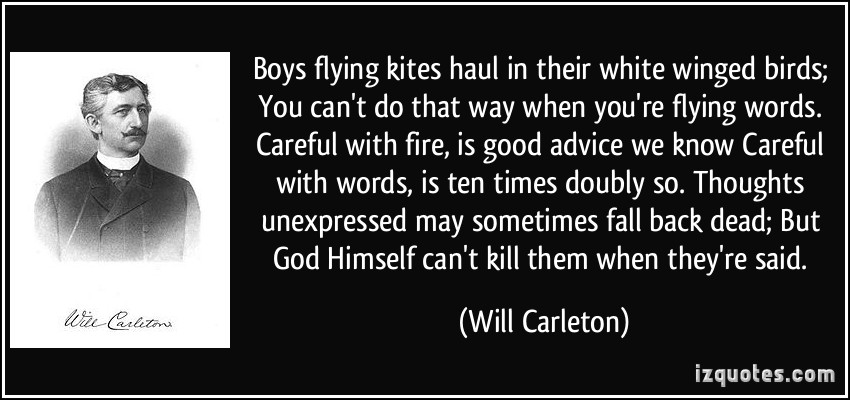
Yet, indignation should be tempered with realization.  Few have so mastered the tongue that they are above the fray we mention here.  Let’s be convicted to practice saying good and kind things behind each other’s backs. Remember to investigate before you propagate, and even then only carefully and prayerfully. Usually, prayer and care will render the “juicy tidbit” dead on the floor of your mind, safely unspoken and incapable of doing any harm. Remember the famous words of 19th Century Michigan poet Will Carleton: “Boys flying kites haul in their white winged birds; You can’t do that way when you’re flying words. Careful with fire, is good advice we know Careful with words, is ten times doubly so. Thoughts unexpressed may sometimes fall back dead; But God Himself can’t kill them when they’re said.”

quote-boys-flying-kites-haul-in-their-white-winged-birds-you-can-t-do-that-way-when-you-re-flying-words-will-carleton-377399

The Art Of Conversation

Neal Pollard

With conversation, when both are active listeners, you are exchanging ideas. Along with this, there’s body language and tone of voice which give clues to what the words mean to the speaker. You negotiate, reason, affirm or deny, and continue through these patterns while discussing any number of subjects. This process is invaluable to building relationships, working together, and even evangelism. For all its advantages, social media lacks almost all of those dimensions.

MIT professor and psychologist Sherry Turkle, in the book Reclaiming Conversation (New York: Penguin, 2015), makes the case that we are talking more than ever but we’ve lost the art of conversation.  Turkle observes, “From the early days, I saw that computers offer the illusion of companionship without the demands of friendship and then, as the programs got really good, the illusion of friendship without the demands of intimacy” (7).  What demands? Paying attention, building trust, having empathy, and giving thoughtful responses (as opposed to rude, reckless ones). 

I’m not trying to militate against the use of social media platforms, texting, or emailing. But the more we gravitate toward those to do our “communicating,” the less we successfully navigate the more difficult, yet more rewarding, art of conversation.

When we read the Bible, we are struck–from beginning to end–with the pervasive importance of dialogue and conversation. From Genesis one, where we read the Godhead’s conversation, “Let us make man…,” to Jesus’ conversation with John in Revelation 22, conversation is indispensable. Not only did God create interpersonal relationships and the vehicle of conversation to build them, but He models it throughout the pages of Scripture.

This article seeks to inform, teach, and even persuade, but it is only one dimension of communication. One might argue that other forms of communication are not only necessary, but in many cases will be more effective. The snippets and soundbites of social media postings, much more condensed and lacking context, while being pithy and thought-provoking, are no substitute for what happens face to face in the tension, hard work, and unpredictable dynamic of conversation. Conversation necessitates practice, attention, and mental engagement. 

From the dawn of time, God observed that it’s not good for man to be alone (Gen. 2:18). As suggested by the title of another book by Turkle, Alone Together, we find ourselves increasingly isolated from others and more ill-equipped for building real life relationships. The antidote to that is simple and so attainable.

Let’s engage people more. Let’s resort more to making real life connections and less to hiding behind screens. Let’s look for opportunities to do this with friends, acquaintances, and strangers. Let’s connect more in real life. As with anything, the more we practice the better we’ll get at it. 

36061_1459393010529_4771877_n
Photo credit: Michael Hite