To Be Like Obed-Edom

Neal Pollard

When studying 2 Samuel 6, we most often reference Uzzah (or even Ahio or David). Yet, there is another man who we rarely talk about in that incident. After the failed and fatal attempt to move the ark of the Lord by ox cart, “David took it aside to the house of Obed-edom the Hittite” (10). The ark remained at his house for three months (11). Nothing is said of Obed-edom’s character per se. We know he was a Levitical gatekeeper (1 Chron. 15:18) and later appointed a minister of the ark (1 Chron. 16:5), but we are not told why he was appointed to these roles. As much as anything, it was likely a matter of ancestry.

But there is no mistaking what happens in those three months the ark resided in his house. Scripture says that “the Lord blessed Obed-edom and all his household” (2 Sam. 6:11b). Again, David reflects on the situation, with others affirming to him, “The Lord has blessed the house of Obed-edom and all that belongs to him, on account of the ark of God” (2 Sam. 6:12a). This news made the king glad (12b).

There are some encouraging truths gleaned from this brief notation in Scripture.

  • Blessed is the home where God’s presence is found (Psa. 128:1-4; Prov. 3:33; 14:11).
  • Scripture tells us that where the Lord is, there is not only blessing (2 Sam. 6:11-12), but peace (Num. 6:24-26), light (Psa. 36:9), refuge (Psa. 46:1), joy (Psa. 16:11), strength (Isa. 41:10), and freedom (2 Cor. 3:17).
  • Others are encouraged when they see the impact of God in our homes (cf. 1 Pet. 2:12; Acts 10:1-2).
  • The Lord actively works for good in our lives and even our possessions where He is the heart and center (Matt. 6:33).
  • When others see God doing good in our lives, they are encouraged to do good, too (Psa. 40:1-3).
  • We should be one whom others think to entrust with spiritual things–David chose Obed-Edom’s house (cf. 2 Tim. 2:2).

This account is not at all about Obed-edom as we have no further insight into his character. It is about the power of the presence of God in the home. God blesses and enhances every home where He is made to be at home. We bless everyone and everything in our home when God is firmly and visibly there! In this way, may we all strive to be like Obed-edom.

Am I A “Seeker”?

Neal Pollard

In the Sermon on the Mount, Jesus states a simple but profound truth: “Ask, and it will be given to you; seek, and you will find; knock, and it will be opened to you” (Matt. 7:7). This is a promise! For our particular focus, notice the middle promise. If you seek, you will find! Seeking implies striving to find for one’s own interest or advantage. 

We often talk about someone who has yet to obey the gospel but who is looking as a seeker. That seems to be the thought shared by Jesus here. But seeking does not end at the baptistery steps. It is a lifestyle, an ongoing decision that may be challenged by distractions and substitutions. There are other things people seek–worldly wisdom (1 Cor. 1:22), their own righteousness (Rom. 10:3), self-interest (1 Cor. 10:24; 13:5; Phil. 2:21), pleasing men (Gal. 1:10), glory from men (1 Th. 2:6), and similar poor alternatives.

But God is seeking those who keep seeking Him and what He offers. This extends beyond the process of becoming His child. Various New Testament writers describe the seeking life.

  • Seek Christ’s kingdom above material things (Mat. 6:33).
  • Seek the glory and honor and immortality that God offers (Rom. 2:7).
  • Seek souls that can be saved (1 Cor. 10:33). 
  • Seek to use your gifts for the strength of the whole church (1 Cor. 14:12).
  • Seek the realities of heaven (Col. 3:1). 
  • Seek peace and pursue it (1 Pet. 3:11).

“The word implies serious effort, and can be used of seeking information (e.g., John 16:19) and of seeking to perform an action” (Luke 6:19)(Mangum, Lexham Theo. Wdbk., np). Have you ever searched for something valuable you owned but misplaced? The greater its value to you, the more intense and sustained your search. What Jesus offers is worth more to us than the whole world (cf. Mat. 16:26)! He wants us to have and keep a mindset that never ceases from serious effort to pursue. How can we be a daily seeker?

  • Include it in our daily prayers, that we will seek God’s will each and every day.
  • Be bold enough to make uncomfortable choices that accomplish His will.
  • Look for people who need His saving gospel and share Him!
  • Keep earthly interests and material things in their perspective, as tools to use for God’s glory and not idols to displace Him.
  • Put Him above every relationship, which means letting no relationship cause us to live contrary to His will or disobey His Word.
  • Do not let the world do our thinking for us on any moral, ethical, or similar issue.
  • Immerse ourselves in His Word, feeding and nourishing not only our soul but also our resolve.
  • Live joyfully, demonstrating thanksgiving for God’s good and perfect gifts.
  • Keep adding to this list!

What Will Others Say Mattered Most To Me?

Monday’s Column: Neal At The Cross

I have preached nearly 100 funerals in my 31 years of full-time preaching. That includes funerals for still-borns all the way up to those 100 years old. It includes services for those who committed suicide or died in accidents, but also a great many who were able to prepare for the process of dying. 

In the course of sitting down with families who have just lost a loved one, it is commonplace to talk about the deceased. Sometimes, I have known and been closely tied to the one whose service I was doing. Other times, I have not known them well and it is not uncommon to perform a service for someone I’ve never even met. Meeting with the family is a great way, especially in these situations, to find out who their loved one was. 

The longer they talk and the more they say, the more clearly they paint a picture of what the dear departed prioritized. The stories center around that theme. All of them want the preacher to know some “faith fact(s)” about them–they were raised in the church, they believed in God, they read (or had) a Bible, etc. Some of them have an abundance of stories about a Christ-centered life. All roads seem to lead back to that: Family stories, work stories, and church stories. 

Sadly, others paint a picture of other things predominating their time, passion, talent, and interest. At a time when people are going to say the nicest things about a person, they are also going to give away what mattered most to them–during the visitation, before, during, and after the service, at the graveside, and otherwise. It always happens.

Most days, our funeral is the farthest thing from our minds. We are busy living life. Yet, we are building, day by day and decision by decision, what our legacy will be. In the book of Ecclesiastes, Solomon talks about the many things that are “vanity.” He uses the word 38 times in 30 verses, at times using the phrase “vanity of vanities” to express utter futility and worthlessness. Work, knowledge, pleasure, competition, money, everything, apart from God, is like chasing the wind. 

At the end of his sermon, this wise king says, “The conclusion, when all has been heard, is: fear God and keep His commandments, because this applies to every person. For God will bring every act to judgment, everything which is hidden, whether it is good or evil” (12:13-14). What an encouragement to you and me to build a God-centered legacy. That requires embracing what Jesus taught, to seek first God’s kingdom and His righteousness (Mat. 6:33). Don’t we want others, most importantly God, to say, our faith defined us? Nothing matters more! 

Neal Pollard

Altars And Allies

Monday’s Column: Neal At The Cross

Neal Pollard

Israel had made political and religious decisions, all of which showed they had left God for the world. Hosea addresses these in Hosea 8. Their national and spiritual interests were to make treaties “among the nations” (10) and make “idols for their own destruction” (4). God did not recognize Israel’s kings and princes (4). 

As irrational as Gomer’s decision to leave the love and provision of Hosea for lovers who used and abused her, Israel’s apostasy was self-defeating. On the surface and at the moment, it may have seemed alluring and promised satisfaction. But they were setting themselves up for hurt and failure. Look at how the inspired prophet evaluates their decisions:

  • They were carrion for the vulture (1).
  • They were incapable of innocence (5).
  • They sowed the wind, and they were going to reap the whirlwind (7).
  • They were swallowed up (8).
  • They were a useless vessel (8).
  • They were a wild donkey wandering alone (9).
  • They were going to writhe in oppression (10).
  • They had erected multiplied altars for sinning (11).
  • They regarded God’s laws as a strange thing (12).
  • They were going to return to a state of bondage (13).
  • They were going to be devoured by fire (14).

It must have pained Hosea to write those words. No doubt, it pained God to have to say them. But, Israel persisted in her unfaithfulness. What was it like for God to look down, day after day, only to see that His chosen people paid no attention to Him. He never entered their thoughts. They pursued a path He knew would only lead them to hurt and destruction. They sought protection from fallible, wicked people. They offered praise to vain, lifeless idols. All the while, their Creator and caregiver was there wanting to be their shield and salvation! 

The application may be obvious. We have the same choices today. We can put our trust in our country and we can make something (work, relationships, pleasure, etc.) the object of our affection in place of God. We may, like Israel, still come to worship (13), but spend our lives with something else laying upon the altar of our heart. That was the condition addressed by Hosea. That was what God illustrates through spiritual adultery. God is belaboring the point, but it’s an eternally important one. He wants us to get it because He loves us so much! 

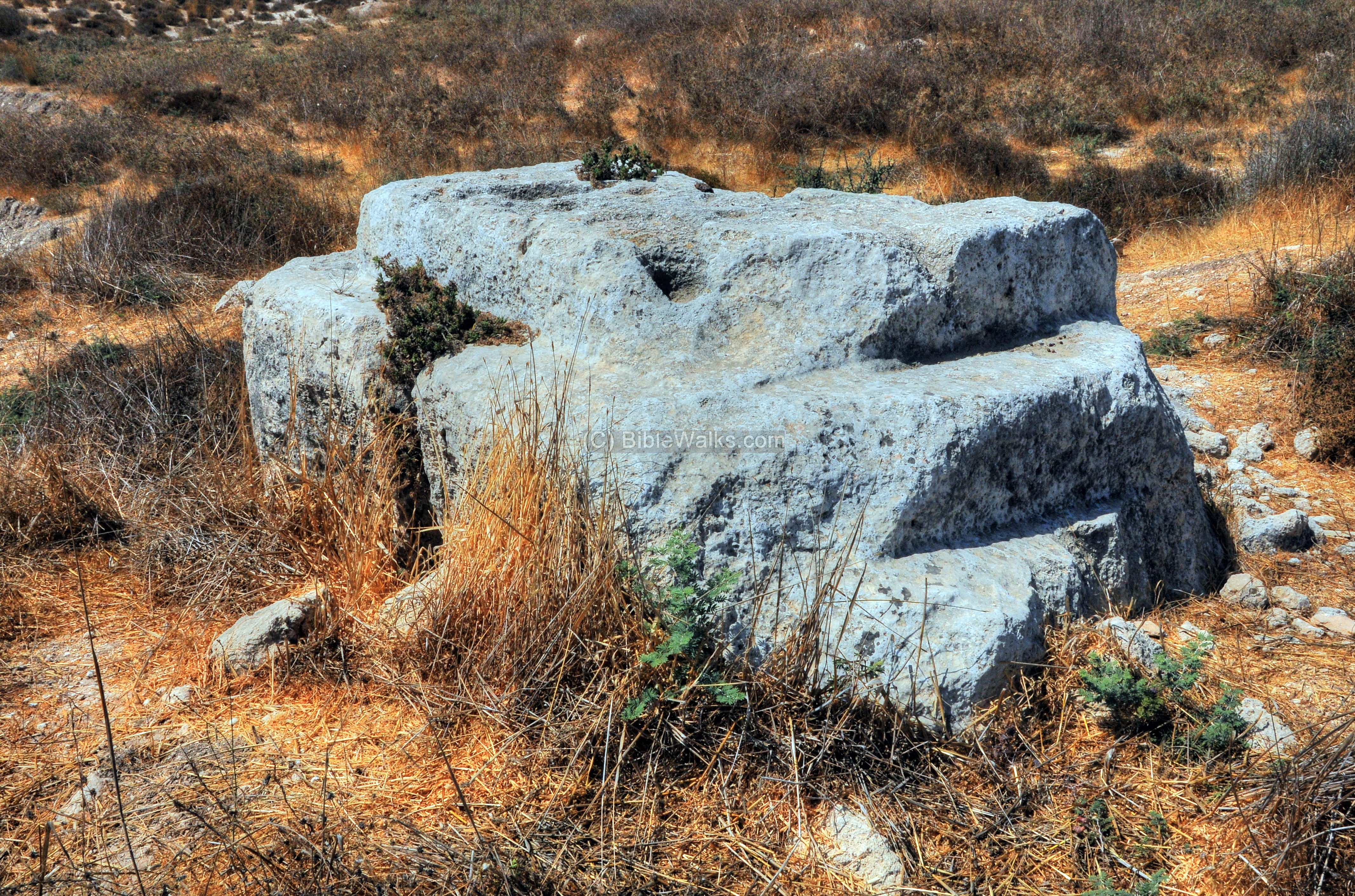
Ancient altar discovered at Manoah (via Biblewalks.com)

Make God A Priority

Friday’s Column: Captain’s Blog

pollards10

Carl Pollard

There’s a story told of four men that went into the woods on a deer hunt one morning. The men split into groups of two and set out for the day. When evening rolled around, 2 of the 4 hunters had already returned and set up camp and were waiting on the other 2 men to return. Hours passed by when finally one of the hunters staggered into camp carrying a massive 8 point buck. The hunters asked where the other guy was, and the man answered and said, “He had a stroke earlier and is a couple miles up the trail.” The men are shocked and they say, “Why did you cary the deer back and leave your friend?” The hunter paused for a moment and said, “Well…I didn’t want my deer to get stolen.” 

Sometimes in life our priorities can get a little mixed up. Maybe not to the point where we would choose a deer over a person, but nevertheless, each one of use is prone to lose focus. The definition of priority is “something that is regarded as more important than another.” For example, when you choose “priority shipping,” it is regarded as more important by the postal service and reaches its destination quicker. The things that we prioritize are the things that take up the majority of our time, money, and effort. A student trying to get a good grade will make studying their top priority. A football player that is trying to be the best will make training, exercise, and memorizing the team plays a top priority. And so it is with any aspect and profession. 

There is revealed to us a top priority for us as christians in God’s Word. In Matthew six Jesus is just about halfway through His sermon on the mount when He turns His focus onto the subject of worry in verse 25. He says multiple times “do not be anxious.” And He goes on to give us a reason why. Jesus explains that God’s care for us is our reason for not worrying. We are more valuable than grass and birds. Therefore do not be anxious. God values us infinitely more than birds and flowers. It is at the end of this section that we find our priority. Verse 33 says, “But seek first the kingdom of God and his righteousness, and all these things will be added to you.” 

According to this verse, what is it that we should make a priority? What should we be putting our energy and focus into? The kingdom of God. “Seek first” literally means to “chase after.” Jesus tells us that we are to be in constant pursuit of the Kingdom. This means we are actively chasing and longing for it. Not just the kingdom of God, but also HIS righteousness. Not our own, but God’s. This is accomplished through constant prayer and daily scripture reading, continuous reflection and growth, caring for those around us and copying the mindset of Christ in everything. 

Make God a priority, and the worries of this world will be taken care of. Chase after God and He has promised to take care of us. 

kisspng-royalty-free-corporation-clip-art-light-priority-5add0df1b76503.0275899515244364657512


WHAT WOULD I GRAB?

Monday’s Column: Neal At The Cross

pollard

Neal Pollard

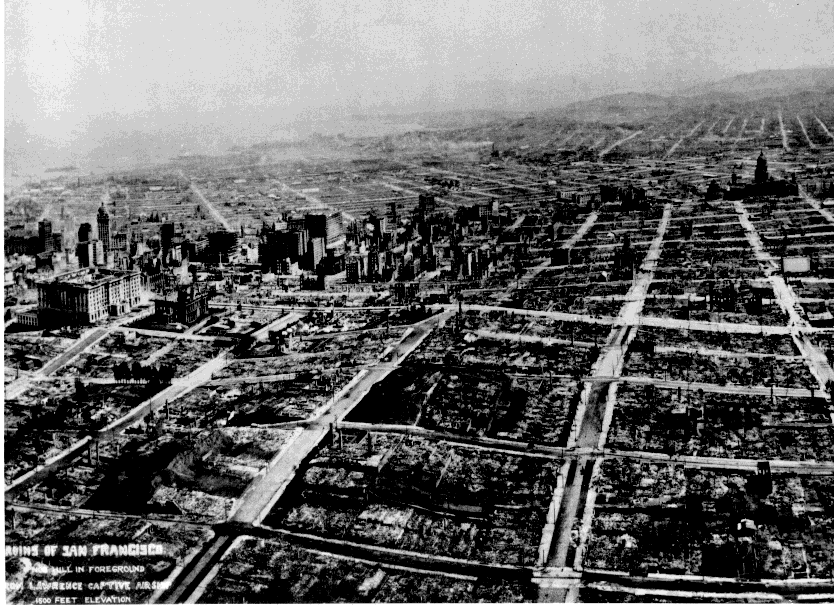
John Castillo Kennedy writes a riveting account of the fire that swept through San Francisco in the wake of the catastrophic earthquake that struck on April 18, 1906. The earthquake and resulting fires, which killed 3000 people, destroyed 80% of the city. Among the dead was the city fire chief. Firefighters, unaccustomed to using dynamite to create firebreaks, caused several of the fires. 

At one point early in the fires, according to Castillo, the spread of the flames surprised people living along Pine, Bush, and Sutter Streets, forcing them to flee immediately. They had been confident that the flames would not reach them there. The author says,

“Quickly filled trunks grated up the hills. Wagons, mostly pulled by men, rattled over the rough cobblestones. Baby carriages and toy express wagons rolled along packed full with the ‘things’ people had snatched up in the flight. Pianos were bumped along the sidewalks–some went to pieces in the process. Sewing machines slipped along on their rollers with stacks of bedding and the like lashed to them. Women had their valuables on their person, or carried trinkets Gypsywise in handkerchiefs. Men wore columns of hats five-high. Some carried only a book. Parrots jabbered and scolded from many cages. Some people had blankets. Girls usually had bandboxes. Boys stretched poles between them and carried, suspended there, bundles of clothing and provisions. Once it was only a ham” (83). 

These panic-stricken people, with no time to prepare, reached for the thing that had the most practical or sentimental value to them. Something made people faced with total loss and threat of life to lug heavy items or pets or food. Many of the choices seem irrational. Perhaps they were in shock or acting in impulse. In essays and contests asking people what they would grab if their house was on fire and they could only grab one thing, they have cited passports, wills, legal documents, insurance policies, personal papers, portable hard drives, phones, etc.

I’m trying to put myself in their shoes. If I was in one of the many neighborhoods forced to flee my home with no time to spare, what would I have been sure to grab? How long would it take my mind to settle on sentimental family items like old photos, my wedding video, or the boys’ baby books? Would I be relieved if I could make it out with my Bible, though I saved nothing else?

I do not judge those folks with their bizarre, split-second decisions. For some reason, it just made me do some introspection. What does my priority list look like? What do I value most in my life and in my home? What would I try to be sure to preserve?

Perhaps the answers to those questions is best provided by my choices in ordinary, every-day actions. I want my wife, children, fellow-Christians, and, most of all, my God to see from my life that they come before the things of this world. The things will all ultimately burn (2 Pet. 3:10). It is the relationships that will outlast the final, global conflagration. I pray that my influence and example will save them from the fire (Jude 23).  

Reference: Kennedy, John Castillo. The Great Earthquake And Fire: San Francisco, 1906 (New York: William Morrow and Co., 1963). 


Surrounded by Orange Daylilies

Friday’s Column: Supplemental Strength

81121814_2462862270639428_5746232403106463744_n

Brent Pollard

Driving along the highways of north Georgia and western North Carolina, there is one flower that stands out, the orange daylily. I look forward to seeing them every year. However, I recently discovered daylilies are not even native to North America. The daylily, which, despite its name, is not a lily, is a native of Asia. At some point, merchants traveling the silk road brought them back to Europe. Later, when Europeans settled in the “New World,” they brought the daylily bulbs with them. Yet, they have become so common here that among their colloquial names is the designation of “ditch lily,” since they have become a ubiquitous feature along highway shoulders and medians. Some do still plant them purposefully, but it is not necessary unless one wants them in a specific location. It is as if some unseen John Chapman, but of the daylily bulb, travels the rural countryside of Appalachia, planting these flowers. It can be bad enough in some locations for the pretty flower to be labeled as “invasive,” since it chokes out local flora.

I’ve already mentioned how I am partial to daylilies, but the world would be less exciting and beautiful if all I saw were the orange daylilies wherever I looked. I understand that other flowers are needed to complement and balance this resilient flower.  I need purple lupines, red roses, and yellow black-eyed Susans too. When it comes to the daily living of our lives, we need such variety also.  Frankly, the only constant should be the “the true bread out of heaven.” Otherwise, our lives will become as dull as a world of but orange daylilies.   Paul reminds us, “Finally, brethren, whatever is true, whatever is honorable, whatever is right, whatever is pure, whatever is lovely, whatever is of good repute, if there is any excellence and if anything worthy of praise, dwell on these things.” (Philippians 4.8 NASB). There is no doubt that the items on Paul’s “focus list” are related and flow from one another. Of a truth, we can describe God using each of those words. Even so, there remains variety, even in the ways we choose to look at God. Do I want to focus on His love? His grace? His justice? His mercy?

“Orange daylilies” surround us in our life’s journey. It is the “news junkie” regurgitating cable news talking points, especially when his or her interpretation of “facts” is different from our own. It is the brother or sister who always has something negative about which to talk, especially the injuries he or she perceives to have suffered. It is the enthusiastic fan who regales us with the latest news from his or her fandom. It is the brother or sister in Christ weaned on a pickle, unable to find joy in life. Again, we do appreciate the orange daylilies for their worth. They have their beauty.  But if we only surround ourselves with them, it chokes out the other “flowers” we want to bloom as well. Consider that also about yourself and your topics of conversation and demeanor when around others. Adopt the attitude of Christ and work to be someone’s red rose or purple lupine even on those days you only feel like being an orange daylily too.

daylily-4590386_960_720

Cultivating Your Spiritual Garden 

Friday’s Column: Supplemental Strength

brent 2020

Brent Pollard

Wisteria is beautiful. Despite its beauty, though, wisteria can be an invasive vine if it is not carefully cultivated, becoming genteel kudzu. As I had to go to a doctor’s appointment in Gainesville, Georgia, yesterday, I noted how much wisteria grows around that city. For the most part, it was not managed well. Thus, you would see azalea bushes or maple trees with purple flowers choking them out. However, if you take the time to train the vine, you can make a stunning addition to your garden with wisteria. One popular way of taming wisteria is having it run along an arbor creating a tunneled walkway through the blooms.

 We have other things around us that act a lot like wisteria. These are things having the potential to be something helpful or enjoyable, but which end up being deleterious to our spiritual health because we do not manage them well.

Becoming distracted by doing good is one such type of spiritual wisteria. When Jesus was with his dear friends in Bethany, Martha wearied herself seeking to be an excellent hostess. She asked Jesus to rebuke her sister, Mary, for not helping her prepare. Since Mary was listening to Jesus teach, He said she was doing what was necessary (Luke 10.39-42). It is a good thing to be hospitable. We note that the need to be hospitable is one of the qualifications for an elder (1 Timothy 3.2; Titus 1.8). However, one’s priority is the kingdom of God (Matthew 6.33). Thus, even in having a desire to do a good thing, one may be overwhelmed and end up missing out on opportunities for spiritual growth.

Social media is another type of spiritual wisteria. During this period of social distancing, I’ve noted how many more brothers in Christ are utilizing Facebook and YouTube to put out encouraging and convicting lessons from God’s Word. Congregations are streaming “virtual worship services” for homebound people to participate in. It excites me that we might be seeing the beginnings of the “Third Great Awakening” in the United States as people realize they have ways of expressing their faith which has nothing to do with a building. Even so, I note that with people using social media even more now (if such a thing is possible) it likewise gives rise to a lot of things that ultimately detract from spiritual growth. People are also posting depressing or rancorous things. You still see lewd jokes and double entendres. We need to ensure that our use of social media at this tend helps us to serve as salt and light in this world so God can be glorified (Matthew 5.13-16).

 You may have noted other types of spiritual wisteria I have not included. We want to emphasize that this “wisteria” in and of itself is not a bad thing. It is, rather, that a failure to discipline ourselves allows for this good thing to lessen its value.  You must put forward the effort to properly utilize and enjoy physical and spiritual wisteria. You must do the same thing when it comes to cultivating a beautiful, spiritual garden pleasing to God (cf. 1 Corinthians 9.24-27).

wisteriatunnel

The Mouse And The Cups 

Thursday’s Column: Dale Mail

83538761_557569434843824_1603081807199207424_n

Dale Pollard

In the pantry there’s a package of white foam cups. A small gray mouse struggles to carry a cup out into a man’s front yard one at a time. Just one cup and one each day. The man sticks to a normal routine. He goes to work early, and he comes home late. He watches TV, cooks a meal, tinkers on projects in the garage, and goes to bed. It’s mindless, it’s robotic, but day in and day out the cycle repeats itself. He leaves for work and the mouse drags yet another cup out onto his lawn. It isn’t until his yard is filled with foam cups that the man takes notice. What a mess! He walks through the yard and picks a few of them up. As he examines them he says, “What a waste. Perfectly good cups, now useless and dirty. We have a limited amount of foam cups in our package, and there’s a day when the mouse will grab the last one. We better put them to use. ”

If God came to you and gave you the chance to make a single request, what would you ask for? Our prayer lives are usually filled with our personal wants and needs. There are countless things that tug at different areas of our heart as we approach our Father, the Creator of the universe. He can do anything, He has all the power, and in one way or another we all desire some Divine intervention. I would like my family to be healthy and happy. I would like to live out the rest of my days with no more worries or anxieties. I would like the peace that comes with total financial stability. I wish my dog would live to be one hundred and five. I would like to be successful in everything I put my mind to.

There are five hundred wants in my heart, but what do I desire more than anything? The answer to that question is deeply connected to our spiritual life. What my heart chases after, where my time and energy goes, and even what I ask God for spreads my top priorities before me. David writes in Psalm 27:4, “One thing I ask of the Lord, this is what I seek. That I may dwell in the house of the Lord all the days of my life, to gaze upon his beauty and inquire in His temple.” David is known as the man after God’s own heart, simply because his heart was after God. David’s one desire was to form a deep and meaningful relationship with God. He understood what truly matters in this life. He even makes that his specific and singular request of the Lord. He puts his faith in action as he seeks that relationship with God. His life was built around this, and everything else is secondary to him. His seeking was that hopeful expectation— the effort he put in to this pursuit was a demonstration of that belief in God’s ability to grant him his one thing. David spent his time wisely. Almost every day that was granted to him he used as an opportunity to seek His Lord.

God is the Alpha the Omega, the beginning and the end. His eyes can see the very point in time in which He decided to create everything. He can also step back and look at His timeline and see the exact moment in which He will bring all things to an end. The Bible is a gift and glimpse into His mind. In it we can see the powerful beginning to the world we live in. We can see how God works in our present, and we can read about a grand event that will come when the days run out.

What is that one thing you want more than anything else? Don’t let the cups pile up in your yard. Let’s all use the time we have to pursue the only thing that matters.


racing-mouse-3499446_1280

Knowing What D.C. Stands For

Neal Pollard

Inasmuch as we don’t want laws or policies enacted that violate God’s Word and we want precious freedoms, especially religious ones, preserved and protected, we can really get into what is going on in Washington, from Capitol Hill to Pennsylvania Avenue. Many know that “D.C.” is an abbreviation for “District of Columbia,” an area of land created at about the time of our nation’s founding under the direct jurisdiction of the U.S. Congress that is not a state.

However, as politics has vied for sports and entertainment as an idol in our culture, it has become the source of unnecessary and even immoral strife between Christians. Blind support and allegiance for one major political party or the other can do more than make us inconsistent. It can make us a stumbling block. It seems to me that D.C. can stand for some dangerously different things.

Distracted Christians. Search high and low in your New Testaments, written during the time of the wicked, often unfair-to-Christians, Roman Empire.  The disciples were about the business of evangelism (Acts 8:4) and growing the church (Acts 6:7). Can the rumblings and drama from the nation’s capitol get us so transfixed that we cannot see past it or through it to our individual and collective mission as God’s people? He has us here to get people into the Kingdom of His dear Son (Col. 1:13). Everything else is secondary. 

Divided Churches. For as long as I’ve been preaching, I’ve seen politics come between brethren in the local church. Thankfully, it does not usually become significant enough to trouble the entire congregation but I have seen it do so. What’s more, I’ve seen brothers and sisters become so confrontational and flagrant about politics–especially through the relatively recent medium of social media–that it has been a stumbling block to new and weak Christians. Perhaps the political world in our country has never been so intensely divisive as it currently is, and what typically troubles the world troubles the church. But, when souls are negatively impacted, God will hold the offenders accountable. 

Devil’s Cauldron. Please don’t misunderstand. Politics, like money, is a neutral matter. But, like money, it can become the root of all sorts of evil (cf. 1 Tim. 6:10)–enmities, strife, outbursts of anger, disputes, dissensions, and factions (Gal. 5:20). Just prior to this list of activities that are the carrying out of the desires of the flesh (Gal. 5:16), Paul warns, “For the whole Law is fulfilled in one word, in the statement, ‘You shall love your neighbor as yourself.’ But if you bite and devour one another, take care that you are not consumed by one another” (Gal. 5:14-15). Who benefits when things like politics distract and divide Christians? It is not the lost, the church, or the Lord!

I can think of a least three godly, wonderful Christians who are public servants in political office and making a profound impact for good–Bill Reiboldt, Sheila Butt, and John DeBerry. They demonstrate that God’s people can devote themselves to politics without sacrificing their faith and example. For those of us “on the outside looking in,” in our love of country and freedom, may we never allow our attitude, words, or actions to betray our highest calling. The more effectively we reach lost souls, reflect the mind of Christ, and reveal the hope of the gospel, the better our nation (and world) will become. What will that make us? Disciples of Christ!

11168488_10153052239815922_846243704468580330_n
From my last trip to Washington, a few summers ago. 

From The Pollard Poetry Archives (I)

“What Is Important?”
Neal Pollard
(11/10/96)

there is much this world crowns king
And before them all they fall
Mere trinkets and perishable things
Upon these they in foolish faith call.

Don’t they know how vainly they plead
Who stake their dear soul in the finite?
They don’t know that they cannot succeed
Without investing their all in The Light.

For far above treasures and pleasures
Lie important and life-changing values,
Like children and peace beyond measure
And love and the gospel’s Good News!

Distracted, discouraged, and drained?
Oh friend, here is what you must do–
Die to the world and the vain
And live for the Lord who loves you!


My Daily “To-Do” List

Neal Pollard

  1. Be Productive With Your Time (Eph. 5:16).
  2. Be Pure In Your Heart (Mat. 5:8).
  3. Be Proactive In Your Relationships (Eph. 5:21-6:4).
  4. Be Peaceable With Your Provokers (Rom. 12:17-21).
  5. Be Purposeful With Your Life (Rom. 8:28).
  6. Be Praiseful With Your God (Psa. 150).
  7. Be Pleasant In Your Demeanor (Prov. 16:24).
  8. Be Prayerful In Your Decisions (Phil. 4:6).
  9. Be Patient In Your Challenges (1 Th. 5:14; Psa. 37:7).
  10. Be Positive About Your Future (Phil. 1:20-21; 4:13).
  11. Be Persistent In Your Evangelistic Pursuit (1 Cor. 9:19-22; Mat. 28:19).
  12. Be Pitying Of The Downtrodden (Prov. 19:17).
  13. Be Picky About Your Associates (1 Cor. 15:33).
  14. Be Passionate About Your Spirituality (Rom. 12:11).
  15. Be Perseverant In Your Trials (2 Th. 1:4).
  16. Be Prospective In Your Opportunities (Gal. 6:10).
  17. Be Petrified Of Falling Away From God (Heb. 6:1-6; 10:26-31).
  18. Be Powerful In Your Faith (Luke 7:9; 2 Th. 1:3).
  19. Be Persistent In Your Study (2 Tim. 2:15).
  20. Be Penitent In Your Sins And Failures (2 Cor. 7:10; Acts 3:19).
  21. Be Plentiful In Your Gratitude (1 Th. 5:18).
  22. Be Permeating In Your Influence (Mat. 13:33-34).
  23. Be Profuse In Your Generosity (3 John 5; Prov. 11:25).
  24. Be Prolific In Humility (Mat. 23:12; 1 Pet. 5:5).
  25. Be Pining For Heaven (Heb. 11:16; Phil. 1:23).

to-do-list-tools

What We Know About Recently Uncovered Ancient Viking Treasure

Neal Pollard

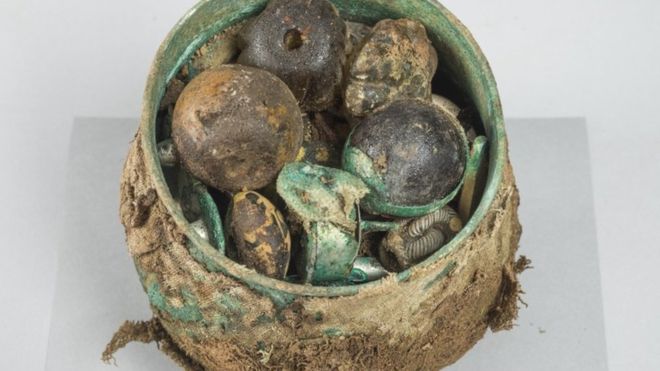
BBC reports that Historic Environment Scotland, Treasure Trove Unit, and the Queen’s and Lord Treasurer’s Remembrance’s conservation team have discovered an ancient Viking pot full of treasure, including six silver Anglo-Saxon disc brooches, a silver brooch from Ireland, Byzantine silk, a gold ingot, and gold and crystal objects wrapped in cloth bundles (read article here). The objects date from the 8th or 9th Century. The article goes on to tell us what the discover cannot tell us, at least without years of further research and theorizing. Stuart Campbell of the Treasure Trove Unit says, “”The complexity of the material in the hoard raises more questions than it answers, and like all the best archaeology, this find doesn’t give any easy answers. Questions about the motivations and cultural identity of the individuals who buried it will occupy scholars and researchers for years to come” (ibid.).

While we do not know whether the owner of this pot was a Christian or was more interested in laying up treasure in heaven, we do know that he (or she) was laying up treasure on this earth. We also know that this treasure did not continue to benefit the owner following his or her demise. The photographs released with the find also show that the objects have been worn and decayed with time.  It seems like a fitting illustration of what Jesus taught.

In the Sermon on the Mount, he wrote, “Do not store up for yourselves treasures on earth, where moth and rust destroy, and where thieves break in and steal. But store up for yourselves treasures in heaven, where neither moth nor rust destroys, and where thieves do not break in or steal; for where your treasure is, there your heart will be also” (Mat. 6:19-21).  He doesn’t condemn saving or even making money. He does continue to warn that one inevitably chooses God or money as master (Mat. 6:24). This find in Dumfries and Galloway, Scotland, reminds us of the ultimate futility in laying up treasures on the earth.  What’s held and hoarded isn’t stored in heaven, but it does reflect what’s in the heart. Later, Paul urges Timothy to teach the need to fix the hope on God rather than riches (1 Tim. 6:17).

It would be great to find out that this was the church treasury of a congregation of God’s people being taken and used to help the poor or preach the gospel or the personal portfolio of a person who put his riches to good use in the kingdom. It’s not statistically probable, but it’s possible. What I do know is that there is a Perfect, Heavenly Accountant who knows what we treasure most. May our legacy be that we “seek first the kingdom of God and His righteousness” (Mat. 6:33).

88913064_vesselwithlidremoved

A LOOK AT SOME GREAT MEMBERS

Neal Pollard

Anything special, big and worthwhile a church attempts, be it a new program, evangelism, visitation, the Bible School, or a lectureship, will fail if it rests only on the shoulders of the elders, preachers, or select few. The late Wendell Winkler was fond of saying, “Programs do not work. People do.” Programs are only as effective as the people in the local church work to make them.  It is estimated that nearly a gazillion little things must be done for something of any magnitude to go smoothly, and the active, tireless labor of as many as possible makes all the difference.

Active members are so crucial to a church being successful, in God’s eyes. Here is a tribute to some very special members of a congregation:

The REMEMBERS: These are the folks who don’t “forget” events on the church’s calendar, who don’t say “Oh, was that this week?”  As you involve yourself in the church’s work, you take seriously the ever-relevant principle, “But you shall remember the LORD your God…” (Deut. 8:18). God does not like to be forgotten (Psa. 42:9; Jer. 2:32; Ezek. 22:12).

The DISMEMBERS: These are folks who are willing to sever themselves from their normal routines, preempting other events, to support an activity or event.  Such are living out Matthew 6:33 and Romans 12:1-2. God richly blesses Christians who make such decisions.  You are those who know it is better to “cut off” anything that keeps you from doing what you can for the Lord (cf. Heb. 12:1).

The EMBER MEMBERS: These are members who are involved, supporting the works and activities of the church. You have your fire lit. You want to be a better child of God. Keep the fires of enthusiasm, rededication, and determination burning brightly. We see your glow. It encourages all of us. You can help smoke out spiritual enemies even better through your faithful participation.

God bless every faithful member of His church. Your support for good works is overwhelming.  Let us use each event and opportunity to make the church, with its every member, stronger.

How Much Will It Take To Make You Happy?

Neal Pollard

Well, according to a London survey, it takes–for the average person–about 1.5 million dollars to make one happy.  One NBC analyst says that by knowing you make more than the Joneses next door, you are likely to be quite happy.  As usual, we give our thanks to the experts.

Are they better informed than the Lord and the inspired writers? Jesus taught, “Beware, and be on guard against every form of greed; for not even when one has an abundance does his life consist of his possessions” (Luke 12:15). Your life does not consist of your possessions. Jesus warns us to ward off such thinking and the selfish, covetous behavior it spawns. He is saying, “You cannot measure who you are and what you are about by checking your bank balance.”

King David says, “Better is the little of the righteous than the abundance of many wicked” (Psalm 37:16). One might conclude from this that one, financially modest Christian is wealthier than all the worldly, howbeit financially richer neighbors. That runs contrary to NBC’s money guru, doesn’t it? What could be “better” than being financially set? Solomon says “the fear of the Lord” (Prov. 15:16).   He says “righteousness” is better (Prov. 16:8; i.e., upright character and moral living). He says “peace and quiet” are better (Prov. 17:1). He says “integrity” is better (Prov. 19:1). He says “love is” better (Song 4:10).

Heavenly standards are superior to those of earth’s sagest experts. Jesus identifies an extremely poor widow as one having more (in the ways that count to heaven) than the wealthiest citizens of Jerusalem in her day (cf. Mark 12:42-44). The world has its values turned upside down, and it seeks to sway the Christian’s thinking on the matter, too. Believe this.  Having more than your neighbor will not bring you lasting happiness, in and of itself. Seeing $1.5 million or more on your bank statement will not supply you the peace that passes understanding.  Don’t trust me. What do I know? Believe the Lord!


THE MASTER’S MATERIAL

Neal Pollard

A while back it was popular in the religious world to talk about Jesus’ encounter with two disciples on the road to Emmaus. The emphasis has often been on the disciples’ experience. I believe the biblical emphasis is on the character of Jesus. The disciples are contemplating Him even as they encounter Him. They describe Jesus as “a man who was a prophet mighty in deed and word before God and all the people” (Luke 24:19). Notice three reasons why He was so mighty in word before all the people.

JESUS KNEW HIS MATERIAL. Luke 24:27 says, “And beginning with Moses and all the Prophets, He interpreted to them in all the Scriptures the things concerning Himself.” Truly His knowledge is perfect and ours is not, but there is no excuse for failing to study–both on our own and for a class we are teaching or sermon we are preaching.

JESUS KNEW HOW TO RELATE ITS MEANING EFFECTIVELY. The men journeying to Emma’s, after walking with Jesus, said, “Did not our hearts burn within us while He talked to us on the road, while He opened to us the Scriptures?” (Luke 24:32). The dismal method of too many Bible classes is to essentially read and paraphrase in verse by verse fashion. Preaching can too often be disorganized in delivery or vague in message. Paul told Timothy, “Do your best to present yourself to God as one approved, a worker who has no need to be ashamed, rightly handling the word of truth” (2 Tim. 2:15, NIV).  Robertson says of “rightly handling” that it means “cutting straight…Since Paul was a tent-maker and knew how to cut straight the rough camel-hair cloth, why not let that be the metaphor?” (Vol. 4, 619). As presenters of truth, tell what it meant then and in context, and then apply it!

JESUS KNEW HOW TO MAKE THE MATERIAL LIVE IN HIS STUDENTS. Luke 24:45 says, “He opened their minds to understand the Scriptures.” That is just what we are after as teachers, preachers, and proclaimers of the Word. We are not just fact-reporting. We are trying to get into the heart. Remember that Jesus sought to change lives with His teaching.

Only Jesus was the perfect teacher. But we can always be better and great. Let us mimic the Master’s approach to His material!

Diversions, Distractions, Or Deviations?

Neal Pollard

All the following are legitimate outlets, kept in proper perspective:

  • Social causes and needs.
  • Politics.
  • Sports, recreation, leisure and fitness.
  • Wholesome forms of entertainment.
  • Family events.
  • Social media.
  • Socializing and fellowship with fellow Christians.
  • Church buildings.
  • Addressing controversial issues and false teaching.
  • Material possessions.
  • Hobbies.

But our common struggle is allowing these to eclipse our purpose on this earth as Christians.  Interestingly, they all can be utilized as part of our mission, but none were ever meant to replace it.  These activities can easily hinder our faithfulness and usefulness to the cause.  Will you pray for me to keep seeking and saving the lost at the top of my “to do” list of life?  I will do the same for you, if you let me know.  Let’s pray for courage, focus, discernment, resolve, and encouragement to take the gospel as we go about each day.  This is what energized the church in its infancy (cf. Acts 8:4).  They had access to the same distractions and diversions we do, but they could not be diverted from the prime objective. Consequently, we read throughout Acts of their exponential, if unlikely, growth.  May we help each other imitate their spirit and service!

Ready For A Trivia Quiz?

Neal Pollard

Here are the rules: Don’t use any resources to look up these answers.  This is a quiz to test your knowledge.

  1. What is Mark Zuckerberg best known for co-founding?
  2. How many regular season games are there in an NFL, MLB, and NBA season?
  3. What is the name of Apple’s media library, media player, and mobile device management application?
  4. What is Ree Drummond’s famous nickname?
  5. Captain America, The Hulk, and Iron Man are all part of a group of superheroes better known by what name?
  6. Which online social networking service restricts users to 140 characters or less?
  7. What is the name of the author of 50 Shades Of Grey?
  8. Name three different, major cell phone service providers.
  9. What is the name of the ABC television series that pairs professional dancers with celebrities who compete against each other?
  10. What is the name of the video-sharing website whose logo is a redbox with a play button symbol in the middle of it?
  11. What is the brand name of Wal-Mart’s generic line of food products called?
  12. What is the name of the website where users can upload, save, sort, and manage images (“pins”) and other media content in collections called “pinboards”?
  13. What upbeat 2013 song by Pharrell Williams lost its Oscar bid to the song “Let It Go”?
  14. What movie did the song “Let It Go” famously appear in?
  15. Name two major cable news networks.

Hopefully that was fun.  How did you do?

If you got 12-15 right, you are fluent in current culture.
If you got 8-11 right, you are passable in current culture.
If you got 4-7 right, you are possibly living on an Amish farm or serving a stint in solitary confinement.
If you got less than 4 right, you may not have a pulse.

(Note: measurements are strictly facetious and unscientific).

Now for a second quiz:

  1. In what Bible book is it said, “We brought nothing into this world, and it is certain we can carry nothing out”?
  2. What was King David’s father’s name?
  3. Name two sons of Jochebed.
  4. Joel, Haggai, and Hosea are all books of the Bible from what literary genre?
  5. What was the name of the hometown of the apostle Paul? What was the name of his famous teacher?
  6. What two men were considered to replace the apostle Judas and which one did God select?
  7. What was the name of the town where Jesus was born?
  8. On what island was the apostle John exiled?
  9. Name two righteous kings of Judah.
  10. What were the names of the rivers Naaman preferred over the muddy Jordan River?
  11. Name the books of the Bible commonly referred to as “the gospels.”
  12. What is another name for the deliverers of Israel whose ranks included Othniel, Tola, and Ibzan?
  13. Who penned the words, “Pride goes before destruction”?
  14. What Jewish sect who opposed Jesus also did not believe in the resurrection?
  15. Who penned the book of Acts?

How did you do on that test?  We absorb so much of the culture because it surrounds us and demands our attention. We see it, hear it, and are in so many ways surrounded by it. The Bible is something we must be intentional about. We must go to it and spend time in it.  When we do, we’ll grow in more than mere knowledge (cf. 2 Pet. 3:18).  We’ll be nourished (1 Tim. 4:6), delighted (Ps. 1:2), enlivened (Ph. 2:16), protected (Ps. 119:11), revived (Ps. 119:25), and sanctified (Jn. 17:17).  We’re not trying to win a trivia contest.  We’re trying to overcome the world and go to heaven.  Bible reading, studying, and meditation is key to that!  Spend some time in The Word today and every day!

Answers To The First Quiz:

  1. Facebook
  2. 16, 162, and 82
  3. iTunes
  4. “The Pioneer Woman”
  5. “The Avengers”
  6. Twitter
  7. E.L. James
  8. Sprint, AT&T, TMobile, Verizon, etc.
  9. “Dancing With The Stars”
  10. YouTube
  11. Great Value
  12. Pinterest
  13. “Happy” or “Happiness Is The Truth”
  14. Frozen
  15. CNN, Fox News, MSNBC

Answers To The Second Quiz:

  1. 1 Timothy (6:7)
  2. Jesse
  3. Moses and Aaron
  4. Prophecy (particularly, “Minor Prophets”)
  5. Tarsus; Gamaliel
  6. Matthias and Barsabbas; Matthias
  7. Bethlehem
  8. Patmos
  9. Hezekiah, Josiah, Asa, Jehoshaphat, etc.
  10. Abanah and Pharpar
  11. Matthew, Mark, Luke and John
  12. Judges
  13. Solomon
  14. Sadducees
  15. Luke

question marks

DETERMINED TO GET OUT THE NEWS

Neal Pollard

I spoke with our newspaper deliveryman this morning, and he had some story to tell.  He summarized his experience as the longest 15 hours of his life.  He got stuck once and had been towed twice.  He delivers his newspapers in a 2014 Toyota Camry, a front-wheel drive vehicle fighting against 10-12 inches of snow in a thousand cul-de-sacs.  Surprisingly cheerful, he was plodding on until finishing his task—delivering The Denver Post to every customer on his route.  That, my friend, is dedication!

As a former subscriber to the Rocky Mountain News and current subscriber to the Post, I cannot describe his product as “good news.”  With the internet competing, the newspaper is far from the exclusive or timeliest source of news.  That notwithstanding, this man is determined to get out the news.

The gospel is, by definition, “good news.”  Without a doubt, it is the most important and timeliest news of all time and eternity.  Every person needs to be exposed to it as it contains information that will impact where they will spend their forever.  God has given the job to you and me and every Christian in this nation and around the globe. Every day, we see people and relate to people on their everlasting journey.  They may or may not be oblivious to their need, but we are well aware of it.

Are we determined to get out the news?  The first century church was.  In bad times (Acts 8:4) or in good times (Acts 2:47), the news went near and far.  Paul described it as news which had reached every creature under heaven (Col. 1:23).  Christ commissioned that the news be spread to that extent (Lk. 24:44ff).  The challenge is great today, with over seven billion people on the earth.  But we have more resources than they did, and there are more of us, too.  The difference, then, may be the level of our determination.  Until we are determined to let nothing stop us from getting out the news, darkness will eclipse light and our challenge will grow.  Let’s let nothing stop us from sharing the great salvation of Jesus to everyone we meet.

“WINNING THE LOTTERY”

Neal Pollard

One of the most recent lottery winners, Jesus Davila, Jr., has an interesting backstory.  He once spent 12 years behind bars for the manufacturing and selling of cocaine, a felony.  This week, he claimed $127 million after taxes.  Sounds like a rags to riches kind of story, doesn’t it?  It is interesting, and not a little sad, to read about some past winners of the lottery:

  • Ibi Roncaioli was murdered by her husband after giving $2 million of her $5 million dollar prize to a secret child she’d had with another man (businessinsider.com).
  • Evelyn Adams won twice, in 1985 and 1986, winning a total of $5.4 million. She gambled it away in Atlantic City and lives in a trailer park today (ibid.).
  • Willie Hurt won $3.1 million in 1989, but spent it all on a horrible crack addiction, divorced his wife, lost custody of his children, and was charged with attempted murder (ibid.).
  • Victoria Zell won $11 million in 2001, but went to prison convicted of a drug and alcohol-induced car collision that killed one and paralyzed another (theatlantic.com).
  • Abraham Shakespeare won $31 million in 2006. He disappeared in 2009, after having spent most of his fortune. He was found under a concrete slab in 2010, a woman accused of fleecing him for nearly $2 million charged with his murder (ibid.).
  • Jack Whittaker, already wealthy when he won $314 million in 2002, suffered too many calamities to mention here, but they include the death of his granddaughter and daughter and being sued for writing bounced checks to casinos. He was quoted as saying, “I wish I’d torn that ticket up” (ibid.).
  • Bud Post won $16.2 million, but squandered it.  His brother was arrested for hiring a hit man to try and kill him. He died of respiratory failure in 2006, living on $450 a month and food stamps. He once said, “I wish it never happened. It was totally a nightmare” (cleveland.com).
  • Jeffrey Dampier won $20 million in 1996. In 2005, he was kidnapped, robbed and murdered by his sister-in-law and her boyfriend (ibid.).

To say there are mountains of additional, equally pitiful stories is to understate the matter.  Certainly, not every one who wins the lottery winds up on skid row or in the morgue because of it.  Yet, neither is it the panacea one might believe it to be.  How many others, who can ill afford to play, squander money on a regular basis in the hopes of striking it rich?  The overwhelming majority will never achieve that, but even many that do wind up worse than before they won.

In the ever-elusive search for happiness and satisfaction, mankind will come up empty when looking to material things for the answer.  Jesus taught that it’s a hollow pursuit (Mat. 6:19).  Paul says not “to fix their hope on the uncertainty of riches, but on God, who richly supplies us with all things to enjoy” (1 Tim. 6:17).  Jesus warned that your life does not consist of your possessions, even if you have an abundance of them (Lk. 12:15).  The good news is that there is a true treasure, one that never disappoints, that never depletes, and will never go away.  Peter calls it “an inheritance which is imperishable and undefiled and will not fade away, reserved in heaven for you…” (1 Pet. 1:4).  Strive to “win” that!

lotto-484801_640