The Truth Is Out There

Wednesday’s Column: Third’s Words

 

Gary Pollard

I believe that God exists. I believe that He communicated with His creation by direct contact, messengers, and a series of ancient texts. I believe that He wants His human creation to be with Him after they die. I believe that He expects those who claim to be His to act within the guidelines He set in those ancient texts. I believe that there is life after death and that where we go depends on whether or not we follow this God.

Why do I believe this, though? What reason do I have to believe in something I cannot experience with my senses? I was not there thousands of years ago when the prophets and Hebrews talked to God. I was not there when God came here to teach. I was not there when the authors of the original texts delivered their writings to the early church. The ancient texts translated into English sometimes do not effectively communicate the emotion of the words and concepts in the original language. So why do I believe these things? Why do you believe these things?

Think about this carefully. From Genesis to Revelation the message is clear: God wants His people to exist with Him after time is destroyed. This message was communicated to an impossible variety of people, sometimes separated by hundreds of years, thousands of miles, culture, kingdom, race, and language. There are tens of thousands of manuscripts of these ancient texts in many, many different languages. There are some 25,000 New Testament manuscripts or fragments that are separated by about a thousand years, at least 8 different languages, thousands of miles of geography, and many different cultures. Yet, they are at least 95% accurate to each other. The remaining 5% do not contain a single contradiction; rather, they are spelling errors, slips of the pen, writing on the wrong line, or minor variances (“God said” vs. “He said” or “and” vs. “but”).

Of the rich libraries we have of ancient literature, none can hold even the dimmest candle to the profound accuracy and unity of the scriptures. They could not have been produced by man alone. There had to be Someone not confined by time supervising each person as they wrote. Keep in mind, these ancient cultures did not have the advantage of modern communication. They were almost totally isolated from each other and would have known little of the others’ existence, much less what they experienced or wrote from God. Our Bible has supernatural origins and its contents reveal the nature of our Creator. What I believe comes from this book because I know it is God’s message to mankind. I encourage those who have not already done so to do an in-depth study of the origin of scripture. It is one of the most faith-building studies anyone could undertake. When you know with certainty that what you are reading contains the actual thoughts and desires of God, it bolsters your faith in ways I could not begin to adequately describe.


Noting God’s Glory on a Cold Day 

Friday’s Column: Brent’s Biblical Bytes

81121814_2462862270639428_5746232403106463744_n

Brent Pollard

“The heavens are telling of the glory of God; And their expanse is declaring the work of His hands.” (Psalm 19.1 NASB1995)   

A cold wind bit my exposed skin as I walked to the mailbox. Three cats wove between legs desiring a petting. I wanted to hurry back to the house but feared inadvertently kicking one of the lovable, purring furballs. I carefully made my way from the shadow into the direct sunlight. I felt the warming rays of the sun on that same exposed skin. I closed my eyes but could still sense the bright light of that gaseous ball some 92 million miles away. As I coaxed the cats back up to the house, I contemplated our life-sustaining star.  

How is it that we happened to find ourselves in the “sweet spot” in our proximity from this sphere of hot plasma? Were we any closer, the conditions on earth might prove too hot to support life. Were we any further away, the conditions on earth might prove too cold to support life. If you do any searching into this happenstance, you will encounter the expression “Goldilocks zone.” You may recall Robert Southey’s story of the titular Goldilocks who decided to make herself at home in the house of three bears. She tried the food, chairs, and beds of the absented creatures, finding the baby bear’s things to be “just right.” 

Somehow we found ourselves on a planet in that spot, which is just right. Atheists say that this is the result of chance. I was reading a site contributed to by those departing the Christian faith as they discussed this very topic. The original poster to the forum said that this habitable zone’s existence was a remaining hurdle for him in his desire to cast off the reality of God. Commentors threw out what I would consider a straw man argument, stating that life is possible elsewhere; it is just that evolution would produce a different result. Thus, some other lifeforms would be having this same discussion about how their planet was in the “right spot.”  

Of course, that does nothing to explain how we found ourselves in just that right spot. It was an explosion from nothing (i.e., Big Bang) that scattered the known universe’s material. Gravity also resulted from this explosion somehow. This gravity enabled the cosmic debris to coalesce into the Earth, Sun, and all the tiny dots of sparkling light observable in the night sky. Yet, despite its chaotic beginning, the earth was situated at the proper distance from the sun to allow life to get sloshed together inside primordial oceans.  

Those simple lifeforms, defying every observation today that things go from a state of order to disorder, managed to grow more complex over eons of time. Yes, there were untold dead ends in which mutation brought about disastrous results. But finally, homo sapiens (“wise man”) emerged at the animal kingdom’s apex, the hairless primate, to ponder his existence. With his technology, he created machines that enabled him to communicate over much distance instantly about how the Goldilocks zone is just the illusion of an Intelligent Creator.   

Call me crazy, but I think it takes more faith to believe that pure chance put us into the sun’s sweet spot. It is much easier for me to accept an Omnipotent God created us and placed us inside the Goldilocks zone He made. Thus, the perfect proximity from our star declared God’s glory to me! As such, as I felt the sun’s warmth on a cold day, rather than think of it merely as a hot ball of gas heating me, I could imagine those sun’s rays were the arms of my Heavenly Father holding me in His loving care.   


“Created for His Enjoyment? “

Friday’s Column: Brent’s Biblical Bytes

81121814_2462862270639428_5746232403106463744_n

Brent Pollard

While in college, I accompanied a friend to Chattanooga to pick up her car from her parents. Both of us were from rural Appalachia and shared a love for nature. Thus, learning that the Tennessee Aquarium was our rendezvous point did not surprise me. It was my first visit to this establishment, and I was impressed. Among the permanent exhibits, there was a temporary one featuring jellyfish. I thought that was lackluster from the sound of it. As I discovered, jellyfish can be quite beautiful. 

There were varieties of jellyfish (i.e., comb jellyfish) looking like UFOs, filled with running lights. I felt like I was watching a science fiction movie as the jellyfish slowly moved through the water. If you have seen Close Encounters of the Third Kind, you may recall the scene where the aliens converge on Devil’s Tower in Wyoming. The “men-in-black-types” atop Devil’s Tower used musical tones associated with colored lights to “communicate” with the extraterrestrial visitors who replied with the same notes and colors. That is what I recalled watching those jellyfish.  

I suppose there may be a sense in which I was watching ambassadors from another world. These are creatures that humanity does not usually get to see, outside of a documentary such as the BBC’s Blue Planet. I suppose prey are attracted to the light. However, a blind mechanism, like evolution, would not have given them the beauty I witnessed. Intelligence must have designed them this way since a single glowing color would be sufficient to attract their meals. Jellyfish would not need a rainbow of colorful lights. Indeed, these comb jellyfish spoke to me of an unseen God (cf. Romans 1.20). 

Isaiah 43.7 informs us God created Israel for His glory. I wish to treat this passage with great care since Christians sometimes use it to give rationale to God’s creation of all humanity. Yet, God made it clear that He picked an insignificant group on purpose (Deuteronomy 7.7). To what end? He could show the world His power and bring salvation through their seed (cf. Genesis 3.15; 22.18). That said, we may safely conclude that God created everything with a purpose. When one can view amazing spectacles, usually observed only by an omnipresent God (cf. Psalm 139), it is hard not to suppose God made things also for His enjoyment.  

In addition to these alienesque gelatinous animals, God has other interesting “sights” to which only He has a regular vantage. Beneath the arctic ice, for example, one can find coral with, admittedly, more subdued colors than their kin in warm, tropical waters. Yet, here is something beautiful and unexpected no human typically sees. But God does. What about other aspects of creation that suggest they exist for God’s enjoyment? Some people say platypuses show God’s “sense of humor.” Consider the amalgamation of creatures one sees within the platypus. The platypus is a mammal but lays eggs. Like an avian, platypuses have duckbills and webbed feet. A platypus has a tail like a beaver and otter-like fur. Male platypuses are even venomous! Platypuses are so odd, in fact, that the first scientists examining them felt someone was pranking them. (“platypus”1)   

Yes, God created the universe and all that is in it per His Will. Maybe God makes nations that can show His glory like ancient Israel. Perhaps, God creates organisms for no other reason than His enjoyment, like comb jellyfish and platypuses. But we know God created humanity so He could have a relationship with us. That is why the Father intervened by sending His Son (Isaiah 53.10-11; John 3.16), and why we find our purpose in doing God’s Will (Ecclesiastes 12.13-14).   

Works Cited 

1 “Platypus.” National Geographic, National Geographic Partners, LLC., 21 Sept. 2018, www.nationalgeographic.com/animals/mammals/p/platypus/.  

God Revealed (poem)

Neal Pollard

The mighty arm of creation, brooding or building
The hand that tipped the canopy, drowning sinners
The finger that stirred the languages, babblers yielding
The heart that made the heirs of Abram winners

The Majesty presented in a bush, resilient though burning
The Master who through plagues made Pharaoh submit
The Merciful One who longed for Israel’s returning
The Measuring Rod whose justice sin did not acquit.

The everlasting to everlasting, whose word’s a holy knife
Inhabitant of the heavens, swaddling Incarnate babe
Kindling Spirit, Father, Son, the way, truth and life
Perfect in character, with power the obedient to save.

Gatekeeper of heaven, consigner of the wicked to hell
Served by angels, ruler of the living and the dead
Spirit, love and light, divinest nature not one part frail
Eyes all-seeing, mind all-knowing, power unlimited.

Hope of the hopeless, joy for the tearful mourner
Source of strength for the heavy-laden soul
Lifter of the penitent fallen, all-glory adorner
Author of salvation who one day will call the judgment roll.

Since He is and is rewarder, let not one refuse His order!
If Satan’s power you’d have repealed, obey the God the word’s revealed!

IMG_1199

The Ankgor Wat Dinosaur

Neal Pollard

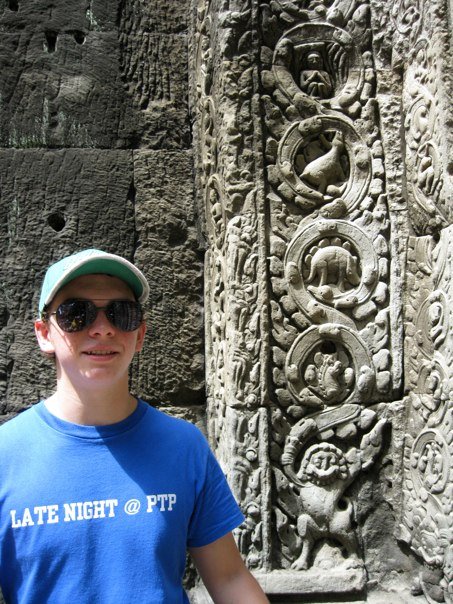
I have been to the Ankgor Wat temple complex, near Siem Reap, four times. It’s a fascinating tourist attraction, but there is one carving, among literally thousands, that stands out above the rest. It is found at Ta Prohm Temple. The temple was built between the late-1100s to early-1200s by King Jayavarman VII and dedicated to his mother. Today, it is “shrouded in dense jungle” and “fig, banyan, and kapok trees spread their gigantic roots over stones, probing walls and terraces” (tourismcambodia.com). “It took 79,365 people to maintain the temple including 18 great priests, 2,740 officials, 2,202 assistants, and 615 dancers” (ibid.). But it’s that stone carving that it most unforgettable.  One particular trip, which I made in 2009 with two elders, three deacons, and my oldest son, Gary, stands out in my mind.

I asked our guide, hired out by the Kazna Hotel in Siem Reap and of the Buddhist faith, what he thought this particular creature was. He said he had no idea what it was and added, “They must have had a really good imagination.”  The question such a response raises is, “How did they know to imagine that?!”

Well, a group from Canada was following close behind our group of seven from Denver, Colorado.  A son asked his father for an explanation of the carvings on the pillar, and dad replied with some authority, “Son, that was their version of a geological timetable.”  Of course, it begs the follow up, “How did 12th-Century Khmer people, well before Darwin and others planted their geological seeds, know of such a timetable?”  Furthermore, this “timetable” looks nothing like anything you will ever see in a textbook–a man above it and a monkey below it.  Based upon what fossil evidence did they create their carving?  There must have been hundreds of fellow “explorers” viewing these temple ruins with us in the few hours we were there.  Some of the fascinated people spoke in languages I cannot understand, but body language was pretty telling.  Others, Americans, British, Australians, and Canadians, all seemed to see that carving for what it most apparently was.  No one said, “That’s a rhino or pig.”  They called it a Stegosaurus.

How many other similar discoveries await reclamation from jungle vegetation, archaeological excavation, and geographic exploration?  In the different disciplines of science and history, man uncovers gems like Angkor Wat’s Ta Prohm from time to time.  Such clear, incontrovertible evidence from a time before our modern “war” between evolutionists and creationists begs to be examined with unprejudiced eyes.  While some may never change their mind regardless of how many items are offered into evidence, I believe that there are a great number of people out there who are honestly, objectively looking for truth.  The Stegosaurus at Ta Prohm near Siem Reap, Cambodia, might be the item that convinces many!

1937409_160820505921_3751983_n
Gary standing next to the column. Notice what/who else is in the carving with the Stegosaurus.

A TRUTH IN THE MIDST OF TRANSIENCE (poem)

Neal Pollard

Waters vast and oceans deep create a marvel and wonder
By its volume and power but also the creatures that you’ll find thereunder.
The stars and planets, galaxies, the universe, the vastness of outer space
The finest particles and smallest molecules, the most infinitesimal place.
The power of the greatest man who rules upon the land
The lowliest person who grovels around unseen and far from grand.
The outward beauty and loveliness of the Lord’s most fair person
The inward workings and intricate details of us all makes this so very certain.
To look upon the mountains high, whether green or rocky or tall
To investigate the tiniest plant and the creatures so delicate and small
Look afar or microscopically, dig and search, uncover
Test it, taste it, see it, smell it, here’s what you’ll discover
Locked within our DNA or viewed from light years away
You see the same truth, over and over, a fact that’s here to stay.
We are the evidence of a Being whose power and knowledge are unending
Who makes what is made extraordinary, through His infinite nature expending
But making what’s made and doing what’s done, His resources are not depleted
Because He is God, He’s never without. He never needs completed.
He’s worthy and mighty, He’s wonderful and true, the God we worship and serve
He’s faithful and ingenious, active and gracious, from perfection He cannot swerve
As you walk through the day and make observations, what you see or happens to you.
Whatever may change, crumble, fall, or fade away, God will still be faithful and true.

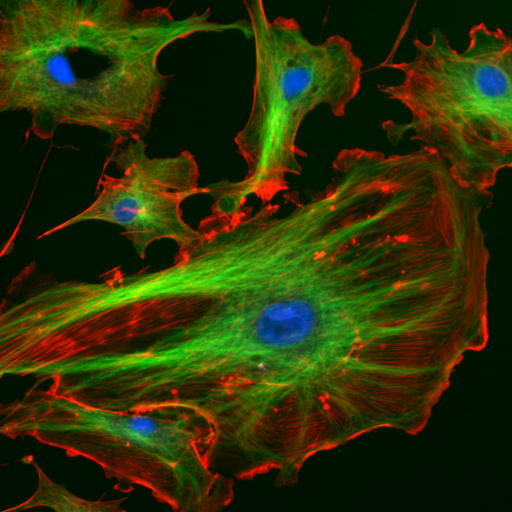
                             Endothelial cells viewed under a microscope

IF THESE THINGS ARE TRUE, HOW DO WE EXPLAIN THE FACTS?

Neal Pollard

  • If the theory of evolution is true, why haven’t they found any transitional fossils?  Charles Darwin, on page 413 of his tome Origin of Species, said, “Why is not every geological formation and every stratum full of such intermediate links? Geology assuredly does not reveal any such finely-graduated organic chain; and this is the most obvious and serious objection which can be urged against the theory.” Almost 150 years of archaeological digging and an incredible volume of fossil-findings later, the objection should be even stronger!
  • If the documentary hypothesis is true, why can’t they find even one copy or fragment? The idea that later scribes and penman wrote the first five books of the Old Testament, some almost 1000 years after the time Moses lived, is widely believed among liberal religious scholars. That there are no copies or fragments of these post-Moses writers has not done much to defuse the zeal of those who teach it.  Neither is any attempt given to explain or rebut the many statements in the Pentateuch claiming that Moses wrote them (cf. Ex. 17:14; 24:4-7; 34:27; Num. 33:1-2; Dt. 31:9-11).
  • If the idea of being genetically predisposed to homosexuality is true, where is the genetic evidence of it? The study most supportive of “the gay gene,” conducted in 1991 by Baiiley and Pillard, found 52% of the pairs of identical twin brothers studied were homosexual.  A much larger sample size, in an Australian study released in 2000 by Bailey, Dunne, and Martin, found only 20% concordance in identical twin males and 24% among identical twin females. Bearman and Brucker, in 2002, found less than 10% concordance (via Journal of Personality and Social Psychology, 78(3): 524-36; Archives of General Psychiatry, 48 (12): 1089-96; and the American Journal of Sociology, 107: 1179-1205).
  • If the idea that a “fetus” is part of the mother is true, why does that unborn one have its own unique genetic code? Not only that, but the unborn can be a different blood type, gender, race, hair color, eye color, and more.
  • If the big bang theory is true, what did it and why?  Whether it is thought to have been highly concentrated matter, energy, or combination, what force acted upon it? It was there, presumably for an eternity.  Why didn’t it “bang” before it did? Why did it bang when it did? How did mind emerge from matter? How did morality emerge from non-morality? How did an explosion or expansion form such order out of chance and chaos?
  • If it is true that making moral judgments about others’ behavior is wrong, why is that moral judgment not wrong?

None of these questions is intended to exhaustively address any of the theories or world-views they represent.  Yet, so many unquestioningly and blindly accept these premises as fact when they are far from it.  Seemingly, the last resort, if ever taken, would be to accept and follow what the Bible says.  However, that is the fundamental dividing line.  Hebrews 11:6 puts it well, that “without faith it is impossible to please Him, for he who comes to God must believe that He is and that He is a rewarder of those who seek Him.”

Implications of God’s Existence

Neal Pollard

“God is.” God is real. God is alive. God is watching. God is in control. All these ideas and an infinite number besides are implicit in the fact of God’s existence. That God is implies other things.

God can work through every event of life among men to accomplish His sovereign purpose (Rom. 8:28).  God, in an amazingly intricate way, weaves together the innumerable actions and occurrences that transpire in daily life on every continent according to His will. He does not make or force anyone to do anything, but He can work through even tragedies caused by men to effect good. The problem comes when one tries to define goodness on his or her terms rather than the transcendent good that is larger than the single person.  Strength in trial, character in tragedy, example in spite of great loss or pain are all transcendent good that can occur even in the reverses we face in our individual lives.

God has not left us alone (Rom. 8:35-39).  Deism suggests that God created it all, then took a Divinely giant step backward forever out of our affairs. Yet, God isn’t aloof and indifferent to man. This was best proven at the cross of Calvary. It is proven in the perfect Word He has left to guide us. It is proven through the strength derived from prayer. It is proven by the fellowship and companionship provided through the church He eternally purposed (cf. Eph. 3:9-11).

God holds us accountable (Rom. 14:12). What a privilege to be counted as part of the human race, made in the likeness of God (Jas. 3:9), and to be recipients of countless blessings! So “…from everyone who has been given much shall much be required; and to whom they entrusted much, of him they will ask all the more” (Luke 12:48). Especially is this true in relationship to God. He has given us life, an everlasting spirit, material and spiritual blessings in abundance, talent, time, and opportunity. For all of these resources, we shall give an account for our stewardship of them.

Only a fool would deny what is so clearly seen (Ps. 14:1; 53:1; Heb. 11:3). Since God is, we must respond appropriately. We should do so both from gratitude and a sober realization that His existence requires our proper response.

Did James Bartley Live To Tell Being Swallowed By A Sperm Whale?

Neal Pollard

On his tombstone in Gloucester, England, James Bartley had written “A Modern Jonah.”  Bartley was allegedly swallowed by a sperm whale while helping to hunt and kill the giant in 1891.  The whale, as the tale goes, was ultimately subdued and conquered, and when its stomach was hoisted on deck two days later, an unconscious and crazed Bartley was found inside. He was a member of a party sent out to harpoon the beast, and in the melee that ensued Bartley was said to be accidentally ingested.  By the mid-1890s, the story was published and circulated as fact on both sides of the Atlantic.  For over 100 years, the Bartley story has been told by eager apologists to defend the veracity of the biblical account of Jonah.  It has served as a theological pingpong ball vollied back and forth between believers and unbelievers.  Research, particularly by a Bible-believing professor named Edward Davis (http://asa.calvin.edu:80/asa/pscf.html | 19:53:53 Mar 16, 2003), ultimately shows beyond a reasonable doubt that the story is a hoax.  Too many aspects of the story do not stand up to scrutiny.  The alleged ship, “Star of the East,” was not a whaler. There was no fishing off the Falkland Islands in 1891. Bartley’s name never appeared on a manifest of the aforementioned ship. The captain’s wife said that her husband never lost anyone overboard in all their years of marriage, and they were married in 1891.  Atheists and skeptics have rejoiced in such findings, using them to discredit the Bible’s account of the Jonah incident.  Apparently, some less than scrupulous (or, at best, sloppy researching) “Christian Apologists” have taken the Bartley story and run with it in an effort to substantiate that ancient account.  Yet, opponents of Scripture have been as out of bounds in their response, making the nonsensical jump from the fraudulent Bartley story to try to discredit the validity of the book of Jonah.  Because modern man fabricated a story about a man being swallowed by a whale does not mean that the account in Scripture should be rejected.

The account of Jonah is believable for at least these reasons.  First, the Bible does not call Jonah’s captor a whale.  It was a fish (Jonah 1:17). The NAS has “sea monster” in Matthew 12:40, but it is better translated “big fish, huge fish” (Louw-Nida, np). Second, this fish was “prepared” (appointed, NAS) by God for the occasion. We have no record of this “species” prior to or after this special occasion meant by God to persuade His pekid prophet.  Finally, Jesus validates the historicity of the Jonah incident. In the aforementioned gospel account, Jesus refers to Jonah as fact rather than fable. If it was a fairy tale, Christ gives no hint of it.  In fact, He says, “…just as Jonah was three days and three nights in the belly of…” this creature (emph., NP).

Have creationists and “fundamentalists” ever overreached to try and prove their point? Undoubtedly!  Have skeptics and atheists ever overreacted to try and protect their non-theistic bubble? Absolutely!  When such battles as these are being waged, I find my confidence in going back and reading the text.  Seeing what the Bible actually says is powerful in keeping us away from either extreme.