It doesn’t matter how much bible knowledge a person has — if they don’t love other people, their knowledge is worthless (cf. I Cor 8.1; 13.1-3).
Hating a Christian brother or sister disqualifies a person from eternal life (I Jn 4.20).
Christianity has many gray-area freedoms that make some people uncomfortable. For either side of an issue: “Be willing to accept those who still have doubts about what believers can do. And don’t argue with them about their different ideas” (Rom 14.1).
And, “Why do you judge your brother or sister in Christ? Or why do you think that you are better than they are? We will all stand before God, and he will judge us all … So each of us will have to explain to God about the things we do” (Rom 14.10, 12).
And, “So we should stop judging each other. Let’s decide not to do anything that will cause a problem for a brother or sister or hurt their faith” (14.13).
And, “Don’t allow what is good for you to become something they say is evil” (16).
And, “Let’s try as hard as we can to do what will bring peace. Let’s do whatever will help each other grow stronger in faith” (19).
Finally, “You should keep your beliefs about these things a secret between yourself and God. It is a blessing to be able to do what you think is right without feeling guilty” (Rom 14.22).
Perhaps the biggest aspect of Jesus’s sacrifice was to become human and stay that way for our sake (cf. I Tim 2.5; Phil 3.20-21; I Jn 3.2-3). He is still human now, though in the kind of perfect body we’ll enjoy when he comes back for us.
God never calls Christians to publicly protest the evil behavior practiced by the world. In fact, he expects the opposite from his children (I Tim 2.1-4; I Cor 6.2; Rom 13.2; I Pt 2.11-17).
The Book of Hebrews is a crucial piece of writing that serves as a bridge between the Old and New Testaments. It demonstrates how the arrival of Jesus Christ fulfilled old promises. The narrative in the text shows how the old covenant, which relied on law and sacrifice, transformed into the new covenant, which operates through grace and redemption. This transformation is evident in chapters 8-10. Though God made the old covenant, it was only a temporary solution until the perfect one arrived – Christ’s selfless love. The text explains how something was amiss with the old covenant, but Christ’s sacrifice provided the ultimate solution to this problem.
Even though people performed the holy rituals and sacrifices of the old covenant with devotion, those actions were only a representation of what Christ could accomplish. In Hebrews 10.1, the author states that Jesus fulfilled what was happening in heaven, and the Tabernacle and its sacrifices only served as mere shadows. As our everlasting High Priest, Christ’s work goes beyond the earthly Tabernacle. He entered the heavenly sanctuary to offer His blood instead of animal blood, which secured our eternal salvation (Hebrews 9.11–12).
Jesus brings a better covenant based on better promises as we move from darkness to light (Hebrews 8.6). His sacrifice was a one-time offering that cleanses our consciences and allows us to have a relationship with God without hindrance (Hebrews 9.14). The key to this new covenant is Jesus’ sacrifice. Unlike the old covenant written in stone, God writes the new covenant in people’s hearts. It transforms people from within and empowers them to serve God with faithfulness (Hebrews 8.10).
The transition from the Old Covenant to the New Covenant brought a significant change not only in the way people worshipped God but also in how God related to them. With Jesus’ death, a new way opened up for us to confidently enter the Most Holy Place (Hebrews 10.19–20). Jesus acted as the mediator and witness of this new covenant. Under the old covenant, people observed the Day of Atonement once a year, which reminded them of their sins. However, Christ’s sacrifice is complete, sufficient, and everlasting (Hebrews 10.12–14).
The teaching in Hebrews serves as an encouragement for Jewish Christians to keep their faith strong by choosing the fullness of Christ’s sacrifice over the old covenant’s useless rules. This message is just as relevant today for all believers. We should celebrate the new covenant that Christ’s death made possible, which is not just a covenant of temporary rituals but an everlasting inheritance. The New Testament calls us to lead a holy life, have faith that we will be saved, and develop a personal and life-changing relationship with God. In short, the new covenant is superior in every sense as it completes God’s story of redemption and sets us on a path of eternal fellowship with Him.
Understanding the difference between the old and new covenants is as important today as in the early church. It not only helps us to understand the history of the Bible, but it also shapes how we practice our faith, dropping old rituals in favor of worship and service per a new, living faith. This change requires reassessing traditional practices. One such practice needing reevaluation by many professing the name of Christ in light of the new covenant is using mechanical instruments in worship. This topic is debated among believers, as some argue it aligns with the spirit of worship under the new covenant. However, it reflects an attachment to old practices that the new covenant has rendered obsolete since those like David, the writer of songs accompanied by musical instruments, lived under the old covenant.
The Hebrews writer states that, in contrast, we under the new covenant offer up the fruit of our lips (Hebrews 13.15). It’s the Spirit’s guidance that leads us to worship in truth and spirit (see John 4.23-24), pointing to a faith that is vibrant and active, rooted in the internal transformation Christ’s sacrifice brings. To fully realize the benefits of the new covenant, embracing this spirit-led rule of faith—secured by Jesus’ blood—is essential. Our worship and devotion to God should thus reflect the inner change wrought by Christ instead of a reliance on outdated rituals. As we navigate these changes, it is the heart transformed by Jesus that directs our service, a theme as central to the message of Hebrews as it is to our contemporary journey of faith.
I Peter 1.1-2 tells us that God chose us a long time ago. This doesn’t mean we have no say, it just means he’s always known who would and wouldn’t follow him. Broadly speaking, it means that he specifically chose Christians to be the ones who leave with him at the end. This means three things: One, he wants us to have a spirit of moral purity. Two, he wants us to obey him. Three, he wants us to be made clean by Jesus’s sacrifice.
1.3-12 — Our reason for living this difficult life is hope. In the context of this letter, hope is the anticipation of what we’ll get after we die. The entire letter points to the next life as our primary incentive for living morally pure lives. When Peter says to do something difficult or painful, he usually follows it up with a reminder that this life is nothing. Everything we do is in view of the next life. Below are a few examples (we’ll look at the rest next week):
1.3 — His mercy gave us new life.
1.3 — This new life makes us live with anticipation for the next life and gives us a powerful, unstoppable hope. We only have this hope because Jesus came back to life, proving that we can and will, too.
1.4 — This new life has us waiting for God to reward us at the end.
1.4 — We know it’s at the end because vs 4 says that it’s being guarded by God for us. Unlike our current life, which is subject to the law of entropy, the next is not capable of wearing down or losing any of its value or novelty. Things that are new and exciting to us in this life can get boring after a while. Hobbies may eventually become an expensive ritual, rather than something that gives fulfillment or excitement or purpose. New Earth has none of that. It’ll be just as exciting on day one trillion as it was on day one!
As Christians it can be easy to lose sight of what our purpose is now that we have been justified through Christ. We are offerings to God. Romans 11:36 says, “from God and through God everything exists.” Now present your bodies a living sacrifice to THAT God. So that your life is acceptable to THAT God. Renew your mind so that you will prove what the will of God is.
You know when you buy toys for your kids or grandkids often times on the package in fine print are these words, “Batteries not included.” Do you know what that means? It means that you get the toy, but the power to make it work is not included. That is not the kind of gift that God gives. God’s gift of holiness includes the power of the fullness of the Holy Spirit – the power to make it work.
We are different from the rest of the world (Rom. 12:2). I am not an offering to me.
A sacrifice is “an act of giving up something valued for the sake of something else regarded as more important or worthy.” What is worthy of your sacrifice? What is worth the sacrifice of your life? For way too many in the world it’s not God and I’m convinced it’s because they just don’t understand who HE is.
Will I sacrifice my life to my job? My spouse? Family? Who is it that is worthy of my soul? If any of those things pull you away from the One that holds your breath and life in your hand and determines your eternal destination, you’ve made a costly and foolish mistake. A truly faithful christian is one that lives as an offering to God.
God offers us something that nothing in this world can, He offers transformation that prepares us to be in His presence. God knows what we need and He has offered it.
I found some advice for those of you that are married, what not to buy your wife…Don’t buy clothing that involves sizes. The chances are one in seven thousand that you will get her size right, and your wife will be offended the other 6999 times. Avoid all things useful. No mops, brooms, Clorox wipes, etc.
Don’t buy jewelry. The jewelry your wife wants, you can’t afford. And the jewelry you can afford, she doesn’t want. Finally, don’t spend too much. “How do you think we’re going to afford that?” she’ll ask. But don’t spend too little. She won’t say anything, but she’ll think, “Is that all I’m worth?”
Unlike shopping for your wife, God knows exactly what we need. He knows our struggles. He knows our battle with sin, so He offered salvation. So will we recognize who we are and what God has done to make us who we are today?
From 1 Samuel 15.12–28, we observe the following. After erecting a monument to himself at Carmel, Saul met Samuel at Gilgal. Saul greeted Samuel and proclaimed he had done as God commanded. Given Saul was supposed to destroy the Amalekites, Samuel questioned why he could hear the bleating of sheep and the lowing of oxen. Saul justified his actions, stating that only the best livestock were spared for sacrifices while he had destroyed the rest.
Saul faced a stern rebuke from Samuel, who reminded him of his humble origins and God’s directive to annihilate the Amalekites. Samuel emphasized Saul’s disobedience in seizing the spoils, a direct violation of God’s command. Saul defended himself, insisting that he had obeyed God and completed his mission, shifting the blame onto the people for preserving the best livestock for sacrifices.
In response, Samuel delivered a profound message, declaring that obedience to God’s instructions outweighs the value of sacrifices. Saul’s insubordination and rebellion were exposed and equated with divination, a grave sin. Samuel announced that since Saul had rejected God’s word, God had reciprocated by rejecting Saul’s kingship.
Saul confessed his transgression and pleaded for mercy, admitting that he succumbed to public pressure out of fear. He begged Samuel for forgiveness and expressed his desire to worship God. However, in his refusal, Samuel asserted that because Saul had dismissed God’s word, God had rescinded Saul’s kingship. As Samuel left, Saul desperately grabbed at his robe, tearing it. According to Samuel, this symbolized God stripping Saul of his kingship in favor of a more deserving ruler.
The narrative of King Saul, serving as a potent cautionary tale about pride and disobedience, hinges on two pivotal events in the books of Samuel. Samuel credits Saul’s humble beginnings with his initial rise to kingship (v. 17). 1 Samuel 15.17–19 records Samuel’s critical observations, hinting at a drastic character shift with grave repercussions. Samuel’s inquiries into Saul’s behavior, which underscore his failure to carry out God’s command to exterminate the Amalekites, highlight a drastic deviation from obedience and the principles that initially defined his character.
In 1 Samuel 13.8–14, we encounter the first instance reflecting Saul’s shifting attitude. In haste, he performs the sacrifice, a task designated for priests. This incident glaringly showcases Saul’s audacious belief that he could usurp responsibilities not assigned to him and his flagrant disregard for God’s laws and timing. This choice sets a precedent for Saul’s subsequent disobedience, eventually losing his kingship and favor with God.
The second occurrence in 1 Samuel 15 provides deeper insight into Saul’s transformation. Saul brazenly disregards God’s command, sparing King Agag and the choicest livestock. His rationale that He intends to use the animals for sacrifice underscores his presumption that his judgment surpasses God’s. This act of rebellion exhibits Saul’s tendency to place his will before God’s and to rationalize his wrongdoings. These actions further strain his already deteriorating relationship with God.In conclusion, the story of King Saul serves as a potent reminder of the dangers of misusing power. While Saul’s story begins with him as a reluctant leader who exhibits humility, his rise to power ultimately results in his fall. The Bible does not inherently vilify power, but its misuse, as manifested in Saul’s arrogance and disobedience, is sternly critiqued. His downfall offers a stark lesson in humility, obedience, and the responsible use of power, contrasting his actions with those of subsequent faithful kings. The story’s moral underscores the need for humility, obedience, and respect for the law, regardless of one’s position of power. It teaches that no one should consider themselves above God’s laws that He has entrusted them to uphold.
When we think about Jesus and material possessions, perhaps we think of passages like Luke 8:3 that tell us He lived from the financial support of Mary Magdalene, Joanna, Susanna, and many others. Or His own words: “The foxes have holes and the birds of the air have nests, but the Son of Man has nowhere to lay His head” (Luke 9:58). Jesus lived humbly. Despite this, how often do we reflect on Jesus’ giving?
He gave Himself. Scripture says this explicitly in several places. He gave Himself “for our sins” (Gal. 1:4;). He gave Himself “for me” (Gal. 2:20). He gave Himself “for us” (Eph. 5:2; Ti. 2:14). He gave Himself for the church (Eph. 5:25). He gave Himself “for all” (1 Tim. 2:6). No matter how you look at the cross, it must be described in terms of His giving. This gift was the most significant act of all history. The writer of Hebrews says “we have been sanctified through the offering of the body of Jesus Christ once for all” (10:10). Isn’t it interesting that Paul praises the unexpected generosity of the Macedonian givers, in part, by saying “they first gave themselves to the Lord and to us by the will of God” (2 Cor. 8:5). Gracious, generous giving is impossible without our first giving ourselves to God. Submitting ourselves to Him in utter dependency, yielding our will and desires, is a prerequisite for Christlike giving.
He found it more blessed to give than receive (Acts 20:35). This was His mentality and outlook. His default position was doing for others, not having others do for Him (Mat. 20:28). Paul, speaking with the Ephesian elders, reflects back on this character trait of Jesus, saying, “In everything I showed you that by working hard in this manner you must help the weak and remember the words of the Lord Jesus, that He Himself said, ‘It is more blessed to give than to receive.’ ” What is Paul talking about? In the context, he is talking about material things like gold, silver, and clothing (33), material needs (34), and helping the weak by working hard (35). He’s not referring to the Sunday collection (cf. 1 Cor. 16:1-2), but an attitude of heart instead. Again, the Macedonians embodied this attitude. Paul is still speaking of them when he writes, “Each one must do as he has purposed in his heart, not grudgingly or under compulsion, for God loves a cheerful giver” (2 Cor. 9:7). We should grow to the point where it brings us joy to give to God. Isn’t that how Jesus gave Himself for us? Study Hebrews 12:1-3 closely!
He gave with grace (2 Cor. 8:9). Most lexical definitions of “grace” include the word “gift,” “favor,” and “benefit.” These are undoubtedly giving terms and, when Paul uses it in 2 Corinthians 8:9, a financial term. Paul says, “For you know the grace of our Lord Jesus Christ, that though He was rich, yet for your sakes He became poor, so that you through His poverty might become rich.” He ties Christ’s gracious giving to his admonition that Corinth be gracious givers, too. He urges them to complete this gracious work (6), to abound in this gracious work (7), and co-participate in this gracious work (19-20). For Jesus, grace meant giving up something to meet the needs of others. For us, gracious giving means giving up something to supply the needs of others. Like with Jesus, we prove the sincerity of our love by gracious giving (8).
Should we give out of duty and obligation? Not entirely and certainly not primarily. Should we give out of gratitude? That’s certainly better than guilt. How about giving out of an effort to imitate our Savior? When we are giving, it is not merely “to the church.” It is giving to the head of the church, the one who gave everything to purchase it (Acts 20:28). Remarkably, sacrificial giving is a tangible, explicit way for us to give like Jesus. Could there be a stronger motivation?
Pioneers are fascinating, whether Gutenberg and the printing press, Jenner and vaccinations, or the Wright brothers and flying. Whether travel and exploration or inventions, people who went first or paved the way for us are people we may never think about but who we owe so much to. Even our highway systems, with paved roads that go through tall mountains, took people to make a way when there was no way.
Hebrews 6:20 uses a word only found in that verse–“forerunner.” The word had a diverse usage. It was used in athletics, of one who runs forward at top speed. It was used of one who went in advance of others, like horsemen or guides ahead of the army. In Alexandria, Roman ships heavily loaded with grain, were led out by a small guide ship. It was used in botany of the first green shoot, tree, or flower of Spring. Metaphorically, it was used of a “precursor” like the apostles or John the Baptist.
The idea in Hebrews 6:20 is that Jesus has gone behind the curtain before us into God’s presence. We can join Him there because His death made it possible for us (Heb. 5:8-9). But we also have unrestricted access to God’s presence now because He prepared the way. The writer tells us that this is our sure and stedfast anchor of hope that allows us to take refuge.
It is beautiful to think that Jesus has gone before us and paved a way for us. This is a theme the writer addresses throughout Hebrews. He shows us how Jesus has done that in the past, is doing it now, and will do it in the future.
He went before me in the creation (Hebrews 1). In the most elementary sense, Jesus went before me in that He brought me into being (Heb. 1:2). He made us knowing that He would someday become one of us, with a human body (Heb. 10:5). He made the circulatory system, the nervous system, the respiratory system, the skeletal system, as well as every other system, cells, tissues & organs, knowing He’d experience them. He was here on earth before most, if not all, the recipients of Hebrews and certainly before all of us—but He paved the way for life on this earth for all of us. He provided for my material needs (Mat. 5:45; 6:25-32; 1 Tim. 6:17), my emotional needs, my social needs (Gen. 2:18; Prov. 17:17), and my spiritual needs–He created me with a desire for worship, fellowship, and discipleship and guides me in the proper expression of each of them.
He went before me in my salvation (Hebrews 2:10). Your version probably says author, captain, founder, or even pioneer. The original word was used of one who founded a city, gave it its name, and became its guardian. Or it was used of a head of a family, a founder of a school, or military commander. The context of Hebrews 2:10 is that Jesus came to earth to experience humanity firsthand, but He’s called the author of our salvation. He does the sanctifying and we’re the sanctified (11). His death freed us from the one who had the power of death (14-15). He made forgiveness for our sins (17).
Hebrews uses “salvation” seven times, but also speaks of sanctification, propitiation, purification, and the like. The letter is full of blessings He gives now because of our salvation–assistance when tempted (2:18), assurance (3:14), bold approach to the throne (4:16), hope (6:19), mercy and forgiveness (8:12), confidence (10:19), nearness (10:22), endurance (12:1), and an unshakable kingdom (12:28). I get a clear sense that He wants me to make it through this world spiritually alive!
He has gone before me in my eternal destination (Hebrews 12:1-2). The writer draws to his conclusion, pointing us to “the race that is set before us.” Everyone of us is still in the race, running toward some conclusion. The writer says to look away from all other things to look at Jesus. He took the lead and is setting the example at the front of the pack. In fact, He successfully finished this race and is waiting on us to finish and join Him in a victory celebration. The only way to lose this race is to stop running, but if we keep our eyes on Christ we won’t stop. Jesus is our leader, inspiration, and goal we are running toward in our race.
The Hebrews’ writer says judgment is coming, but Jesus has paved the way for us. Throughout Hebrews, he tells us we can have confidence (4 times), assurance (4 times), and hope (7 times). Jesus is the basis for all of that.
Jesus made the hard choice. He left heaven and came to take the punishment we deserve so we could receive the reward He died to give us. He could have chosen to save Himself and let us die lost and without hope, but He made the unselfish choice. What about us? Are we willing to sacrifice now, so that we can ultimately receive the prize? We can do it! Jesus showed us how!
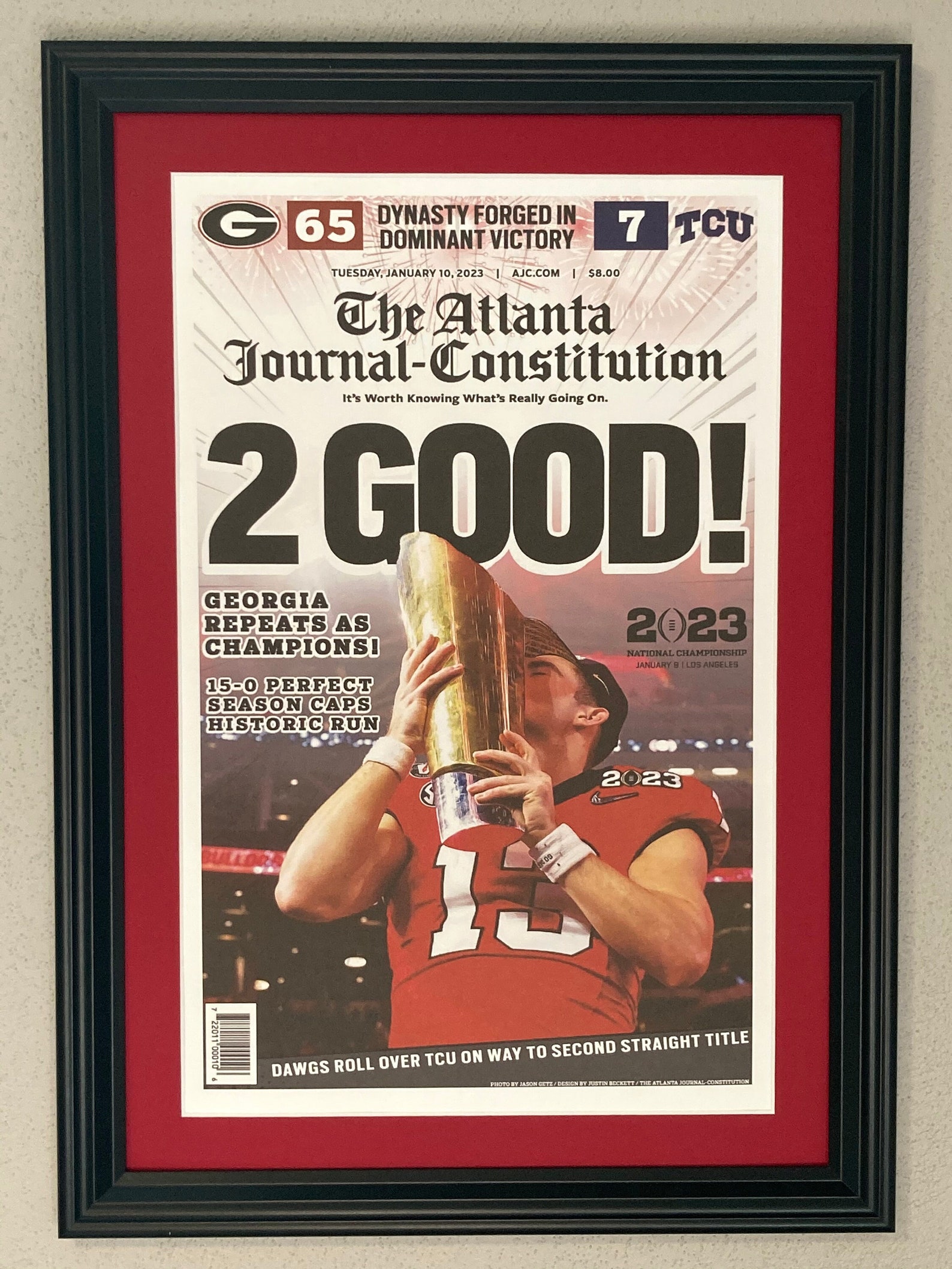
The 2022 college football season has gone, and the Georgia Bulldogs have repeated as national champions. Some argue that our national admiration of sports numbs us to the deterioration of our society. (Think ancient Rome and circuses and bloody spectacles.) However, there are also critics within the college football fan base who believe that the current method of crowning a national champion is unfair. The latter is more a matter of sour grapes. But when I consider paid college football players and transfer portals that foster a sense of entitlement among four- and five-star recruits, I find it difficult not to listen to some criticism.
As Kirby Smart’s teams have improved over the years, so has their emphasis on teamwork and selflessness. They’ve made it a permanent part of their game strategy, and as a result, they consistently give it their all in most contests. ESPN sports pundits marveled at Kirby’s ability to make his team believe they were undervalued and disrespected despite being labeled the favorites. But, as the adage goes, the proof is in the pudding. Many athletes wanted to help pave the way to victory for their teammates. That is to say, rather than dwelling on how many times they had possession of the ball or how many big plays they had made, they celebrated the accomplishments of their teammates. Nolan Smith, a senior, is a prime example of this because his senior season was cut short due to an injury. After his stellar play on last year’s national championship team, he was eligible to enter the NFL draft. But he returned to Georgia for his senior year. However, his injury hasn’t stopped him from acting as a de facto coach for the rest of the team. Marvin Jones, Jr., one of Smith’s admirers, says he wants to fill the void Smith will leave after graduation.
Some readers might assume I’m just trying to boast about “my” Georgia Bulldogs. Trust me; there’s more to it than that. An even more valuable group needs the same sense of teamwork and selflessness. Yes, I’m referring to the church. Like sports teams, the church requires teamwork and a selfless attitude to work together for the same mission. Paul writes that each church member contributes to its growth by fulfilling their role (Ephesians 4.16). One aspect of this role is encouraging and supporting each other (1 Thessalonians 5.11). Paul even went so far as to say that we should defer to our weaker brothers’ scruples to pursue peace and edification (Romans 14.19). While it is true that we will give an account of ourselves to God (Romans 14.12), we must focus on the “team.” Jesus loved the church so much that He gave His life for her (Ephesians 5.25). As a result, we are to have the mind of Christ (Philippians 2.5ff). And the early church had its counterparts to people like Nolan Smith, most notably Andrew and Barnabas, two men about whom less is known but who undoubtedly had a significant impact on the early church. These two provided the selflessness and humility the church needs today by following the Lord’s call and putting aside their desires.
Remember, we are not competing for a stylized black football atop a golden pedestal. Instead, we seek an imperishable crown (1 Corinthians 9.25). As a result, our devotion to the church must outweigh our enthusiasm for a football team on any autumn Saturday, especially in the South.
In Acts 20:24, Paul says, “…But I do not consider my life of any account as dear to myself…in order that I may finish my course.”
What an incredible attitude. In verse 24 Paul stated the reason he was willing to face the dangers in Jerusalem. He was ready to surrender his life for the gospel. In his epistles Paul often stated his readiness to suffer, even to die for Christ. Paul had completely given his life to Christ. He was willing to die for what he believed. Are we? As ministers we should believe in the word of God so much that we are willing to give our lives for it. What are our lives to us? How much do they mean to us? Do we care so much about our lives that we are willing to preserve them over preserving the word? Those are a lot of questions, but there’s one simple fact that we must remember. A preacher that is not willing to give his life for the cause of Christ is not worthy to preach.
God’s church, the Bride of Christ, deserves a man willing to lay down his life for the gospel. When Jesus came to Paul on the road to Damascus, He gave Paul his life’s mission. By the grace of God, Paul completed a lifelong service to Him. As ministers, there is not a better life to model ours after, besides Jesus, than the life of Paul. He was selfless to the very end. His body was a mere tool just for the cause of Christ. What does that take? A lifetime of studying and growing our relationship with the Lord. A man with a poor or lacking relationship with God does not belong in the pulpit.
From the book of Acts we can pull many examples from Paul’s life and apply them to that of the modern day minister. The Bible is 1900 years old, but it is still a practical guide to today’s preachers. We have different challenges that may seem like new issues, but Paul proves over and over again that following Christ wholeheartedly is all we truly need to make it as successful ministers in the church today. Who does the church see in the pulpit? Who does the church need in the pulpit? These are often two very different things. The preacher can act one way in front of everyone, but who he is when he’s alone is what counts. Does he study and pray constantly? A minister should follow closely the example of Paul, and in doing so he will not fail. If every church had a preacher like Paul the church would be a strong and thriving group.
Ephesians 1.3 says, “In Christ, God has given us every spiritual blessing in the heavenly places.” What does that mean? We hear “spiritual blessings” and might gloss over it as another Christianese phrase. Here’s a short list of what those spiritual blessings are.
1.4 — God chose us before Christ made the world.
1.4 — He chose us out of love to be his special people.
1.5 — He chose us to be his own children through Jesus Christ.
1.6 — God gives grace liberally.
1.7 — We are free because of Jesus’s sacrifice.
1.7 — We have forgiveness because of God’s grace.
1.8-9 — God told us how we can get that grace. He didn’t set up a system that we would have to look super hard for, he made sure to preserve the information needed to find him.
1.10 — He is bringing the heavens and the earth together through Jesus.
1.12-13 — He made grace available to every country on earth, not just one group.
1.13-14 — He gave us his spirit as a downpayment on our reward.
While we won’t fully appreciate these spiritual blessings until later (Paul says these riches are “too great to fully understand” in 3.8), we’re still extremely grateful that God has done so much to give us hope for eternal life.
The Lord’s Supper comes once a week. Often I find myself wishing that we could spend more time dwelling on the death, burial and resurrection of Christ. But Sunday morning isn’t the only time that we can think about our Savior. In fact, if we spend more time throughout the week thinking about it, the time during the Lord’s Supper can mean so much more.
In this article I want to encourage each Christian to start thinking about Christ and His sacrifice before Sunday comes this week. You’d be amazed at the difference it makes. These few verses and hymns are a beautiful reminder of what Christ went through on our behalf. Our sins are washed away through the powerful blood given by God’s Son!
Isaiah 53:3, “He was despised and rejected by men, a man of sorrows and acquainted with grief; and as one from whom men hide their faces. he was despised, and we esteemed him not.”
When I survey the wondrous cross On which the Prince of glory died, My richest gain I count but loss, And pour contempt on all my pride.
Isaiah 53:4, “Surely he has borne our griefs and carried our sorrows; yet we esteemed him stricken, smitten by God, and afflicted.”
See from His head, His hands, His feet, Sorrow and love flow mingled down! Did e’er such love and sorrow meet, Or thorns compose so rich a crown?
Isaiah 53:5, “But he was pierced for our transgressions; he was crushed for our iniquities; upon him was the chastisement that brought us peace, and with his wounds we are healed.”
And can it be that I should gain An interest in the Savior’s blood? Died He for me, who caused His pain— For me, who Him to death pursued? Amazing love! How can it be, That you, my God, would die for me? Amazing love! How can it be, That you, my God, would die for me?
I pray that this weekend we all see the importance of having the right mindset going into worship on Sunday. I pray that as a church we recognize the unity and fellowship we have in Christ. May we never take the cross for granted!
TODAY’S ARTICLE IS REPRODUCED FROM YESTERDAY’S LEHMAN LEARNER. I EMAIL AN EXPOSITORY STUDY OF A SECTION OF A BIBLE BOOK EACH MORNING. YOU CAN SUBSCRIBE AT “LEHMANOFFICECOC@GMAIL.COM.”
S.J. Friesen, in a book edited by Susan R. Holman entitled Wealth and Poverty in Early Church and Society. Holy Cross Studies in Patristic Theology and History (2008), reveals at least seven categories or classes in imperial Rome. This would have certainly applied to Jesus’ day. From top to bottom, they were:
Imperial elites (0.04% of society)
Regional or provincial elites (1%)
Municipal elites (1.76%)
Moderate surplus resources (7% estimated)
Stable near subsistence level with reasonable hope of remaining above the minimum level to sustain life (22% estimated)
At subsistence level and often below minimum level to sustain life (40%)
Below subsistence level (28%) (p. 19-20)
In that lowest category were included beggars, the disabled, unskilled day laborers, prisoners, and unattached widows.
So the woman we meet in Mark 12:41-44 was on the bottom rung of society. Typically, every day was a fight for survival and full of uncertainty about meeting the basic needs of life. She had no advocates, champions, and could have been the target of unscrupulous men if she had a house or anything her husband had left her. Just before Jesus calls attention to the widow in our text, He had condemned the scribes for at least five offenses. The fourth was that they “devour widows’ houses” (40), for which “they will receive the greater condemnation” (40). Was the widow in these verses one of their victims?
What we know is that she enters the alms area of the temple in the court of women carrying “two small copper coins, which make a penny” (42). He makes no judgment on the contributions made by the wealthy, but holds up the woman as a contrast to the scribes and any who practiced pretentious religion.
She gives unpretentiously. She does not draw attention to herself. She quietly slips in the two coins. It is because Jesus is omniscient and observant that He is aware of her gift. She did not make any announcements or ask for any prayer requests, that God help her since she was giving everything to God. It was an assuming moment in time that might have passed unnoticed but for Jesus.
She gives sacrificially. Many rich people put in large sums (41), yet Jesus says they contributed out of their abundance (44). However much they gave, they could continue their lifestyle at the same rate and pace as before their gift. But she “put in everything she had, all she had to live on” (44). The Macedonians were great givers, who “according to their ability, and beyond their ability gave of their own accord” (2 Cor. 8:3). As incredible as that is, this poor widow gave more. Only Jesus could exceed her gift (cf. 2 Cor. 8:9).
She gives abundantly. Jesus signifies this by saying she gave more than the rich that day (43). It was not a competition to her, a cause for swelling pride. We will suggest her motive in a moment, but the consequence of her gift was that it was unmatched generosity. Those whose giving cost them something know the fulness of heart and the favor of God this woman must have felt. What a challenge!
She gives trustingly. Mark does not tell us this. In fact, neither does Luke (21:1-4). But what other conclusion can we draw? She gave God all she had to live on. Do we suppose that she left the temple, curled up in a ball, and died of starvation and exposure? Is that how God has ever responded to those who give in faith? Has anyone ever out-given God? That does not mean that God moved her up a rung or two in society because of her gift. That is a very materialistic way to view this account. Instead, the way she gave was inseparably joined to the way she lived. She gave with reckless abandon, left only with a confidence that God would be her protector. Had she heard that day or at some point the words of the psalmist, “How blessed is he whose help is the God of Jacob, Whose hope is in the Lord his God, Who made heaven and earth, The sea and all that is in them; Who keeps faith forever; Who executes justice for the oppressed; Who gives food to the hungry. The Lord sets the prisoners free. The Lord opens the eyes of the blind; The Lord raises up those who are bowed down; The Lord loves the righteous; The Lord protects the strangers; He supports the fatherless and the widow, But He thwarts the way of the wicked” (146:5-9)? She seemed to know the source of her help and hope, her administrator of justice, provisions, and support. She gave accordingly.
Next Sunday, we will make an offering as part of our worship. Across 2,000 years, Jesus holds up this widow to challenge us. Will we give like her, unpretentiously, sacrificially, abundantly, and trustingly? If we do, will He cause us to suffer? That is the mental battleground upon which we all stand. May He help us successfully fight that battle.
There is a story about a father building his daughter a wheelchair from the ground up after she got paralyzed in a car crash. Her father was willing to do all the research and put all the time in to building a wheelchair for his daughter who he loved so much. I don’t think I would trust my dad to make me a wheelchair, but this father demonstrates the love he has for his daughter and the lengths he would go to to keep her safe. We are told in multiple different ways how deep the Father’s love is. As the song goes, “Why should I gain from His reward I cannot give an answer.” I want to share just three points with you tonight why we gained from his reward.
The first one is that His love is so deep that He created us. Genesis 1:27 says that God created man in His image. Since we are made in God’s image, we are His special creation. In return for Him to love us so much we need to love Him and obey Him.
Then when we messed up God loved us so much that He gave His only Son for our sins (John 3:16). He was willing to do anything for us as His children. I know this is a point that is used a lot. Would you give your son? Not just your son, but your only son. Now I don’t have children but I’m sure that if I did that I would not be willing to do that. If you go on to verse 17 it says that He did it so that we might be saved. If we do what is commanded here on earth we will have an eternal home.
The third point we gained from his reward was because he loved us so much that He wanted us to have an eternal home with Him. Go back to John 3:16. It says that whoever believes in Him shall not perish but have everlasting life. Now going back to the example I gave just a moment ago. I don’t think I will ever love anyone enough to give my son. Now let’s back up for a minute and ask ourselves why do we not love each other that much? We are all God’s creation so we should love others like God tells us.
Thinking back to my childhood when my dad would get mad at me I failed to realize that he loved me enough to help me do right. God loves me enough to give me the opportunity to stand up here and give this devo. And God loves everyone of us enough to give His only Son for our foolishness. And now our job is to love Him so much to obey his laws.
Romans 12:1-2, “I appeal to you therefore, brothers, by the mercies of God, to present your bodies as a living sacrifice, holy and acceptable to God, which is your spiritual worship. Do not be conformed to this world, but be transformed by the renewal of your mind, that by testing you may discern what is the will of God, what is good and acceptable and perfect.”
As we enter chapter 12 the point is, “what are the practical implications of 1-11?” It is the start of a five chapter section on how we can put what Paul has said into action. In the first section of the book we learn that we all have sinned, but through faith we have received justification. This gift of justification should motivate us to faithful service.
Paul begins 12:1 by saying “I urge,” which is the powerful petition verb (parakaleo). It is always used by Paul to indicate a significant point.
Here it represents a transition from the doctrinal discussion to the practical. It also represents a key thought, that we must present ourselves to God as a “living sacrifice.” This is in contrast to the dead sacrifices of the Old Testament (slaying of innocent animals that wasn’t enough).
We must give to God while we are young, alive, and capable of service.
We must present ourselves to God as a living sacrifice that is Holy and acceptable. Holy means we are free from moral filth. Holy means that we are devoted to serving God. Holy means that we are an instrument of righteousness.
Then we come to verse 2 where Paul says, “Do not be conformed.” As Christians that are wanting to build our character we cannot let the world be our standard when it comes to:
Our morals (the way we act)
Philosophy (the way we think)
In context the way we dress and the way we worship.
Rather than being conformed to the world, we must “renew our minds.”
In intellect (change the way we reason, and think about things)
In emotion (Renew our state of mind, the way we respond to different circumstances)
In will power (have the strength to restrain our human impulses)
Have we found ourselves living without righteous thinking? We must renew our minds. When our gym membership runs out, we renew it. When our car insurance policy period is over, we renew it. When our thinking isn’t in line with God’s, we renew our minds.
Why do we sacrifice, and renew our minds? To prove/discern:
What the good will of God is
What the acceptable will of God is
What the perfect will of God is
And by discerning these things, we can be known as Christians who think righteously.
Romans 12:1 says, “I appeal to you therefore, brothers, by the mercies of God, to present your bodies as a living sacrifice, holy and acceptable to God, which is your spiritual worship.” What is a holy sacrifice? Holy means, “to be set apart.” It’s living free of moral filth and being devoted to God. A holy sacrifice is one who is devoted to the service of God. Matthew 6:33 says, “But seek first His kingdom and His righteousness, and all these things will be added to you.”
God’s agenda comes first. We are now used as an instrument of righteousness. Romans 6:13 says, “and do not go on presenting the members of your body to sin as instruments of unrighteousness; but present yourselves to God as those alive from the dead, and your members as instruments of righteousness to God.” We should want to be useable in the hands of God! We should also look to accomplish that which is pleasing to God.
Ephesians 5:6-10 says, “Let no one deceive you with empty words, for because of these things the wrath of God comes upon the sons of disobedience. Therefore do not be partakers with them; for you were formerly darkness, but now you are Light in the Lord; walk as children of Light (for the fruit of the Light consists in all goodness and righteousness and truth), trying to learn what is pleasing to the Lord.” Who are we trying to please? If we want to be a holy sacrifice we must be aiming to please God.
People make sacrifices all the time, but think about something or someone you love. It’s easier to sacrifice for family. God is our family, so why do we not sacrifice for Him? If anyone is deserving of sacrifice, it’s God. I once had a pet squirrel when I was 11. My older brother Gary and I saved it from falling out of a tree. Every day I used an eye dropper to feed it milk and nurtured it into an adult.
It would be with me during school, and at night I’d have to stay up super late feeding and caring for it. Stuart the squirrel was great, but to nurture him back to health and care for him took a lot of sacrifice on my part. But I was willing to do it. I loved that squirrel.
Love makes sacrifice easier. How do you feel about living the Christian life? Do you feel like you are sacrificing other pleasures in order to live a life for God? How much does your sacrifice take from you? Be a holy sacrifice when others around you are unholy. Imitate Christ around your coworkers, your kids, your spouse, your friends. Be holy in your service to God and wholly sacrifice your life.
In Brian De Palma’s The Untouchables (1987), loosely based on historical events, Elliot Ness must stop gangster Al Capone. Ness, portrayed by Kevin Costner, is recruiting capable men to help him accomplish his task. One of the men he selects is an Irish beat cop, Jimmy Malone. Malone, played by Sean Connery, asks Ness what he is prepared to do to stop Al Capone. Ness replies he is willing to do anything within the law. However, Malone reminds him that Capone doesn’t play by those rules, implying that Ness will have to dirty his hands to bring Capone to justice. Sadly, one of Capone’s cronies mortally wounds Malone later in the movie. As he lay dying, he again asks Ness what he is prepared to do. Malone’s death finally causes Ness to take his gloves off and give Capone a hard fight.
Obviously, our devotional thoughts are just as loosely based on The Untouchables as the said movie was on the actual events occurring during Prohibition. Thus, I am primarily focusing on Malone’s question of what one is prepared to do. This question strikes me as pertinent to two parables spoken by Jesus to His disciples in Matthew 13.44-45. There are seven parables in Matthew 13, but Jesus gave only four of those to the assembled masses. The remaining three he spoke to the disciples alone. Of those three parables, two deal with people making an incredible discovery and the lengths they go to secure it. The Pearl of Great Price and the Hidden Treasure is parables requiring sacrifice from those wishing to obtain what Jesus equates to the kingdom of heaven.
Wait a minute. Are these not disciples to whom He addresses these parables? Yes. So, have they not already found the treasure, having decided to follow Jesus? Indeed, they have. However, there remains something even they must do. Even though they have acknowledged that there is something special about Jesus, that He is the Messiah, there is still a price to be paid. If they wish to complete their faithfulness, they must be willing to forfeit all to secure God’s precious promises. In the case of some, this knowledge came because of a diligent search. For the others, they had chanced upon the Messiah. Regardless of the circumstances, though, both groups had to surrender everything to receive the kingdom.
Recalling Matthew’s original audience, we note Matthew’s message is Jesus is the Messiah. Thus, he wrote primarily for the benefit of the Jews looking for the Messiah. They had to recognize that Jesus of Nazareth was He about whom the prophets had spoken, even Moses. Yet, they had to do more than mentally assent to Jesus’ identity. The believer’s conviction would cause them even to forfeit their former spiritual wealth obtained under the Law of Moses since God’s kingdom is invaluable in comparison. Elsewhere in Matthew’s Gospel, Jesus tells those who would follow Him that they had to remove all stumbling blocks from obedience, even if that were a foot or an eye (Matthew 18.7-9). Jesus was using this language figuratively, of course, as He was not advocating self-mutilation. But the message is the same as that of the Pearl of Great Price and the Hidden Treasure. You must remove absolutely everything coming between you and the acquisition of the kingdom of heaven without prejudice.
That is a sober message for those of us reading Matthew’s Gospel today. We may have satisfied ourselves with the knowledge that we have grasped the identity of Christ. Perhaps, we have even taken steps to become Christians. We are His disciples. But even to us, Jesus asks, “What are you prepared to do?” If the answer is not the equivalent of forfeiting all for the sake of the kingdom, then we have not yet done enough. As those to whom the Hebrews’ writer wrote, “You have not yet resisted to the point of shedding blood in your striving against sin” (Hebrews 12.4 NASB1995). The implication, of course, is Christians elsewhere in the first century were shedding their blood for their faith. Hence, the road taken by the recipients of the Hebrews letter was calmer in comparison. Thus, as I read those parables of the Pearl of Great Price and the Hidden Treasure, I must ask myself if I likewise will give my all to receive the kingdom of heaven. So then, when the situation calls for it, I must do whatever it takes to receive the kingdom of heaven. Only then will I have obtained the Pearl of Great Price and the Hidden Treasure.
Someone once said, “There are two reasons I know the devil exists. Number one, the Bible tells me so. Number two, I’ve done business with him.” There is no denying that the world is filled with sin. Romans 3:23 tells us that “all have sinned and fall short of the glory of God.” The penalty for sin is condemnation. The wages of sin is death. Every time we sin, death is the payment.
Under the old law, people would watch as an innocent animal was slaughtered on their behalf. They would watch as these animals bled to death knowing that it was THEIR sin that caused it. In the New Testament we learn that our sins brought about the the death of Jesus. A pure and holy sacrifice, sent once and for all mankind (Romans 5:8).
But the death of God’s Son brings hope to mankind. This sacrifice means that our sins are not unforgivable. We can come before the throne of God and have them taken away. The Bible tells us of God’s love for us, and how badly He wants us to live with Him for all eternity. John 3:16 says, “for God so loved the world that He gave His only Son, that whoever believes in Him should not perish, but have eternal life.”
This message is a life-changer. But it will only change our life if we listen and obey it. Each and every person can be saved because God “shows no partiality…” (Acts 10:34). Salvation can be found, but only if we are willing to change and live according to God’s will.
“The times of ignorance God overlooked, but now he commands all people everywhere to repent…” (Acts 17:30).
Some of the most powerful messages are often delivered through song. If you want to really show someone how much you love them, you write a song. If you want to tell others about yourself or your family, you write a song. Songs are a great way to get across a message in a powerful way. In the church we sing songs for several reasons.
Paul tells us in Col. 3:16, “Let the word of Christ dwell in you richly, teaching and admonishing one another in all wisdom, singing psalms and hymns and spiritual songs, with thankfulness in your hearts to God.”
We sing to help the word of God dwell in our hearts. We sing to teach each other. We sing admonish and correct. We sing out of thankfulness for God. Since there are so many different reasons we sing, each song has a different message. Some are encouraging, some are reminders, and some are a plea to the sinner. We call some of these “invitation songs. ” And usually these are sung after a lesson as a way to encourage lost souls to respond and return.
“Though Your Sins Be As Scarlet” identifies a major problem that has plagued man since the Garden of Eden, our sin. The choices we make, the way we live, has stained us. This song calls to our attention the sin problem of man. This song is based on Isaiah 1:18, “Come now, let us reason together, says the Lord: though your sins are like scarlet, they shall be as white as snow; though they are red like crimson, they shall become like wool.”
This invitation song shows us the blessing that Christ has given. Though we’ve been stained by sin, they shall become like snow. Pure, holy, undefiled. If you’ve ever spilled grape juice on a white T-shirt, that’s the imagery.
Sin has ruined our hearts, but Christ is the perfect stain remover. He is able to remove every spot and blemish. Rom. 3:23 tells us that all have sinned and fallen short of the glory of God. Do we really think that we could live up to the glory of God himself? Could we have fixed this sin problem on our own? No. And we sing this song to remind us of WHO our solution is.
Through the gift of Christ they will be removed. Though your sins be as scarlet, they shall be as white as snow.
On an old rugged crossJesus paid it all, and all to him I owe. I come just as I am, but I surrender all. Will you cherish the old rugged cross? Do you recognize the blessing and the blood that has washed us whiter than snow?
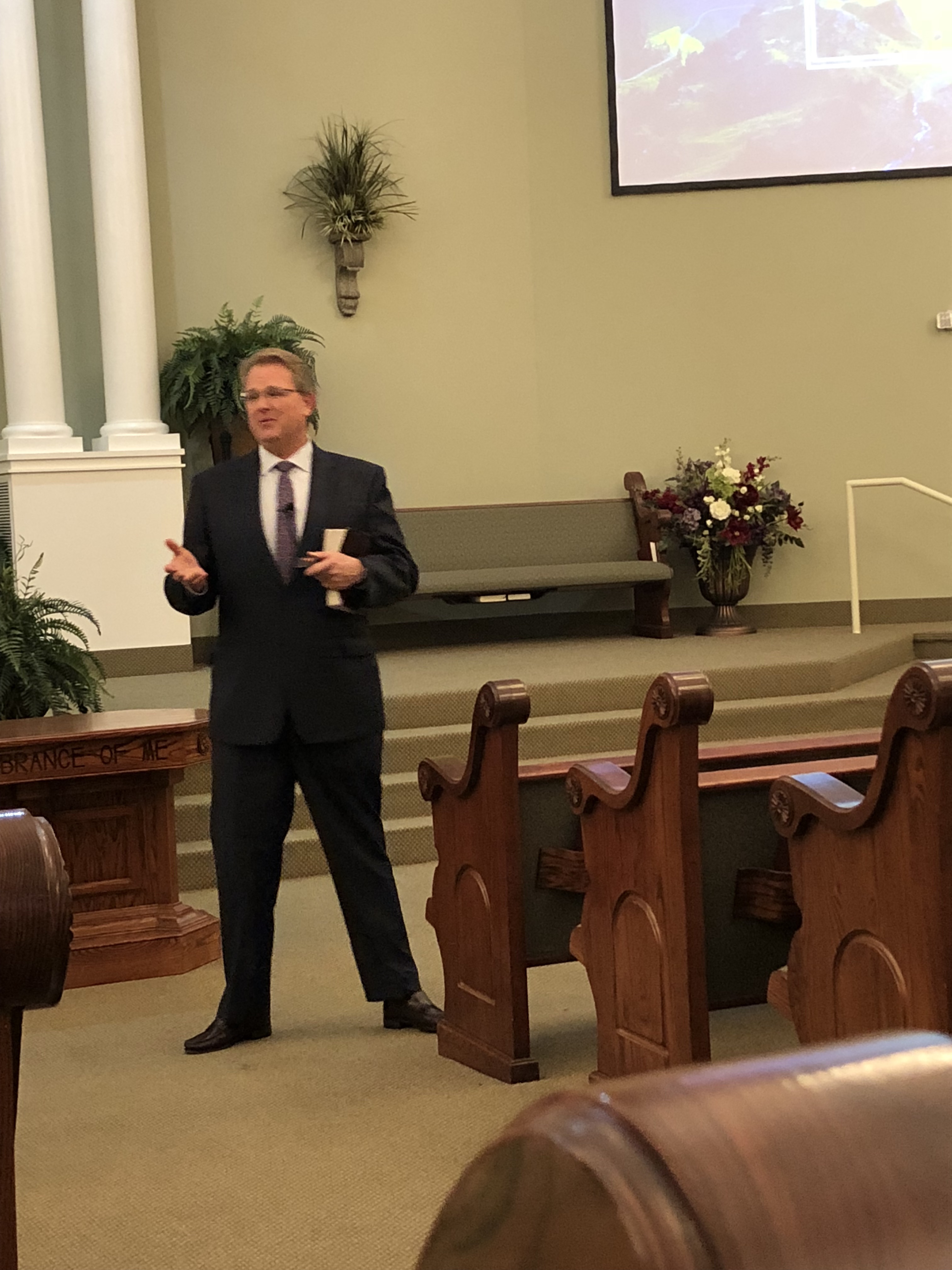
One of my favorite preachers delivering the invitation in Lexington, KY (2018)
The world’s most expensive new car is $18,000,000 (Bugatti La Voiture Noire). The most expensive house is around $2,000,000,000. According to Google, the most expensive thing in the world is apparently Walmart. It’s either Walmart or a $4,800,000,000 gold yacht. On the average US salary for a family it would take 100,000 households’ total income to purchase. Or, it would take one person 100,000 years.
For most of us, those numbers are unattainable. That kind of value is totally out of reach.
Jesus did something that makes those numbers look pathetic. He paid our insurmountable debt with something that cannot be valued with any mortal currency (I Peter 1.18,19; Acts 20.28).
He values His church at one eternal blood sacrifice (Hebrews 9). We could not possibly drum up enough money over all history and economies to even approach one eternal blood sacrifice. And He paid that for us. God gave up everything to “buy” our spiritual freedom.
I doubt myself constantly and even feel somewhat worthless at times. It’s part of our humanity! We instinctively know that we’re insignificant in this universe (Ps. 8; Ps. 144). But like David said (twice), He does care for and think about us, despite our insignificance.
Spending eternity with God will be incredible by itself, but knowing that at death we will be face-to-face with the One who sees us as being that valuable is so exciting!! Knowing this, let’s do whatever it takes to make it there (I Cor. 6; 7; I Pet. 1.18f; Rev. 22.14-17).
On at least two different occasions, Jesus said, “Go and learn what this means: ‘I desire mercy and not sacrifice’” (Matthew 9.13; Matthew 12.7). It’s quoted from Hosea 6.6, but in multiple other passages God tells us that He prefers obedience over going through the motions of worship (Isaiah 1.11ff; Amos 5.21; Micah 6; Mark 7).
This is NOT saying that worship is less important than obedience, since obedience causes us to worship. It does show God’s attitude toward those who claim to follow Him, but whose actions say otherwise. Listen to the force behind His words in Amos 5.21, “I hate, I despise your feasts, and I take no delight in your solemn assemblies.” Israel had adopted some religious and social misconduct.
Do our actions cause God to wince at our worship? Israel was God’s chosen nation, but when they neglected to show mercy, justice, compassion, or faithfulness, God rejected their worship and sent them into captivity. So what kind of worship does God love? Obedience, mercy, pursuing good, showing compassion to those less powerful, integrity, justice, and being morally pure (Amos 5.11ff).





















 The Preacher Pollard Blog