When Jude Quoted Books God Didn’t Write

Twenty-five verses. That’s all Jude needed to expose false teachers, rally believers, and deliver one of Scripture’s mightiest doxologies. Yet within this compact letter lie two startling citations—neither from Moses, the prophets, nor the Psalms, but from Jewish apocryphal writings. Why would an inspired writer quote uninspired sources?

Brent Pollard

Twenty-five verses. That’s all Jude needed to expose false teachers, rally believers, and deliver one of Scripture’s mightiest doxologies. Yet within this compact letter lie two startling citations—neither from Moses, the prophets, nor the Psalms, but from Jewish apocryphal writings. Why would an inspired writer quote uninspired sources?

The Arrogance That Mocks What It Cannot See

Jude writes his general epistle with a sense of urgency. False teachers have misused grace to justify immoral behavior and show disrespect for authority. By verse 8, their pride has become demonic, and they “speak evil of dignitaries,” which most likely refers to angelic beings. Jude does not intend to promote the worship of angels; instead, he warns against hubris. These false teachers behaved as if they had authority over realms they did not have, and that is the pride Jude exposes. Therefore, these men slander realities beyond their understanding.

To expose such folly, Jude reaches for an unlikely illustration.

When Even Angels Know Their Limits

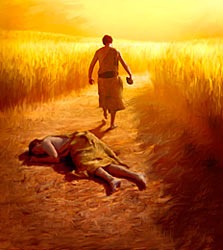
Jewish tradition, preserved in the Assumption of Moses, tells of Michael the archangel disputing with Satan over Moses’ body. The devil claimed ownership—perhaps because Moses had killed an Egyptian, perhaps because Satan styled himself lord of the earth.

Michael’s response? He refused to pronounce judgment on his own authority. Though heaven’s chief warrior, he simply said, “The Lord rebuke you.”

Here is Jude’s blade: If Michael—commander of celestial armies—dared not revile even Satan, what business have mortals mocking spiritual powers they neither respect nor understand?

True strength bows before God’s sovereignty. Pride pretends to authority it does not possess.

The Prophet Who Saw Judgment Coming

Jude then quotes 1 Enoch, a Jewish apocalyptic text known to his audience:

“Behold, the Lord comes with ten thousands of His holy ones, to execute judgment upon all, and to convict all who are ungodly of all their ungodly deeds.”

This inclusion is no blanket endorsement of Enoch’s book any more than Paul’s citations of pagan poets made them Scripture. Instead, the Spirit guided Jude to extract one true statement—a warning echoing throughout divine revelation—and press it into service for eternal purposes.

God can take a fragment of human tradition and forge it into revealed truth without sanctifying its source.

How Inspiration Actually Works

Jude’s method reveals three vital principles:

1. Authority lies in God’s selection, not the source’s pedigree.

The Spirit determines what enters Scripture. Truth remains truth wherever it appears, but only God’s breath makes it authoritative. Jude’s quotes became inspired not because of their origin, but because God chose them.

2. God meets people where they live.

Jude’s Jewish Christian readers knew these traditions. Using familiar examples, he illustrated the truth vividly. We do the same, quoting, say, Shakespeare or Einstein—not to canonize them, but to communicate clearly.

3. The message matters infinitely more than the medium.

Both stories serve one purpose: to contrast human arrogance with divine authority and to warn that God judges all rebellion.

Three Applications for Your Life Today

First, guard your tongue when speaking of spiritual realities.

If Michael, who stands before God’s throne, refused to speak presumptuously, how much more should we? Reverence isn’t weakness; it’s wisdom. Before you dismiss spiritual truths or mock what you don’t understand, remember who you’re dealing with.

Second, rest in the certainty of God’s judgment.

False teachers may flourish now. Arrogance may strut across platforms. But Enoch’s prophecy stands: God will judge every ungodly deed. Your job isn’t to play God. It’s to trust Him.

Third, quote wisely, but verify everything.

You’ll find truth scattered across literature, philosophy, and even secular observation. Quote it when it serves God’s truth. But never confuse a helpful quote with Scripture’s authority. Test everything against the Word (1 Thessalonians 5:21). All other lights are dim candles held up to Scripture’s blazing sun.

The Weight of a Short Letter

Don’t mistake brevity for shallowness. In twenty-five verses, Jude wields ancient tradition, angelic authority, and divine judgment to demolish pride and call the church back to truth.

Michael’s humility rebukes the arrogant. Enoch’s prophecy warns the rebellious. Together they sound Jude’s central note: “Contend earnestly for the faith which was once for all delivered to the saints.”

In a world drowning in opinions, that call has never been more urgent.

God has spoken. The question is whether we’ll listen with the humility of angels or the arrogance of fools.

The difference is eternal.

Even when he quotes from outside Scripture, Jude points us back to Scripture’s heart—the unchanging authority of God and the sure destiny of all who defy it.

Origen’s “On First Principles” (Preface 5-6)

What did those believers in Christ close to the days of the apostles understand and teach concerning major theological topics. While these words are not inspired, they are very insightful. Two related topics are discussed by Origen in today’s blog post.


Gary Pollard

5. The apostles also taught that our soul has a form and life force of its own. Once it’s free of this body it will get what it deserves. We’ll either gain immortality and happiness, or we’ll be punished forever with fire. This all depends on how we live our lives. The apostles also said that there will be a day when all people come back to life. When that happens this body “which was planted in the grave and will ruin and decay” will be “raised to a life that cannot be destroyed.” And the dead body that “has no honor” will be “great and glorious” when it is raised from death. Another thing that is clearly taught in every church is this: Every person has the power to choose what they do. Every person is involved in a struggle against the devil and his angels and anti-virtues. They try very hard to make every person do all kinds of bad things. But if we’re trying to live the right way, we should determine to fight off these things. We understand that no one’s forcing us to do anything against our will — right or wrong. Even if we have full control over ourselves, some influences may convince us to do something bad. Some may also help us do the right thing! Whatever it is, we’re not forced to do the right thing and we’re not forced to do the wrong thing. Some people think we are forced to do right or wrong based on the positions or movements of certain stars. They think we’re totally powerless to act against whatever these astrological positions determine. Getting back to the ‘soul’ topic: We don’t have enough information to be dogmatic about it. Does it come from our parents or genetics and is fundamentally part of our physical bodies? Or does it come from somewhere else? We don’t know if we get it at birth or if it’s given to us by an outside source. 

6. About the devil and his angels (and “anti-virtues”), we don’t have good information either. The churches have only told us this: They exist. Aside from this, we haven’t gotten any clarification about what kind of body they have or where they come from. Here’s what most people seem to believe, though: The devil used to be an angel and he rebelled against God. When he did this he convinced a lot of angels to fall with him. From the time he did that until today they are called “the devil’s angels”. 

King Saul: Lessons from a Proud Monarch

Brent Pollard

“The Lord resists the proud; but he gives grace to the humble” (Proverbs 3.34 LXX).

The rise and fall of King Saul is worthy of any Shakespearean drama. When God chose Saul as King of Israel, he attempted to hide from the people (1 Samuel 10.22). For his part, Saul looked the part, standing head and shoulders taller than everyone else (v.23). The people believed he was the right person to rule over them and shouted, “Long live the king” (v.24). However, Bible readers are already familiar with the entire story. The longer Saul reigns, the prouder he becomes.

In 1 Samuel 15.1-3, Saul failed to carry out God’s vengeance on the Amalekites. He made a weak excuse for his failure (vv. 15, 20–21) and was proud of his actions, building a monument to remember them (v. 12). When Samuel arrived, Saul was unaware of God’s anger. Saul greeted Samuel warmly, boasting of his obedience in carrying out God’s commands (v. 13). Samuel not only rejected Saul’s excuse but also asked him to recall a time when he had been humble (v. 17). God chose Saul as king while he was still humble.

Saul’s failure to “hack Agag to pieces” (as described in 1 Samuel 15:33 ESV) was just one of many examples of his arrogance. Further reading of 1 Samuel reveals more instances where Saul’s pride caused him to make poor decisions. By examining these examples, we can learn an important lesson about the importance of humility.

In 1 Samuel 13.8–14, Saul made an unauthorized sacrifice, a duty nearly exclusively assigned to priests but also permitted for some prophets, such as Samuel and Elijah. Saul took this action because Samuel took longer than expected to arrive in Gilgal, and he was concerned about his men scattering. He wanted to demonstrate his dominance or power. However, Samuel chastised Saul for this act, claiming that his kingdom would not last because of it. This incident could be interpreted as an early indication of Saul’s pride, as he overstepped his authority and assumed a priestly role.

In 1 Samuel 14:24–46, Saul makes a hasty vow prohibiting his soldiers from eating. Even when it puts the battle at risk and endangers the life of his son Jonathan, who unknowingly ate some honey, Saul refuses to admit his mistake. Jonathan criticizes the vow, arguing that the army would have been better off eating from their enemies’ spoils. However, Saul puts his command above his troops’ safety and the situation’s practical needs. The people must intervene to save Jonathan from execution, and this episode demonstrates Saul’s flawed leadership and decision-making. He prioritizes his pride and desire for authority over the welfare of his people, resulting in decisions that lack wisdom and compassion.

We see Saul’s angry reaction to a song about David’s victory over Goliath in 1 Samuel 18:6–9. The song says, “Saul has slain his thousands, and David his ten thousands.” As a result, Saul becomes very angry and envious. He says, “They ascribed ten thousand to David, but thousands to me. What else can he have besides the kingdom?” Due to his jealousy, Saul keeps a close eye on David and makes several attempts on his life. He pursues him relentlessly, as he cannot bear the thought of someone else receiving more praise and admiration than him.

In 1 Samuel 20.30–34, when Saul confronted Jonathan, his jealousy, rage, and fear of losing his kingship to David were evident. However, his pride also played a significant role in his actions. Saul’s reaction to Jonathan’s defense of David revealed the extent of his pride, paranoia, and violent desire to rule. He insulted Jonathan and even tried to kill him with a spear for supporting David, whom he saw as a threat to his throne. Saul’s pride and ego were so intertwined with his kingship that any challenge to his rule or authority provoked a drastic and irrational response. To Saul, Jonathan’s loyalty to David was a direct challenge to his kingship.

Saul’s behavior reveals his unwillingness to accept Samuel’s prophecy that David will replace him as king and his kingdom will end. His pride prevents him from considering the situation from a divine or practical perspective, causing him to focus only on his desires and fears. Saul’s pride is more than just arrogance; it is a harmful combination of fear, authority, and a refusal to acknowledge his mistakes or comprehend that his actions may cost him God’s favor and reign. Therefore, Saul’s clash with Jonathan illustrates how his pride and desire to retain power at any cost have damaged his character and leadership abilities.

In the book of 1 Samuel chapter 28, we read about Saul’s visit to the witch of Endor. Saul found himself in a desperate situation as he confronted the Philistine army. Despite his efforts, God did not respond to Saul’s prayers through dreams, prophets, or the Urim and Thummim. As a result, Saul turned to an Endor medium to summon the spirit of Samuel, who had died. This act of seeking the aid of a medium contradicted God’s commands, as stated in Deuteronomy 18.10–12. This move demonstrates Saul’s departure from reliance on God, possibly motivated by a prideful belief in his ability to control his destiny through any means available, even if forbidden.

Saul’s tragedy is a powerful warning about the corrupting influence of pride. Initially, he reigned with humility and submission to God, but his behavior degenerated into arrogance, defiance, and self-destructive actions. Saul’s elevation to kingship fed his ego, leading to impulsive decisions that separated him from God’s favor and ultimately caused him to lose his kingdom. His story highlights the significance of remaining humble, wise, and reliant on God’s guidance, even when in positions of power and authority. Pride can lead to ruin, but cultivating a humble heart enables us to make decisions that honor God and benefit those around us. Saul’s life reminds us that uncontrolled pride precedes the fall.

Solomon’s Paradox

Wisdom, Governance, and the Search for Fulfillment

Brent Pollard

What events so enraged the majority of Israel’s tribes that they chose to secede from the Davidic monarchy? In 1 Kings 12, Jeroboam and a group of Israelites confronted the recently anointed monarch.

Your father made our yoke hard; but now, lighten the hard labor imposed by your father and his heavy yoke which he put on us, and we will serve you.” (1 Kings 12.4 NASB)

I read this passage for a long time without fully comprehending its significance. Solomon used corvée (kor-VAY) labor to build extravagant structures. Many of these people chosen to work were foreigners discovered during David’s disastrous census (2 Chronicles 2.17). Solomon is portrayed more favorably in the Book of Chronicles than in the Book of Kings. However, in 1 Kings 5.13, Solomon “conscripted forced laborers from all Israel” (NASB, emphasis mine). 

Is there a modern equivalent of corvée labor? Military service is mandatory in some modern nations. Some countries that do this include Israel, South Korea, and Switzerland. However, the focus of corvée labor is on infrastructure projects. It would be a more fitting analogy if the Civilian Conservation Corps of the New Deal had mandated rather than recruited young men. I live in an area with state parks built by the Civilian Conservation Corps. Photographs document their hard work cutting trees and building park facilities.

As a result, the populace informed Rehoboam that they did not appreciate the yoke his father had imposed upon them. Rehoboam told the people he would respond to their complaint in three days (1 Kings 12.5). Within those three days, Rehoboam consulted his older advisors. They told Rehoboam to lift the burdens placed on the people by his father. Rehoboam also consulted his young advisors. Their advice was different. 

“And the young men who had grown up with him spoke to him, saying, ‘This is what you should say to this people who spoke to you, saying: ‘Your father made our yoke heavy, now you make it lighter for us!’ You should speak this way to them: ‘My little finger is thicker than my father’s waist! Now then, my father loaded you with a heavy yoke; yet I will add to your yoke. My father disciplined you with whips, but I will discipline you with scorpions!’” (1 Kings 12.10-11 NASB)

To the ruin of the united monarchy of Israel, Rehoboam went to his peers’ advice. Of course, given the sins of Solomon in going after the gods of his many wives (see 1 Kings 11.4–8), we know that this was the determination of God to tear away the kingdom from him and give it to his servant, Jeroboam (1 Kings 11.11–13). 1 Kings 12.15 clearly states that Rehoboam did not listen to the people “because it was a turn of events from the Lord, in order to establish His word which the Lord spoke through Ahijah the Shilonite to Jeroboam the son of Nebat.” (NASB) 

On the one hand, it is hard to feel sympathy for the Israelites. God had warned them that such a scenario was possible when they clamored for a king. Note 1 Samuel 8.10ff: 

“So Samuel spoke all the words of the Lord to the people who had asked him for a king. And he said, “This will be the practice of the king who will reign over you: he will take your sons and put them in his chariots for himself and among his horsemen, and they will run before his chariots. He will appoint for himself commanders of thousands and commanders of fifties, and some to do his plowing and to gather in his harvest, and to make his weapons of war and equipment for his chariots. He will also take your daughters and use them as perfumers, cooks, and bakers…He will also take your male servants and your female servants, and your best young men, and your donkeys, and use them for his work…Then you will cry out on that day because of your king whom you have chosen for yourselves, but the Lord will not answer you on that day.” (NASB) 

Despite hearing this, the people said, “No, but there shall be a king over us, so that we also may be like all the nations, and our king may judge us and go out before us and fight our battles.” (1 Samuel 8.19-20). God told Samuel to let the people have what they wanted. 

On the other hand, we have to wonder how the wisest man, other than the Son of Man, who ever lived, could so choose to burden his people as to make them grumble and complain. After all, Solomon imparted some wisdom about rulers to his son in Proverbs. For example, in Proverbs 28.16, Solomon says, “A leader who is a great oppressor lacks understanding, But a person who hates unjust gain will prolong his days.” (NASB) It is a paradox that someone can be both wise and demonstrate a lack of understanding. Yet, this describes Solomon well. 

The greatest tragedy is how Solomon felt after considering everything he achieved using corvée labor. Note Ecclesiastes 2.4-6 and 11:

I enlarged my works: I built houses for myself, I planted vineyards for myself; I made gardens and parks for myself, and I planted in them all kinds of fruit trees; I made ponds of water for myself from which to irrigate a forest of growing trees. (NASB)

So I considered all my activities which my hands had done and the labor which I had exerted, and behold, all was futility and striving after wind, and there was no benefit under the sun. (NASB)

Thus, he built things thinking it would bring him a sense of satisfaction, only to realize that after he was gone, everything he had made would fall into the hands of another (see Ecclesiastes 2.18). The reality made him realize that this, too, was vanity. Solomon proves that having wisdom on a personal level doesn’t always translate seamlessly to governance. Making decisions impacting an entire nation can vastly differ from making personal decisions or offering advice to individuals. 

The story of Solomon and the division of the kingdom that followed is a timeless cautionary tale about the difficulties of leadership, the perils of absolute power, and the universal human yearning for meaning and purpose. We may find it hard to relate to the specifics of Solomon’s rule and the events leading to Israel’s division, but the underlying themes remain relevant to our time. No matter how experienced or knowledgeable they are, leaders can still make mistakes. Pursuing one’s ambition can frequently result in undesirable outcomes without moderation and self-reflection. 

This story serves as a reminder for those in authoritative roles to listen to sound advice and stay in touch with the wants and feelings of the people they govern. For everyone else, it highlights the futility of placing one’s hope for happiness in material things and the fleeting nature of life itself. It’s a sobering reminder that pursuing lasting happiness should take priority over acquiring worldly power and prestige.

Much Better To Listen And Obey

Neal Pollard

God has a straightforward task for Saul in 1 Samuel 15. As a consequence for their opposition to Israel as they are fleeing Egypt in the battle where Aaron and Hur hold up Moses’ arm as Joshua leads the battle (Ex. 17:8-16), Amalek was devoted for destruction by God (Deut. 25:17-19)(1 Sam. 15:1-3). God is not ambiguous. He says “devote to destruction all they have” (3) and “do not spare them” whether man, woman, child, infant, or livestock (3). 

Saul is given the task of carrying out that total annihilation. He amasses a huge army of 210,000 soldiers and sets out against Amalek (4). After warning the Kenites (5-6; Num. 10:29-32) among the Amalekites to leave or die, Saul and his army thoroughly defeat this enemy (7). Up to this point, Saul’s effort has been nothing but a success!

However, Saul decides to do things the way he thinks is best. While he kills all the people as God instructs, “Saul and the people spared Agag and the best of the sheep and of the oxen and of the fattened calves and the lambs, and all that was good, and would not utterly destroy them. All that was despised and worthless they devoted to destruction” (9). God commanded Saul and he “would not” do it.

Samuel records some pretty chilling words regarding His choice of Saul. God says, “I regret that I made Saul king” (11,35). This is very similar to what God said about humanity in Noah’s day (Gen. 6:6-7). The text reveals several factors that led to God’s grief. 

  • Saul turned back from following God (11)–He followed what he wanted to do
  • Saul had not performed God’s commandments (11)–He neglected or omitted what God instructed
  • Saul blamed his followers for this sin (15,21)–He left out his part as decision-maker and pinned it on the people
  • Saul forgot his humble roots (17)–He allowed his position to go to his head
  • Saul was disobedient (19)–This was at the very core of Saul’s issues
  • Saul was greedy (19)–He pounced on the spoil
  • Saul had no fear of God (19)–He did evil in the very sight of Him
  • Saul rationalized (20-21)–He claimed to have done what God said except for the “best of the spoil” in order to sacrifice them to God; He reasoned that it was OK since his motives, he claimed, were right.
  • Saul feared the people and listened to them (24)–He got things backward!

But, that is when Samuel delivers the well-known, oft-quoted response to Saul. He tells the king, ““Has the Lord as great delight in burnt offerings and sacrifices, as in obeying the voice of the Lord? Behold, to obey is better than sacrifice, and to listen than the fat of rams. For rebellion is as the sin of divination, and presumption is as iniquity and idolatry. Because you have rejected the word of the Lord, he has also rejected you from being king” (22-23). What was going through Saul’s mind? Whatever it specifically was, he decided his way was better than the way God commanded him to go. 

God’s attitude toward such a spirit and mindset is crystal clear. God rejects it! It’s obvious that Saul knew what he was doing. His confession of sin reflects he completely understood what he had done wrong (24-25), but he still feels more concerned about his image with the people than his integrity before God (25,30). He falls at Samuel’s feet and tears the prophet’s robe, and Samuel tells him that symbolized how the kingdom has been torn away from him and his descendants (27-29). Samuel tells him he cannot and he will not keep up appearances for Saul’s sake, but he does follow Saul back to the people so that he can finish the job Saul had not done. He kills Agag (32-34). Then, he leaves Saul never to see him again (35). Samuel was far from hard-hearted, but instead grieved over how Saul had turned out.

It is dangerous for us to put question marks where God has put periods and exclamation marks. We have no right to make right what God has clearly deemed wrong, and we’re wrong to make wrong what God has not forbidden. Saul put himself in God’s place and thereby placed himself in spiritual danger. Perhaps worst of all is behaving in such a way that God regrets choosing to use us to accomplish His will because we would not trust and obey! We can always be sure that what God says is right and only His way is the way to go. In case we lose sight of that, we help ourselves by reviewing the sad case of Saul! “Behold, to obey is better than sacrifice, and to listen than the fat of rams” (22).

The Church’s First Internal Problem

Monday’s Column: Neal At The Cross

Neal Pollard

We cannot call what happens in Acts five the church’s first problem. Having your members hauled before community leaders and threatened would be stressful and concerning. Having members in financial need would be considered a tough issue. But, neither of those things were “unforced errors.” In an organization filled with people, there will be internal problems because we have struggles and sins. What we do about them and after them spells the difference in ultimate success and failure. 

THE REBELLION (1-10). We are introduced to a couple named Ananias and Sapphira, members of the Jerusalem congregation. In the spirit of sacrificial generosity, Barnabas, who owned a tract of land, “sold it and brought the money and laid it at the apostles’ feet” (4:37). This couple also sold a piece of property, an admirable and generous thing to do to prevent needs among the Christians (4:34). But, what they did after the sell was anything but righteous. They kept back part of the proceeds from the sale. What was the sin in that? Apparent there was an intent to deceive, to suggest that they were giving all the money while keeping part of it for themselves. The word translated “keep back” is the word for pilfer or embezzle, suggesting they had pledged the full price of the sale but kept back some for their own security. This would also suggest covetousness or greed, hearts influenced by worldliness. It also certainly implies pride, wanting to be seen as generous as Barnabas while not suffering the full sacrifice of surrendering all the money for the needs of the saints. This husband and wife were united, but in the worst possible way. Do we struggle with materialism, pride, greed, dishonesty, and selfishness? It is good for us to appreciate how seriously God takes the willful sin in the lives of His children (Heb. 10:26ff). God preserved this in Scripture for us to contemplate how harmful “sin in the camp” is to the spiritual health and well-being of His sacred community (the church). 

THE RESPONSE (3-10). Peter calls out Ananias (3-4), then Sapphira (8-9) three hours later. He specifies what they had done and why it was so wrong. God’s response was to strike each of them dead! Looking back on this, especially if we struggle to see the “big deal” of their sin, we might think the reaction was overly harsh or unreasonable. No doubt this event gets our attention and sharpens our focus on how seriously God views premeditated sin and sin that threatens to harm the entire spiritual community. Conceiving transgression in the heart and attempting to lie to God is such a basic betrayal of our Lord. While we should be grateful that God does not choose to respond with such immediacy today, we should also reflect deeply upon how grave it is to engage in unrighteousness. It’s not “no big deal,” something to be rationalized away. Even if church leadership does not address it in this life does not mean God will not address it at the judgment. This text encourages us to keep our heart soft to His will and to the reality of our willfulness. 

THE RESULT (11-16). We might think that people would have left that church in droves! After all, if they had a marquee in front of their “building,” it might say, “Come inside and try us. The Holy Spirit strikes down our liars.” Yet, what happens next? As we might suspect, “great fear came upon them all” (11). But, the judgment on the couple did not drive people away or even send the cause in a backward direction. The apostles demonstrate God’s power (12), the church spent more time together (12), the broader community held them in high esteem (13) and benefited from their benevolence (15-16), and, maybe most startling, “all the more believers in the Lord, multitudes of men and women, were constantly added to their number” (14). How could this be the result of the ultimate example of “church discipline”? Simply, this is God’s wisdom. Paul will later say, “the foolishness of God is wiser than men, and the weakness of God is stronger than men” (1 Cor. 1:25). Just because we don’t understand God’s ways does not make them inappropriate and improper (Isa. 55:8-9). The Potter has a right over the clay (Rom. 9:20-21). We must resist the temptation to protest the teaching and conclusions God’s Word makes because we find it too hard and narrow. If we trust God’s wisdom and pattern, we’ll find it works in any culture, time, and place. 

Come Receive Your Wisdom at Jehovah’s School

Friday’s Column: Brent’s Bent

Brent Pollard

“This chapter is one of the most excellent in all this book, both for argument to persuade us to be religious and for directions therein,” Welsh Nonconformist theologian and commentator Matthew Henry said of Proverbs 3.1 I agree that it is a practical chapter. And a couple of verses of this section land on my toes. However, Proverbs 3 contains surprises for everyone, such as one verse that tells us that Jehovah has a school. This phrase is used in verse 11 by Lutheran commentators Karl Keil and Franz Delitzsch. 2 

I’ve seen different plans for Proverbs 3, but the one I like best right now is to divide the chapter into 8 points. Lady Wisdom tells her students to do the right thing first (1-4). Next, she advises students to believe in God’s plan (i.e., Providence; 5-10). The student is then told by Lady Wisdom not to look down on the “school of Jehovah” (11-12). After that, Lady Wisdom will offer a discourse about the practical applications of wisdom in our lives (13-26). Then, in verses 27 and 28, Lady Wisdom tells people not to put things off. (There go my toes!) Lady Wisdom then tells students to love each other and be patient, and then she tells them not to feel sorry for bad people who get what they deserve (29-32). Finally, lady Wisdom ends by comparing the house of the wicked to the home of the humble and wise (33-35). 

However, those who do the right thing will avoid many pitfalls into which the foolish repeatedly fall. Sin can have both natural and long-term consequences. Sexually promiscuous people are at risk of contracting a disease. A car accident may kill a drunken driver. When a curious teen tries illicit drugs for the first time, he or she may overdose. Those who do the right thing will avoid these scenarios. Those who do good will also have peace of mind. Their conscience does not interfere with their sound sleep. They also have peace because they have a good relationship with God. Before I go, I’d like to make one more point. Doing the right thing gives someone a sense of purpose (Ecclesiastes 12.13-14). That certainly adds to the quality of life. 

Lady Wisdom advises us to put our trust in God’s plan (i.e., Providence). Following God’s plan leads to our greater industry and avoiding the previously identified pitfalls. Lady Wisdom says wealth results from working in concert with God’s Providence, as opposed to the prosperity gospel’s teaching that faith alone can produce wealth. We trust God for the increase, but we contribute by working. Unlike those who make rash plans, we pray for God’s will to be done (cf. James 4.13-16). We have faith in God’s wisdom. 

We are now at the text portion where Lady Wisdom enrolls us in the “Jehovah’s school.” Interestingly, this passage shows that Keil and Delitsczh change God’s “chastisement” to His “school.” According to their understanding of Hebrew, the word in the original text means “taking one into school.” 3 But isn’t that in line with what God says about His correction elsewhere in the Bible? He corrects us through His love for us to share in His holy nature and bear righteous fruit (Hebrews 12.1-13). Of course, God could let us go without discipline, but that would not be in our best interests. 

Lady Wisdom describes the practical benefits of wisdom obtained through diligence after we enroll in Jehovah’s school. On a much smaller scale, the person willing to apply himself or herself can receive the same information God used to create and sustain the cosmos. No, our wisdom will never be as great as God’s (Isaiah 55.8-9), but it can be significant enough to serve as a badge of honor. Wisdom, once established, also provides a peaceful life. It’s worth noting that Solomon mentions peace twice in Proverbs 3. We could say that wisdom makes life easier, which leads to peaceful outcomes. 

When you’re feeling overwhelmed, what do you do? Anxiety and fear fill your heart. Those thus afflicted shut down and cannot process rational thought, and there is no peace. I jokingly referred to this phenomenon as “panic logic” to my speech therapist. In other words, one loses reasoning and follows the first impulse that comes to mind. I told her about when I stepped into a fire-ant bed as a kid. The ants were already halfway up my leg and stinging when I realized what I had done. My rescuer was watering his garden when he ran over to me with the garden hose. Rather than spraying my legs with water and sending the ants flying, as would have been more logical, he began swatting them away with the hose itself—what a way to add insult to injury. So, I had to contend with stinging ants as well as stinging blows from a rubber hose. A person who follows Lady Wisdom not only has peace of mind because of his relationship with God, but he can also keep his cool in worldly dealings because he “knows stuff.” It’s no surprise that wisdom is valuable! 

And now we come to the part of Proverbs 3 that I need to remind myself of daily. Lady Wisdom instructs us not to procrastinate by using a benevolent illustration. If we are in a position to act and have the resources to do so, we should act immediately. Why? It is because we are easily distracted. Remember how Joseph predicted in Genesis 40 that an imprisoned servant would return to serve the pharaoh as a cupbearer? Joseph requested that the cupbearer communicate his plight to the pharaoh since he had his ear. But the cupbearer managed to forget Joseph. Was it because he was a bad guy? No, not necessarily. We can get caught up in the minutiae of life and lose sight of our responsibilities or promises. Or, if it is a matter of money, it vanishes (Proverbs 23.5). You may intend to assist someone with his financial burden “tomorrow,” but tomorrow arrives with an illuminated check engine light. So, whenever the opportunity arises, do good (Galatians 6.10). 

Outside of the example of benevolence, how does this relate to the overall procrastination problem? When given a deadline or promise to do something, it is easy to become distracted by other things or waste resources, such as time. As someone who has written many term papers in the final hours before they are due, I can tell you that procrastination is not a good idea, even if you claim that you need the adrenaline rush to finish projects! 

At the end of the chapter, our other lessons from Lady Wisdom in Proverbs 3 now flow together. Solomon says God gives people what they deserve and sometimes uses men in His Providence. As a result, we can be blessed by others while also becoming a blessing to others. We should maintain good relationships with others and avoid arguing with anyone without justification. When we come across someone who is suffering as a result of his foolishness, we are to leave him alone. That may appear harsh, especially considering Jesus came to seek and save the lost (Luke 19.10). However, God explains it to us by making it clear what He means when He speaks of the fool. Remember that a fool is someone who lacks moral character. As a result, a fool is rebellious and stubborn. When people rejected the message, Jesus told His disciples in the limited commission to shake the dust from their sandals and walk on (Matthew 10.14). So, we preach the Gospel to the world (Mark 16.15-16), but we recognize when it devolves into throwing pearls before swine or giving holy things to dogs (Matthew 7.6).  

Finally, there is a clear distinction between these two paths. Those seeking wisdom live in homes where God’s grace has healed their wounds and declared them righteous. The foolish scoffer will live in the filth of his own dishonorable home. God will laugh when he sees his house. Are you paying attention to Lady Wisdom? Do you refrain from disparaging Jehovah’s school? All the decisions you make today and the effort you put in to become wise will make all the difference. 

Sources Cited 

1 Henry, Matthew. Commentary on the Whole Bible (Complete). Biblestudytools.com, Salem Media Group, www.biblestudytools.com/commentaries/matthew-henry-complete/proverbs/3.html

2 Keil, Karl, and Franz Delitzsch. Keil & Delitzsch Commentary on the Old Testament. Worthy.Bible, Worthy Ministries,www.worthy.bible/commentaries/keil-delitzsch-commentary/commentary-on-proverbs-3

3 ibid 

The Fall Before The Fall

Tuesday’s Column: Dale Mail

image

Dale Pollard

The Bible indicates a battle between Satan and his rebellious followers in several key passages. The reason for this spiritual spat is not given to us in great detail but we are told that it began after they abandoned their rightful habitation (Jude 1:6). While many have speculated as to what and how this happened, we simply aren’t told. Some have also made the argument that this event took place after the Creation of the world, but this is also not certain. Genesis 2:1 says, “the heavens and the earth were completed and all their hosts.” While that may seem to clearly indicate that angels must have been created alongside everything else, Job 38:7 states that angels gave “shouts of joy” after the creation of stars.

The spiritual conflict ended with Satan and his apostate followers cast from the heavenly realm (2 Peter 2:4, Rev. 12:14, Jude) just before, it seems, the creation of earth with the Archangel Michael taking a significant role in his defeat and expulsion. 

Satan seems to have been at one time a high ranking Angel who thought he somehow stood a chance against his very Creator. That is a ridiculous thought! The application of this historical (pre-historical?) event is evident. Nobody, whether Angel or man, can win against God’s will. It’s mind boggling to imagine taking on God Almighty in some kind of battle, yet Paul tells us in Romans five that we were enemies of God at one point while living in sin, and are currently waging a war with God if we are living in sin. We should let that long ago battle in the heavenly realm be a reminder to us that God always wins the war. He’s already won! Now is the time to make sure that you’re on the side of the truth and triumph and not the devil and the defeated. 


Six Lessons From The Tower of Babel

Tuesday’s Column: Dale Mail

DaleandJanelledirectorypic
(Happy birthday to Janelle)

Dale Pollard

 
We all know the story of the Tower Of Babel. It’s the event that gave us all the diverse languages of the world. That account is not just for our entertainment or education, but there are many spiritual applications that can be pulled from the event. Here are just six from Genesis 11:1-9. 
  1. What we are building will only be successful if God designed the blue prints. What are we building? Where do we choose to place our time and effort? Making a name for ourself? Making the most money? Getting the most pleasure out of life? If this is the life we’re building, like the foolish man that’s a life built on sand. 
  2. We are free to do as we want, but for every bad decision there are consequences. 
  3. There is a truth to what God said about our ability to accomplish much as a unified people. There’s also a positive side to this not so positive account. When the church body is unified there is no limit to what we can accomplish. When there’s dissension we are weaker. 
  4. Ignorance does not mean a blissful existence. It was ignorant to think that a closer relationship with God involved building a stairway into the sky that in their minds would allow God to have the ability to descend to earth. The opposite is true. God built us a way to go to Him. 
  5. Be mindful of the presence you keep and the vision you share. It seemed that most if not all mankind at this time was unified under one vision. “To make a name for themselves,” they worked together. They planned, schemed, spent resources and time to build something that would change the world forever— but it wasn’t God’s vision. The presence you keep and the shared vision matters. What are we building? 
  6. Accounts in the Bible that seem unrealistic or mythical should not weaken our faith but strengthen it when we do our due diligence in digging into His word. God is capable of great things, and that hasn’t changed. We serve a powerful God who has big plans for the world. Are we willing to side with Him? 

Socially Distant from God?

Friday’s Column: Supplemental Strength

brent 2020

Brent Pollard

Raymond Burke, an American Catholic Cardinal serving in the Vatican, voiced his opinion about the novel coronavirus. He stated that one “cannot consider the present calamity in which we find ourselves without considering how distant our popular culture is from God.” He continued, “It is not only indifferent to His presence in our midst but openly rebellious toward Him and the good order with which He has created us and sustains us in being.” 1

Burke’s comments follow his observation that in times past when plagued by disease, people normally turned to God. Under our current circumstances of trying to mitigate COVID-19, however, we are forbidden from meeting in assemblies of more than 10 persons. Burke went on to say that our homes are “a little Church into which we bring Christ from our encounter with Him in the bigger Church.” Hence, he encouraged Catholics to pray.

From a purely doctrinal standpoint, I am unable to agree with Raymond Burke. Even so, I was struck by the quotation by him which I shared. Right now, we are isolating ourselves from one another to prevent the spread of a virus. Yet, people have been keeping themselves distant from God for years. And not only do they seek to stay distant from God, but they also promote an environment that seeks to distance others from Him as well. Burke sighted those sins like abortion and the perversion of God’s design for sexuality as proof of this distancing from God. I’d be hard-pressed to disagree with that thought.

Yet, it is not just those sins that cause people to become distanced from God. For example, in Isaiah 59, Isaiah reminded those people in a covenant relationship with God under Moses’ Law that God was separated from them by their hands defiled with blood, fingers defiled by iniquity, lips speaking falsehoods, and tongues muttering wickedness (3). He further stated they conceived mischief and brought forth iniquity (4). He said their feet ran to evil (7). Consequently, they made crooked paths for themselves, which deprived others of peace when they traveled upon them (8). Frankly, modern America sounds no different.

And what was the consequence of being distant from God? Isaiah began by saying that God had become separated from them which prevented Him from hearing their prayers or helping them (1-2). Justice was far from them and despite their hope for light, they were ensconced in darkness (9). Indeed, the Israelites were blind men groping along the wall and stumbling during the day as though it were night (10). They were compared to dead men (10).  Truly, without God people are in a terrible position.

During this pandemic, I have noted more references to God on television. As I’ve heard the discussion of our mental health during this crisis, even news commentators have lauded the role of faith in preventing people from despairing. After all, hope is an anchor. Vice President Mike Pence, in commenting about the deaths from the coronavirus, quoted from 1 Thessalonians 4.13 that we do not grieve like those who have no hope. 2 As refreshing as all of this is, I am afraid that it smacks of waiting until the house has burned down to call the fire department.

If we truly want for God to bless us individually, as the church, or to bless our secular nation, we cannot afford to practice social distancing from God. We must allow for the only name given under heaven among men that saves (Acts 4.12) be always on our lips as we preach and teach to our neighbors (Matthew 28.19-20).


References

1 Chapman, Michael W. “Cardinal Burke: Consider Virus in Light of ‘Actual Sins,’ Abortion, Gender Theory.” CNSNews.com, Media Research Center, 27 Mar. 2020, 15:36, www.cnsnews.com/article/international/michael-w-chapman/cardinal-burke-consider-virus-light-actual-sins-abortion.

2 Foust, Michael. “’We Do Not Grieve Like Those Who Have No Hope,’ Pence Says of Pandemic during Easter.” ChristianHeadlines.com, Salem Web Network, 9 Apr. 2020, www.christianheadlines.com/contributors/michael-foust/we-do-not-grieve-like-those-who-have-no-hope-pence-says-of-pandemic-during-easter.html.

Why Is The World Asking “Why?”

Neal Pollard

Today, everyone is hurting. Whether because of gun or knife violence or vehicular homicide, groups of people in our nation and other parts of the world are being torn from time and prematurely vaulted into eternity. We weep and mourn for the loss. We consider the enormous grief and heartache multiplied many families face from California to Florida, Connecticut to Texas, Colorado to Tennessee, Virginia to Nevada (and many other places).  Those whose voices we hear the most through all of this, like the national and local media, seem fixated on learning the perpetrator’s motive each time it occurs. Experts and analysts look at religious ideology or mental health issues. It seems as if they believe that if they can determine the motive, that will solve the violent epidemic that has disturbed the peace of so many people in our society. The danger of oversimplifying any specific tragedy notwithstanding, there are some right answers the world will have a difficult time embracing but that get us so much closer to resolving this plaguing problem. Why are these horrific crimes occurring?

  • The world has rejected God. Romans 1:28 says, “ And just as they did not see fit to acknowledge God any longer, God gave them over to a depraved mind, to do those things which are not proper….” “Not proper” seems benign to us in the way we use the phrase in English (bad table manners, having your shirt untucked, etc.). Kittel says, “Paul has in mind what is offensive even to natural human judgment. The decision against God leads to a complete loss of moral sensitivity, the unleashing of unnatural vices, and hence the type of conduct that even healthy pagans regard as improper” (386). Paul tells us this improper conduct includes “all unrighteousness, wickedness, greed, evil; full of envy, murder, strife” and other things we see in these current tragedies (29, cf. 30-31). Read the context to appreciate the rotten fruit of such thinking.
  • The world has redefined sin. A worldview or value system is built bit by bit, choice by choice. Paul writes, “Do not be deceived, God is not mocked; for whatever a man sows, this he will also reap. For the one who sows to his own flesh will from the flesh reap corruption, but the one who sows to the Spirit will from the Spirit reap eternal life” (Gal. 6:7-8). If we devalue human life through sinful practices like abortion or euthanasia, we plant destructive seed. If we glorify violence or imbibe in sins like pornography that objectify human beings, we plant desensitizing seed. Long ago, Isaiah warned, “Woe to those who call evil good, and good evil; Who substitute darkness for light and light for darkness; Who substitute bitter for sweet and sweet for bitter!” (5:20). Such leads to weeds which choke out spiritual fruit.
  • The world has rebelled against biblical counsel. The absolute truth of Scripture is lost in the shuffle of worldly values. Jesus says, “Treat others the same way you want them to treat you” (Luke 6:31). He says, “Love your enemies and pray for those who persecute you” (Mat. 5:44). Paul echoes, “Do not be overcome by evil, but overcome evil with good” (Rom. 12:21). He also writes, “Do nothing from selfishness or empty conceit, but with humility of mind regard one another as more important than yourselves; do not merely look out for your own personal interests, but also for the interests of others” (Phil. 2:3-4). The Bible urges us to be kind, unselfish, compassionate, and helpful through precepts and examples. The world has ignored the ethics of Scripture in preference of humanistic philosophy.
  • The world has replaced God with self as lord. What is the ultimate consequence of denying God the place that rightfully belongs only to Him? Isaiah referred to a worldly nation, saying, “I have spread out My hands all day long to a rebellious people, Who walk in the way which is not good, following their own thoughts” (65:2). Repeatedly, Scripture decries the folly of crowning ourselves king and dethroning God (Jer. 10:23; Prov. 14:12; 16:25).  When a society writes its own rules or tries to live life on its own terms, it charts a path for heartache and disaster. How concisely Solomon says this, that “Righteousness exalts a nation, but sin is a disgrace (shame, reproach) to any people” (Prov. 14:34). When whatever a person says, wants, or believes is what goes, ultimately nothing is out of bounds for him or her.

Brethren, in this frightening, dark, and uncertain atmosphere, a world which “lies in the power of the evil one” (1 John 5:19), we must share what we know! John says, “We know that we are of God…and we know that the Son of God has come, and has given us understanding so that we may know Him who is true; and we are in Him who is true, in His Son Jesus Christ. This is the true God and eternal life” (5:19a, 20). We have security, confidence, understanding, and hope, all because of God and His Son. Take courage and share that with everyone you can! It’s the only hope the world has!

kcmkjjb5i

Do You Want A Better Life?

Neal Pollard

Who would answer “no” to that question? Who wants a worse life or a life that never gets better? But the better question is, “How do you get a better life?” Advertisers have so many answers to that, involving their currency or investment tool, their pill, diet, or workout routine, their travel agency or vacation destination, or product for your home, transportation, business, and the like. So many put so much into these promising plans, but still find their life wanting.

In religious matters, there is no room for subjective thought when it comes to what it takes to have a better life. We find ourselves often bobbing in a sea of religious confusion. Many groups claim to be the best religion and point to their ingredients as reasons for such claims. They point to their numeric size, number of programs they have, or how socially active they are. Our religious attitude ought to be one of humility, not boasting of our achievements or comparing ourselves with others (cf. 2 Cor. 10:12). Genesis 4:1-16 points us to the first recorded version where more than one kind of worship was offered to God and how God rated them. But this chapter also paints a picture of two ways of living life.

Cain is mentioned by three Bible writers after Moses writes about him in this chapter. The writer of Hebrews calls Abel’s offering more excellent than his (Heb. 11:4). John calls his works evil and his allegiance “of the wicked one” (1 John 3:12). Jude implies that the way of Cain is the wrong way to go (11). It seems that Genesis four shows us the better ingredients for a better way of living today.

  • Better living isn’t determined by age (1-2). Cain was the firstborn, a place of honor and privilege especially throughout the Old Testament.  But under the New Covenent, there is no spiritual advantage because of birth order. It is not a matter of firstborn, but a matter of being born again (John 3:1-7). Growing older should mean growing wiser, but reaching a milestone on a calendar does not equate to better living.
  • Better living isn’t determined by occupation (2).  Growing up, we might be tempted to see our occupation as the gateway to happiness and satisfaction, financial freedom and security, independence, and privilege.  When we look at Cain and Abel, what they did for a living wasn’t the determiner of the quality of their lives. Some occupations can stand in the way of better living, whether the nature of the job or the quality of the people one works with. Some can let their jobs stand between them and their relationship with God and His church. But, one can do right in unfavorable work circumstances, staying faithful to God.
  • Better living is determined by worship (3-4). That statement may be offensive to our multicultural world that says there are no absolute rights or wrongs. Contrast our culture’s thinking on this matter with what we read in Genesis four. Both Cain and Abel brought an offering to the Lord. God responded to both offerings, but He accepted one while rejecting the other. While many make worship nothing more than taste, preference, and personal, we learn here that not all worship is equal. God “had regard for” Abel’s, but not for Cain’s. It does not say if Cain was sincere. It doesn’t seem to matter. We learn here that the worshipper and the worship offered rise and fall together. God regarded Abel and his offering, but rejected Cain and his offering. Can one offer God vain worship, and have God reject it but accept him? Apparently not.
  • Better living is determined by attitude (5-7). Cain reacts to having himself and his worship rejected by God. He was very angry. His insides burned! His countenance fell. He took on an ugly look. We’re not told how old he was, but it almost sounds like a temper tantrum. Whether home training, lack of discipline, poor stress management, pride, jealousy, or anything else leads us to lose our tempers, all of them are matters only we can control. When we don’t control them, we’re responsible! Ill-tempered people are not living the better life! A positive life doesn’t require prospering, education, or earthly success. But you can’t have a positive attitude without mastering self.
  • Better living is determined by action (8-16). The word “sin” is first used in Genesis 4:7, but God was looking ahead with perfect foresight to what Cain was going to do to his brother (cf. 1 John 3:11-15). Bible writers speak of his deeds, offering, and way. These are all action words. After his sin, he is rebuked and punished by God and separated from God. Sin will not deliver what it promises. All actions have consequences (Gal. 6:7-9).

Someone said, “The line of Cain gives us murder, cities, polygamy, musicians, metal workers, and poetry, but not one who walked with God.  In fact, Cain’s legacy led to a repeat of his violent ways by a descendant (cf. 4:23). Abel leaves no physical lineage, but he leaves a great spiritual heritage (Heb. 11:4). We each get to choose what kind of life we’ll pursue. It matters which way we decide.

cain-and-abel