What is faith? According to the world, faith is seen as a blind trust. It is belief in something regardless of a lack of proof. Many believe that as Christians we are called to have a blind faith. But this is simply not the case.
The word for faith in scripture is “pistis” and it is defined as “that which evokes trust.” This is trust that is formed from an objective basis. It is a confidence in the proof that has been revealed in scripture. The biblical definition is far from this idea of a blind faith.
We know what faith is, but what does it look like practically? Faith is holding on to God through tragedy and loss. Faith is knowing that no matter what sickness or trial we go through, God is still in control. Faith is persevering through life with a confidence and hope in our eternal home.
Faith impacts every aspect of life and that’s why we should always strive to grow our faith.
There is a need for greater faith. We can grow our faith by looking to those who Jesus commended for their great faith.
Throughout Jesus’ ministry he encountered several people that showed great faith. There are only two occurrences in scripture where Jesus “marveled.” One is Mark 6:7, where Jesus marveled at their unbelief (lack of faith). The other is Luke 7:9, where Jesus marvels at the Centurion’s great faith. With our faith we have the ability to cause Jesus to Marvel. The question is, will Jesus marvel at our belief or our unbelief?
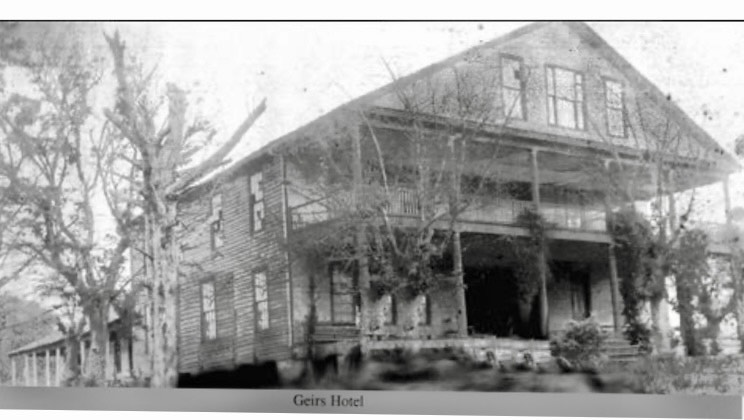
The Valhermoso Springs Resort was a gathering place for those seeking treatment from the famous Sulphur and mineral springs. The three springs were even used by the Indians for the same reason— adding yet another vale of mystery to the area. Despite being a place that attracted visitors from all around the world, including European and French royalty, there are only three low quality images of the place. Walking through the dense brush and stepping over toppled stones can give one the impression that this spot is determined to keep its secrets.
In the upper room there was a dancing hall with slat boards covered in tile. During the civil war, confederate soldiers were hidden by Mrs. Geirs who was a hot-blooded rebel sympathizer.
One of many legends surrounding this resort is that of the visit of famous outlaw Jesse James. It’s rumored that a man matching the description of Jesse rode in one night from Huntsville after robbing a bank. He wore two leather bags slung over his shoulder as he dismounted his horse. At some point, it’s unclear how he was discovered, but the law came knocking on the resort’s front door. Jesse’s stealth and cunning kept him alive during the bloody guerrilla skirmishes of the civil war, and they would help him escape the clutches of justice time and again. Legend says he left the hotel in a hurry— without his two leather bags. Did Jesse James stash his stolen goods in a cave or bury it? There’s not even hard evidence that the outlaw made a stop at the tavern, or even robbed a bank in Huntsville.
In Numbers 13 there are twelve spies who go into the land of Canaan for forty days. Their goal was to make observations that would help them conquer it as well as bring back reports about the kind of land it was. Upon their return only Joshua and Caleb are willing to take on the giant challenges that they’ll need to overcome in order to claim Canaan. Sadly, the message that the people chose to believe was that the giants were even bigger than God. What evidence did they have? Not a shred. God had proven His might and power throughout their time in the wilderness. He’s the one who directed the children toward Canaan in the first place! The fear in the crowd and the report of ten cowardly spies was contagious.
If we’re not careful, we might end up believing what’s not based in fact, too. We might be tempted to believe that Christians are a weak minority who can’t do a thing to change the culture. We might be tempted to believe that nobody is interested in spiritual things anymore. We might begin to believe that the world is bigger and stronger than the God who spoke the world into existence. Of course, this is simply not true.
Relics found by Dale and Carl on the site of Valhermoso Springs Resort
The war in Ukraine is tragic, with loss of life in the several thousands already. Families have been displaced. Untrained civilians fiercely resist invasion. NATO can’t make up its mind, leveling sanctions as though at war, but not declaring war formally. This – among other factors – is escalating an already volatile situation. A great many feel as though we’re at the brink of WWIII.
Maybe we are. Humans tend to show their very worst or their very best in times of crisis. When the pandemic started, millions forgot their humanity. Fights broke out in grocery stores, people forgot what patience, selflessness, and compassion were, and hoarding was the name of the game. Besides all that – as if we needed another polarizing issue – families, friends, and neighbors bitterly fought about masks and vaccines and social distancing.
But for many (most?) other people, it brought out their best. People checked on each other regularly. Personal feelings were put aside to accommodate the apprehension some felt. Resilience and benevolence was/is strong. The church was heavily invested in each others’ lives.
War is a tragic part of the human experience. Some may be fought for good reasons, but war itself is never good. We all hope the conflict in Europe will be resolved soon and with minimal loss of life. It might not, though. So what will we do?
Train the Brain – Determine to respond with levelheadedness and compassion, period. If it comes to war, we won’t forget our humanity. We will look out for others and act rationally. Our conditioned response will be, “How can I help other people?”
Be Like Jesus – He didn’t exploit weakness to gain an advantage. He didn’t stockpile supplies to the detriment of others. He wasn’t concerned about maintaining his standard of living. He fed people, healed people, gave them counseling, and gave them hope. That will be our response, whatever the future holds.
Be Cool – We might get scared, but it’ll never override our desire to look out for each other. We’ll demonstrate genuine faith in the creator by not acting like people who are controlled by fear.
Those are easier said than done. But we can do them, and I’m confident that we will. If the threat never exceeds high fuel prices or inflation, we’ll have made the best of a bad situation. If the threat becomes war, we’ll make the best of a bad situation. Dark days make it that much easier to shine God’s light. So that’s what we’ll do!
We have abused this word. We say things like, “I hope there’s some food at the house” or, “I hope the weather is nice tomorrow,” and “I hope my team wins the Super Bowl.” The hope that’s mentioned in scripture has a completely different definition.
The word in Romans 15:13, for example, is the Greek word “elpis. “Now may the God of hope fill you with all joy and peace in believing, so that you will abound in hope by the power of the Holy Spirit.” This word is defined as, “Looking forward to something with confidence” (BDAG 319). It is an expectation that we have as Christians. We have hope because we call God our Father.
The world does not have that relationship and because of this they have nothing to hope in. If they look forward to anything it’s pay day, or the weekend, or vacations. Every one of these come to an end and once again they are left with no hope.
Don’t get me wrong, we look forward to these things too. And there’s nothing wrong with that, but this isn’t what we look forward to solely. We know that there is more to life than vacation.
1 Peter 5:10 is an incredible verse that describes the hope we have. It says, “After you have suffered for a little while, the God of all grace, who called you to His eternal glory in Christ, will Himself perfect, confirm, strengthen and establish you.”
This is true hope. It is the God of the universe Himself that will do this for each one of his children. We may not see it every day, but the world is lost and desperate. We have what they need. They’re desperate for guidance because they’re lost. They’re desperate for purpose because they have none. They’re desperate for Hope because the world offers nothing to those who are struggling.
God has entrusted us with the answers to life, so what are we doing with this knowledge?
Do you remember what any of your childhood fears were? Maybe you never really grew out of those fears. I can remember a number of phobias I had as a child but one of them was not arachnophobia. In fact, me and my younger brother would collect spiders from the backyard and put them all in a container in our bedroom. At night we would put a flashlight behind a clear cage and watch all the spiders make their webs— occasionally fight each other. I don’t believe mom ever discovered this little secret. For some reason as I grew older (more mature) I developed a fear of spiders, despite having played with them often as a young kid.
Fears can be funny like that. They can come from bad experiences or just somewhere in the back of our minds. There’s a lot of fear in the world today!
One of my favorite psalms in the Bible is Psalm 46. We read about what seems to be those worst case scenarios, but God still reigns over all. What if the earth gives way? What if the mountains are thrown into the sea? What if the wrong man becomes our new president? What if this virus never goes away? Even so, we have no reason to fear. God is bigger than our fears. We serve a Being with that much power and it should fill us with courage. What are you afraid of?
For those not on social media and connected either with Kathy or any of our three sons, Carl, our youngest (and Thursday’s blog writer), was in a serious motorcycle accident a little over a week ago. A large pickup truck tried to turn left onto the highway and Carl hit it going highway speed. Our concern was for both his immediate safety and longterm health. Add this to two sons unofficially assisting police in breaking up a local theft ring, a son tackling a shoplifter attempting to flee a store and interrupting a gang initiation beating, broken bones, ER trips, ICU stints for health issues, and that’s not to mention innumerable “close calls,” “near misses,” “close shaves,” and “narrow escapes.” Of course, it’s not just health. What about their relationships? What about their jobs, careers, and financial futures? What about the country they are inheriting or the children God may bless them with? Most of all, what about their spiritual condition, their faith, and their relationship with Christ? With each new phase of life, we are left to numerous consider “what ifs.” For future empty-nesters, that does not decline or disappear when they leave home. If anything, it mounts. So, how does a Christian not worry about their children?
Philippians 4:6. Paul urges us to “be anxious for nothing.” That word for anxious depicts apprehension, being unduly concerned about possible danger or misfortune. We can drive ourselves crazy thinking of all the scary scenarios. Paul says instead to pray (speak to God and petition His help), supplicate (urgently request God to meet the need, suggesting begging and pleading), and express gratitude. Specifically articulate the help you seek from God. Won’t this just make things worse? Not at all. Instead, “the peace of God, which surpasses all comprehension, will guard your hearts and your minds in Christ Jesus” (7).
Luke 12:25-26. Luke records Jesus’ voluminous teaching on various material concerns. In the middle of it, Jesus shares a principle that applies to any number of matters. He teaches, “And which of you by worrying can add a single hour to his life’s span? If then you cannot do even a very little thing, why do you worry about other matters?” What a practical, sensible truth. What do we change by endless fretting and worrying? Does it change outcomes? Does the exercise of worry keep the bad and scary things from occurring? Does it override the freewill choices of our children or others? We are at one place at a time. God knows everything (30). “He who keeps you will not slumber…nor sleep” (Psa. 121:3-4). Trust that!
Matthew 6:33. What Matthew records is close to parallel to the material in Luke 12, though the wording and setting are different. The counsel here is about prioritization. It’s hard to “let go and let God,” but that’s Jesus’ bottom-line guidance. Again, in context, He’s dealing with material things rather than our kids. But substituting the one concern for the other does not change the principle. We are well-served to practice “God-firstness” from as early as possible, before our children are born. We should strive to live by that principle throughout the years they are in our homes, trying to show it to them. Then, we must continue to live it out personally and exemplify it before them after they leave the home. God’s kingdom, His will, His righteousness, His goals, His Word comes first and foremost. Keeping focus on that, trust Him to take care of not only us but those whose lives we care about. Jesus sweetly consoles us, “So do not worry about tomorrow, for tomorrow will care for itself. Each day has enough trouble of its own” (34).
1 Peter 5:7. I love how Peter acknowledges that we all have anxiety. We’re all tempted (and all of us at least occasionally succumb to the temptation) to worry. Peter’s words are practical. Humbling yourself under God’s all-powerful hand, throw all your anxieties on Him. He is strong enough to carry it. Do you know what’s the best part? Not only can He do it, He wants to. Why? He cares for you! He’s your Father. “Care” here means concern and anxiousness. Our lives matter to Him. His heart is involved. We may not stop to think that all of us are His children. The difference is that this Father can see the future, is fully in control, will never be startled or surprised, and never lacks for what to say, how to react, and what to do. How foolish not to give Him the things we would obsess over, be consumed with, and eaten up by.
I wish I could tell you I will never worry about Gary, Dale, and Carl again. Those who know them know what a tall task that is. I wish I could tell you that you will never worry about your precious children again. But, none of us should. We can make progress and get better if we’ll feed on the rich truths of passages like the ones we’ve visited briefly together today. Go back and read them again. Drink deeply of their comforting, helpful truths. They will help you trust Him more with whatever frightening prospects you face regarding your children’s lives. I don’t promise. He does!
Saturday at Hebron church of Christ (where Carl, center, preaches). This was at Carl and Emily’s wedding shower. The boys had just returned from hunting wild hogs near Demopolis, AL. It never ends!
When you’re reading the Bible or sitting in a Bible class do you ever secretly think you’re better in some ways than the characters you’re studying? Before that sounds terrible let me explain.
Moses is walking along minding his own business and tending to his father in-law’s flock in Exodus three. As the chapter progresses we see that he has a supernatural encounter with God when God appears to him from a burning bush. The voice of The Angel of the Lord is speaking from a bush that isn’t consumed by this supernatural fire— incredible. Would that be enough to convince you to go and confront the most powerful and powerfully stubborn world leader of the day?
What about the disciples when Jesus calms the storm in Mark four then walks on the water in Mark six? After these encounters the disciples still respond, “Who is this Man?”
Maybe on occasion we find ourselves thinking that we would react and act more favorably in similar situations.
As Christians there are certainly times when we fall embarrassingly short, but the same God that spoke from a burning bush to Moses and calmed the seas is the very God that reaches out to pick us back up when we fall. It’s tragic that some, even in the church, have this image of God in their minds as a stern tyrant waiting for us to become hopelessly tangled in this messy world. Your Creator is just too perfect to act like that. If you find yourself struggling spiritually then may this be a friendly reminder to look up and grab the hand of our Savior. He understands how human we are and how desperately we needed the One He sent in the first place.
We are imperfect people trying to get to Heaven, and we make mistakes. Throughout scripture is a distinction between people who live to sin and people who struggle with sin, but live for God.
I John 5.16, 17 and Romans 7.5-8.17 are perhaps the most encouraging passages for a Christian who struggles with sin. These passages demonstrate God’s willingness and great desire to keep us pure, even when we struggle with sin.
Paul teaches us that sin is something we struggle with and should hate (Rom. 7.15-20). We don’t want to sin, but we do. We love God’s law, we recognize that it’s good, and we want to live up to it, but we often don’t (7.22, 23). Paul even goes so far as to say, “I don’t understand my actions. I don’t do what I want, but I do what I hate” (Rom. 7.15). It causes him great distress, and he expresses a desire that all creation shares: release from sin’s power and life with God without the possibility of sin’s influence (7.24; 8.22-24). He says twice that sins we struggle against are not held to our account (7.17 and 7.20).
I John 5.16, 17 shows that a Christian who struggles with sin is still pure in God’s eyes. The key idea is struggle. We can’t fool God – He looks at our hearts to determine whether we hate the sin in our lives or welcome it with open arms (Rom. 7.27). If sin is something we hate, grace keeps us pure despite our weakness (I John 1.9, 10; 3.19-24; 4.13-19; 5.18-20; Romans 7.25)!
This is so encouraging because it shows that God does everything within His power to keep us pure. We are lost when we reject Him to pursue a sinful lifestyle, certainly. But if we hate our sin and fight our sin, He keeps us faithful!
Heaven is attainable, God is good.
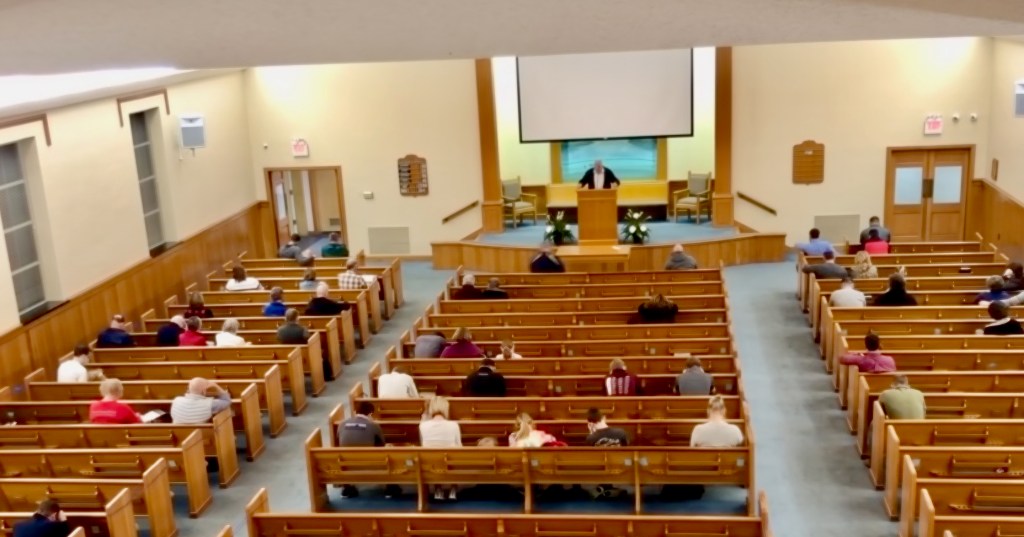
Over 50 members came to pray Tuesday night for our soul-winning plans, including our “Fill The Void” seminar (photo credit: Randy Simpson)
In the movie 20,000 Leagues Under The Sea there is a scene where one of the main characters finds himself on an island in the middle of the ocean. Suddenly he hears the faint sound of bongo drums in the distance and the sound becomes louder and closer. Out of the jungle a large group of cannibalistic natives appear, chasing this poor man across the beach. The hero escapes, but only by the skin of his teeth. That scene used to terrify me and an irrational fear of cannibals was instilled in me at a fragile age. In the 1830s when European explorers came to the Fiji islands they were horrified to discover the local practice of cannibalism. To me, the sake of exploration is not worth confronting that particular fear.
We all fear something! The one who claims to be fearless is afraid to admit or confront their fear. Fear isn’t wrong, it’s natural. We’re supposed to have a healthy fear of the Lord (Job 28:28). Facing our fears is a noble thing, but it really only matters in a spiritual sense.
A common phobia in our world today seems to be the fear of truth itself. Many Christians in the Lord’s church know family members and friends who have refused to listen to and act on the truth found in God’s Word. They’re afraid to give up the teachings taught to them by their families or the religious groups they grew up in. They’re afraid that the truth requires them to give up a sin they tightly hold on to and the sacrifice required to follow Christ.
The gospel of John is all about truth. In it we learn that Jesus is the only way to salvation and heaven; that’s the truth (John 14:6, 17:17). We must teach through our actions, daily lives, and yes, by inviting them to look at this great truth in Bible study. Though confronting that truth might make some fearful, we must show others that it has the power to free and cleanse us from the guilt of our sins.
We have entered the vestibule of a new year. Upon reflection, one might realize how subjective the significance of this day is. Neil deGrasse Tyson likes to point this out annually. For example, in 2011, he tweeted: “January 1, 2011: Happy New Year to all –at this arbitrary spot in Earth’s orbit around the Sun.” (Tyson) Consider China. They may observe the Gregorian calendar to conduct global business, but they will not celebrate the new year until February 12, 2021. Why is there a discrepancy? The Chinese, like the Jews, have a lunar-based calendar. God may have created time as a construct in our material universe, but the only “clocks” He provided were the moon and the sun (Genesis 1.14-19), and it is easier to mark time by the moon since we watch it wax and wane. The sun may appear a little lower or higher in the sky, but it is always making its same east-west circuit.
Even so, we choose January 1 as a special day to begin making necessary or desirable changes to our lives. I would hope that in an age of “fear porn,” the child of God will choose calm. I apologize if the use of that four-letter word is offensive. However, “fear porn” is an expression that has entered our vernacular. Oxford defines this specific usage of the word “porn” as follows: “[in combination or with modifier] Television programs, magazines, books, etc. that are regarded as emphasizing the sensuous or sensational aspects of a nonsexual subject and stimulating a compulsive interest in their audience.” (“Porn”) Perhaps the definition provided by a user of the less-authoritative Urban Dictionary is more accessible. “Mainstream Media content that deliberately and enticingly plays on people’s fears about disaster, disease, and death.” (Animalfarm1984)
While addressing the Great Depression, Democrat Franklin Delano Rosevelt famously stated, “…the only thing we have to fear is fear itself.” Among others, Michael Reagan, speaking of his political opponents, has altered the maxim to be “the only thing we have to offer is fear itself.” (Reagan) I imagine there are those considering that indictment up to debate. However, it is not my point to assign blame to political parties or politicians. Many thrive on instilling fear regardless of political affiliation. As one writer for a pop-psychology magazine opined, fear is “the most powerful motivator of all.” (Wilson)
I set out to recall a time in my life in which no Chicken Little was trying to scare me about something. I fail to remember a season when all was well with the world. In nearly a half-century of life, alarmists told me of the perils I face from nuclear war, a new ice age, a hole in the ozone layer, acid rain, killer bees, the deforestation of the Amazon region, the policies of Ronald Reagan, Y2K, global-warming-no-wait-let’s-call-it-climate-change-to-cover-all-our-bases, the policies of Barrack Obama, Ebola, the very existence of Donald Trump, the Illuminati, Globalists, Antifa, Black Lives Matter, COVID-19, and, now, Joe Biden’s socialist regime. Phew. Sadly, I have occasionally given such Chicken Littles a greater hearing than the assurances found in God’s Word.
What was it that the inspired Apostle John said? “You are from God, little children, and have overcome them; because greater is He who is in you than he who is in the world” (1 John 4.4 NASB1995). Jesus created and now sustains creation (Colossians 1.16-17). It is He who will destroy it when the time comes (2 Peter 3.10). In the interim, as God promised Noah: “While the earth remains, seedtime and harvest, and cold and heat, and summer and winter, and day and night shall not cease (Genesis 8.22 NASB1995).” It may be that we figuratively see the writing on the wall as Belshazzar indeed did in Daniel 5, but even so, God will be our Rock. Even if the mountains crumble and fall into the sea, He is still our refuge (Psalm 46). It is OK to face uncertainty with apprehension like Habakkuk did as he awaited the impending Babylonian invasion (Habakkuk 3.2,16). Yet, like Habakkuk (and the Apostle Paul), we must bravely move forward, recognizing our dependence upon Providence (Habakkuk 3.17-19; Philippians 4.11-13). Regardless of what 2021 may hold, if you seek God and His Kingdom first, God has your back (Matthew 6.33)!
Works Cited
Tyson, Neil deGrasse (neiltyson). “January 1, 2011: Happy New Year to all –at this arbitrary spot in Earth’s orbit around the Sun.” 1 January 2011, 2:55 p.m. Tweet.
“Porn: Definition of Porn by Oxford Dictionary on Lexico.com Also Meaning of Porn.” Lexico Dictionaries | English, Lexico Dictionaries,www.lexico.com/en/definition/porn.
Reagan, Michael. “Stories in the News – Ketchikan, Alaska – The Fear Peddlers.” Sitnews, Stories in the News, 15 May 2003, 4:25 p.m.,www.sitnews.net/Columnist/051503_reagan.html.
One night Chelsea and I were walking the dog before bed and came across an enormous armadillo. We were in a rural area and it was pitch black outside except for her flashlight. I had a rifle with me, so I took a shot at the armadillo. Instead of falling where it stood (as they had usually done), this one jumped a couple feet into the air and then ran off with surprising speed.
We thought that was the end of it, so she walked the opposite direction with the flashlight and the dog. In the pitch black, I heard the angry armadillo heading towards me full-steam.
Being rushed by an armadillo in the dark is terrifying, no two ways around that. The darkness accentuates our helplessness and makes defense a lot harder. I John 2.11 makes it very clear that if we hate our church family, we’re walking in darkness and don’t know where we’re going because the darkness has blinded us. If we’re in darkness, we have no fellowship with Jesus and we’re liars (1.6).
2020 has given our mortal sides quite a bit of strain. We’re so divided as a nation that a person’s political party alone is enough to preclude their value in the eyes of their opposition. The church has to be different.
Had the moon not come out just a little and the laser on my optic not worked, I would have been cut up pretty good by that armadillo. Light gave me the means to save my skin!
If we show love to our church family and are walking in the light, we have been given the ability to be saved. If we live and die in the light, we gain an eternity where there is no night or darkness in a new heaven and a new earth (Rev. 21 ). As November 3rd looms ominously over us, let’s remember that our eternal destination hangs – at least partially – on how we treat one another after this stressful election.
Owners of small dogs are familiar with how easily they can be made to bark. Small noises to us are great potential threats to them. A small ladder may be Mt. Everest to an ant, but is a way to reach the top of the pantry for us.
Our perspective drives our perception. A very large, very strong person likely does not feel threatened by anyone. A small, weak person may feel threatened by many.
Our problems in life seem massive. If we weigh them against the past, with its billions of lives and many cultures, our problems seem smaller. Compare them further to the infinite nature of God, and our problems are inconsequential.
James tells us that when we face difficulties in this life we must appeal to the One who has infinite wisdom and power, the God of the stars, the source of every good and perfect gift (1.5-8, 17). We ask Him for the ability to understand our trials. They refine us and make us mature and well-rounded. With that wisdom we can have perspective, seeing our massive trials as the small ladders they are.
This song by the Gaithers was written in 1971 at the height of the Vietnam War. Also happening in this country was great civil unrest, school and public arena shootings, civil rights/suffrage/anti-war protests, political unrest, economic downturn, and concerns over the rising influence of communism. It was written during the Cold War when children had to do nuclear attack drills at school.
I never noticed how important the line, “this child can face uncertain days because He lives” was until seeing the year it was published. Those were definitely uncertain days.
Our time isn’t much different. I don’t have to elaborate on the stuff that makes our days uncertain – we’re very aware. We are able to handle what’s going on because He lives. No political unrest, civil disorder, threat of war, disease, or economic downturn can keep shut us down for good because He lives.
“Because He lives, I can face tomorrow. Because He lives, all fear is gone. Because I know He hold the future, and life is worth the living just because He lives.”
The term comes up most frequently in golf and baseball. In 1998, L.A. Times writer Thomas Bonk interviewed elderly PGA golfers like Byron Nelson, Gene Sarazen, and Paul Runyan, whose career went back to the 1920s and 1930s, to find out if they knew the origin of the word “yips.” Nelson said, “I first heard it when I was on the tour in the ’30s. It was always just there” (Thomas Bonk, 2/26/98, “‘Yips’ or ‘Twitches,’ Who Knows Origin?”).
No less than the Mayo Clinic discuss this condition, which they describe as “involuntary wrist spasms that occur most commonly when golfers are trying to putt.” But, as they point out, anxiety makes it worse as the athlete “becomes nervous and self-focused–overthinking to the point of distraction–that their ability to execute a skill, such as putting, is impaired” (Mayo Clinic).
The American Heritage Dictionary defines it as “Nervousness or tension that causes an athlete to fail to perform effectively, especially in missing short putts in golf.” I am more familiar with this term in baseball. Mackey Sasser was a catcher who, after a home plate collision, began having difficulty accurately throwing the baseball back to the pitcher. Second baseman Chuck Knoblauch started having trouble throwing accurately to first base. Pitcher Rick Ankiel could not keep from throwing wild pitches and Jon Lester, another pitcher, has had trouble for years throwing the ball to first base.
Just Google “yips” and you can read about how traumatic and life-changing it is for those who once mindlessly, successfully did a task they ultimately found debilitatingly difficult to do. They consulted psychologists and hypnotists, struggling to get back to where they just didn’t think about the fundamental task that now overwhelmed them. But, some have succeeded. Steve Sax, who suffered from the yips in 1983–the second baseman had 26 errors by the All-Star Break–would rebound to be the best defensive second baseman in 1989. He credits a conversation with his ailing father during the 1983 break. His father told him it wasn’t a mental block, but a temporary loss of confidence, that he needed to practice being more confident and it would positively effect his play (Sportscasting.com).
Have you ever found it difficult to do something that once came easily or naturally? Has fear ever gripped you and become a roadblock to success? Certainly, there are mental health conditions that cause people to panic and wrestle with anxiety. But, what about the person who tried to share the gospel with a friend only to suffer rejection or maybe even embarrassment? What about the one who tried to gently confront someone at spiritual fault or overtaken by sin, who was rebuffed to such a degree that it was traumatic? What about the new Christian who was asked to lead public prayer, whose mind went blank, froze, and nearly couldn’t complete the task? There are several areas of Christian duty that can cause us to “freeze up” or shy away from doing them. An unpleasant experience can get into our heads and talk us out of trying to do them again.
How can we overcome this? Consider a few tips from Scripture:
Forget the past and focus on the future (Phil. 3:10)
Pray for boldness and confidence (Acts 4:29,31)
Ask others to pray for your ability and boldness (Eph. 6:19)
Get others to join you or help, where possible (Ecc. 4:9-12)
Look to Christ for your confidence and success (Phil. 4:13)
Don’t let a past failure define you; Keep at the task (Acts 15:38 and 2 Tim. 4:11)
Elevate your motivation and remember why you do what you do (Col. 3:23)
Focus on those who may be taking their lead from you, who look to you as their model (1 Tim. 4:12; Heb. 13:7)
Rediscover the joy (Phil. 2:17)
These are just a few of the divine strategies from the mind of God. We have a Father who speaks to us in His Word. His counsel is also for us to practice being more confident, but to look to Him as the source of that confidence. The end result is more than mere professional success. We can impact eternity when we overcome any obstacle to our service. Do you need to “get back in there”? Utilize the tools He has given! You’ll be so glad you did, and so will others.
Romans 5.5 is a verse that I know I’ve read many times, but never paid attention to.
It says, “and hope does not disappoint, because the love of God has been poured out in our hearts through the Holy Spirit who was given to us.”
This whole section of Scripture is awesome, but this verse really caught my attention. How is the love of God poured into our hearts? How do we experience this? Is it a feeling or understanding? Are we given a sense of calm knowing we are saved?
Context reveals that Jesus showed this love by dying for those who hated Him. God’s love is experienced through Jesus’ death (Romans 5.6, 8). So in that sense, we are able to access God through the sacrifice Jesus made with the Spirit who was given to us.
However, it does seem that the love mentioned in verse five is something a little different.
Firstly, it isn’t the only thing we have with God. We also have peace with God and grace (Romans 5.1, 2). The context of this chapter and much of the next is about the benefits of salvation.
Secondly, the love of God seems to be pretty directly applied. The word “poured” in 5.5 is ἐκχέω (encheo), which means, “to cause to fully experience” (BDAG 312). It’s also a perfect passive verb, which means it was poured in the past and continues to be poured; God was the one doing the pouring.
The destination of this love is our (that is, those who are saved) hearts. When we have been justified, and when we take pride in our trials because they develop endurance, proven character, and hope, God pours love into our hearts.
Because of the multitude of “for”s and “therefore”s following this verse, I lean more towards the idea that this love is something we experience as a result of gaining rational confidence of our salvation through Christ.
My goal in writing this article is not necessarily to explain Romans 5.5 – I do not pretend to know the answer – but to hopefully provoke thought and demonstrate the depth of scripture. I love these difficult passages, and hope that you will study them as well.
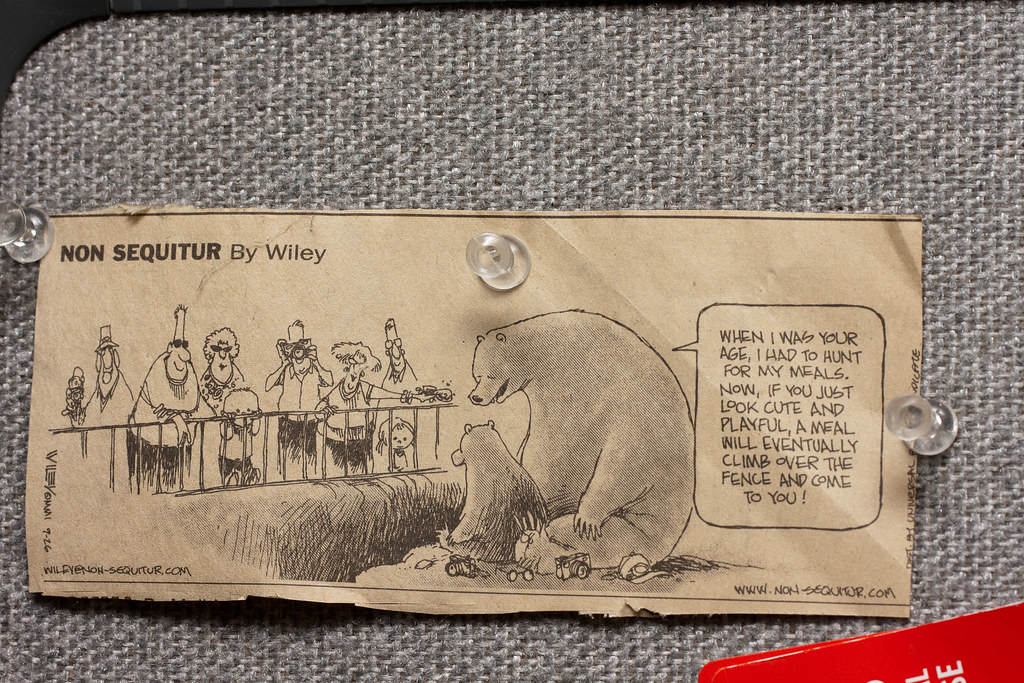
Wiley Miller is the creator of the comic strip, Non Sequitur. When apolitical, Miller’s strip can be enjoyable. I cut one of his strips from a daily edition of The Fayetteville Observer (Fayetteville, NC) back in the early aughts featuring “the eternal optimist.” In the one-panel comic, the grim reaper stands before a man in business attire. This eternal optimist calls to his wife in another room: “Well, honey, it doesn’t look like I have to worry about that long commute anymore.” I kept that strip until it yellowed with age and crumbled into oblivion. I did so for another reason than having a dark sense of humor. I hope I am an optimist on the order of the businessman finding something good to say even in the face of death.
Paul had such a character. He told the Philippians that he had everything to gain in death, as a Christian, and needed only remain for the sake of the brethren (Philippians 1.21-26). Nearing the end of his life, a confident Paul told Timothy, “I have fought the good fight, I have finished the course, I have kept the faith; in the future there is laid up for me the crown of righteousness, which the Lord, the righteous Judge, will award to me on that day; and not only to me, but also to all who have loved His appearing.” (2 Timothy 4.7-8 NASB). Why was Paul an eternal optimist? It was not because he was free of sin. Indeed, Paul considered himself the chief of sinners (1 Timothy 1.15). However, Paul was full of faith and understood God’s grace.
We cannot afford to live in fear, whether that fear is of death or whether we are “good enough.” We must do the will of God. John says, “But if we walk in the Light as He Himself is in the Light, we have fellowship with one another, and the blood of Jesus His Son cleanses us from all sin” (1 John 1.7 NASB). That faith may not always take us to places providing comfort. Shadrach, Meshach, and Abed-nego had their faith put to the test. Nebuchadnezzar had instructed everyone to bow to his golden image in worship. The young Hebrews refused because they remembered the Law of Moses and their covenant relationship with God. Nebuchadnezzar was angry with the young men and told them they would perish in a fiery furnace. They replied, “O Nebuchadnezzar, we do not need to give you an answer concerning this matter. If it be so, our God whom we serve is able to deliver us from the furnace of blazing fire; and He will deliver us out of your hand, O king. But even if He does not, let it be known to you, O king, that we are not going to serve your gods or worship the golden image that you have set up.” (Daniel 3.16b-18 NASB).
Did you notice why they did not fear? Can you see why they were optimistic? They understood their God was more powerful than a king and could deliver them. Yet, even if God did not deliver them, they still realized they had an obligation to serve Him regardless. These days the world seems scary. There is so much bad news on TV. But our God is more powerful. Thus, we can even say, “If I do catch COVID-19, God will deliver me. But even if He does not, I know Heaven will be my home.” Other scenarios would likewise suffice as an example. However, this is one of the things that seems to be on the minds of many today. Build your faith and become an eternal optimist as well. The world, in turn, will become a less daunting place.
We know that tomorrow isn’t promised and we also understand that, unless God comes first, everyone will die one day. With that being said, I am almost 100% certain that nobody reading this will pass from this life after having a cow fall through your roof. The “steaks” just aren’t that high. While this is an unlikely way to die, it’s not an impossible way to go. In fact, this is exactly what happened to Joao Souza in 2013. A one-ton cow was grazing on the hills behind his home in Caratinga before it somehow found it’s way up on to his roof. An unknowing Souza was snoozing on his couch when suddenly his life was over. The asbestos-filled roof collapsed under the weight of the cow. Being done in by a bovine is not exactly a bodacious way to make that final transition, but the media had reported two more similar events of cows seemingly falling from the sky in this area just two years prior. Even though this event actually occurred, how ridiculous would it be for us to spend our days in fear— worrying that we will meet a similar fate?
The last verse of Matthew six will tell you not to exert so much energy worrying about tomorrow. This passage has brought peace and comfort to many Christians throughout the years, but many of us still worry about our tomorrows. I guess if our tomorrows were actually ours to begin with, we may really have something to fear. The truth is, God owns the future. He doesn’t tell us not to worry about the things that are unlikely to happen, He simply tells us not to worry. God’s almighty hand still holds the world, and for the faithful believer this reality can set your mind to rest. I’m not sure what tomorrow brings. It’s possible that a cow could even come crashing through my roof and send me into eternity— but that’s alright. It’s not just alright because I could use a little more dairy in my diet, but it’s alright because a life in Christ comes with a secure future. It doesn’t matter what Fox News tells us when the Good News already told us everything we need to know. No matter what the day may bring nothing can change the fact that Jesus came, He died, and He definitely is alive, well, and active every day. Don’t worry about tomorrow. Let’s live our lives with joy and in the peace only He can provide.
I hope this moos you and that you have an udderly fantastic day. If this beefed up your spiritual cow-fidence please share with someone else.
In a world facing ever-changing circumstances, we need to be reminded of some truths about God. A great text that can help us do this is found in the writings of the Messianic prophet, Isaiah. He tells us some exciting facts about God in Isaiah 33:5-6.In brief, Isaiah reminds us of God’s transcendence (“exalted…on high”), His trustworthiness (“has filled Zion with justice and righteousness”), and His treasure (“a wealth of salvation, wisdom and knowledge; The fear of the Lord is his treasure”).In the midst of upholding God’s perfect character, the prophet makes this reassuring statement: “And He will be the stability of your times.”
In part, here is what that means to us today…
There is no minimum distance we have to keep from Him under any circumstance (Jas. 4:8).
There is no restriction or limit on our access to Him and His blessings, on prayer or His Word (Phil. 4:19).
There is no chance that you will look for Him and He will not be there (Psa. 50:15).
There is no possibility that you will learn that what was true of Him yesterday is not true of Him today (or tomorrow)(Heb. 13:8)
There is no cancellation policy at the throne of grace for the child of God (Heb. 4:16).
There is no threat or danger that can keep you from the love of God (Rom. 8:38-39).
There is no earthly thing to nullify the truth that “the Lord is my helper, I will not be afraid” (Heb. 13:6).
The more we expose ourselves to Him, the healthier we will be.
There is zero chance that you will go to Him for healing and have it fail (Jer. 8:22; Luke 5:31).
Scripture calls Him the Rock (Deut. 32:4), the shield (2 Sam. 22:31), my protection (Isa. 27:5), my shield, stronghold, and protection (2 Sam. 22:3), and a strong tower (Prov. 18:10). As Nebuchadnezzar understood, “all His works are true and His ways just” (Dan. 4:37).
Take heart. Take on the day. Take comfort and refuge. “And He will be the stability of your times.”
Random great photo: courtesy Baker Street Photography
We find God not in an anxious mind, but a still heart. God exhorts us in Psalm 46.10a, “Be still, and know that I am God” (KJV). Contextually, this statement occurs amid the possibility of much turmoil. We admit sometimes we must move forward to receive God’s deliverance, as the Israelites did when pressed by pharaoh’s army at the Red Sea (Exodus 14.13-16). Yet, there are also times when we can do nothing. For those times, we’re to be still.
What do we mean by “still?” Without trying to sound like a Hebrew scholar which I’m not, allow me to suggest by using this word God is saying, “Drop your arms!” In other words, quit fighting or putting up a resistance. The New American Standard states in Psalm 46.10a we are to “cease striving.” Each of us reach a point in our life when the time for our struggle ends and we must enter the vestibule of God’s Providence.
What do we do, for example, when the doctor says we have cancer? The Kubler-Ross model of grief puts anger as third on its list of seven stages. We all experience grief differently, so anger may come either sooner or later for you than at stage three. However, I can tell you from experience, anger is something you feel dealing with cancer. “Why me? Why not this sinner over here? I never smoked. I never drank. I’ve been chaste.” Yet, God says, “Be still, and know that I am God.” He has shown us through His Word, His grace is enough (2 Corinthians 12.8-10). And for any lingering anxiety, there’s prayer. What does prayer do? It grants peace we cannot even comprehend (Philippians 4.6-7).
Though an entire lesson can be given about Providence, let me briefly suggest why it’s more awesome than the miracles for which people beg when they hear “cancer.” For a miracle, God instantaneously suspends natural law, and directly intervenes. It’s amazing, I admit. It shows His power in a way one cannot ignore (e.g. parting the Red Sea). Yet, it’s also not the thing to which He must resort to heal one’s body of a disease like cancer. His Providence is there to use the immune system which He placed within us. Providence is quiet. It requires that we be still to observe it. When we do, we see God in a thousand different things. Like a domino stacking champion, God aligns the bits and pieces that, when struck, fall into place revealing the beautiful mosaic He planned for us all along.
The more still you make yourself throughout life, the more you see His Providence. Through prayer comes peace, yes, but so, too, the wisdom to know when to move and when to be still (James 1.4-6). So, let go and let God. Live faithfully and trust Him do the rest.
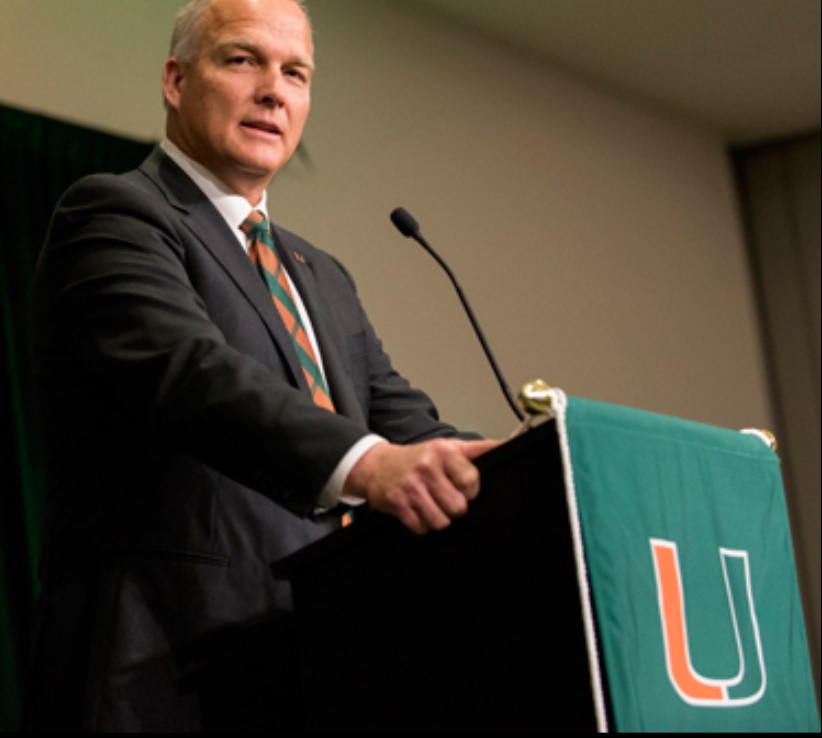
It was painful to watch my Georgia Bulldogs pulverized by the Auburn Tigers (my fellow Bronco fans can easily relate this year). Yet, later that Saturday evening, I found myself smiling and even cheering for a familiar face who was calmly embracing a signature win against college football’s number three team, Notre Dame. Level-headed. Even-keel. Happy. None of those words quite captured the way I wanted to describe Miami’s head coach, Mark Richt (former general of my beloved Dawgs). It was Dan Walken (USA Today, 11/13/17, 1C,6C) who found the one I was searching my mind for: “serene.” He is peaceful, placid, poised, and phlegmatic. But, as Walken points out, it’s not because the Hurricanes have ascended to number two in the Coaches and Press polls. He has been that all along, even the day he was fired at Georgia (his .740 winning percentage, 145-51, is the highest in college history for any coach ever to be fired). He was criticized for not being able to win the big game—which he still hasn’t. Second to that, the fan base was agitated that he was too concerned about his off-season mission work. There’s such an interesting story about how Richt came to faith, and how deeply his faith drives his life. Walken’s article mentions nothing of that, but few people who know about Richt fail to know how profoundly religion effects his life. It is, unquestionably, what drives his come-what-may serenity.
What characteristic best describes me? I know several I’d like for it to be, but, ultimately, I don’t get to describe myself. The people who know me or know about me get to do that. While the word “serene” is not found in most English translations, it is a biblical concept. 91 times, the New Testament uses a word (εἰρήνη—eirene) that is usually translated “peace.” Luke 11:21 has “undisturbed” (NASB). It can describe harmony between governments or in personal relationships, but it also describes a state of well-being within. In fact, that’s usually the way New Testament writers use it. Jesus says He offers a peace superior to what the world can give (John 14:27). A mind set on the Spirit is life and peace (Rom. 8:6). The God of hope can fill you with peace in believing (Rom. 15:13). This peace passes all comprehension and guards your heart and mind (Phil. 4:7). It can rule your heart (Col. 3:15). It can be yours in every circumstance (2 Thes. 3:16). Repeatedly, Scripture promises peace to the disciple of Christ.
But our world continually scrambles to find it, much less maintain it. It seeks to achieve peace through alcohol and drugs, firearms, money and things, achievement and success, and other earthly things to plug that void. If at our core we do not fill ourselves with the peace of God, we will find ourselves futilely searching and never finding tranquility and undisturbed calm. Richt was able to smile and be joyful at the press conference that centered around his dismissal. You and I can embrace joy and steadiness in the darkest, most painful, moments of life. We never want false hope or empty peace. But a life directed and submissive to the pure, unadulterated Word and will of God leads to unshakable peace. No matter what comes our way!



























 The Preacher Pollard Blog