Romans 13: Respect Caesar, Surrender to Christ

Brent Pollard

Christians often experience an inner tension when considering their relationship with civil government. We belong to a heavenly kingdom whose values frequently stand in sharp contrast to the world around us, yet we remain citizens of earthly nations—subject to laws, rulers, and civic obligations that demand our attention and participation. Scripture does not ignore this tension. Instead, God’s Word provides principles that help believers navigate their dual citizenship with clarity, humility, and unwavering faith.

The apostle Paul reminds us that entering the brotherhood of Christ does not sever our connection to the broader human community. While the church thrives on humility and sacrificial love, the civil sphere requires submission to authority and the pursuit of justice toward our fellow citizens. Far from being contradictory, these obligations are complementary expressions of Christian discipleship lived out in the real world.

Why Christians Should Submit to Government: The Practical Case (Romans 13.1-4)

Paul opens his instruction with a command that echoes through the centuries: “Let every person be subject to the governing authorities” (Romans 13.1). This is not blind compliance but thoughtful, conscientious obedience rooted in practical wisdom.

At the most basic level, civil government exists to accomplish specific purposes: promoting order, restraining wrongdoing, and encouraging what is beneficial to society. “For rulers are not a terror to good conduct, but to bad,” Paul writes. “Would you have no fear of the one who is in authority? Then do what is good, and you will receive his approval” (Romans 13.3). Laws—when rightly administered—serve the common good, providing the stability and protection necessary for human flourishing.

Think of it this way: A ship requires a captain, a household requires order, and a society requires governance. Without structure, chaos reigns. Roads crumble, courts fail, emergency services disappear, and defense collapses. These necessities do not materialize from thin air—they require resources, planning, and the coordinated effort that only organized government can provide.

It is reasonable, then, for Christians to obey the law in their general conduct. Lawful behavior benefits both the individual and the community. Similarly, paying taxes and other civic dues is not merely a burden imposed by the state but a contribution toward maintaining public order and security (Romans 13.6-7).

Yet Scripture presses us beyond mere outward compliance. Paul speaks of rendering “to all what is owed to them: taxes to whom taxes are owed, revenue to whom revenue is owed, respect to whom respect is owed, honor to whom honor is owed” (Romans 13.7). Even in civil matters, the heart must be engaged. Respect for authority is not simply about avoiding penalties; it reflects an inner disposition shaped by reverence and integrity. Mechanical obedience—though better than rebellion—falls short of what God expects from His children.

The Higher Foundation: God’s Sovereignty Over All Authority (Romans 13.1-2)

While practical reasoning can justify civic obedience—the desire to avoid fines and penalties—the Christian’s motivation runs far deeper. Submitting to governing authorities is not just sensible; it is divinely commanded. Paul declares the foundation plainly: “For there is no authority except from God, and those that exist have been instituted by God. Therefore whoever resists the authorities resists what God has appointed, and those who resist will incur judgment” (Romans 13.1-2).

This is the bedrock truth that transforms civic duty from pragmatic necessity into spiritual worship: God Himself stands behind human authority. The Old Testament confirms this reality throughout its pages. Job declares that God “makes nations great, and destroys them; He enlarges nations, and leads them away” (Job 12.23). Daniel proclaims that “the Most High rules the kingdom of men and gives it to whom he will” (Daniel 4.25; see also Daniel 2:21). Even pagan rulers exercise power only because God, in His inscrutable wisdom, has permitted it.

Nebuchadnezzar learned this lesson the hard way. This mighty king was humbled—literally driven to eat grass like an animal—until he acknowledged that “the Most High rules in the kingdom of men and gives it to whom He will” (Daniel 4.32). Jesus Himself reminded Pontius Pilate, “You would have no authority over me at all unless it had been given you from above” (John 19.11).

These passages confront us with a stunning reality: No government rises or falls apart from God’s providence. Authority is not a purely human invention or the result of social contracts alone. It exists because God, in His sovereign wisdom, has ordained the structures necessary to maintain order in a fallen world. To resist lawful authority without biblical cause, therefore, is not merely to defy human institutions but to rebel against the divine order God has established.

This does not mean that every action of every ruler is morally right or that Christians owe absolute obedience to human commands. Scripture itself records moments when obedience to God required civil disobedience—when Peter declared, “We must obey God rather than men” (Acts 5.29), or when Hebrew midwives defied Pharaoh’s infanticide (Exodus 1.17). But these are exceptions that prove the rule. The default posture of the believer is submission, not suspicion; respect, not rebellion; honor, not contempt.

How to Honor Imperfect Rulers: Seeing God’s Hand in Human Government (Romans 13.4)

Perhaps the most challenging aspect of Paul’s teaching is learning to see God’s hand at work in imperfect—even deeply flawed—human institutions. This requires spiritual vision that penetrates beyond the visible to the invisible.

Rulers are fallible. Governments make unjust decisions. Leaders disappoint us. Yet Paul wrote these very words to Christians living under Nero, one of history’s most despicable tyrants, a man who would soon ignite the first great persecution of the church. Still, Paul calls him “God’s servant for your good” and “the servant of God, an avenger who carries out God’s wrath on the wrongdoer” (Romans 13.4).

How can this be? Because God’s purposes transcend human wickedness. He uses even unjust rulers to accomplish His sovereign will—sometimes through their good actions, sometimes despite their evil ones. Joseph understood this when he told his brothers, “You meant evil against me, but God meant it for good” (Genesis 50.20). God’s ability to work all things together for His glory does not excuse human sin, but it does mean that no human ruler operates outside the boundaries of divine providence.

This perspective transforms how we engage with civil authority. When Christians obey the law, pay their taxes, and show honor to those in positions of leadership, they do so not merely for pragmatic reasons or from servile fear, but as an act of reasonable service. Paul emphasizes this: “Therefore one must be in subjection, not only to avoid God’s wrath but also for the sake of conscience” (Romans 13.5). Civic responsibility becomes a spiritual discipline. The ordinary duties of citizenship are transformed into opportunities to glorify God.

This biblical vision guards us against two opposite errors. On one side, we avoid the idolatry of placing ultimate hope in governments, political parties, or charismatic leaders. On the other side, we reject the cynicism that treats all authority with contempt and every civic obligation with resentment. Instead, we acknowledge government’s limited but real role under God’s greater rule, participating faithfully while keeping our ultimate citizenship in heaven (Philippians 3.20).

Living as Citizens of Two Kingdoms: Practical Steps for Today

The Christian life does not retreat from the public square—it redeems it. Just as Paul instructs us to do everything “to the glory of God” (1 Corinthians 10.31), our civic engagement is part of our Christian walk. Here are practical ways to live out Romans 13 in our daily lives:

First, cultivate a posture of respect. Even when you disagree with policies or disapprove of leaders, maintain respectful speech and behavior. Remember that God has placed them in authority, however temporarily (1 Timothy 2.1-2).

Second, fulfill your civic duties faithfully. Pay your taxes honestly and completely. Obey traffic laws. Serve on juries when called. Vote thoughtfully and prayerfully. These mundane acts become sacred when done “as to the Lord” (Colossians 3.23).

Third, pray consistently for those in authority. Paul commands us to pray “for kings and all who are in high positions, that we may lead a peaceful and quiet life, godly and dignified in every way” (1 Timothy 2.2). Prayer acknowledges God’s sovereignty while interceding for His purposes in government.

Fourth, know when to say no. While submission is the rule, obedience to God takes precedence when human laws directly contradict divine commands. But let this be a last resort, exercised with wisdom, humility, and willingness to accept the consequences (Acts 5.29; Daniel 3.16-18).

Finally, maintain your eternal perspective. Governments will rise and fall. Political parties will gain and lose power. Leaders will come and go. But the throne of heaven remains unshaken. Our hope rests not in Washington, London, or any earthly capital, but in the New Jerusalem where Christ reigns eternally.

The Christian Difference in a Polarized Age

In an era of bitter political polarization, pervasive mistrust of institutions, and constant outrage, Christians have a unique opportunity to model a radically different spirit—one marked by humility, respect, and unshakable confidence in God’s sovereignty.

We can disagree without demonizing. We can advocate without idolizing. We can submit without compromising our ultimate allegiance to Christ. This is not weakness but strength—the strength that comes from knowing that “the king’s heart is a stream of water in the hand of the LORD; he turns it wherever he will” (Proverbs 21.1).

Paul’s words in Romans 13 invite us into this paradox: We submit to earthly authority precisely because we belong to a heavenly kingdom. We honor human rulers precisely because we worship the King of Kings. We engage politically precisely because our citizenship is ultimately elsewhere.

And because God reigns—truly reigns, not as a distant concept but as the living Lord who governs nations and guides history—His people can submit without fear, obey without resentment, and honor without compromise, trusting that the Most High still rules in the kingdom of men.

This is how Christians navigate the tension between heaven and earth: not by escaping the world, but by bringing the kingdom’s values into it; not by grasping for power, but by wielding influence through faithful presence; not by placing ultimate hope in any government, but by honoring all governments under the Government of God Himself.

In this way, even our relationship with earthly authorities becomes a testimony to the reign of our heavenly King.

We Gotta Stop!

Wednesday’s Column: Third’s Words

Gary Pollard

If you’re reading this right now, it means you have access to electricity and internet. If you have access to those, you’re already familiar with the subject of this article. This specifically applies to Christians living in the United States, but I encourage those who don’t consider themselves religious to think about the following as well. There’s no other way to address this, so I apologize for having to write it.

“Let’s go Brandon” is everywhere: gas pumps, sporting events, social media posts, bumper stickers, etc. I thought it would die out by now, but it’s everywhere. I see it almost every day on gaming platforms, with many adopting some form of it as a username/handle. It’s become colloquial, used to “thank” the president for any less-than-ideal circumstance.

I am not a fan of our current president. If you drive, you know how much gas is right now. Afghanistan. The Russian ammo ban (and other anti-freedom measures). If you eat food, you’re already familiar with inflation’s impact on groceries. We could go on for a week, but this is a long-winded disclaimer and I need to get to the point.

No Christian should ever adopt the mentality behind the phrase at the beginning of the second paragraph. Besides the crass and hateful language it represents, it’s a sinful way to view our president. Christians are supposed to respect their government leaders (I Pt 2.17). In that passage it’s not a suggestion, it’s an order. The word τιμᾶτε (timate) is an imperative. It means “to show high regard for” someone (BDAG, τιμάω).

Paul wrote, “You should pray for rulers and for everyone who has authority. Pray for these leaders so we can lead a quiet and peaceful life…” (I Tim 2.2). Paul was under an emperor similar to our own president. God’s expectations for Christian behavior don’t change when the president is bad. We don’t have to like him, but we certainly have to respect him and pray for him.

We should not expect to live with God forever if we talk about the president the way so many others do. I get it – it’s hard. Politicization of the medical field under his administration has had a direct impact on my own quality of life. Praying for/respecting the president is not easy at all. But it wouldn’t have been easy for Christians under any of the Roman emperors in the first century, either. If they could do it, so can we. Please think about the serious impact our words have on where we spend eternity. Our first allegiance is to God. If He’s really our King, we’ll have respect for our president.

Image courtesy Flickr.

Handling Thorny Issues

Wednesday’s Column: Third’s Words

IMG_3575

Gary Pollard

Christians live on planet earth and aren’t immune to social issues. The vaccine is one of them. This article is NOT about vaccination specifically. I am not qualified to write about it, but this wouldn’t be an appropriate forum even if I was.

However, this issue has influenced the church in a few timeless ways: misapplying scripture, creating division, and engendering hostility.

Misapplying Scripture: Applying Romans 13 to this subject is not appropriate. Nothing about the passage sheds light on which governing authority we should follow. What if federal law contradicts state or local law? Which do we follow then? I Peter 2.13-14 does address varying levels of governing authority, but does not specify which takes precedence. Both passages demand submission to everyone who has authority over us because it’s what God wants. As it stands now, neither passage applies to this issue. We cannot use God’s word to enforce or condemn issues that have no bearing on salvation. When state or local law is in conflict with federal law (or vice versa) and the issue at hand isn’t a salvation issue, it falls under the jurisdiction of Romans 14.

Creating Division: Differences in opinion aren’t new to the church. No reasonable person will call this a salvation issue, so it does fall under the purview of Romans 14. We need to remember the commands in this passage: accept those who have different opinions (1), do not think poorly of those who disagree (3), do not judge someone who exercises preference (3), make decisions based on conviction (5), do not condemn each other over opinions (13), don’t let opinions destroy relationships (15), and don’t let your decision become a problem (16). What does this mean for us? Respect your Christian family’s decision, do not think less of them because of their decision, make the decision you feel is best for you, don’t condemn someone based on their decision, and don’t let an issue that has no bearing on our Christian lives become a source of division.

Hostility: The previous point addresses this somewhat, but sinful behavior has come out of this. Thinking less of a Christian who gets the vaccine is sinful. Thinking less of a Christian who doesn’t get the vaccine is sinful.

Nothing about this issue is new or different. Controversial opinions over military service, firearms, holiday observance, or vaccination are not handled any differently. God expects us to put these kinds of issues in their proper place: the back seat.

“We have to love each other, because love comes from God and everyone who has love belongs to God and knows him. Anyone who doesn’t love doesn’t know God, because God is love” (I Jn. 4.7-8).

“Love each other deeply with a pure heart” (I Pt. 1.22).
“You must continue to love each other” (Heb. 13.1).
“Pursue righteousness, godliness, faithfulness, love, endurance, and gentleness” (I Tim. 6.11).

Knowing What D.C. Stands For

Neal Pollard

Inasmuch as we don’t want laws or policies enacted that violate God’s Word and we want precious freedoms, especially religious ones, preserved and protected, we can really get into what is going on in Washington, from Capitol Hill to Pennsylvania Avenue. Many know that “D.C.” is an abbreviation for “District of Columbia,” an area of land created at about the time of our nation’s founding under the direct jurisdiction of the U.S. Congress that is not a state.

However, as politics has vied for sports and entertainment as an idol in our culture, it has become the source of unnecessary and even immoral strife between Christians. Blind support and allegiance for one major political party or the other can do more than make us inconsistent. It can make us a stumbling block. It seems to me that D.C. can stand for some dangerously different things.

Distracted Christians. Search high and low in your New Testaments, written during the time of the wicked, often unfair-to-Christians, Roman Empire.  The disciples were about the business of evangelism (Acts 8:4) and growing the church (Acts 6:7). Can the rumblings and drama from the nation’s capitol get us so transfixed that we cannot see past it or through it to our individual and collective mission as God’s people? He has us here to get people into the Kingdom of His dear Son (Col. 1:13). Everything else is secondary. 

Divided Churches. For as long as I’ve been preaching, I’ve seen politics come between brethren in the local church. Thankfully, it does not usually become significant enough to trouble the entire congregation but I have seen it do so. What’s more, I’ve seen brothers and sisters become so confrontational and flagrant about politics–especially through the relatively recent medium of social media–that it has been a stumbling block to new and weak Christians. Perhaps the political world in our country has never been so intensely divisive as it currently is, and what typically troubles the world troubles the church. But, when souls are negatively impacted, God will hold the offenders accountable. 

Devil’s Cauldron. Please don’t misunderstand. Politics, like money, is a neutral matter. But, like money, it can become the root of all sorts of evil (cf. 1 Tim. 6:10)–enmities, strife, outbursts of anger, disputes, dissensions, and factions (Gal. 5:20). Just prior to this list of activities that are the carrying out of the desires of the flesh (Gal. 5:16), Paul warns, “For the whole Law is fulfilled in one word, in the statement, ‘You shall love your neighbor as yourself.’ But if you bite and devour one another, take care that you are not consumed by one another” (Gal. 5:14-15). Who benefits when things like politics distract and divide Christians? It is not the lost, the church, or the Lord!

I can think of a least three godly, wonderful Christians who are public servants in political office and making a profound impact for good–Bill Reiboldt, Sheila Butt, and John DeBerry. They demonstrate that God’s people can devote themselves to politics without sacrificing their faith and example. For those of us “on the outside looking in,” in our love of country and freedom, may we never allow our attitude, words, or actions to betray our highest calling. The more effectively we reach lost souls, reflect the mind of Christ, and reveal the hope of the gospel, the better our nation (and world) will become. What will that make us? Disciples of Christ!

11168488_10153052239815922_846243704468580330_n
From my last trip to Washington, a few summers ago. 

How To Unite In A Culture Of Division

Neal Pollard

It’s no news flash to observe that our culture seems hopelessly divided along political lines. That seems to impact race, gender, and other lines, too. The most tragic consequence of this is that it has not left the church unaffected. Social media is often a barometer for how emotional and passionate brethren on both sides of this divide can become when discussing some specific aspect of this. We cannot hope that social media will provide the answer. Who your friends are and what their leanings are on political issues influence what shows up on your homepage as they share politically or socially charged blogs, videos, and the like. Pundits have, for a few years, theorized and analyzed the reality of a “political social media bubble.” Barton Swaim, in an August 1 article on The Weekly Standard online, said, “more than any other social media platforms, Facebook and Twitter are avenues for the kind of acrimony that has embittered our politics and poisoned reasonable dialog” (https://www.weeklystandard.com/barton-swaim/a-political-social-media-bubble). It’s not just conservative publications making that observation. Google the term “political social media bubble” and conservative, moderate, and liberal outlets can at least agree about its existence (a trip to The Guardian, New York Times, National Review, et al finds plenty of material if written from different points of view drawing different conclusions).  Too often, God’s people get drawn into this hurtful, messy arena and turn on each other like gladiators in the Roman Colosseum. The God of heaven must certainly weep.

This weekend, I visited the Lord’s church in Chesapeake, Virginia, a state that is often a political cauldron boiling hotter than many other places. I’m not sure how many congregations were represented, but we had to have had close to half white and half black people attending (with various Asian and Hispanic visitors there, too). Politics were mentioned a few times, but only in the sense that they have too often become a stumbling block and distraction in the Lord’s church and that they cannot solve our nation’s problems. But I was beholding the answer without it having to be pointed out. Those in attendance had a thirst for a “thus saith the Lord.” People of different colors lovingly, naturally worshipped, fellowshipped, visited, laughed with, and enjoyed each other throughout the weekend. It was genuine. It was deep. It was powerful. And it was neither contrived nor manipulated. Its glue and bond was the blood and body of God’s Son. Christ is the great uniter. As we unite on His terms and His way, we destroy barriers. That’s by design.

What Paul says to Jew and Gentile in Ephesians 2:14-18 can have application between black and white, Republican and Democrat, rich and poor, male and female, or however our country wants to erect barriers. Christ is our peace and can break down the barrier of any dividing wall. He helps us view each other as “fellow citizens” and “family” (2:19) who are “together” (2:21,22). When we get ahold of that, nothing can keep us apart!

43368956_10155859106275922_391409913101811712_n
At yesterday’s PM worship services at the Chesapeake church of Christ

The Christian And Government 

Neal Pollard

There is a passage that can be so disturbing because it is so adamantly clear. That passage is Romans 13:1-7. The early church fathers had a lot to say about this passage. They lived at a time when the government sponsored and led persecution and even execution of Christians simply for being Christians and sharing Christ with others. Nobody living in our country today has any experience with what this is like. Despite the pain and price inflicted by the Roman Empire on them, over and over the early Christians defended Paul’s words in Romans 13.

  • Basil—It is right to submit to higher authority whenever a command of God is not violated thereby
  • Ambrosiaster—Those who believe cannot play fast and loose with the law
  • Apollinaris—To disobey rulers is condemned as a mistaken way of thinking
  • Chrysostom—There should be rulers and ruled and…that things should not just lapse into anarchy is the work of God’s wisdom (Ancient Christian Commentary, Vol. VI, Oden, ed.).

Whether you long for the Obama administration or love the Trump administration, whether you love or loathe your governor, senators, and congressmen, Romans 13 applies to us today.  Whatever your feelings about law enforcement or our judicial system, Romans 13 applies to us today. No one should be more conscientious about their relationship to the Civil Government than a Christian. What does this text reveal to us about “the earthly powers that be?”

  • The government has a Divine source (1). They are “from God” and “established by God.”
  • The government is a divine statute (2). Paul calls their ruling “the ordinance of God” and he warns against opposing such.
  • The government is comprised of Divine servants (3-6). The term Paul repeatedly uses of those within such earthly institutions is “ministers of God” (“servants of God,” 6) bearing the sword, bringing wrath, and devoting themselves to maintaining divinely-ordained order on earth.
  • The government carries Divine stipulations (7). God calls for Christians to render them what is due to them, namely taxes, customs, fear, and honor.

The limit to this is if they command us (forbidding or making us) to do what would cause us to disobey God (cf. Acts 5:29). That is not the same as commanding us to do something that restricts our “rights,” “freedoms,” or “liberties.” There may be privileges we enjoy in a free nation which contribute to our comfort, happiness, and enjoyment. They may even be dubbed “unalienable rights” in our national constitution. May we never confuse earthly privilege with divine precept. The inspired Paul makes it clear that God is behind government for the reasons seen above. Peter, in a context about civil government, reminds us that we are “aliens and strangers” on this earth (1 Pet. 2:11; cf. 13ff). As we loudly, lustily sing, “This world is not my home, I’m just a passing through…”  “For such is the will of God that by doing right you may silence the ignorance of foolish men” (1 Pet. 2:15). May God give us the strength and wisdom to this end!

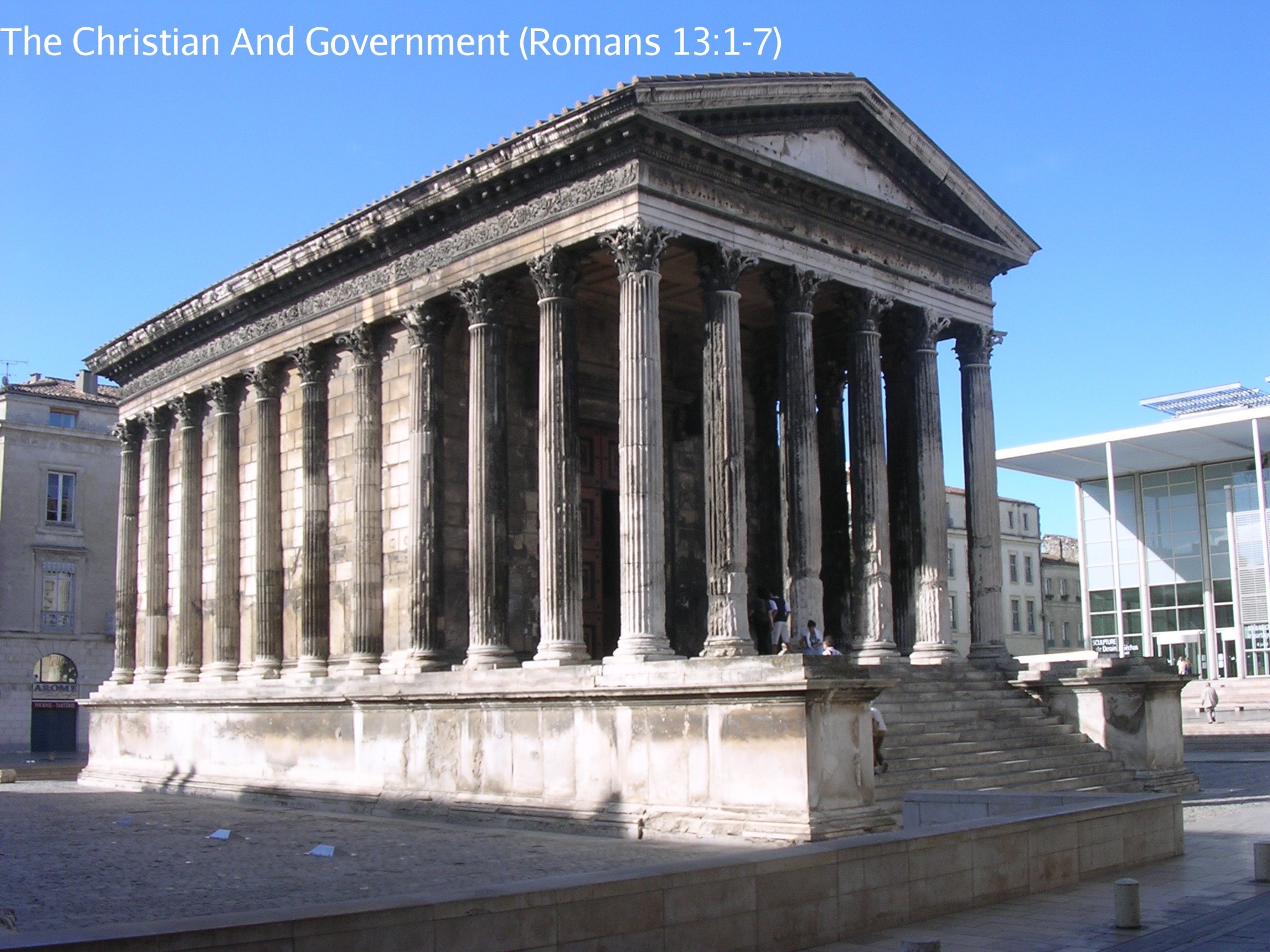
Maison Carrée, Temple of Rome and Augustus

The Religious Freedom Rally For Jack Phillips

Neal Pollard

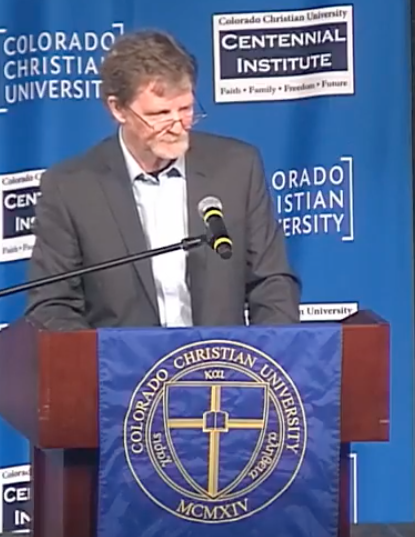
It was my privilege to be in attendance at the “Religious Freedom Rally for Jack Phillips,” held on the campus of Colorado Christian University in Lakewood, Colorado. If you do not know, Jack Phillips is the owner of Masterpiece Cake Shop, a business he opened and has operated since 1993. Because he refused to decorate a cake for a same sex couple, Phillips was sued. His case has gone through the various court systems and will be heard before the United States Supreme Court on December 5, 2017.

While the Event Center where it was held was not packed and overflowing, there were hundreds present. I met and walked in with a young man and woman from Sweden, who came to the United States primarily to cover this event for a Christian Magazine in their country. The rally’s speakers included the head of Catholic Charities, the managing director of Jewish values, a state senator, a congressman, part of Phillips’ legal team, university officials, Barronelle Stutzman (the owner of Arlene’s Flowers in Richland, Washington, who was sued by Robert Ingersoll because she refused, out of conscience, to make a floral arrangement for the same-sex wedding of Ingersoll and Curt Freed), and others.  There were many poignant moments and memorable quotes. A team member from the Alliance Defending Freedom, representing Phillips, said, “America did not give us freedom of religion. Freedom of religion gave us America.” Mrs. Stutzman still does not know if her case will be heard by the SCOTUS, and she stands to lose everything financially. Yet, she was gentle, meek, and soft-spoken, though obviously full of conviction. The tone was cordial and respectful, from every speaker to everyone in attendance. The rabbi, Yaakov Menken, said, after talking about ancient, longstanding forms of “political correctness,” that “what is new and profoundly disturbing is the use of civil rights to trample civil rights.” Last of all, Jack himself spoke. It was understated, almost matter-of-fact. He spoke eloquently and simply about the importance of our being able to act in accordance with consciences shaped by Scripture. Everyone spoke of the importance of believing and behaving in accordance with convictions that are dear because they are true.

Today was a stark reminder of the reality of forces who are actively assaulting faith in God and His Word. These are willing to do whatever they can to prevent us from doing what God has commanded us to do—share the pure, unaltered will of the One who gave us life and saved us from our sins. They are not bound by biblical ethics, so they will deceive, distort, manipulate, bully, attack, suppress, and fight divine truth. We are bound by a higher law, but truth, kindness, mercy, and love, as taught by God, will prevail. If not now, if not under our government and institutions, then undeniably at the very end of all things. Don’t lose heart. Whatever else you may lose at the hands of those described by Jesus in Matthew 5:44ff, some things cannot be taken away from us! Hold onto to those things.

Screen Shot 2017-11-08 at 1.37.31 PM

Religious Freedom Rally For Jack Phillips

DIVIDING OVER POLITICS

Neal Pollard

“Rancor” is synonymous with hostility, bitterness, spite, and vitriol. In Ephesians 4:31, Paul warns the Christian against “bitterness and wrath and anger and clamor and slander [and] malice.” While it didn’t seem possible that this election cycle could produce more heat and saber-rattling than the last couple, it has already exceeded it. It is almost painful to watch the cable news networks, but we should expect the world to behave like the world. Yet, when I see brethren so vehemently defending their candidate and excoriating those who disagree with them, I am truly disheartened. Social media continues to pour gasoline on this already potent fire.

I try to imagine the apostles and early Christians, were they to have such an outlet, tying into one another and beating their chest as they debated each other over the merits of Claudius over Nero, devoting so much time arguing their points about which candidate would better favor the cause of Christianity.  Inspired writers had every opportunity to show such a participation and bias, but they are conspicuously silent. While I do not agree with the extreme that David Lipscomb took in his book On Civil Government, can we not, if we are not careful, veer toward the other extreme through blind allegiance to rulers who, when dispassionately and objectively viewed, honor and demonstrate evil over godliness? Whether it is foul language, deceit and dishonesty, and glorifying sexual immorality (a la Playboy!) or lying, pro-abortion, and criminal behavior, I am baffled as to why a Christian should get so invested in one candidate or exorcised at the other.  May we never prioritize America over our dear brotherhood or our heavenly goal. We gauge that priority by our thoughts, speech, attitude, and actions regardless of what we claim.

As a husband and father for whom the prospect of grandchildren may not be many years hence, I grasp with such personal investment the gravity of this year’s election and the current world situation. Yet, I can let the fear of that eclipse the infinitely bigger picture. What a glorious day it would be if we could steer our consuming passion toward Jesus and the mission He left us!

You may have a decided leaning toward the Republican or Democratic offering in this year’s election. Given this year’s choice, I don’t believe you can cling to either without your hands being very dirty. That being said, may we all be prayerful and imminently restrained in our interchange especially with our brethren and before the eyes of the world. Our unity in truth, our common mission, and our Christian example are eternally more important than politics. Period!

detail-of-american-flag-11279635008nzaN