1 Peter–Unconditional Love

Wednesday’s Column: Third’s Words

Gary Pollard

For the next several weeks, I’ll be repeating the book of I Peter in present-day terminology. It’s not a true translation of the book, as I am not qualified to do so. It will be based on an exegetical study of the book and will lean heavily on the SBL and UBS Greek New Testaments, as well as comparisons with other translations (ESV, NASB, NIV, ERV, NLT). My goal is to reflect the text accurately, and to highlight the intent of the author using concepts and vocabulary in common use today. 

This is not an essentially literal translation, and should be read as something of a commentary. 

I Peter – Pt III

Since we’ve decided to follow God, we have to love each other unconditionally. We have to love each other without ulterior motives. We do this because we’ve cleaned up our lives. We weren’t born into a new life through natural means (like babies). Jesus gave us new life, and he’s never going to die. You’ve read this before, “Everything alive is like grass. Its impressive qualities are like the flowers that show up in grass. Grass dies, along with its flowers, but God’s word will live forever.” This is what you were taught already. 

Since you know we’re on borrowed time, sustain yourself with God’s words. Babies instinctively crave what they need to stay alive. We must do the same with God’s words. If we decide that God’s words are good for us, we’ll be rescued when we “grow up.” Before we get to this point, we have to get rid of bad qualities. There’s no room for hate, dishonesty, hypocrisy, jealousy, or attacking character. 

Wichita Mountains Wildlife Refuge (Lawton, OK)

1 Peter 1– Hope’s Value

Wednesday’s Column: Third’s Words

Gary Pollard

For the next several weeks, I’ll be repeating the book of I Peter in present-day terminology. It’s not a true translation of the book, as I am not qualified to do so. It will be based on an exegetical study of the book and will lean heavily on the SBL and UBS Greek New Testaments, as well as comparisons with other translations (ESV, NASB, NIV, ERV, NLT). My goal is to reflect the text accurately, and to highlight the intent of the author using concepts and vocabulary in common use today. 

This is not an essentially literal translation, and should be read as something of a commentary. 

I Peter I – Hope’s Value

The prophets who told us about this rescue were very curious about it. They investigated and obsessed over the identity and timing of the rescuer Christ’s Spirit was telling them about. He told the prophets that he would suffer at first, but would gain everything after. He told the prophets that their writings were for people in the future, not for them. You are those people in the future! Through God’s influence, people told you about our hope for rescue. By the way, even angels are deeply interested in the hope you have right now! 

Since you have this hope for rescue, don’t ever let it go. Everything you do must be influenced by this hope. Make sure you’re mentally preparing yourself for spiritual combat. Make sure you have self-control going into this. We’ll be rescued when we see Jesus, so hang on tight to hope. 

Don’t go back to your old lives. You had those old, unhealthy desires before you knew any better. Instead, you must live like God wants you to. Jesus did! God’s word said, “You have to be morally pure, just like I am.” You know that God will judge everyone without bias. Live like you know this, and let that give you a healthy dose of fear. He didn’t use an unstable asset like money to secure your rescue. He used the most valuable thing in existence: his own flawless blood. 

Jesus’ plan was in motion before we were even created! He recently made his appearance just for us. Because of him, we believe in God, who brought Jesus back to life and gave him recognition and power. We believe in him. We have hope because of God. 

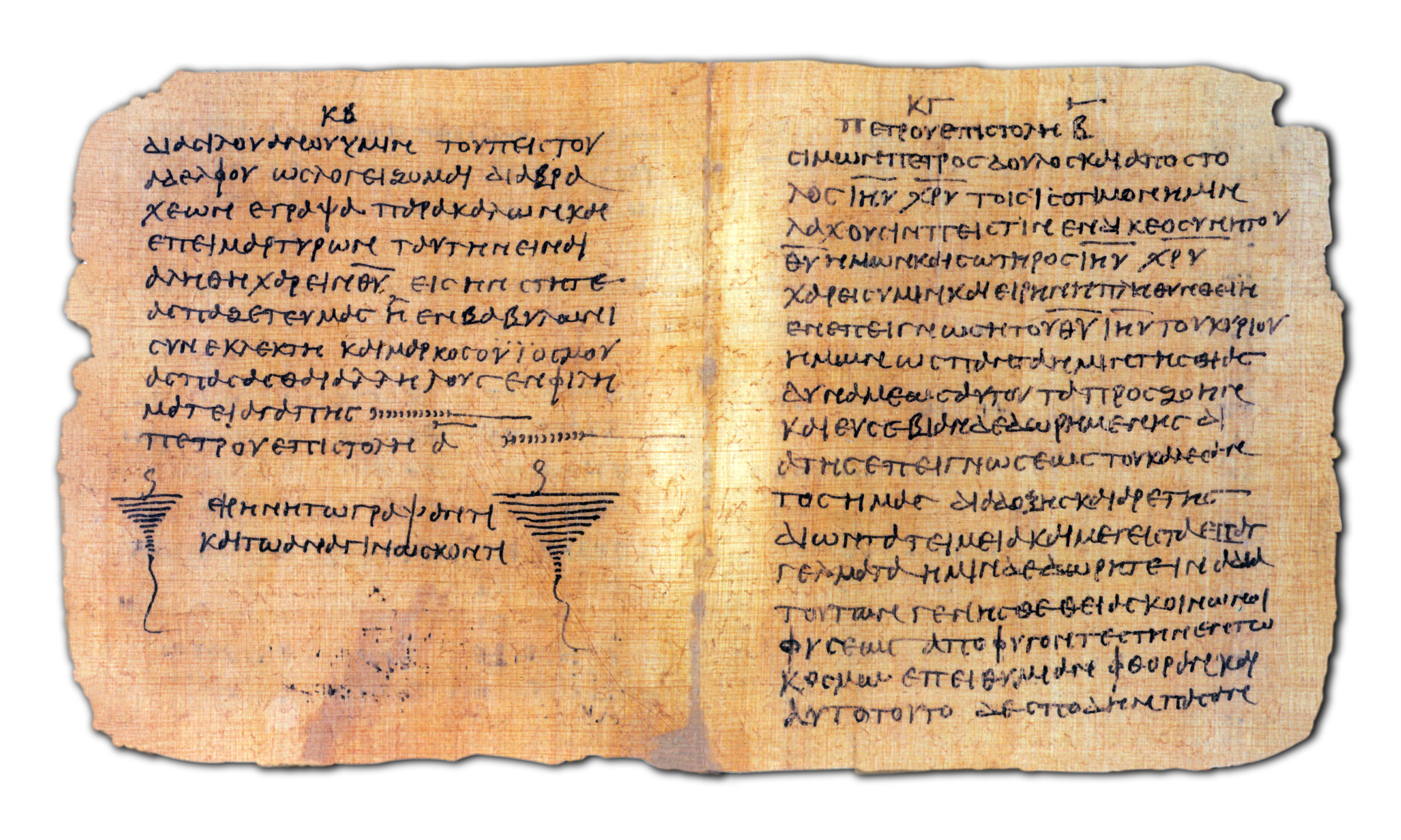
Fragment containing 1 Peter 1:23–2:5 on Papyrus 125 (3rd/4th century).

A Simple Study Of 1 Peter (Part One)

Wednesday’s Column: Third’s Words

Gary Pollard

For the next several weeks, I’ll be repeating the book of I Peter in present-day terminology. It’s not a true translation of the book, as I am not qualified to do so. It will be based on an exegetical study of the book and will lean heavily on the SBL and UBS Greek New Testaments, as well as comparisons with other translations (ESV, NASB, NIV, ERV, NLT). My goal is to reflect the text accurately, and to highlight the intent of the author using concepts and vocabulary in common use today. 

This is not an essentially literal translation, and should be read as something of a commentary. 

I Peter I – Intro to Hope

I am Peter, one of the special messengers that Jesus chose to follow him. This is for the chosen ones who had to leave their homes; they are spread out over Pontus, Galatia, Cappadocia, Asia, and Bithynia. 

You were chosen by our father, God, because that was his plan. It was his Spirit that made you special people who live differently from everyone else. He chose us [Christians] to be the ones who obey him. He chose us to enjoy grace through Jesus’s blood, the one who came here to rescue us. May you have plenty of grace and peace. 

God, the father of our master Jesus (the one who saved us), deserves our love and praise! He has so much good will for us that he gave us new life and a hope that can never die. We have that hope because Jesus came back to life. 

This hope is for something we’ll get when we die: a brand new, untouched, permanently perfect place to live forever. It’s reserved for you right now, protected in heaven. God’s power is protecting you right now because of your faith. He’ll make sure you get the results of your hope when it’s revealed at the end of time. 

Are You Ready?

Jeremy Waddell

jeremy talking

A lot of you do not know this about me but I grew up on a dairy farm. Holstein cows were a part of every day of my life up until about five or six years ago.

I have milked, showed, studied, and researched cows for years and invested so much time, effort and even money into cows. I can answer almost any question and have a deep conversation at any moment and can be confident in my answers when it comes to a Holstein cow… who won the show, who owns it, where it came from, her genetics.

The thing is… cows are no longer part of my life. I still have all that knowledge that worked so hard for, but it is basically useless in my everyday life.

Most people I deal with today would think I was crazy and probably take offense if I came up and asked what they thought about the rump and legs on that cow.

The need for that knowledge faded away just like every other earthly thing will and does for each of us.

I am sure we all have things in our life that seemed so important at one time and that we have moved on from. It faded away and was not near as important as we thought it was. Things of this earth will always fade away at some point.

God, Jesus, and the Bible does not fade away and never will!

1 Peter 1:4 tells us that God has given us an inheritance that is incorruptible and undefiled and that does not
fade away. It is reserved in heaven for each of us because of the blood that Jesus shed for us. We should have the same knowledge and confidence in the Bible and about Jesus that we have about our hobby or job or whatever else it is that consumes our time and know that it will never become useless. If anything, it should get more and more important in our lives.

We should be able to have:

-Have a conversation about Jesus and not be nervous
-Be confident in answering questions about the Bible
-Quote scripture and passages from heart just as we can the facts about our hobby or job and whatever interest we have that consumes us on a daily basis.

1 Peter 3:15 says, “But sanctify the Lord God in your hearts, and always be ready to give a defense to everyone who asks you a reason for the hope that is in you, with meekness and fear;” God has given us everything we need to be prepared to win souls AND to save our own soul.  2 Timothy 3:16-17 tells us, “All Scripture is given by inspiration of God, and is profitable for doctrine, for reproof, for correction, for instruction in righteousness, that the man of God may be complete, thoroughly equipped for every good work.”

We need that same knowledge, passion, and fire for studying the Word of God and being the “workman” that we are for our hobbies and earthly things. Being able to teach anyone at any time about Jesus and have ready answers for them. There are people out there that want to hear about Jesus. We need to be ready and able to talk to them, teach them and most importantly be an example to them. Remember: ““Study to show thyself approved unto God, a workman who does not need to be ashamed, rightly dividing the word of truth” (2 Tim. 2:15). 

  • –  Are you the worker God wants you to be?

  • –  Are you ready to use the tools He has given you? The Bible, your abilities and talents

  • –  Are you ready to put in the time and effort that you need to to be the Christian that

    God wants you to be? To study and learn from something that will never fade away or become useless.

Christ’s Focus On Getting Rid Of Sin

Wednesday’s Column: Third’s Words


Gary Pollard

This week we will do a brief study of I Peter 3.17-22. 

In verse 17, the emphasis in the original text is “doing good.” If it is God’s desire (this is emphasized) that we suffer, it is better (stronger, more prominent, more advantageous) that we suffer for doing good works than evil works. How much more powerful a message do we send when we come under fire for doing something that benefits others? If we suffer for doing something bad, we’re just another criminal. But to suffer in the act of doing something good – in context – is a far more powerful evangelistic tool. 

In the following verses, Peter gives a powerful example of Christ’s focus on getting rid of sin. He put everything into saving mankind – including giving His own life – so that we could all have the opportunity to come to God. Even before the destruction of the world through the flood He made sure everything had the opportunity to hear about their spiritual state. Whether this was done through Noah and his sons or whether He had a more direct hand in this is immaterial. The point of the text is that the message got out to those who are “now in prison.” His goal was to bring others to God, even when it caused Him suffering. 

Only those who did listen and obey – eight people – were rescued from evil by the waters of the flood. Notice that the Spirit does not record Noah’s ark as being what saved them! They were saved in the important sense by the destruction of evil. Our focus is not earthly. 

Just as water saved Noah and his family from evil, water saves us from spiritual death. Being immersed in water is how we make a formal appeal to God for a clear conscience! Some translations render this, “A promise to God from a good conscience,” as if baptism is some kind of outward sign of an inward faith. This is not reflected in Greek; it is a conscience cleared by an appeal to God, because of the resurrection of Jesus. He has all power, so He can clear our record when we submit to Him. 

Having all of this as a background, we have some motivation to keep our actions pure, suffer for doing good things, and understand that God’s power is what saves us. Peter gives many other phenomenal motivators for living a pure life, which we will look at in detail in the coming weeks. 

“It’s Not About Me” In 1 Peter 3

Wednesday’s Column: Third’s Words

Gary III

Gary Pollard

 
We’re going through I Peter in the college class at Lehman Avenue and we most recently studied part of chapter three. This chapter further discusses the theme of submission (giving up our power willingly to another) frequently appearing throughout the book. Christians are essentially told, “It’s not about me,” that we should get rid of certain behaviors, and an explanation for why we give up certain behaviors or power is given.
 
For example, we should get rid of hatred, taking advantage of others, hypocrisy, jealousy, and character assassination (2.1), because we know that God has shown us mercy (2.9, 10). That’s hard. We should listen to our government, even when we disagree with them (as long as it doesn’t violate God’s word), because God uses them to maintain some semblance of law and order (2.13-17). That’s hard. We should be good employees, even when our bosses aren’t fair, because Christ suffered, too, and God looks at us favorably when we suffer for doing the right thing (2.18ff). That’s hard.
 
In the same way – that is, keeping with the theme of surrendering our own power and doing something difficult for the sake of goodness – Peter addresses women and men specifically in chapter three.
 
This is an interesting study because it sheds light on a controversial topic: wives being submissive to their husbands. Let’s look at the text:
 
  • Γυναίκες (wives/women): Submit to ιδιοις (your own) husbands. Not all men, just husbands. Peter is not saying that women are inferior and should submit for that reason.
  • Ινα (in order that): For the purpose of cultivating godliness and influencing a fallen husband. It’s not for the purpose of manifesting inferiority, but to influence a lost husband! This involves a difficult task – as in 2.18 – which demonstrates the power of the word.
  • Δια (through/by): γυναικών αναστροφής (womanly or “wifely” conduct). Through her submission to her husband and through an emphasis on timeless inner beauty, she can save his soul. “Men and women have different ways of expressing godliness. Peter is showing how women can powerfully influence their husbands, which is by submitting to them” (Edwin Jones).
 
This sensitive topic is nonetheless a powerful one. Wives are not told to submit because it’s “just what women should do,” or because of a belief that women are somehow inferior, but are told to submit because it can save souls. Men are told to assign value to their wives and to be respectful and considerate with them if they want to be right with God (3.7), followed by a general set of commands for all Christians to act a certain way for the sake of godliness (3.8ff).
 
We submit and suffer as Christians to save souls and to remember that, “It’s not about me.”
(Gary teaching 1 Peter in the college class at Lehman Avenue)