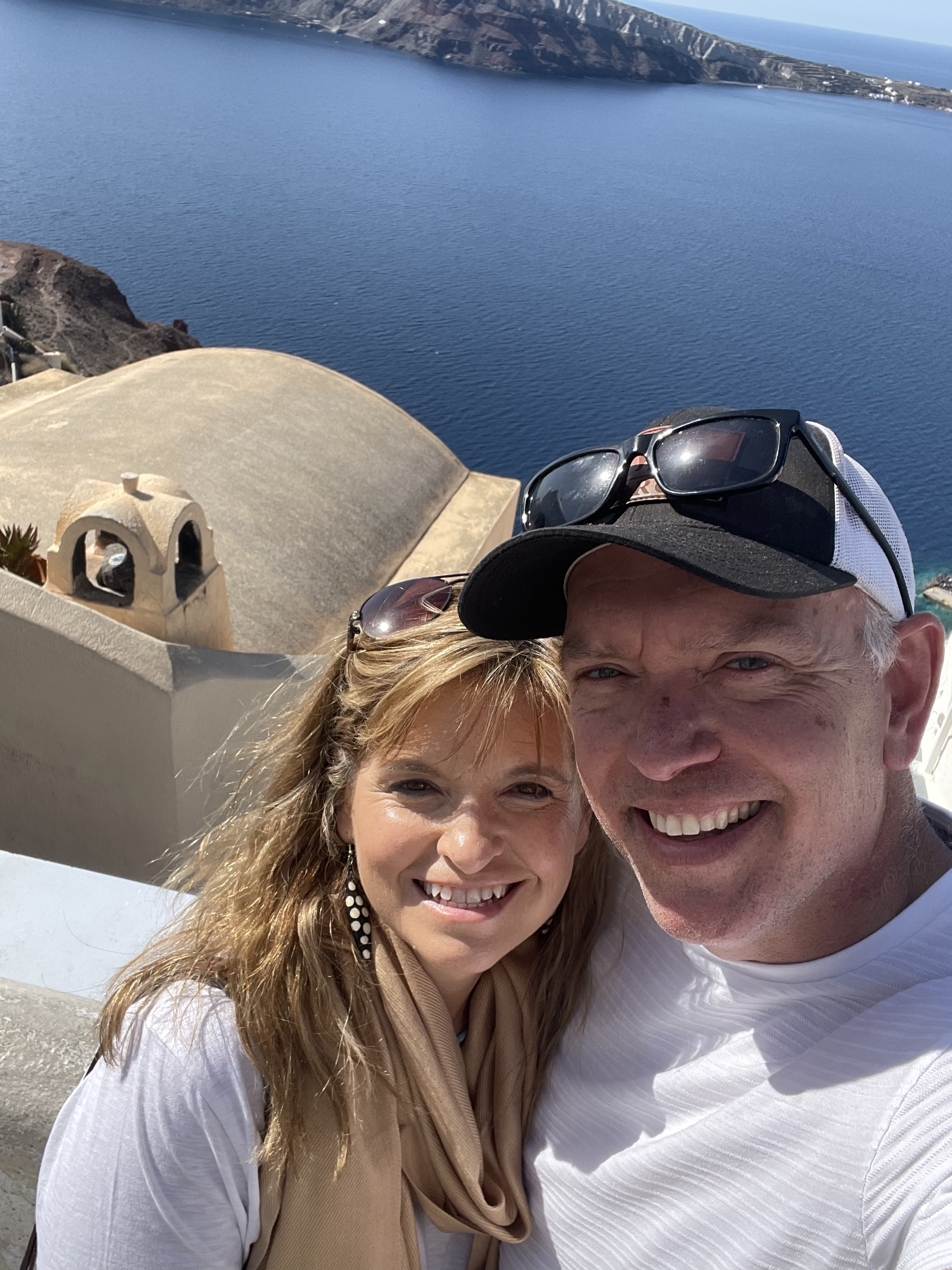
Today was a free day. We made a stop that almost undoubtedly the apostle Paul nor any other Christian in the New Testament ever made: Santorini. According to multiple sources, Christianity did not make an appearance on the island until the third or fourth century. What this Greek island is known for is its explosive history and the breathtakingly spectacular beauty that resulted from it. While some have tried to “explain” (or explain away) the Ten Plagues in Moses’ day by suggesting it was the result of the massive volcano that erupted there 3500 years ago, there is no doubt that a powerful volcano destroyed all life living there. In fact, it has erupted many times (more information here: link). Some have linked the volcano of Moses’ day to the lost city of Atlantis.
Today, it is yet another example of God’s great creative power. Even in a fallen world, we can see stunning beauty in places like Santorini. It’s vivid blue waters, which almost look painted between crags and cliffs, sit atop a giant caldera (large volcanic crater formed by a major eruption leading to the collapse of the mouth of the volcano). The caldera is about 7.5 by 4.3 miles, surrounded by cliffs almost 1000 feet high on three sides. Kathy and I traveled to two cities on Santorini today, then rode over to Nea Kameni and Palea Kameni (small uninhabited volcanic islands that have formed over the past 2000 through repeated eruptions of lava and ash).
It was an enjoyable day to spend with Kathy and see God’s creation. Tomorrow, we will visit another place where Paul walked and likely worked. The island of Crete is familiar to us through Acts 27 and the book of Titus, as well as a possible, surprising Old Testament connection. We’ll see tomorrow!
“For it was fitting for Him, for whom are all things and by whom are all things, in bringing many sons to glory, to make the captain of their salvation perfect through sufferings.” (Hebrews 2.10 NKJV)
Hebrews has a powerful picture of Jesus that stands out for its clarity and brilliance. The book of Hebrews refers to Jesus as the captain of our salvation. To truly comprehend the breadth and scope of this title, we must first understand the Greek word some translators render captain – “archegos.”
When applied to a person, “archegos” indicates that they are the first in a line of characters or events. Jesus made our salvation possible and is the perfect savior. Furthermore, the term can refer to the originator or founder of something significant. Using the word “captain,” the translators of the King James Version intended to highlight Jesus’s role as a leader and guide for Christians on their spiritual path.
The book of Hebrews extols Jesus’ important role as our high priest and the leader of our faith, demonstrating the way forward by enduring suffering and ascending to glory. This illustration is symbolic and closely resembles the role of a captain in an army, historically and today.
The Captain’s Charge on the Battlefield
A captain in the military is responsible for a wide range of duties. A captain is responsible for overseeing the execution of orders from higher ranks by a company of anywhere from 75 to 100 soldiers in the United States military. The parallel is Jesus’ dedication to carrying out the Father’s will (John 5.30).
In the heat of battle, a captain must put their strategic abilities to the test. They must assess circumstances quickly, make immediate decisions, and modify strategies. Jesus is our compass, showing us how to break down the barriers of sin and live a righteous life.
Furthermore, a captain ensures that his troops are well-supplied, whether with ammunition, food, or medical supplies. This provision is echoed in Jesus’ teachings, where He promises abundant life, is our eternal bread and water, and is the source of all spiritual blessings (John 10.10, 6.35; 7.37; Ephesians 1.3).
The captain has an essential role in raising morale among the troops. A soldier’s hope and confidence can turn the tide of battle. Jesus encourages us on our spiritual journey by assuring us that He has already conquered worldly challenges (John 16.33).
The captain acts as a liaison between the higher-ranking officers and the troops, facilitating effective communication and meeting the needs of both sides. In 1 Timothy 2.5, we learn that Jesus mediates between us and God.
Lastly, captains lead from the front, setting examples of bravery, decision-making, and resilience. In His life and teachings, Jesus exemplifies these characteristics, encouraging us to follow in His footsteps (John 13.15; 1 Peter 2.21).
In Conclusion
By comparing Jesus to a captain, we can better understand His unrivaled role as guide, leader, and supporter on our spiritual voyage. We are more than just soldiers with Jesus as our leader; we are more than conquerors (Romans 8.37). We must put our faith in the One leading us to eternal glory, the Captain of our Salvation.
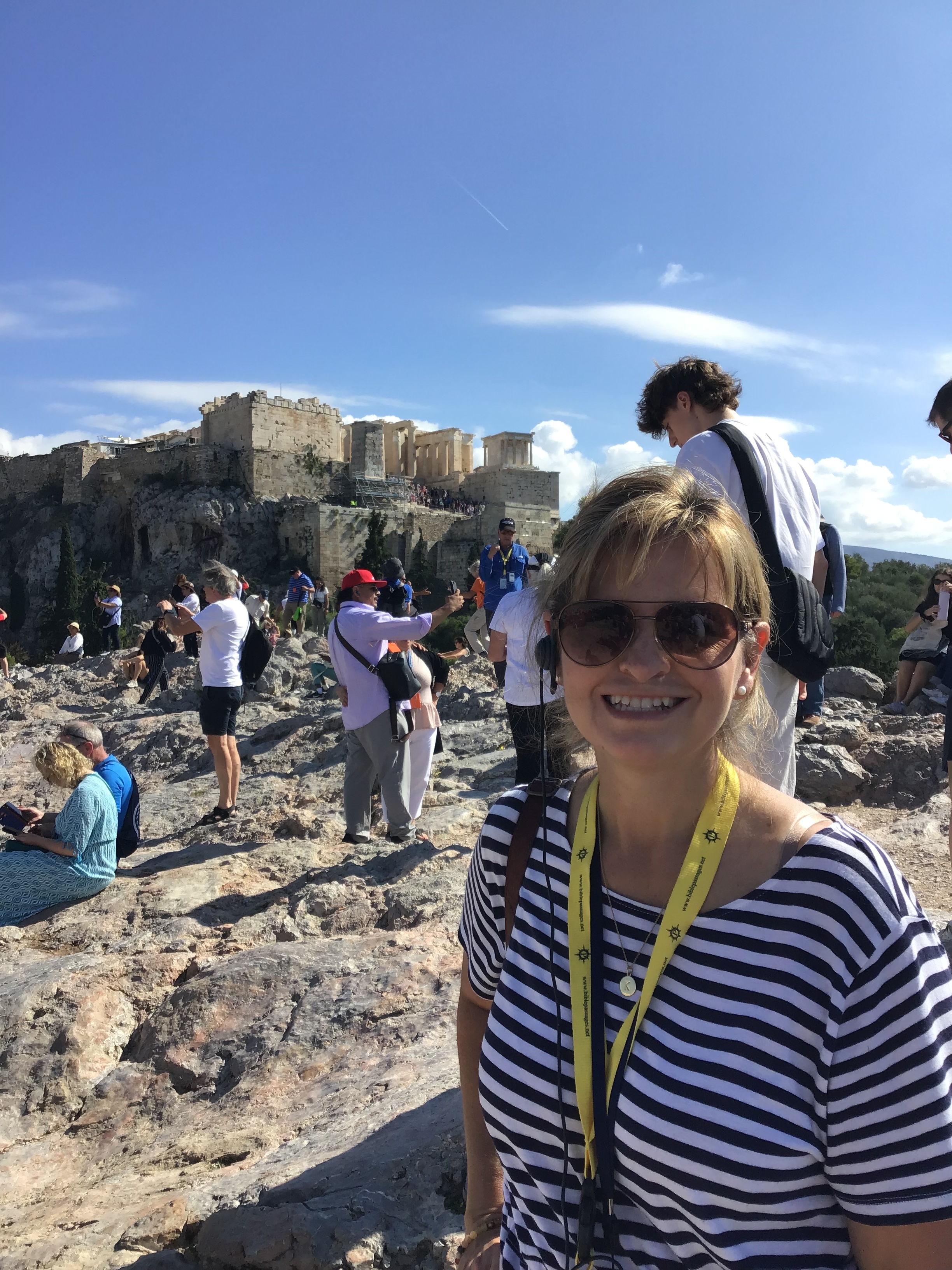
The Acropolis towers over the 4.5 million people who call Athens home. From nearly any point around this iconic spot that looms 450 feet above sea level, you can see it from the heights. In Acts 17, we see an example of the division of labor with Paul and his fellow-missionaries. Timothy and Silas have stayed behind doing follow up in Thessalonica while Paul goes on to Athens. Cosmopolitan man of education and experience that he is, Paul is still agitated and disturbed by the rampant idolatry of the place.
Visiting the city today, you see evidence of the mythology of Poseidon and Athena complete with temples dedicated to their honor and that of so many gods. Paul began as he always did in any new place, attempting to reach the Jews in the synagogue (Acts 17:17) while also making effort to evangelize in the marketplace. The Epicureans, rugged individualists and materialists, and Stoics, devoted to reason above all else, were intrigued and incensed by Paul’s “new teaching” (Acts 17:18). These philosophers brought him to the Aeropagus (hill of Ares in the Greek; “Mar’s Hill” in the Latin) so he could explain himself.
Many believe that, just as Socrates had done over 450 years earlier, Paul was called before their supreme court and tried for his “strange” beliefs. There are parallels between Socrates defense and Paul’s. Second, Dionysius, who will believe Paul’s preaching, is an Aeropagite or judge on this court. Third, it fits with Luke’s theme of Paul testifying before magistrates–the Philippian magistrates, the Corinthian proconsul, the Roman governors at Caesarea, the Jewish Sanhedrin, King Agrippa, and, ultimately, the Caesar. If it was a trial, it was also a masterful sermon. Paul uses their own philosophy, their own philosophers, and their own presuppositions to preach God and the resurrection of His Son and the judgment to come.
Standing on Mar’s Hill this afternoon, with the Parthenon jutting out on the Acropolis across the way, I thought about how Paul was given such a huge forum and he rose to the occasion. He gave us a masterful example of how to reach the unbelieving, biblically illiterate of any age. Ultimately, his message centered on the resurrection and the responsibility we have to stand before God, that we must believe that God is and that He is a rewarder of those who diligently seek Him (Heb. 11:6).
Right before we went to the top of Mar’s Hill, the preacher for the church at Athens, Dino Roussos, spoke to us about this event and even quoted (in Greek, of course) a portion of Paul’s sermon. How great to see the Lord’s church alive in a city where it seems Paul had, at best, only nominal success! How thankful we continue to be that Paul was willing to boldly go where no Christians had gone before to plant the first gospel seeds that are still producing today!
Today was the first day for all but one of our 56 members to be in the country of Turkey. We will make two stops in this country. Ephesus, from which we have just left, and Bodrum on Sunday. I knew I wanted to see the city of Ephesus, not far from the modern city of Kusadasi, but I had no idea how exciting and enriching the day would be. We had an outstanding guide, a man, Cenk, in a Muslim-majority nation who considers himself a Christian and whose working knowledge of the Bible was pleasantly surprising.
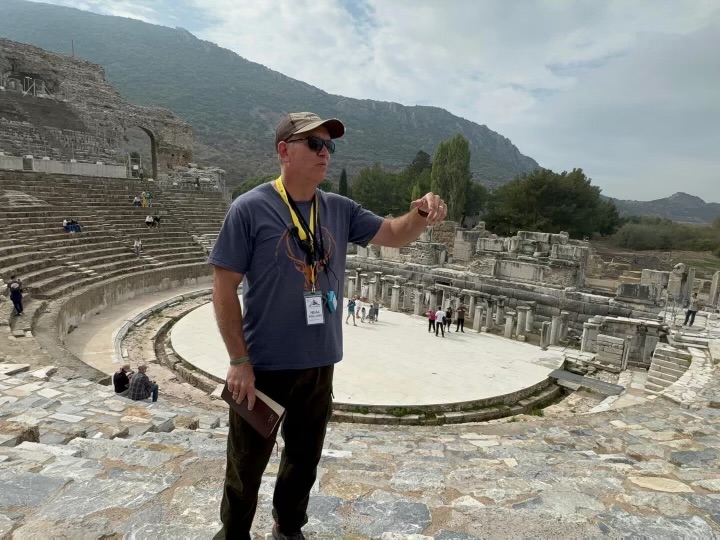
We spent a full two hours at Ephesus, starting at the ancient Harbor Road which Paul would have traveled to come up from the ancient port site of the city. Then, we went into the very theatre we read about in Acts 19:29! Getting to speak for a few minutes about that moment to our group in this theatre was a personal highlight! We saw the facade of the library of Celcus, an impressive second-century building. All along the way, we saw ancient ruins of this once thriving and leading city of Asia and the entire Roman Empire.
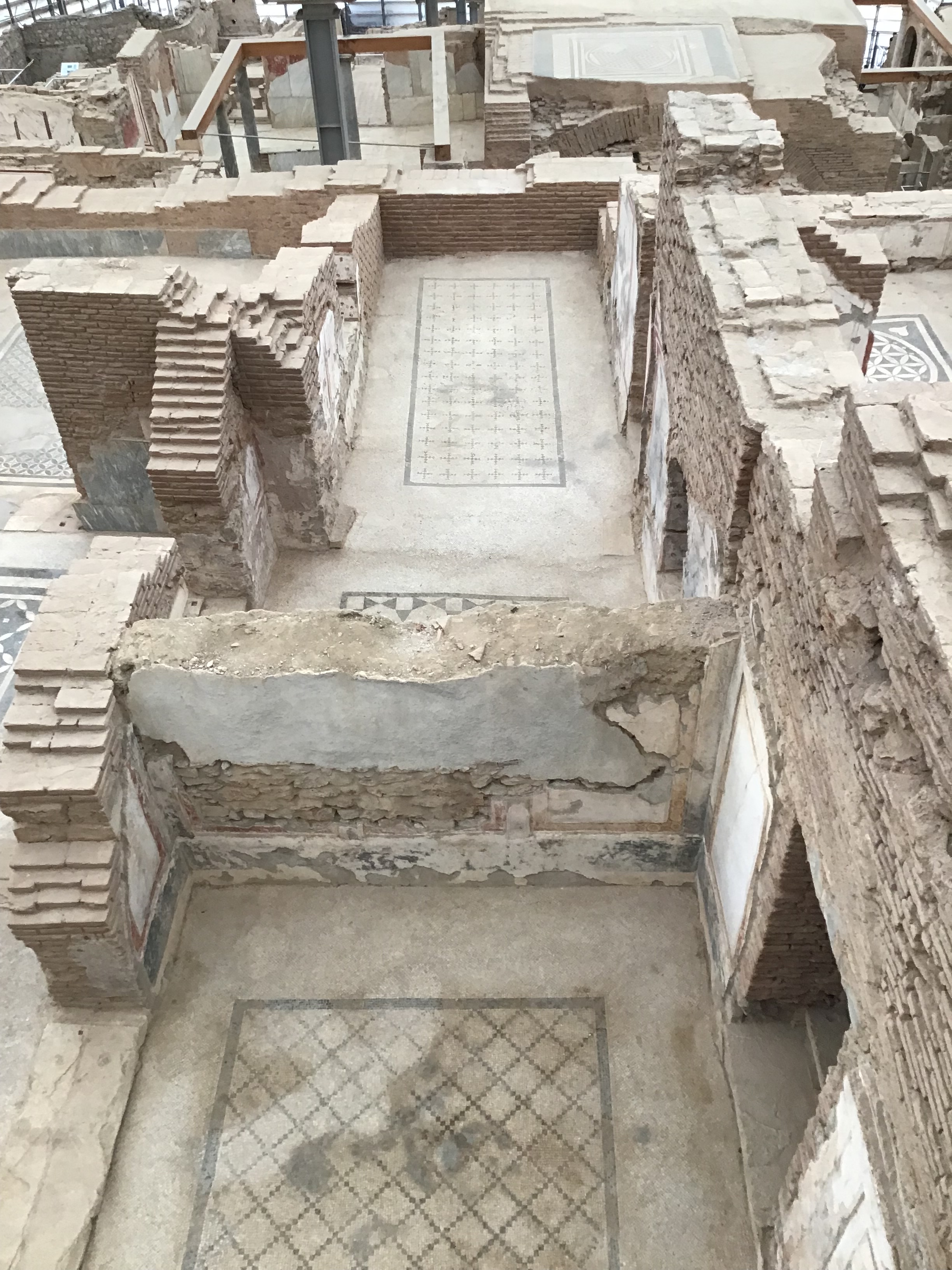
But perhaps the most exciting part of the day (though a visit to Aladdin’s Rug Warehouse was quite the unexpected treat) had to be walking through the recent excavations of the terrace houses among the Ephesus ruins. John Moore did us the wonderful favor of scheduling this as an add-on to the tour, and it was more than worth it! Cenk stopped the group and read this passage from Colossians 4:15, which says, “Greet the brethren who are in Laodicea and also Nympha and the church that is in her house.” Laodicea is about 120 miles due east, inland from where we stood in these houses. With the thriving, growing congregation at Ephesus, it was very likely that Christians were meeting somewhere in these houses or houses just like them. Church buildings were not built until the fourth century, after Christianity was “legalized” in the Roman Empire.
It is hard to describe how exciting it was to know we were walking through a city Paul called home for three years (Acts 20:31) and where he worked so fruitfully (please take a moment to read Acts 19). Paul shed tears with the Ephesian elders in and around these now ancient buildings, teaching publicly and privately to help this influential church grow! These are faith-building days, a reminder of how unique the Bible is as not only the supreme source of truth but as a book that constantly serves itself up as a book which is verified by history, archaeology, science, and geography!
I Peter 2.18-23 was originally addressed to servants. As we’re probably aware, the kind of slavery that was legal under the Old Law and Roman law was nothing like the chattel slavery we’re familiar with. Slaves had rights and personhood. They had the option to work for and earn their freedom. If a slave had a family, whoever purchased them was usually obligated to take care of the family. They had strict legal protections against abuse, but some masters really toed that line to its fullest extent.
This applies to us today in the employer-employee relationship. God expects us to behave respectfully towards good bosses and bad bosses (18). Even when a bad boss mistreats us (which is far too common, unfortunately), God’s happy with us when we go through it with patience and respect (19).
In vs 20, he cautions us against being punished for bad behavior in the workplace. Even if we go through that punishment with patience, it doesn’t really mean anything. But the reason we would ever put up with bad bosses or corrupt government rules is because that’s what Jesus did while he was on earth (21-25). He was treated unfairly the entire time he was here, and his execution was completely illegal. Many of his rights as a citizen in a Roman jurisdiction were violated. But “when people insulted him, he didn’t retaliate. He suffered without threatening anyone” because “God is the one who judges” (23).
Jesus even told his apostles that he had to power to destroy the earth and not have to go through any of those human rights violations. He had over 70,000 angels on standby, probably chomping at the bit for him to say the word and make their day. But he suffered without lashing out and that’s what he expects us to do, too. This is as far from easy as it’s possible to get, and something I certainly struggle with. God, give us the strength to stand down when the world hurts us because we believe.
Hans Glaser records an event that took place around dawn on April 14th, 1561 AD. He states that, “many men and women saw an aerial battle out of the sun.” This strange celestial phenomena was followed by the appearance of a large black triangular object which resembled the tip of a spear. There were spheres that fell to earth and cylindrical objects that moved erratically in the sky above. The woodcut illustration that these events were engraved on show objects of various shapes and sizes, including crosses and two large crescents.
What had Hans and all the others seen that day? It’s still up for debate. Was it a meteor shower? Was it a Sun Dog? It’s not clear. However, it provides us with an interesting mystery that also serves as a spiritual reminder.
Hans Glaser certainly felt that this was a sign from God and that the community of old Nuremberg needed to turn from their sinful ways— but was it?
Scripture records some celestial phenomena that we can confidentially say were supernatural in their planning (Josh. 10.11-14, Lk. 23.44) but outside of that we must be careful not to attribute what we don’t understand to an purposeful act of heaven. After all, it could be a rare but natural occurrence. It could be a misidentification or misinterpretation and we shouldn’t forget how human we all are. If God directly tells us through His word, we can trust it. If it’s not inspired, but claims things with great spiritual consequences— careful.
It’s far too easy for us to wrongly interpret even the scriptures we have to try and make sense of the world around us. While there are relevant passages that shed light on the modern age, the faithful should take to heart the command to Timothy (2 Tim. 2.15) and handle God’s book with great respect humility. There’s so much we don’t know, but we can be confident in that we serve a God who knows all.
Today was the first day we did not leave the ship, but we were able to get a preview of Ephesus from John Moore as we considered one of the most important cities of the New Testament. We This day was a day about fellowship. One of the great things about a trip like this is that you get to spend quality time with brothers and sisters you go to church with or that you just met. Each night, like right now, we have the opportunity to spend time playing cards and visiting. Earlier today, there were opportunities to do bumper cars, go to the gym, or other activities with brothers and sisters in Christ. That is a serious benefit of a trip like this.
When we study the early church, we see that from the very beginning they made time to be together. The church was established in Acts 2:41, then in the very next verse we read, “They were continually devoting themselves to the apostles’ teaching and to fellowship, to the breaking of bread and to prayer” (42). They were close because they shared a common bond, had the same worldview and God-view, and they faced the same challenges of growing their faith in adverse circumstances. They shared so much together (1 Cor. 10:16). Fellowship was precious (1 Jn. 1:3,7).
Tomorrow, we embark again on a tour of a biblical site. We will have that memory in common. But, even when we return to the ship, we will continue to share! That’s just the way God set up His church!
The ship left dock yesterday evening to begin our tour through the Mediterranean. Today, we visited an iconic site that at first glance may seem to have no biblical significance. The city of Pompeii and its lesser-known neighbor, Herculanum, were destroyed by a massive volcanic explosion in 79 A.D. Herculanum, much closer to the blast, was much more destructive to its inhabitants while the city of Pompeii was almost perfectly preserved due to its being covered by ash which did not vaporize buildings and houses.
There is some theory that there were a small band of Christians in the city when the catastrophic natural disaster occurred. Beyond that, the city was thought by Jews and even Romans to be a judgment against the rampant sin and immorality of the city or a divine judgment, from the Roman historian Cassius to the Sibylline Chronicles. While we cannot know that, we know that there will be a judgment none will escape at the end that God wants us all to be prepared for.
Before we returned to the ship, we were able to see where Paul docked in Italy. The small port in Puteoli is near the modern city of Naples (Napoli). Luke records this fact for us in Acts 28:13.
It was impressive to see what the first-century world was like where Christians had to swim against the massively immoral tide of their culture and society. Spiritual darkness must have seemed eclipsing at times, but they had the boldness to live their faith even in wicked cities like Pompeii. We have so much to be thankful for as we consider the relative ease with which we can express our faith and share it today! It is not always that way. It did not seem to be in southern Italy near the end of the first-century.
Today, we completed our land tour of Rome. I mentioned that there are 56 of us, ranging in age from teenagers to pushing 80. So, we move different speeds and are in different degrees of health. We are often having to go far and somewhat fast, requiring patience on the part of everyone. It has been pretty hot and sunny all weekend, too! Would you believe that everyone has kept such a great attitude and been so pleasant? Of course! We have been with God’s family, who you would expect to act more like Him than anyone else.
This morning, we all piled into our tour bus (packing about 90 bags into the bottom of it) and made our way to meet with the “Chiesa di Cristo” in Rome. This church of about 30, which has two elders, welcomed us with open arms. Some of their brethren led us in worship, some of our group led us in worship, and we sang, prayed, heard the word proclaimed, contributed, and observed the Lord’s Supper together. We sang in Italian, in English, and even in Xhosa (a South African language). We greeted and talked as best as we could with the language barrier and got to know some of each other’s stories. It was emotional.
I thought about what happened to Paul right before he was arrested and wound his way to Rome to appeal to Caesar. Nearing the end of his third missionary journey, he met in Miletus with the elders of the church at Ephesus (a city we’ll visit later this week)(Acts 20:17-38). Paul had worked with them for three years. At their parting, they wept, hugged, and said an emotional goodbye. The next place we know that he stopped was at Tyre (past Cyprus, which we plan to visit next week) in Acts 21:3-6. Paul and his fellow-missionaries were with these Christians just a few days. When they said goodbye, it was still an emotional, heartfelt goodbye.
That was the general feeling as we pulled away from brethren we only knew a couple of hours. Separated by language, culture, and background, we felt the bond of Christ strongly! It was hard to leave. It was wonderful to be there, to be with God’s family. How eternally wise our God was in building the church like He did. We will make some lifelong friendships as we tour so many places where Paul once walked and preached. We will have difficulty saying goodbye to some we’ve known and others we’ve met. But, that’s always the way it is when you’ve been with God’s family! They are the best!
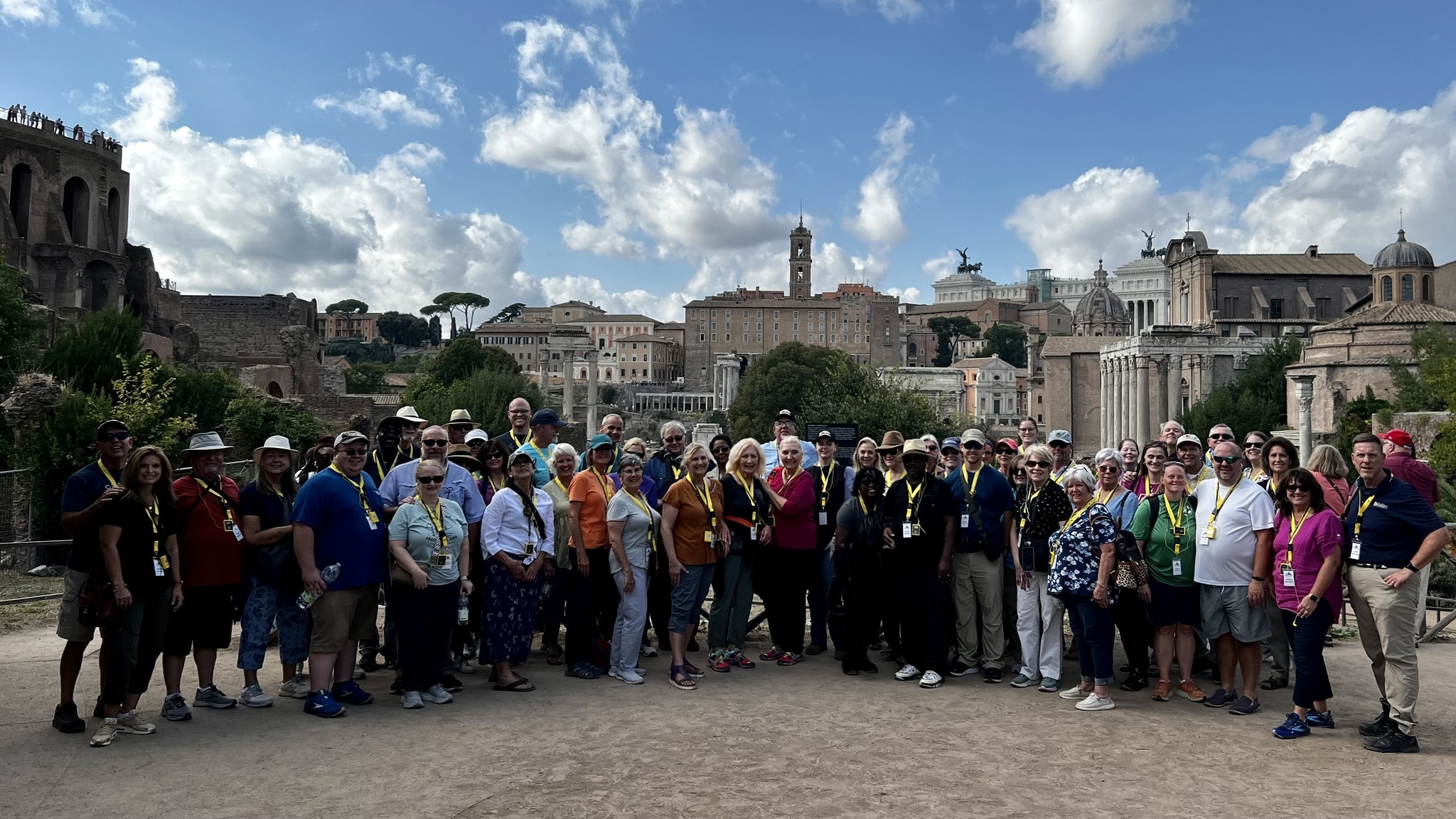
56 Christians from Arizona, Arkansas, California, Colorado, Kentucky, Michigan, Mississippi, Nebraska, South Carolina, Texas, and Virginia converged on the Hotel Gioberti in Rome, Italy, to begin a tour of places where the great preacher, evangelist, writer, and leader, Paul, shared the gospel of Christ. We began where it all ended for him: Rome. While our visit to where it all began for him, Israel, will sadly not be a part of our itinerary due to the tragic events now occurring there, we will visit a great many places where he helped fulfill Christ’s Great Commission in incredible, far-reaching ways.
He longed to get to Rome to “obtain some fruit among” them (Rom. 1:13), converting the citizens of that city the same as he had in so many other places. We know from Acts 28 that he did reach this city. This weekend, we saw what he found in his day. Emperors who would be declared gods by their senate, idolatry and the worship of gods of war, water, the sun, and a pantheon of others, and immorality like that described by Paul in Romans 1:18-32. Perhaps the first Christians came to Rome after hearing the first gospel sermon and obeying it (Acts 2:10). There are plenty of Christians to greet Paul as he approaches Rome in chains (Acts 28:14-15).
We encountered a city with stunning architecture, engineering marvels, Renaissance giants, and rich history that spans across, as John Moore eloquently put it, three eras–the pagan era, the Christian era, and the modern era. In a few hours, we will assemble with the saints at the church in Rome. It will be an exciting opportunity to meet in the capital city of what was, in the first century, the center of a global empire into which Christianity was born (Dan. 2:40-44). Standing in the midst of that city, imagining what our first-century spiritual family not only encountered but also endured, is a rare and beautiful opportunity to appreciate the power and spread of God’s eternal truth even in unfavorable social and political circumstances. It is a reminder, as Paul first put it, of the power of the gospel of Christ that brings salvation (Rom. 1:16). As Paul exhorted the Christians at Rome, I must not be ashamed of that gospel!
Reading comments on social media posts is bound to irritate you, like an eyelash that has gotten into your eye. People frequently share the most repulsive thoughts hidden in their hearts on the internet because of the relative anonymity it provides. I have seen the same confirmed regarding the recent Hamas-led assault against Israel. People are trying to gloss over the actions of terrorists by equating them to the alleged occupation of Jews in the region since the creation of the nation-state of Israel in 1948.
This defense of terrorism is an equivocation. Though the creation of the Israel nation-state indeed allowed many Jews of the diaspora to return, it is naive to believe that no Jews lived in the region before May 1948. Indeed, records show that at least 600,000 Jews lived in Jerusalem before David Ben Gurion became Israel’s first Prime Minister. There were even enough Jews present in 1909 to create the city of Tel Aviv as a suburb of the Arabic city of Jaffa (Joppa). Thus, framing this argument in terms of colonialism or imperialism or accusing Israelis of perpetuating apartheid against Palestinians is a ridiculous attempt by the enemies of Western culture to validate their radical, often violent ideology.
As a Christian and an earthly citizen of the United States, it would be easy for me to sit back and watch things play out on the evening news. I can close my eyes and say that this does not concern me, even though the United States has previously been subject to jihadi attacks. But I am only fooling myself. I saw the pro-Palestinian protesters in New York City and other metropolitan areas brandishing Nazi swastikas and using the “Free Palestine: From the River to the Sea” slogan. This current protest is not about a two-state solution. Instead, these protests openly advocate for eliminating the Jewish presence in Israel. And if that sounds ominous, consider that pro-Palestinian protesters in Australia were on video chanting, “Gas the Jews.”
But allow me to play the devil’s advocate. What if the Jews have committed atrocities against Palestinians? What then? Would the type of violence we witnessed be acceptable? The Jewish and Arab concepts of an eye for an eye and a tooth for a tooth notwithstanding, we know what one Jew from Nazareth taught. When the rabble Judas led came to arrest Jesus, impetuous Peter pulled his sword and cut off Malchus’ ear (John 18.10). Jesus, the Jew under consideration, told Peter to put his sword away. Note Matthew’s account of these events in Matthew 26.51–53:
And behold, one of those who were with Jesus reached and drew his sword, and struck the slave of the high priest and cut off his ear. Then Jesus said to him, “Put your sword back into its place; for all those who take up the sword will perish by the sword. Or do you think that I cannot appeal to My Father, and He will at once put at My disposal more than twelve legions of angels? (NASB)
Jesus sought to contrast His followers with those coming to arrest Him. Those men Judas led had swords and clubs. And Jesus asked them why they treated Him like He was the leader of some revolt (see Matthew 26.55). This mob did not need to threaten His person with physical violence. Jesus was not going to fight them. If He wanted to, Jesus could have called for 72,000 angels to protect Him (Matthew 26.53). However, 72,000 angels would have been overkill. With but one angel, God slew 185,000 Assyrians that had come to attack King Hezekiah (see 2 Kings 19.35).
Jesus acknowledged the legitimacy of the other sword, which was present, and had come to arrest Him in this moment of the “two swords,” even though His arrest was unjust (see Romans 13.4; John 18.3). In other words, Jesus recognized and submitted to the authority of the Romans. As He told Pilate, the spiritual nature of His Kingdom meant that His servants would not fight (see John 18.36).
Though Jesus did not teach us to be doormats, He reminded us to “turn the other cheek” when the situation requires it (Matthew 5.39). If you observe the text from Matthew 26 again, Jesus did not tell Peter to disarm himself but to put his sword back in its place. Again, this was not a time for violence. Jesus was aware of the bigger picture and the larger purpose of His mission. Jesus knew that resorting to violence at that moment would detract from His more excellent message and mission. One can apply this strategy to any cause; the methods used to advance a cause can significantly impact the perception and success of the cause itself. Jesus knew that His path required that His enemies lift Him up so He could draw the world to Himself (see John 12.31–33).
Hence, even if we were to say that Israelis “earned” the violence dealt to them by Hamas, the methods used to advance the cause—beheading babies, raping women, killing the elderly—impact public perception of their alleged cause. It sours the stomach and jaundices the eye. It’s better to walk the path of nonviolent resistance than give your detractors the rationale they need to justify their violent retribution against you. And in the days ahead, we will no doubt see much more violence in Gaza.
As we continue to follow the unfolding events between Israel and Hamas, we must learn the lessons that history and the Bible have to teach us about violence and the repercussions of our actions and beliefs. The advice to avoid escalation and seek understanding is universally applicable, regardless of whether we are policymakers, commentators, or observers. Wisdom and compassion pave the way to long-lasting solutions, while violence breeds more violence irrespective of the justification or historical context. We can only hope that the leaders of all parties learn from history and pursue paths that lead to peace, reconciliation, and coexistence.
Growing up our parents had a hard time calling us. I’d be in the living room and dad would say, “Gary-Er Dale-I mean Carl!” This would happen almost every time they would call for us. I don’t think this is a problem unique to our family. This is a problem that almost every parent has, and I know that once our daughter is born I’ll get Rich and Amara mixed up.
Similar to our parents calling for us, there’s a phrase used in scripture that sounds almost identical. In various texts throughout scripture you’ll come across the phrase, “call on the name of the Lord.” There’s a lot of confusion surrounding this phrase, so let’s take a few moments to figure out what it means, and what it looks like to call on the name of the Lord.
In Acts 2:21 Peter uses this phrase, but to get a better idea of the context and meaning we need to start in the book of Joel. In this short book there are a few important facts we need to recognize. Not much is said about Joel, but many believe that he ministered to those in Judah. In this prophecy to Israel He speaks of a plague of locusts and tells the people that it represented the coming day of the Lord.
These locust would bring complete and total destruction. The day of the Lord was a time greatly anticipated by Israel because they believed that God would then judge the nations and restore Israel to her former glory. But Joel says that God would punish not only the nations but unfaithful Israel as well. This day of the Lord was going to be like nothing they were expecting. Joel urges everyone to repent, and told of a day when God would “pour out [his] Spirit on all flesh” (2:28). That day arrived on Pentecost (Acts 2:17). In the middle of the book Joel arrives at the peak of his writing and in verse 32 he says this, “And it shall come to pass that everyone who calls on the name of the Lord shall be saved.”
Peter uses this exact quote In his sermon on the day of Pentecost. We read the same phrase in Romans 10:13 when Paul says, “For “everyone who calls on the name of the Lord will be saved.” We now know the origin of this phrase, but what does it mean? How do we call on the name of the Lord? Some believe that in order to be saved all you need to do is literally call out the Lords name. Others say that calling on the name of the Lord means praying a certain prayer in order to be saved.
In Acts 2, we can see an example of what it means to call on the name of the Lord.
It Requires a Proper Attitude. The Israelites thought that the Lord was theirs to control. They thought He would bend to their wills and wishes. They wanted the day of the Lord to be a day that would liberate Israel. And so they spun this phrase to fit their narrative, to the point that their meaning for the day of the Lord was the exact opposite of its true meaning. Joel and Peter clear up the air and explain who God really is. He’s not a gene, he’s not our puppet, He has a will of his own that we are to conform to. Calling on the name of the Lord requires a proper attitude. An attitude of submission to God and His will. An attitude of humility, recognizing our failures, and understanding Gods perfection.
The Israelites had it all wrong, and sadly sometimes we are the same way. We want God to make us happy. To grant every request we bring to him. We go to Him in prayer with everything that is wrong in our lives and say, “Okay God, fix it.” If what we pray for doesn’t happen, we think God didn’t answer. God always answers us, but the answer is sometimes “no.” Jesus in the garden asked God to take away His responsibility of going to the cross, but He was still crucified. Paul asked God to remove the thorn in his flesh, and the answer was no. God knows just what we need, what is best for us in the long term. We should never treat prayer as a gene in a lamp.
This is not what calling on the name of the Lord means. The Greek word for call is Kaleo, in this context it is the act of calling upon deity. The reason we call upon deity is because we understand our own imperfection. We need help seeing God’s will. Not our own like Israel did.
Calling on the name of the Lord requires a proper attitude, one of humility and understanding. And now more than ever we need to call on the Lord in order to find salvation.
“The signs” are a thread that run throughout the gospel of John. It is the signs observed by Nicodemus that brings this Pharisee to Jesus by night to speak with Him. He is a member of the Sanhedrin (7:50; 19:39), which is what John highlights by calling him a “ruler of the Jews” (cf. 7:48). The Sanhedrin, from the Greek word meaning “seated together,” was “a council in Jerusalem that functioned as the central judicial authority for Jews” (Myers, Eerdmans, 912). Yet, while that group will notoriously and constantly oppose Jesus and plot His death, Nicodemus approaches Jesus as a believer. He says, “Rabbi, we know that You have come from God as a teacher; for no one can do these signs that You do unless God is with him” (2). Who is the “we”? We are not told, but we do know that faith in Jesus is already beginning to spread.
Jesus, however, controls the direction of the conversation. He responds by teaching Nicodemus about the necessity of one being born again (3ff). This intrigues and mystifies that respected teacher. In this starlit classroom, Jesus lays the groundwork for a truth which future students like you and I also need to grasp.
The new birth is essential (3-5). Jesus says one must be born again. One must be born of water and the Spirit. Without this new birth, one cannot see or enter the kingdom of God. Paul is going to call this the “washing of regeneration and renewing by the Holy Spirit” (Titus 3:5).
The new birth is spiritual (6-8). Nicodemus is trying to understand Jesus’ teaching from a physical perspective, wondering if He meant literal rebirth–which he knew was impossible. Jesus contrasts that fleshly idea with being born of the Spirit. He likens this rebirth to the wind, something real but not something observable. We can see someone being baptized, but the cleansing of the soul and becoming a child of God is something actual which God sees but which we accept by faith.
The new birth is understandable (9-15). Now, Nicodemus is struggling to make sense of it, but Jesus says that is because he is thinking in earthly rather than heavenly terms. Those signs Nicodemus marveled at were designed to verify the truths He was teaching. All of it was meant to create faith in open hearts. To aid his understanding, Jesus asserts that He had come down from heaven to be “lifted up” (14). He refers this Old Testament scholar to an event during the wilderness wandering, when the brazen serpent was put on a pole to save the sinful Israelites who had complained and been bitten by serpents (Num. 21:9). Those who trusted in this remedy God provided to save their lives and looked on the pole did not die. Those who did not believe and look died. Jesus ties God’s grace and man’s obedient faith together to teach the new birth.
The new birth is providential (16-21). Simply put, God provided the new birth as part of His eternal plan. Jesus came to earth to teach that plan, but also to enact that plan. He was like the brazen serpent. He would have to be lifted up (14). He would have to be “given” (16). It was because men would not believe this that they would act in violence to kill Him, ironically facilitating God’s eternal plan of redemption (18-20). Jesus was going to expose the evil of men’s deeds, and they would hate Him for it. But Jesus, referring to Himself as Light (five times from verse 19 to 21), was illuminating the path of righteousness for those who believe (21).
I wonder what went through Nicodemus’ mind when he left Jesus that night. How many times did he review this lesson in his mind, pondering the weighty truths Jesus shared with him? What about when he tactfully defended Jesus when the Sanhedrin doubtfully disputed about Him (7:50-52)? What about when he helped fellow-Council member Joseph prepare Jesus’ body for burial after His crucifixion (19:38-39)? However that went, Nicodemus was taught one of the most important, yet basic, truths of all. He was faced with embracing it, and so are we. A place in God’s kingdom, eternal life, salvation, and coming to the Light are all blessings of being born again! It is an awesome thought that Jesus not only invites us to that, but gave His life to make it a reality.
We all need to come to ourselves in life so that we can make the right changes and do the things that God would have us to do. In Luke 15 we read about the prodigal son who went out and lived a life of sin and rebellion. But one day when he was away in a far country, the Bible says, “he came to himself” and then decided it was time to go home (Luke 15:17). Here are three times in life when I have come to myself and when you might need to do the same thing.
#1. Sobriety and turning from sin.
There was a time in my life when alcohol had a strong hold on me, and I was not living a sober and healthy life. I was allowing it to ruin me as a person and I had to come to myself and realize it was time to make a change. The Bible says whoever is led away with alcohol is not wise (Proverbs 20:1). I was being led away and nothing was going to change until I came to myself. We all sometimes notice sin in our lives, and we need to come to ourselves to repent and change it, Jesus said, “I tell you; but unless your repent, you will all likewise perish.” (Luke 13:3).
#2. Salvation
I came to a point when I recognized I needed God in my life and started to read and study the Bible. At that point I came to myself and realized that I was lost. I needed to be baptized into Jesus for the forgiveness of my sins as stated in Acts 2:38. I came to myself and made spiritual changes, and this is something everybody in the world needs to do.
#3. Service
After being baptized we need to find out where we can serve God and how we can be of use in his church. We need to come to ourselves and see how we can use our talents and abilities to serve in the church, help others, and glorify God. The Bible says, So, whether you eat or drink, or whatever you do, do all in the glory of God (1 Corinthians 10:31).
Be honest with yourself, find out what you can do, and then do it.
As I prepared for an appointment, the television commercial advised me to take advantage of their services so that I could “expect the unexpected.” I’m not too fond of that phrase. It could be considered a pet peeve. The statement’s paradoxical nature irritates me. It is impossible to anticipate something that is, by definition, unexpected or unforeseen. So, why do we keep using this illogical expression?
Since I grasp this idiom’s meaning, I recommend replacing it with “prepare for the unexpected.” The second option is feasible for us. Since we anticipate the possibility of unexpected events, we can plan accordingly to deal with or adapt to them. It’s like preparing for an accident by stocking your first aid kit with bandages for occasions when you get a cut or scrape. You didn’t know you would get that cut, but you had a dressing ready just in case.
Spiritually, Jesus tells us to prepare for the unexpected. Contextually, the unexpected is His Second Coming. To teach us this lesson, Jesus told the Parable of the Ten Virgins (see Matthew 25.1–13). The titular maidens are members of the bridal party. Unbeknownst to most contemporary readers, weddings in the first century were a different type of affair.
The bridegroom’s arrival was cause for both celebration and anticipation in first-century Jewish wedding customs. After the engagement, the bride would wait at her father’s home for her future husband to come and take her away. The groom had complete control over when this occurred.
The groom frequently transformed the process into a joyful game or challenge in which he attempted to surprise the bride and her attendants. This element of surprise heightened everyone’s excitement and enthusiasm for the party. Shouts announced the bridegroom’s arrival, so the wedding party members had to prepare to join the procession anytime, even after dark.
The five prudent virgins were ready for whatever might happen. They had brought extra oil because of the potential for the groom to be late. Those considered foolish should have considered the possibility of the bridegroom arriving late at night. According to the parable, the shout announcing the bridegroom’s arrival woke them up.
The foolish virgins woke without oil for their lamps and asked the wise ones to borrow some. The wise virgins said they didn’t have enough oil to spare for the foolish virgins’ lamps. The bridegroom led the wise virgins to the wedding feast while the foolish virgins went to get more oil. By the time the foolish came, it was too late; the groom shut the doors.
Jesus ends the parable by telling us to be alert since we do not know the day or the hour of His return. Hence, you and I must prepare for the unexpected (i.e., the Second Advent).
We need general preparedness. The most crucial general preparation is to obey the Gospel. For those who felt the weight of their sins on the Day of Pentecost, Peter preached repentance and baptism (Acts 2.38). Individuals submitting to baptism resulted in church growth. The Bible says that the Lord kept adding to that number those He saved (Acts 2.47). Once one is a part of the Body, he must make other general spiritual preparations such as prayer, good deeds, and maintaining a solid relationship with God (see 1 John 1.7).
We need mental preparedness. Christians should have a strong faith and accept that God’s timing may not coincide with their own. Like the bridegroom in the parable, we cannot know when Jesus will appear “with a shout, with the voice of the archangel and with the trumpet of God” (see 1 Thessalonians 4.16 NASB). Predicting when our Lord will return is fruitless, but people have been trying for years. Jesus declares that not even He knows when that day will be, only His Father (Matthew 24.36). Thus, we don’t know the exact date, but we know that God has chosen it (Acts 17.31).
We need to practice risk management. Believers waiting for Christ’s return should take precautions against the spiritual “risks” or pitfalls that could undermine their faith or readiness. Do you remember what Jesus taught in the Sermon on the Mount? If your right eye and right hand are the source of your sin, Jesus says it is better to have them amputated than go to hell as a fully functional human (Matthew 5.29-30). Jesus isn’t suggesting we physically cut out our eyes, but instead that we turn away from the things that trigger our lust. Jesus isn’t telling us to cut off our hands, but rather that we turn away from the things that trigger our greed. The gates of hell are not a place where Christians play chicken. Instead, we manage risks.
In conclusion, even though paradoxical sayings like “expect the unexpected” can be annoying, “preparing for the unexpected” is a powerful reminder of the deeper truths embedded in our spiritual journeys. Like the prudent virgins in Jesus’ parable, we must be ready for anything, including the unanticipated events of everyday life and, most importantly, the return of Christ. There are many facets to this kind of readiness, including general and mental preparedness, recognizing our human limitations when it comes to divine timing, and taking proactive measures to protect our faith from harm.
Let us go beyond waiting for the Lord’s return and establish ourselves in purpose, deed, and unwavering faith. By getting our heads and hearts in the right place, we anticipate His return and make strides toward spending eternity with Him.
Today’s families are falling apart. The home is divided, and God has been moved to the back burner. That is why now more than ever we should be able to see a difference in the Christian home, and the home that Christ is not in.
If we can’t see a difference, how will the world ever change? If we can’t see a difference in our homes and the world, chances are we aren’t glorifying God. The family that Christ is in will have unique attributes that are difficult to come by in our society. The Family that glorifies God:
Admits their sins.
The ability to be open and honest about sins and failures results in accountability and change. Paul says in Romans 8:1, “There is therefore now no condemnation to those who are in Christ Jesus, who do not walk according to the flesh, but according to the Spirit.” God has given us Christ as payment and He covers our sins, but we should be open and honest in order to find growth. Parents won’t be perfect and neither will children. Admitting sin to each other helps us to grow and change as a family.
The family that Christ is in:
Is Gracious To Each Other
Once again this is a trait that is rarely seen in a worldly family. As a people who have found forgiveness through Christ, we must be gracious towards each other. The Bible teaches us that by the grace of God we can be forgiven and set free from the control and imprisonment to sin. With the freedom to confess sin comes the freedom to repent of it and seek God’s forgiveness. Knowing God’s forgiveness gives us the ability to ask and receive forgiveness from those we have sinned against. In the same way God has forgiven us, we should forgive each other. Sometimes it is those we hold dear and love that hurt us the most. Be forgiving. My brothers and I used to have plastic lightsaber fights, and we’d really get into it. It often ended in screams of pain and anger. Be forgiving to your siblings. Parents, be forgiving of your children. By doing so we will glorify God.
The family that Christ is in is:
Ever Growing and Improving
Where there is spiritual life there is spiritual growth. No true Christian can remain the same. The Christian home is a place of constant spiritual growth. Every day we should do our best to glorify God even more.
How can we glorify God in the family? How can we make Christ a part of our home? Deuteronomy 6:5 says, “You shall love the LORD your God with all your heart and with all your soul and with all your might.” Give yourself to God, be wholly devoted to Him, and watch as you, your spouse, and your children bring glory to the Most High God.
This is a tough one to read, and it was certainly a tough one to write. This is one of those texts where “quick to listen, slow to speak about it, and slow to become angry [at scripture]” (Js 1.19) certainly applies. Those who know me know where I stand on most political and social issues. As a Christian, though, some of those things occasionally have to take second place. This is extremely difficult (even painful), as some of these things completely fly in the face of our political convictions. We sometimes conflate our political and spiritual values. While our political values should absolutely be influenced by our spiritual ones, the two aren’t inseparable. Sometimes we have to go against our political convictions if pursuing them means violating a Christian principle.
I Peter 2.13-25 is a difficult passage for many of us to swallow because it’s about giving up our own rights and freedoms for the sake of the message. God expects us to obey all government officials, even when their policies are unfair (or blatantly unconstitutional). Only when what they tell us to do violates God’s law are we permitted to disobey them. What does this mean practically? As a Christian, we have to comply with any policy upheld by a governing body who has authority over us (2.13-14, 16). This applies to any regulation that — even though unconstitutional — is upheld by government (cf. Rom 13). God expects us to comply because that falls in line with not causing trouble and living a quiet, peaceful life (I Tim 2). We often talk about how difficult the Christian life is, but these kinds of things make it real. My inalienable rights aren’t worth losing my eternal soul.
In 2.16-17, Peter addresses a loophole we might be tempted to exploit. Yes, we’re God’s people first. Yes, we’re an independent nation as his church, and we’re subject to him first before government. But that doesn’t give us the right to disobey laws we don’t agree with. We’re told to “live as servants of God”, which in context means “complying with all government regulations that don’t violate God’s law.” That’s hard. Nothing about this is easy, especially for us Americans who enjoy life in a country whose founding documents recognize and legally restrain government from interfering with natural freedoms. But the reward for following God’s word on this issue is immortality on a perfect new earth where — among many other blessings — there are no three-letter agencies or any other corrupt human act of authoritarianism.
He was born of a virgin, foreseen by the few A miraculous event— many know to be true He would save those in sin both friend, neighbor, and stranger But all that happened when He got out of the manger
His life was a short one, at least on this earth Some overlooked Him, his power, and worth He faced many challenges, his future looked bleak He was tortured and beaten, but turned the other cheek
A beautiful life— filled with joy and with danger, But all that took place once the Lord left the manger He holds many titles, king of kings and Lord of Lords He established His kingdom without even a sword
He’s the healer, our Savior, and any-life-changer But there’s more to His story He’s coming in glory Because Jesus left the manger
You may had heard once about the couple archaeologists dug up in an excavation in Rome, Italy. They found the bones of a couple who would have possibly lived before Noah, but how they found them was most unique. The skeletons were found in embrace, suggesting especially to the sentimental the profoundest expression of love and togetherness possible (source here).
Who knows what it truly means, who they were, and if they were even husband and wife? Yet, I would like to think that they were a couple so close and whose lives were so intertwined that their repose in death was symbolic of how they were to each other throughout life. We certainly need good role models, wherever we can “dig them up.”
Society does not do so much to encourage married people staying together. In fact, infidelity and fornication are idolized character traits. Those who stick together through thick and thin are portrayed as foolish or at least boring. Yet, God laid out a blueprint for the whole that includes a bond much stronger than an embrace for couples staying together (cf. Gen. 2:18-24; Mat. 19:3-9; 1 Pet. 3:1-7; etc.). The Lord’s church needs men and women who are committed to staying together, to building healthy, happy and close marriages. Societies, to long endure, need such values embraced and encouraged. You, if you are married, need to rededicate yourself to your spouse each day, finding ways to stick close and reasons to stay together.
As many of you know, in sports a team has to work together to succeed in the game. According to the Merriam Webster Dictionary teamwork is “work done by a group acting together so that each member does a part that contributes to the efficiency of the whole.”
Turn with me to Psalms 133:1 “Behold, how good and how pleasant it is For Brethren to dwell together in unity.” Just as team members are unified in the goal of winning, we as Christians should be unified in our efferts to please God and win a home in Heaven.
Proverbs 27:17 says, “As iron sharpens iron so a man sharpens the countenance of his friend.” this verse demonstrates the positive effect we can have on one another.
Ecclesiastes 4:9-12 reads, “Two are better than one because they have a good reward for their labor. For if they fall one will lift up his companion. But woe to him who is alone when he falls, for he has no one to help him up. Though one may be overpowered by another, two can withstand him. And a threefold cord is not quickly broken.” We should be uplifting to each other, and working together we can accomplish more.
A month ago I had the opportunity to play with the JV soccer team against Monroe County, In that game our team had many assists for our goals. These assists were very important in the game because without them there wouldn’t be a goal.
Romans 12:4-8 teaches, “For as we have many members in one body, but all the members do not have the same function,so we, being many, are one body in Christ, and individually members of one another. Having then gifts differing according to the grace that is given to us, let us use them: if prophecy, let usprophesy in proportion to our faith;or ministry, let us use it in our ministering; he who teaches, in teaching;he who exhorts, in exhortation; he who gives, with liberality; he who leads, with diligence; he who shows mercy, with cheerfulness.” Just like our team, not every one has the same job- one has to score the goal, someone provides the assist, others provide defense, while the goalie protects the goal. Not every one has the same position, every one plays a different role.
Just as a team practices for a winning game. God has provided us with the necessary things to win.
In Ephisions 6:13-18, Paul says, “Therefore take up the whole armor of God, that you may be able to withstand in the evil day, and having done all, to stand. Stand therefore, having girded your waist with truth, having put on the breastplate of righteousness, and having shod your feet with the preparation of the gospel of peace; above all, taking the shield of faith with which you will be able to quench all the fiery darts of the wicked one. And take the helmet of salvation, and the sword of the Spirit, which is the word of God; praying always with all prayer and supplication in the Spirit, being watchful to this end with all perseverance and supplication for all the saints.”
Just as teams strive to win a championship, we too can win a reward living for God.
Colossians 3: 23-24 says, “And whatever you do, do it heartily, as to the Lord and not to men, knowing that from the Lord you will receive the reward of the inheritance; for you serve the Lord Christ.”











 The Preacher Pollard Blog