The History of Christmas: How Christendom Came to Celebrate Christ’s Birth

Brent Pollard

Consider for a moment how we came to stand where we are. The manger scene feels ancient—as though Christendom has always paused each December to marvel at the incarnation. Yet history reveals something startling: the first Christians never celebrated Christmas.

This is not a scandal but a testimony. The cherished celebration emerged slowly, like dawn breaking over centuries, as believers reflected deeply on what it means that God became man. What began as an unobserved event in Bethlehem became a worldwide moment of worship—not by apostolic command, but through man’s appreciation of glory made flesh.

The New Testament: A Conspicuous Silence on Annual Celebration

Matthew and Luke give us the nativity accounts with luminous detail: angelic announcements, shepherds startled in the night, magi following a star. These chapters overflow with wonder. Then the narrative rushes forward to Jesus’ ministry, His cross, His resurrection, His return.

What’s missing? Any instruction to celebrate His birth annually.

The apostles gathered on the first day of the week, remembering Christ’s death and resurrection through the Lord’s Supper. They proclaimed His gospel with urgency. But they left no pattern, no command, no practice for memorializing His birth each year. This was not oversight—it was simply not their focus.

Early Christianity: Avoiding Birthday Traditions

The earliest believers lived in a world where birthdays carried pagan associations. Jewish tradition paid little attention to such celebrations, and Roman birthday customs often intertwined with idolatrous practices. As a result, Christians in the first two centuries steered clear of birthday observances entirely—even Jesus’ birthday.

Origen, writing in the third century, expressed the prevailing sentiment: only the birthdays of sinners like Pharaoh and Herod were celebrated in Scripture. The righteous did not.

This wasn’t legalism. It was discernment. God’s people were learning to walk differently in a pagan world, careful not to blur the lines between sacred and profane.

The Growing Curiosity: When Was Christ Born?

By the late second and early third centuries, Christian scholars began asking a natural question:

When, exactly, was Jesus born?

Their calculations varied widely—March, May, November—but the question itself signaled something important. These believers were not merely theologians; they were people falling deeper in love with the incarnation. To wonder about the timing of His birth was to treasure it.

Yet even then, no feast day emerged. The curiosity was intellectual, not liturgical.

December 25: The First Christmas Celebration

The earliest solid evidence for celebrating Christ’s birth on December 25 appears in a Roman calendar from around AD 336. Why this date?

Two theories dominate:

Theological Calculation: Some early Christians believed Jesus was conceived on the same date He died—March 25. Counting forward nine months places His birth on December 25.

Cultural Context: December 25 fell near Roman festivals like Sol Invictus (the ‘Unconquered Sun’) and Saturnalia. Choosing this date may have offered believers a Christian alternative to pagan revelry, declaring boldly that the true Light has come into the world.

Both explanations reflect the church’s dual task: theological precision and cultural engagement. The church was not absorbing paganism—it was confronting it with truth.

East Meets West: Different Dates, Same Savior

While the West settled on December 25, Eastern Christians initially observed Christ’s birth on January 6, called Theophany or Epiphany. By the fifth century, most Eastern congregations also adopted December 25 for the nativity, reserving January 6 for celebrating Christ’s baptism and the revelation of His divine identity.

This convergence is instructive. Though separated by geography and culture, believers across the empire felt the same pull—to set aside a day each year to contemplate the mystery Paul described:

‘Great indeed is the mystery of godliness: He was manifested in the flesh’ (1 Timothy 3:16).

The Medieval Church: Layering Tradition on Truth

As Christianity shaped Europe’s cultures through the Middle Ages, Christmas absorbed many traditions: nativity plays dramatizing the Bethlehem scene, carols sung in village streets, gift-giving recalling the magi’s offerings, and evergreen decorations symbolizing eternal life.

These additions were not corruptions. They were expressions—imperfect, human, sometimes misguided—of a truth too glorious to contain in words alone. The church has always been a community of storytellers, and Christmas became the story believers told again and again, in every creative form available.

The Reformation: Christmas Under Scrutiny

When the Reformation arrived, Christmas faced fresh examination. Lutherans and Anglicans embraced the celebration as a legitimate way to honor Christ’s incarnation. Puritans, however, rejected it, viewing Christmas as an invention unmoored from Scripture.

Both positions reflected sincere convictions about how to honor God. The Puritans feared idolatry and human tradition; the Lutherans treasured gospel proclamation wherever it appeared.

Modern Christmas: Sacred Truth Meets Cultural Expression

From the 1800s onward, Christmas continued to evolve. Charles Dickens’ writings awakened social conscience, Santa Claus captured children’s imaginations, and commercialization introduced both celebration and distraction.

Today’s Christmas is a complex blend: nativity scenes beside reindeer, worship services near shopping frenzies, profound theological truth intertwined with consumer excess.

Conclusion: Celebrating the Incarnation

Christmas is not commanded in Scripture. The apostles did not practice it. Its date may be symbolic rather than historical. Yet it endures because it points to something utterly real:

God became man.

In Bethlehem, divinity clothed itself in human flesh. The infinite became finite—the eternal entered time. The Creator took the form of a creature. This is the heartbeat of Christianity—not merely that God loves us, but that He came to us.

John wrote it plainly:

‘The Word became flesh and dwelt among us, and we have seen his glory, glory as of the only Son from the Father, full of grace and truth’ (John 1:14).

So whether we observe Christmas or not, let us never stop marveling at what happened in Bethlehem. Let us preach it, sing it, tell it to our children and our neighbors. Let us declare with unshakable confidence that God has acted in history, that heaven has invaded earth, and that nothing will ever be the same.

This is the glory of the incarnation—and it deserves to be celebrated every single day.

Serving Two Masters:

The ancient Samaritans believed they could negotiate with God, showing just enough reverence to escape calamity while holding tightly to their beloved idols. They did not understand that the God of Israel stands alone, not as one among many, but as the true God who rightfully demands and deserves our entire devotion.

Brent Pollard

Idolatry and the Call for Undivided Faith

The passage from 2 Kings 17.33 presents a profound reality: “They feared the Lord, yet served their own gods…” (NKJV). This ancient narrative of the people resettled in Samaria following the Assyrian captivity serves as a profound and disquieting reminder of the dangers posed by a divided heart and the subtle syncretism that can infiltrate our worship.

Following the fall of the Northern Kingdom of Israel to the Assyrian Empire in 722 BC, the Assyrians deported most Israelites. They filled Samaria with people from distant lands, including Babylon, Cuthah, and Hamath. These new inhabitants ushered in a diverse tapestry of deities and sacred traditions. When adversity, particularly lion attacks, beset them in their new territory, they ascribed it to their lack of understanding of “the god of the land.” The Assyrians dispatched a priest from Israel to instruct them in the ways of the Lord. Yet, what unfolded was not a genuine transformation of the heart but a calculated amalgamation of beliefs—a superficial acknowledgment of Yahweh that coexisted with their enduring devotion to idols. Their reverence for the Lord stemmed from a dread of punishment rather than from a place of love or genuine repentance. They desired a taste of God’s presence to feel secure, avoiding the profound commitment of total surrender.

The intertwining of genuine worship with pagan customs led to a weakened faith, a spiritual compromise where each nation erected shrines and idols alongside the reverence of Israel’s God. They paid lip service to Yahweh, yet their hearts and deeds clung to their former paths and idols. This blending of beliefs, this endeavor to serve two masters, endured through the ages, forging a spiritual legacy that, even in the time of Jesus, identified the Samaritans as possessing a distorted form of worship.

The peril emphasized in 2 Kings 17.33 transcends the boundaries of ancient history. We, too, encounter the subtle and dangerous allure of a divided heart. Though few in our time may kneel before stone figures, countless individuals unwittingly offer their allegiance to contemporary “deities” that compete for their hearts in a manner that rivals the worship of the Creator. These may reveal themselves as: 

  • The god of material prosperity: pursuing riches and material goods as the highest aspirations rather than viewing them as instruments for serving others.
  • The god of self-determination: elevating personal desires and ambitions above the clear guidance of God’s revealed will.
  • The god of cultural accommodation: compromising the unchanging truth of Scripture to align with society’s ever-changing standards.
  • The god of religious formalism: engaging in external expressions of faith while lacking genuine heart change and obedience to God’s Word.

It is all too easy to offer mere words of devotion to God while allowing other priorities to steer our daily lives and choices, much like the settlers in Samaria did. We may gather for worship and declare our faith, yet still hold tightly to the values of this world in our relationships, ethics, and allocation of time and resources. This “pious worldliness” reflects a contemporary manifestation of revering the Lord while simultaneously bowing to our idols.

With clarity and conviction, the Word of God calls us to pursue an undivided heart and offer our exclusive devotion to Him alone. From the Ten Commandments, “You shall have no other gods before Me” (Exodus 20.3 NASB95), to Jesus’ bold proclamation, “No one can serve two masters… You cannot serve God and mammon” (Matthew 6.24 NKJV), the message resonates profoundly. The Lord calls us to surrender our hearts, souls, and strength (Deuteronomy 6.5; Luke 10.27).

Our Lord Jesus directly addressed this matter, declaring to the Samaritan woman that genuine worshipers will worship the Father “in spirit and truth” (John 4.23-24). This truth transcends mere external rituals or compliance driven by fear; it is a deep reverence that transforms our hearts and guides us toward righteous living. The call made by Joshua echoes throughout history: “Choose for yourselves today whom you will serve…but as for me and my house, we will serve the Lord” (Joshua 24.15 NASB95).

To steer clear of the missteps of the Samaritans, we must diligently nurture a faith that is genuine, obedient, and wholly devoted:

  1. Honest Self-Examination: We must continually ask ourselves, “What other ‘gods’ vie for our devotion?” Are there unseen idols—whether our careers, comforts, relationships or even our own opinions—that overshadow God’s supremacy?
  2. Immerse yourself in Scripture: Engaging deeply and consistently with the Word of God illuminates His expectations and safeguards against the encroachment of worldly influences into our faith.
  3. Consistent Obedience: Genuine worship is revealed not merely in our Sunday gatherings but in our daily expressions of faithfulness and submission to the will of our Heavenly Father. James instructs us to be “doers of the word, and not hearers only” (James 1.22 NKJV).
  4. Reject Man-Made Substitutes: We must anchor our faith in the truth of God’s revealed Word rather than relying on human traditions or our perceptions of what is right.

The ancient Samaritans believed they could negotiate with God, showing just enough reverence to escape calamity while holding tightly to their beloved idols. They did not understand that the God of Israel stands alone, not as one among many, but as the true God who rightfully demands and deserves our entire devotion. Let us embrace this significant truth, reflecting on our lives and committing each day to serve the Lord with sincerity and authenticity. He alone deserves our complete and unwavering devotion.

The Two Black Wigs In The Baptismal Preparation Room

Neal Pollard

One of our young people who was recently baptized asked Kathy to help her solve a mystery that perplexed her to no end. Her Bible class teacher took her and the other students on a tour of the building, ingeniously including a trip to the baptistery and baptismal preparation room. Among the towels, garments, and other items, she noticed two black, curly wigs hanging on the wall. Her question for Kathy was, “Why are those wigs hanging there?” Kathy’s wise answer is that they were probably put there a long time ago, perhaps for older women getting baptized whose hair was brittle or thin. They might have looked baldish when they came up out of the water with wet hair, and the wig would disguise that. Yet, between them, Kathy and Kamdyn could not completely solve the conundrum.

Sometimes we have “wigs” hanging around. They may be traditions that were started in other times for specific reasons. You may have seen communion covered by runners or tablecloths going back to times when buildings didn’t have air conditioners and the cloth was used to keep the flies off. The circumstances changed, but the cover remained.

There are many traditions we honor that are fine and acceptable, but which are only expedients and may be a mystery to our young, new Christians, visitors, and the like. That is not to disparage them, but it is to say that we should be ready to discuss them. Whether that is standing before a song or Scripture reading, leading a specific number of songs before prayer, having an invitation at the end of a sermon, having the Lord’s Supper before the sermon (or vice versa), ending worship with a prayer or a song (Mat. 26:30), the way those leading in worship enter the auditorium, or any number of habits and customs congregations settle into, we should never let these simply settle into our subconsciousness.

Periodically, it’s good to explain and discuss these whether in brief form during the course of our services, at greater length in a Bible class on hermeneutics (Bible interpretation) or another textual or topical class, and certainly in one-on-one conversations.

It is also good to ask if and how we might vary or alter some of these customs, periodically or even permanently. There are acts of worship we are commanded to engage in each Lord’s Day (Acts 2:42; 20:7; 1 Cor. 16:2), but for how long and in what order? The Word of God is to be reverenced, but does standing inherently do that? What the people did in response to Ezra was spontaneous, and they followed it up by bowing low with their faces to the ground (Neh. 8:5-6).

Let’s remember that these traditions are good, or at least they are neutral. The point is to keep them from becoming mysteries hanging on the walls of our faith or our worship. Let’s continually ask what we are doing and why.

Christ? Or Man-Made Traditions?

Gary Pollard

Colossians 2 repeats the confidence theme “I want them to be strengthened and joined together with love, and to have the full confidence that comes from understanding.” We can only get this confidence by sticking to the essentials that Jesus gave us. 

2.4 says, “I tell you this so no one can fool you by giving you ideas that seem good, but are false.” Then 2.7-8, “You must depend on Christ only, drawing life and strength from him. Just as you were taught the truth, continue to grow stronger in your understanding of it. Never stop thanking God. Be sure you aren’t led away by the teaching of those who have nothing worth saying and are only trying to trick you. That teaching isn’t from Christ. It’s only human tradition and comes from the powers that influence this world.” 

Man-made traditions are powerless and often damaging, since they come from the powers that influence this world. But that wasn’t Jesus’s purpose! 

2.13-14 says, “You were spiritually dead because of your sins and because you weren’t free from the power of your sinful self. But God gave you new life with Christ. He forgave all of our sins. Because we broke God’s laws, we owed a debt — a debt that listed all the rules we failed to follow. But God forgave us of that debt. He took it away and nailed it to the cross.” 

This leads to 2.16 — “So don’t let anyone make rules for you about eating or drinking or about Jewish customs. In the past, these things were like a shadow that showed what was coming. But the new things coming are found in Christ.”

The entire book of Colossians is summarized with 2.18 — “Some people enjoy acting as if they are humble. They worship angels, and they always talk about the visions they’ve seen. Don’t let them cheat you out of your reward. It’s foolish for them to feel any kind of pride because it’s all based on their human ideas.” 

The keyword of 2.18 is καταβραβευετω (translated “cheat” in the verse above) — today we might say something like “umpire”. Don’t let anyone try to force you to observe a man-made tradition and then say “you’re out” if you don’t follow it. Paul lists some specific traditions in Colossians — circumcision (2.11) and prohibitions like “don’t eat that” or “don’t taste that” or “don’t touch that stuff” (2.21). 

This is after he says, “You died with Christ and were made free from the powers that influence this world. So why do you act as if you still belong to the world? I mean, why do you still follow those rules? Those rules are talking about earthly things that are gone after they’re used. They are only human commands and teachings. These rules may seem to be wise as part of a made-up religion in which people pretend to be humble and punish their bodies. But they don’t help people stop doing the evil that our sinful self wants to do.” 

This section reminds us that the power of our faith comes from Jesus, not man-made traditions. In fact, enforcing man-made traditions as important to our faith is sinful. If we follow those enforced traditions, we run the risk of losing our reward. If we want to see God, we need only what Jesus told us and nothing more (2.13-14). 

Jesus Is All You Need

Gary Pollard

We’ll spend the next few weeks on an overview of Colossians. The theme of Colossians is simple — Jesus is all you need. You don’t need Jesus, plus some other tradition. 

The letter starts with a reminder of why we live the Christian life. 1.5 says, “Your faith and love continue because you know what is waiting for you in the heavens: the hope you’ve had since you first heard the true message about God’s grace.” This is very similar to 3.1, which says, “You were raised from death with Christ — so live for what is above, which is where Christ is sitting at God’s right hand.” Our hope is in Jesus, who came from above. Our faith and love continue because we know what’s waiting for us when the one who is in the heavens comes back for us. 

1.9-11 promises that God will make us completely sure of what he wants. He will help us live the kind of lives that make him happy. He’ll help us to be productive and expand our knowledge of him. He’ll also give us strength with his own power so we can make it through difficult times. Our response should be happiness (1.12) and gratitude! By helping us live the right kind of life — thanks to Jesus’s sacrifice (1.14) — we’ll be able to get what he promised us, which is immortality and escape from earth’s corruption. 

Understanding Truth

Thursday’s Column: Captain’s Blog

Some things just don’t mix. Milk and orange juice, taxes and freedom, Coca cola and Mentos. But there is one particular mix that can sometimes be fatal. Blood pressure medicine can be a great thing, but when mixed with Advil/Ibuprofen it can harm your body and even give you a brain hemorrhage. If you mix rubbing alcohol and bleach you create chloroform. It’s safe to say that some things in life just don’t mix.

20-30 years after the ascension of Jesus, Paul wrote to a group of Celtic Christians in Galatia warning them of the dangers of mixing two teachings. We find the establishment of these Galatian churches in Acts 13-15 (Derbe, Lystra, Iconium, and Antioch of Pisidia). In 15:1 Some people came down from Judea teaching that circumcision was required for salvation. This occurred right after Paul had converted them. They are new Christians, and Paul had a “great debate” with them there. In Acts 15:5, the Pharisees who “had believed” were the ones commanding this of Christians. Fast forward a decade, and these teachers are back in Galatia teaching that circumcision is required for salvation.

In Galatians one, the question Paul is trying to answer is, “What is required for a person to be saved?” Forget circumcision, forget additional teachings, what does GOD say? Paul gives his answer by basically saying, “We need nothing other than what is contained in scripture to walk in the light.” There is only ONE gospel. In Verse 6 Paul says, “I am amazed that you are so quickly deserting Him who called you by the grace of Christ, for a different gospel.” He uses the word “amazed” or thaumazo. 

These were Christians who should’ve known better. Their quick acceptance of this addition to the gospel amazed Paul in a negative sense. In Acts 4:13, this same Greek word is used to describe the scribes and Pharisees’ reaction to the apostles’ teachings. Again in Mark 5:20, we read that people were amazed by Jesus’ teaching. Paul now uses this word to describe his reaction to these Christians deserting the gospel! This word could be accurately translated as “deeply disturbed.” 

If there is anything added to that which is necessary for the maintaining of your walk in the light, it is not necessary for salvation. These Christians should’ve known better, but sadly sometimes we are the same way. We know what’s right and wrong and yet we still choose poorly (speech, actions, thoughts). 

The message that these Christians were to accept was that of the death, burial, and resurrection of Jesus and the correct way to be saved. Any requirement outside of the plan of salvation is a false doctrine that must be condemned. If that other requirement is the sinner’s prayer, it must be condemned. If that other requirement is a “new wave of salvation,” as some denominations teach, it is to be condemned. If that other requirement is a tradition not necessary for salvation yet is enforced as such, it is to be condemned. We are only compelled to follow what is contained in God’s Holy Word. 

Let’s be careful as Christians to follow and teach solely what God has required of us. 

Carl Pollard

Traditional Traditions Transitioned

Thursday’s Column: Carlnormous Comments

carl-pic

Carl Pollard

 
Say that three times in a row. Now that you’ve done that, let’s focus on a very important question. Are traditions splitting the church? To answer this we must look at the source of our traditions. As a church we follow both divine and man-made traditions. The ones from God must be followed and taught in the church, but the ones from man have no authority from God.
 
So, are traditions splitting the church? The word “tradition” means to “pass something down.” Galatians 1:14 says, “and I was advancing in Judaism beyond many of my contemporaries among my countrymen, being more extremely zealous for my ancestral traditions.” Were the traditions that Paul was learning about passed down by man or by God? He labels them as being his “ancestors’ traditions.”
 
We must be careful to determine if a tradition that is being taught is divine or was instituted by our “ancestors.” For example, serving the Lord’s Supper from the front of the auditorium on a table that says, “Do This in Remembrance of Me”, and using brass plates are man-made traditions. This is not found in scripture.
 
There’s nothing wrong with practicing this tradition. The problem is when some try to enforce this and say “if you don’t do this for the Lord’s Supper then you haven’t really done what has been commanded.”
 
This teaching of tradition can split the church and we must be careful that we are enforcing God’s tradition and not our own. To do this we should ask, “Is it a violation of Scripture, or is it a tradition?” It’s okay to go along with traditions, but it is not okay to bind human traditions as a salvation issue.
 
There are some in the church that have taken their man-made traditions to heart. So we must ask ourselves, are we binding man-made traditions on others for salvation? Do we get upset if someone changes up the order of worship? Maybe we get mad when there are only two songs between the opening prayer and the sermon?
 
Divine traditions are what we must follow, and we must not force man-made traditions. Galatians 1:8-9 says, “But even if we, or an angel from heaven, should preach to you a gospel contrary to what we have preached to you, he is to be accursed! As we have said before, so I say again now, if any man is preaching to you a gospel contrary to what you received, he is to be accursed!” Paul’s point is this: “Who did you receive it from?”
 
1 Corinthians 15:1-3 tells us, “Now I make known to you, brethren, the gospel which I preached to you, which also you received, in which also you stand, by which also you are saved, if you hold fast the word which I preached to you, unless you believed in vain. For I delivered to you as of first importance what I also received, that Christ died for our sins according to the Scriptures.” It is important that we check to see where the tradition came from.
 
Paul got his teachings from Jesus Christ. That is the divine source we must use. Not your preacher or the old wise man. This tradition was divine. Even if it is a tradition that has been around for many years, this does not automatically make it a divine tradition.
 
We must always keep in mind two facts when it comes to tradition.
  1. Divine tradition is binding while man-made is not.
  2. Look for the source of the tradition in order to clarify fact number one.

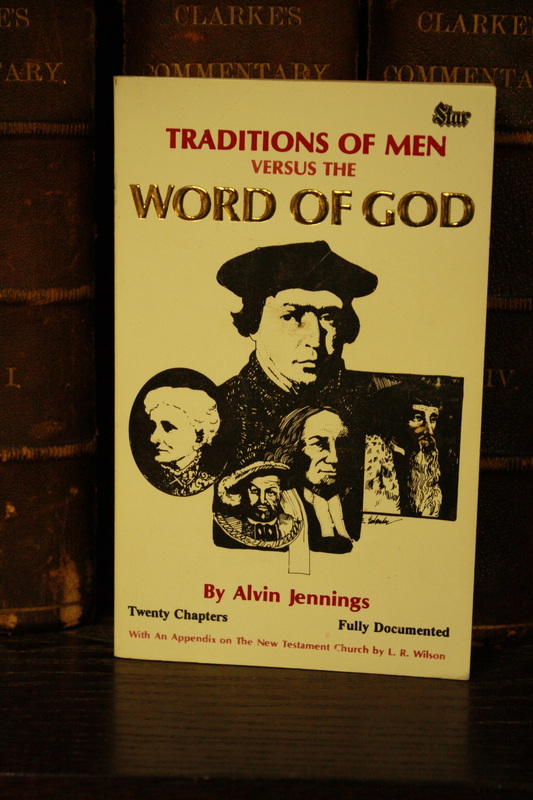
Traditions Of Men Versus The Word Of God

Neal Pollard

For as long as I have been preaching, I have had at least one copy of the Alvin Jennings’ book bearing the title above. The book was originally printed in 1972, but it has been reprinted several times. Jennings clarifies the way he uses the word “traditions” in his title. Rather than the sense of being a writing handed down from God (2 Th. 2:15; 3:6; 1 Co. 11:2), he used the word to refer to “religious laws and traditions originating from the minds of men and handed down orally and/or in printing from generation to generation” (iv.). He rightly points out that such traditions were condemned by Christ (Mat. 15:2-3,6; Mark 7:3,13; Col. 2:8; 1 Pet. 1:18; Gal. 1:14). Some of the problems with these traditions were that they got in the way of obedience to what God commanded, caused negligence regarding and the setting aside of God’s commands, enslaved one to something or someone other than Christ, and created a zeal that could lead to unhealthy consequences. The traditions Jennings examines substituted  false, human ideas for clearly revealed, divine truth. Anything that binds where God has not bound or gives permission where God doesn’t permit must be rejected. It’s a tradeoff with the gravest consequences (cf. Rev. 22:18-19).

However, I hope that as we strive to follow the pattern for New Testament Christianity we will be careful about elevating any tradition to be on a par with Scripture. There are some traditions we may choose to observe (or not):

  • Offering an invitation after every sermon
  • Having worship leaders, including the preacher, wear suits and/or ties
  • Women wearing dresses to church services
  • Songs or songbooks reflecting a particular time period (whether old or new)
  • Mandating a specific Bible version be utilized in the public assemblies
  • Choosing to have an evening assembly
  • Replicating the format of the morning assembly (in lieu of using the time for class, for example)
  • A particular order of worship (including whether the Lord’s Supper precedes or follows the sermon)
  • Offering the Lord’s Supper on Sunday evening
  • Any practice or tradition that arises from expedience or the realm of judgment, but that is not specifically mandated in Scripture

The church finds itself at a crucial crossroads. Undoubtedly, there is nothing new under the sun, but we do find ourselves at a unique place in cultural history. Since we live in an argumentative, rancorous atmosphere fueled by everything from cable news to social media, we should be careful to maintain a spirit of love and kindness whenever we sort through matters like these. We should never cherish non-binding traditions more than we do people. Those of us who are older and presumably more mature should consider carefully where and when we might compromise regarding matters not tied down in Scripture. More than that, we should foster rather than fear an environment that allows for such discussions to occur—without animosity or distrust. This will mean spending much more time developing our relationships with one another on the local church level (across generations). The better we know each other and the more we grow our love for each other, the better equipped we should be to sort through such things. Coupled with serious Bible study, this will hopefully sharpen our ability to distinguish between traditions and truth. May we have the grace to listen to each other without prejudice or minds already made up. Instead or ridiculing or caricaturizing the church in demeaning ways, let all of us “put on a heart of compassion, kindness, humility, gentleness and patience; bearing with one another, and forgiving each other, whoever has a complaint against anyone…” (Col. 3:12-13a). 

s702601590478870340_p115_i1_w533