Jesus: The Captain of Our Salvation

Brent Pollard

For it was fitting for Him, for whom are all things and by whom are all things, in bringing many sons to glory, to make the captain of their salvation perfect through sufferings.” (Hebrews 2.10 NKJV)

Hebrews has a powerful picture of Jesus that stands out for its clarity and brilliance. The book of Hebrews refers to Jesus as the captain of our salvation. To truly comprehend the breadth and scope of this title, we must first understand the Greek word some translators render captain – “archegos.”

When applied to a person, “archegos” indicates that they are the first in a line of characters or events. Jesus made our salvation possible and is the perfect savior. Furthermore, the term can refer to the originator or founder of something significant. Using the word “captain,” the translators of the King James Version intended to highlight Jesus’s role as a leader and guide for Christians on their spiritual path.

The book of Hebrews extols Jesus’ important role as our high priest and the leader of our faith, demonstrating the way forward by enduring suffering and ascending to glory. This illustration is symbolic and closely resembles the role of a captain in an army, historically and today.

The Captain’s Charge on the Battlefield

A captain in the military is responsible for a wide range of duties. A captain is responsible for overseeing the execution of orders from higher ranks by a company of anywhere from 75 to 100 soldiers in the United States military. The parallel is Jesus’ dedication to carrying out the Father’s will (John 5.30).

In the heat of battle, a captain must put their strategic abilities to the test. They must assess circumstances quickly, make immediate decisions, and modify strategies. Jesus is our compass, showing us how to break down the barriers of sin and live a righteous life.

Furthermore, a captain ensures that his troops are well-supplied, whether with ammunition, food, or medical supplies. This provision is echoed in Jesus’ teachings, where He promises abundant life, is our eternal bread and water, and is the source of all spiritual blessings (John 10.10, 6.35; 7.37; Ephesians 1.3).

The captain has an essential role in raising morale among the troops. A soldier’s hope and confidence can turn the tide of battle. Jesus encourages us on our spiritual journey by assuring us that He has already conquered worldly challenges (John 16.33).

The captain acts as a liaison between the higher-ranking officers and the troops, facilitating effective communication and meeting the needs of both sides. In 1 Timothy 2.5, we learn that Jesus mediates between us and God.

Lastly, captains lead from the front, setting examples of bravery, decision-making, and resilience. In His life and teachings, Jesus exemplifies these characteristics, encouraging us to follow in His footsteps (John 13.15; 1 Peter 2.21).

In Conclusion

By comparing Jesus to a captain, we can better understand His unrivaled role as guide, leader, and supporter on our spiritual voyage. We are more than just soldiers with Jesus as our leader; we are more than conquerors (Romans 8.37). We must put our faith in the One leading us to eternal glory, the Captain of our Salvation.


Jesus Didn’t Retire

Wednesday’s Column: Third’s Words

garyandme521

Gary N. Pollard III

Satan tried to trip Jesus with a killer deal: “I’ll give you every nation in the world if you worship me” (Matt 4.8-10). This wouldn’t have been a temptation if he couldn’t deliver. What might Jesus have gained by having Satan give up control of every nation on earth? It would have made his job a lot easier! He wouldn’t have to fight with Pharisees or other hostiles. He wouldn’t have to disappear after teaching or healing. He could avoid the kind of rejection that broke his heart (Luke 19.41). 

Sometime after this encounter, Jesus started to recruit followers. He may have had Satan’s offer on his mind as he was calling Peter (Matt 4.18ff). He knew Peter would be so ashamed of him that he’d deny any connection to him (Matt 26.69-75). He knew that every one of his followers would abandon him when he most needed them (Matt 26.56). 

He still lived his life, he still taught, he still sacrificed himself for everyone. How many of us would still pursue something if we knew how painful or difficult the outcome would be? How many of us would continue to pursue something if we were given the option to take an easier path? 

Jesus didn’t even retire once his mission was accomplished! He faced homelessness, assault, rejection, betrayal, injustice, torture, and execution. I would have retired after that in a heartbeat, and I would feel that I had more than earned that retirement. 

After he went back to be with the father, he rolled up his sleeves and got to work. He’s a full-time mediator (I Jn 2.1-2). He’s making sure the natural universe operates as it should (Heb 1.3; Col 1.17). He’s keeping evil in check (Phil 3.21; I Cor 15.27). When the end comes, he’ll destroy the universe and judge every human who’s ever lived (Heb 9.27; II Pet 3.7-10; Rev 20.12, 21.1-2). 

Whew. He still loves us (Rom 8.35; II Cor 5.14; Gal 2.20; Rev 1.5)! He still gives grace with generosity (I Jn 1.7; Rom 5.15-21, 6.14). We serve a tireless God who invested everything in us and will do so until the end of time. Life gets us down and we ask, “Why?” Just remember who’s watching our backs and won’t ever let us down! 

The wilderness of Judea

Much More Better

Wednesday’s Column: Third’s Words

IMG_3575

Gary Pollard

Jesus wants us to have a perfect eternity with him because he sees us as family (Heb. 2.11-14). He took drastic measures to make sure anyone who wants to could easily get a passport to heaven. 

  • He took a 33 year demotion to save us (Heb. 2.9). The engineer and fabricator of reality stepped down to an entry-level position so His own creation could abuse and kill him. 
  • An immortal being allowed Himself to die. He did this to experience what all of us have to experience (2.9). 
  • The best pulmonologists have a respiratory disorder (or a family member with one). They empathize and know from personal experience what works. Jesus was the perfect person to give out freedom because He personally experienced what we go through. If someone’s going to be in charge of handing out grace, who better than someone who can empathize with our struggles (2.10; 17,18)? 
  • He makes us perfect in God’s eyes (2.11). 
  • He brags on His family to the father and to the faithful dead who are hanging out with Him until judgment (2.11-13; 12.21-23). 
  • Death is scary and uncertain, but not for Christians. Satan used our fear of death against us (2.14; cf Rom. 8.15), but Jesus confiscated Satan’s power.  
  • He made God very accessible, which makes it easy to stay faithful (4.16). 
  • He’s better than ancient human priests – and even they were gentle/patient with ignorant and weak believers (5.1,2). If they were patient with ignorant, weak believers, He’s even more patient (5.5-10). 
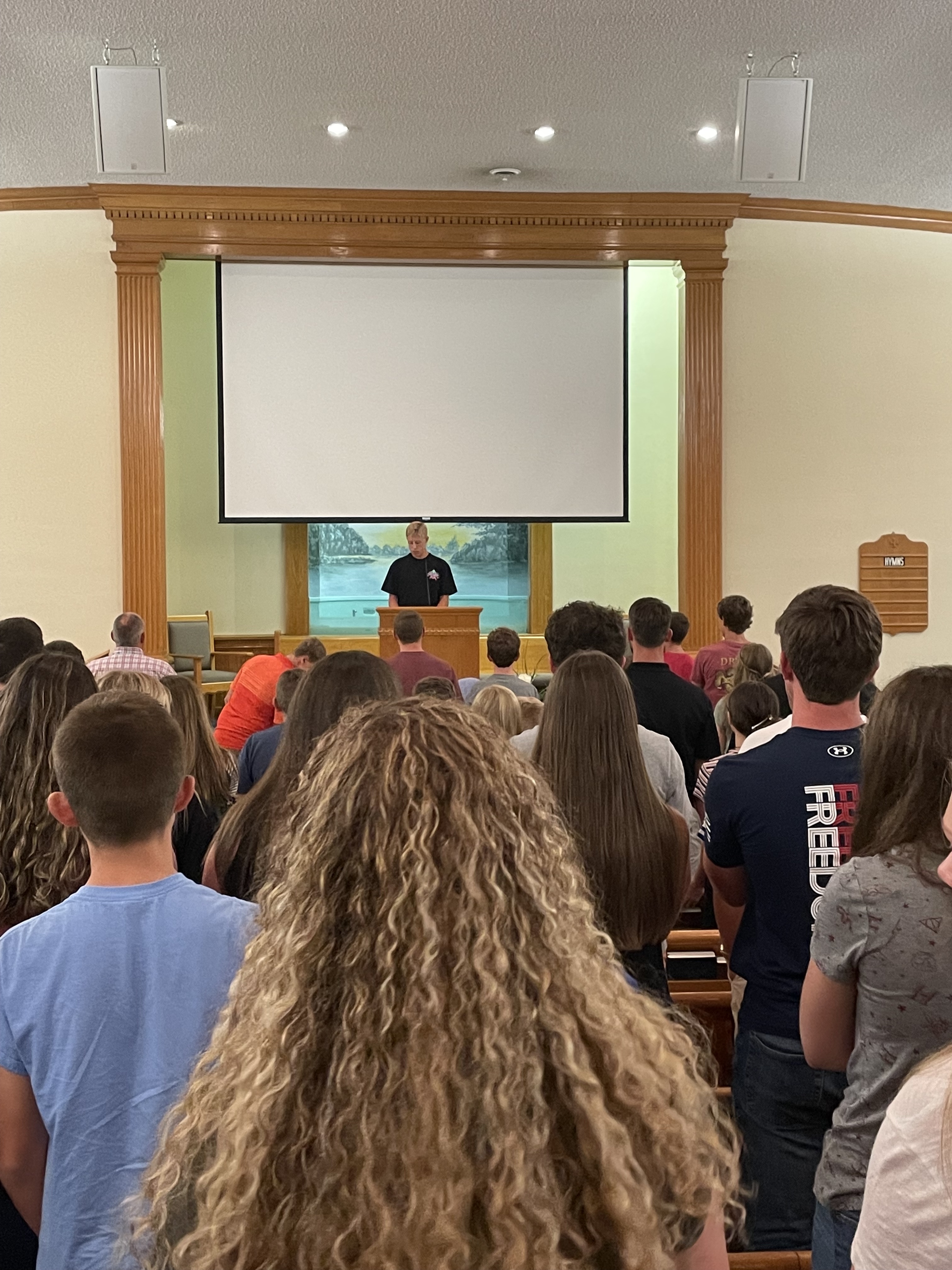
Teens stand for Scripture reading at recent Summer Youth Series (Chase Johnson reading)

Circle of Life

Wednesday’s Column: Third’s Words

gary and chelsea

Gary Pollard

  1. Earth Created (Gen. 1) (A)
  2. Man Sins, Earth Corrupted (Rom. 8) (B)
  3. Access to Tree of Life Blocked (Gen. 3) (C)
  4. Man Unified in Evil (Gen. 6) (D)
  5. Earth Destroyed by Water, Preserved for Destruction by Fire (II Pet. 3.6,7) (E)
  6. Jesus Grants Access to God As Mediator, High Priest, Perfect Sacrifice (Heb. 2.9; Rom. 8.17) (F)
  7. Man Rejects God, Unified in Evil (II Thess. 2.3-12) (4) (D)
  8. Earth Destroyed by Fire (II Pet. 3) (E)
  9. Man Redeemed, Creation Redeemed (Rom. 8.18-20; cf Mt. 19.28) (A, B)
  10. Access to Tree of Life Restored (Rev. 22.2) (C)
  11. God’s Own Live with Him, Share Unique Bond, Can Never Lose Paradise Again (II Pet. 3.13; Rom. 8.29; II Tim. 2.12) (F)

You can also look at it this way: 

  1. Earth Created (Gen. 1) New Heavens, New Earth (II Pet. 3.13; Rev. 21.1; Matt. 19.28)
  2. Man Sins, Earth Corrupted (Rom. 8.18-20) Man Redeemed, Earth Redeemed (Rom. 8.18-25)
  3. Access to Tree of Life Blocked (Gen. 3) Access to Tree of Life Restored (Rev. 22.2)
  4. Man Unified in Evil (Gen. 6)  Man Unified in Evil (II Thess. 2.3-12)
  5. Earth Destroyed by Water (Gen. 7; II Pet. 3.6,7) Earth Destroyed by Fire (II Pet. 3.7)
  6. Jesus Gives Access to Father (Heb. 2.9)  We Live With God (II Tim. 2.12; I Jn. 3.1ff; Rom. 8.29)

“The God and Father of our lord Jesus Christ is blessed. Thanks to His incredible mercy, we are born again into a living hope through the resurrection of Jesus Christ out of death. Because of this, we have an immortal inheritance that has no flaw and cannot wear out. This is guarded in heaven for you who are also guarded by God through faith. This salvation will be revealed to you at the end” (I Pet. 1.3ff).

The Angels’ Struggle (And Ours)

Wednesday’s Column: Third’s Words

Gary III

Gary Pollard

We sometimes have a tendency to give up when we mess up spiritually. We’ll think, “Guess I blew it, there’s no point in trying now.” Guilt or frustration over the difficulty of living for God and falling short is a powerful Achilles Heel of ours. Paul describes our struggle with sin as combat with self (Romans 7). 

A Christian who is fighting to follow God is still going to sin at some point. We sometimes allow the loss of that battle to drag us into a pattern of sinning solely because we’ve become discouraged that we even allowed that sin to happen. 

I’d like to point out that we aren’t alone in that struggle. Consider Job 38.7: angels – who do not need faith because they live in the presence of God – were up close and personal to the creation of our incredible universe. They watched in awe as God fabricated the stars. They heard those stars sing, which means that they were amazed by the sheer power and majesty of what we can only hear as obscure signals. They were right there! 

Some of those same angels were caught up in sin (II Peter 2.4ff; Jude 6-9). Satan currently has followers who were at one time up close and personal to the Power behind our existence (Romans 12.7ff; Matthew 25:41). 

If an angel, a being who does not serve God based on a mere belief in His existence, but because they were originally created for the sole purpose of carrying out His will, and who are eyewitnesses to His existence and unlimited power, can be tempted to the extent that they are willing to abandon the presence of God and forfeit ever seeing His face again, who are we to think that our struggle is that defeating? 

God does not have a salvation plan for angelic beings (II Peter 2.4). When they breach their boundaries, that’s it. The moment they act outside of God’s will is the moment they forfeit the presence of God for eternity. 

We are lower than angels on the creation totem pole (Psalm 8.5), yet we have Jesus as a mediator defending us before God (I John 2.1) and constantly making us sinless in God’s eyes when we’re doing our best to live for Him (I John 1.7). We have a gift that angels do not enjoy: we get extra chances. As long as we are willing to wage war with our sinful desires, as long as we are striving to be like Him, and as long as we are trying to incorporate the word of God into our lives, we have grace. 

We’re stepping out of the concrete and into conjecture, but there is at least some evidence that lust (Genesis 6; II Peter 2; Jude 6-9) and perhaps tragedy (Matthew 18.10) are enough to make an angel forfeit their home. Again, this is pure conjecture but it has, at the very least, some scriptural evidence to suggest legitimacy. 

When we sin, we need to take a step back and get some perspective. We must not brush off sin as being inconsequential, but we also must avoid allowing a mistake to send us into a dysfunctional pattern just because we think, “I’ve blown it, there’s no point in trying now” or, “This struggle is too great for me.” If angels aren’t immune, why on earth would we think that we are supposed to be? 

The beauty of Christianity is found in God’s grace. It is understandable, seeing how some have abused the subject, to want to avoid the topic altogether. How many, though, have found themselves trapped in sin because they did not understand or believe in the power of God’s continual forgiveness?

Understanding what we have when we make a concerted effort to follow God is of the highest importance. We will sin. If we say that we have no sin, we are liar and there is no truth in us (I John 1.8). When we do sin, let’s remember that not only can we have forgiveness if we’re walking in light, we’re not especially awful just because we find ourselves falling short. If even God’s angels can be tempted to the point of leaving His presence forever, so can we who have not seen His face. And let that cause us to seek His face with even more enthusiasm than before! 

I Corinthians 10.13

II Peter 3.9

573a4f4881b5ac289f8fd610e9755dcb

THE RESCUER AND THE ONE IN TROUBLE

Neal Pollard

In Romans 8:26, speaking of the work of the Holy Spirit, Paul writes, “ In the same way the Spirit also helps our weakness; for we do not know how to pray as we should, but the Spirit Himself intercedes for us with groanings too deep for words.” The Holy Spirit “helps,” lending “a hand together with, at the same time with one” (AT Robertson) and coming to the aid of one (Bauer). This is said in connection with the Christian’s prayer life. It is an acknowledgement that sometimes we need the help of God’s Spirit in particularly agonizing times, times where words like “weakness” and “groanings” describe the struggles in prayer.

In the same passage, Paul says the Spirit “intercedes,” a picturesque word of rescue by one who ‘happens’ on one who is in trouble and ‘in his behalf’ pleads with ‘unuttered groanings’ or with ‘sighs that baffle words’” (Reinecker 367). What graphic imagery! When I am in real trouble, no one can help me like God can. Sometimes, only God can help me when I am in trouble. Paul teaches that there is no depth of struggle or trial in prayer too complex or incomprehensible for the omniscient God. As the Psalmist once wrote, “Out of the depths I have cried to You, O Lord. Lord, hear my voice! Let Your ears be attentive to the voice of my supplications” (Ps. 130:1). Paul is saying, “The Lord does hear and is attentive not only to my voice, but even to the unspoken, unutterable fears, desires, and longings in my heart that cannot be formed into words on my lips when I pray.

Our God is a God of rescue (Ps. 18:19; 116:8; 136:24). He has rescued man in dramatic ways, from the Red Sea crossing to Jericho to Gideon’s tiny army to Calvary’s cross. He has demonstrated that He wants to help us and will freely extend Himself to do so. But, He wants us to reach out to Him and appeal for help. Even when the words will not exactly come to us, He knows the intent and desire and He looks with an eye toward aiding His children (1 Pet. 3:12). Do not only come to Him when in trouble, but do come to Him when in trouble. You do not have trouble too big for Him to come along and rescue you from it.

Trust that!

maxresdefault