The Split Rock Of Horeb

Rising stark and solemn from the barren Saudi wilderness, the Split Rock of Horeb stands like a silent sentinel of ancient power. Towering nearly 60 feet high, the colossal granite monolith looms over the desolate plain, its weathered and tan flanks are etched by wind and time. But what sets it apart, what seizes the imagination…

Dale Pollard

 —————————————————

It’s not just a rock. 

It’s a rock surrounded by empty silence and scorched earth. It appears, not as a mere geological feature, but a thunderstruck altar where the desert drank. A place where a miracle met stone. 

Rising stark and solemn from the barren Saudi wilderness, the Split Rock of Horeb stands like a silent sentinel of ancient power. Towering nearly 60 feet high, the colossal granite monolith looms over the desolate plain, its weathered and tan flanks are etched by wind and time. But what sets it apart, what seizes the imagination—is the cleft. A prodigious vertical split that is so unnaturally straight it’s as though it were torn by an invisible hand. 

The two halves, still joined at the base, are separated by a gap so wide a man could walk between them. Where is the magic sword from heaven that must have struck it so cleanly? 

At its base, the rock bears smooth channels and grooves—as if torrents of water once burst forth, carving trails into the stone that in wild obedience submit itself to divine command. Light filters through the divide, casting shadows that whisper about that day even to this day.

Yes, the rock still stands. 

Despite centuries of exposure to harsh desert winds, sand, and temperature extremes, the massive split rock remains tall and intact. It has an imposing presence, seemingly sliced vertically in a way that defies typical erosion patterns. The site receives occasional attention, but not too much and rarely up close. 

It’s in a remote, restricted area which is often under military control, and access has historically been limited or even outright prohibited by Saudi powers. 

NO TRESPASSING?

Many of the widely circulated photos and videos of the rock come from unauthorized expeditions, but here’s a couple  stand outs (Ron Wyatt won’t get any attention here). 

Jim and Penny Caldwell

 (1992) 

They were just the average American oil workers living in Saudi Arabia, but with a neat twist.

On numerous occasions they took considerable personal risk by sneaking into restricted areas to document the rock and other sites, including:

  • The Split Rock 
  • The blackened peak of Sinai 
  • Altar-like structures and petroglyphs of bulls (linked to the golden calf story)

Oh, and they had to smuggle all  pictures and footage out of the country. 

Bob Cornuke 

(Late 1990s-Early 2000s)

He was just your average former police investigator, but with a neat twist! 

He collaborated with the Caldwells and visited the site to gather photographic and testimonial evidence. His trips were perfectly reasonable, just slightly (ok, entirely) unauthorized and clandestine.

Other explorers have faced interrogation, arrest, or deportation by Saudi authorities and the government has since built a fence around Split Rock. Access is now heavily restricted or off-limits to the public. 

                      ————————-//————————

Bonus Neat 

Local Bedouins have called it the “Rock of Moses” for generations and their oral traditions speak of how water once flowed from it. Some Bedouins avoid the site entirely. 

Bread Facts 

“And the LORD said to Moses, ‘Pass on before the people, taking with you some of the elders of Israel, and take in your hand the staff with which you struck the Nile, and go.

I will stand before you there on the rock at Horeb, and you shall strike the rock, and water will come out of it, and the people will drink.’ And Moses did this in the sight of the elders of Israel.”

Exodus 17:6-7 

(see also, Numbers 20:1–13) 

The Hornets Of God

Did God actually send hornets against the Canaanites? What do you think is meant by God sending a hornet before Israel?

Dale Pollard

God not only told the Israelites that He would give them the land of Canaan, He also told them how He would do so. Moses records the very words of God as He explains what the initial steps of the conquest was going to look like and it’s as fascinating as it is strange. 

Angelic (Conditional) Assistance 

“Behold I send an angel before you to guard you on the way and to bring you to the place I have prepared. Pay close attention to him and obey his voice; do not rebel against him, for he will not pardon your transgressions, for my name is in him” (Ex. 23:20-21). 

We’re told that the angel would “go before them” and bring them to pagan armies and peoples such as the Amorites, Hittites, Perizzites, and of course, the Canaanites— to name a few. (V.23). 

The Terror & The Hornet 

After this the reader is thrown a curve ball as two additional names are introduced. 

“I will send my terror before you and will throw into confusion all the people against whom you shall come…” (v.27). 

“…I will send hornets before you, which shall drive out the Hivites, Cannanites, and the Hittites before you” (v.28). 

The angel, terror, and hornet are each different Hebrew words but share a commonality— they go before the Israelites. 

It sounds like these terms could describe three separate beings or forerunners that were meant to accomplish separate tasks. It’s an interesting idea so that’s reason enough to dive in and investigate. Hopefully by the time we come up for air it’ll make more sense. 

Hornets In The Bible 

First, let’s deal with “the hornets.” Only three other times in the Old Testament do we find passages with hornets. Exodus 23:28 is the first time it’s used and here Moses is quoting what God told him that He would do. 

The next occurrence is in Deuteronomy 7:20 where Moses reminds the Israelites just before they storm the Promise Land about those hornets God said he would send ahead of them. 

Finally, the last mention is the most elucidating. In Joshua 24:12 there’s a subtle hint found in most English translations. It says, “And I sent the hornet before you, which drove them out before you…”. All three passages about hornets refer to the conquest event. More importantly, Joshua seems to recall a single hornet rather than multiple hornets. 

Make It Make Sense 

Joshua is the only passage in most translations that describes a singular hornet but the other two passages actually use the same Hebrew word. Meaning, the translators chose to make the hornets plural in two passages but chose to make it singular in Joshua’s account. 

Well, now it’s time to revisit Exodus. Here the angel is mentioned in the singular and then what the angel does to the Lord’s enemies. The angel will bring the Lord’s “terror” on the pagan people which will “throw them into confusion.” The terrified and confused people will “turn their backs” and run from the Israelites. Like a hornet, the angel will literally put the fear of God in them and chase them. Anybody who’s been chased by a hornet will know that fear and madness all too well. 

The guardian angel of the Israelites is mentioned several more times throughout the Old Testament but this particular event showcases the role that their angel played in the conquest of Canaan. It’s probably not talking about literal hornets or even just one nasty hornet that buzzed into battle. You could even argue that Exodus 33:2 further attests to this. It states, “I will send an angel before you and I will drive out the Cannanites, the Amorites, the Hittites…” God explains how He’s going to assist them and then what His assistant is going to do. God’s  angel is going to run off the bad guys like an angry hornet. 

Could God accomplish His will with just one little hornet? I think every believer knows the answer to that— absolutely. 

Hosea: Unfaithfulness (XI)

How does God feel about us when we refuse to be faithful to Him?

How Can I Give You Up? How Can I Surrender You? (11:1-12)

Neal Pollard

Israel and Judah have betrayed God and given Him up for far inferior and worse alternatives. Their wanton pursuit of such love interests was met by violence and mistreatment from their misguided choice. What utter folly in exchanging the perfect, providing, and protecting God for the perverse, pitiless, and pompous world and its idols!

Despite their resolute determination to forsake Him, God’s perfect love cannot be extinguished. That does not mean He will change His mind about their judgment and punishment, but He does not do so with out of control rage and jealousy. He does so, as it were, with audible weeping and restraint. These are His people, and He loves them so much. 

He recalls the love He had for the nation at its beginning, when He led them out of Egypt (1). He calls Israel His son, the very way He refers to the nation to Moses (Ex. 4:22). The ultimate fulfillment of this prophecy, according to Matthew, is when Joseph and Mary take Jesus from hiding in Egypt to settle in Nazareth (Matt. 2:15,19-23). In the context, though, God is recalling the beginning of their relationship. Yet, in such recall, He remembers how their idolatry and unfaithfulness started even back in this formative stage (2). While God was teaching them to walk, taking them in His arms, leading them with bonds of love, lightening their burdens, bending over and feeding them, they refused to return to Him (3-5). For that reason, God says, they will return not to Egypt but instead go to Assyria (5). 

He will allow them to have the consequences of their own choice. They will experience the sword of the notoriously cruel Assyrians (6). Their property and bodies will be demolished (6). Why? Because they turned from Him and none exalted Him (7). Despite how God felt about Israel, He would not make them love Him and be faithful to Him. He allows us to go the way we prefer to go, even if it is disastrous for us. 

But do not miss the heart of God! It is vividly depicted in the last five verses. He says, “My heart is torn within me, and my compassion overflows” (8b, NLT). This is why He cries out to the nation, “How can I give you up…How can I surrender you…How can I make you like Admah…treat you like Zeboiim?” (8). The cities mentioned here are the lesser known towns in the Valley of Zoar that were destroyed with the better known dens of wickedness, Sodom and Gomorrah (Deut. 29:23). He will not execute His fierce anger or come in wrath (9). He speaks of a future where they would return to Him and resettle (11), even as they were presently walking in treachery before a God who is faithful (11b). This reminds me of something Paul will say later about the steadfast character of God: “For if we died with Him, we will also live with Him; If we endure, we will also reign with Him; If we deny Him, He also will deny us; If we are faithless, He remains faithful, for He cannot deny Himself” (2 Tim. 2:11-13; cf. Rom. 3:3).

He desires our faithful devotion (see Hos. 4:1). But even when we refuse to come to Him, He loathes to let us go. If we persist, He will do so. Yet, He does so not with gritting teeth or clinched hand. He does so with weeping and wailing, devastated at the very loss. 

Through Heaven’s Eyes

Landon Bryant

Have you ever felt worthless? Or at the very least unimportant? 

These are very human thoughts and feelings. It doesn’t take very long in scripture to find numerous examples of how God values the people in his kingdom. 

Just a few examples being: 

Matthew 10:29-31, ESV “Are not two sparrows sold for a penny? And not one of them will fall to the ground apart from your Father. But even the hairs of your head are all numbered. Fear not, therefore; you are of more value than many sparrows.”

Or Jeremiah‬ ‭31‬:‭3‬ ‭NASB2020 “The Lord appeared to him long ago, saying, “I have loved you with an everlasting love; Therefore I have drawn you out with kindness.”

And last but not least, Psalm 139:13-14 NIV, NASB “For you created my inmost being; you knit me together in my mother’s womb. I praise you because I am fearfully and wonderfully made; your works are wonderful, I know that full well.”

With that in mind, I want to tell you about a movie I used to watch as a young boy. 

The Prince of Egypt is an animated children’s movie that attempts to tell the story of the Exodus. As a kid I just thought it was a good movie and never really understood the biblical aspect of the story. Watching it again with children of my own now gave me a fresh perspective. 

Here are the lyrics from one of the musical numbers in the film, and I want you to think about how this might apply to your own life. 

THROUGH HEAVEN’S EYES

“A single thread in a tapestry

Though its color brightly shines

Can never see its purpose

In the pattern of the grand design

And the stone that sits on the very top of the mountains mighty face

Does it think it’s more important than the stones that form the base?

So how can you see what your life is worth or where your value lies?

You can never see through the eyes of man. 

You must look at your life, Look at your life through heaven’s eyes

‬‬ A lake of gold in the desert sand Is less than a cool fresh spring

And to one lost sheep, a shepherd boy is greater than the richest king

If a man loses everything he owns, has he truly lost his worth?

Or is it the beginning of a new and brighter birth?

So how do you measure the worth of a man?

In wealth or strength or size? In how much he gained or how much he gave?

The answer will come to him who tries, to look at his life through heaven’s eyes

And that’s why we share all we have with you, Though there’s little to be found

When all you’ve got is nothing, there’s a lot to go around

No life can escape being blown about by the winds of change and chance

And though you never know all the steps, You must learn to join the dance

So how do you judge what a man is worth, By what he builds or buys?

You can never see with your eyes on earth, 

Look at your life through heaven’s eyes

  • Through Heaven’s Eyes: By Stephen Schwartz. 

Another way of saying this is that it’s about perspective. We all have a purpose, whether we have found it yet or not. We are made in the image of God. The alpha and the omega, the one who spoke everything, literally everything, into existence. No matter how broken this life becomes nothing in this world can take that away from you. 

Don’t count yourself out on any grounds. Just because you can’t see how you are supposed to shine in this brightly colored tapestry of Gods people doesn’t mean you aren’t as important as any other of those threads around you. 

Deuteronomy: The Second Giving Of The Law (V)

The Power Of The Law (4:1-40)

Neal Pollard

In the New Testament, we are going to read about the superiority of the New Covenant over the Old (Heb. 8:6-10:18). But, even in touting the superiority of faith in Christ over the Law, Paul calls it holy (Rom. 7:12) and good (Rom. 7:16). It’s deficiency was in man’s shortcoming to fully keep it, not in the ordinances or statutes themselves. Yet, before Christ, they were kept in custody under the law (Gal. 3:23ff). Moses says, “listen to the statutes and the judgments which I am teaching you to perform, so that you may live and go in and take possession of the land which the Lord, the God of your fathers, is giving you” (1). 

The Law Exhorts (1-14)

He begins by stating emphatically that this Law could not be altered either by addition or subtraction (2). Its benefit was in keeping it just as God gave it. This law was to govern and guide them in the new land they were about to take possession of. When they kept it, the people would see through their obedience what a special and loved people they were in the sight of God (6-8). The Law contained reminders of where they had been and what had happened in the past, both good and bad (9-14). Life and blessing would be the consequence of this revelation. It brought honor in the eyes of men and favor in the eyes of God. 

The Law Warns (15-31)

We see the warning in words and phrases like “watch yourselves carefully” (15,23) and “beware” (19). The warning here centered especially around them turning to something in substitution for their faithfulness to God. He is speaking more thoroughly here about the second commandment which he will restate as part of the second giving of the ten commandments in the next chapter (5:8-10). 

The basis of the warning is what it would do to them–it would be corrupting (16) and the source of their swift perishing (26). The warning is also because of what it would cause them to do–be drawn away and worship and serve them (19). Further, the warning is because of what God would do to them if they gave themselves over to it–scatter them among the nations and cause their numbers to be decimated (27). Moses reminds them, “For the Lord your God is a consuming fire, a jealous God” (24) and idolatry would provoke Him to anger (25). 

God did not want the relationship to be marked by threat and punishment. These are forewarnings, for their own spiritual good. Even if they fell prey to them but genuinely, wholeheartedly repented, God would restore them (29-30). The God who warns through His Word “is a compassionate God; He will not fail you nor destroy you nor forget the covenant with your fathers which He swore to them” (31). 

The Law Gives Relationship (32-40)

Thus, with the blessings and cursing of the Law set before them in brief, God reminds them of the unprecedented relationship He had entered with them. No one had ever known a relationship with their gods, much less the God of gods, as Israel would enjoy (32-36). The foundation of this relationship was love (37). It was proven by His sovereign choice (37). Because of this relationship, God would stand at the front of their armies and fight for them (38), and He would bless their children and grandchildren with life and land (40). He wants them to take this to heart (39) so that they would play their part in this special relationship (40).

The Law of Moses was to be their national, political, and spiritual governance. It would remind them of their past, reinforce them in their present, and reassure them of their prospects. It was the mind of God revealed, the way He wanted them to go and the ways He wanted them to avoid. As their maker and redeemer, He knew what was best for them and what would hurt them. Israel needed to trust that, so Moses takes the time to lay the groundwork for the retelling of the commandments. They needed this foundation. 

Deuteronomy: The Second Giving Of The Law (II)

Why They Wandered In The Wilderness (1:1-46)

Neal Pollard

Interestingly, Moses begins the book of Deuteronomy by giving the date, location, audience, and reason for writing. He gathered all Israel in the portion of the wilderness in the land of Moab, on the first day of the 11th month of the 40th year of their wandering. He writes that with his first address to the people he did so to “expound this law” (5). In order to give a detailed explanation of the law, he chooses to review exactly how they came to be in their current predicament. 

A Rejected Mission (6-25). Moses starts his review at Mt. Sinai, where God told them to go and take possession of Canaan (6-8). To mobilize and care for a people so numerous–at the suggestion of his father-in-law (Ex. 18)–wise and experienced men were delegated to judge any grievances and issues among the people (9-18). When they arrived at Kadesh-Barnea in the hill country of the Amorites (19-20), they glimpsed their promised land (21). Moses admonished them, “Do not fear or be dismayed” (21b). The people devised the plan of sending spies into Canaan to bring back produce and a report of what they found in the land, which Moses approved (22-25). What he did not approve was their evaluation. 

A Rebellious Men (26-33). Moses says that despite acknowledging that the land was good, they were rebellious and unwilling (26). They grumbled (27). The spies spread fear into the hearts of the people (28). They were shocked and afraid (29). They did not trust God, despite His faithful leadership and protection (30-33). An objective as ancient as Abraham, the very target they aimed at upon their exodus from Egypt, was now shunned. They let emotions overshadow their God-given purpose. For this, God calls them an “evil generation” (35). 

A Recompensing Maker (34-46). Moses tells us how God felt about their distrust and disobedience. Not only was He angry with the nation (34), He would be angry for Moses during the wandering (37; Num. 20:12; Deut. 3:26; 4:21). God took an oath against them, a sobering image to consider (34). That generation was forbidden from entering Canaan (35,40), with the exception of Caleb who “followed the Lord fully” (36) and Joshua who would succeed Moses (38). Their children, whom they used as an excuse for disobedience, would grow up and go do what they lacked the faith to accomplish (39). Hearing this, the people suddenly mustered their courage and attempted to take the land. But God had withdrawn His help, and the people were chased as if by bees and “crushed…from Seir to Hormah” (41-44). Again, they were being  rebellious and presumptuous (43). They wept to the Lord, but He would not listen to a people who had stubbornly rejected His Word (45). They were consigned to circle around Mount Seir for the duration of their wandering (2:1ff). 

This new generation needed to know exactly why there were in the wilderness. They needed to know the way to leave the wilderness and to take the promised land. They needed to be more intimately acquainted with the God who had preserved them these 40 years, to trust Him as He led them in the conquest to come. They needed to come face to face with the faults of their fathers, to avoid repeating the deadly cycle. To go forward, it is often helpful to remember the past. We do not have to be enslaved by it, but we must be educated by it. Therefore, the wilderness experience will be retold by Bible writers throughout the Old Testament and even reviewed in the various genres of New Testament literature: the gospels (John 3:14; 6:32), history (Acts 7:44), and the epistles (1 Cor. 10:5; Heb. 3:8,17). In fact, Paul said God wants us to learn from this generation how not to live (1 Cor. 10:11). Moses is trying to do that with the next generation, to get them to see where their fathers had fallen short. 

Genesis: These Are The Generations (XLVIII)

All Together Again (46:1-34)

Neal Pollard

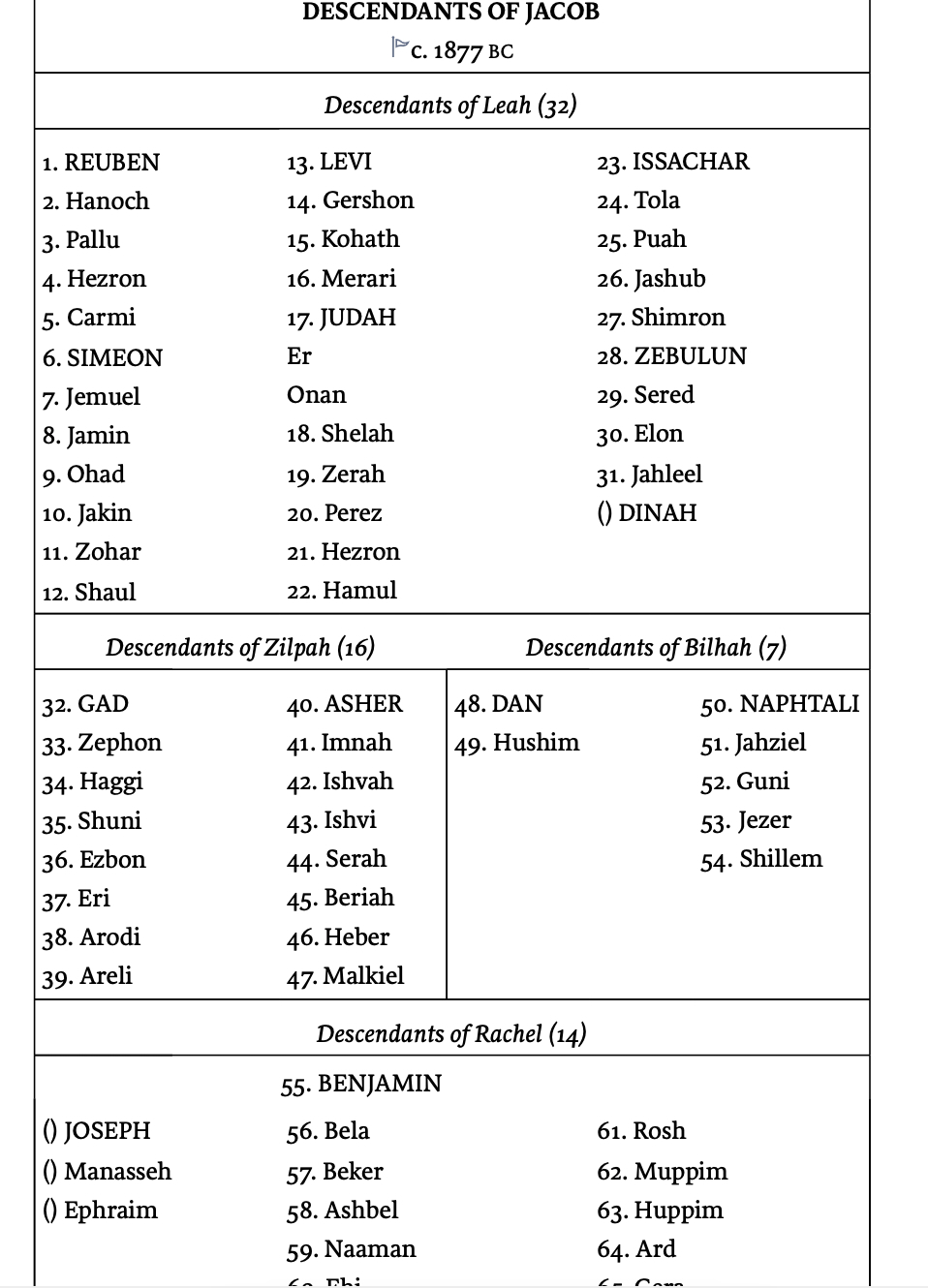
The caravan noted in this chapter will make up 70 in Jacob’s household who will eventually blossom into the nation of Israel (remembering that this is the name God gave Jacob). Moses will revisit this in setting up the bondage period in Exodus 1:5, then review it at the end of his life in Deuteronomy 10:22, while Stephen in Acts 7:14 follows the Greek Old Testament (and Dead Sea scrolls) for the number 75. There are any number of ways to account for the slight disparity in numbers–like asking who was counted or omitted among the sons’ families or Joseph’s sons’ families or how many daughters besides Dinah Jacob had (37:35). The point of this chapter is to emphasize, one last time, the genealogical importance of a family central to the explanation of how the nation of Israel was formed and how the Messianic line was being formed, too. What else might we observe?  

Worship was the first order of business (1-4). The evolution of Jacob’s faith was such that he was compelled to offer sacrifice when he came to the significant place of Beersheba, where his father had built an altar (26:24-25). God reveals Himself to Jacob there and reassures him that this move to Egypt was in accordance with His will. He pledges His presence to Jacob and tells him of the peaceful future that awaited him. Though some of the variables in this situation differ from what we will encounter today, may it be suggested that worship still is powerful and transforming today. God, through His Word, is still revealing Himself to us today and reassures us with His promises and helps us see that our future will be punctuated by eternal peace. 

God’s foreknowledge was demonstrated and His promises fulfilled (5-27). In Genesis 15:13-14, God told Abraham that this was going to happen. Now, about 200 years later, it is occurring. Don’t miss that God tells Jacob’s grandfather, “Know for certain…” (15:13). Repeatedly, the Bible highlights that God keeps His promises (Josh. 21:43-45; 1 Ki. 8:56; 2 Cor. 1:20). 

Truly, God’s promise to Abraham was now being fulfilled (8-27).It is interesting to read what undoubtedly is Egyptian confirmation of the Genesis account of Jacob’s family’s travel from Canaan to Egypt. Wilkinson writes, “A scene depicted on the tomb of Chnumhotep, the near relative and successor of Osirtasen I., at Beni-hassan, represents a company of immigrants, apparently Shemitic in their origin, entering Egypt with their goods, as well as women and children, borne upon asses. Without affirming that this was the Egyptian version of the descent of Israel into Egypt, it may serve as a striking illustration of that event” (‘Ancient Egyptians,’ vol. i. p. 480, ed. 1878; et al). Just one generation after it was only Abraham, Sarah, and Isaac, 70-plus people, enumerated in this paragraph, are filing into Goshen. 

Once again, we are indebted to James Smith for his masterful charts. He gives a summary of the household of Jacob which settles in Egypt in the land of Goshen.

Screenshot

God provided a land of plenty for them to flourish in (28-34). While Canaan is called the land flowing with milk and honey and the destined possession of Jacob’s descendants, what a mark of God’s goodness to provide a place for them to burgeon into a people so numerous that Moses writes, “But the sons of Israel were fruitful and increased greatly, and multiplied, and became exceedingly mighty, so that the land was filled with them” (Ex. 1:7; cf. Ex. 1:12, 20). Goshen was that sector of Egypt where Joseph’s family is given to tend their vast herds of livestock. While we do not know exactly where Goshen is today, we do have clues. Jamie Banister says, “Clues to Goshen’s location are based on the description of the region, seemingly close to the Nile River, and the mention of Pithom and Rameses (Exod 1:11) as supply cities built by the forced labor of the Israelites who were living in Goshen. The general consensus is that Goshen was somewhere along the eastern part of the Nile Delta, probably in or near the Wadi Tumilat, a fertile valley connecting the Nile Delta east to Lake Timsah” (Barry, ed., Lexham Bib. Dict., np.). 

Does it not make us think of God’s goodness, giving every good and perfect gift (Js. 1:17)? Even in time of famine, His children have all they need to fulfill God’s purpose. That does not mean that following God always brings about material prosperity; we know from the whole of Scripture that it may bring tribulation (John 16:33). Yet, we do know God is at work to fulfill His purpose through those of us who serve and follow Him (Rom. 8:28). 

There is a foreshadowing of trouble to come is implied (34). There is a footnote at the end of the chapter, foreboding future events. Shepherds are loathsome to the Egyptians. That was the occupation of this family, and it would be of their descendants. At this time, the Pharaoh’s feelings of indebtedness to Joseph are recent, profound, and strong. But, later, it would not be the case (Ex. 1:8). While there would be additional reasons why later Egyptians would despise Israel (Ex. 1:10), this was an early one. 

Finding Faith On The Mountain Of Curses

Brent Pollard

Dr. Scott Stripling, excavations director for the Associates for Biblical Research (ABR), made a significant biblical archaeology discovery on Mount Ebal in 2020. Stripling found the amulet in the eastern dump pile, and they believe it came from one of the altars that Professor Adam Zerta excavated more than 30 years ago.

Tomographic scans revealed an ancient proto-alphabetic Hebrew inscription on the amulet, hundreds of years older than any other known Hebrew inscription from ancient Israel. Two epigraphers, Pieter Gert van der Veen and Gershon Galil, identified the amulet as a curse tablet (defixio). The word “cursed” appeared ten times in the inscription, as did the tetragrammaton (YHWH) twice.

Mount Ebal is significant in biblical history because it was where curses were pronounced during the covenant ceremony before the Israelites’ entry into Canaan (Deuteronomy 11:26ff). Due to its discovery within the ruins of an altar, Dr. Scott Stripling and Pieter Gert van der Veen propose a link between the discovered amulet and the biblical covenant renewal ceremony (Joshua 8:30ff). Furthermore, Prof. Gershon Galil’s textual analysis suggests that the person who inscribed the amulet was most likely a prominent figure, and the deliberate placement of the talisman near the religious site supports the biblical account of Joshua’s altar’s historical accuracy.

What is the significance of this? The consensus is that Israel entered Canaan around 1250 BC or in the 13th century BC. (Metych) Scholars have long assumed that they had no written language when they arrived in Canaan. Furthermore, scholars believe that the Hebrews only wrote their Scriptures once imprisoned in Babylon or even the Persian or Greek eras. Consequently, scholars think that various cultures influenced a substantial portion of the concepts presented in Scripture. (e.g., Noah of Genesis vs. Utnapishtim of The Epic of Gilgamesh).

However, this Ebal inscription predates the pottery discovered in the 2010s, dating back to the end of the First Temple period 2,710 years ago. (Staff) The engraving on Ebal is at least three hundred years older. And, despite being written in a proto-alphabetic script, the message indicates that those who placed the amulet there were YHWH worshippers. YHWH is God’s covenant name, which He taught Moses when He tasked the latter with leading His people out of Egypt (Exodus 3.14). And now we have proof that people in Joshua’s time could write.

There is also the implication that the Exodus may have occurred earlier than previously believed. The Pharaoh Merneptah created a victory stele discovered in Thebes in 1896. (Kettley) Merneptah claimed to have defeated the nomadic people “Israel” in his campaigns in Canaan on the stele. Merneptah was a little-known pharaoh who ruled from 1213 to 1203 BC.

Suppose Israel was already present in the early 13th century BC. Could we not deduce from the evidence atop Ebal that these “nomads” against whom Merneptah fought were not a people devoid of civilization and culture? Why would Merneptah boast about his victory over them if they weren’t fearsome and capable of mounting a defense? Some believe that Merneptah’s father, Rameses II, ruled Egypt during the Exodus. If true, though I am skeptical, Merneptah may have wanted to boost his image following his father’s failure.

I am mindful of the warning from the Hebrews’ writer that “It is a terrifying thing to fall into the hands of the living God” (Hebrews 10.31 NASB1995). Even so, I don’t think I have ever been happier to read about God’s curses. It may be one of the few times that you can build your faith when you read: “Cursed, cursed, cursed—cursed by the God YHWH. You will die cursed. Cursed, you will surely die. Cursed by YHWH— cursed, cursed, cursed.” (Eliyahu Berkowitz)

Works Cited

Metych, Michele, editor. “Canaan | Definition, Map, History, and Facts.” Encyclopedia Britannica, 14 Apr. 2023, www.britannica.com/place/Canaan-historical-region-Middle-East.

Staff, JPost. com. “2,700 Year Old Hebrew Inscription Uncovered in City of David.” The Jerusalem Post | JPost.com, 18 Aug. 2013, www.jpost.com/features/in-thespotlight/ancient-engraved-earthenware-discovered-in-city-of-david-323438.

Kettley, Sebastian. “Merneptah Stele: How This 3,200-year Artefact Could Prove Bible RIGHT.” Express.co.uk, 26 May 2020, www.express.co.uk/news/science/1285868/Merneptah-Stele-Israel-artefact-ancient-Egypt-Pharaoh-Merneptah.

Eliyahu Berkowitz, Adam. “‘Curse’ Text on Ancient Amulet Could Change Way Scholars Read Bible.” The Jerusalem Post – Christian World, 24 Mar. 2022, www.jpost.com/christianworld/article-702243.

Further Reading

Sudilovsky, Judith. “Researchers Decipher Oldest Known Hebrew Inscription on ‘cursed’ Tablet.” The Jerusalem Post | JPost.com, 24 Mar. 2022, www.jpost.com/archaeology/article-702271.

Siegel-Itzkovich, Judy. “Ancient Tablet Found on Mount Ebal Predates Known Hebrew Inscriptions.” The Jerusalem Post | JPost.com, 14 May 2023, www.jpost.com/archaeology/article-743039.

Fred Baur

Thursday’s Column: Learning From Lehman

bwilsons

Braden Wilson

It was 2008, just 20 days shy of his 90th birthday, when Fred Baur died. On the way to the funeral home, his kids decided to stop at a nearby Walgreens to pick up some salty snacks. They debated for a bit, should it be sour cream and onion, cheddar cheese maybe? Larry and his siblings finally decided on Original. 

You see, Fred adored his kids, but his passion was snacks. His accomplishments included a variety of frying oils and freeze-dried ice cream. 

Fred was an American organic Chemist that had received both his masters and PhD at The Ohio State University, and it was 1966 when P&G came calling. Evidently, in the 1960s, there was a problem with the packaging and shipping of potato chips. By the time the consumer would pick up potato chips at a store, well, they were merely in pieces. This is where P&G thought Fred could help solve this problem. 

After two years of experimentation, Fred developed a chip of dried potato flakes, added a bunch of unpronounceable ingredients, and cut them into thin hyperbolic paraboloids. With this shape, Fred could neatly stack his chips into his vacuum sealed tube. 

By this time, you know that I am referring to Fred’s invention of Pringles, but the story doesn’t end there. Fred still wasn’t done with his invention. 

There were problems:

First and foremost, they tasted like sawdust, so Fred spent another 2 years to improve the taste. Then, another issue. Frito-Lay sent lawyers because they said Fred’s chips weren’t potato chips at all because they were just 42% potato. 

After some time and haggling, they decided to call them potato crisps. 

Fred persevered.

He gave birth to an iconic brand that many of us still enjoy today. Through years of experimentation, development, and disappointments, lawyers-at one point P&G wanted to trash the idea. 

But Fred persevered. 

He was able to see his brand break 100 million in sales. He was able to see it break 500 million in sales. However, he wasn’t there in 2011 when P&G sold Pringles for almost 2.5 Billion Dollars. 

That brings us back to 2008 when Fred’s children showed up to the funeral home with the Original flavored can of pringles. Fred’s wish was to have his ashes be placed in a Pringles can when he passed. 

Fred got his wish.

As great as this story is, we wouldn’t have this story if it wasn’t for Fred’s perseverance. And as great as Fred’s perseverance was, we have so many examples of greater perseverance in the Bible. 

Consider Joshua, Job, Jeremiah, Nehemiah and our greatest example of perseverance, Jesus. These are just a few of the many examples the Bible gives us. 

Two points I want to quickly make about Perseverance, and the lesson is yours. 

Number 1. WE HAVE A NEED FOR PERSEVERANCE.

It’s not a matter of if, but when…Christians Will Face Tribulations in Life. Jesus says in John 16:33, “These things I have spoken to you, that in Me you may have peace. In the world you will have tribulation; but be of good cheer, I have overcome the world.” 

Christ never promised us that this life would be a bed of roses. The Gospel never said we’d go to Heaven on “flowery beds of ease.” Rather, we are promised that we shall have hardships and tribulations in this life, especially if we are faithful Children of God.

Only those who persevere receive the reward. Revelation 2:10-11 tells us, “ Do not fear any of those things which you are about to suffer. Indeed, the devil is about to throw some of you into prison, that you may be tested, and you will have tribulation ten days. Be faithful until death, and I will give you the crown of life.”

Number 2. PERSEVERANCE IS DEVELOPED IN TRIBULATION.

Romans 8: 18-28 can be summarized as this: Viewed in faith, tribulation is a friend rather than an enemy. I don’t know a lot of adversity that is necessarily fun, but we can learn from it, and we can grow from it. 

In Deuteronomy 8, the Israelites failed to see the benefits of their trials. 

In Numbers, we see there was an Exodus of over one Million Israelites. 

We later see that only two Persevered and reached the promised land. 

In 1 Corinthians and Hebrews, Paul admonishes us not to imitate the Israelites.

Rather than complain, rejoice in God’s work in your life. 

Difficulties and trials would not normally be considered an occasion for joy but think about James and Paul and how they exhort us to look beyond the immediate pain and discomforts of trials to the lasting effect they have on the character of the Christian. 

It is the development of our character, that should cause us to rejoice in adversity. Always remember who wins in the end. 

We all have mountains to climb and sometimes holes to dig ourselves out of. Perhaps you want to begin to persevere and put on the armor of God through Baptism. There is no better time than now. Perhaps you’ve been baptized, and you’re currently trying so hard to climb the mountain that you’re on and you’ve had setbacks. We would love to help you reach the peak. 

JETHRO

Monday’s Column: Neal At The Cross

pollard

Neal Pollard

Jethro is one of my favorite Old Testament people. His efforts in Exodus 18 seem to be what he’s remembered most for. Yet, he is quite an impressive person from the time we meet him in the beginning of the book of Exodus.

  • Jethro was an appreciative man (Ex. 2:20). Moses met Jethro’s family after fleeing from the Pharaoh’s wrath following Moses’ murder of an Egyptian taskmaster. Moses helps Jethro’s seven daughters by fending off some mischievous shepherds and caring for the man’s sheep and family’s water needs. When Jethro heard of this, he asked his daughters, “Why is it that you have left the man? Call him, that he may eat bread.” Jethro was eager to quickly, tangibly show his thanks for Moses’ kindness.
  • Jethro was a spiritual man (Ex. 2:16; 3:1). One of the first facts we learn about the man is that he is “the priest of Midian.” He likely was the chief representative of the people in religious sacrifice, though it seems that when Moses meets him he has not yet learned who the true and only God is. That realization comes later (Ex. 18:10-11), but his role as spiritual leader is introduced to us from the beginning though with no details of it in the text.
  • Jethro was an accommodating man (Ex. 4:18). When the time came and Moses heeded God’s bidding to confront the Pharaoh, it meant separating himself from his work and living arrangements in Midian. Moses pleaded with his father-in-law, and Jethro made that easy for him, telling him, “Go in peace.” Jacob’s father-in-law had not been so kind. What a contrast in this man who saw the bigger picture and made his son-in-law’s departure that much easier.
  • Jethro was a sensible man (Ex. 18). This is the quality of the man about which we have heard most. Jethro’s appeal to Moses’ common sense, to get help from the people in judging the people, has served as a role model in spiritual leadership for centuries. Jethro could see the effect of the old, broken system on both Moses and the people. He sized it up, saying, “The thing that you are doing is not good” (17). But, a sensible man does more than raise the specter of the problem. He offers a solution (19-23), and it works beautifully (24-26).

One of the marvel’s of the Bible’s inspiration is seeing the supporting cast of men and women whose lives crossed the people we know best in Scripture. Moses was perhaps the most prominent figure of Old Testament history, so those whose lives he touched show up at several points. Jethro is one of the most interesting of them all.

pikiwiki_israel_35745_sheep_grazing

PRAISE IDEAS FOR PRAYER

Neal Pollard

Prayer is a very personal exercise, a life built between an individual and God. Thus, these suggestions may of themselves feel intrusive or foreign to some.  However, through the years, I have heard many express some difficulty in knowing how to praise God or what to say in praise to Him when in prayer.  Leah, in naming Judah, was the first to articulate the idea (through his name), “I will praise” (Gen. 29:35).  Moses resolved the same at the head of his song in Exodus 15:2.  The remaining six times the phrase appears, the psalmist pens the words (Ps. 22:22; 35:18; 69:30; 109:30; 145:2; 146:2).  Twice in the Psalms we learn that “praise is becoming” (33:1; 147:1). In fact, it makes little sense to make the case for the importance of praise to anyone who professes a belief in God and has seen His blessings and assistance in his or her life.

Having said all of that, what are some specific things one can praise God for in the exercise of prayer?

  • Praise Him for His attributes (eternality, limitlessness, superlativeness).
  • Praise Him for the wonders of creation (try praying under a starry sky, as the sun is rising, or out in the midst of nature’s beauty—words of praise will flow like water).
  • Praise Him for His blessings.
  • Praise Him for His sovereignty and superiority.
  • Praise Him for His promises.
  • Praise Him for His desire to have relationship with you.
  • Praise Him for His providence.
  • Praise Him for His plan of salvation, giving thought to its component parts.
  • Praise Him for the glorious future He has prepared for you.
  • Praise Him for the victorious work of Christ and the spiritual benefits that brings you.

Obviously, this is just a primer list of ideas.  Contemplate God, His nature, His work, His personality, and you will have an ever-growing, ever-changing, and ever-deepening “praise component” to your prayer life.  It is good to thank Him and petition Him, but take sufficient time to exalt Him by infusing your supplications with praise to Him!  As David urged Asaph and his relatives to proclaim, “For great is the Lord, and greatly to be praised” (1 Chr. 16:25a). Amen!

Neal's Phone_20140906_003