Jesus was teaching around the Sea of Galilee when some Pharisees from Jerusalem saw some of His disciples eating bread with unwashed hands. They considered this ceremonial impurity (Mark 7:1-2). Mark gives a short list of examples of rules the Pharisees inherited from their forefathers and pushed as divine law (3-5). This law-making upsets Jesus considerably. In Mark 7:6-13, Jesus rebukes them for confusing tradition and God’s commandments. They were so in love with their traditions that it actually caused them to violate God’s will.
Then, He uses that episode as a springboard to discuss a related spiritual concern. The central thought was, “The things that proceed out of a man are what defile the man” (15b). The point was probably missed on the crowd because it was missed by the disciples (17). Mark tells us that Jesus was declaring all foods clean (19), but there was a deeper, spiritual point. He makes it plainly when He says, “That which proceeds out of the man, that is what defiles the man. For from within, out of the heart of men, proceed the evil thoughts, fornications, thefts, murders, adulteries, deeds of coveting and wickedness, as well as deceit, sensuality, envy, slander, pride and foolishness. All these evil things proceed from within and defile the man” (20-23).
I wonder how this initially hits the disciples. The Pharisees definitely would not have appreciated it. They considered themselves spiritually superior, but context would suggest they would have been as big offenders as anyone in this. Some of what comes out of the heart that Jesus mentions is “big” enough to make our sin’s “hall of fame” or at least its “all-star” team. Wouldn’t you be quick to put fornication, theft, murder, adultery, and wickedness on the “evil things” list?
But Jesus digs deeper and exposes our hearts further. Look at what makes His “big” list with those other sins: evil thoughts (literally, harmful reasoning), deceit, envy, slander, pride, and foolishness (lack of good judgment). Before we brush these aside, consider some practical application.
What is it when we assume others’ intentions and motives without tangible evidence? What about when we have such a tainted perception of someone that we cannot be civil and peaceable, much less tenderhearted, kind, and forgiving toward them (cf. Eph. 4:32)? What of using opportunities to gossip and slander a brother or sister in Christ? What about the words we say when our pride is wounded or we feel slighted? What about a failure to be discreet about people’s situations we come into the knowledge of?
Scripture tells us how vitally important a good, Christlike attitude is. Philippians uses the word “mind” to admonish proper attitude. A mind fueled by encouragement, love, affection, and compassion lead not only to unity, humility, and high regard for others, but it also reflects the mind of Christ (Phil. 2:1-11). It eliminates grumbling and disputing (Phil. 2:14). It shows us to be above reproach in the middle of a world that lives out the kinds of things Jesus reproves in Mark 7:20-23 (Phil. 2:15).
If I have a heart filled with the kind of “evil things” in Jesus’ Mark seven list, how can I have the right, Christlike attitude He expects me to have? I will likely be biting, sarcastic, bitter, hateful, negative, complaining, and critical. Whatever that says about the object of my bad attitude, it does not excuse me in His eyes. He would tell me I am defiled. That means unclean and unacceptable. To see it that way convicts me to watch my heart so that acidic content does not spill out and hurt my reputation, my relationships, and my Righteous Ruler!
“And when he was come to Jerusalem, he assayed to join himself to the disciples: and they were all afraid of him, not believing that he was a disciple. But Barnabas took him, and brought him to the apostles, and declared unto them how he had seen the Lord in the way, and that he had spoken to him, and how at Damascus he had preached boldly in the name of Jesus. And he was with them going in and going out at Jerusalem, preaching boldly in the name of the Lord” – Acts 9:26-29a
In 1984 the Chicago Cubs hired Jim Frey as manager. During spring training, while inspecting his new team, Frey saw a young infielder named Ryne Sandberg hitting hard groundball after hard groundball to shortstop. Another word for a groundball to shortstop, no matter how hard hit, is an out.
So Frey took aside the 24-year-old, whom the Cubs had received as a throw-in two years earlier from the Phillies, who projected him as nothing more than a backup. The manager’s message was: You’ve got the size; you’ve got the ability; drive the ball! When you get that inside fastball, don’t ground out; knock it over the left-field fence.
It worked: That year Sandberg won the National League’s Most Valuable Player award. By the time he had retired, he had hit more home runs than any other second baseman in major league history. And when he was inducted into the National Baseball Hall of Fame, the highest honor afforded any baseball player, and this for a guy deemed expendable by the team who drafted him, Sandberg invited as his special guest to the ceremony his old manager, Jim Frey.
What a difference a word of encouragement can make!
This is the difference we see Barnabas making for Saul. The church in Jerusalem, which Saul had persecuted, is afraid of him when he comes and tries to join them. But Barnabas, who had credibility with the church and the apostles, takes him to the leadership and vouches for what Saul had done by preaching boldly in the name of Jesus. And what a difference it made for the future of the church!
Why did Barnabas react differently than others in the Jerusalem church? I think Barnabas saw the same potential that the Lord saw in Saul, whom He had appointed as his chosen vessel to take the gospel to the Gentiles (Acts 9:15). Barnabas saw not what Saul had been but what he could be.
It’s not a coincidence that later we see Saul, by then known as Paul, offering encouragement to his son in the faith, Timothy (2 Timothy 1). All of us can think of examples of people who have encouraged us in our Christian walk, and because of that we are strengthened to encourage others.
Here’s a challenge: Who is one person in your congregation who you could encourage to do more for the Lord? You’ve got to be intentional in doing this, or it tends to never happen. And you need a deadline; I challenge you to reach out in some way to encourage them in the next week.
“But godliness with contentment is great gain” (1 Timothy 6.6 ESV).
Recently, the battery of our 2014 Chevrolet Impala died while I sat in the local hospital’s parking lot. Of course, we did not realize that it was “just” the battery at the time. The problem seemed worse. As my dad and I were in a difficult situation, stranded in the hospital parking lot, we had the car towed to our local mechanic. Luckily we thought to facilitate everything through our local auto insurance agent, including our car rental. That choice certainly made things smoother. While our mechanic repaired our Impala, we rented a 2020 Toyota Corolla. I will be honest. I really liked the Corolla. I was a little disappointed when the mechanic called to let us know we could pick up our car.
Isn’t that odd? There is nothing wrong with the 2014 Impala. Cosmetically, it looks good. It has low mileage. It is like one of those mythic cars that little old ladies only drove to church on Sunday. Yet, the Corolla had cool little bells and whistles. An alarm sounded if I drifted over the middle line or the line on the shoulder. (I heard that sound a lot, taking the many curves as I went over the mountain. It can be hard not to approach the middle or shoulder of the road when the road is curvier than it is straight.) The rental also had some driver-assist feature coupled with the cruise control that turned the wheel according to the road surface marking detected by its radar. Consequently, it handled curves well and had a good fuel economy. The only “negative’ was that road noise seemed more significant in this lighter automobile.
Here is the question. From whence did my sudden discontentment arise? It is not as if there is a need for a new automobile. Yet, driving a new car for a few days made me feel like I was missing out on something. It may be, too, that I was subconsciously acknowledging my desire to change something (anything) in my life. However, the problem with that thinking is that it reflects a lack of gratitude for my current blessings. Were I to go and buy a 2021 Corolla tomorrow, my happiness would be short-lived. Those elated feelings might last a few months or a year, but the pleasure would fade. What’s worse is that I would end up making myself more miserable by saddling myself with new debt as I paid off the car over several years. Indeed, discontentment is not a problem solved by material gain.
Our emotions are complex. Indulging the lust of the eyes and flesh and the boastful pride of life may act as a placebo, obscuring the underlying problem. Still, there is no cure for discontentment besides gratitude and acceptance. As Paul reminds us, God supplies our every need (Philippians 4.19). Thus, we should be content with food and covering (1 Timothy 6.8). Should God bless us with more, it is a sign He expects more from us (Luke 12.48). And we are to be looking out for the interests of others (Philippians 2.4). Therefore, “while we have opportunity, let us do good to all people, and especially to those who are of the household of the faith” (Galatians 6.10 NASB1995).
When you realize you are a citizen of another country and have your provisions as you make your way home, you, too, will feel contentment. It will certainly give you greater peace of mind. Then comes the realization that salvation and a loaf of bread are worth more than all the gold in Fort Knox. Yes, “godliness with contentment is great gain.”
It will make congregations forsake God’s command to practice church discipline, especially in the age of Facebook and Instagram. It will disrupt, cancel, and in other ways impact congregational plans, faced with something that has killed .0004% of the world’s population. It will cause congregations to abandon the biblical position on any number of things that accommodates the cultural point of view. But, biblically speaking, what is particularly the fear of the devil, mankind, or things of this earth?
F-AITHLESS. You’ll find fear and faith contrasted in Scripture (Mat. 14:31; Mark 4:40; Heb. 11:23). Jesus rebukes a fear which hinders faith more than anyone. When we are driven by fear rather than faith, we confess that we believe in something more than we believe in God. Fear is completely understandable, something the Bible’s greatest heroes felt. But, they overcame their fear of men and even the devil by a greater faith in God’s power. The generation of Israel Moses led were the poster children of fear (Num. 14:9), yet what does the writer of Hebrews diagnose as the root cause of their punishment and rejection? “Unbelief” (3:19).
E-PIDEMIC. Have you noticed how quickly and widely fear spreads? The spies sent to Canaan came back afraid and they transmitted it to the whole nation almost immediately (Num. 13:31-33; 14:1ff). The devil has plenty of channels to transmit fear, from traditional to social media. But even pulpits, private meetings, and informal discussions can fan the flames of fear. Fear plays to our flesh, and the voice of fear travels at light speed.
A-MPLIFYING. Have you ever suffered from economic, relationship, occupational, or spiritual problems? Lie still in your bed at night (or wake up in the middle of the night) and those fears grow exponentially. Like worry, fear is often greater than the problem. It’s why the devil finds it a useful tool in his warfare (cf. Rev. 2:10; 21:8–“cowardly” is the word “afraid” in Mark 4:40; 2 Tim. 1:7). The enemy looks bigger and scarier than it is, but giving in to fear can make it seem gigantic.
R-ASH. Jesus makes this clear during His earthly ministry. He says, “Do not fear those who kill the body but are unable to kill the soul; but rather fear Him who is able to destroy both soul and body in hell” (Mat. 10:28). The analogy is definitely disturbing. There are physical and spiritual entities out there with the power to take our lives. We can be so quick to respond to them by retreating or withdrawing. But if the fear of those things replaces or supplants the fear that belongs rightfully only to God, we are in big trouble.
These, are fearful times! Who doesn’t wrestle with fear? It seems that Jesus did (Luke 22:44; Heb. 5:7). God understands we’ll struggle with fear (Psa. 103:14). But His lovingkindness and compassion are “on those who fear Him” (Psa. 103:11,13,17). There is more Kingdom work to do than ever! There are numerous obstacles, but let’s not get in our own way through fear!
Quite possibly one of the most difficult passages to read is 1 Samuel 15:3. In this verse God commands the Israelites to kill the Amalekites and He specifically says, “kill both man and woman, child and infant, ox and sheep, camel and donkey.” This verse is used by many to discredit the Bible and mock those that believe in a “God that murders babies.”
At first glance, this verse appears to be morally wrong. Did God really command the Israelites to commit infanticide? If He did, why would we serve a God like that? Why take the time to pursue a relationship with God knowing that He shed innocent blood? Doesn’t Proverbs 6:17 say that God “hates hands that shed innocent blood?” Maybe God’s a hypocrite and there’s a double standard. Maybe God doesn’t really love His creation. Maybe we serve a God that isn’t as pure and holy as He claims to be. Or maybe there’s a reason why God gave this command.
1 Samuel 15:3 can be better understood if we recognize several important facts.
The Context. In order to properly handle God’s Word, we can’t just pick a verse and read it at face value. So it is important that we read the context. Verse two shows us that the Amalekites attacked Israel on their journey out of Egypt. In return God promised to one day utterly destroy the nation (Deut. 25:17-19). From the moment the Amalekites chose to fight the nation of Israel, their fate was sealed…but not immediately. Exodus 17:8-16 records the events that took place and God says, “the Lord will have war with Amalek from generation to generation.” 1 Samuel 15:3 is God keeping His word.
Biblical and secular history. The Amalekites were recorded as being ruthless and cruel. They would actively search for pregnant women and kill their babies before killing the mother. In raids they would kill women, children, and everything else. They killed for sport and they raided places for fun. They didn’t fight other nations trying to protect themselves or their land, they just enjoyed slaughtering people and taking their stuff. The Amalekites were known for their cruelty, but also their hate for the Israelites. History also reveals that the Amalekites required that any and every living offspring was to avenge any nation or people that attacked them. This is seen with the Israelites in scripture. For 300 years the people of Israel fought with them. “Generation after generation” experienced war with the Amalekites. 300 years God let the murdering of His own chosen people to happen.
Why did God let them do this for so long? Well, why did God save Rahab? Or tell Noah to warn the sinful people about the flood? Why did God promise not to destroy a city if there were just ten righteous people in it? Why did God send prophet after prophet to warn the Israelites of their sin? Why did God allow His own creation to spit on, mock and crucify His only Son? Because God is a God of mercy and second chances. The Amalekites were given 300 years to repent, but 1 Samuel 15:3 is the result of their lack of repentance. God warned them what would happen, and there had to be punishment for sin.
But what about the innocent children and babies? Do you think God knew their future and what they would eventually become? God would never destroy a person that wanted to be saved. God wants everyone to come to repentance. 300 years of children and not a single one came to God and asked for repentance. God knows a whole lot more than we do. He has a perfect knowledge of the past, present and future. Since the culture of the Amalekites demanded that their offspring continue to murder and raid, the killing of the Israelites never ceased. If only a select group were killed, the problem would persist in the future as it had in the past.
God cannot sin, and in His infinite knowledge He gave a command that was without sin. A sinful nation that refused to acknowledge God had to face the consequences. On the judgement day there will be many people who are punished because of their sin. God in His mercy has given us a way to be saved, but it is up to each individual to make the decision that will ultimately lead to either torment or salvation. God is patient and loving, but He is also holy and righteous in His judgment.
We don’t typically associate salvation with death. Normally the opposite is true! In the New Testament salvation normally describes forgiveness of sins (Acts 4.12, for example). Escaping spiritual death is how the word is primarily used. The exception to this rule is fascinating and sobering.
Human instinct compels us to avoid unpleasantness, suffering, and death. When faced with danger or difficulty, our default response is avoidance at all cost. This was a great temptation for many in the early church.
Peter wrote to Christians who were about to face some awful hardships. He encouraged them by promising salvation, but it was a hard message to swallow. In the following examples, Peter used “salvation” to mean something different (it would have been understood to mean this because of context):
I Peter 1.5 – Death
I Peter 1.8ff – Death
I Peter 2.2ff – Death
How is death the same thing as salvation? For those who were suffering and stayed faithful, death was the ultimate salvation. For those whose lives were upended because of persecution, being with God forever was salvation. For those who lost their family members, salvation meant reunion. The ultimate result of faith is eternal life with God.
How do we view difficulty? Do we compromise faith to avoid suffering? At worst, suffering leads to death. At best, suffering leads to death. Nothing can slow a faithful Christian down! We have salvation in this life (guilt does not weigh us down), and the end of this life is salvation. We have an awesome God.
Kathy’s article two weeks ago really got me thinking. Since I’ve leaving home I’ve frequently thought, “I wish I knew this when I was younger.” I know this is something everyone’s experienced! While it’s nice to have the knowledge, it’s quite frustrating. I could have saved myself from so much heartache, embarrassment, anger, regret and pain.
Sometimes I feel like I don’t have any wisdom to offer since I’m still in my early 20’s and I’m not a mom (unless you consider Bear to be my child, because I do #dogmom). But I’ve often thought about things I wish I knew growing up and about what I could’ve done differently.
Here’s what I would tell myself:
Your parents are more than likely trying their best. I am ashamed to say that I was maybe 20 when I realized that my parents are people, too. They have…
In many cases the battles that wage inside of us are never seen by others. The Bible, however, gives us a few clues as to what might be going on inside our hearts.
A cheerful disposition can be the sign of a healthy heart according to Proverbs 15:13. Sometimes our appearance can show the darkness that has crept in.
Consider the following verses,
“And the LORD had regard for Abel and his offering, but for Cain and his offering he had no regard. So Cain was very angry, and his face fell. The LORD said to Cain, “Why are you angry, and why has your face fallen?” (Gen. 4.5-6).
God already knew what was in Cain’s heart, but notice how He tells Cain the outward signs of his inward struggles.
He’s angry and his countenance had fallen. In the following verses Cain ends up killing his own brother because that darkness had taken over.
God knows the heart. He knows every aspect of the heart.
In 1 Kings 12, Jeroboam has just become king over the Northern tribe of Israel. In the Southern kingdom they had the capital of Jerusalem where all the Israelites in that region would gather to sacrifice to the Lord. The Bible indicates to us the very plans that Jeroboam said in the “privacy” of his heart. He built his own place of worship and foolishly stood those golden calves up for his new kingdom to worship.
Jesus proves once again that He’s the son of God by reading the hearts of many individuals in the New Testament (Luke 16:15).
May we never forget that we serve a God who can read our hearts. There are things we can hide from every human on earth, but certainly not God. Let’s also never forget that we don’t have the ability to read hearts and attempting to do so is to pretend to be something other than human.
Our hens are good layers, even when molting and during bitter cold temperatures. Now that Spring and warmer temperatures are here, they are averaging an egg per day per chicken. But getting into the head (brain?) of a chicken is an impossible task. Many times, we have no idea why they do what they do. Their habits down to their individual decisions defy explanation. The hens have three nesting boxes, but many months ago they all decided they preferred just one. They all use it. Occasionally, you can find all four eggs neatly nestled together in one pile. More often, you will find that one of them has done her own thing. We have found eggs under the roost, at their feed trough, or in some stray, lone position. I need to post a game camera inside to solve mysteries like this.
What I do know is that none of them are acting out of a rational, intelligent decision to act out of step with the crowd. They are just being odd and quirky. There’s neither rhyme nor reason.
All of us, by intelligent design, are social creatures (Gen. 2:18; Ecc. 4:9-12). Whoever makes up our circle, however small or large it is, we do not typically like to be at odds with or stand out from them. At school, at work, wherever our social life takes us, we do not usually crave to speak or act in a way that ostracizes ourselves.
However, there are times when following the guidance of God and His Word will put us at odds with the world. Describing the sacrificial life we are called to as Christians, Paul writes, “Do not be conformed to this world, but be transformed by the renewal of your mind, that by testing you may discern what is the will of God, what is good and acceptable and perfect” (Rom. 12:2, ESV). Using the faculty of intellectual perception (mind, BDAG 680), which has been “renewed” (caused to become new and different, with the implication of becoming superior, LN 593), we use the filter of God’s Word to understand what is morally good, acceptable to God, and meeting His highest standard. If we are asked or pressured to do something by “the crowd” that does not pass this test, we cannot comply. Even though we dislike their disapproval, even if it makes us uncomfortable, even if it means potential sacrifice and suffering, and even if it means isolation and ostracism, we make the choice to stand alone. It is more important for us to know and to help others to know God’s will on the matter than to blend in with the group in doing what violates His will.
Few of us want to be seen as odd and strange, but Scripture warns that it can happen. Peter writes, “For the time that is past suffices for doing what the Gentiles want to do, living in sensuality, passions, drunkenness, orgies, drinking parties, and lawless idolatry.With respect to this they are surprised when you do not join them in the same flood of debauchery, and they malign you; but they will give account to him who is ready to judge the living and the dead” (1 Pet. 4:3-5). We may bear the scorn of the crowd on occasion, but we are more concerned about the judgment. There, the number of those unprepared to stand before Him will be much greater than those who are ready. Let’s always be more concerned with what He thinks about our conduct!
A lot of you do not know this about me but I grew up on a dairy farm. Holstein cows were a part of every day of my life up until about five or six years ago.
I have milked, showed, studied, and researched cows for years and invested so much time, effort and even money into cows. I can answer almost any question and have a deep conversation at any moment and can be confident in my answers when it comes to a Holstein cow… who won the show, who owns it, where it came from, her genetics.
The thing is… cows are no longer part of my life. I still have all that knowledge that worked so hard for, but it is basically useless in my everyday life.
Most people I deal with today would think I was crazy and probably take offense if I came up and asked what they thought about the rump and legs on that cow.
The need for that knowledge faded away just like every other earthly thing will and does for each of us.
I am sure we all have things in our life that seemed so important at one time and that we have moved on from. It faded away and was not near as important as we thought it was. Things of this earth will always fade away at some point.
God, Jesus, and the Bible does not fade away and never will!
1 Peter 1:4 tells us that God has given us an inheritance that is incorruptible and undefiled and that does not fade away. It is reserved in heaven for each of us because of the blood that Jesus shed for us. We should have the same knowledge and confidence in the Bible and about Jesus that we have about our hobby or job or whatever else it is that consumes our time and know that it will never become useless. If anything, it should get more and more important in our lives.
We should be able to have:
-Have a conversation about Jesus and not be nervous -Be confident in answering questions about the Bible -Quote scripture and passages from heart just as we can the facts about our hobby or job and whatever interest we have that consumes us on a daily basis.
1 Peter 3:15 says, “But sanctify the Lord God in your hearts, and always be ready to give a defense to everyone who asks you a reason for the hope that is in you, with meekness and fear;” God has given us everything we need to be prepared to win souls AND to save our own soul. 2 Timothy 3:16-17 tells us, “All Scripture is given by inspiration of God, and is profitable for doctrine, for reproof, for correction, for instruction in righteousness, that the man of God may be complete, thoroughly equipped for every good work.”
We need that same knowledge, passion, and fire for studying the Word of God and being the “workman” that we are for our hobbies and earthly things. Being able to teach anyone at any time about Jesus and have ready answers for them. There are people out there that want to hear about Jesus. We need to be ready and able to talk to them, teach them and most importantly be an example to them. Remember: ““Study to show thyself approved unto God, a workman who does not need to be ashamed, rightly dividing the word of truth” (2 Tim. 2:15).
– Are you the worker God wants you to be?
– Are you ready to use the tools He has given you? The Bible, your abilities and talents
– Are you ready to put in the time and effort that you need to to be the Christian that
God wants you to be? To study and learn from something that will never fade away or become useless.
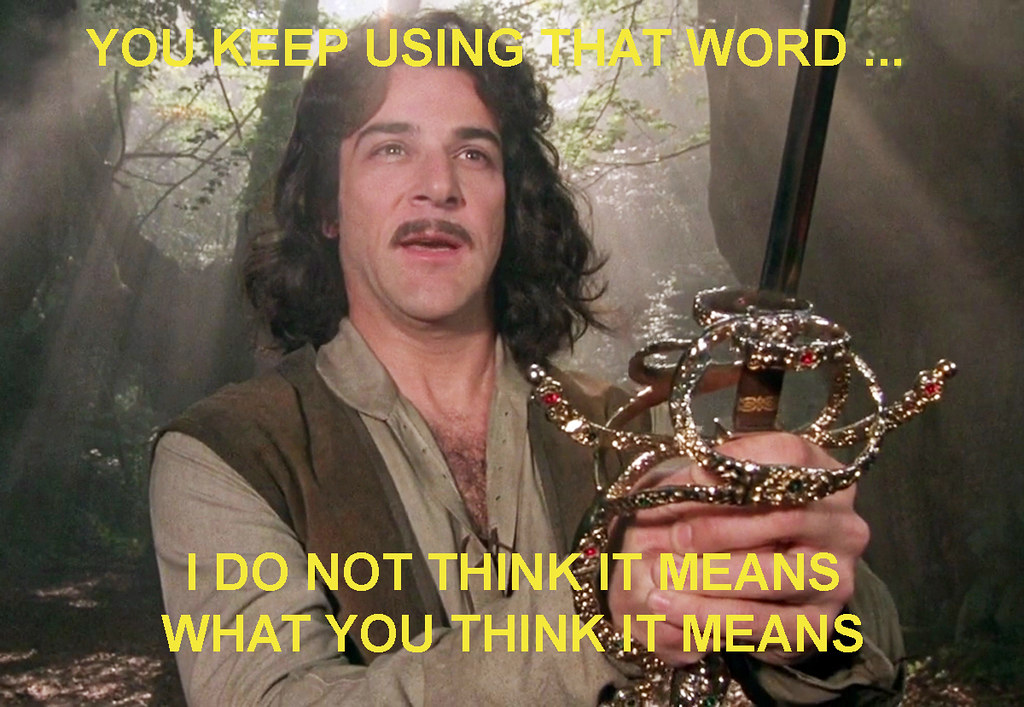
In The Princess Bride, one character questions another for the latter’s repeated use of a word telling him that he did not think that word meant what the one using it thought it meant. I have run into a little bit of that myself recently with the odd usage of the word “wholesome.” I grew up when “wholesome” described something good for the body, mind, or spirit. The folks at Lexico dot-com have my back on this one:
“Conducive to or suggestive of good health and physical well-being.”
1.1 “Conducive to or characterized by moral well-being.” 1
However, for current usage, it sometimes helps to consult a tertiary source like Urban Dictionary dot-com. Anyone can define a word, and users vote for the meanings they think are best. User, 265daysofpatandspongebob, provided the most current and popular user-contributed definition of “wholesome.”
“An embodiment of the following: self-less, considerate, sweet, compassionate, thoughtful, generous, genuine, doesn’t talk trash about other people,”2
Yes, I realize that the grammar is not perfect, but that is not the point. Somehow people have come to associate this adjective with the result of having been nurtured by the wholesome. For example, it would be hard to be selfless without wholesome influences. A secondary definition offered by another contributor was essentially something or someone bringing a smile to another’s face.3 Finally, there was the usage I had encountered. The fourth most popular submission asserted that something wholesome expressed love and affection, not lewdness.4
While I can appreciate that people realize that lewdness is not a virtue, not all love and affection are “wholesome.” The forum in which I encountered this word recently was about a story of a young adult who took in a runaway teen. Sadly, the young woman previously traded her body for a place to stay and assumed her new caretaker would desire the same type of “payment.” To his credit, he told her that she had value other than just her body and deserved good treatment with no strings attached. Those who are saying that the story was wholesome, I suppose, were expressing surprise that a vehicle of popular culture was not glorifying casual relations, especially between those of about a ten-year age difference. Thus far, the relationship presented is platonic. Perceptions of the story’s “wholesomeness” among audience members may change if a romance develops between the adult and the teen, even if the former waits to pursue romantic feelings until the latter reaches what the West considers the age of majority.
While I would prefer people to react this way because of moral instruction, I fear it stems more from the self-righteousness associated with political correctness. In other words, it has more to do with #MeToo than God said. After finally understanding how people are using “wholesome,” I thought of how I’ve previously seen the word used by other forum members in the past. The very first time I encountered this odd definition of “wholesome” was in a story with a fantasy setting. A woman befriends a female dragon. The dragon assumes a human form and lives with the woman, and takes care of her like a maid. The dragon acts smitten with the human, but the human has no romantic interest. But with the addition of other dragons who take up residence with the human, the setting assumes the form of a non-traditional family. Like the other story, I referenced, the relationship is platonic. However, the LGBTQ+ community lifted it as a positive example of the gay lifestyle. Commentators talked about how “wholesome” it was. Again, the idea was that it highlighted love and affection without lewdness. Hence, making it more acceptable to the “straights” in the audience.
It seems religious instruction is as lacking as English education today. If newspeak continues replacing our language, we might see other words perverted to accommodate meanings wordsmiths never intended for them. I am mindful of the warning from God as given by His prophet, Isaiah.
“Woe to those who call evil good, and good evil; Who substitute darkness for light and light for darkness; Who substitute bitter for sweet and sweet for bitter!” (Isaiah 5.20 NASB1995)
In the interim, take the time to teach the young people in your life what is wholesome. Let them know that being wholesome requires more than the absence of lewdness, causing others to smile, or remaining selfless. To be wholesome means you surround yourself with makes you a better, more moral person. The only thing capable of doing this is Christ, the Word, and the church.
Works Cited
1 “WHOLESOME: Definition of WHOLESOME by Oxford Dictionary on Lexico.com Also Meaning of WHOLESOME.” Lexico Dictionaries | English, Lexico Dictionaries, www.lexico.com/definition/wholesome.
Have you ever seen those little rocking horses that little kids ride? They hop on and rock back and forth, but they never go anywhere. There’s a whole lot of motion and work put in, but there’s never any progress made. Just like we don’t sit in a rocking chair to go somewhere, we need to understand how to work towards growth and maturity in our faith and knowledge.
We can work towards growing as Christians, but if we aren’t studying properly, or have the wrong mindset, our work and effort will never produce the outcome we are looking for. 2 Peter 3:18 tells us to “grow in the grace and knowledge of our Lord and Savior Jesus Christ. To him be the glory both now and to the day of eternity.” We are told by Peter through inspiration from God to “grow” and this isn’t a suggestion. It’s an imperative we are commanded to obey.
If you’re like me, this seems like a general command that can be overwhelming. If we want to grow a garden we have to do several things in order to be successful. We have to prepare the soil (no rocks or weeds) in order to give the plants what they need to grow and produce. There’s maintenance work to be done once the plants begin to grow. Keep weeds from choking out the plants, and make sure they are watered. Keep animals and bugs from destroying the plants. Make sure they get enough sunlight. And depending on the type of plant we will need to trim and cut excess leaves and stems to help it produce more produce (see what I did there?). Having a garden takes time, effort and patience.
Gardens don’t just magically appear. But there are some rare exceptions. I was burning some old clothes and furniture last year and I decided to throw some spoiled corn in the fire. When summer came around guess what I had sprouting out of my fire pit? Stalks of corn! And I got a great harvest of about 9 kernels. I ate them and it was pretty good! As Christians we will grow to a point without having to work too hard. We can learn from the lessons we hear at church, we can grow from what our parents teach us, but there will come a time when that won’t be enough. The corn in my fire pit only grew so much before it started turning brown. Turns out the roots were only surface deep because there was a sheet of metal keeping them from growing deeper. This in turn affected the produce that came from the plant. Hopefully as Christians we want to produce more than 9 kernels, and in order to grow properly we need put in the work.
Peter tells us that as Christians we must increase in grace (Eph. 2:8-9; Col. 3:16; 2 Pt. 1:2), grow in knowledge (Eph. 4:15; Col. 1:10, 2:19; 1 Pt. 2:2), and be motivated by a desire to glorify Christ (2 Pt. 3:18).
Our effort should produce results. In order for this to happen we must know the proper steps to take. We should never be satisfied with our knowledge of scripture. There’s no such thing as knowing too much Bible. We should never settle for the small amount of growth we encounter at services 3 times a week.
In the following fictional scenario, an unnamed extremist country has defeated the United States of America (work with me, there’s a point to this). They established a puppet government and required survivors to pay exorbitant, unreasonable taxes. The country has dealt with oppression under their rule for long enough that rebellions start to take place, but aren’t very successful.
Some are desperate enough (or simply weren’t patriotic to begin with) to work for the state controlled by the enemy. Worse, their job is to force an already oppressed people to pay tributes they can’t afford. The enemy has killed too many Americans. The enemy has humiliated the country – once the global power – in ways that may never be reversed. Any American working for the enemy is a traitor.
Imagine we have two different individuals in this dystopia: one is a freedom fighter, dedicated to overthrowing the enemy, the other is a traitor (and fair game for the freedom fighters). Both of them somehow find God, follow His word, and end up working together in a congregation of dedicated followers. The freedom fighter would kill the traitor, except for something that changed his mind forever: Jesus. The traitor would abuse and absolutely ruin his own people before Jesus.
If this seems far-fetched, consider that two of Jesus’ disciples were Matthew (a tax collector for the Romans and a traitor in the eyes of Jewish people) and Simon the Zealot (a freedom fighter sworn to kill people like Matthew). Their political and social views were radically different, but Jesus brought adjustments to their world views that changed them forever. They were no longer a freedom fighter and tax collector, but followers of Jesus (see Acts 1.12-14).
While there aren’t likely too many Christians with national animosity at that level, we aren’t strangers to the political division that affects every aspect of our lives. You may have even seen it play out in your church. We have focused too much on politics!
Many with good intentions (that includes me) have even said something like, “We should be able to get along, Republican and Democrat, if we’re in the same church.” That’s technically true, but misses the point.
We are not republicans or democrats (or any other political party, for those outside of the States). Our identity is not tied to a political party. We are Christians. Our leader is Jesus, our country is Heaven, our flag is His church. Yes, we live in our own countries and must be good citizens (Romans 13). Yes, we’re going to have differing viewpoints on social issues.
We have to stop blurring the line between our political parties and our faith! On both sides of the political aisle is immorality and incompetence. Christianity is beautiful because it shifts our primary allegiance and focus to God, not government. It’s a new allegiance that allowed former traitors and freedom fighters to work together for a greater cause!
If someone asks us to describe our world view and our first thought is political preference, we’re wrong. We will only have unity and peace when God is our common king. We can say that He is already, but our actions confirm or deny that claim. If God is our king, we will be good citizens (Romans 13.1-7). If God is our king, we will love each other deeply (I Peter 1.22). If God is our king, our morality/worldview/outlook will come from His word and not from our preferred political party (principle found in I Peter 1.14-19; Romans 14; Acts 1.13; John 18.36). I struggle with this. Many of us do. We have to be Christians before anything else, and remember that our primary allegiance is to God!
Listen! That’s how Jesus starts His lesson in Mark 4:3. He has just stepped out onto a boat so that He could speak to the large crowd that had gathered to hear Him. This was a very special sermon. Jesus is going to give the secret to all of His parables by telling a unique parable about the farmer who goes out to sow on the various kinds of ground. When Jesus said “Listen!” He was talking to a specific kind of person.
He wasn’t interested in the one who would hear His words and then fall away later when called to stand up for their faith. He wasn’t looking for the one who would hear His words and then foolishly decide that this world had more to offer.
Jesus said “listen!” because He knew that some would hear His words and those words would change their lives. They would live out His teachings. They would become those lamps He would later discuss later in the chapter. Those who truly listened to this specific sermon and took it to heart would bear fruit. It’s humbling to think that some only believe they’ve listened to Jesus, but on the last day will find out that they only thought they listened (verse 25).
Are we listening to the Savior? One way Jesus tells us we can know if we and others are listening is by looking at the fruit being planted. This section of scripture is a great reminder that there are many who will not hear the Lord and His life-changing and life-saving message, but there are also those out there in our communities who are willing and waiting for us to share Him with them.
“Outlook” is one’s point of view or general attitude about life. It’s really the way one looks out at the world and sees it. Your outlook may be colored by a lot of things going on in the world right now. It’s easy to let the negative, scary, and discouraging events cloud our view. Are there some proactive measures we can take to improve that picture? Yes!
Invest in someone. Perhaps no one should have had a harder time keeping positive than the apostle Paul. Read all that he suffered and endured (2 Cor. 11:23-33). He repeatedly labored under the threat of danger (1 Cor. 15:30) and death (cf. 2 Tim. 4:6). Yet, he exuded positivity (Phil. 4:13,19; 2 Cor. 9:8). Surely one reason was Paul’s knack for investing in others. He mentored Timothy (1 Tim. 1:2; 2 Tim. 1:2), Titus (Ti. 1:4), and Onesimus (Phile. 10). He spent time nurturing and developing churches like Corinth (1 Cor. 4:14-15) and Thessalonica (1 Th. 2:7-8, 11). He was willing to run the risk of being disappointed by the people he invested in (2 Tim. 4:10). For every Demas, there was a Luke (2 Tim. 4:11). There is someone who needs to benefit from your wisdom, maturity, experience, and understanding. Seek them out and help them, for their sake but also for yours.
Clarify your purpose. It is easy to reduce our view of this life to a daily grind we find ourselves working at. We can get lost in our routine, not unlike Martha whose outlook was distorted by hers (Luke 10:41). Being organized and fulfilling our responsibilities are vital, but what can help restore joy and meaning to all of it is regularly remembering why we engage in it all. Marriage, parenting, friendships, occupation, education, daily Christian living, church membership, and personal growth all serve a deeper purpose. Paul’s advice to slaves with earthly masters has broader application: “Whatever you do, do your work heartily, as for the Lord rather than for men, knowing that from the Lord you will receive the reward of the inheritance. It is the Lord Christ whom you serve” (Col. 3:23-24).
Reduce media consumption. If you constantly monitor news and current events, you will stay discouraged and fearful. The media has always thrived on reporting on the worst events happening, and it seems there is more and more of it to report. The same kind of thing can happen with too much social media consumption. Polarizing, inflammatory posts and reactions can form a black cloud over you pretty quickly. When Paul urges us to ponder things that cause pleasure and delight (Phil. 4:8), I’m pretty sure he wasn’t thinking of anything like what the media is churning out.
Increase personal interaction. Technology has steadily pushed so many toward isolation and disconnection. The pandemic forced this tendency further. Those monitoring the news cycle du jour (see previous point) retreat into virtual bunkers of suspicion against people of different colors, nationalities, and political persuasions. They become impersonal caricatures, grotesquely exaggerated and larger than life. How do you break through resulting prejudices? The Lord’s way was to be in people’s lives. Engage them. Listen to their stories. Grow empathy. Understand their hurts, fears, and needs. Realize their humanity and remind yourself how profoundly and infinitely God loves each and every one of them (John 3:16; 1 Tim. 2:4). People can be broken, full of dysfunction, and even prickly, but we will brighten our outlook when we get out of our shells and into their lives.
Focus on encouragement. Several times, I heard the late gospel preacher, George Bailey, say, “A man wrapped up in himself makes a pretty small package.” I have yet to meet a self-absorbed person who is happy with what they’ve filled themselves with. We’re just not wired that way. Paul’s central focus with the Philippians is on how to think right, their mindset and attitude. He urges placing others above self and looking out for others’ interests (Phil. 2:3-4). It’s amazing how God has wired us. When we find people to uplift and build up, it improves our own outlook. There are countless folks all around you who are struggling with their outlook. Compliment, express appreciation for, and gratefully acknowledge them. It’s a godly thing to do, but a side-effect will be what it does for you!
Look up and look ahead. Though not every time, usually my dampened outlook can be attributed to not only looking too much at this world and myself but also by not looking more at the world to come and God. It’s harder to focus on what’s invisible to the naked eye, but it’s crucial. Paul reminds us, “for we walk by faith, not by sight” (2 Cor. 5:7). Spend more time in God’s throne room and His inspired library. Deepen your dependency upon Him. In doing so, focus more intensely on His promise of the world to come (John 14:1-3; 2 Pet. 3:13; Rev. 21:1ff). This life is temporary. Eternity is–well–eternal! Looking up, you’ll see the all-knowing, all-powerful, ever-present, and all-loving God (Psa. 139:1-18). Looking ahead, you’ll see victory (1 John 5:4).
I think we’ll always struggle with dark days and discouragement. Did Paul? Read 2 Corinthians and 2 Timothy. But, he and other Bible writers give us a laundry list of ways to combat these and make them temporary. David was walking through the valley of the shadow of death, but He could still see divine presence, divine comfort, divine provision, divine blessings, and divine promise (Psa. 23:4-6). So can we! It just may take adjusting the way we look out at the world.
Minimalism is a term often associated with the arts and humanities. It can also be a term used to describe a lack of decoration or adornment in design. One notes that minimalism features everywhere today, from webpage design to people’s desire to live in tiny houses. Despite sounding like a paradox, I suppose one can make the case that minimalism is the ultimate form of refinement. Even Leonardo DaVinci allegedly proclaimed that simplicity is the art of sophistication.
Since minimalism appears to be beloved, why is it so difficult to share the simple Gospel to a postmodern world? What could be more straightforward than the Gospel of Jesus Christ? Paul distilled it to three topics about Christ, even though each of those topics can fill volumes of their own accord (cf. 1 Corinthians 15.1ff). Yes, the Gospel, at its core, is the death, burial, and resurrection of Jesus Christ. Our salvation is contingent on symbolically reenacting His death, burial, and resurrection (Romans 6.3-6). Indeed, the salvation plan is so simple that kids sing a song detailing those steps to the tune of “Pop Goes the Weasel.”
Yet, when it comes to religion, complex human emotion appears to trump Divine simplicity. Ask Naaman. When told how to cure his leprosy, Naaman balked. The prophet told him to dip himself seven times in the Jordan River to cleanse his leprosy. Naaman stormed off.
“Behold, I thought, ‘He will surely come out to me and stand and call on the name of the Lord his God, and wave his hand over the place and cure the leper.’ Are not Abanah and Pharpar, the rivers of Damascus, better than all the waters of Israel? Could I not wash in them and be clean?” (2 Kings 5.11-12 NASB1995)
Luckily, Naaman’s wise servants were not turned away by simplicity. They reminded their master he would do any great thing to cure his leprosy. So, why not just wash? (2 Kings 5.13) Similarly, I do not think that telling people to be immersed so that they can wash away sins and call on the Lord’s name (Acts 22.16) is a matter of complexity. It is simple. The stumbling block for those unwilling to obey is typically prejudices and fears. They think another way is better. Perhaps, this other way was taught to them by a dear, departed loved one. They do not want to “condemn” their relative by obeying the Gospel.
However, obeying the Gospel is not an act of judgment. In rendering obedience, I am demonstrating a good conscience before God (1 Peter 3.21). We allow God to take care of the implications and trust, like Abram, “Shall not the Judge of all the earth deal justly?” (Genesis 18.25 NASB1995). No doubt, if that loved one who taught us something differently had the opportunity to be preached the simple Gospel of Jesus Christ, then they would have obeyed too.
If time permitted, I could expound upon other areas in which human emotion overly complicates the minimalism of God’s Divine plan for items such as worship. Yet, as with the virtue I am extolling, minimalism, it is best to keep this focused and concise. We should not be surprised that God would make the most critical things, like salvation, simple for us all to understand. Minimalism, experts remind us, is user-friendly and accessible. That is why we like it so. And it is also why God, the Master Designer, set up things so that the simplest among us can gain wisdom from it (Psalm 19.7).
Indeed, what can be more minimalist than the Gospel?

























 The Preacher Pollard Blog