You Are Not The Owner

Carl Pollard

We live in a world that constantly says, “This is mine.” My time, my money, and my plans! 

But Scripture confronts that mentality head on. The Christian life begins with a fundamental shift in identity. You’re not an owner, you’re a steward.

A steward is someone entrusted with what belongs to another. And according to the Bible, everything we have, everything we are, and everything we will ever touch ultimately belongs to God. “The earth is the Lord’s and the fullness thereof” (Psalm 24:1). That includes me and you.

You Are a Steward of Your Life

You don’t belong to yourself. “You are not your own, for you were bought with a price” (1 Corinthians 6:19–20) That’s one of the hardest teachings in Scripture. Your life isn’t self-owned, it’s God-owned. You have been purchased by the blood of Christ. That means your life isn’t about personal fulfillment, comfort, or even your own plans. Out focus is now on faithful management of what God has entrusted to us. We should be asking, “What does the Owner want me to do with this?”

You Are a Steward of Your Time

Time is one of the clearest tests of stewardship because once it’s spent, it’s gone. “Making the best use of the time, because the days are evil” (Ephesians 5:16). Every day is a deposit from God into your account. You don’t control how much you get, but you do control how you spend it. We often say, “I don’t have time,” but the truth is, we all have the same 24 hours. We just have misplaced priorities. How much of our time is given to God’s Word? Prayer? Serving others? Teaching our families? And how much is consumed by distraction?

You Are a Steward of Your Money

Jesus talked about money more than almost any other topic because it reveals what we truly value. “As for the rich in this present age… they are to do good, to be rich in good works, to be generous and ready to share” (1 Timothy 6:17–18). Your money is not ultimately yours, but it is a tool entrusted to you by God.

You Are a Steward of Your Abilities

Every talent, skill, and opportunity you have is given by God. “As each has received a gift, use it to serve one another, as good stewards of God’s varied grace” (1 Peter 4:10). God gave you abilities so you could serve, not to be selfish. Some have the ability to teach, others to encourage, or lead, or give. And all are expected to use what they’ve been given.

You Will Give an Account

This is what makes stewardship so serious.“Moreover, it is required of stewards that they be found faithful” (1 Corinthians 4:2). One day, every Christian will stand before God and give an account of how they managed what He entrusted to them. Jesus told parables about this (Matthew 25:14–30). The master returns. The servants report. And faithfulness is rewarded.

You are not the owner of your life, you are the manager of it. And one day, the Owner is coming back. If God evaluated your stewardship today, your time, your money, your abilities, your life, what would He say “Well done, good and faithful servant”?

Or, “Why did you waste what I gave you?”

Books by the Pollards

A Tiny Spark Snail Mail Club (Kathy Pollard)

9 Kernel Crop

Thursday’s Column: Carlnormous Comments

carl-pic

Carl Pollard

 
Have you ever seen those little rocking horses that little kids ride? They hop on and rock back and forth, but they never go anywhere. There’s a whole lot of motion and work put in, but there’s never any progress made. Just like we don’t sit in a rocking chair to go somewhere, we need to understand how to work towards growth and maturity in our faith and knowledge.

We can work towards growing as Christians, but if we aren’t studying properly, or have the wrong mindset, our work and effort will never produce the outcome we are looking for. 2 Peter 3:18 tells us to “grow in the grace and knowledge of our Lord and Savior Jesus Christ. To him be the glory both now and to the day of eternity.” We are told by Peter through inspiration from God to “grow” and this isn’t a suggestion. It’s an imperative we are commanded to obey.

If you’re like me, this seems like a general command that can be overwhelming. If we want to grow a garden we have to do several things in order to be successful. We have to prepare the soil (no rocks or weeds) in order to give the plants what they need to grow and produce. There’s maintenance work to be done once the plants begin to grow. Keep weeds from choking out the plants, and make sure they are watered. Keep animals and bugs from destroying the plants. Make sure they get enough sunlight. And depending on the type of plant we will need to trim and cut excess leaves and stems to help it produce more produce (see what I did there?). Having a garden takes time, effort and patience.

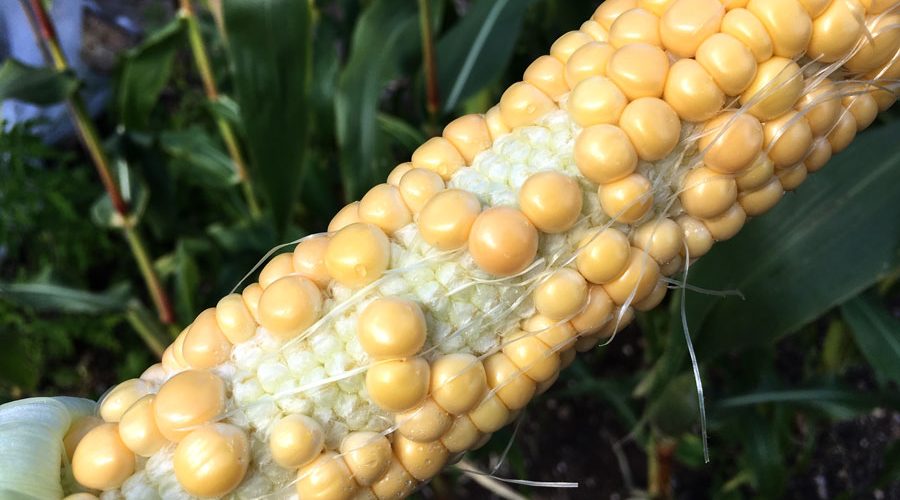
Gardens don’t just magically appear. But there are some rare exceptions. I was burning some old clothes and furniture last year and I decided to throw some spoiled corn in the fire. When summer came around guess what I had sprouting out of my fire pit? Stalks of corn! And I got a great harvest of about 9 kernels. I ate them and it was pretty good! As Christians we will grow to a point without having to work too hard. We can learn from the lessons we hear at church, we can grow from what our parents teach us, but there will come a time when that won’t be enough. The corn in my fire pit only grew so much before it started turning brown. Turns out the roots were only surface deep because there was a sheet of metal keeping them from growing deeper. This in turn affected the produce that came from the plant. Hopefully as Christians we want to produce more than 9 kernels, and in order to grow properly we need put in the work.

Peter tells us that as Christians we must increase in grace (Eph. 2:8-9; Col. 3:16; 2 Pt. 1:2), grow in knowledge (Eph. 4:15; Col. 1:10, 2:19; 1 Pt. 2:2), and be motivated by a desire to glorify Christ (2 Pt. 3:18).

Our effort should produce results. In order for this to happen we must know the proper steps to take. We should never be satisfied with our knowledge of scripture. There’s no such thing as knowing too much Bible. We should never settle for the small amount of growth we encounter at services 3 times a week.

Am I willing to put in the work?