Where is mount Sinai? It’s an important mountain in the Bible but today there’s several different peaks that claim to be the real deal. Let’s dig a little.
In Galatians 4:25, Paul states:
“Mount Sinai is in Arabia.”
Here’s the thing though. 1st century Arabia did not mean the Sinai Peninsula of Egypt. It was the vast area of Arabia Petraea that included:
• Northwest Saudi Arabia
• The land of Midian
Well now, that last one is a juicy detail because Moses actually lived in Midian for decades (Exodus 2–3). If God met Moses “at the mountain of God” while he was in Midian, the most natural place for Sinai to be is near where Moses had been, not hundreds of miles away.
There’s more!
The Bible repeatedly ties Sinai to Midian. Here’s a quick recap:
Moses flees Egypt, then settles in Midian.
God appears to Moses at the mountain of God while shepherding there.
Jethro (a priest of Midian) later visits Israel at Sinai.
If Sinai were deep in the Egyptian Sinai Peninsula, Jethro’s involvement doesn’t make much sense.
If Sinai were in or near Midian (which is in Arabia), the narrative flows nice and cleanly.
For these reasons, and more— many early Jewish and Christian traditions placed Sinai east of the Gulf of Aqaba.
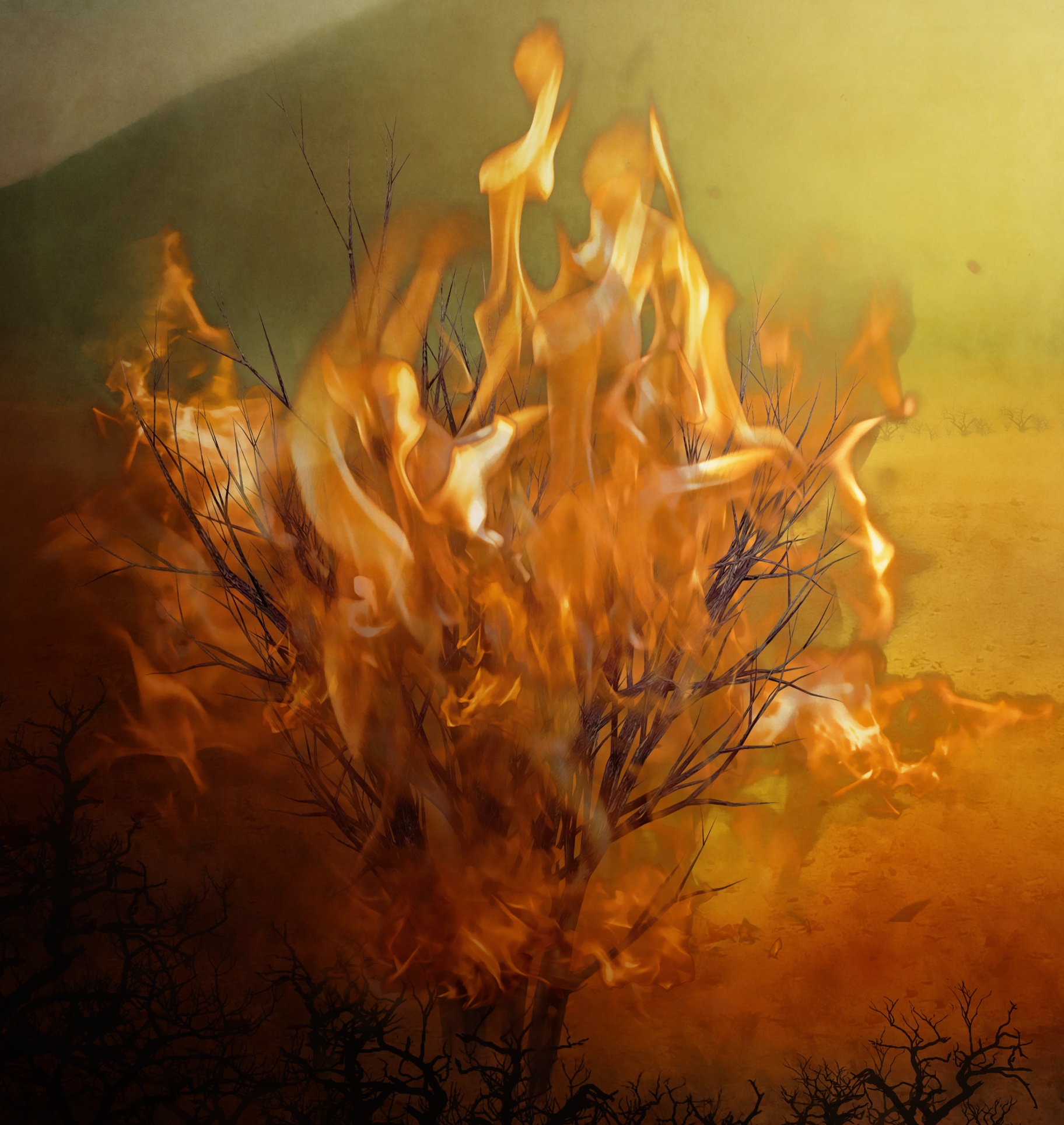
Sinai had some strange things happening on its peak— just read Exodus 19. There’s thunder, lightning, trumpets blasting, and fire. It’s hard to wrap our minds around exactly what was taking place.
With all of that history in mind, there’s a site called Jabal al-Lawz. It’s an odd name but it’s a real interesting Candidate.
This mountain seems to have it all, including:
• A darkened summit
• Nearby ancient stone structures
• Rock art that appears to depict cows
• Large open plains suitable for a massive encampment
Is it the one? Who knows. Seems like a great place to do more investigation though.
A carving on a temple wall shows an animal with a row of vertical plates along its back, sharply resembling a Stegosaurus. Some arguments have been levied against this claim but they’re hardly worth covering as most, upon seeing it, know exactly what’s being depicted. It’s not a porcupine.
Dale Pollard
The Ta Prohm Temple Stegosaurus
Location: Angkor, Cambodia
A carving on a temple wall shows an animal with a row of vertical plates along its back, sharply resembling a Stegosaurus. Some arguments have been levied against this claim but they’re hardly worth covering as most, upon seeing it, know exactly what’s being depicted. It’s not a porcupine.
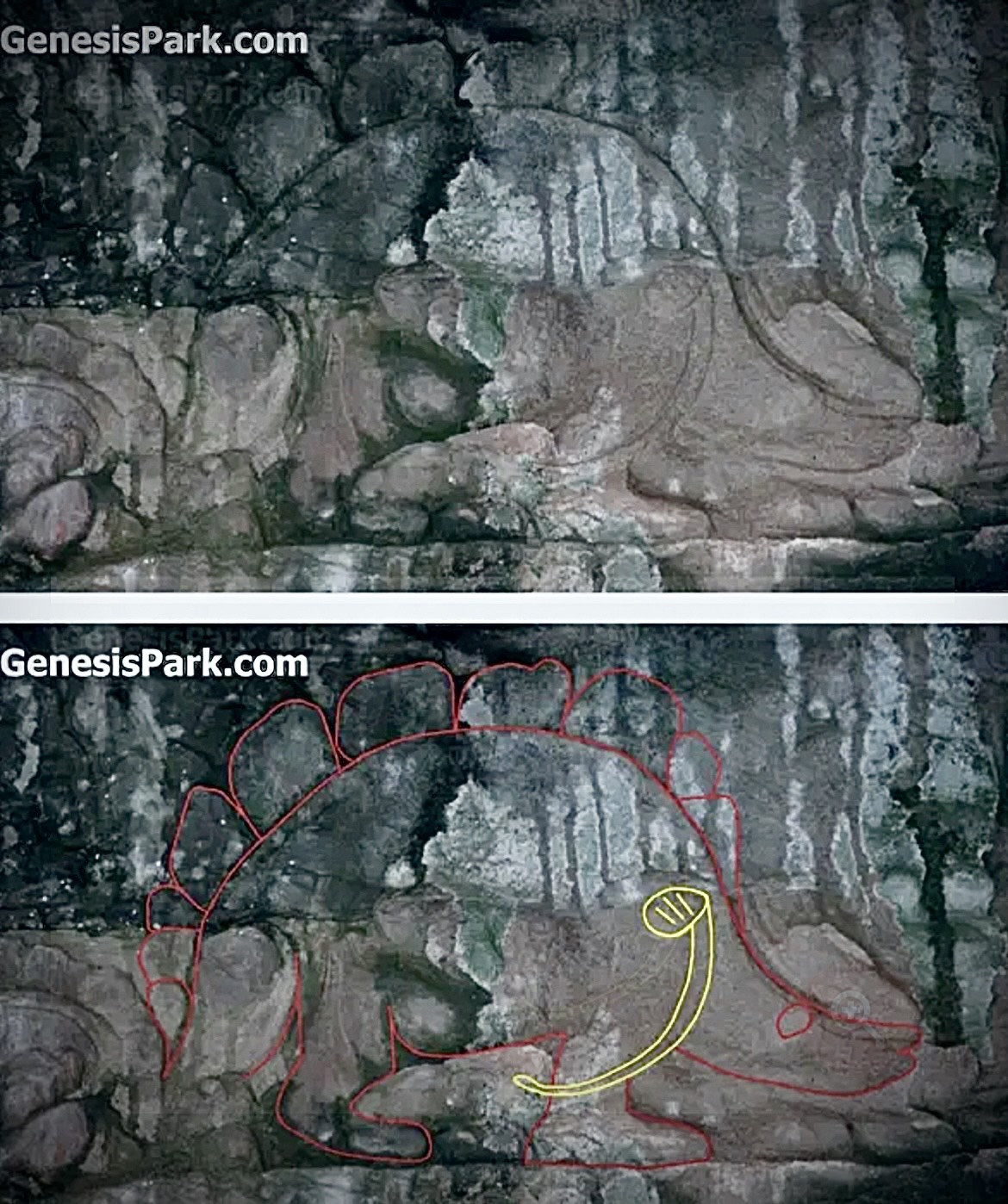
In addition to that well-known stegosaurus carving, the existence of a second, lesser-known relief can be found in the same complex. This carving is larger and more eroded but the features of a stegosaurian dinosaur are clear enough. A bulky body, dorsal plates, and tail are easily made out— along with something else. Interestingly, the head appears elongated and slender in comparison to the first making it more realistic, but it’s what’s on the head and neck that you’ll find amazing.
An unusual feature around the neck shares uncanny similarities to a bridle or harness— suggesting domestication. The work that could (hypothetically) be done with an animal of that size is fascinating to think about. Perhaps it could even explain the massive amounts of stone which were moved to complete the temple it was carved into. Many don’t realize that the volume of stone used at the Angkor Wat complex is greater, proportionally, than even the largest pyramid on Giza plateau in Egypt. But back to the stegosaurus bridle. The evidence is mainly that it mirrors other carvings around Ta Prohm depicting bridles on horses, elephants, and oxen in the same manner.
The Triceratops Rider
Location: Acambaro, Mexico
A clay sculpture depicting a human figure riding a Triceratops was discovered in 1944. This piece is part of a larger collection of around 33,000 ceramic figurines near Acámbaro, Guanajuato, Mexico, by a German man named Waldemar Julsrud.
In the 1950s, Professor Charles Hapgood investigated the site and supported the idea that the artifacts were genuine. Apparently, thermoluminescence dating was done in the 1960s and 1970s (don’t ask me how that works) and the results indicated that the figurines might have a pre-Columbian origin.
Could it be that the mainstream evolutionary timeline is that blatantly false? The author obviously believes that to be the case. Humans and dinosaurs walked the earth at the same time. While some were predators that our ancestors feared (Job 40-41), it seems that some were also tamed and used in a ways not unlike the ox or horse. Could you imagine?
What do you think of when you read or hear of “walking in the truth”? Is it more than worshipping according to the New Testament pattern and baptizing for the remission of sins? What does the epistle of 2 John teach us about this important character trait?
Gary Pollard
II John 3 talks about living in truth and love. John was happy that they were following the truth, but they apparently weren’t following the way of love. We’ve looked at how John defines this love in I John 3, but as a quick refresher: “This is how we know what real love is — Jesus gave his life for us. So we should give our lives for each other. Suppose a believer who is rich enough to have all the necessities of life sees a fellow believer who is poor and does not even have basic needs. What if the rich believer doesn’t help the poor one? Then it is clear that God’s love is not in that person’s heart” (16-17). He uses almost exactly the same formula in II John, which reads like I John if it were condensed to one chapter.
In II John 6 he says, “Loving means living the way he commanded us to live. God’s command is this: that you live a life of love. You heard this command from the beginning.” We won’t have “grace, mercy, and peace from God the Father and his Son” if we aren’t living in both truth and love (3). This lady and her family had the truth thing down, but their love needed some work. John seems to go back and forth between the truth and love theme in this letter.
There’s a warning sandwiched between two “truth” statements. “Be careful! Don’t lose the reward we have worked for. Be careful so that you will receive all of that reward” (8). Be careful about what? “There are many false teachers in the world now,” and, “Everyone must continue to follow only the teaching about Christ. Whoever changes that teaching does not have God” (7 and 9). The teaching about Christ is that he came to Earth and became human (cf. 7).
We may take this for granted and/or may not appreciate its significance. Many gods competed for the hearts of nations, and most of world had a pantheon. Paul said that these gods are actually just demons (I Cor 10.19-20; cf. Deut 32.17, I Enoch 19.1), and there is compelling evidence of certain of these taking different names throughout history. The Egyptian god Thoth was worshipped by the Greeks as Hermes and the Romans as Mercury. Amun (Egypt) was Zeus (Greece) and Jupiter (Rome). Isis (Egypt) was Aphrodite (Greece) and Venus (Rome). Ra (Egypt) was Zeus (Greece), Jupiter (Rome), and Indra (Hindu). Hathor (Egypt) was a fixation for some time over the last couple of centuries, and has also been associated with Aphrodite (Greece) and Venus (Rome).1 This list is far from exhaustive. They’re all just archetypes used by demons to manipulate and derail civilizations.
No god took human form23 and lived a very public life doing good for others in the most selfless possible way. No god was perfectly innocent. But God made himself human, was morally perfect, and sacrificed his physical body before coming back to life. That last action was a promise — we’ll get that too! God becoming human for our sake is the most beautiful narrative ever conceived. God becoming human revealed the Great Mystery to all of humanity for the first time (Eph 3.4-6, Col 4.3): there is a greater power, he wants a relationship with humanity, and he’s coming back to save his family when earth is destroyed.
With this truth in our hearts, God expects us to capitalize on any opportunities we have to show selfless love to our Christian family, and then to all people we encounter.
Don’t save treasures for yourselves here on earth. Moths and rust will destroy them and thieves can break in and steal them. Instead, save your treasures in the heavens, where they cannot be destroyed by moths or rust and where thieves cannot break in and steal them. Your heart will be where your treasure is (Mt 6.19-21).
1 Editors of Encyclopaedia Britannica (2017, October 27). 11 Egyptian Gods and Goddesses. Encyclopedia Britannica. https://www.britannica.com/list/11-egyptian-gods-and-goddesses 2At the very least it’s curious that many polytheistic cultures believed in an incorporeal afterlife. A physical God and a physical resurrection repulsed the Gnostics, who were certainly influenced by Egyptian theology. The Egyptians believed in a non-physical afterlife, as did many or most other religions (sadly, many Christians do, too). While it may or may not be accurate, Enoch claims that demons are the spirits (consciousness) of human/watcher offspring who’ve been relieved of their bodies (15.8-9). If that’s true, it’s at least interesting that most of the cultures they influenced also despised the concept of a physical afterlife. Our God came back to life in a real, physical body and promised us the same. It’s real hope. Their gods are smoke and mirrors and offer no tangible, practical hope. 3I’m not talking about humans whose actions ultimately led their deification, but primordial “gods” considered superior to humanity by the cultures who worship them.
James Smith observes, “Four exhortations to Zion follow the third Servant poem (which he identifies as 50:10-51:8, NP). Each is accompanied by promises designed to lift the spirits of God’s people during the period of their captivity” (OT Survey, 145). The first exhortation, to trust God in adversity, is found in the last several verses of chapter ten, followed by three in this chapter. First, remember their heritage (1-3). Second, listen to divine instruction (4-6). Third, take courage in God’s deliverance (7-8). This is followed by an extended call to God to “awake” and to Jerusalem to “rouse” (9-23). Verses 9-16 have been called a “wake up prayer to God,” while verses 17-23 have been called a “wake up prayer to a drunken woman” (Zion)(Smith, 147). It appears to me that there are three categories of individuals that are the subject of this “Servant song,” looking at past, present, and future. All the way through this section, the central focus is on one individual–The Servant–who is the coming Christ.
Isaiah 51 speaks of the expectation of the righteous (1-8). One is struck with the calls for the upright to act: “listen” (1,7), “look” (1,2), “pay attention” (4), “give ear” (4), “lift up” (6), “fear not” (7), and “be not dismayed” (7). These are calls of encouragement from the Lord. Blessed assurance fills the content of this paragraph. They could remember Abraham and Sarah, who were unlikely candidates for beginning an entire nation (2). They could remember Eden and appreciate what God was capable of, even as they found themselves in waste places, wildernesses, and deserts (3). The reason for their optimism was the character of God, from His law (4) to His deliverance and salvation (5-6,8). It was but for them to be faithful and fearless (7).
Isaiah 51 speaks of the endurance of the Lord (9-16). Isaiah builds upon the righteous character of the Lord in assuring the godly and obedient. This prayer begins with the nation pleading with God to awake, but He declares that He is not only awake but also at work. He is the God of comfort (12), creation (13), capability (14-15), covenant (15,16), and covering (16). He declares who and what He is–“I am” (12,15) and what He has done– “I have” (16, cf. 22). To a people afraid of their enemies and lacking confidence in their deliverance, God reminds them of His limitless ability which aids them and destroys their enemies.
Isaiah 51 speaks of the enfeeblement of the wicked (17-23). The tables are turned, and now God is calling for the spiritually drunk to wake up and sober up. They called on God to wake up, and He proves to them He is never asleep on the job. Instead, they are reeling from drinking the cup of God’s anger due to their rebellion (17). Sin has left the nation weak, aimless, unguided, inconsolable, helpless, and the object of God’s wrath and rejection (18-20). Yet, even in this condition, they are offered hope from God. He offers to take the chalice of reeling and divine anger from their hands and put it in the hands of their tormentors (21-23). Grace even in judgment! Hope even in the wake of their sin!
In the past, the people had seen God deliver them from Egypt (Rahab, 9; see 30:7). In the future, the people would see God deliver them from the Chaldeans (23; see 49:26). In the present, the people should look to the God they had ignored and forsaken, repenting and once again finding their strength and salvation in Him alone. What a timeless message!
Have you ever felt worthless? Or at the very least unimportant?
These are very human thoughts and feelings. It doesn’t take very long in scripture to find numerous examples of how God values the people in his kingdom.
Just a few examples being:
Matthew 10:29-31, ESV “Are not two sparrows sold for a penny? And not one of them will fall to the ground apart from your Father. But even the hairs of your head are all numbered. Fear not, therefore; you are of more value than many sparrows.”
Or Jeremiah 31:3 NASB2020 “The Lord appeared to him long ago, saying, “I have loved you with an everlasting love; Therefore I have drawn you out with kindness.”
And last but not least, Psalm 139:13-14 NIV, NASB “For you created my inmost being; you knit me together in my mother’s womb. I praise you because I am fearfully and wonderfully made; your works are wonderful, I know that full well.”
With that in mind, I want to tell you about a movie I used to watch as a young boy.
The Prince of Egypt is an animated children’s movie that attempts to tell the story of the Exodus. As a kid I just thought it was a good movie and never really understood the biblical aspect of the story. Watching it again with children of my own now gave me a fresh perspective.
Here are the lyrics from one of the musical numbers in the film, and I want you to think about how this might apply to your own life.
THROUGH HEAVEN’S EYES
“A single thread in a tapestry
Though its color brightly shines
Can never see its purpose
In the pattern of the grand design
And the stone that sits on the very top of the mountains mighty face
Does it think it’s more important than the stones that form the base?
So how can you see what your life is worth or where your value lies?
You can never see through the eyes of man.
You must look at your life, Look at your life through heaven’s eyes
A lake of gold in the desert sand Is less than a cool fresh spring
And to one lost sheep, a shepherd boy is greater than the richest king
If a man loses everything he owns, has he truly lost his worth?
Or is it the beginning of a new and brighter birth?
So how do you measure the worth of a man?
In wealth or strength or size? In how much he gained or how much he gave?
The answer will come to him who tries, to look at his life through heaven’s eyes
And that’s why we share all we have with you, Though there’s little to be found
When all you’ve got is nothing, there’s a lot to go around
No life can escape being blown about by the winds of change and chance
And though you never know all the steps, You must learn to join the dance
So how do you judge what a man is worth, By what he builds or buys?
You can never see with your eyes on earth,
Look at your life through heaven’s eyes
Through Heaven’s Eyes: By Stephen Schwartz.
Another way of saying this is that it’s about perspective. We all have a purpose, whether we have found it yet or not. We are made in the image of God. The alpha and the omega, the one who spoke everything, literally everything, into existence. No matter how broken this life becomes nothing in this world can take that away from you.
Don’t count yourself out on any grounds. Just because you can’t see how you are supposed to shine in this brightly colored tapestry of Gods people doesn’t mean you aren’t as important as any other of those threads around you.
Jesus chose the Passover as the memorial that his sacrifice would fulfill. He is the perfect lamb whose blood saves us from death. Israel was protected from the angel of death through the lamb’s blood on their doorpost, and we’re saved from death through the blood of the lamb. Death is the consequence of sin. By saving us from sin, he saves us from death’s permanence. When we say that he saved us from our sins and he saved us from death, we’re saying exactly the same thing. The two are interchangeable. Without sin there is no death. Without forgiveness of those sins, there is no life.
Because of Jesus’s sacrifice and because he came back to life, taking a position at the Father’s right hand as our perfect high priest, he will save us from our own Egypt — this earth. Being saved from death isn’t where the Exodus story ended, right? Israel was also saved from a dysfunctional country. The Jewish people saw this parallel eight centuries before YHWH came to earth as Jesus (Is 65.17, 66.22). They were looking forward to the return of Eden, the perfect creation of the first time — before man had to fight the earth for food, and before woman had to experience pain in childbirth and submission to her husband.
Peter makes the comparison between the first destruction of earth and the second, and quotes Isaiah and Jesus when he says, “But according to his promise, we are waiting for a new heavens and a new earth where only goodness can live” (II Pt 3.13). This new earth does not have the curse God put on this earth when humanity sinned (Rv 22.3; Rom 8.15ff). The wording used II Pt and Rev 21, 22 strongly suggests a literal understanding of this teaching. The use of γης for earth (instead of κοσμος), the use of καινην for new (instead of νεος, though this is only suggestive and not something that stands alone as proof), and the use of παλλιγγενεσια (return to a former state) in Mt 19.28 all point to a literal understanding of this promise.
We can add to this the fact that the word “heaven” is ουρανος — a word that was primarily understood to mean “sky” by Greek speakers from the Classical period on. In its plural form — usually the dative plural ουρανοις or genitive plural ουρανους — it could be the realm of the stars (it also means “skies” when context demands). It was understood to be the place where God lives. Jesus said as much in Mt 6.9, 6.14, and 6.32 (and fifteen other passages, mostly in Matthew). Our ultimate destination is not figurative. No figurative interpretation appears to have existed before the Docetics and other gnostic groups came to prominence in the mid-to-late 1st century.
Salvation is not some intangible platitude or vaguely-defined ethereal existence. How would that produce effective anticipation or hope? It had to make sense to the people it was written to, and it had to use language native to their thinking. If not it wouldn’t have been as powerful.
What better way is there to preach a climactic conclusion than to put a powerful emphasis on God? In these last 20 verses, Moses mentions “the Lord your God” a stunning 15 times (“Lord” 19 total times and “God” 17 total times). He makes a full court press for these travel-worn wanderers to be totally committed to “return” (2), “obey” (2,8,10,17,20), “love” (6,16), “observe” (8,12-14), “keep” (10,16), “turn” (10), “walk” (16), “choose” (19), and “hold fast” (20). This is the divine expectation. He punctuates it with the repeated use of the word “all”–all your heart (2), all I command (2,8), all your heart and all your soul (6,10)!
Yet, in response to their commitment, look at what God would do. He would “restore” (3), “have compassion” (3), “gather” (3,4), “bring” (4,5), “prosper” (5,9), “multiply” (6), “circumcise their hearts” (6), punish their enemies (7-8), “rejoice over you” (9), and “bless” (16). He wanted this for them and their descendants (6, 19).
In the absence of obedience, Moses has repeatedly reminded them of how painful, counterproductive, and defeating life would be. Serving a substitute god would be unfulfilling, and its end would be divine rejection. In the humble practice of obedience, God would bless them beyond their comprehension. Through Moses, God encourages them to see this choice as one they were fully capable of making. In the heart of this chapter, Moses says these commands to obey were not out of reach or too difficult (11-13). It was near to them (14)! They could do this!
So, what’s the bottom line? Much like Joshua will do at the end of his tenure as Israel’s leader, Moses says “choose.” But understand what you are choosing between– “life and prosperity” or “death and adversity” (15), “life and death” (19), and “the blessing and the curse” (19). In case it was not abundantly clear, Moses final word is, “So choose life in order that you may live, you and your descendants, by loving the Lord your God, by obeying His voice, and by holding fast to Him; for this is your life and the length of your days, that you may live in the land which the Lord swore to your fathers, to Abraham, Isaac, and Jacob, to give them” (19b-20). The blessings of choosing God, when summed up, are life, legacy, love, length of days, and a land of promise. While the particulars have changed under Christ, it is only because they are better. They are parallel to these, only superior! We face the same contrasting choices, framed by New Testament writers as the world or the Lord (Js. 4:4; 1 Jn. 2:15-17). It’s really not much of a choice, is it?
The challenge was formidable! The inhabitants still included giants and their fortifications were still high and impregnable (1-2). How would they do it? More to the point, why should they anticipate that it would happen?
The power and promise of God (3-4a,5). He builds on something he has just said, “But you shall remember the Lord your God, for it is He who is giving you power to make wealth, that He may confirm His covenant which He swore to your fathers, as it is this day” (8:18). God would be a consuming fire destroying, subduing and driving the natives out of the land (3-4). They could believe this because God had sworn it with an oath to their forefathers, Abraham, Isaac, and Jacob (5; Gen. 12:7). The ark of the Lord would go ahead of them as they invaded Canaan (Josh. 3:11). Consider the prayer the weeping prophet would pray, thinking back to this moment in history, when his people faced a self-induced crisis (read Jeremiah 32:17-22).
The wickedness of the Canaanites (4-5). God makes a point of it to say that the conquest was not a matter of Israel’s meritorious goodness. He warned against such self-righteousness. He corrects the mindset, stating, “It is not for your righteousness or for the uprightness of your heart that you are going to possess their land, but it is because of the wickedness of these nations that the Lord your God is driving them out before you” (5). Genesis 15:16 had predicted this day would come. Now it was time. Even today, we are saved “not on the basis of deeds which we have done in righteousness, but according to His mercy, by the washing of regeneration and renewing by the Holy Spirit” (Titus 3:5). This should humble us and combat any self-righteousness on our part.
The righteousness of God (6). This is implied by Moses’ three-fold use of “righteousness” (4,5,6), when the people are told it was not because of their righteousness. The word means “the state of doing what is required according to a standard, the state or condition of fairly deciding what is right in a legal case, without prejudice, and the state of not having any sin or its associated guilt, according to a standard” (Swanson, DBL, np). This does not describe man at his best, much less the conduct of Israel from the moment they left Egypt. Instead, God’s faithful character was bringing this conquest about. They needed to never forget that. Through Christ, we are made the righteousness of God through Him (2 Cor. 5:21). We have no basis to establish our own righteousness (Rom. 10:1ff). Isaiah would describe our righteous deeds, at best, as “filthy garments” (64:6).
The intercession of Moses (7-29). What a powerful illustration we have in the bulk of this chapter. Moses reviews how they provoked the Lord to wrath, from Mount Sinai through these 40 years in the wilderness (7-8). They were rebellious against God (7,24). They acted corruptly and turned aside (12). They were stubborn and fit for destruction (13-14). They sinned against God (16). They were wicked (27). They needed to clearly understand this to grasp why they were alive to hear this impassioned sermon. In addition to the character of God already mentioned, there was the righteous intercession of their godly, earthly leader. Moses pleaded with God on their behalf. What did he do?
He fell down before the Lord (18).
He fasted for 40 days and nights (18).
He prayed for Aaron and the people (19-20,26).
He destroyed what offended God (21).
He appealed to God’s goodness and promises (27-29).
Consider how wonderful it is to know that godly people are praying for us. Many times throughout the years, I have bowed my head in meetings with elders where they prayed earnestly on behalf of their sheep who struggled physically, financially, emotionally, and spiritually. This is in addition to their private petitions. What about the godly women, older and younger, whose ministry includes intercessory prayer? How much have we been spared and what floodgates of blessings have been opened to us because of the righteous prayers of others on our behalf (Jas. 5:16)? Thank God for godly Christians who steadfastly pray for their brethren, for you and me (1 Th. 5:17). May we be people who do that for others, too!
There are multiple memory tools–the rule of three, memory palaces, chunking, mnemonics, acronyms, and I am sure there are others I’m forgetting. How many of us have upset and disappointed others, especially loved ones, because of failing to remember something that was important to them? Three times in this chapter, Moses mentions forgetting (11,14,19). Twice, he says to remember (2,18). Yet, the whole chapter centers around the importance of remembering and the danger of forgetting. His most serious warning was that they would forget God and think they did all of it by themselves (12-13,17). Self-reliance would make them forget the One responsible for all their blessings. So Moses warns:
Don’t forget God’s past provision (1-5,14-16). He points them all the way back to Egypt and the exodus from slavery (14), but he repeatedly reminds them of how God had taken care of them in the wilderness these past forty years. There was the manna (3), the durability of their clothes and shoes (4), the protection from scorpions and serpents (15), and the provision of water (15). Without God’s provision, they would neither be free nor alive that very day!
Don’t forget God’s precepts (6, 11). Attached to His gifts, God blesses them with perfect direction. He calls it “commandments” (6), “His ways” (6), “His commandments and His ordinances and His statutes” (11). It contained His covenant (18). Studying each of these synonyms gives aspects of God’s authority and right to govern, and each are conditions for His blessings. Moses has just restated the Ten Commandments for them. His Law was to govern them and aid them in daily life. They would forget it to their own peril!
Don’t forget God’s promises (7-10). God is not simply being a domineering autocrat, who threw His weight around just because He could. Earthly rulers might inevitably act that way, but not the perfect God. God longed to lavish His blessings on them. He wants them to remember these promises He is making: a good land, many waters, valleys and hills, a land producing all sorts of sustaining food, and precious metals. All of it would be abundantly given! If they would remember Him and His Word, they would be blessed beyond anything any of them had experienced.
Don’t forget God’s power (18-20). All of this was possible because of His power (18). If they forgot Him, the power He would use to overthrow their enemies in the conquest would be turned on them. He ends by saying, “Like the nations that the Lord makes to perish before you, so you shall perish; because you would not listen to the voice of the Lord your God” (20). Are you reminded of God’s impartiality? Though Israel was His special, chosen people (7:5), God is eminently fair! Thankfully, through Christ, that impartiality opens the door wide to whosoever will (Acts 10:34-35)!
Memory is a powerful thing! Even those who suffer dementia may retain long past memories. Yet, nothing is worse than choosing to forget or allowing something else to crowd from our minds the very things that must remain firmly in place. Israel stood at the threshold of incredible hope and promise. God wants them to remember the source and respond appropriately. God wants the same of you and me today.
Sumerian culture talks about a ziggurat dubbed “Etemenanki” and it was hailed as the “House of the Foundation of Heaven and Earth.” It was dedicated to Marduk, a serpentine/dragon deity, and the patron deity of Babylon. It was said to have measured three-hundred feet tall and featuring seven stacked levels.
Famed Assyriologist, George Smith (1840-1876), provided a translation of some Sumerian clay tablets and here’s his brief summary of the inscription:
“…we have the anger of the gods at the sin of the world, the place mentioned being Babylon. The building or work is called tazimat or tazimtu, a word meaning strong, and there is a curious relation, lines 9 to 11, that what they built in the day the god destroyed in the night.” (The Chaldean Account of Genesis, 1876, p. 162).
Egypt’s Babel
A portion of the Qur’an makes a few claims that resemble the legendary biblical tower— save a few key differences. In the Islamic story, the event takes place in Egypt and the Pharaoh orders a minister named Haman to build a tower that reaches the heavens.
Mexico’s Babel
Pedro de los Rios, writing sometime before 1565:
“Before the great inundation which took place 4,800 years after the erection of the world, the country of Anahuac was inhabited by giants, all of whom either perished in the inundation or were transformed into fishes, save seven who fled into caverns. When the waters subsided, one of the giants, called Xelhua, surnamed the ‘Architect,’ went to Cholula, where, as a memorial of the Tlaloc which had served for an asylum to himself and his six brethren, he built an artificial hill in the form of a pyramid. He ordered bricks to be made in the province of Tlalmanalco, at the foot of the Sierra of Cecotl, and in order to convey them to Cholula he placed a file of men who passed them from hand to hand. The gods beheld, with wrath, an edifice the top of which was to reach the clouds. Irritated at the daring attempt of Xelhua, they hurled fire on the pyramid. Numbers of the workmen perished. The work was discontinued, and the monument was afterwards dedicated to Quetzalcoatl.” (Mexico as it is and was, 1844, Brantz Mayer, p. 28)
Non-Canonical Coincidences
In the Greek Apocalypse of Baruch (written between the 1st-3rd Cen.) we find a description of the condition of Jerusalem after the sack by Nebuchadnezzar.
The Greek Apocalypse details a vision of Baruch ben Neriah and in it he sees the punishment of the builders of the “tower of strife against God,” which sounds remarkably similar to the Tower of Babel.
Abydenus (a Greek historian of the mid-fourth century B.C.), as quoted by Eusebius, spoke of a great tower at Babylon which was destroyed. The record notes:
“[U]ntil this time all men had used the same speech, but now there was sent upon them a confusion of many and divers tongues”
Josephus, the Jewish historian, quoting from an ancient source, records these words:
“When all men were of one language, some of them built a tower, as if they would thereby ascend up to heaven, but the gods sent storms of wind and overthrew the tower, and gave every one his peculiar language; and for this reason it was that the city was called Babylon”
(Antiquities of the Jews, 1.4.3).
THE TRUTH BEHIND THE TOWER
While we don’t need the extra biblical evidence and anecdotes to prove what God already told us, it’s certainly interesting and faith-building to discover. We shouldn’t forget the main message of His account. When humans are united we’re either powerfully wicked or powerfully righteous. The top of our metaphorical towers will either touch heaven or hell and the end result depends on what we’ve decided to unite under. If Christ is on the banner we fly then we’ll find success. If pride, greed, or any other selfish ambition brings us together— that tower will inevitably fall.
The Birth of Behemoth-Buildings
First to Scrape The Sky:
The first skyscraper was built in Chicago by William LeBaron Jenney in 1885. While that nine story structure no longer stands, many skyscrapers from that time period remain.
King of the Towers:
The Burj Khalia in Dubai is the tallest building in the world— standing at 2,717 feet tall.
Jenney’s “Home Insurance Building” (demolished in 1932 to make room for a larger building)
How important is Abram to the subsequent narrative of the entire Old Testament? From creation to the flood is at least 1656 years, and it is covered in six chapters. Abram’s lifespan is 175 years (25:7), and it is covered in 15 chapters (ch. 11-25)! In the first full chapter, this chapter, we see the development of Abram’s faith.
To say “development” is to point out that it needed to grow and mature. As this chapter and even later circumstances show, Abram wrestles with fear and anxiety when facing intimidation. Yet, God foresaw what his faith could become and chose this man to father the nation through whom His Son would come.
A Commission (1,4-6,8-10). Let’s not dismiss the greatness of Abram’s faith to receive and obey such an incredible charge, a call to leave his homeland for a distant land (1). The commendation of Scripture is, “So Abram went forth as the Lord had spoken to him” (4a). He was 75 years old, and while he would live another century he was at best middle-aged! Abram collected his apparently considerable possessions and the people of his household and traveled toward Canaan. The trek recorded here covers hundreds of miles, with Abram first going northeast well into modern-day Syria before heading southwest into the heart of what would become Israel. However, Abram goes on his own much further south into Egypt because of famine (10). This would prove a stumbling block in his journey of faith.
A Commitment (2-3, 7). God binds Himself with an incredible promise to Abram that requires divine ability to fulfill. There are several components to this promise:
I will make of you a great nation (2).
I will bless you (2).
I will make your name great (2).
I will bless those who bless you (3).
I will curse those who curse you (3).
In you all the families of the earth will be blessed (3).
To your descendants I will give this land (7).
As you can see, there are seven parts to what God promises Abram. Eventually, God will fulfill every one of them even though some would be long after this patriarch’s death. While we see obedient faith on this man’s part, we also see grace and mercy on God’s part through each stage of this mission.
A Concern (11-14). Perhaps it was a lapse of faith that caused Abram to head into Egypt for famine relief (there is no record of God telling him to go down there). His confidence is certainly shaken once he and Sarai get into this pagan territory. Knowing his wife’s beauty, Abram coaches her to mislead any who inquire about her by telling them he was her brother rather than her husband. Technically, they are half-siblings (20:12), but that was not the nature of their relationship. Sure enough, his concern was well-founded. The Egyptians, seeing Sarai, found her “very beautiful” (14).
A Compromise (15-20). Abram’s faith failed him in Egypt. By his influence, Sarai sells the lie. Because of it, Pharaoh takes her into his house (15) and gifts Abram with much livestock and servants (16). The Lord strike’s the pharaoh’s house with plagues, leading him to confront Abram (17-18). Not only did Abram deceive, but he also brought suffering on others and was the proper subject of rebuke from this pagan ruler. Pharaoh says, ““What is this you have done to me? Why did you not tell me that she was your wife? Why did you say, ‘She is my sister,’ so that I took her for my wife? Now then, here is your wife, take her and go” (18-19). God’s providence is still with Abram and Sarai, as they are allowed to leave unharmed and with increased goods (20). God shows grace and favor even when His people fell short.
While these words are written worlds away from where we are today, I think about some unmistakable parallels to our circumstances today. We have been given a commission (Mat. 28:18-19), one requiring faith on our part to follow. Yet, with that comes a divine commitment of help and His presence (Mat. 28:20). We are going out as sheep among wolves (Mat. 10:16), and being frightened and intimidated in carrying out our mission is an ever-present concern (1 Pet. 3:14-15). What we cannot do is compromise our faith! God is counting on us to faithfully represent Him to the world. However, isn’t it wonderful that God extends His grace and mercy when we do fail? This is not a license to give up and stop pursuing our mission! Abram doesn’t stop. Let us be thankful for God’s patience and faithfulness, even when we are not at our best. We can still be people of faith, even if we stumble along the narrow road.
We know little about the treasurer from “Ethiopia,” introduced in Acts 8. How did he come to believe in Judaism? What was his given name? What happened to him after Phillip baptized him into Christ? A study of this enigmatic figure is fascinating.
Did you know that the treasurer’s homeland was known as the “Kingdom of Meroe”? The remnant of the once-powerful Kingdom of Kush ruled over even their Egyptian neighbors for a time. If you recognize the name “Kush,” it is because Noah had a grandson named “Cush” (cf. Genesis 10.6-8; Daniel 11.43). The “Ethiopians” are Cush’s descendants.
The “Kandake” line of queens ruled over Meroe. It is known as “Candace” in English Bible translations. The sequence of queens is likely named Candace, a famous empress who ruled the Kushites during Alexander the Great’s conquest. She was a well-known military general and tactician. According to legend, Alexander refused to invade “Nubia” for fear of being defeated by her.
The Ethiopian eunuch, as treasurer, would overlook an impressive treasury. Meroe was a prosperous kingdom due to her trade with the Romans and African tribes from Africa’s western grasslands. They traded with the Romans for gold and other sub-Saharan products until the third century AD. Meroe maintained prominence after their trade with the Romans declined in the early third century due to her ability to smelt iron. Meroe’s workers’ tools and weapons were sought after by her neighbors. Meroe eventually fell from grace and was conquered by her southern neighbor, Axum. This formerly independent state is now an integral part of Sudan.
Meroe’s inhabitants worshiped Egyptian gods and a few gods of their creation. Someone proselytized people in the region at an unknown point in antiquity. According to the Old Testament book of Jeremiah, Jews were living in lower Egypt just before Judah and Benjamin’s Babylonian captivity (cf. Jeremiah 44.1ff). God foresaw those fleeing south to avoid the Babylonians and warned them against their actions (cf. Jeremiah 42.19ff). The treasurer is an example of someone who converted to Judaism. There remain adherents to Judaism in the region today.
What distance did the treasurer go to worship God? Meroe to Jerusalem was about 3,000 miles round trip. So, the treasurer was devout. And consider that once in Jerusalem, the Old Law prohibited his entry into the Temple proper because he was a eunuch and forbade entry. Thus, his desire to be close to God was strong!
Though we do not know the treasurer’s name, we know some of the Meroitic men’s surnames. Arkinidad, Amanislo, Pakheme, Shorkaror, Teritegas, and Yesbokheamani were some of their names. Such names are foreign to the English-speaking ear. It’s possible that the treasurer’s name sounded strange to Philip as well.
What happened to the Ethiopian treasurer after he became a Christian? The treasurer returned to Meroe and converted Queen Candace and many of his fellow Meroites, according to Irenaeus and Eusebius, two Christian writers of the second century AD. They also stated that the treasurer was a martyr dying in Ceylon after preaching the Gospel throughout Arabia Felix (i.e., Yemen). Though we cannot verify the information of Irenaeus and Eusebius, it is consistent with the character introduced on the sacred page.
Herodotus casually mentions that there were snakes that would fly from Egypt every year from the Sinai wilderness (Herodotus 2.75-76). This may strike fear in the heart of any snake-fearing person, but it sure is interesting. Marco Polo would also write in his travel log about flying venomous “birds” as well as snakes of gigantic proportions as he explored Asia.
The Bible records several strange serpents and one passage in particular is especially fascinating.
In the book of Numbers there’s an account that’s made many readers scratch their heads as they wonder what these fiery serpents are (21:6-9) that God sent to plague the Israelites.
“TheLord sent fiery serpents among the people and they bit the people so that many people died in Israel. So the people came to moses and said “we have sinned because we have spoken against the Lord and you; intercede with the Lord, that He may remove the serpents from us. And Moses interceded for the people. Then the Lord said to Moses make a fiery serpent and set it on a standard, and it shall come about that everyone who is bitten when he looks at it he shall live. And Moses made a bronze serpent and set it on the standard and it came about that if a serpent bit any man, when he looked at the bronze serpent he lived.”
Some commentators have suggested that perhaps the strange description is of a particular kind of venomous snake. Others have made the observation that the Hebrew word for serpent here (Saraph) could be symbolic to indicate their color since it means “burning ones.” Interestingly enough there are bronze colored serpents around today in Australia that are incredibly poisonous. Perhaps there’s something to this based on the Lord’s instruction to Moses to fashion a serpent made of brass. Of course this description could also literally be taken to mean snakes which either breathed fire, or were somehow on fire. God was, after all, punishing a people who had complained of their miraculous meals of manna.
Though the identity of these fiery serpents may always be a mystery, the lessons taught to us through this event are powerful. The connections John will make (Jn. 3.14-15) as well as the Hebrew writer (12.2) focus on the crucifixion and the concept of looking to Jesus for our salvation.
The relationship between belief and action here are also telling. Those Israelites that believed were led by that same belief to look— then were healed. If we believe Jesus can and will heal us of our sins, then that belief must lead us to the water (Act 2.38, Mk. 16.16).
Its blood was the difference in life and death (Exodus 12:13,23)
Its sacrifice was to be commemorated (Exodus 12:14-22,24-27)
Its sacrifice drew reverence and worship from the obedient (Exodus 12:27)
Interestingly, Paul says, “For even Christ our passover is sacrificed for us” (1 Corinthians 5:7). Jesus, as a faithful Jew, had observed the passover throughout His public ministry (John 2:13; 6:4; 11:55), but He knew that the one recorded in Matthew 26 would be different. He told His disciples, “You know that after two days, the Passover is coming, and the Son of Man is to be handed over for crucifixion” (2). On that Passover, He would be sacrificed for us. Jesus of Nazareth, an unblemished (1 Peter 1:18) male (Mark 8:31; 9:31), was killed (Acts 2:23). His blood is applied (Romans 3:25; 5:9; Ephesians 2:13; Hebrews 9:22; 10:19; 12:24; 13:20; Revelation 1:5; 5:9) to the obedient (Hebrews 5:8-9) and is the difference in spiritual life and death (John 6:53-54). As we do every Sunday, this Sunday, which the world recognizes as Easter, we will commemorate the sacrifice of Jesus as part of our weekly worship (Acts 20:7; 1 Corinthians 11:23-29).
Jesus was arrested on Thursday, crucified on Friday, lay buried all day Saturday, and arose on Sunday. Today, New Testament Christians commemorate this sacrifice every Sunday. The unleavened bread represents His body, and the fruit of the vine represents His blood. The God of perfect foreknowledge made these “emblems” part of the Passover feast which Israel celebrated the night they left Egypt, and it predated the first covenant (Exodus 20). The physical passover lamb sacrificed by Israel had significance to them in their generation and it was to be handed down to their descendants. But, God was drawing a picture that night that would be completed the moment His Son said “It is finished,” bowed His head, and gave up His spirit (John 19:30).We celebrate and rejoice because He died, was buried, and rose again! May we never let this sacrifice lose its significance to our past, present, and future.
Neal Pollard
Moses is remembered for his meekness, yet he also is the man who in indignation killed an Egyptian slave driver. He was afraid to lead, but what a leader he was with God’s help. In Exodus three, we see this man who has gone to hide among his father-in-law’s sheep as one who was ready for confrontation. Of course, at times this was good and at times it was not. What did Moses confront?
–Moses confronted his God. Receiving his Great Commission at the burning bush, Moses was introduced to the God who desired to work with him to accomplish some of the greatest feats of the entire Old Testament period. Moses learned just who his God was, a lesson that would continue the rest of his life. –Moses confronted himself.He was a man with a bag of excuses, all of which he apparently pulled out to try and avoid the task God was handing him. He rightly saw his personal inadequacies, but he reluctantly began to see the Moses he could be in God’s omnipotent hand. –Moses confronted his people. He had to go back to his hometown. Many of us would have a hard time being effective in that forum, but Moses had the gall to go. Did he have to face the two Hebrew men whose fight he had tried to break up, men who had either witnessed or at least heard about Moses’ murder? It must have been to go back and face his fellow country men, but he did it. –Moses confronted his enemy.Rarely has an enemy been so formidable as Pharaoh was. His heart was hard to his very end. He was arguably the most powerful man on earth and as stubborn as he was strong. –Moses confronted his faith. Hebrews 11 affirms the greatness of his faith. It was challenged and he did not possess a perfect faith, but inspiration proves that it was exemplary and memorable faith. –Moses confronted his penalty. At the end of his journey with a stubborn and disobedient, yet chosen, people, Moses took too much on himself. He disobeyed God and failed to properly glorify him. Consequently, he was denied the Promise Land. The result of his sin was separation; for him, it was from the physical land of promise. For the disobedient who fail to repent, it will be from the spiritual land of promise. We all confront the fact that our sin has consequences.
Moses was a man who talked to God as friend talks with friend. He was an imperfect man and even occasionally an impetuous man. Yet, he was a successful man in part because of his willingness to confront. May we be so bold!
Sostratos the Cnidian built this world-famous lighthouse in 297 B.C., located on the coast of the island of Pharos (Negev, The Archaeological Encyclopedia of the Holy Land, Rev., 1986: 27). It made the Greek poet Sopater’s list of the original seven wonders of the world. Examined with the other six, this lighthouse seems to have been the only wonder which also served a practical purpose. It would have towered nearly 400 feet above the sea, about forty stories tall. What an imposing figure it would have been, and some, though these claims are mildly disputed, said its light could be seen from as far as 100 miles away on the sea. Its architecture and inscription were rooted in Greek mythology, dedicated to Poseidon and various protectors among the gods. Eventually, it suffered the structural damage associated with aging. Two earthquakes in the fourteenth century damaged it and made it unsafe to explore. It was finally torn down by a sultan in the fifteenth century, who used stones from its ruins for part of the wall of an Egyptian fort that remains to this day. Diving expeditions in the last ten to fifteen years have discovered ruins in the sea that almost certainly include remnants of this famous lighthouse (see also http://www.touregypt.net, http://www.new7wonders.com).
Though it was impressive for a time, this lighthouse suffered the fate inevitable for material things on this earth. The once imposing figure of this lighthouse was eventually eclipsed by time, war, and natural events. This beacon lives now only in the ancient writings that recall it.
There have been many ideas and philosophies of men that have been erected throughout human history. Each of them have purported to point the way of man toward his purpose. Solomon spoke of some of them in Ecclesiastes: wealth, pleasure, education, occupation, etc. So many have lived and died following a guiding light that ultimately could not stand the test of time.
Jesus mentions another light–Himself! He calls Himself the light of the world (John 8:12). The apostle John wrote to testify of this light (John 1:4-5). In Matthew’s gospel, Jesus illuminates the way for His disciples and says that His followers would reflect His light and be light to the world (Matt. 5:14ff). This is the light for all people, places, and times. Only it will endure and stand the ultimate test in eternity. It will not be destroyed, ravaged by weather or catastrophe, or successfully overtaken by men. Let us be thankful that we have been given this timeless, illuminating light to show us the way from earth to heaven.
I thought about this question as I meditated today on the state of the church in our nation. Composed of so many dedicated, wonderful people, the church as a whole, nonetheless, is tempted to drift from biblical moorings. It is anecdotal to observe seismic philosophical shifts in the leadership and direction of various congregations, pulled for one reason or another from the place and being the people God wants it to be. The whole wilderness analogy is drawn from the events in the book of Numbers, a wandering that went for forty years in the wake of a 40-day scouting trip. It might have been different for Israel, and it can be different for us. Return with me for a moment to that fateful event that would forever shape their nation.
It begins with leadership (Num. 13:25ff). The spies chosen were “leaders” among the 12 tribes (13:2). Obviously, they had sway with the people (14:1). Because of their negative influence, the people went the wrong direction–into the wilderness and ultimately to their deaths.
It involves faith-driven obedience (Num. 13:30). Caleb understood this and argued for the people to proceed on that basis. Yet, their reaction was the opposite of obedience. Moses, Aaron, and Joshua warned them, “Only do not rebel (emph. mine) against the Lord…” (Num. 14:8). That very rebellion, called “iniquity” by Moses in his prayer to God (Num. 14:19), cost them the promised land (Num. 13:23ff). Instead, they earned a trip into the wilderness. Why? Hard-hearted disobedience and unbelief (Heb. 3:15, 18-19).
It includes courage (Num. 13:25-33). The majority of the spies lacked the courage to act and obey. They were content to go back to Egypt (Num. 14:2ff). They would rather face bondage alone than Canaan with God. So, their cowardice was not only wrong but misplaced. They were afraid of the wrong things and the wrong ones. This fear led them into the wilderness (cf. Num. 14:9).
We live in daunting times, yet in them God still has given us a job to do. If we do not do it or if we fail to do it the way He has commanded, we will wind up, like Israel, in the wilderness! God give us the leadership, faith-filled obedience, and courage to follow Christ and thereby miss the wilderness.










 The Preacher Pollard Blog