The rest of I Peter 3 is about two key points: be good to each other as a church, and don’t lash out at the world when they hurt you. We’ll look at a couple of applications from this section.
Verse 14 says, “Don’t be afraid of people who make you suffer. Don’t worry about it, either. Make sure Christ is the ultimate authority in your life.” This is the context for a verse often misused: “Always be ready to answer everyone who asks you to explain about the hope you have.”
The entire section is about suffering. Peter tells us that our fear of God should be greater than our fear of people who make us suffer. We usually try to explain away φοβος (phobos) as meaning “respect” or “reverence”, but that’s not what this word means. It means terror. I Pt 3.15 tells us, “We need to be more terrified of the consequences of abandoning God than we are of people who want to hurt us.” We can only do that by making Jesus the most important thing about our lives.
As if that’s not hard enough, God also expects us to handle these potentially life-threatening confrontations with gentleness and respect, and offer a rational explanation for our hope of new life. This leaves no room for a hostile response (including self-defense) when we’re being attacked because of our faith. Remember Jesus’s reaction to mistreatment according to I Pt 2.23 — “People insulted him, but he did not insult them back. He suffered, but he did not threaten anyone. No, he let God take care of him. God is the one who judges rightly.” And, “It is better to suffer for doing good than for doing wrong. Yes, it is better if that is what God wants. Christ himself suffered when he died for you, and with that one death he paid for your sins. He was not guilty, but he died for people who are guilty. He did this to bring all of you to God” (3.17-18).
The rest of this section is a doozy, so we’ll save that for next week.
Not all kids will be killed or harmed in an alcohol related incident, but many are. Not all marriages will be destroyed by alcohol-fueled abuse, but many have been. Not every crime that’s committed will somehow involve alcohol, but many do. As a preacher, I don’t need the Bible to help me formulate my opinion on alcohol. Nobody does. While the Bible has a lot to say about a lot of things, one doesn’t need to crack open The Good Book to find out whether or not alcohol will improve lives— or make lives worse. Consider the following statistics pulled from non-religious and globally respected sources.
This is the reality.
Youth And Alcohol Don’t Mix
People ages 12 to 20 drink 3.4% of all alcohol consumed in the United States. Although youth drink less often than adults, when they do drink, they drink more. More than 90% of all alcohol drinks consumed by youth are consumed through binge drinking
In 2021, 5.9 million youth ages 12 to 20 reported drinking alcohol beyond “just a few sips” in the past month.
In 2021, approximately 613,000 youth ages 12 to 20 reported binge drinking on 5 or more days over the past month.
What could possibly go wrong?
The possibilities are endless, and none of them are good. Problems related to underage drinking include trouble in school, unsafe sexual behavior, drinking and driving, aggressive or violent behavior, and trouble with the law.
It Could Kill Them: Alcohol is a major factor in the deaths of people younger than 21 in the US each year. This includes deaths from car crashes, homicides, alcohol overdoses, falls, burns, drowning, and suicides.
It Could Harm Them: In 2011 alone, about 188,000 underage drinkers found themselves in the emergency room for alcohol-related injuries.
It Could Permanently Damage Them: Underage drinking leads to a higher risk of alcohol use disorder (AUD) later in life. Adults 26 and older who started drinking before age 15 are 3.5 times more likely to report having AUD in just the past year.
Source: National Institute on Alcohol Abuse and Alcoholism
Alcohol And Marriage Don’t Mix
Two-thirds of victims of spousal abuse report that the perpetrator had been drinking at the time of the incident(s). This doesn’t just apply to the United States. Global studies show higher odds of domestic abuse if one or both partners are dependent on alcohol.
Around 50% of marriages end in divorce. When alcohol abuse is present in a household, the chances of divorce nearly triple.
Source: Alcohol Rehab Guide (Apr. 20, 2023)
Alcohol And Crime Don’t Mix
Excessive drinking has the ability to lower inhibitions, impair a person’s judgement and increase the risk of aggressive behaviors. Because of this, alcohol-related violence and crime rates are on the rise throughout the country.
Alcohol is a leading cause of traffic fatalities. Drinking and driving kills 28 people a day in the U.S. — about one person every 52 minutes — according to the National Highway Traffic Safety Administration (NHTSA). That’s more than 10,000 lives lost each year to drunk driving.
Add. Source: National Institutes of Health (Mar 16,2023)
These statistics speak for themselves. We should be careful as Christians what we say about alcohol consumption because it’s taken a lot from countless people. It’s taken health, wealth, children, spouses, and ruined otherwise bright futures. Alcohol simply costs far too much to fool with– and that’s not up for debate.
Concerning Money: Don’t judge a book by its cover (7). The wealthy face threats and dangers that the poor do not (8). Get rich quick schemes usually fail (11). People who are “too smart” to learn earn poverty and disgrace (18). A good name is better than wealth (22; cf. 22:1). The resources of the poor are often robbed by injustice (23).
Concerning Desire: You can tell a lot about a person by what he wants (2). Hope deferred makes the heart sick, but a desire fulfilled is a tree of life (12). A desire fulfilled is sweet to the soul, but to turn away from evil is an abomination to fools (19). Godliness with contentment is great gain (25; cf. 1 Tim. 6:7).
Concerning Laziness: The lazy person wants but never gets, but the hard worker gets by diligence (4).
Concerning Teachability: A scoffer ignores rebuke (1). The wise take advice, but strife follows the rebellious (10). Those who hate the word destroy themselves (13). Good teaching is a fountain of life helping us avoid deadly traps (14). Every prudent man acts with knowledge, but a fool flaunts his folly (16).
Concerning Speech: The difference between life and ruin is determined by how well you control your tongue (3; Jas. 3:2ff). A faithful messenger brings healing (17).
Concerning Character: The righteous hate falsehood (5). Righteousness paves a protected path (6). The light of the righteous rejoices (9). The righteous are rewarded with good, not disaster (21). The righteous have enough, but the wicked never do (25).
Concerning Common Sense: Good sense wins favor (15). Every prudent man acts with knowledge (16).
Concerning Friends: To be wise, walk with the wise (20).
Concerning Child Training: Spare the rod, spoil the child (24).
Proverbs are general truths, tried and found to be the rule rather than the exception. All of God’s Word serves as a guidepost for success in every way it can be measured. These proverbs are short, insightful, and inspired tidbits of helpful guidance, intended to help us know the way to strengthen our relationships and steward our resources. Many are the sad, foolish persons who ignored these instructions to their own hurt. Many who thought they came up with brilliant insights do not know that they are merely echoing the sounds of God’s wisdom.
Recently, I received fantastic news that the Department of Education has wiped out my massive student debt. Like millions of other people, I was still making payments on my student loans. So, my debt wasn’t unique. However, my inability to work due to my disability has made it difficult to make progress toward paying off that debt. I have been participating in the gig economy since 2013, and I must ensure that my assets stay within a specific limit to maintain my health insurance coverage.
When you are on a fixed income, you cannot afford to pay the DOE several hundred dollars monthly. Your loan quickly becomes delinquent. Thus, you can imagine my elation when I recently received an email stating, “The Biden-Harris Administration has forgiven your federal student loan.” My mom joked that the DOE included this information so I would know who to thank in 2024. Whatever the case, her words reminded me of Jesus’ Parable of the Two Debtors.
And Jesus responded and said to him, “Simon, I have something to say to you.” And he replied, “Say it, Teacher.” “A moneylender had two debtors: the one owed five hundred denarii, and the other, fifty. When they were unable to repay, he canceled the debts of both. So which of them will love him more?” Simon answered and said, “I assume the one for whom he canceled the greater debt.” And He said to him, “You have judged correctly.” (Luke 7.40-43 NASB)
The Humanity of Judgment
Let’s analyze this parable in its original setting of Luke 7.36-50 and draw some conclusions. The action takes place in the house of a Pharisee. During the meal, a woman notorious for her sins comes up to Jesus and offers Him a profoundly loving and humbling gesture. Simon, a Pharisee, interrupts this moving scene because he cannot overlook the woman’s sins. This reaction serves as a sobering reminder that it’s easy to become like Simon—quick to judge and blind to the splendor of the present because we’re stuck in our preconceived notions.
The Parable of Two Debtors
Knowing that people were passing judgment on the woman, Jesus tells a simple parable. Two debtors, unable to make payments, have their balances wiped clean by their moneylender. Jesus’ question, “Which of them will love him more?” is profound. Gratitude is the topic of this inquiry. It’s about acknowledging our complete dependence on God and the immensity of His grace toward us. If someone fully comprehends the magnitude of their debt, receiving forgiveness can often overwhelm them with emotion.
The Depth of Love
The unidentified woman showed Jesus not only love but also profound comprehension and gratitude. Grace was something she realized she needed. Her tears reveal her sorrow, and her deeds reveal her love. Unlike Simon, who failed to extend basic courtesies, this woman lavished love on Jesus. She did this not because she felt like she should but because she deeply understood who Jesus is and what He offers.
Forgiveness, the Heart of the Gospel
The words Jesus spoke to the woman, “Your sins have been forgiven,” capture the essence of the Gospel and its power. The love of God brings restoration and redemption. Our faith in Jesus enables us to experience transformative forgiveness as a reminder. The guests’ question, “Who is this man who even forgives sins?” exemplifies the revolutionary nature of Jesus’ message and mission.
A Call to Love and Recognize
The story concludes with a decisive mandate: “Your faith has saved you; go in peace.” It’s a call to reckon with our debts, comprehend the immensity of God’s mercy, and respond with profound, genuine, and transformative love.
In Conclusion
Do we love with the same depth and enthusiasm demonstrated by the woman in the Gospel? Or do we hastily pass judgment like Simon? Simon could not recognize the vastness of his debt but was acutely aware of the woman’s transgressions. His narrow perspective caused him to overlook the basic courtesies expected of a host. On the other hand, the woman was mindful of her need for grace, which led her to make a costly sacrifice by anointing Jesus.
Let us pray that Christ’s boundless love and forgiveness reshape us. May we recognize our need for grace and be ever receptive to His love, becoming instruments of His grace for all around us.
Jesus in Luke 17 gives us some challenging commands. In the previous chapter, He tells His followers that you can’t serve two masters, that God’s Law can’t be changed, and divorce for the wrong reason is adultery. He tells a very sobering story about the Rich man and Lazarus.
He begins chapter 17 with a warning to the ones who cause others to sin. He then moves on to teaching us about forgiveness toward others. Everything that Jesus has been teaching up to this point was very challenging for His listeners, and for us as readers!
He told them to go beyond what they thought was righteous. His teachings were difficult to hear, and yet essential to practice.
The apostles say this in Luke 17:5, “Lord, Increase our faith!” They recognized that their faith was in need of improvement if they were going to obey Christs commands.
It is the same for us today. Often times we lack faith to follow through with the commands Jesus gives to each one of us. It’s hard to rejoice in trials, it’s tough to say no to temptation, it’s difficult to walk the narrow path that leads to salvation. What’s stopping us from asking God the same thing the apostles asked?
Lord, increase my faith. The stronger our trust in God, the easier it becomes to make those difficult changes. Jesus responds to the apostles by telling them the power that is found in faith (Luke 17:6).
Lord, increase our faith. So that through our unwavering trust we can be found forgiven on that last day.
How strong is your faith? We can all take a step in the right direction today if we would ask God to strengthen our faith. Trust in Him! With even the smallest amount of faith Jesus tells us we can move mountains.
If we will trust God completely, our lives will be shaped by His desires and not our own. The commands from Christ our for our own benefit, but it takes faith to see that. Lord, strengthen our faith!
I asked for this photograph to be taken during a break in yesterday morning’s teaching. The rest of our group probably has no idea why. Many in this picture also may not know why. But there is a specific, important reason, one very dear to me.
We’ll start with Brian Ketchum, whose sweet wife, Shannon, took the picture. He’s standing just to my left. He was a toddler whose parents were members of the Cold Harbor Road church of Christ in Mechanicsville, Virginia, when Kathy and I moved to work with that church in 1994. We got to watch him reach his teen years and have enjoyed seeing the godly Christian man he has become. Currently, he is a student at the Bear Valley Bible Institute and a big help to the great work John and Carla Moore do with Bible Passages. It was a “world’s collide” moment when we heard the Ketchums moved to Denver.
We made the difficult decision to leave Virginia for Denver back in 2006. Over time, we became good friends with many families, including the Murphys and Randalls. Dean (pictured at far left next to the Kemps) was one of my elders for several years, but also a friend I went hunting with, played ball with, and did a lot of church work with. His wife, Kathy, is still a dear friend of my wife (she was not in the room for the photograph). The Randalls (Pam is fourth from right, two over from Brian and Rick is the man in the back right of the photo near John) are very evangelistic people. I had several studies with their contacts, but they have also studied with many more over the years. They were converted through Bear Valley’s bus program in the ’70s. They have been actively trying to work on non-Christians throughout this cruise! I’m not surprised! We have also enjoyed many great moments in their home and at their ranch. John and Carla Moore, some of our best friends, came to work with Bear Valley Bible Institute in 2016. We were already friends with them when they arrived, but we have been literally across the world with them several times and served together in various ways. Carla and Kathy co-host “Looking Up!,” a podcast for Christian women.
(Latest episode here)
For the rest of the sweet, wonderful people in this picture, we have come to know each of them since making the difficult but extremely rewarding decision to leave Colorado for Kentucky. To the right of Dean Murphy are our dear coworkers, Hiram and Brittani Kemp, who actually moved to Bowling Green two years after we did. They are such a blessing, not only to the church but to our lives. Next to them is Andrew Gott (wife Haley is bending between Kathy and Carla). They are an active, fun young family with two of the spunkiest, red-headed boys you will ever meet! Andrew is a deacon at Lehman Avenue.
In front of Andrew is Darlene Clark, a cousin to Doris Phelps and member of a nearby congregation. Next to her is Doris, one of our wonderful ladies at Lehman and a great student of the Bible. She sends the greatest cards, could be a stand-up comic, and is incredibly creative and hospitable.
Next to Darlene and Doris are David and Sarah Pahman. We actually went to Faulkner University with them in the late ’80s and early ’90s. The Pahman moved to Kentucky a couple of years ago, as David became president of our local Christian school. He is also one of Lehman’s elders. They are a dear family, loving and devoted to Christian education.
Behind Pam Randall, to her left, is Linda Matthews. She is Lehman’s church secretary, a faithful Christian and avid horse rider and adventurer. She has been a vital part of the congregation for several decades, one of the best at keeping up with our elderly and shut-in members. On the other side of Pam is Clint Raymer, one of our young adults who grew up at Lehman. He’s now a physical therapist and spends much time in travel nursing since Covid, but he is multitalented and loves the Lord (and singing)! In the back, between Clint and Brian, is Rhonda Garland. She is also such a faithful, caring Christian whose daughter, son-in-law, and grandsons also attend Lehman. She is one of the most active listeners, whether in Bible class, worship, or conversation.
It was beautiful and wonderful to be able to experience this cruise with members of three of the four congregations I have preached for. The common thread here, besides our Lord, is the woman in the very middle. Only she (besides me) has been a member of all three of these congregations and worked under the oversight of their elderships. She has been by my side through the ups and downs of life, encouraging, loving, admonishing, and helping me to be the servant of Christ I should be. She loves the church and the people who make it up, as I do. She has been fellow-worker, fellow-member, and fellow-heir, help meet, and my best friend through all of this and mother of our sons and grandmother to our grandchildren along the way. We share the rich heritage symbolized in this picture above.
It breaks my heart to hear voices habitually critical of the church, its members, or the broad-sweeping “that’s the problem with churches of Christ” or decrying issues with the institution or organization of the local church or our dear brotherhood (1 Pet. 2:17). Christ’s bride is full of imperfect, yet redeemed, people who at times will disappoint, fall short, and go astray in various ways. These must be addressed, but for those struggling with bitterness or extreme disillusionment toward God’s own possession, each of us have our own spiritual mosaic! Think of the congregations you have been a part of and how your brothers and sisters have not only assisted you, but have become a part of you!
I have loved so much about this trip (and it’s still not quite over), but I have loved nothing more than being with the 55 other people on this adventure. I have a special connection with the folks in that picture, but I have built or built upon connections with the rest of this group. It includes dear friends from over the years as well as many new friends I will continue to benefit from going forward. Who knew that some of the greatest treasures would not be identified by historical markers and professional guides, but rather sealed by the blood of the Lamb?
The submission topic continues into I Peter 3. This time, it’s a message to husbands and wives. 3.1-6 addresses the wives, but husbands are far from off-the-hook, and their message comes with a bit of a threat (7). God expects Christian wives to yield leadership to their husbands. This is a difficult one for us to swallow, too. It’s certainly countercultural, but it’s what God wants.
This passage highlights the ideal qualities of a Christian wife — her submission and focus on morally pure living could very well win over a husband who doesn’t believe in God or has fallen away (3.1-2). The ideal Christian wife doesn’t express her beauty with physical or worldly ideals. She finds her beauty and value in a gentle, peaceful, morally pure spirit, because that’s extremely valuable to God (4). Verses 5-6 give historical role models to emulate.
But husbands have a huge responsibility as well (7). God expects a husband to live with his wife in a common-sense way. The phrase often translated “with understanding” is κατα γνωσιν — “according to knowledge”. Husbands know (or should know) what their wives like and dislike, and should try to act accordingly. Husbands also have to remember the differences between men and women. He isn’t going to treat his wife the same way he treats his bros. That usually doesn’t go over well and God doesn’t allow it.
Husbands have to remember that wives are every bit as equal in value in God’s eyes (7). They’re just as entitled to God’s grace. If a husband fails to live up to these expectations, God will actively block his prayers (7). This is a serious verse for us to consider. If husbands don’t live up to God’s standards, he will turn the volume all the way down on their prayers.
Especially since we lost the ability to visit Israel, I have been looking forward to visiting the country of Cyprus. Though it was a hurried trip, it did not disappoint me. Cyprus is mentioned so frequently in Scripture, Kittim (Chittim) and Elishah in the Old Testament (as well as Cyprus in the Major Prophets), then featuring prominently in the book of Acts–the first stop on the first Missionary Journey, the home of a disciple named Mnason, and an early stop on Paul’s ill-fated ship in Acts 27:4. It is also the native country of Barnabas, one of the unsung heroes of the New Testament. Our group was able to go to Paphos, where Paul and Barnabas converted Sergius Paulus.
There was so much more to see in the country, even more than we possibly had time to see in the course of just a few hours. What we dearly wanted to do did not work out, going to Fumagusta to meet the only known New Testament Christian in this country–Kith Nambale. He is a student in Eastern Mediterranean College who searched for the truth and was baptized by Rod Seaman earlier this year. Soon, Wayne Parker, a long time missionary is moving to Cyprus to work as a missionary. To me, it is always exciting where the gospel returns to places where it was in the early days of Christianity.
I have appreciated the daily habit we have developed of meeting on deck after dinner to sing and pray. It has drawn the attention of quite a few passengers. We also have sung on the bus each day as we have gone on our excursions. It is such a blessing when God’s people love to sing and take time to do so. It will be one of the treasured memories of this trip, a souvenir like no other! I have also appreciated how evangelistic John Moore is, taking every opportunity to teach and share the gospel with each guide, bus driver, and other non-Christian we have as a “captive audience.” He and Carla do such an incredible job in this ministry.
While I am sad that this was the last Bible land excursion, I am beyond thankful for each opportunity. It has enriched our faith and built our appreciation for especially the sacrificial service of the great apostle Paul! Like him, we are on a ship headed for Rome. We pray that our experience will mirror the ship he stepped onto in Acts 28 rather than the one in Acts 27!
This morning, John Moore gave us great perspective on what we were to see on the island of Rhodes today. He showed how the various attempts at unification in the Roman Empire led to the rise of the west and the east and how that eventually gave rise to the western (Catholic) and eastern (Orthodox) church several hundred years after the New Testament. Those churches adopted the structural organization of the empire and filled the power vacuum that arose after the disintegration of the western half of the empire (Rome). The east, whose capital was Byzantia, gave rise to the time known as the Byzantine period (the city was renamed Constantinople after the Roman empire who moved his base of operation there). Following the beginning and rise of Islam, there were efforts made to stop the spread of that religion and retake Jerusalem and Palestine.
Our trip into Rhodes helped give us an appreciation for efforts in these periods of time. Also, up at Lindos at the very north end of the island, tradition has arisen that this was the port where Paul landed en route to Rome. The port in this village is known as St. Paul’s Bay. John believes the port city where our ship is docked in the more credible site given its position to the route Paul would have taken from Rhodes to Antioch. We know from Luke that Paul spent time on Rhodes, but how long is uncertain (Acts 21:1).
It is fascinating to think about the amount of ground Paul covered spreading the gospel. He embraced his role as the apostle to the Gentiles and took the good news far and wide. That includes the island of Rhodes.
Today was a special day, not just because it was our last day in Turkey or an exciting holiday for the Turkish people that included being buzzed by fighter jets. It was special because of both God’s people and the privilege of worshipping God in such a meaningful way. We met for worship this morning in a large conference room. We had about 10-12 guests from the ship in addition to our Bible Passages group of 56. Among the several who led us in worship were Lehman’s Clint Raymer, Andrew Gott, and Hiram Kemp. Hiram’s sermon was an excellent look at 1 Peter 3:10-12, written to churches all around the very area that is the country of Turkey today (cf. 1 Pet. 1:1).
Afterward, many of our Lehman members spent several hours walking around Bodrum, seeing an archaeological museum devoted to underwater wreckage recovery. The finds went back to the 14th Century B.C. and included a ship from almost 1500 years ago that was retrieved and placed on display. It was yet another opportunity to experience the history of the areas we’re traveling in. We also were able to spend some time looking in the markets.
It was wonderful to fellowship with God’s people from all around the country and wonderful to fellowship with the brothers and sisters we spend so much time with. To do so in what was Asia Minor is a visual illustration of how we must continue to build God’s family for the generations to come. Tomorrow is another day in which we will be where the Bible records Paul’s steps. It will be exciting to continue that odyssey!
Today was an unexpected and pleasant surprise. We docked at the Souda Port in Crete and set out to see the Archaeological Museum of Chania.
It had an impressive array of artifacts going back to early Minoan civilization, millennia before Christ.
While there, we learned of Roman ruins not far from the museum, so we hired a minibus for our group of ten and headed to ancient Aptera. As one site describes it, “Aptera was inhabited since Minoan times (the first reference of the city Aptera as A-pa-ta-wa is traced in Linear B tablets coming from Knossos in the 14th- 13th century BC) but it only became a significant city around the 8th century BC. Its location above the bay of Souda was also strategically important: close to its two seaports Minoa (today’s Marathi) and Kasteli (near Kalyves) Aptera could control the circulation of ships and it became a very important trading post in Crete and one of the greatest cities on the island” (https://www.west-crete.com/aptera.htm).
Ultimately, it was taken over by the Romans and made over into a Roman city and fortress. During the time in which Paul and Titus lived, it would have been thriving and operating at its height. It would be destroyed by an earthquake in the fourth century. These ruins have been partially restored.
Crete appears in the New Testament starting in Acts 2:11. Paul and the other passengers on the ship bound for Rome stop there (Acts 27:8). Later, Paul urges Titus to appoint elders in every city in Crete, as well as urge the members to focus on “good deeds” among the ill-reputed Cretans (Titus 1:12). Crete may have been Caphtor of the Old Testament (Jer. 47:4; Amos 9:7). But the gospel reached these shores, perhaps as early as the 30s AD. It was exciting to walk where Paul and his trainee, Titus, once worked. It’s sad to know the church is not currently there, but the same gospel that reached them the first time is still as powerful today!
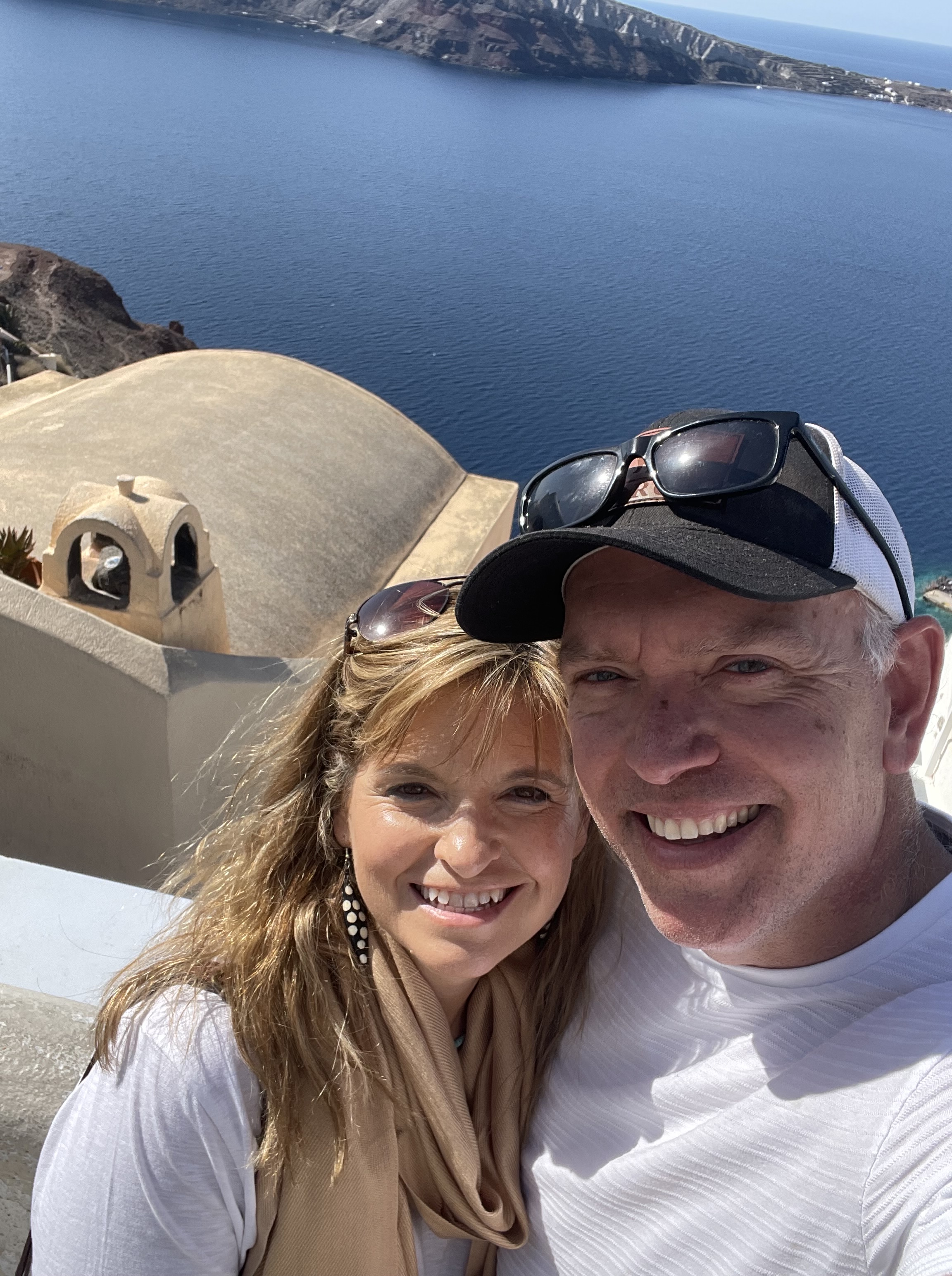
Today was a free day. We made a stop that almost undoubtedly the apostle Paul nor any other Christian in the New Testament ever made: Santorini. According to multiple sources, Christianity did not make an appearance on the island until the third or fourth century. What this Greek island is known for is its explosive history and the breathtakingly spectacular beauty that resulted from it. While some have tried to “explain” (or explain away) the Ten Plagues in Moses’ day by suggesting it was the result of the massive volcano that erupted there 3500 years ago, there is no doubt that a powerful volcano destroyed all life living there. In fact, it has erupted many times (more information here: link). Some have linked the volcano of Moses’ day to the lost city of Atlantis.
Today, it is yet another example of God’s great creative power. Even in a fallen world, we can see stunning beauty in places like Santorini. It’s vivid blue waters, which almost look painted between crags and cliffs, sit atop a giant caldera (large volcanic crater formed by a major eruption leading to the collapse of the mouth of the volcano). The caldera is about 7.5 by 4.3 miles, surrounded by cliffs almost 1000 feet high on three sides. Kathy and I traveled to two cities on Santorini today, then rode over to Nea Kameni and Palea Kameni (small uninhabited volcanic islands that have formed over the past 2000 through repeated eruptions of lava and ash).
It was an enjoyable day to spend with Kathy and see God’s creation. Tomorrow, we will visit another place where Paul walked and likely worked. The island of Crete is familiar to us through Acts 27 and the book of Titus, as well as a possible, surprising Old Testament connection. We’ll see tomorrow!
“For it was fitting for Him, for whom are all things and by whom are all things, in bringing many sons to glory, to make the captain of their salvation perfect through sufferings.” (Hebrews 2.10 NKJV)
Hebrews has a powerful picture of Jesus that stands out for its clarity and brilliance. The book of Hebrews refers to Jesus as the captain of our salvation. To truly comprehend the breadth and scope of this title, we must first understand the Greek word some translators render captain – “archegos.”
When applied to a person, “archegos” indicates that they are the first in a line of characters or events. Jesus made our salvation possible and is the perfect savior. Furthermore, the term can refer to the originator or founder of something significant. Using the word “captain,” the translators of the King James Version intended to highlight Jesus’s role as a leader and guide for Christians on their spiritual path.
The book of Hebrews extols Jesus’ important role as our high priest and the leader of our faith, demonstrating the way forward by enduring suffering and ascending to glory. This illustration is symbolic and closely resembles the role of a captain in an army, historically and today.
The Captain’s Charge on the Battlefield
A captain in the military is responsible for a wide range of duties. A captain is responsible for overseeing the execution of orders from higher ranks by a company of anywhere from 75 to 100 soldiers in the United States military. The parallel is Jesus’ dedication to carrying out the Father’s will (John 5.30).
In the heat of battle, a captain must put their strategic abilities to the test. They must assess circumstances quickly, make immediate decisions, and modify strategies. Jesus is our compass, showing us how to break down the barriers of sin and live a righteous life.
Furthermore, a captain ensures that his troops are well-supplied, whether with ammunition, food, or medical supplies. This provision is echoed in Jesus’ teachings, where He promises abundant life, is our eternal bread and water, and is the source of all spiritual blessings (John 10.10, 6.35; 7.37; Ephesians 1.3).
The captain has an essential role in raising morale among the troops. A soldier’s hope and confidence can turn the tide of battle. Jesus encourages us on our spiritual journey by assuring us that He has already conquered worldly challenges (John 16.33).
The captain acts as a liaison between the higher-ranking officers and the troops, facilitating effective communication and meeting the needs of both sides. In 1 Timothy 2.5, we learn that Jesus mediates between us and God.
Lastly, captains lead from the front, setting examples of bravery, decision-making, and resilience. In His life and teachings, Jesus exemplifies these characteristics, encouraging us to follow in His footsteps (John 13.15; 1 Peter 2.21).
In Conclusion
By comparing Jesus to a captain, we can better understand His unrivaled role as guide, leader, and supporter on our spiritual voyage. We are more than just soldiers with Jesus as our leader; we are more than conquerors (Romans 8.37). We must put our faith in the One leading us to eternal glory, the Captain of our Salvation.
The Acropolis towers over the 4.5 million people who call Athens home. From nearly any point around this iconic spot that looms 450 feet above sea level, you can see it from the heights. In Acts 17, we see an example of the division of labor with Paul and his fellow-missionaries. Timothy and Silas have stayed behind doing follow up in Thessalonica while Paul goes on to Athens. Cosmopolitan man of education and experience that he is, Paul is still agitated and disturbed by the rampant idolatry of the place.
Visiting the city today, you see evidence of the mythology of Poseidon and Athena complete with temples dedicated to their honor and that of so many gods. Paul began as he always did in any new place, attempting to reach the Jews in the synagogue (Acts 17:17) while also making effort to evangelize in the marketplace. The Epicureans, rugged individualists and materialists, and Stoics, devoted to reason above all else, were intrigued and incensed by Paul’s “new teaching” (Acts 17:18). These philosophers brought him to the Aeropagus (hill of Ares in the Greek; “Mar’s Hill” in the Latin) so he could explain himself.
Many believe that, just as Socrates had done over 450 years earlier, Paul was called before their supreme court and tried for his “strange” beliefs. There are parallels between Socrates defense and Paul’s. Second, Dionysius, who will believe Paul’s preaching, is an Aeropagite or judge on this court. Third, it fits with Luke’s theme of Paul testifying before magistrates–the Philippian magistrates, the Corinthian proconsul, the Roman governors at Caesarea, the Jewish Sanhedrin, King Agrippa, and, ultimately, the Caesar. If it was a trial, it was also a masterful sermon. Paul uses their own philosophy, their own philosophers, and their own presuppositions to preach God and the resurrection of His Son and the judgment to come.
Standing on Mar’s Hill this afternoon, with the Parthenon jutting out on the Acropolis across the way, I thought about how Paul was given such a huge forum and he rose to the occasion. He gave us a masterful example of how to reach the unbelieving, biblically illiterate of any age. Ultimately, his message centered on the resurrection and the responsibility we have to stand before God, that we must believe that God is and that He is a rewarder of those who diligently seek Him (Heb. 11:6).
Right before we went to the top of Mar’s Hill, the preacher for the church at Athens, Dino Roussos, spoke to us about this event and even quoted (in Greek, of course) a portion of Paul’s sermon. How great to see the Lord’s church alive in a city where it seems Paul had, at best, only nominal success! How thankful we continue to be that Paul was willing to boldly go where no Christians had gone before to plant the first gospel seeds that are still producing today!
Today was the first day for all but one of our 56 members to be in the country of Turkey. We will make two stops in this country. Ephesus, from which we have just left, and Bodrum on Sunday. I knew I wanted to see the city of Ephesus, not far from the modern city of Kusadasi, but I had no idea how exciting and enriching the day would be. We had an outstanding guide, a man, Cenk, in a Muslim-majority nation who considers himself a Christian and whose working knowledge of the Bible was pleasantly surprising.
We spent a full two hours at Ephesus, starting at the ancient Harbor Road which Paul would have traveled to come up from the ancient port site of the city. Then, we went into the very theatre we read about in Acts 19:29! Getting to speak for a few minutes about that moment to our group in this theatre was a personal highlight! We saw the facade of the library of Celcus, an impressive second-century building. All along the way, we saw ancient ruins of this once thriving and leading city of Asia and the entire Roman Empire.
But perhaps the most exciting part of the day (though a visit to Aladdin’s Rug Warehouse was quite the unexpected treat) had to be walking through the recent excavations of the terrace houses among the Ephesus ruins. John Moore did us the wonderful favor of scheduling this as an add-on to the tour, and it was more than worth it! Cenk stopped the group and read this passage from Colossians 4:15, which says, “Greet the brethren who are in Laodicea and also Nympha and the church that is in her house.” Laodicea is about 120 miles due east, inland from where we stood in these houses. With the thriving, growing congregation at Ephesus, it was very likely that Christians were meeting somewhere in these houses or houses just like them. Church buildings were not built until the fourth century, after Christianity was “legalized” in the Roman Empire.
It is hard to describe how exciting it was to know we were walking through a city Paul called home for three years (Acts 20:31) and where he worked so fruitfully (please take a moment to read Acts 19). Paul shed tears with the Ephesian elders in and around these now ancient buildings, teaching publicly and privately to help this influential church grow! These are faith-building days, a reminder of how unique the Bible is as not only the supreme source of truth but as a book that constantly serves itself up as a book which is verified by history, archaeology, science, and geography!
I Peter 2.18-23 was originally addressed to servants. As we’re probably aware, the kind of slavery that was legal under the Old Law and Roman law was nothing like the chattel slavery we’re familiar with. Slaves had rights and personhood. They had the option to work for and earn their freedom. If a slave had a family, whoever purchased them was usually obligated to take care of the family. They had strict legal protections against abuse, but some masters really toed that line to its fullest extent.
This applies to us today in the employer-employee relationship. God expects us to behave respectfully towards good bosses and bad bosses (18). Even when a bad boss mistreats us (which is far too common, unfortunately), God’s happy with us when we go through it with patience and respect (19).
In vs 20, he cautions us against being punished for bad behavior in the workplace. Even if we go through that punishment with patience, it doesn’t really mean anything. But the reason we would ever put up with bad bosses or corrupt government rules is because that’s what Jesus did while he was on earth (21-25). He was treated unfairly the entire time he was here, and his execution was completely illegal. Many of his rights as a citizen in a Roman jurisdiction were violated. But “when people insulted him, he didn’t retaliate. He suffered without threatening anyone” because “God is the one who judges” (23).
Jesus even told his apostles that he had to power to destroy the earth and not have to go through any of those human rights violations. He had over 70,000 angels on standby, probably chomping at the bit for him to say the word and make their day. But he suffered without lashing out and that’s what he expects us to do, too. This is as far from easy as it’s possible to get, and something I certainly struggle with. God, give us the strength to stand down when the world hurts us because we believe.
Hans Glaser records an event that took place around dawn on April 14th, 1561 AD. He states that, “many men and women saw an aerial battle out of the sun.” This strange celestial phenomena was followed by the appearance of a large black triangular object which resembled the tip of a spear. There were spheres that fell to earth and cylindrical objects that moved erratically in the sky above. The woodcut illustration that these events were engraved on show objects of various shapes and sizes, including crosses and two large crescents.
What had Hans and all the others seen that day? It’s still up for debate. Was it a meteor shower? Was it a Sun Dog? It’s not clear. However, it provides us with an interesting mystery that also serves as a spiritual reminder.
Hans Glaser certainly felt that this was a sign from God and that the community of old Nuremberg needed to turn from their sinful ways— but was it?
Scripture records some celestial phenomena that we can confidentially say were supernatural in their planning (Josh. 10.11-14, Lk. 23.44) but outside of that we must be careful not to attribute what we don’t understand to an purposeful act of heaven. After all, it could be a rare but natural occurrence. It could be a misidentification or misinterpretation and we shouldn’t forget how human we all are. If God directly tells us through His word, we can trust it. If it’s not inspired, but claims things with great spiritual consequences— careful.
It’s far too easy for us to wrongly interpret even the scriptures we have to try and make sense of the world around us. While there are relevant passages that shed light on the modern age, the faithful should take to heart the command to Timothy (2 Tim. 2.15) and handle God’s book with great respect humility. There’s so much we don’t know, but we can be confident in that we serve a God who knows all.
Today was the first day we did not leave the ship, but we were able to get a preview of Ephesus from John Moore as we considered one of the most important cities of the New Testament. We This day was a day about fellowship. One of the great things about a trip like this is that you get to spend quality time with brothers and sisters you go to church with or that you just met. Each night, like right now, we have the opportunity to spend time playing cards and visiting. Earlier today, there were opportunities to do bumper cars, go to the gym, or other activities with brothers and sisters in Christ. That is a serious benefit of a trip like this.
When we study the early church, we see that from the very beginning they made time to be together. The church was established in Acts 2:41, then in the very next verse we read, “They were continually devoting themselves to the apostles’ teaching and to fellowship, to the breaking of bread and to prayer” (42). They were close because they shared a common bond, had the same worldview and God-view, and they faced the same challenges of growing their faith in adverse circumstances. They shared so much together (1 Cor. 10:16). Fellowship was precious (1 Jn. 1:3,7).
Tomorrow, we embark again on a tour of a biblical site. We will have that memory in common. But, even when we return to the ship, we will continue to share! That’s just the way God set up His church!
The ship left dock yesterday evening to begin our tour through the Mediterranean. Today, we visited an iconic site that at first glance may seem to have no biblical significance. The city of Pompeii and its lesser-known neighbor, Herculanum, were destroyed by a massive volcanic explosion in 79 A.D. Herculanum, much closer to the blast, was much more destructive to its inhabitants while the city of Pompeii was almost perfectly preserved due to its being covered by ash which did not vaporize buildings and houses.
There is some theory that there were a small band of Christians in the city when the catastrophic natural disaster occurred. Beyond that, the city was thought by Jews and even Romans to be a judgment against the rampant sin and immorality of the city or a divine judgment, from the Roman historian Cassius to the Sibylline Chronicles. While we cannot know that, we know that there will be a judgment none will escape at the end that God wants us all to be prepared for.
Before we returned to the ship, we were able to see where Paul docked in Italy. The small port in Puteoli is near the modern city of Naples (Napoli). Luke records this fact for us in Acts 28:13.
It was impressive to see what the first-century world was like where Christians had to swim against the massively immoral tide of their culture and society. Spiritual darkness must have seemed eclipsing at times, but they had the boldness to live their faith even in wicked cities like Pompeii. We have so much to be thankful for as we consider the relative ease with which we can express our faith and share it today! It is not always that way. It did not seem to be in southern Italy near the end of the first-century.
Today, we completed our land tour of Rome. I mentioned that there are 56 of us, ranging in age from teenagers to pushing 80. So, we move different speeds and are in different degrees of health. We are often having to go far and somewhat fast, requiring patience on the part of everyone. It has been pretty hot and sunny all weekend, too! Would you believe that everyone has kept such a great attitude and been so pleasant? Of course! We have been with God’s family, who you would expect to act more like Him than anyone else.
This morning, we all piled into our tour bus (packing about 90 bags into the bottom of it) and made our way to meet with the “Chiesa di Cristo” in Rome. This church of about 30, which has two elders, welcomed us with open arms. Some of their brethren led us in worship, some of our group led us in worship, and we sang, prayed, heard the word proclaimed, contributed, and observed the Lord’s Supper together. We sang in Italian, in English, and even in Xhosa (a South African language). We greeted and talked as best as we could with the language barrier and got to know some of each other’s stories. It was emotional.
I thought about what happened to Paul right before he was arrested and wound his way to Rome to appeal to Caesar. Nearing the end of his third missionary journey, he met in Miletus with the elders of the church at Ephesus (a city we’ll visit later this week)(Acts 20:17-38). Paul had worked with them for three years. At their parting, they wept, hugged, and said an emotional goodbye. The next place we know that he stopped was at Tyre (past Cyprus, which we plan to visit next week) in Acts 21:3-6. Paul and his fellow-missionaries were with these Christians just a few days. When they said goodbye, it was still an emotional, heartfelt goodbye.
That was the general feeling as we pulled away from brethren we only knew a couple of hours. Separated by language, culture, and background, we felt the bond of Christ strongly! It was hard to leave. It was wonderful to be there, to be with God’s family. How eternally wise our God was in building the church like He did. We will make some lifelong friendships as we tour so many places where Paul once walked and preached. We will have difficulty saying goodbye to some we’ve known and others we’ve met. But, that’s always the way it is when you’ve been with God’s family! They are the best!