Taming The Tongue

Carl Pollard

Water is an unstoppable force. Every year, 40 billion dollars worth of damage is caused by flash floods around the world. There’s nothing you can do to stop a tsunami, a flooded river, or a tidal wave. Water is powerful. Just go to the ocean and try to fight against the waves as they crash into the beach. I ain’t exactly a small guy, last I checked I was 186 pounds (more like kilograms…), and I get thrown around like a rag doll by the waves. 

There are certain parts of God’s creation that are a reminder of His power. No matter what advancements we make, what towns and cities we build, they can be wiped out in seconds by what we call “natural disasters.” I want you to picture in your mind a roaring river. Think of the trees that are swept away, the damage that occurs as a million pounds of water flood a river bed. Let’s read James 3, and keep that image in our minds. 

The tongue is James’ focus as we read verses 1-12. The small muscle behind your teeth is a source of great destruction. James, the half brother of Jesus, paints a vivid picture of the tongue. He describes it basically as a weapon of mass destruction. 

And for good reason. Just like a tidal wave can cause billions in damage, the tongue causes all kinds of terrible destruction. The human race as a whole speaks a staggering amount of words every single day. Let’s do the math. The average person speaks between 18-25 thousand words a day. With around 8 billion people on the planet we’re looking at around 150 trillion words that are said every day. 

And God listens to every single one, He remembers every word. Sadly, the overwhelming majority of those words are evil. And that’s exactly what James is trying to address in this section of scripture. As Christians, the words we speak should be different from the rest of the world. 

Leading up to chapter 3, James has just finished a discussion on faith and works. 

Faith without any works is dead. If your faith in God isn’t actually affecting what you do, then it is a dead faith, and it is useless. Even the demons believe, but they don’t change their lifestyle. Immediately after this section he talks about the tongue. That’s because there is a strong connection between the heart and the tongue. Your faith and your words are tied hand in hand. How you use your words, what you say to others, is essential to your salvation. If you can’t guard your words, your faith is dead. The transformation of the tongue is essential. It may be the single greatest proof that you really are a Christian.

We must tame the tongue because we are judged by our words. James 3:1 says, ”Not many of you should become teachers, my brothers, for you know that we who teach will be judged with greater strictness.” I’ve got to be honest, as a teacher this verse is a very sobering reminder. Each Sunday, I get up and speak, and how my words impact people’s faith is seen by God. James says, don’t take the role of teacher without seriously examining your motives. When you teach, God is going to be stricter with His judgment of you. When we accept the responsibility to teach the word of truth, we will give an account for what we teach. 

Keep in mind, as Christians we are expected to teach others and become teachers (Heb. 6, Matt. 28:18-20). So what is James saying? In the first century many wanted to become teachers for the wrong reason. They had bad intentions. Teachers in the first century were highly regarded and were elevated in society. Many were motivated to teach, not because they wanted to share the word, but because they wanted power and influence. James says later on that these teachers were speaking out of selfish ambition and jealousy (3:14). So James is saying, unless you’re doing it for the right reasons, don’t become a teacher! Because by our words we are judged, and as a teacher, that judgment is even more severe. 

In His ministry, Jesus linked the heart directly to our words. In Matthew 12:34-35, He says, “You snakes! You are so evil. How can you say anything good? What people say with their mouths comes from what fills their hearts. Those who are good have good things saved in their hearts. That’s why they say good things. But those who are evil have hearts full of evil, and that’s why they say things that are evil.” The heart is the issue. If you want to know the spiritual state of the heart, listen to your words. They are controlled solely by your heart. And that is why Jesus says we will be judged by our words, because what we say is written on our hearts.

In Matthew 12:36-37, He continues, ”I tell you, on the day of judgment people will give account for every careless word they speak, for by your words you will be justified, and by your words you will be condemned.” On that final day, God will look at the sum total of your words, and He will know all He needs to know about the condition of your heart. 

As a side note, if you struggle with feelings of doubt about your salvation, just keep track of what you say. If your words are filled with love, encouragement and praise, you can be sure of your salvation. But if your speech toward others is filled with lying, hate, gossip and insults, God will judge your heart by what He hears. So start controlling your tongue! Start encouraging each other, start sharing the gospel! Because the words filled with love bring about salvation, but the words filled with resentment, hate, gossip, and anger will send us into torment for all eternity. 

Why should we be so concerned about taming our tongue? Because one day, we will be judged by every word we have said.


Winning Words

Dale Pollard

Ephesians 4.29 says, 

“Do not let any unwholesome talk come out of your mouths, but only what is helpful for building others up according to their needs, that it may benefit those who listen.” 

If you were to open up any Greek interlinear (like in the BlueLetter Bible app) and look at the key words in this verse it becomes even more practical. 

Unwholesome: 

“Rotten, putrefied” 

Helpful: 

“good, pleasant, agreeable, joyful, happy” 

Benefit: 

“that which affords joy, pleasure, delight, sweetness, charm, loveliness: grace of speech” 

There are three rules for winning words in Ephesians 4.29 and they are… 

1. Don’t let anything rotten come from your mouth. If it comes from a bad place keep your mouth shut. 

2. If it doesn’t build someone up don’t say it. Our ultimate goal must be to promote growth and if it doesn’t do that, it’s not worth saying. 

3. If It doesn’t bring delight, show grace, or joy in the end— don’t say it. 

This is the way Jesus treats us. If it’s God’s approach then who are we to say otherwise? No excuse, situation, or feeling should remove grace from the words we say. 

God Owns My Mouth

Thursday’s Column: Captain’s Blog

Carl Pollard

In Psalm 19:14, David says, “May the words of my mouth be acceptable in your sight.” Knowing that the author of scripture is God Almighty, David hopes that the words he speaks would be impacted by his knowledge of the Law. Shouldn’t we long for the same thing as Christians? We know who the author of the Bible is, we understand the way we are called to live and speak, and that should influence our words. The Bible is very clear on how we are to speak. 

Our words are a direct reflection of our faith. James 1:26, “If anyone thinks he is religious and does not bridle his tongue but deceives his heart, this person’s religion is worthless.” Do you call yourself a Christian but fail to control your words? James would say we are deceiving ourselves. Our speech is directly impacted by our religion. Our faith should change our speech and make it stand out from the world. 

The Bible also gives us a very sobering warning in Matthew 12:36-37. Jesus says, “I tell you, on the day of judgment people will give account for every careless word they speak, for by your words you will be justified, and by your words you will be condemned.” On that day will we find justification or condemnation from the words we have spoken? We should use this knowledge to help guard our speech. 
Scripture also tells us in Luke 6:45 that, “The good person out of the good treasure of his heart produces good, and the evil person out of his evil treasure produces evil, for out of the abundance of the heart his mouth speaks.” We can know the condition of our hearts by what is contained in our words. 


Our tongue has a way of getting us in trouble. Ever heard the saying, “Keep your words soft and sweet because you never know when you may have to eat them”? We can do a lot of damage if we aren’t careful.

On every car there’s this handy little device called a fuel filter. A fuel filter is in between your car’s engine and the gas tank. Its job is to keep all the sediment and dirt that accumulates in the gas tank over time from getting to the engine. Basically it keeps impurities from destroying your engine. Our words need a fuel filter between the mind and the mouth. Think about what you are about to say. Is it impure or harmful in any way? Don’t say it. President Calvin Coolidge was famously known as a man of few words. His nickname was “Silent Cal.” His wife, Grace Goodhue Coolidge, told the story of a young woman who sat next to her husband at a dinner party. She told Coolidge she had a bet with a friend that she could get at least three words of conversation from him. Without looking at her he quietly retorted, “You lose.” Coolidge understood very well the value of using only carefully considered words—and those being few in number.


We filter our words and carefully choose them because, like David, we understand who we belong to when we are Christians. God now owns our words and we use them to glorify Him in everything. God’s Word should affect our own words.

Is Hyperbole a Sin? 

Friday’s Column: Brent’s Biblical Bytes

81121814_2462862270639428_5746232403106463744_n

Brent Pollard

Someone asked if traffic had increased on our little country road. My mother replied that we had more traffic than the nearby town. This response is an example of hyperbole. Hyperbole has long been used rhetorically for effect. So, was my mother lying? It seems that in recent years some are equating hyperbole to lying. Critics routinely called our nation’s previous president a liar because of his frequent use of hyperbole. Reuters published an article in 2015 about how the president’s habit, as extolled in his Art of the Deal, might backfire against him (Flitter and Oliphant). They were correct.

Consider the treatment that the word “hyperbole” receives from Webster’s Dictionary, as demonstrated in the original 1828 edition and 2021 online version. The former is more nuanced.

“In rhetoric, a figure of speech which expresses much more or less than the truth, or which represents things much greater or less, better or worse than they really are. An object uncommon in size, either great or small, strikes us with surprise, and this emotion produces a momentary conviction that the object is greater or less than it is in reality. The same effect attends figurative grandeur or littleness; and hence the use of the hyperbole which expresses this momentary conviction.” (Webster)

And here is what Merriam-Webster tells modern students of English:

“: extravagant exaggeration.”

In other words, as noted by Daniel Webster himself, hyperbole might reflect one’s emotional state rather than a conscious decision to deceive. However, the successful use of hyperbole requires an unbiased and knowledgeable audience. In other words, they must be able to understand you are exaggerating for effect.

Even so, we admit people can use hyperbole to manipulate. Perhaps, this is the type of hyperbole usage that caused President Trump’s political enemies to call him a liar. For example, was he the “best jobs president?” He did create an economic environment that led to historic job growth. However, if God allows time and the United States to continue, another president may create even more jobs. Hence, we can only qualify his statement. The truth as to whether his message is a lie boils down to intent, which may be something requiring omniscience to determine.

We asked at the outset, with our title, whether hyperbole is a sin. It might be helpful to know that the Bible contains hyperbole. Jesus used hyperbole in Mark 10.25.

“It is easier for a camel to go through the eye of a needle than for a rich man to enter the kingdom of God.” (NASB1995)

What about Jesus’ usage of hyperbole in Matthew 5.29-30?

“If your right eye makes you stumble, tear it out and throw it from you; for it is better for you to lose one of the parts of your body, than for your whole body to be thrown into hell. If your right hand makes you stumble, cut it off and throw it from you; for it is better for you to lose one of the parts of your body, than for your whole body to go into hell.” (NASB1995)

How would you qualify our Lord’s speech? Was He lying? Certainly not!  Clearly, He is using exaggeration for rhetorical effect. In the latter case of hyperbole cited, He says that you should be willing to do whatever it takes to enter heaven, even if it seems unreasonable or extreme to you since your entry into heaven is of greater importance than anything sacrificed.

If people equate hyperbole with lying today, it seems more likely an indictment of our public education system’s failure or an unwillingness to evaluate the intended purpose of its usage fairly. Someone may be acting too nitpicky. But we do remind the Christian desirous of communicating the Gospel to others that Paul commands us to ensure our speech’s soundness is beyond reproach (Titus 2.7-8). There are groups with whom we must exercise caution since they take things literally, primarily children and those on the autistic spectrum. Neither should we use hyperbole derogatorily since James cautions us not to use the same tongue to praise God while cursing men (James 3.8-10). Otherwise, our hyperbole use may be the greatest seasoning we can add to our speech when making a point. As with all communication, it is best to season it with grace (Colossians 4.6).

5159999696_66bc9f0de2_b

Sources Cited:

Flitter, Emily, and James Oliphant. “Best President Ever! How Trump’s Love of Hyperbole Could Backfire.” Reuters, Thomson Reuters, 28 Aug. 2015, www.reuters.com/article/us-usa-election-trump-hyperbole-insight-idUSKCN0QX11X20150828.

“Webster’s Dictionary 1828 – Hyperbole.” Websters Dictionary 1828, webstersdictionary1828.com/Dictionary/hyperbole.

“Hyperbole.” Merriam-Webster, Merriam-Webster, www.merriam-webster.com/dictionary/hyperbole.

Foul

Wednesday’s Column: Third’s Words

Gary III

Gary Pollard

This word has no positive meaning. Fouling on a spark plug means it’s time to replace it. A foul smell is an unpleasant one. Fouling in the barrel means it’s time to clean your gun. In sports, a foul is usually bad for your team.
 
In older English translations, “foul” is used to describe something impure, unholy, or evil (Mark 5.8; Luke 6.18; Revelation 16.13). Regardless, we understand that something foul is not what we want attributed to our character or in contact with our senses.
 
Are our words foul (Eph. 4.29)? Unwholesome here is σαπρός (sapros), which means “rotten, bad, or harmful.” It describes any kind of speech that has no positive effect or worth. Christians, there is no world in which cursing is excluded from this definition.
 
Consider the following:
 
I Corinthians 9.19ff encourages us to follow culture as long as it doesn’t violate God’s law. Even our secular culture recognizes that some words are not appropriate. Every culture has a set of words, phrases, postures, etc. that are offensive or recognized as inappropriate. These are σαπρός, and have no place in our lives.
 
I Peter 3.10 points out that our words have an effect on our quality of life. This includes avoiding lies and evil speech. Evil here is κακός (kakos), which means “bad, injurious, harmful, or wrong.” Lots of words fall under this category, but why are some exempting curse words? How do those not fit σαπρος or κακός?
 
In the last few years, even some theologians have argued that cursing is not under the purview of these passages. Far too many Christians use words that our culture understands to be curse words.
 
Ephesians four is a chapter about leaving our old lives behind. Part of leaving our old self behind is controlling our speech and using it to encourage others (28). By using foul language (σαπρος), we grieve (offend, distress, cause to become sad) the Holy Spirit (29)!
 
If we know that our words can have an effect on the Spirit that translates our deepest emotions and loss for words into meaningful petitions to God (Romans 8.26, 27), why would we use words that could very easily be described as worthless, harmful, or wrong?
 
James 3.2

The Haste Of The Hermandads

Monday’s Column: Neal at the Cross

pollard

Neal Pollard

In the 1100s, in an effort to protect travelers going from northern Spain over the Pyrenees to Santiago de Compostela in Galicia (Dogs of God, Reston, 50), a military force known as the hermandads (“the brotherhood”) was organized.  Soon, these vigilantes spread across Spain and offered themselves as protectors of roads and merchants.  Eventually appointed as a national police force who could collect taxes and prevent insurrection in every municipality, they would go on to exterminate untold numbers of Muslims, Jews, and other “enemies of the state” during the Middle Ages.  Reston mentions an unsettling “right” granted to the hermandads in the 15th Century, during the famous reign of Isabella and Ferdinand.  He writes, “In a curious turnabout, executions took place first, and trials were held afterwards” (51).

Given our country’s constitutional concept of “innocent until proven guilty,” this practice seems both backward and barbaric.  How useful is a trial to present facts about a case after the defendant has been executed?  What if the deceased was found innocent? What if there was no proof of guilt?  Of course, the “facts” of every case incredibly supported the punitive action that preceded it.

While we may find such a practice appalling, how often do we do the same with our tongues?  Through rash anger, reckless gossip, and rabid prejudice, we can serve as judge, jury, and executioner of the reputation and actions of another.  How often do we jump to conclusions and assassinate another’s character, but later revelations prove our actions both premature and unjustifiable?  Unfortunately, the damage having been done, nothing done by way of reparation can fully undo the effects upon the victim.

What we need to see is the spiritual danger we face who “execute” before “trial.”  Solomon wrote, “He who gives an answer before he hears, it is folly and shame to him” (Prov. 18:13).  A few verses later, he says, “Death and life are in the power of the tongue…” (21a).  That New Testament “wisdom writer,” James, adds, “But no one can tame the tongue; it is a restless evil and full of deadly poison. With it we bless our Lord and Father, and with it we curse men, who have been made in the likeness of God;  from the same mouth come both blessing and cursing. My brethren, these things ought not to be this way” (3:8-10).

Be very careful!  Even when we think we have the facts about another, let us post a guard outside the door of our lips (cf. Ps. 141:3).  Better to deliberate and reserve judgment than to execute before the trial has been held!

How To Slay A Dragon

Thursday’s Column: Captain’s Blog

IMG_0806

Carl Pollard

There’s a part in Sleeping Beauty where the Prince slays a fire breathing dragon with his sword. This is at the climax of the movie, so this entire time the story has been building up to this one, final moment. It’s pretty epic. In our lives, we have many “Fire Breathing Dragons.” At this moment I would like to talk about three of them and how to “kill” them.

First, notice with me the “dragon” of lying. If you look at Colossians 3:9, it says, “Don’t lie to each other, for you have stripped off your old evil nature and all it’s wicked deeds.”
Lying in Colossians is labeled under “evil nature.” If we have stripped our old ways, why do we continue to lie? Because much of the lying that we do is for personal gain. For example, someone could come up to me and ask, “How much can you bench?” and I might say “850 pounds.” That’s a classic example of lying for personal gain. From now on that person will believe that lie I told them and possibly tell others. We can slay this dragon by telling the truth. Challenge yourself to tell full truths, and not half-truths.

Second, there is the “dragon” of Hate. Luke 6:27 says, “But I say to you who hear, Love your enemies, do good to those who hate you.” The hardest part of this verse is the second half. Trying to love those who hate us is extremely difficult because in our minds they started it so we have the right to hate them back. If you look at Jesus, our example, He says to love those who hate us. How do we do this? It requires a change of vision. We should try to look at those who hate us as a lost soul that needs saving. Looking at them this way might help us to love them more.

Third, and finally, is the “dragon” of Gossip. This one can be very dangerous because it might tear apart a friendship, a person, and the church. If you look at Ephesians 4:29, It reads, “Let no corrupt communication proceed from your mouth, but that which is good to the use of edifying, that it may minister grace unto the hearers.” Instead of tearing down someone or spreading rumors, let’s try to build up one another! To keep from letting something slip about someone, let’s try to practice what our parents told us from day one: “Think about what we say before we say it.”

Now there is one more thing we can use to slay “dragons.” The ultimate Two-Edged Sword is for slaying any kind of “dragon.” This Two-Edged Sword, the Bible, can slay any dragon that Satan sends our way. Today we only looked at three of the dragons that Satan uses against us. There are many more, and we must study Scripture to see what they are, and how we can slay them.

73667.jpg.cf

6 Things About Gossip That I Don’t Like

Neal Pollard

As masterfully and humorously portrayed in the 15th episode of the first season of the Andy Griffith Show (“Those Gossipin’ Men”), gossip can seemingly appear, full-blown, out of thin air. It can be personally hurtful, but it’s part of the territory of living and breathing.  Here are 6 things I particularly dislike about the ugly specter of gossip.

  • It’s GallingIt “reveals secrets” (Prov. 11:13). It separates friends (Prov. 16:28), yeah even “intimate friends” (Prov. 17:9). While cowardly, it still takes a lot of nerve!
  • It’s Obstructive. Billing itself as “helpful” and “instructive,” it usually serves the opposite purpose. It “reveals secrets” (Prov. 20:19) and is the hallmark of idle busybodies (1 Tim. 5:13).
  • It’s Spurious. As previously mentioned, gossip is as apt to be false and inaccurate as it is to be trustworthy.  Even if there is a grain of truth, it can have an admixture of inaccuracy blended in.  Tragically, it is often received as the truth and nothing but the truth.
  • It’s Sinful. Find it listed alongside “strife,” “jealousy,” “slanders,” and “arrogance” (2 Cor. 12:20). God calls the spreader of such “a fool” (Prov. 10:18). It’s an “evil weapon” (cf. Isa. 32:7) and “stubborn rebellion” (Jer. 6:28). See also Romans 1:29, 2 Timothy 3:3, and Titus 2:3.
  • It’s Inconsiderate. Few gossips would want to be treated the way they treat their subjects (Luke 6:31).  Repeatedly, Christians are urged to “be kind to one another” (Eph. 4:32). We’re to love each other without hypocrisy and “be devoted to one another in brotherly love; give preference to one another in honor” (Rom. 12:9-10).  Gossiping is rarely wrapped in forethought and careful circumspection.  It’s not “friendly fire.” It’s just fire.
  • It’s Presumptuous. Gossip is acting with entitlement, believing that it is fair and right to spread (whether true or false) information about the subject thereof. The gossip believes himself or herself qualified to share something about someone else, and such are usually mortified if the tale is traced back to them.

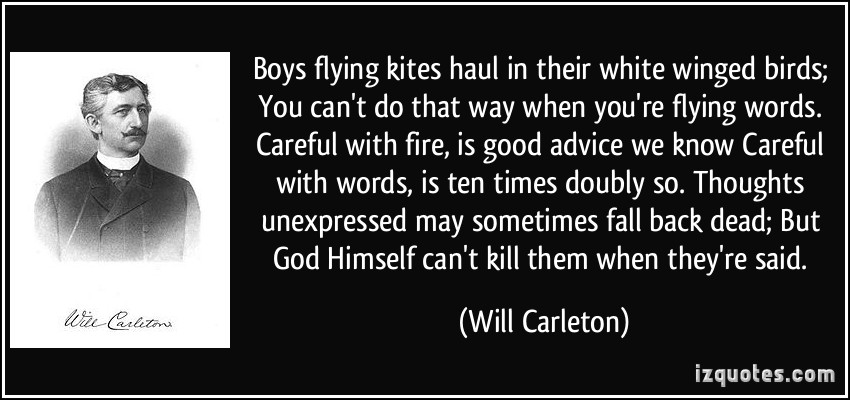
Yet, indignation should be tempered with realization.  Few have so mastered the tongue that they are above the fray we mention here.  Let’s be convicted to practice saying good and kind things behind each other’s backs. Remember to investigate before you propagate, and even then only carefully and prayerfully. Usually, prayer and care will render the “juicy tidbit” dead on the floor of your mind, safely unspoken and incapable of doing any harm. Remember the famous words of 19th Century Michigan poet Will Carleton: “Boys flying kites haul in their white winged birds; You can’t do that way when you’re flying words. Careful with fire, is good advice we know Careful with words, is ten times doubly so. Thoughts unexpressed may sometimes fall back dead; But God Himself can’t kill them when they’re said.”

quote-boys-flying-kites-haul-in-their-white-winged-birds-you-can-t-do-that-way-when-you-re-flying-words-will-carleton-377399

INSTRUCTIONS FOR PRIVATE OFFENSES

Neal Pollard

The Son of God gives specific instructions for what to do when a spiritual family member sins. Jesus clearly says, “If your brother sins, go and show him his fault in private; if he listens to you, you have won your brother. But if he does not listen to you, take one or two more with you, so that by the mouth of two or three witnesses every fact may be confirmed. If he refuses to listen to them, tell it to the church; and if he refuses to listen even to the church, let him be to you as a Gentile and a tax collector.” Notice the Divine pattern. 

  • Perpetration (15a)–“If you brother sins.” This is what initiates the situation.
  • Presentation (15b)–“Go and show him his fault in private.” Paul would teach this later (Gal. 6:1). Notice that this is to be done privately.
  • Aspiration (15c)–“If he listens to you, you have won your brother.” Ideally, this is where the matter should end.
  • Escalation (16-17)–Jesus tells one what to do if a sinner refuses to listen. Start by taking one or two. If that does not work, then tell it to the church.
  • Repudiation (18)–If all three of these approaches fail to win the sinner, then you reject them.

Tragically, we very often disobey Jesus’ instructions about this and fail to understand that rebelling against His commandment then makes us a sinner, too.  How often does it happen that a person, rather than dealing directly with the sinning brother, tells someone else? Then, that someone tells another. Soon, a whole group or even the whole church knows about the sin. Often, something that was private and even between just two people is made public by gossipers who continue to spread the matter. In some cases, those who hear and spread the matter never even speak to the offender. This prevents the sinner from being aware of who knows about it or being able to reconcile. It can even be the case that the sinner has repented and handled the matter with the original offender, but now others are brought into the matter after the fact. Those who have come to hear about the situation treat the sinner “as a Gentile and a tax collector,” without ever once speaking to them about it. Rifts form and relationships are affected. 

When we fail to do things God’s way, we will make matters worse. May we consider passages like Mark 7:21-23, where Jesus places “big” sins like “fornications, thefts, murders, adulteries, deeds of coveting and wickedness” alongside “little” sins like “deceit, sensuality, envy, slander, pride, and foolishness.” Jesus’ analysis is that “all” these things are “evil” and “defile the man.”

gossip-532012_640

It Didn’t Go Like He Planned

Neal Pollard

G. Gordon Liddy once related a bazaar story about a man, jilted by his girlfriend. Apparently, he tried to commit suicide in front of his rival (the girl’s new boyfriend). He pointed the pistol at his chin, pulled the trigger, and fully intended to die. However, the bullet somehow ricocheted off his teeth and fatally struck the other fellow. Intending to “end it all,” the young man was charged with manslaughter, third-degree murder, kidnapping, and assault.

That was not in his script. He had not planned it to go like that. He was going to show his counterpart, his girlfriend, and the rest of the world that his emotional wounds were so great that he was going to engineer his final exit strategy. How remarkably foolish!

How often, though less dramatically, does this occur? In words or actions, we tell others, “I’ll show you! You’ll be sorry!” With such haste and waste, we rashly do something we live to regret. We put our souls in jeopardy to get even with actions or words we perceive  offensive and injurious to us.

Solomon warned, “He that is slow to wrath is of great understanding, but he that is hasty of spirit exalts folly” (Prov. 14:29). When we act without weighing the consequences, we rue the choice we make. Appropriately, the wise man again said, “Do not be hasty in word or impulsive in thought to bring up a matter in the presence of God. For God is in heaven and you are on the earth; therefore let your words be few” (Ecc. 5:2).

Spiteful actions are futile and sinful (Psa. 10:14; Luke 18:32). “Get even-ism” is a sickness and a symptom of worldliness. It disregards Christ’s mandate for God’s children to turn the other cheek (Luke 6:29). It is written, “If you have been foolish in exalting yourself
Or if you have plotted evil, put your hand on your mouth” (Prov. 30:32). If everyone practiced this sage advice, fewer would overreact and more would overcome.

Think before you speak. Consider the consequences of rash decisions (remember Jephthah?). Avoid the tragedy of thoughtlessness. The failure to control our lives results in a punishment far outweighing a jail sentence.

Consider the words of this poem, written anonymously.

“Boys, flying kites, haul in their white-winged birds,
But you can’t do that when you’re flying words.
Thoughts unexpressed may sometimes drop back dead,
But naught can kill them when they’ve once been said.”

1

THE POWER OF THE TONGUE

Neal Pollard

One of the leading stories in today’s news concerns a young woman, Michelle Carter, facing manslaughter charges for allegedly coercing her boyfriend, Conrad Roy, to commit suicide. He was 18 and she was 17. While at earlier points in their relationship she tried to dissuade his talk of suicide (he had attempted suicide before meeting her), by the end she was insistent and even steered him onto the subject of taking his own life. The night he succeeded in killing himself by carbon monoxide poisoning, she even urged him at one point to get back into the truck. The hundreds of text messages she wrote are disturbingly callous and malicious, and she faces 20 years in jail if convicted. Her words are at the heart of this case, and prosecutors say she is complicit in his death because of all that she said (The Washington Post online, 6/7/17, Kristine Phillips and Swati Sharma).

It is incredible to consider that this young woman used her words to so discourage and deflate another human being, to even actively push him to die. Yet, Scripture tells each of us that, spiritually, we all are exercising the power to either promote life or death through our words. Proverbs 18:21 tells us, “Death and life are in the power of the tongue.…”  This is why Paul urges us to give thought about the character and nature of our speech, saying, “Let your speech always be with grace, as though seasoned with salt, so that you will know how you should respond to each person” (Col. 4:6). Our speech can kill in many ways:

  • Vulgar, coarse speech that can encourage others to think of the unwholesome and sinful
  • Hypercritical speech that can deflate and discourage people’s good works
  • Gossipy speech that can cause people to be divided and distanced from undeserving victims
  • Dishonest speech that can lead people astray from the truth
  • Railing, sinfully angry speech that can be self-destructive to the speaker
  • Hypocritical speech that can cause people to be turned off by Christianity

We may be prone to excuse our words as harmless when in fact they can be a matter of spiritual life and death for ourselves or someone else. Our prayer should mirror that of the psalmist, who pleads, “Set a guard, O Lord, over my mouth; Keep watch over the door of my lips” (Psa. 141:3). We possess such power! Let us harness it and use it for life, not death (cf. Jas. 3:2-12).

maxresdefault

The Assassins In Our Midst

Neal Pollard

They are on the loose and nobody even seems to be hunting for them. They have struck countless times. They strike daily. Yet, they will never make the nightly news or the local paper. They do their deeds with seeming impunity. At times, their actions cause the weak and fearful to simply follow or at least stand by and say nothing. While they may escape the earthly courts of justice, they will give an account in the heavenly one.  Who are these brutal killers?

Some strike at the personal level, assassinating the character of a brother or sister in Christ through gossip, slander, and backbiting.  This type of assassin takes the good name and reputation of their victim and shreds it. Sometimes what they say is true but it should not be said. Usually, it is said in the absence of the object who is left unable to defend or explain. As often, what they say may be untrue, distorted, or crafted in such a way as to portray the object in the most unflattering or unsavory light. With practice, these assassins can seemingly wield their deadly weapon with seemingly seared conscience. Whether careless or calculated, they fire their darts with blind indifference. They leave a wake of carnage.

Some strike at the good works of a congregation, school, or program of work.  With what appears to be little interest in fact-finding, for motives often unknown and perplexing, they often slander, misrepresent, or inconsistently apply rules they themselves cannot and do not live up to. At times, they make themselves the judge and create the standards whereby others are deemed fit or unfit to survive their assaults. But in doing this, they are hopelessly inconsistent. They face the prospect of facing merciless judgment, they themselves having been merciless.

Some strike without respect of person. Their tongues are unbridled, their passions and self-control are unchecked, and their disposition is volatile and ungodly.  They are quick to fire, and their speech spews venom and acid.  Most tragic is when they aver that they are speaking as a Christian or as an ambassador for Christ. People who witness their cold and brutal attacks are left to assume that such is what constitutes Christianity.  Repulsed, the world violently turns away and vehemently reacts against any and all efforts to teach even difficult and sensitive subjects the world is prone to reject.

James unapologetically condemns such careless slapdash strikes!  He says, “Even so the tongue is a little member and boasts great things. See how great a forest a little fire kindles! And the tongue is a fire, a world of iniquity. The tongue is so set among our members that it defiles the whole body, and sets on fire the course of nature; and it is set on fire by hell. For every kind of beast and bird, of reptile and creature of the sea, is tamed and has been tamed by mankind. But no man can tame the tongue. It is an unruly evil, full of deadly poison. With it we bless our God and Father, and with it we curse men, who have been made in the similitude of God. Out of the same mouth proceed blessing and cursing. My brethren, these things ought not to be so” (James 3:5-10). Before loading up and taking aim at someone, may we consider the eternal implications of it. Thankfully, such assassins can be reformed and retrained through remorse and repentance. May it be!

6713closeupf

Lessons From Yogi Berra’s “Yogi-isms”

Neal Pollard

One of the great American personalities of the 20th Century, Yogi Berra, has died. The 90 year old died Tuesday, September 22, in West Caldwell, New Jersey.  In his wake, Berra, a Hall of Fame catcher with the New York Yankees in the 1940s-1960s, left a book full of memorable quotes, such as:

  • “It’s deja vu all over again”
  • “you should always go to other people’s funerals, otherwise, they won’t come to yours”
  • “if I can hit it, it’s a good pitch”
  • “when you come to a fork in the road…take it”
  • “you can observe a lot by watching”
  • “it gets late early out here”
  • “a nickel isn’t worth a dime anymore”
  • “if it’s an emergency, it’s usually urgent”
  • “nobody goes there anymore. It’s too crowded”
  • “never answer an anonymous letter”
  • “pair off in threes”
  • “I really didn’t say everything I said”    (via USA Today and Fox News)

Yogi’s inimitable wit and wisdom will long outlive him.  Those of us who were born after his amazing baseball career more likely remember him for the Yoo-Hoo ads or the Aflac Commercials. However, observers of human behavior can learn a lot from this legendary figure.

—“Death and life are in the power of the tongue” (Prov. 18:21). Yogi reminds us of the influence we wield by the very words we speak.  Paul would urge us to let our “speech always be with grace, seasoned with salt” so that we will know how we should answer every man (Col. 4:6).  Daily, people hear our speech. Are we “killing” them or “saving” them?

—Cause people to think.  The longer you mull over a “Yogi-ism,” the more profound it becomes. With the Bible, our source material is unmatched. Whether a preacher or a Bible class teacher or a one-on-one Bible teacher or even as a Christian being light and salt in the world, the “attention getter”—not to ever draw attention to us but to the Lord—is powerfully effective. Jesus caused hardened officers to confess, “No man ever spoke like this Man!” (John 7:46). He had a wisdom and insight we’ll never attain, but we have a message unmatched by even a wordsmith like Berra.

—You will be remembered. Do you remember how the writer of Hebrews memorialized righteous Abel? “…Through faith, though he is dead, he still speaks” (11:4).  Of course, how we are remembered is etched by the lives we live in these bodies. We will be recompensed for this before Christ one day (2 Cor. 5:10).  We’ll be remembered by the people we leave behind, from the eulogy and obituary to the memories people keep with them of us. We’ll be perfectly remembered by God (cf. Rev. 14:13).

We lost an iconic cultural figure with Yogi Berra’s demise. But people like that continue to leave an impression on us after they are gone. As Christians, may we live so that when we die the impression we leave can influence and positively alter the eternal destiny of those we touch.

Temper And Tongue

Neal Pollard

Without wading into the waters of political correctness or questioning motives, Donald Sterling can blame his temper as much as his girlfriend’s surreptitious audio recording.  He joins an infinitely long line of those whose unrestrained anger has cost them much more than they anticipated.  While most people will not pay the earthly price Sterling appears destined to pay, so many have permanently damaged relationships and paid with their souls for failing to conquer temper and tongue.

James clearly sets forth God’s view on the matter.  “The tongue is a fire, a world of iniquity” (3:6). “It defiles the whole body” (3:6). “It is set on fire by hell” (3:6). “It is an unruly evil, full of deadly poison” (3:8). It can reveal hypocrisy at a disgusting level (3:9-12).  James’ words are so convicting, yet, having privy to them, we still stumble with our speech.

I have seen the untamed tongue, so often fueled by anger and even rage, tear churches apart.  But, what has it done in the lives of individual members of those congregations?  Certainly, we think of it as characteristic of those outside the body of Christ, but so often it ignites deadly fires in Christians’ lives.

If I am honest with myself, I should be more concerned with the spiritual impact my tongue has on my soul than other deeds of the flesh.  There are so many ways for me to stumble over my tongue—gossip, lying, outbursts of anger, wrath, deception, filthy or suggestive speech, greed, and just about every outlet of sin seems to intersect with the misuse of the tongue!

James speaks to our hearts when he says, “My brethren, these things ought not so to be” (3:10).  Can I comprehend the impact that has on my soul, not just yours?  Rather than counting up ways you offend me with your tongue, may I have the humility and honesty to examine my use of my tongue and see how it might be hurting you and, even more importantly, hurting Almighty God!  Lord, help us see the power of the tongue.