“Come Unto Me”

Carl Pollard

The Pharisees placed an unbearable amount of teachings on the people. They forced traditions and self-made commands on every person to the point that they became weary. They did this to gain power, to appear holy, and to validate their egos. Jesus dealt with the Pharisees on numerous occasions, but the condition of their hearts was too far gone. They refused to let go of the teachings they had forced on the people. 

In Matthew 11, Jesus warns the cities where He performed many miracles but the people refused to believe and change. He mentions several cities by name who refused to obey the Son of God. Turns out, these cities were heavily influenced by the Pharisees. Jesus ends this section by saying, “it will be worse for these people on the day of judgment than for Sodom.”However, after this harsh teaching, Jesus offers an invitation. He uses three significant words to call us to Him. He invites us to “come, take, and learn.” 

Considered by many to be the greatest invitation ever offered, these words have the power to change your life. The false teachings of the Pharisees had called the people to embrace their rules and regulations. They were no longer rejoicing in their faith. They were forced, instead of seeking after God. Following God had become more of an obligation than an adoration, lacking a genuine hunger and thirst for God. They showed up at the synagogue because it was just a habit. Worship was not something that they longed to do; it was something they HAD to do in order to acquire God’s blessing.

At this point in Matthew 11, Jesus is addressing people who have lost their longing for God. To a group of weary men and women, Jesus says, “Come to me, take my yoke, and I will give you rest.” 

“Come To Me” (28)

You ever had someone over and they just wouldn’t leave? What do you do? Do you drop hints? Do you just hope that they decide to leave soon? Do you perform the classic stretch, yawn, and look at the watch?

This can be a tricky situation, especially if the people that are there are the ones that would stay all night if you let them. There are actually many cultures where guests will not leave until you tell them to. I read about a missionary group that traveled to the island of Yap in Micronesia. They invited some locals over for supper at the home they were staying in. After several hours the conversation died down, and things got a little awkward. The missionaries kept wondering when these people would leave. 

At this point they were just sitting in silence looking around. Finally, a local missionary came over and told the others, “Here in Yap, guests will not leave until you tell them to.” So that’s exactly what they did, they told their guests “it’s time for you to leave” (after which everyone seemed to breathe a sigh of relief).

In Matthew 11:28, Jesus does the exact opposite. Rather than telling us to leave, He implores us to COME. “Come unto me, all ye that labour and are heavy laden, and I will give you rest.” Look at who Jesus invites to come to Him: the labored and the heavy laden. Both of these words in context are a description of what happens when you try to work your way to salvation. The Pharisees forced traditions and commands on the people so that they would be saved. This mindset and lifestyle is a burden. In case we have forgotten, Galatians 2:16 says, “Know that a person is not justified by the works of the law, but by faith in Jesus Christ. So we, too, have put our faith in Christ Jesus that we may be justified by faith in Christ and not by the works of the law, because by the works of the law no one will be justified.” 

If you are trying on your own deeds instead of trusting in Jesus, that will make you weary. 

This mentality the Pharisees forced on the people is still seen today. It is wearying, but it is also a heavy burden. The word used here is, “phortizo” means to “load up something on an animal or to load cargo onto a ship.” The Pharisees had laid many burdens on the people and their religion did not give rest and peace. No human religion can give peace to the heart. In Matthew 23:4, Jesus says this about the Pharisees, “They tie up heavy burdens, hard to bear, and lay them on people’s shoulders, but they themselves are not willing to move them with their finger.”

Weariness like this comes from trying to earn salvation on your own. Salvation comes through Christ, which is why He implores the weary and heavy laden to come to Him!

The Invitation Song

Thursday’s Column: Captain’s Blog

carl-pic

Carl Pollard

Some of the most powerful messages are often delivered through song. If you want to really show someone how much you love them, you write a song. If you want to tell others about yourself or your family, you write a song. Songs are a great way to get across a message in a powerful way. In the church we sing songs for several reasons.
 
Paul tells us in Col. 3:16, “Let the word of Christ dwell in you richly, teaching and admonishing one another in all wisdom, singing psalms and hymns and spiritual songs, with thankfulness in your hearts to God.”
‭We sing to help the word of God dwell in our hearts. We sing to teach each other. We sing admonish and correct. We sing out of thankfulness for God. Since there are so many different reasons we sing, each song has a different message. Some are encouraging, some are reminders, and some are a plea to the sinner. We call some of these “invitation songs. ” And usually these are sung after a lesson as a way to encourage lost souls to respond and return.
 
“Though Your Sins Be As Scarlet” identifies a major problem that has plagued man since the Garden of Eden, our sin. The choices we make, the way we live, has stained us. This song calls to our attention the sin problem of man. This song is based on Isaiah 1:18, “Come now, let us reason together, says the Lord: though your sins are like scarlet, they shall be as white as snow; though they are red like crimson, they shall become like wool.”
This invitation song shows us the blessing that Christ has given. Though we’ve been stained by sin, they shall become like snow. Pure, holy, undefiled. If you’ve ever spilled grape juice on a white T-shirt, that’s the imagery.
 
Sin has ruined our hearts, but Christ is the perfect stain remover. He is able to remove every spot and blemish. Rom. 3:23 tells us that all have sinned and fallen short of the glory of God. Do we really think that we could live up to the glory of God himself? Could we have fixed this sin problem on our own? No. And we sing this song to remind us of WHO our solution is.
 
Through the gift of Christ they will be removed. Though your sins be as scarlet, they shall be as white as snow.
 
On an old rugged cross Jesus paid it all, and all to him I owe. I come just as I am, but I surrender all. Will you cherish the old rugged cross? Do you recognize the blessing and the blood that has washed us whiter than snow?
 
 
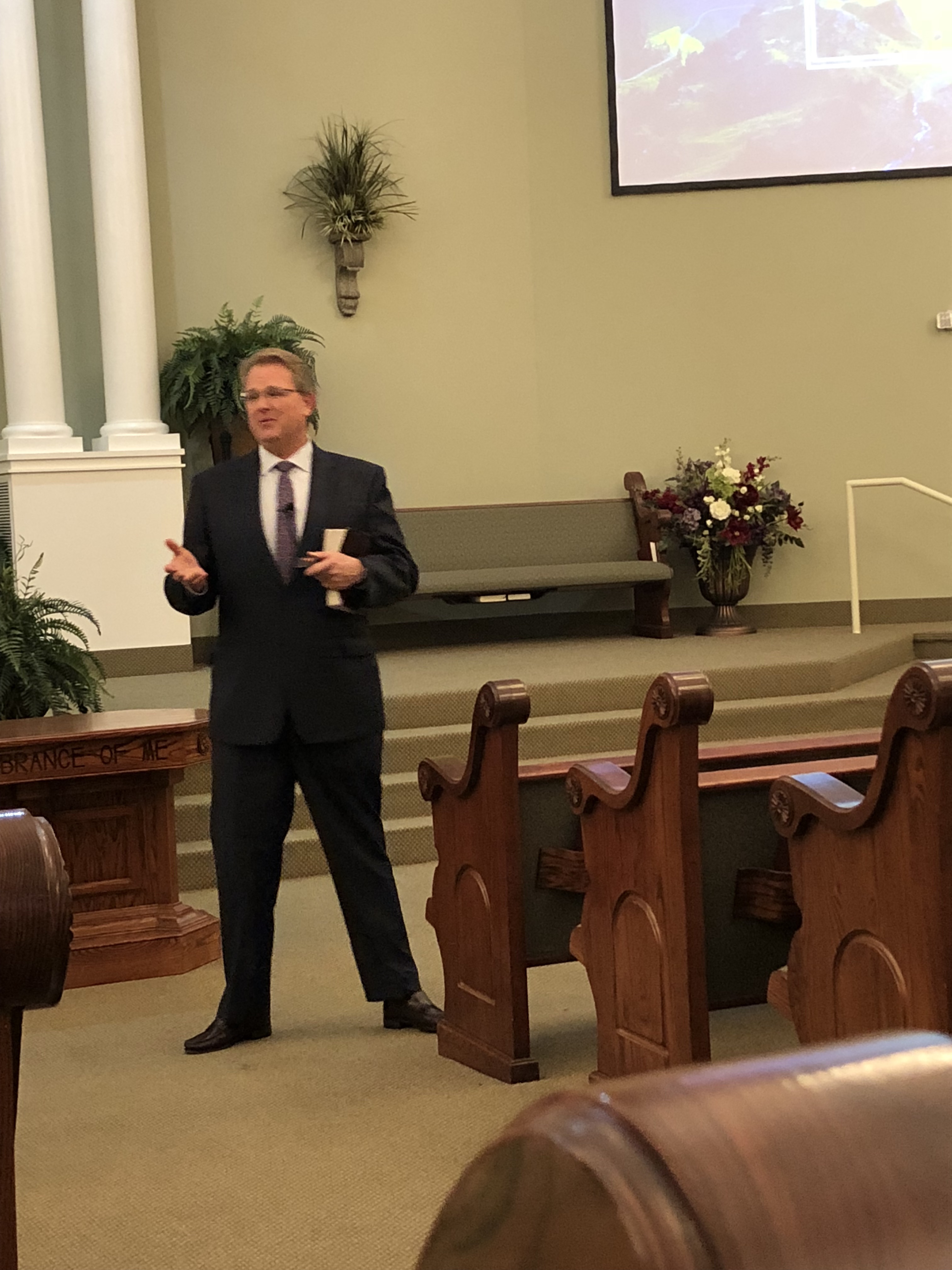
One of my favorite preachers delivering the invitation in Lexington, KY (2018)

The Guest 

Tuesday’s Column: Dale Mail

DaleandJanelledirectorypic

Dale Pollard

A knock came on my door one day, I opened and it was Sin
Before that moment we hadn’t met, but still I let him in
He made me laugh, and seemed alright
so I let him stay a night

As host, I tended his every need
though he was quite a mouth to feed
He was entertaining
so he kept remaining—
With me, another day

One evening he sat at my table and dined

but late that night he robbed me blind

In an empty house I sat alone
The tears welled up, I should have known

Sin ate his fill against my will,

and now I’m skin and bone

Then again I heard a knock on my door

Reluctant was I to rise from the floor
If a guest, they can’t stay here anymore

the previous left me dejected and poor

But again and again
came the knock on my door
So timidly I answered,

but only opened it so wide

and there stood Jesus waiting,

on the other side

I had nothing left to give Him, nothing left to eat—
Yet He came inside,then got down, and began to wash my feet
He told me I could live with Him, for He had many rooms
No pain was there at His house, and the flowers always bloom
Could this be true what I was hearing—
I longed for nothing more
Then Jesus smiled and gently said—
this offer is for you and all
who open up the door
doorknob-686491_960_720

Biggest Misunderstandings About Public Responses

Neal Pollard

There are a couple of examples of public responses to the gospel message in the Bible, both in Acts.  One is positive and the other is negative.  As Peter was preaching that God has made Jesus Lord, the Pentecost crowd interrupted him with the question, “What shall we do?” (Acts 2:37).  As Stephen was delivering a similar message, his audience stopped listening and they cried out with a loud voice before putting the preacher to death (Acts 7:54ff).  Mention is made of a one another response that could apply to the corporate assembly, confessing sins (Jas. 5:16; 1 Jn. 1:9).  How public the setting was when Peter called for Simon to repent we do not know for certain (Acts 8:18-24).  So, why do we end our sermons with a call to publicly respond?  Is this simply borrowed from the denominations or is it just a rote tradition devoid of deeper purpose?

Often, we have explained the invitation as being an “expedient,” which I think it is.  When we speak of an “expedient,” we refer to a practice that is thought convenient, practical, suitable or appropriate but neutral (neither right nor wrong) and a-biblical (not found in the Bible but not unbiblical).  It is a sensible activity.  Hopefully, the sermon contains a call to change and is persuasive in nature.  Maybe, the person comes in the door that day convicted of his or her need to become a Christian or repent of public sin.  Affording a moment that makes it easy for one needing to obey Christ in one of these ways to do so is appropriate.

I have been in assemblies in this country and overseas that do not have such a time set aside or that do so at other times during the gathering—some do so at the beginning of the service so that a person can worship without being alienated from God (cf. Mat. 5:24), some invite anyone who needs to publicly respond to remain standing after the lesson and a song, some encourage people who need to respond to write their need on a card or piece of paper and hand it to an usher, the preacher, the elders, or someone designated to collect such communication.

While I think it is good for us to consider that there is more than one way to do this and that we are not mandated to do it at all in the assembly, I believe our current arrangement is a fine way to try and help people who need to make spiritual changes and improvements.   Yet, someone who feels the need to make such a response often hesitates or decides against it.  Certainly, the problem on such an occasion might be fear or delay, but is it ever due to some misunderstanding such a one has?  Here are a few of the biggest misunderstandings people have about responding to the invitation:

  •  Nobody but me is struggling with sin in their lives.  Truth: Romans 3:23.
  •  It is a sign of weakness to respond publicly.  Truth: Luke 15:10, 17
  •  Everybody will look down on me, judge me, or gossip about me if I respond.  Truth: Luke 15:28-32
  •  People will distance themselves from me if I respond.  Truth: 1 Corinthians 12:26-27.

Maybe you are thinking this or something similar.  May I assure you that every righteous person on earth and all the inhabitants of heaven would like nothing better than to help you be right with God.  Death and the Judgment loom, and we cannot let anything keep us from making proper preparation for them.  So, if you need to respond today or any day, won’t you come?

14-church-carpet

He Can Carry What’s Too Heavy For You

Jeff Wiant has been a Christian since early 2015. Since then, he has written 11 hymns. They are all beautiful, but this may be his best. It’s his first invitation song to write.

Poem inspired by this beautiful new song by Jeff Wiant, member at Bear Valley.  Click on the link below to hear it:

CLICK HERE: Jeff Wiant’s “Won’t You Come”

Neal Pollard

We struggle and strain to carry our load
We buckle as it gets heavier on our backs
We fall and hurt on this rough, rocky road
The weight makes us stop in our tracks

Looking around with a face full of pleading
We wonder who is observing our pain
We’re wounded, weary, broken and bleeding
Set to surrender from the stress and strain

Tears flow freely, we have been here before
We know how the journey seems endless
Certain we can’t make it alone to the door
We feel solitude, helpless and friendless

It’s bigger than us, crushing and enormous
And the contents shameful and unsightly
We’ve borne it so long it’s begun to conform us
To a stooped struggler holding on tightly

A voice calling gently, “Bring it over to Me,
I can help you and give you My best,
Your burden is heavy, I know you are weary,
Come to Me and I will give you rest.”

Could you double down, wincing and worn,
Grit your teeth and ignore His free aid?
Eventually, it will bury you after making you mourn
You know an exorbitant price must be paid.

He is able and willing, but waiting for you
To seek what He offers you without reservation
Let Him do for you what only He can do
Give your burdens to Christ with no hesitation.

Think of the journey, partnered with One
Without limits in power, purity and pity
Who’ll stay with you until your journey is done
As together you arrive at His heavenly city.

Dockers de Cap-Haïtien

Embracing The Struggler

Neal Pollard

So much is said about the deficiencies of youth and young adults in our current culture. While every generation has its shortcomings, I have observed a hopeful trend. Perhaps it rests on the faulty foundations of political correctness and relativism, but young people today seem much more prone to accept and nurture those who have discernible difficulties like handicaps, mental or physical challenges, or social limitations.

Another way it shows up, specifically in the church, is the way they rally around those who are spiritually broken or in need. When a teenager or young adult responds to the invitation, watch how their peers flock to their side to show their support. This beautiful, tangible act is reflective of the father in the parable of the Prodigal Son, and it is a trait that the father so wanted from the older brother (cf. Luke 15:20,31-32). It looks a lot like the tender goodbye between Paul and the elders in Acts 20:37.

This willingness to reach out and comfort one another is a supremely biblical way of interacting within the family of God. 1 Thessalonians 5:11 says, “Therefore encourage one another and build up one another, just as you are also doing.”  God calls His people to have that kind of nurturing spirit. When we see those who are physically hurting, we should respond (Mat. 25:35-36; 1 Jn. 3:17). When we see those who are emotionally hurting, we should respond (Rom. 12:15). When we see those who are spiritually hurting, we should respond (Gal. 6:1-2; Jas. 5:19-20). The response should be more than token and certainly should not be heartless and surface. It should not be shown with favoritism, but to everyone who is in need of it.

This warm and loving response may not come as naturally to some of us who are older, but oh how crucial it is that we stretch ourselves to do it. Embracing a sinner does not mean embracing a sin. Let us discipline ourselves to see the difference. Hear the words of the Hebrews 12:12-13: “Therefore, strengthen the hands that are weak and the knees that are feeble, and make straight paths for your feet, so that the limb which is lame may not be put out of joint, but rather be healed.”

13407188_10209411714315519_8514604783791013955_n