METH-FLAVORED MILKSHAKE

Neal Pollard

It allegedly happened in 2014, but now Fred Maldonado is taking In-N-Out Burger to court for what he said he found at the bottom of his cup.  While their is some “fishiness” to his story and the restaurant “will vigorously defend [against] these baseless claims,” Maldonado “found a napkin and two capsules in the bottom of his milkshake cup” and “later testing revealed that the capsules contained methamphetamine” (from “Businesstech” article).

Search the internet a little and you will find more stories than you can probably stomach about what people have found in their prepared or packaged food and drinks.  As a consumer, the thought of such is enough to make you grow everything you eat and never eat out again.  In the supposed “meth” incident, add danger to disgust!  There is a certain amount of faith and trust one has that those responsible for getting his or her food (or drink) will give them what and only what they paid for.

Tragically, every Sunday in churches across the globe, people sit down to receive what they sincerely believe to be the “bread of life” (cf. John 6:35) and the “water of life” (John 4:10). They trust that the one who is delivering it to them, maybe one they consider a friend and a spiritual brother, is giving them exactly what is claimed—the Word of God. Yet, Scripture warns that there are those who taint the message with something far more appalling and dangerous than anything else could be.  Instead of truth, they get myths (2 Tim. 4:4). Instead of the sure word of Scripture, they get destructive heresies (2 Pet. 1:19-2:1). Instead of light, they get darkness (John 12:46). Instead of Christ, they get philosophy, empty deception, tradition of men, and elementary principles of the world (Col. 2:8).

Paul wrote that divine judgment awaits any who “did not believe the truth, but took pleasure in wickedness” (2 Thess. 2:12).  The hearer has a responsibility to check what the teacher says, to make sure it is right and true (Acts 17:11).  God will hold everyone responsible for what they did with His Word. Even though teachers face a stricter judgment (cf. Jas. 3:1), He holds you and me responsible for avoiding dangerous, disgusting doctrine.  It takes practice to have our “senses trained to discern good and evil” (Heb. 5:14).  Take charge of your own spiritual nourishment, from what you hear on Sunday to what you read every day!

If The Bible Is God’s Word…

Neal Pollard

  • It answers the biggest mysteries of this life that so baffle humanity.
  • It reveals the plan of the Creator of everything.
  • We are accountable to it.
  • It tells us where we are going.
  • It will give us a guide we can have confidence in as we head to the future.
  • We cannot refuse to follow it.
  • We should share it with as many people as we possibly can.
  • It is not on a par with other books; it is superior to all of them.
  • He disapproves of religious division.
  • There is a right way to worship Him.
  • We can know the truth.
  • We discover some great, precious and exciting truths and promises.
  • The New Testament church is eternally important.
  • We should read and study it faithfully.

Investigate the Bible and explore its origin and the book as it is today.  God’s Word is not afraid of investigation.  It has been more scrutinized than any other book ever written, and it still stands.  It is a foundation we can confidently build our lives upon.  It is a guide that can safely lead us now and forever.  Have you been in the book of books today?

THE MASTER’S MATERIAL

Neal Pollard

A while back it was popular in the religious world to talk about Jesus’ encounter with two disciples on the road to Emmaus. The emphasis has often been on the disciples’ experience. I believe the biblical emphasis is on the character of Jesus. The disciples are contemplating Him even as they encounter Him. They describe Jesus as “a man who was a prophet mighty in deed and word before God and all the people” (Luke 24:19). Notice three reasons why He was so mighty in word before all the people.

JESUS KNEW HIS MATERIAL. Luke 24:27 says, “And beginning with Moses and all the Prophets, He interpreted to them in all the Scriptures the things concerning Himself.” Truly His knowledge is perfect and ours is not, but there is no excuse for failing to study–both on our own and for a class we are teaching or sermon we are preaching.

JESUS KNEW HOW TO RELATE ITS MEANING EFFECTIVELY. The men journeying to Emma’s, after walking with Jesus, said, “Did not our hearts burn within us while He talked to us on the road, while He opened to us the Scriptures?” (Luke 24:32). The dismal method of too many Bible classes is to essentially read and paraphrase in verse by verse fashion. Preaching can too often be disorganized in delivery or vague in message. Paul told Timothy, “Do your best to present yourself to God as one approved, a worker who has no need to be ashamed, rightly handling the word of truth” (2 Tim. 2:15, NIV).  Robertson says of “rightly handling” that it means “cutting straight…Since Paul was a tent-maker and knew how to cut straight the rough camel-hair cloth, why not let that be the metaphor?” (Vol. 4, 619). As presenters of truth, tell what it meant then and in context, and then apply it!

JESUS KNEW HOW TO MAKE THE MATERIAL LIVE IN HIS STUDENTS. Luke 24:45 says, “He opened their minds to understand the Scriptures.” That is just what we are after as teachers, preachers, and proclaimers of the Word. We are not just fact-reporting. We are trying to get into the heart. Remember that Jesus sought to change lives with His teaching.

Only Jesus was the perfect teacher. But we can always be better and great. Let us mimic the Master’s approach to His material!

“Moral Leadership?”

Neal Pollard
This is how Seth Fiegerman at Mashable summarized new Apple CEO Tim Cook’s recent moves, an array of social activist “statements” that includes an Apple gay pride parade and declaring himself homosexual, calling to attention to perceived environment and climate change, and associated causes. Fiegerman also synonymously dubbed his activism as “moral authority” and “staking out moral ground.”   The evocative title of the article is “Apple’s new moral era begins” (6/8/15). As a happy “Macster” with an iPad and iPhone, I am not a frustrated PC user looking for an opportunity to rage against the Apple machine.  It is what it is.
Whether or not you agree with Cook, he is most certainly assuming definite moral leadership.  Indeed, it is not overstating things to say he is “moralizing,” as vehemently as any preacher, professor, or reformer could.  In his powerful position at one of the most influential companies in the world, Cook is spending his leadership capital in a profound, definite, and specific way.  However, it is not as if he invented moral leadership.  Anyone with any influence in any point in history is wielding moral leadership, staking out moral ground with at least some degree of moral authority.  The defining question is, “Whose morality?”
The Bible defines morality.  As the product of a transcendent, all-powerful authority, the Bible is the only legitimate standard of morality.  It outlines a specific way of living, using words like godliness (see especially 1 Tim. and 2 Pet.), moral excellence (2 Pet. 1:5), detailing a moral lifestyle (cf. Gal. 5:22-23), and the like. It also forbids a specific way of living, using terminology like immoral and immorality.  Its standard is specific.  Consider a few examples:
  • If a man marries a woman and her mother, it is immorality (Lev. 20:14).
  • Divorcing your wife and marrying another woman is adultery, unless your wife is guilty of sexual immorality (Mat. 19:9).
  • A man who had his father’s wife was guilty of immorality (1 Cor. 5:1).
  • Sodom and Gomorrah were guilty of gross immorality and going after strange flesh (Jude 7).
  • Along with a covetous, idolatrous, drunk, or swindling person, God says to avoid the immoral (1 Cor. 5:11).
  • Immoral men are placed alongside homosexuals, kidnappers, liars and perjurers as contrary to sound teaching (1 Tim. 1:10).
  • Esau selling his birthright is called immoral (Heb. 12:16).
There are many other examples of Scripture defining morality, often by pointing out its opposite.  People who use their influence to lead people to do the immoral are certainly exerting moral leadership, but it is leadership contrary to the heart and will of God.  There is a vital need for you and me, as those who love and trust God’s Word, to exert true, moral leadership, to exalt His morality.  A saying attributed variously to Edmund Burke, John Stuart Mill, and Charles Aked, is very familiar to most: “The only thing necessary for the triumph of evil is that good men should do nothing.”  May we step forward and exert moral leadership that honors God.

The “Moral Compass” Of The Modern Culture

Neal Pollard

If a nation or people will move back toward the Bible, it must overcome three philosophical barriers.  I mentioned these in an earlier blog (read here).  Here are the three barriers:

  • The Cultural Sickness Of Subjectivity.  Subjectivism, in its final form, makes the individual “god” and their views supreme. Thoughts and feelings trump a rational look at an individual matter, and even searching for an objective viewpoint is disdained.
  • Society’s Warped View Of Tolerance.  Rather than “hate the sin, love the sinner,” the mantra is “there is no sin and no sinner.”  Though everyone has a line in the sand somewhere, no one wants anyone putting their behaviors on the other side of the line.
  • The Average Person’s Ignorance Of The Bible.  Of course, we are getting past the point where the average person believes the Bible or has a favorable view of it.  The fruit of the seeds of biblical illiteracy is more than immorality.  It includes prejudice against the Bible and contempt for those who seek to upheld it in most any forum.

Certainly, those professing to follow the Bible and its guidelines have hurt their own cause through ungodly attitudes, hypocrisy, isolation, and prejudices of their own.  Christians must be willing to make the first (and even second and third) steps (cf. Mat. 5:41).  We must model biblical teaching with righteous lives (Mat. 5:14-16; 1 Pet. 2:9).  We cannot expect the world to act Christlike, but we must expect that Christians will not be worldly.  We can effect the change we want to see, and, in time, align the culture’s moral compass with the Creator’s.

The “Religious Condition Of The People”

Neal Pollard

After describing the “religion of the heart, not of the head,” scripture-less sermons of his contemporaries, a certain writer then focused on the consequent religious condition of the people.  He wrote,

The religious condition of the people very greatly corresponded to the teaching
of these preachers. The native common sense of some told them, that if God
gave a revelation to man, it certainly was one that man can understand.  That
it was unreasonable God should give a revelation of his will, and then need an
interpreter of it to the very men, for and to whom he gave it, so they studied it
for themselves, and learned many of its truths…

But the masses of the people did not study the Bible, made no effort to learn
what God had revealed in this Book to men, looked at it as a sealed Book to
them, made no effort to a religious life further than to live a respectable moral
life, obey the laws of the land, and maintain a reputable character among their
fellowmen…The religious life was one of impulse and feelings, days of sunshine
and cloud, moments of joy and hope, succeeded by long periods of doubt and
despair. They had no though of regular, faithful, self-denying obedience to God
bearing the fruit of joy and peace in the Holy Ghost.
(Lipscomb, David. Life and Sermons of Jesse L. Sewell.
Nashville: Gospel Advocate, 1891. p. 35-36).

Lipscomb wrote concerning those in mid-19th Century Tennessee, but it was probably true of mainstream America at the time.  They experienced different religious influences, particularly the ideas of hardline Calvinism.  Yet, how similar it sounds to even our own day.  Some are willing to hold themselves personally accountable for knowing the Bible, God’s written revelation.  They know they need to study and follow it, and they are open to do that.  Yet, the masses still try to live a self-guided, vaguely “moral” life of doing good things without learning for themselves what God’s instruction book says.  As the result, they meander through life in a sort of rudderless fashion.  That is, they have no concrete guide and show no serious interest in what God wants them to do.  At least, their interest is not great enough to drive them to read, study, and try to understand the Bible.

We have an obligation to seek searchers and point them to “the Book.” We also have a responsibility to ourselves, to faithfully delve into the Sacred pages, discern God’s will and then be changed by it.  The masses will likely always be as they were in Lipscomb’s and our day.  Our task is to go deeper and help others do the same.

IS TRUTH “OBJECTIVE” OR “SUBJECTIVE”?


Neal Pollard

“You folks believe baptism is essential, but we believe we are saved when we accept Jesus in our hearts by faith.” “Why does the church of Christ think it is wrong to use a piano?”  “You must not like women.  You sure don’t let them use all their ‘gifts’ in your worship and leadership.”  These are just three random examples of statements of perception made by our friends and family concerning “our beliefs.”

How would you answer these?  Even within the Lord’s church, more than one answer is often offered.  Sadly, too often the heat of emotion eclipses the light of scripture in these matters.  How is truth determined?  Is it man’s right to decide what truth is “for him”?  Can I have my truth and you have your own, different truths, and we both are right?  Please understand that I am not speaking of matters of judgment, opinion, matters that must be determined by principles of scripture, scruples, and conscience.  Take the three examples mentioned-baptism, church music, and the role of women.  Are these matters that must be decided by mere human judgment, opinions, and conscience?  Or can we “know the truth” on these things (cf. John 8:32)?

All of this ultimately boils down to our attitude and approach to God’s Word.  Do we accept it at face value and glean from it what it has already said, or do we infuse (insert) into it our predetermined values and desires?  Consider the three examples.

Baptism is connected to salvation in the gospels (Mk. 16:16), the history book of the New Testament (Acts 2:38; 22:16; etc.), and the epistles (Rom. 6:1-6; Gal. 3:27; Col. 2:12; 1 Pet. 3:21; etc.).  Why would we deny it?  Do we really hope to make scripture fit our view by trying to make Bible verses conflict with each other (cf. John 3:16; Acts 16:31)?  If the Bible repeatedly says baptism is necessary for salvation, isn’t that a truth objective and universal?  If not, why not?

Singing is specifically commanded in major worship passages like Colossians 3:16 and Ephesians 5:19.  We have no doubt that God wants us to sing.  Now, some say that it is a matter of preference whether you sing with or without instrumental accompaniment.  I find it interesting that a New Testament writer teaching a New Testament principle makes his point with an example from the first covenant.  In Hebrews 7:14, the penman writes, “For it is evident that our Lord arose from Judah, of which tribe Moses spoke nothing concerning priesthood.”  Moses did not forbid a man of Judah from serving as a priest.  God simply specified that the tribe of Levi was to be the priestly tribe.  Was priesthood selection a matter of personal preference?  Absolutely not (see 1 Kings 12)!  

Women’s role in the church is discussed in the midst of an epistle the thesis of which is that the church may know how to conduct herself (1 Tim. 3:15).  Part of that conduct regards women’s role in the church (1 Tim. 2:9-15).  The Christian woman is not to teach or have authority over the man (2:11-12).  The reason is not tied to Greek culture, but way back to original design at the beginning of the world (2:13-14).  When some push for an “expanded” role for women, are they letting cultural pressure of heavenly desire drive them?

Certainly, we cannot be callous or altogether dispassionate in studying or discussing these matters.  But, without recognizing a sovereign, divine standard of truth, what are we doing with Scripture?  Whether meaning to or not, we are subjugating God’s stated will to our subjective, ever-shifting will.  John 12:48 reminds us that the latter will ultimately be irrelevant.

WRONG QUESTION: “WHO’S THE GREATEST?”

Neal Pollard

It was the late ’70s and I was spending the night with my best friends, Patrick and Jody Smith.  We had just finished watching The Bionic Man on TV, and there was a special on Muhammad Ali.  I can still remember his banter with Howard Cosell and the gifted boxer looking at the camera and saying, “I-am-the-greatest!”

“Who is the greatest?” is a burning question in men’s minds.  We want to know who’s the greatest.  Whatever the profession, endeavor, or skill, there are folks vying for the top spot.  People once immortalized for feats and accomplishments, like Tom Courtney, Neil Armstrong, George Washington, Clara Barton, Florence Nightingale, or Muhammad Ali, fuel future competitors to meet and exceed their successes.

The disciples wanted Jesus to tell them, “Who then is greatest in the kingdom of heaven?” (Matt. 18:1).  On a journey to Capernaum, they argued among themselves about who was the greatest (Mk. 9:34).  Here were twelve men who were selected by Christ to have a part in the greatest work on earth.  That was honor and purpose enough, but they wanted more.  If that was good, being the best of the best was better.  Such thinking was way off base, which Jesus repeatedly demonstrated through His humility, sacrifice, and service for the good of others.

Today, we wrestle with the same affliction.  Whether in our daily lives or even within our function in the church, we can get caught up in being recognized as the best.  This is a destructive exercise and misses the point.  If we are Christians, we are among God’s chosen on this earth.  What a privilege!  We have the highest, most important business to do.  Let us do our best and work our hardest, but let us never get caught in the trap of showing others that we are the best.  The very attempts disqualify us.


“Addressing The Huge Unmet Needs Of Young Children”


Neal Pollard

The philosophically liberal magazine, American Prospect, included an article in the January/February, 2014, edition, by Sharon Lerner entitled, “Starting Smart.”  The article begins by asserting that there is almost universal support in the public, business, and political sectors for mandatory, universal Pre-K education.  Lerner, considering such broad favor, ardently calls for leveling the playing field wherever there is a perceived gap, and mandating public education for the nation’s youngest citizens is alleged as the way to go (62-65).  While I have multiple problems with the content of the article, my biggest disagreement is that social, economic, or other physical needs are, as the article contends, a small child’s greatest unmet needs.

The hugest unmet needs of young children in this and every culture are spiritual.  It would be interested to know what percentage of our nation’s children get even weekly Bible instruction.  For several decades, there has been a steep decline in spiritual interest in our country.  Secular interests have far eclipsed spiritual interest.  I am confident that such tragic facts, when we stand before Christ at the Judgment, will help explain the moral volcano that has spilled its damaging influence over just about every aspect of society.

While our evangelistic efforts can help us reach more “unchurched” folks and incorporate them into our Bible school program, something else has amazed me.  Growing up in the church, I have for all my life seen neglect from some members of the church in this area.  Parents did not bring their children to Bible class regularly if at all.  When those children grew up and left the home, they usually left the church, too.  I still witness that same trend, both in congregations where I have preached and in places where I travel to speak.  In essence, this robs children of the solid foundation they must have to navigate the turbulent spiritual waters of this life.  Parents, let us take Solomon’s words to heart and do all we can to properly train our children for later life and eternity (Pr. 22:6)!  God has entrusted their eternal welfare into our hands.

Avalanche Season

Neal Pollard

They are calling it an historic avalanche season in Colorado.  With snowpack at well over 100% due to massive amounts of mountain snowfall, conditions are prime for avalanches to breakout all over the backcountry. Already, six have died in avalanches this winter.  In fact, there have been three deadly slides just in the past week.  Warnings continue to come in from The Colorado Avalanche Information Center about dangerous conditions following two weeks of heavy snow.  Others have escaped death, but have harrowing tales of survival and, in some cases, broken bones.  Avalanches travel at the rate of a speeding car and hit with the force of a freight train. Typically, those buried in an avalanche lie beneath a ton of snow and the most common killer is either suffocation or blunt force trauma.  The head of the CAIF says the three most important tools are the beacon, probe, and shovel. The first is worn by the potential victim, while the other two are used by the rescuer.  Though these events can happen and be over in a matter of seconds, they can bring permanent consequences (information via FoxNews and Time’s Science And Space).

How often do we face overwhelming circumstances which we might liken to an avalanche?  They happen suddenly and seriously, and the aftermath can feel almost suffocating.  Though with different images, Bible writers speak of the feeling of burdens and sins being heavy and over their head (Ps. 38:4; Lam. 3:54).  David says similar things about trouble (Ps. 119:143) and iniquity (Ps. 40:12) overtaking him so that he cannot look up.  Maybe you can relate to such feelings, whether brought on by the guilt of sin or the difficulties of life. Both can threaten to bury us.  These things have even led to spiritual death.

May I suggest that we need the same three tools for our spiritual escape.  We have a beacon (Ps. 119:105), yet it also serves as a probe (Heb. 4:12) and a shovel (cf. Ps. 107:20; 147:16ff).  He also blesses us through prayer and providence.  Through all He does, God provides us a way of escape (1 Co. 10:13)!   We can survive, even in those times when problems crowd into our lives and threaten to bury us!  God is greater and stronger.  When swept up, hold on! Help is on the way.

SOLA SCRIPTURA?

Neal Pollard

Pythagoras is said to have been the earliest outside of Scripture (Isa. 40:22) to contend that the earth is round. He did not make the earth round with his assertions, but identified what already was.  Sir Isaac Newton certainly did not create gravity, but he is credited for our modern understanding of it.  Likewise, the term “sola scriptura” is not found in scripture (similar to terms like “trinity” and “omniscience”), but it was coined during the “Reformation Movement” as part of Martin Luther’s protests against perceived corruptions of the Catholic Church.  It was a “Latin phrase (literally ‘by Scripture alone’) describing the Protestant theological principle that Scripture is the final norm in all judgments of faith and practice. Church traditions and customs, pronouncements of church officials, civil law or any other purely human source, including human reason, must yield to clear scriptural pronouncements” (Reid, Daniel G., et al.  Dictionary of Christianity in America, 1990: n.p.).  Did the Protestant Reformers, who, incidentally, got unfortunately got so many things wrong, originate that idea?  Because they were wrong on many doctrinal conclusions, does that automatically make the idea of “sola Scriptura” incorrect? It seems to me that at least three questions are in order regarding this subject.

What does “by Scripture alone” mean?

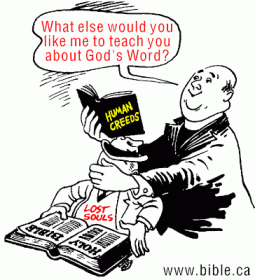
It means that the Bible does not share authority with anyone or anything else.  One author says it meant “’the freedom of Scripture to rule as God’s word in the church, disentangled from papal and ecclesiastical magisterium and tradition.’ It viewed the Word as supreme over tradition and the sacraments” (McArthur, John. Expository Preaching, 1992. Dallas: Word Pub., 47). A creed book, discipline, or annual church conference may vote and decide about what a religious group’s view on a matter should be.  They may even change their view from a previously held, correct view.  Or, a religious group may claim to have received latter day revelation and may produce a book they claim to be co-authoritative with the Bible.  Or, they may say “the church” and “church tradition” is co-authoritative.  The idea of “by Scripture alone” rejects competing or co-authoritative standards.

It does not eliminate the need to “handle aright” or involve hermeneutics (the science of interpretation).  That is a cognitive necessity.  You cannot read even the simplest of instructions or follow the most basic of tasks without employing logic, reason, and deduction.  That is not the same thing as a person, group, or book that claims to rival or co-authorize with Scripture.

What is the alternative?

That question has really already been answered.  The alternative is to suggest that Scripture alone is insufficient or inadequate, that is not the sole authority on matters of truth and right.  Some would even call the idea of following only Scripture as destructive heresy. Yet, the alternative to Scripture alone is Scripture along with something else, whether a man, group, council, church, or governing body.

Why is it so important?

This is the crux of the matter.  Scripture is God-breathed, making one spiritually complete (2 Tim. 3:16-17).  If Scripture is sufficient, what need is there for anything beyond it?  On what basis would we accept anything more or less than or different from the Bible?  How could fallible man be equal to or co-authorize with the perfect law of the Lord?  Let us accept no substitute or rival to the Bible!

The reader is encouraged to consider some excellent thoughts on this subject from here: https://www.christiancourier.com/articles/557-what-is-sola-scriptura


IF THE CHURCH OF CHRIST WILL TRULY BE UNDENOMINATIONAL

Neal Pollard

The Restoration Plea is valid, vital, and victorious!  It urges every believer in Christ to throw off the shackles of humanly-devised traditions and beliefs that undermine and contradict the sole, supreme authority of Christ.  Religious division has been spawned through time because of men’s preference for their own creeds and doctrines.  Reason and rationale becomes, “We’ve always done this” or “We prefer this” rather than “Thus saith the Lord!”  With human nature, we are often prone to see such faulty thinking in others while being blinded to our own potential guilt.  This happens to us individually and it certainly can happen to us collectively.  Painfully aware of my own limitations and shortcomings, may I offer some cautions to us out of a sincere love of Christ and His glorious bride?

If the church of Christ will truly be undenominational,

  • We must build our faith and beliefs from the “text out” rather than assert our beliefs and then find verses to support it.
  • We must avoid blind loyalty to any individual, congregation, school, work, and the like.
  • We must determine not to press our inclinations, preferences, judgments, and opinions to the extent that such divides brethren or becomes matters of fellowship.
  • We must strive to preach and practice “the whole counsel of God,” even in unpopular matters or those we may have neglected (church discipline, evangelism, marriage, divorce, and remarriage, moral purity, first-century-like benevolence, etc.).
  • We must be patient and loving within and towards congregations, be they Thessalonicas or Corinths.
  • We must avoid unconditionally venerating and idolizing men above the Lord.
  • We must repent of our intensely “in-reach” philosophy and rededicate ourselves to intense “outreach” in our communities.
  • We must avoid convenient silence in our pulpits and classrooms regarding New Testament distinctiveness and doctrine.
  • We must increase our faith in the absolute, unqualified Lordship of Jesus.

This list is inevitably incomplete and imperfect.  How could it not be, since it is put forward by one who is certainly both those things?  Yet, it is put forward to emphasize that there is an urgent need for us to continually examine our beliefs and practices making sure our allegiance is to the Christ and not men—however great and noble they seem to us.  Our Lord said, “He who rejects Me and does not receive My sayings, has one who judges him; the word I spoke is what will judge him at the last day” (John 12:48).

Addicted To The Taste

Neal Pollard

On a slightly different life’s path, Kathy could easily be a world-famous, wealthy celebrity on Food Network.  Her culinary skills and creativity in the kitchen has yielded some incredible dishes that would cave the iron-willed. Incredibly, she has learned through the years to make things that are good for you not simply palatable but tasty!

In 1 Peter 2, Peter urges Christians, facing an ultimate inheritance from a God who wanted them though impeded by persecution by a world who did not want them, “Therefore, laying aside all malice, all deceit, hypocrisy, envy, and all evil speaking, as newborn babes, desire the pure milk of the word, that you may grow thereby, if indeed you have tasted that the Lord is gracious” (1-3).

Peter urges them to purge from their spiritual diet those dangerous additives of attitudes in verse one.  They are more than malnourishing; they are poisonous!  Instead, he calls for them to hanker for the pure milk of God’s Word.  What would heighten their craving was having tasted the Lord’s graciousness.

May I suggest that this is a cyclical process.  In other words, we must be willing to begin feeding on the word.  For most, this is an acquired taste.  But from the first serving, the reader gets a taste of God’s good food.  It nourishes and satisfies.  It illuminates the soul.  It is practical in daily application.  It helps forge a closeness with God.  It gives strength in a difficult world.  The blessings of Scripture are multifarious, endless, and inexhaustible. The very experience of all of this by the consumer drives him or her right back into the Word for more!

Are you addicted to the sweet savor of Scripture?  If you are not partaking, you are starving your soul!  Those hunger pangs you feel cannot be satisfied by adulterated alternatives. Let us say with the ancient patriarch Job, “I have not departed from the commandment of His lips; I have treasured the words of His mouth more than my necessary food” (23:12).


Are There Diamonds In Antarctica?

Neal Pollard

With the recent discovery of kimberlite on the east coast of Antarctica around Mount Meredith in the Prince Charles Mountains, there is considerable talk that much more may lay beneath the ice and cold at the south pole.  Kimberlite is a type of rock known to contain diamonds, named for Kimberly, South Africa, which lays not far to the north.  It is a rare rock, and the discovery of it in Kimberly led to a 19th-century diamond rush.

Despite the promise and prospect of diamonds in Antarctica, there will not likely be an onslaught of prospectors there.  There is the forbidding cold, isolation, and winter darkness, the meticulous restrictions forged by environmentalists, and how difficult it is to travel there.  For now, it is an interesting discovery.  Whether or not there will be diamond mining there in the future, time will tell (Alister Doyle, Reuters, 12/18/13).

Is it possible that an even bigger treasure is buried, not beneath ice or international treaties, but rather mounds of fear, indifference, and the like?  Paul says “we have this treasure in earthen vessels” (2 Co. 4:7).  The treasure is the message of salvation through Christ (cf. 2 Co. 4:2-6) and we are the earthen vessels.  God gets this treasure to the world through us.  But, far too many of us are burying this treasure like one man did in the parable of the talents (Mat. 25:25).  In a similar parable in Luke, a man hides his mina in a handkerchief (19:20).  In both parables, the application is the same.  God does not want us to keep this treasure hidden and inaccessible.

The soul-saving message of grace should not be buried.  We should not keep it in isolation, be cold or forbidding in any way.  God wants every person to have access to this treasure (1 Ti. 2:4), and He is counting on us to share it!

TIPS FROM JESUS

Neal Pollard

These are far from comprehensive, but they form a sample of Jesus’ vast wisdom:

  • “Come to Me and I will give you rest” (Mat. 11:28-30)
  • “Give and it will be given to You” (Luke 6:38)
  • “Seek the Kingdom first and all these things will be added to you” (Mat. 6:33)
  • “Whoever desires to come after Me, let him deny himself” (Mark 8:34)
  • “He that believes and is baptized shall be saved” (Mark 16:16)
  • “It is more blessed to give than to receive” (Acts 20:35)
  • “The greatest among you shall be your servant” (Matt. 23:11)
  • “If you love Me, keep My commandments” (John 14:15)
  • “If you forgive men their trespasses, your heavenly Father will also forgive you” (Mat. 6:14) “Do not worry” (Luke 12:22)
  • “All men will know you are My disciples if you love one another” (John 13:35)
  • “Everyone who lives and believes in Me will never die” (John 11:26)
  • “Take heed; keep on the alert!” (Mark 13:33)
  • “Be on your guard against every form of greed” (Luke 12:16)
  • “Unless you repent, you will perish” (Luke 13:3)
  • “First take the log out of your own eye” (Mat. 7:5)
  • “Do not let your heart be troubled, nor let it be fearful” (John 14:27)
  • “Do not store up for yourselves treasures on earth” (Mat. 6:19)
  • “All things you ask in prayer, believing, you will receive” (Mat. 21:22)
  • “Whoever does not receive the kingdom of God like a child will not enter it at all” (Mark 10:15)

This is truly just the “hem of the garment.” Spend some time with the gospels and the life of Christ. It will enrich you with infinitely more than money. It will allow you to bless others, but none will be more blessed than you if you take these to heart and live them out in your life!