Why Going To Church Matters

 Saturday’s Column: Captain’s Blog

Carl Pollard

There’s the story told of an elderly lady that was amazed at how nice the young man next door was. Everyday he would help her gather things from her car or help her in her yard. One day the old lady finally asked the young man, “Son, how did you become such a fine person?” The young man replied, “Well, when I was a boy, I had a drug problem.” The old lady was shocked and said, “I can’t believe that.” The young man replied, “It’s true, my parents drug me to church on Sunday morning, drug me to church on Sunday night, and drug me to church on Wednesday night.”
Have you ever paused and thought about why you go to church? What reason causes you to bring your kids to worship? What’s the point? Contained in the pages of God’s Word we can find at least three reasons why we go to church. 

A Past Example

God is a God of remembrance. He would repeatedly instruct, comfort, and encourage the Israelites by reminding them of things He had done in the past. He used reminders of past instances to help motivate His people. God’s Word continues to do that for us today. It is filled with past examples to help remind us why we come together each week. We go to church because of a past example (Acts 2:41-47; Acts 20:7). 

A Present Encouragement 

1 Thessalonians 5:11 says, “Therefore encourage one another and build one another up, just as you are doing.” Hebrews 3:13 says, “But exhort one another every day, as long as it is called ‘today,’ that none of you may be hardened by the deceitfulness of sin.”
Each week in the world we may feel outnumbered trying to live a godly life. When we come together we’re reminded that we aren’t the only ones that are trying to be like Christ. William Ward once said, “Flatter me, and I may not believe you. Criticize me, and I may not like you. Ignore me, and I may not forgive you. Encourage me, and I will not forget you.” Our present encouragement comes from unity and the sharing we all have with each other. We’re encouraged through fellowship, but also praise. Worship is a time to reflect on God and what He has done for us. We focus on His nature and His love and we praise Him because we are blessed beyond belief. Our present encouragement comes from our time spent praising God our Father. We come to worship to receive our present encouragement.

A Future Event

On February 3, 2018, Robert Meilhammer, 51, of Crapo, Maryland, was struck in the head by a dead Canada goose. The bird that hit him was 14 pounds and had a nearly 6 foot wingspan. It plunged from the sky after a fellow waterfowl hunter fired a blind shot on a flock overhead. The goose fell about 90 feet, knocking the hunter out instantly and causing head and facial injuries. If you could see what was coming you would prepare. If Robert Meilhammer would’ve known about the goose coming he could’ve taken a step forward to keep from getting knocked out. If we knew what was coming, we would prepare. God in his love and grace has revealed what is coming and what needs to be done in order to prepare. We come together to remind each other of the day that is coming in the future. We come together to encourage our church family to fight the good fight, keep the faith, and to stay the course. Mark 16:16 says, “Whoever believes and is baptized will be saved, but whoever does not believe will be condemned.” The judgement day is coming and God is clear on what we should be doing. Get prepared and stay prepared by going to church. 
We assemble as a family on the first day of the week because of a past example, a present encouragement, and a future event. 

Three Keys To Better Bible Classes

Tuesday’s Column: Dale Mail

image

Dale Pollard  

The Tompkinsville church family is blessed to have some righteous and knowledgeable elders. In the past week and in separate Bible classes these men have each shed some insight on three different biblical texts. One elder brought a passage of scripture to the table that clarified the difference between anger and sinful anger. Another elder gave a separate take on the dispersion of humanity after the language change at Babel. After a discussion surrounding the blessing that was promised to Jacob, one of the elders broadened the scope and showed how that promise played out in Jacob’s life and in the life of the Israelites. Though the insights they offered in class were contrary to some beliefs in the brotherhood, they navigated the disagreements with grace and tact. These were not matters of salvation and in some cases were simply a matter of opinion.

The biblical text is not always clear in the English translations since there is the cultural and linguistic barriers that must be taken into consideration. Since that’s the case, there are occasionally opposing views that could both be correct. To some degree, speculation and educated guess work will attempt to fill in the gaps. Is there a hard line in the sand that indicates when anger becomes sinful? Certainly. Could God have miraculously scattered the confused people after the Tower of Babel was completed? Yes. God could have also allowed them to naturally migrate to their respective regions. Are there several applications that can be taken from Genesis 32 where we read that Jacob wrestled with God? Definitely. A church family should appreciate an eldership with a heart and mind so immersed in God’s word that they have drawn their own conclusions based on their personal study. Godly men and women express their faithfulness in Bible classes in several ways. 

  • First, they understand that the truth must be spoken in love (Ephesians 4.15). They are able to tell the difference between matters of opinion and matters of salvation. 
  • Second, they are eager to maintain a unity of spirit and a bond of peace (Ephesians 4.3-6). Godly members are not purposefully divisive or quick to start heated debates. 
  • Third, the older Christians recognize the responsibility they have to share their wisdom with the younger generation and the godly youth respect the wisdom that is given from the older generation (Titus 2.2-12). 

When the body of Christ is unified it’s also unstoppable. The church family that respects those God-given rolls that we are all assigned will find that Bible classes, Biblical discussion, and relationships are enriched and strengthened. Knowledge is both shared and received in love and humility. 

Why I Attend Wednesday Night Church Services

Neal Pollard

  • I need the fellowship of Christian family in the middle of a week spent exposed to the world.
  • I draw strength from the teaching of God’s Word and the comments others make on the subject being studied.
  • Others need my encouragement and influence, and my presence can be so faith-building to them.
  • Bible class teachers have taken precious time to prepare and deliver their material.
  • I believe God is pleased with my making such a commitment and a sacrifice, though it’s so little compared to all that He has done for me.
  • It builds my interest in spiritual things.
  • I believe it helps contribute to the overall strength and influence of the local church.
  • It is an affirmation of the eldership’s wisdom to have such classes in the first place, where they seek to help give me spiritual food.
  • I live by the philosophy that I make time for what is most important and valuable.
  • My family is guided by my leadership and priorities.
  • I live in a nation that allows me to freely assemble to build and express my faith, and I do not want to take that for granted.
  • I have so many great memories of Wednesdays, and I continue to make them.
  • Though I have often arrived tired and frazzled, I have almost always left rejuvenated and rejoicing.
  • I want to.

What would you add?

IMG_6008

Audience Analysis

Neal Pollard

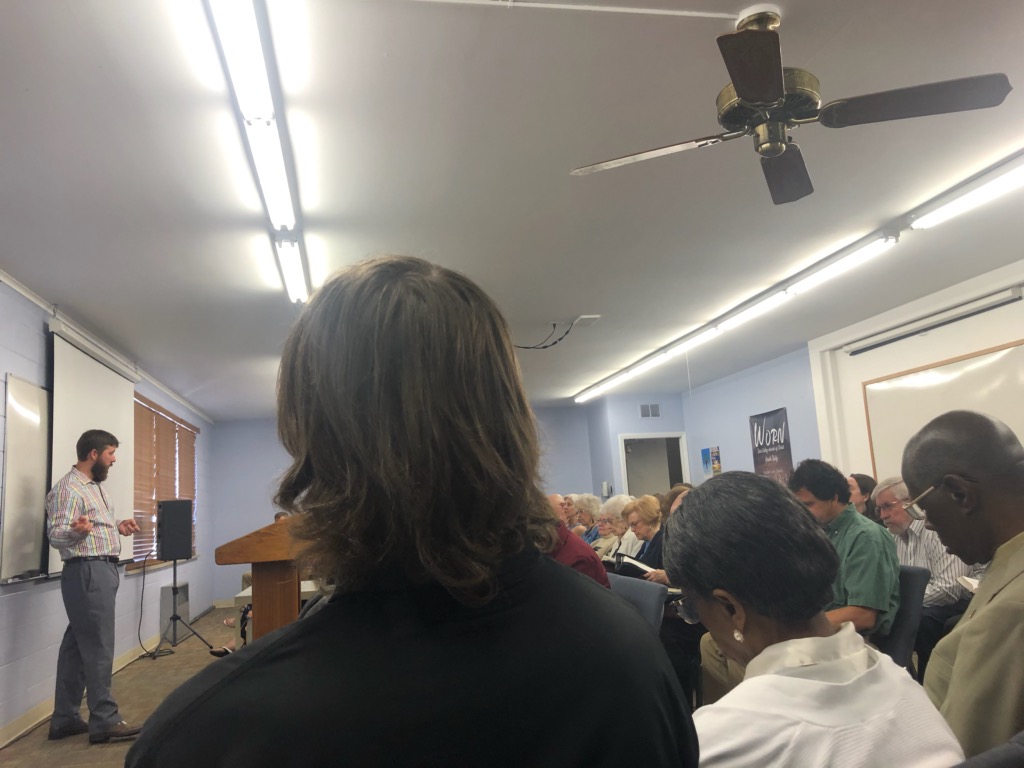
People, in talking about public speaking, will sometimes speak of “audience analysis.” What they mean is that you need to know your audience or you run the risk of being irrelevant, disconnected, and even possibly offensive. You may assume too much of them or sell them way short. Neither extreme is effective.

A wonderful sign for any congregation is the presence of especially non-Christian visitors, especially those from our community. Hopefully, we are doing something right when these visitors make repeat visits to our assemblies. However, too often, I fear that we have not done sufficient “worship neighbor analysis” or, equally, “Bible class neighbor” analysis. I recently was in a class when a teacher made a remark about how poorly a specific religious group scored on a Bible comprehension quiz. The remark itself was poignant and effective, but the cackling laughter from a few near the front of the class was easily heard throughout the classroom. I’m sure it was heard by two students sitting near them whose background is in that religious group. One is a brand new Christian and the other is a non-Christian visiting with him. Not only was the members’ reaction unnecessary, it displayed a lack of awareness of who else was present.

At times, we select songs from a century when “thees” and “thous” were commonplace and whose vocabulary was drastically different from how we speak today (“guerdon,” “cassia,” “pinion,” “dross,” and “hoary”). Even songs I have long been fond of read in ways that seem almost foreign to us today. Preparation for worship leadership should include a cognizance of how new Christians, young people, non-Christians, and the like will process or even if they can process such.

Specifically biblical or theological terms which we know people like our neighbors, coworkers, and classmates do not understand should not be uttered undefined. Making assumptions in an age marked by a growing lack of biblical literacy can undermine our effectiveness. It can make the most relevant message of all seem irrelevant and incomprehensible.

Of course, most fundamentally, one of the most unforgivable sins in the eyes of the typical visitor is to be ignored or made to feel invisible. We may hesitate to engage someone because we lack awareness of their “status” (visitor or member). Instead of risking embarrassment, scorn, or an expenditure of time, we walk past them or speak to someone we know we know. Perhaps, in believing that true seekers find, we let ourselves off the hook despite Jesus’ call for us to sympathetically consider others (Lk. 6:31; 1 Pet. 3:8).  Common sense should move us to see that we can attract or detract, depending on how we react.

Spiritual maturity will steer us to be mature, kind, patient, and self-aware. Basic thoughtfulness will help us prepare, speak, and act in ways that make us magnets for the Messiah rather than repellant from the Redeemer. The effort will be appreciated and, I truly believe, rewarded. If we need to, let’s break out of our bubbles of isolation and seek to see things through the eyes of others—especially “the little” (Mat. 10:42; 18:6-14) and “the least” (Mat. 25:40).

4aee607aa23e1943b2f475b58974c89f-bulletin-board-church

THE MASTER’S MATERIAL

Neal Pollard

A while back it was popular in the religious world to talk about Jesus’ encounter with two disciples on the road to Emmaus. The emphasis has often been on the disciples’ experience. I believe the biblical emphasis is on the character of Jesus. The disciples are contemplating Him even as they encounter Him. They describe Jesus as “a man who was a prophet mighty in deed and word before God and all the people” (Luke 24:19). Notice three reasons why He was so mighty in word before all the people.

JESUS KNEW HIS MATERIAL. Luke 24:27 says, “And beginning with Moses and all the Prophets, He interpreted to them in all the Scriptures the things concerning Himself.” Truly His knowledge is perfect and ours is not, but there is no excuse for failing to study–both on our own and for a class we are teaching or sermon we are preaching.

JESUS KNEW HOW TO RELATE ITS MEANING EFFECTIVELY. The men journeying to Emma’s, after walking with Jesus, said, “Did not our hearts burn within us while He talked to us on the road, while He opened to us the Scriptures?” (Luke 24:32). The dismal method of too many Bible classes is to essentially read and paraphrase in verse by verse fashion. Preaching can too often be disorganized in delivery or vague in message. Paul told Timothy, “Do your best to present yourself to God as one approved, a worker who has no need to be ashamed, rightly handling the word of truth” (2 Tim. 2:15, NIV).  Robertson says of “rightly handling” that it means “cutting straight…Since Paul was a tent-maker and knew how to cut straight the rough camel-hair cloth, why not let that be the metaphor?” (Vol. 4, 619). As presenters of truth, tell what it meant then and in context, and then apply it!

JESUS KNEW HOW TO MAKE THE MATERIAL LIVE IN HIS STUDENTS. Luke 24:45 says, “He opened their minds to understand the Scriptures.” That is just what we are after as teachers, preachers, and proclaimers of the Word. We are not just fact-reporting. We are trying to get into the heart. Remember that Jesus sought to change lives with His teaching.

Only Jesus was the perfect teacher. But we can always be better and great. Let us mimic the Master’s approach to His material!

Bible Classes, Special Services, And P.M. Worship Services

Neal Pollard

  • I attend because I want to honor God in the special way that occurs when the church assembles to worship Him
  • I attend because I want to encourage others and be with them every opportunity I can
  • I attend because I find the acts of worship so meaningful
  • I attend because there’s so much of the Bible I have yet to master, and I want to hear what the teacher and the other students may have to say about it
  • I attend because what I do know and have learned I feel compelled to share when given the opportunity occasioned by the assemblies
  • I attend because I often meet those searching for truth, those new to the area, and those brothers and sisters visiting from out of town during those times
  • I attend because I think it sets a good example for my family, friends, and neighbors
  • I attend because the very exercise of what’s done in assembling, if my heart is engaged, helps me grow in my Christian walk and strengthens me for the week ahead.
  • I attend because I want to rise above the bare minimum expectations

Certainly there are many more and probably better answers regarding the motivation for attending every time the local saints are assembled.  But these are enough to move me, when I am able, to join my spiritual family in both study and worship.  I try to prioritize the assemblies above the unnecessary things and the things that will not endure beyond this life.  The same reasons will draw me to come when we have seminars, gospel meetings, Vacation Bible School, lectureships, and the like.  When I can attend, I want to attend and will attend!  I’m thankful that so many others must feel the same way.  There’s always room for more!