For the past six days Russia has made significant advancements on several strategic locations in Ukraine. Every news outlet is showing photos and videos of devastation that has already occurred, and it’s predicted to escalate still. There are complicated foreign policies being discussed over topics like NATO, sanctions, and the effects on the rest of the world after Putin’s recklessness.
Many countries are mad, some indifferent, while some cheer on their favorite country like it’s their favorite sports team. It’s chaotic and it’s concerning, but it’s not the Christian’s long-term problem. If this earth was our eternal home then I would be biting my nails and losing my hair. However, Christians all over the world should take comfort in the fact that heaven is a place where there is no war. We should remind each other that in order to make it, we are not required to be Republicans or Democrats. There are two camps in this world, but those aren’t it. The two groups are those who are lost and those who are saved. When you look at your TV or maybe out of your window and you see the death and carnage, we aren’t witnessing the death of heroes and villains. We’re watching souls walk through the door of eternity.
Our focus is easily pulled away from the reality that is only seen through a spiritual lens but it’s the reality that matters the most. The lyrics of two hymns have been strung together in my mind this week, “There’s a Great Day coming and this world’s not my home.”
“Beloved, never avenge yourselves, but leave it to the wrath of God, for it is written, “Vengeance is mine, I will repay, says the Lord.”
My first foreign mission trip was to eastern Ukraine in the Spring of 2002. I returned in 2003, and each time we flew in and out of Kharkiv (which is under siege as I type). We worked with the Bear Valley Bible Institute’s first foreign extension school, but also worked with brethren in the village of Slavyanogorsk.
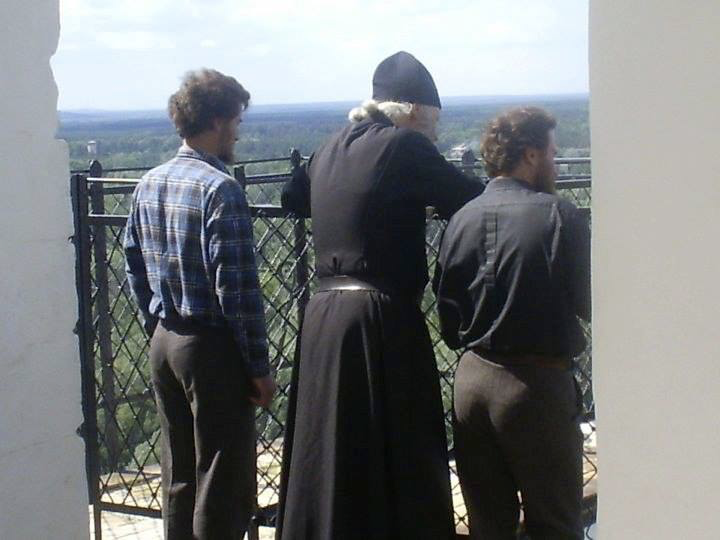
I took this picture of Slavyanogorsk from the monastery overlook.
We held Bible studies and taught English using the book of Mark and enjoyed success especially with young people and young adults. The influence of the Russian Orthodox Church was strong among the locals, but there was a congregation of about 30 there.
Russian Orthodox monk at the monastery in Slavyanogorsk. Having fellowship with the brethren at Slavyanogorsk. The local preacher at the time, Victor Semikoz, is barely in view (right). Terry Harmon, at the time the director of the Bear Valley extension, is wearing the tie.
On my second trip, Kathy was able to go with me along with several other members of the Cold Harbor Road congregation in Mechanicsville, Virginia, where I preached at the time.
Members of the Cold Harbor and Pikeville, KY, congregations at the Kharkiv airport. Do you see Kathy?
The memories we made together and with our brothers and sisters in Ukraine have left a lasting impression on my mind and my faith. Though I had always known that the church existed in places outside the United States, this was my first tangible experience with them. While we were separated by language and cultural barriers, we were drawn together by our common faith and hope. These first few trips increased my desire to teach and evangelize not only those in other nations, but also motivated me to try harder to do so locally. Those travels to Ukraine were extremely faith-building.
Right now, those brethren are displaced, distressed, and disturbed by the Russian invasion well underway. Their relatively modest houses and apartments have been at the center of fighting between Ukrainians and Russian separatists, with many of the cities in that region controlled by those separatists. They are in the crosshairs of danger, facing an uncertain future.
As I read the New Testament, inspired writers addressed congregations and asked them to care about, pray for, and provide the needs of brethren who faced various crises. There were the poor and needy saints of Jerusalem, whom Paul tells Rome that Macedonia and Achaia had financially supported (Rom. 15:26; cf. 1 Cor. 16:1). The writer of Hebrews told his audience, “Remember the prisoners, as though in prison with them, and those who are ill-treated, since you yourselves also are in the body” (13:3). He praised them earlier in the letter for showing sympathy to the prisoners (10:34). We never know when similar circumstances might befall us. As Paul told Thessalonica, “For you, brethren, became imitators of the churches of God in Christ Jesus that are in Judea, for you also endured the same sufferings at the hands of your own countrymen, even as they did from the Jews, who both killed the Lord Jesus and the prophets, and drove us out. They are not pleasing to God, but hostile to all men, hindering us from speaking to the Gentiles so that they may be saved; with the result that they always fill up the measure of their sins. But wrath has come upon them to the utmost” (1 Th. 2:14-16). While their suffering was primarily spiritual persecution, Paul urged empathy and endurance.
What can we do for our brethren who are at ground zero of this awful conflict? We can better inform ourselves of the specifics there (https://christianchronicle.org/ukraineexplainer/). We can pray, congregationally and individually (daily!). We can listen for opportunities to assist our brethren. Heaven will be filled with saints from every nation (Rev. 7:9). These brethren are part of our “household”; let us stand ready to do good for them (Gal. 6:10). Remember them as they suffer!
Having tea in our sister, Luba’s, apartment on a rain-soaked evening in Slavyanogorsk.
The fear I’m talking about is not the kind that tells us be cautious or keeps us from harm, it’s the kind that fills our hearts and minds with doubt, apprehension, and anxiety. When this fear keeps us from doing things that please God, things that he expects from us and commands of us, it is a big deal.
When preparing for this I was given the advice that we should speak about things we are familiar with. I say that because fear has kept me for a long time avoiding opportunities such as this. I have never given a devotional before tonight. It is because of that Fear I mentioned. This type of fear convinces us of things that aren’t true. It convinces you that you’re not good enough to get up here and speak. You are not qualified or educated enough to speak to a group of people; you care too much about what people think of you and the things you say. It convinces you that you are terrible at public speaking, you won’t speak well, or say the right things. This is my personal fear, but all of us here tonight deal with fears that keep us from doing what God wants us to do and what pleases him.
A great biblical example of this is:
Moses, in Exodus 3: 8-10 when God called him to go lead Israel out of Egypt and speak to pharaoh.
In vs 11 you can tell he is afraid because he says, “who am I that I should go to pharaoh and that I should bring the children of Israel out of Egypt?” God is quick to reassure Moses “I will certainly be with you.”
He continues in chapter 4:1 to make excuses to God “what if they will not believe me or listen to my voice” So, God sent miraculous signs to help convince the people.
In 4:10 he basically said I can’t speak “I’m not eloquent, I’m slow of speech and slow of tongue.” So, God reminded him who made man’s tongue, have not I?! He then said He would be his mouth and teach him what to say.
And finally in vs 13 he even asked the Lord to send someone else. We should never get to this point.
We should always look to God, put our faith and trust in the Lord, because fear is not from God. He is a God of love and fear does not have to consume us.
We should always trust in God when we are afraid. If we draw near to God, he will cast out that fear. In Isaiah 41:10, God reassured Israel – “Fear not, for I am with you; Be not dismayed, for I am your God. I will strengthen you, Yes, I will help you, I will uphold you with My righteous right hand”
II Timothy 1:7 reminds us that “God gave us a spirit NOT OF FEAR, but of power and love and self-control”.
“I will never leave you nor forsake you. So, we may boldly say: ‘The Lord is my helper; I will not fear. What can man do to me?’” in Hebrews 13: 5-6
Ultimately, we can’t let fear keep us from doing what God has commanded of us – we are to go into all the world to spread the gospel with everyone. How can we do that if we carry around the burden of Fear.
In closing tonight, I want to ask each of us to think about what gets us out of our comfort zone when it comes to doing the will of God? Is it speaking to someone about Christ? Is it inviting our friends or co workers to come to worship service with us? Maybe having a Bible study with a complete stranger? Perhaps leading a devotional for the first time, or maybe leading singing.
Whatever those things are, we should set aside our fears, put our trust in God, let our hearts be full of Love, not Fear. We should be on fire for God as Jeremy said last week. We as Christians are capable of much more than we realize but how will we ever know those capabilities if we are too afraid to try.
Philippians 4:13 doesn’t say I can do some things….it says I can do ALL things through Christ who strengthens me.
How amazing is it that we serve a God that loves us so much, and says he will always be with us, that he will never leave our side. He tells us time and time again we have no reason to be afraid.
(From Travis’ first-ever devotional delivered at Lehman on Wednesday night, 2/16/22)
There are days when one must turn off the news and go to the prayer closet. Current events sometimes make us uneasy, and the “if-it-bleeds-it-leads” type of yellow journalism permeates the twenty-four-hour news cycle. And while I sit here and write, the big story is the Russian invasion of Ukraine. Putin’s pretense is that Ukraine is committing genocide against the “ethnic Russians” living in Ukraine. There has been no evidence produced supporting this claim, of course, but there is evidence that pro-Russian militants have committed crimes, some violent, within Ukraine.
In 2014, for example, Pro-Russian militants seized the building housing the Bear Valley Bible Institute of Ukraine in Horlivka. Armed men gave the brethren of the congregation assembling in the same building as the Central church of Christ three hours to remove those contents from the building the members wanted. Thankfully, no one was injured.1 But as I think of the location of the current branch of the Bear Valley Bible Institute of Ukraine2, about 50 miles southwest of Kyiv, I cannot help but be concerned for my Christian brethren impacted by the specter of war in Ukraine. After all, Russia has already bombed the Ukrainian capital.
Then there are the less important factors than human life that produce potential anxiety. For example, what is going to happen to the price of petroleum? Authorities say it is going up. WSB in Atlanta reported that “experts” believe that the sanctions placed on Russia will cause gas prices to increase to a national average of $4 a gallon by March or April.3 Higher gas prices lead to higher transportation costs, which causes the costs of goods to increase. In a country already hit by the highest inflation in 40 years, we might view such painful side effects from trying to rein Putin as too much.
Plus, one wonders if we now hear the renewed drumbeats of global war. Some pundits lay the blame for this at the feet of the current U.S. President, whom they claim looks weak to foreign leaders. Thus, neither Putin nor Xi Jinping may refrain from acting upon imperial ambitions. Ukraine is one thing, but what if Putin desires to reconstitute the former Soviet Union? Eventually, that would mean that Putin would invade a NATO country. We would be obliged by treaty to intervene.
Meanwhile, soon after Putin invaded Ukraine, nine Chinese fighter jets violated Taiwan’s airspace.4 This is not the first Chinese incursion into Taiwanese airspace, but the timing is unsettling. China still believes that Taiwan belongs to China. Since 1954, we have been in a bilateral treaty with Taiwan.5 Therefore, if China invades Taiwan, we would be obliged to respond to China’s actions. Granted, we are assuming that the United States will keep the word that it has given to its treaty partners. Possibly, our leaders may try to do so economically rather than placing boots on the ground.
During this time, when the waters of the sea roar and foam and the mountains shake, it is marvelous to know that God is our refuge. This truth is the assurance the sons of Korah provide in Psalm 46. Commentators believe the author wrote the psalm when the Moabites, Ammonites, and Edomites moved to attack the kingdom of Judah (cf. 2 Chronicles 20.1ff). King Jehosophat prayed for God’s intervention, and God replied by confusing Judah’s enemies. Those enemies ended up killing one another. When Jehosophat rose to face them as God commanded, he found every one of them dead. Thus, God was Judah’s refuge.
Turning our attention once more to Psalm 46, we note three quick points. First, God is our place of refuge when everything around us seems insecure (1-3). Thus, we are told not to fear (2). When we look at the boisterous sea rather than our Lord, we will quickly sink as Peter when he joined Jesus walking on the Sea of Galilee (Matthew 14.30). Therefore, we must increase our faith (Matthew 14.31). So, there is no reason to feel insecure when the God of peace is with us (Romans 15.33).
Second, God provides us with a walled city (i.e., stronghold) secured by a flowing river of life (4-7). There is debate whether this is a picture of Heaven. Indeed, Heaven has its River of Life. But it was a tactic of siege warfare to cut a walled city off from food and water sources. One such siege by Sennacherib led Hezekiah to construct a tunnel to bring water to Jerusalem (2 Kings 20.20; 2 Chronicles 32). Despite Sennacherib’s bravado, Hezekiah knew that his people would not cry out from thirst. Providence would spare them. Martin Luther, reading Psalm 46.7, was moved to pen the hymn “Ein Feste Burg ist Unser Gott” (“A Mighty Fortress Is Our God”). Yes, we find in God that bulwark that is never failing.
Third, God will provide us with what man cannot (8-11). Sometimes we try and solve things on our own. When we feel exasperated, we might even look to our fellow man for answers. It seems that we look around everywhere but to where we should. To this practice, God tells us, “Stop!” The NASB1995 renders it, “Cease striving and know that I am God” (46.10). God will be exalted! And indeed, we see His mighty works that attest to His great power. The sons of Korah tell us in conclusion that God is with us.
Our world feels like a crazy place now. I recently commented that it feels more like 1938 than 2022. In 1938, Adolph Hitler annexed Austria to reabsorb the “ethnic Germans.” In the United States, Americans were still struggling to overcome the Great Depression. So, current events do seem comparable. But, by God’s help, we survived that turbulent time, and we will also live through an uncertain future. God is in control, and He tells us that He will provide us with refuge. So, we must cease our striving and enter it.
Each Sunday, Christians come together to worship our Creator. But before we can properly worship God, we need to know what He wants from us. We can’t just come together and do what we think God would want. There is no guesswork required because God has plainly told us. This isn’t an article on our singing, taking the Lord’s supper, or reading scripture. But worship requires knowledge, and this knowledge will help us to properly prepare when we come together.
If our knowledge is lacking, what happens? In Leviticus 10, Nadab and Abihu offered God something He did not ask for. “Now Nadab and Abihu, the sons of Aaron, took their respective firepans, and after putting fire in them, placed incense on it and offered strange fire before the Lord, which He had not commanded them. And fire came out from the presence of the Lord and consumed them, and they died before the Lord” (1-2).
“Strange fire?”
Depending on your translation there are several different interpretations of what they offered.
ESV “Unauthorized”
NKJV “Profane”
RSV “unholy”
None of these translations speak well of their actions, and we read the consequences of their actions. They offered God a sacrifice without proper knowledge. Some would say that how God responded was uncalled for, and while His actions may seem extreme, there are several facts we learn about Worship.
We learn that when God tells us how to do something, we better listen. We learn that proper knowledge of how to worship is essential. We learn that God takes worship seriously.
I’m thankful that God doesn’t deal with us today in the same way. The times that I’ve caught my mind wandering in the songs we sing, or when I loose my train of thought during the Lord’s supper, I’m sure that God has had plenty of opportunities to strike me down.
Leviticus 10 is a sobering reminder. And we need to ask ourselves, “Are we offering strange fire to God?”
We can avoid doing this by having the proper knowledge of what God has commanded.
It’s not about what we think sounds good, or what we think God would like.
It’s about our Creator. We don’t need to guess; He has clearly told us. In John 4:23-24, Jesus in speaking with the Samaritan woman says, “You worship what you do not know; we worship what we know, for salvation is from the Jews, But an hour is coming, and now is, when the true worshipers will worship the Father in spirit and truth; for such people the Father seeks to be His worshipers.”
What does God want us to know about worship? The people God seeks to be His are the ones who worship in Spirit and Truth.
The word Spirit literally means, “As the source and seat of insight, feeling, and will.”
Basically what Jesus is trying to convey is that:
When we sing, we sing with feeling
When we pray, we pray with feeling
When we remember Christ, we feel the weight of the sacrifice.
When we read God’s word, we do it with feeling.
God wants our hearts to be in worship.
A knowledge of God helps us accomplish this command. Which is exactly why Jesus says to worship in spirit, but also in Truth. Our emotions and feelings are based on the truth that God has revealed. The truth that comes from divine inspiration. If we worship in spirit and neglect the truth, we are offering strange fire. If we worship in truth alone without emotion, we are offering strange fire to God.
In order to worship, we must have a knowledge of what God wants from us.
Disclaimer: I am not a scientist. This is not intended to be an apologetics article, more like comments on phenomena we don’t fully understand presented as food-for-thought.
We shouldn’t be able to observe the fascinating, terrifying cosmic events known as black holes. They have an event horizon – the area around the black hole itself – and a singularity (the “center”). We have no way to determine what came before it because no information can escape its gravity. This “black hole information paradox” has been a headache-inducing puzzle for this era’s brightest minds. Some have attempted explanations (Engelhardt, Page, etc), but the issue is far from resolved.
As observers, we could not see something go into the singularity because time would slow to a stop. This is caused by gravitational time dilation – something we experience on earth everyday. Time – from an observer’s perspective – is effected by gravity. The satellites orbiting our earth experience time at a slightly faster rate, something we have to account for with things like GPS. Time even moves slightly faster at high altitudes on earth than it does at sea level. Gravity affects the way we observe time. Higher gravity makes time appear to move slower, lower gravity makes it appear to move faster.
Gravitational time dilation also means that we can’t watch the birth of these terrifying cosmic events because it would take an infinite amount of time. Yet they do exist, and we can “see” them. We have photographic proof of their existence with M87, and we’ve seen enough to infer the existence of Sgr A at the center of our own galaxy.
So, if a black hole takes an infinite amount of time to form, how can we observe it? Einstein himself was doubtful of their existence because he couldn’t justify it with general relativity (Annals of Mathematics, Vol 40, No. 4, 922). Almost everything in the universe is explainable through two major theories: quantum mechanics and general relativity. General Relativity describes big, heavy stuff (planets, stars, galaxies); Quantum Mechanics is for tiny stuff that isn’t gravity-related (subatomic particles, atoms).
When it comes to black holes, though, these two theories collide. We don’t have a Theory of Everything that satisfactorily explains why these two can’t work together. Quantum Mechanics and General Relativity should not be able to coexist in one cosmic phenomenon. So how do they? How can we observe something that should take an infinite amount of time to form? What could unify General Relativity and Quantum Mechanics – both of which have been verified repeatedly – and account for their coexistence in a black hole? What is the missing puzzle piece in the Theory of Everything?
Is it so irrational to assume that something not affected by either is the answer? Is it bad science to posit an infinite power source as the unifying agent of the two theories? As a believer, the answer that makes perfect sense is God. An infinitely powerful being is the Theory of Everything. He created the black hole at the same time as other stars (Gen 1.14-19). He bridges the gap between General Relativity and Quantum Mechanic’s explanations of reality (Heb 1.3).
To me, the black hole is one of the most compelling evidences of God’s existence. The only way we could ever observe something infinite is if something infinite put it there. Who else could be powerful enough to let general relativity and quantum mechanics play in the same phenomenon? Would he not be the perfect unifier of the two? I believe we can observe cosmic events – like black holes – because God put them there in our timeline.
If you were to flip on the TV and watch a news channel, it can quickly become frustrating. Channels like CNN will often say something entirely different than FOX or vice versa. What’s actually true? Who can we trust? What should we believe?
Just when your mind begins to become convinced of one thing, you hear or see something that changes your thinking once again. This creates the skeptic, the double-thinker, and the cynic.
Since a variety of propaganda will always be pushed and those personal agendas will always be hidden, it’s more comforting than ever to read and soak in pure unadulterated truth. So, here are some of those truths we can count on that our found in the Bible.
God is real and His message to mankind can only be found in every inspired word written in the scripture (2 Tim. 3:16-17).
The scriptures teach mankind the means by which we are saved and added to His church. God adds us through our action- based belief, repentance, and immersion (Acts 2:42ff, Titus 1:5-11).
Christians must live faithfully and in accordance to His instructions (1 Peter 1:15).
The faithful can only truly worship by following the pattern which is demonstrated by the 1st-century church and Apostolic examples (1 Tim. 2:8-15).
The Bible teaches that one day everyone will walk through the door that leads out into eternity. Whether or not we are lost or saved as we pass through that door will be the determining factor that dictates where our final destination will be (Rev. 20.12).
It’s our Christian duty to ensure that others are aware of this spiritual reality (Matt. 25:46, Ecc. 12:7, 1 Jn. 1:7).
God can’t lie and every word He wrote is true (Ti. 1:2; Ps. 119:160).
It’s our responsibility to study His message because it’s the only thing that matters.
These truths will never change. They are a constant you can count on and we’ve only scratched the surface. It’s crucial that every follower of Christ is convicted and well versed in His Word. This is where and how we find peace and direction. The Bible is the only source that we can rely on 100% and that’s something that’s increasingly hard to find today.
As Paul works his way through some of the challenges and issues the Corinth congregation was dealing with, he turns his attention to an awful situation. As he says, “It is actually reported that there is immorality among you, and immorality of such a kind as does not exist even among the Gentiles, that someone has his father’s wife” (1 Cor. 5:1). This was being openly practiced at the congregation, and Paul compares how they were reacting to how they should react. Even if the congregation unanimously embraced this situation, the end result would not be unity in truth. As Moses said in his day, “You shall not follow a multitude in doing evil” (Ex. 23:2).
Paul rallies them to unite in doing what pleased God. This began with amending their hearts, mourning rather than being arrogant (2). It should be followed by removing this man from their midst (2). Based on the report (presumably from Chloe’s household), Paul already knew what needed to be done (3). While the term “church discipline” is not used in the text, that is the action. Paul uses such words and phrases as “deliver to Satan” (5), “clean out” (purge, 7), “do not associate” (9,12), and “remove” (13). Why was such a drastic action necessary?
“THAT HIS SPIRIT MAY BE SAVED IN THE DAY OF THE LORD JESUS” (5)
By withdrawing fellowship from him, the goal was to induce his sorrow and cause his repentance. This relationship was unrighteous, and it would cost him his soul if he did not end it. How uncaring is it to validate an unscriptural relationship, knowing what Scripture says about it? Paul is about to write that fornicators and adulterers will not inherit the kingdom of God (6:9).
“A LITTLE LEAVEN LEAVENS THE WHOLE LUMP OF DOUGH” (6-8)
Paul calls this the leaven of “malice and wickedness” (8). Allowing sin unchecked and unaddressed to continue in a congregation does not make the sin all right. It allows the influence of sin to spread throughout the congregation. Remembering that the church is the body of Christ (see chapter 12), how can the body act in rebellion to its head and still please God? For the purity of Christ’s body, this action must be taken.
THERE IS GUILT BY ASSOCIATION (9-11)
Paul expands this beyond just the situation of the man with his father’s wife. He says not to associate with the immoral, covetous, idolatrous, reviling, drunkard, or swindling brother in Christ (11). Even eating a fellowship meal with them sent them the message that they were okay living in rebellion against God. Remember, this is not about vengeance or angry resentment. This was about honoring God’s will in a matter that God’s word clearly addresses.
IT IS AN EXERCISE OF DIVINE JUDGMENT (12-13)
This was not a matter for human courts, which in most civilizations do not legislate morality. This is an “internal matter,” a child of God “judged” by the people of God according to the will of God. God established the pattern.
When I preached in Virginia and Colorado, the elders in both churches practiced church discipline. It was done in such a loving way, with the elders first going to the individuals in various sinful situations and pleading for them to repent. When they refused, the elders brought the matter before the congregation urging any and all with any influence and relationship to plead with them. When that did not work, they announced that it was necessary to withdraw fellowship from them. There was no angry or hateful rhetoric, no gleeful attitude that such an action would be taken. To the contrary, it was as sad and solemn a moment as I’ve experienced in the family of God. I am happy to say that I have witnessed on several occasions the ultimate repentance and return of some of these wayward Christians. That was the goal in every situation. It would seem to me that one of the most neglected, disobeyed commands among God’s people is the practice of church discipline. It is unpleasant, frightening, and unpopular, but it is what God commands. God knows what is best and what is the best way to handle every situation among us. We should always trust Him and submit to His pattern for handling every difficulty and dilemma among us. The end result is biblical unity.
One of the tedious but necessary items we pay attention to on the news is the economic reports. No, we do not do so out of love for money, but because we desire to be good stewards with the resources with which God has entrusted us. But unfortunately, the SARS-COV-2 virus has had quite an impact on our economy. In addition, we are coming up on the third anniversary of the pandemic shutdowns. So, it is safe to say that things have yet to return to where they were before March of 2020.
Some industries, like the hospitality industry, have been decimated. For example, as of January 2022, the National Restaurant Association found that about 80,000 restaurants have closed because of COVID.1And those restauranteurs with an open business have difficulty staffing themselves and obtaining supplies. Here locally, I noted a combo KFC and Taco Bell franchise offering an $500 sign-on bonus in January 2021 to rectify the labor shortage. I have since read of other fast-food restaurants across the nation likewise offering large sign-on bonuses to perform what is considered non-skilled labor.
Now, I do not call any work in which one employs himself to be beneath anyone’s dignity, despite the technical designation of some jobs as being “non-skilled.” On the contrary, these are routine jobs suitable for teenagers seeking their first job experiences or seniors needing to supplement their retirement or stay active. But something has happened because of the pandemic. Whether large or small, one factor that keeps people away from gainful employment is the CARES Act, passed in March 2020. With this piece of legislation, one could argue that our federal government incentivized the acceptance of unemployment payments that, for many, exceeded the salaries earned at jobs from which COVID displaced them. In contrast, we might point out that those states doing better economically today wised up quickly and took away those incentives to stay out of work.
And now, we are hearing a strange new phrase on newscasts: “The Great Resignation.”2 Since there are more jobs than workers, people dissatisfied with their current occupations opt to quit. You have likely heard the real estate terms of “buyer’s market” and “seller’s market.” The former is a real estate market where buyers have the upper hand. As a result of various circumstances, there is more inventory than demand. As a result, the buyer has greater leverage to ask for price reductions from the homeowner. In a seller’s market, you have the opposite conditions. There is less inventory available. So, a buyer will pay more to purchase a house or land because other potential buyers are waiting in the wing. With the Great Resignation, the thought is that we are basically in a “worker’s market.” These job-shoppers know that employers need workers so desperately that they will do things like offering $1,000 to entice them into accepting the position they offer.
As anecdotal evidence for this “worker’s market,” I will offer a repeated observation from my lengthy hospital stay in 2021. There is no doubt that doctors and nurses have had it rough during the pandemic. Thus, we rightly call their actions heroic. But among the nurse technicians, I heard a few of the “lesser heroic” ones talking about how they loved the current climate because they could just quit abruptly and walk down to the next hospital to take advantage of the better incentive package they offered. Before someone thinks I am being too harsh, I will tell you more. These individuals said they could bounce around, even returning to the hospitals that they had left to game the system. Their “loyalty” was to the highest bidder.
What has this to do with Christians or theology? I will put the question to you this way. What kind of a society is born from our current environment with people choosing to stay at home and collect benefits for not working or taking advantage of desperate employers? Does this mindset end with work, or does it spill over into all of one’s life? Is there an immoral cause? Paul cautioned the Thessalonicans: “…if anyone is not willing to work, then he is not to eat, either.” (2 Thessalonians 3.10 NASB1995) In addition, idleness poses a danger. An idiom pairing well with 2 Thessalonians 3.11 is “idle hands is the devil’s workshop.” Paul said the nonworkers within the Thessalonican church made themselves busybodies, living undisciplined lives. Ouch.
Remembering one’s actual Employer resolves a part of this problem. Paul reminds us:
“Slaves, in all things obey those who are your masters on earth, not with external service, as those who merely please men, but with sincerity of heart, fearing the Lord. Whatever you do, do your work heartily, as for the Lord rather than for men, knowing that from the Lord you will receive the reward of the inheritance. It is the Lord Christ whom you serve.” (Colossians 3.22-24 NASB1995)
Though not “slaves” in the same sense as those recipients in the first century (most people living in the Roman Empire were slaves to someone), we see how we are fángnú (Chinese for “mortgage slaves”) today. God expects us to be industrious. Even the inaugural pair placed in paradise had to “cultivate and keep” their garden home (Genesis 2.15). A nation where people work doesn’t have time to riot, loot, play keyboard warriors, “cancel” others, or push agendas on other people’s children. We are citizens of the Heavenly Kingdom first and foremost but let us not participate in those shortcomings here that create a land where you get paid a sign-on bonus to flip burgers.
As humans we have a hard time when it comes to focusing. Attention spans seem to be getting shorter and shorter. Goldfish have an attention span of about 5 seconds. I’m convinced that mankind will one day be on the same level if nothing changes.
While focus in our everyday lives can be a struggle, what about in worship? How can we improve our focus when we come together each week? Before we even assemble, we should be preparing to focus on worship.
Isaiah 29:13 says, “…Because this people draw near with their words, And honor Me with their lip service, But they remove their hearts far from Me, And their reverence for Me consists of tradition learned by rote.”
They drew near to God with words, just like we do in singing songs each Sunday.
They honored God with their lips, much like we do in our prayers each week. What they were saying sounded good! But, if our hearts are not in worship, we have failed God.
Isaiah writing on God’s behalf says that their “reverence consisted of tradition learned by rote.” This word reverence is the the Hebrew word for “fear.” You may have heard that every time you read the word “fear” in the Bible to replace it with the word “respect” or “reverence.” This couldn’t be further from the truth. Hebrew language has a word for respect, and this isn’t it. It means literal fear.
In fact, the Greek equivalent of this word is Phobos, which is where we get our English word phobia. For example, if you have arachnophobia you have a fear of spiders. If you saw a spider crawling on your leg, and you are afraid of spiders, you’re not going to look at it and go, “I respect you.” That’s not how fear works; you’re going to use any means necessary to dispatch the threat.
So we are supposed to worship in fear? YES.
Focus out of fear and awe of WHO we are worshipping. We are singing to the creator.
We are praying to the God who parted seas, spoke the world into existence, and guided the Israelites with a pillar of fire. We are worshipping the King of Kings, the Great I AM, the Alpha and Omega, the One with no beginning or end, we are bowing down before the Most Holy God of the Universe.
If we realize what we are doing in worship, we can’t help but feel a little fear. Isaiah says, their worship was done through traditions learned “by rote.” This literally means, “Mechanical or habitual repetition.” We may be physically singing and look like we are worshipping God, but only the individual and God above know what is going on in the heart.
Isa. 12:5 “sing to the Lord.” This requires FOCUS, not mindlessly singing songs.
There are songs for each other, and songs directed toward God. “I want to be a worker for the Lord” …do we mean it? We can’t sing “Stand up, stand up for Jesus” on Sunday when all throughout the week all we’ve done is sit down. Focus on the words.
God would rather hear a tone deaf person who sings with their heart and mind, then a classically trained singer who only focuses on what it sounds like to them. Sunday morning worship comes once a week; it can be easy to let it turn into a mindless habit. Train your mind to focus on every act of worship. Don’t let worship become something we do out of tradition or habit. Focus on WHO we have come together to worship.
In almost every major war preceding World War I, men met face-to-face on the battlefield. The weapons used by soldiers had not changed much in thousands of years, so engagement distances were limited to 100 or so meters at most. By World War I, the bolt-action rifle had been perfected, machine guns were everywhere, some artillery pieces had a range of 80 miles, people fought in the skies for the first time, and some soldiers even had portable machine guns.
Commanding officers didn’t care, though. Soldiers always charged into battle; that was a thing. This was how they had fought for thousands of years, so why change now? They threw soldiers’ lives away over and over again, each charge being erased by the enormous volume of bullets. Why hadn’t they changed tactics after the first couple of failed charges? 9.7 million soldiers died in World War I (https://www.census.gov/history/pdf/reperes112018.pdf). A hefty percentage of them would have survived if the commanding officers had just changed tactics.
Christianity is warfare (Eph 6.12; II Cor 10.3-6; II Tim 2.3ff). We fight our own nature, the influence of evil, and the involvement of the enemy (satan). Christianity is also a rescue operation – we’re trying to save people! Just as with any war, the enemy is always trying to stay one step ahead. Ours is the most advanced threat anyone could face! No stakes are higher, no enemy more powerful, and he’s primarily concerned with causing as much damage as possible. He knows he’s doomed (cf Matt 8.29), which makes him an enemy with nothing to lose. We KNOW he’s used evolving tactics over the millennia.
The message Jesus gave us is timeless and can never be changed. The way Jesus wants his church to operate is timeless. Doctrine cannot be changed. But this gospel is not confined by an era or aesthetic. The message is relevant across time, culture, and understanding. If we confine Christianity to a form that hasn’t been in common use for a long time, do we not demonstrate a lack of faith in his timeless message? Worse yet, it would mean our rescue operation is several steps behind the enemy’s offensive.
We have the most powerful entity as our ally, but this mission is ours. What God wants to accomplish will be accomplished. Since this mission is ours, we must execute it as effectively as possible! How? The message is timeless, so it works in any culture and time. Match it to our culture and time in every way that doesn’t compromise (I Cor 9.19-23), and let God’s power do the rest.
“Our fight is not against people on earth. We are fighting powers of darkness. We are fighting against the spiritual powers of evil in the heavenly places” (Eph 6.12).
“I’m afraid there’s no denyin’ I’m just a dandy-lion A fate I don’t deserve I’m sure I could show my prowess Be a lion, not a mouse If I only had the nerve”
– Cowardly Lion
I shiver when I think back to the times that me and my younger brother would collect spiders from the backyard and put them all in a container. Sometimes we would take it up to our bedroom! At night we would put a flashlight behind the clear cage and watch all the spiders make their webs— occasionally fight each other.
I don’t believe mom ever discovered this little secret. Despite the many creepy gladiator wars that my brother and I hosted, for some reason as I grew older (more mature) I developed a fear of spiders.
Fears can be funny like that. They can come from bad experiences or just somewhere in the back of our minds. There’s a lot of fear in the world today! One of my favorite psalms in the Bible is Psalm 46. We read about what seems to be those worst case scenarios, but God still reigns over all. What if the earth gives way? What if the mountains are thrown into the sea? What if the wrong man becomes our new president? What if this virus never goes away? Even so, we have no reason to fear. God is bigger than our fears. We serve a Being with that much power and it should fill us with courage. What are you afraid of?
The English Romantic poet, Elizabeth Barrett Browning, is famed for her Sonnet 43. It is also known by its first line: “How do I love thee? Let me count the ways.” She was reared with privilege, wealth, and the finest education, but her health was compromised by an equestrian accident. Her father was controlling, and when she eloped to marry Robert Browning she was disinherited. She published many works of various types throughout her life, and this allowed her to become independently wealthy though her health made her an invalid. Robert became enamored with her writing, and they corresponded for two years. During this time, she wrote fervently romantic poems showing her love for Robert. For all that she wrote in her relatively brief life, her poetry stands out most of all. Of her poems, Sonnet 43 may be most famous.
The title above Psalm 92 reads, “a song for the Sabbath day.” That connects its words to worship, and this psalm shows the writer’s deep adoration for God. He never uses the word “love,” but his affection for God is obvious. It seems that the writer gives several proofs of that love here. Notice how.
HE GIVES THANKS TO THE LORD (1)
HE SINGS PRAISES TO HIS NAME (1,3-4)
HE DECLARES HIS LOVINGKINDNESS AND FAITHFULNESS (2)
HE PRAISES GOD’S WORKS AND THOUGHTS (5,8)
HE SCORNS THE WICKED WHO OPPOSE GOD’S WAY (6-7,9,11)
HE APPRECIATES THE BLESSINGS OF A GOD-APPROVED LIFE (10,12-14)
HE EXPRESSES CONFIDENCE IN THE CHARACTER OF GOD (15)
One of the most rewarding exercises you can engage in is to enumerate the ways you love and appreciate God. Do it in your prayer life; spend time praising God and be specific in expressing your adoration and admiration. Think deeply about it. Look around. Look into your life. Consider what looks like His providence in your life and the life of others. Count your blessings, and tell God what you are thankful for. Wait! Did you mention running water, hot water, reliable vehicles, paved roads, coffee, air-conditioning, music, puppies, baby’s breath, eyesight, and brisket? What about the church, salvation, prayer, the Bible, peace, the hope of heaven, His guidance and protection, the elders, deacons, Bible teachers, your spouse, your parents, and your children?
This will build your love and appreciation for God. It will remind you of how much He loves you and cause you to love Him more. It will humble you and help you focus on the fount of your every blessing! It should make you a better, more obedient servant for Him. How do you love Him? Like this psalmist, count the ways! It will lift your spirit and open your eyes to a harvest ripe with those who need what you have. Get counting!
When I was growing up, there were certain tasks that my parents would give me that I didn’t want to do. Washing the floorboards, weeding the garden, cutting vinyl siding, and digging holes with a post hole digger are just a few examples of what many of us would consider hard work.
I remember the hours working on these jobs, covered in sweat with blistered hands, and an all-around feeling of fatigue. There were a couple times In particular where I can remember my dad saying the classic phrase, “Son this is character-building work.” And then he would tell a story about some hard job he had to do as a kid. Looking back, these jobs really did build character, but there’s more to it than just digging a hole and sweating.
You can be a hard worker, and still lack honesty, sincerity, and humility. Character building takes serious work and commitment. Luckily, God has given us His perfect word that tells us how we can grow our character.
If you’ve ever struggled with living out your faith, or with your commitment to Christ, working on growing our character will help us to focus on what’s truly important in this life.
There are many different ways that we could go about building our character, and as we look to scripture a good place to start in this endeavor is by practicing righteous thinking. If we want to grow our character, we have to start changing the way that we think. Problem is, it’s a lot easier said than done. There are two different passages that tell us how we can practice righteous thinking.
Philippians 4:8 reads, “Finally, brothers, whatever is true, whatever is honorable, whatever is just, whatever is pure, whatever is lovely, whatever is commendable, if there is any excellence, if there is anything worthy of praise, think about these things.” As Christians we can learn to dwell on righteousness by filling our mind with godly traits. If we are truly set on transforming our minds to think on righteousness, we have to replace worldly thinking with godly traits.
Romans 12:1-2 says, “I appeal to you therefore, brothers, by the mercies of God, to present your bodies as a living sacrifice, holy and acceptable to God, which is your spiritual worship. Do not be conformed to this world, but be transformed by the renewal of your mind, that by testing you may discern what is the will of God, what is good and acceptable and perfect.” It’s possible to practice righteous thinking by renewing our mind with the will of God. No longer looking to ourselves as master, but to God. By doing this our thinking changes. Our focus shifts from this world, and our minds will dwell on righteousness.
Do you want to be known as a person of character? The first change we must undergo is to start thinking righteously. Righteous thinking is no easy task. It takes work, and many times we fall short of this goal. Thankfully we serve a loving God who wants nothing more than for us to spend an eternity with Him in Heaven.
Question is, do we want this future enough to make the right decisions?
When my father and I travel in the car together, we listen to one of three SiriusXM stations: 40s Junction, Bluegrass Junction, or Willie’s Roadhouse. Today, we tuned the radio dial to Willie’s Roadhouse as I made my way to a gastroenterology appointment. On the way home, Tom T. Hall’s tune, “Faster Horses (The Cowboy and the Poet),” played as we started back up the mountain towards Blairsville, Georgia. I have heard this song by “The Storyteller” before. “Faster Horses” never fails to remind me of King Solomon.
Within Hall’s song, a poet asks a cowboy for words of inspiration. Instead, the cowboy tells the poet that the best things in life are “faster horses, younger women, older whiskey, and more money.”1 The poet balks at the idea, but the cowboy calls him a liar. The poet desires to punch the cowboy, but the cowboy draws a weapon, and the poet backs off. Eventually, the poet drops his philosophical pursuits, settling on the “wisdom” imparted to him. He supposes the “wisdom” sage enough to share with his offspring. I would venture to guess that alcohol, at least, figured prominently in Hall’s life as he also wrote the songs “I Like Beer” and “Old Dogs, Children and Watermelon Wine.” Even my favorite of Tom T. Hall’s discography, “I Love,” contained the lyrics “bourbon in a glass and grass.” (As an aside, there was a radio edit that substituted those lines with “old TV shows and snow.”)
In Ecclesiastes 2.1-3,8, Solomon admits, “I said to myself, ‘Come now, I will test you with pleasure. So enjoy yourself.’ And behold, it too was futility. I said of laughter, ‘It is madness,’ and of pleasure, ‘What does it accomplish?’ I explored with my mind how to stimulate my body with wine while my mind was guiding me wisely, and how to take hold of folly, until I could see what good there is for the sons of men to do under heaven the few years of their lives…Also, I collected for myself silver and gold and the treasure of kings and provinces. I provided for myself male and female singers and the pleasures of men—many concubines” (all ref. NASB1995 unless otherwise indicated).
Yes, Solomon said it was futility (vanity—KJV and ESV). Solomon tried the cowboy’s life and found it wanting. It may well be that the late Tom T. Hall found out the same thing. On August 20, 2021, Tom T. Hall took his life. He was 85 years old.2 Though I do not wish to debate the wisdom of Chilon of Sparta, who in circa 600 BC was the first recorded speaker of the aphorism, “Do not speak ill of the dead,”3 I will add that many suicides stem from a sense of hopelessness. Depression is typically the common factor among those choosing to end their life. If this was Hall’s motivation, and only God knows, we note how the vanity of “faster horses, younger women, older whiskey, and more money” can create a downward spiral.
Vanity is an unhealthy type of narcissism. One is preoccupied with best satiating his desires, as Solomon well documented. In Ecclesiastes 6.7, Solomon says of his pursuits, “All a man’s labor is for his mouth and yet the appetite is not satisfied.” Thus, Solomon assures us that he found his pursuits futile despite trying everything he could. So why didn’t Solomon’s dissatisfaction cause him to lose hope or become depressed? Because he still had enough wisdom to draw the proper conclusion: “The conclusion, when all has been heard, is: fear God and keep His commandments, because this applies to every person. For God will bring every act to judgment, everything which is hidden, whether it is good or evil.” (Ecclesiastes 12.13-14).
If we are to develop the mind of Christ (Philippians 2.3-8), our focus must be outward. Rather than following one’s vanity to inevitable destruction, one must look out for the interests of others (Philippians 2.4). Therefore, whether said initially by Benjamin Franklin, John Ruskin, or Henry Emerson Fosdick, we note the truth in the expression, “A man wrapped up in himself makes a very small bundle.” Embiggen yourself by obeying the law of Christ (cf. Galatians 6.2,10). Don’t follow vanity where it leads.
You might accuse the older brother in the story of the Prodigal Son of many things, but laziness is not one of them. In fact, notice what all he does as Jesus introduces him to us:
He came and approached the house (Lk. 15:25)
He heard music and dancing (Lk. 15:25)
He summoned a servant and inquired (Lk. 15:26)
He became angry (Lk. 15:28)
He answered and said to his father (Lk. 15:29-31)
In fact, throughout the parable, he’s constantly saying or doing something regarding the situation of his broken brother who had returned home. However, for all his activity, nobody admires him. Instead, we are disgusted by his behavior. That’s exactly what Jesus wants us to get out of this, since this brother represents the Pharisees and the scribes (Lk. 15:1-2).
When we remind ourselves that this son never left home, we do well to let him cause us to examine ourselves if we are “faithful Christians.” When others offend me and sin against me, do I have the Father’s disposition of heart? Am I eager to receive and forgive? I may be tempted to get my mouth, my attitude, and my actions involved in such a way that’s active, but actively opposed to peace and reconciliation. Maybe it’s slandering that brother or even the Father. Maybe it’s actively working to hurt and punish the penitent. Maybe it’s holding a grudge that we refuse to let go. Maybe it’s nurturing resentment.
If we are “mature” and “spiritual,” won’t we make sure that we do right no matter what our prodigal does or doesn’t do? Galatians 6:1 governs our actions. We must guard against being “in the right,” but being wrong! Let’s channel our energies and efforts toward what serves the Father’s purposes. We are to work in His vineyard, accomplishing His agenda! We cannot be too actively engaged in that (Gal. 6:9; 1 Cor. 15:58; 2 Cor. 4:1).
Dan Winkler delivering a different, richer lesson on the older brother at FHU today.


















 The Preacher Pollard Blog