Several of our classes have assistants to the Bible class teacher. She (or perhaps in select cases “he”) serves in a support role, helping students do handwork, find Bible verses, or occasionally keep order. These are vital roles, and often a teacher’s aid later actually becomes a teacher. Teachers’ aids are part of a great team and education system that benefits everyone in the classroom. There is a constant, pressing need for more teachers’ aids. I don’t mean in the actual classroom during the “Bible class hour.” These aids are needed Sunday afternoons, late Wednesdays, Saturday afternoons, and/or opportune moments between these times. These aids have even more power than those helping the teacher in the classroom. They are the parents and care-givers of the students. There are several ways they can “aid” the teachers who put in hours of preparation time and tons of energy and emotion into the task of teaching. Aid teachers by making sure your children do their homework. Most teachers give homework, memory work or activity sheets. This is a vital supplement to the actual lesson taught in class. When children come to class with their homework done, teachers are elated and made to feel that their efforts are appreciated. They feel that their students take the class as seriously as they do. Aid teachers by asking about what they have learned. Ask your children what they talked about in class that day. Ask them to review as much as they can. Ask them what they learned and how they can make application from the class. What better topic of conversation can parents and children discuss on the way home from services? Aid teachers by making sure they feel appreciated. One way to do this is by making sure you practice the first two suggestions. However, having the child send a thank you note or by personally thanking your child’s teacher, you are aiding through the means of encouragement. Everyone likes to feel appreciated. Teachers are no different. The qualifications are simple enough. To be this type of teacher’s aid, simply do all you can to partner with the efforts of your children’s teachers. Your child, your home, and your child’s teacher will all be blessed by it.
Neal Pollard
pinch-hitting for Carl, who is in the delivery room!
I Thess 1.7-9 shows that when we believe something enough to fundamentally change our lives, it makes a powerful statement to the world. Our reason for this change is outlined in 1.10: We’re waiting for God’s son to come from the sky. This verse is a summary of our purpose.
Jesus came back to life as proof of concept. Death is terrifying to most of us because it’s unknown. Jesus died and came back to life after a couple of days to prove that death’s temporary. Paul hints in I Cor 15.50-52 that death will only last fraction of a second from our perspective. One moment we’ll pass away, the next we’ll be awakened by Jesus’s return. This is a huge comfort to us because we’re God’s people. But this should be terrifying to people who don’t love God. When we come back to life, we’ll get to leave this place with Jesus. But everyone else will suffer forever.
We also learn from 1.10 that Jesus’s return is to rescue us when God unleashes his anger on the earth. II Pt 3.5-7 describes the end of earth as a fire-flood. It’s clearly compared to the ancient world’s water flood. I Thess 4.17 tells us that we’ll meet him in the air, which would have to take place before the atmosphere is obliterated by whatever thermal event wipes this place out (II Pt 3.10, 12). Jesus is our savior. To put σωτήρ (soter) in modern English, Jesus is our rescuer. What’s he rescuing us from? Our sin is part of that, but ultimately he’s going to rescue us from God’s anger when the world is destroyed for the last time (Phil 3.20; I Thess 1.10).
The tsunami traveled at a speed of about 200 miles per hour across the Pacific Ocean. That massive wave would kill sixty one people in Hawaii, one hundred and thirty eight in Japan, and thirty two in the Philippines. This Chilean earthquake which occurred on May 22, 1960, may be the largest earthquake ever recorded.
The word “vexed” is an old Latin word meaning “to quake/rumble” and although Latin isn’t the language that the Old Testament was written in, the Old English word was used by scholars when translating Ecclesiastes 1.18.
“For in much wisdom is much vexation, and he who increases knowledge increases sorrow.”
At first glance, it may seem like Solomon is discouraging one from pursuing knowledge— but the message is a lot deeper.
Some have taken the view that Solomon is speaking of an earthly knowledge. It’s true that the sort of knowledge the world offers isn’t going to bring you the kind of fulfillment that the wisdom God provides. The world’s understanding lacks the answers to major questions which are essential to our spiritual health. Where did we come from? What’s the purpose of life? What happens when we die? Is this all there is? Earthly wisdom will either provide one with answers with holes, answers that are depressing— or no answers at all.
However, God’s wisdom can bring much vexation as well.
With God’s wisdom you come to understand that the majority of people on earth aren’t pursuing Him. You discover that most people live their lives in a way that grieve Him. That sort of understanding also brings you closer to that God. When the Lord is upset, troubled, angered, frustrated, or vexed, then his faithful are going to feel similarly.
With much of God’s wisdom, comes much vexation. With much of the world’s wisdom, there’s much vexation. The question we should ask, is why do we want our souls to be troubled? You can be fulfilled and troubled at the same time because with God, there’s always a light at the end of the tunnel.
In southern Peru, there is a massive area of geoglyphs carved into the ground and rock. They are named for the area, called the Nazca Lines. There are humongous carvings of people and animals, National Geographic reporting that “in total, there are over 800 straight lines, 300 geometric figures and 70 animal and plant designs, also called biomorphs. Some of the straight lines run up to 30 miles, while the biomorphs range from 50 to 1200 feet in length (as large as the Empire State Building)” (NAT GEO). There are so many theories about the meaning and purpose of these etchings, made by a people who could not have seen the entirety of figures that require aerial view to take in. It is suggested that these geoglyphs were formed between 500 BC and 500 AD by people from at least two distinct cultures. Overall, they have been well-preserved (aided by lowest annual rainfall rates in the world) and their authenticity is indisputable.
While this massive ancient project raises more questions than answers, it points to an effort that was done by a people whose work could not be appreciated in their own lifetime. The time, calculation, effort, and plotting required to draw these figures in the ground is awe-inspiring. We could argue that their work did not have the significance of medical breakthroughs, ingenious inventions, and literary brilliance, but they are still impressive. They could not see the fruits of their own labor, yet they continued to diligently work.
When it comes to matters of faith, how hard it is to labor with such foresight. The decisions we make every day, the priorities we map out for ourselves and our families, even the seemingly insignificant choices definitely impact ourselves. But, we are also building for the future in ways that we may never see in our lifetime. They will eat the fruit of the trees we are planting today.
Asaph urged an investment in the faith of one’s descendants. He says, “For He established a testimony in Jacob and appointed a law in Israel, which He commanded our fathers that they should teach them to their children, That the generation to come might know, even the children yet to be born, That they may arise and tell them to their children, That they should put their confidence in God And not forget the works of God, But keep His commandments, and not be like their fathers, A stubborn and rebellious generation, a generation that did not prepare its heart And whose spirit was not faithful to God” (Ps. 78:5-8).
When we write God’s love and His will on the hearts of our children, it increases the likelihood that generations yet unborn will trust, remember, and obey God (cf. 2 Cor. 3:2-3)! That’s profound! New Testament Christianity extends back several generations on my mother’s side. The same is true of Kathy’s father’s side of the family. We pray daily for our children’s faith and their children’s faith. Won’t it be wonderful to spend eternity with descendants, maybe many generations removed from us, who “saw” our faith and imitated it? That is a wonder that far exceeds any archaeological find!
Live your faith! Not only will it save you, but may contribute to the salvation of many generations yet to come. Keep writing on tablets of human hearts. The future will see it and marvel!
I like to ask questions; these are rhetorical. Have you ever lost something and been frustrated or sad that it’s no longer here? What about someone ? I know I have. I think we can all relate.
And what about this. Have you ever given away something, whether a donation or to a friend, and regretted it because you needed it later?
These people and or things that came to your mind, would you like to have them back? Some may be less important than others, but regardless the point remains.
I can’t tell you how often I’ve thought about something or someone I’d like to have back.
Beyond people and things, what about time? I’m sure a decent portion of us are happy with where our life is now, I know I am blessed beyond measure.
This doesn’t mean there aren’t certain events or decisions we wouldn’t mind to have a do over on. I mean, after all, hindsight is 20/20, right?
If hindsight is 20/20, What about foresight? Think about this, it’s impossible to change your past. You can try all you want. You can’t do it. But you can change your future.
You can make a decision here and now that you’re going to stop, start, or continue down any number of paths. So, which path are you going to take?
To help reflect on this, let’s take a look at a passage from 1st John 1 – Verses 6 and 7:If we say that we have fellowship with Him and yet walk in the darkness, we lie and do not practice the truth; 7 but if we walk in the Light as He Himself is in the Light, we have fellowship with one another, and the blood of Jesus His Son cleanses us from all sin.
With this in mind, I want us to fast forward from the here and now. We are going all the way to judgment day. We are standing there awaiting our final judgment. Suddenly, you find yourself amongst those doomed souls that are told to depart. It’s no small matter, being eternally separated from God and his grace.
Now, what would you do if you were given a second chance? You’re told, you can have that “do over”. All you have to do is follow the plan laid out in the Bible and you’ll be given that opportunity to go back with that ever elusive do over. Scripture like John 14 – Verse 15 tells us. “If you love Me, you will keep My commandments.
I don’t know about you, but when I explore this idea, I’d like to imagine that I would move mountains with this second chance. So what stops me from having this level of commitment now?
Why do so many of us squander the first chance, knowing we can’t have a second when this life ends. It sounds trivial to compare this to anything earthly, and in a way it is, but the idea that we would attempt to prepare for anything of an earthly matter, but not expend a tremendous amount of our time and energy on spiritual preparation is really something to reflect on.
I think it’s amazing we have the gift of free will, but it’s important we understand there is an enormous responsibility that comes with that free will.
Our Lord has given us the roadmap. We must follow it. We said earlier hindsight is 20/20. But foresight….. is 66 books long. We just have to pick up the good book and apply it to our lives. We won’t be perfect. We just need to aim our feet and hearts down the road laid out before us.
The misunderstanding of the disciples recorded in Matthew 16.5–12 and Mark 8.13-21 has always amused me. Jesus warned them about the leavening of the Pharisees and Sadducees as they sailed away from Magadan, where He had just encountered some annoying members of those religious sects. According to Matthew and Mark, the disciples assumed Jesus was disappointed that they had forgotten to bring bread. Instead, Jesus reminded them that He had recently fed a total of 5,000 and 4,000 men with only a few loaves and fish. In Matthew’s account, the disciples finally realized Jesus was referring to their teaching when he repeated that they should avoid the leaven of the Pharisees and Sadducees. Luke tells us that Jesus had also given a similar warning to the people (Cf. Luke 12.1-2).
Pharisees and Sadducees crop up in every era, and it is vital to identify the error we should avoid. Thus, let us think about the fallacies against which Jesus cautions. We begin with the issues that characterized the Pharisees. The original Pharisees, whose name comes from the Hebrew word for “to separate,” were strict observers of the elders’ traditions. The Pharisees separated themselves by refusing to assimilate into Greek culture. Though laudable, the Pharisees eventually revered their traditions as sacred as the Law of God, which Moses received on Mount Sinai.
We can find similar practices today in creeds, catechisms, disciplines, and papal decrees. These traditions, however, need to be more trustworthy. Stories can be altered, manipulated, and distorted to the point where the original narrator would not recognize them. The only way to avoid this is to keep the divine inspiration flowing throughout the distribution process. God only put such safeguards in place for His Word. Traditions can also be harmful to God’s Law. The ancient Pharisee, for example, interpreted the Law according to his rules, rendering it null and void. And so, the Pharisees would do things like pay tithes on items in their herb garden while neglecting the weightier matters of the Law (Matthew 23.23; Luke 11.42). Jesus called them experts at setting aside God’s commands to keep their traditions (Mark 7.9).
And what of the Sadducees? The Sadduccees’ origins are up for debate. The Sadducees claimed descendancy from a priest named Zadok, who anointed Solomon as king (cf. 1 Kings 1.39). On the other hand, the Sadducees were most likely the followers of a man named Zadok, who had been a pupil of the Pharisee Antigonus of Sokho. Zadok misinterpreted what Antigonus of Sokho said to mean there was no afterlife. (According to Antigonus of Sokho, one should obey God out of love and reverence rather than expectation of reward.) The spreading of Zadok’s beliefs to others formed the Sadduceean sect. The Sadducees were similar to the Epicureans, except that the former believed God created the world and governed it through his providence.
The Sadducees were wealthy and boasted of superior intelligence. Herod was a Sadducee who led the Galilean Sadducees. As a result, the group is also referred to in the Gospels as Herodians (Mark 3.6). The leavening agent introduced by this sect is probably called pseudo-intellectualism. Sadduceeism exists not only in the past; we can also find it today under different names such as atheism, deism, agnosticism, positivism, rationalism, and Erastianism. We typically observe these beliefs in opposition to modern Phariseeism.
But what do the Pharisees and Sadducees have in common? To put it briefly: hypocrisy, lack of knowledge of God’s Word, and hostility toward Jesus. Jesus more effectively exposed their hypocrisy than I could, so I will let His condemnations stand in my stead. So, let us first observe how both groups failed to understand how the prophecies of God fit into the divine plan. They were not spiritually enlightened enough to see the signs that God was giving through Christ. As a result, they did not benefit from Jesus’ teachings in the here and now or the hereafter. (This is especially true of Jesus’ warnings in Matthew 24 about the Romans destroying Jerusalem. Cf. Matthew 24.15, 28.) If the Pharisees had been less concerned with tradition and the Sadducees with looking smart, they could have saved themselves by actually listening to Jesus’ words. But today’s society is just as blind to God’s Word and, therefore, blind to vital information.
Second, there was another thing upon which Pharisees and Sadducees could agree. They both opposed Jesus and could put aside their differences to crucify Him. The proverb, “The enemy of my enemy is my friend,” has been around for a long time; scholars traced the earliest known use of the phrase back to a 4th century BC Indian Sanskrit. And unfortunately, even those who advocate opposing errors frequently join forces to fight God’s truth today. The Pharisees act piously while ignoring God’s goodness, and the Sadducees claim scholarship while opposing God’s truth.
When we consider the errors Jesus found in the leaven of the Pharisees and Sadducees, we can appreciate the importance of His warning. The Bible emphasizes the pervasiveness of leaven. Any substance you add it to will be altered. For example, accepting sinful behavior in Corinth introduced a type of leaven (1 Corinthians 5.6). A Christian had married his father’s wife! Even the heathen, according to Paul, would not do such a thing. As a result, Christians must discipline the sinner to correct this error. And, according to Galatians 5.9, a little false teaching, like yeast, can leaven the church. In this context, Paul refers to the Judaisers’ negative influence on the Galatian saints. Paul expressed his surprise that a false gospel could easily persuade them in Galatians 1.6-7. In Galatians 3.1, Paul even says it is as if the Judaisers bewitched them.
The leaven of Phariseeism and Sadduceeism can cause us to be hypocritical, remove the boundaries of belief, and lead us to false doctrines. Their teachings can demoralize us and make us feel hopeless if we don’t have faith. We must also be aware that false teaching can discourage our temperament and behavior, even leading to blasphemy. If you recall the context upon which I based this article, Jesus separated Himself from the Pharisees and Sadducees by crossing the sea, which may be a good symbol of the great chasm between the righteous and the wicked. We must also distance ourselves from the leaven of the Pharisees and Sadducees today. Let us be more like good King Josiah of whom God said walked righteously without departing to the right or left (2 Kings 22.2).
2 Timothy 4:2 Paul says, “preach the word; be ready in season and out of season; reprove, rebuke, and exhort, with complete patience and teaching.”
This is a verse that many have heard before, but as usual with scripture I found something I hadn’t seen before. At the end of verse 2 it says, “with great patience.” In context, why would we need great patience when we are preaching the Word? Starting in verse 3 Paul gives a list of why we need patience.
First, a time will come when the world will not “endure sound doctrine.” Second, they will accumulate for themselves teachers in accordance to their own desires. And third, they will turn away their ears from the truth and turn to myths.
As Christians when we are spreading the Gospel it takes patience because the people we meet have turned to their own desires. The message we bring is completely different from what the world has taught them. To truly understand the gospel is to acknowledge sin. Many today have been convinced that who they are is enough. They won’t always like what we are telling them. The world will be angry at Christians for proclaiming the truth. Paul tells us that it’s in these times when we are to be patient.
But we are patient for a reason!
2 Timothy 4:8 says, “Henceforth there is laid up for me the crown of righteousness, which the Lord, the righteous judge, will award to me on that day, and not only to me but also to all who have loved his appearing.”
We have a reward for our trials on this earth. We have a motivation to bring up those difficult topics that makes us hated by the world. We’ll receive a crown of righteousness if we fight the good fight!
Let’s remember the next time we are in study or a conversation with someone that their soul hangs in the balance. How we act may determine their reaction to the Gospel. So stay patient with the lost, because every soul is important to God. Think souls.
In I Thessalonians 1.2-3, we’re motivated to work for each other for three reasons. First is our faith, which is a confidence that Jesus is coming back for us. It’s enough to make us go out of our way for each other. Our love for God is another motivator. We love God because he promised us a life with Jesus forever. Because he showed this kind of love, we show the same love to each other. Our hope is the last motivator listed in this section. A better word for this is anticipation. According to research led by Dr Andrew Huberman (neurobiologist and behavioral scientist at Stanford School of Medicine), anticipation is one of the strongest human emotions. This makes perfect sense, as our anticipation of Jesus’s return is why we live the Christian life. This is almost a word-for-word parallel to I Corinthians 13.
I Thessalonians 1.4-6 reminds us that God loves us, so he chose us to be rescued. A few thousand years ago, God chose Israel to be his special people. When they were faithful to him, they enjoyed physical blessings and a relationship with him. God chose us to live with him forever. We’re his special people. Paul also points out that we can trust God to deliver on his promise. This will show up again later in the letter. God promised that we’ll live with him forever when his son comes back for us. Faith means confidence or trust. When we trust God to deliver on his promise, we’re demonstrating faith.
This section also teaches that we can find happiness while we’re suffering. The anticipation we have of Jesus’s return is the only reason this statement is true. If this life is all there is, we’re the most miserable group of people in the world. What makes death, suffering, and anxiety worth the pain? How can we have any semblance of sanity when all the bad stuff happens? We keep going because he promised he’d come back for us, and because this life is short any way!
A new podcast for Christian women started today, January 16, hosted by Carla Moore and Kathy Pollard. It is available on several platforms (Spotify, Anchor, Google, and Apple Podcasts). Want to check it out? Listen here: Looking Up With Kathy And Carla
Any day now, Kathy and I expect to officially become grandparents. Carl and Emily are at the end of her pregnancy. In a few more months, Dale and Janelle, Lord willing, will be having their first child. As we prepare for this monumental change, we are doing things like going through our upstairs storage where there are several bins labeled “Future Grandchildren” and “Sentimental.” Our sons’ baby books are there, and in them we saw records of first words, dates of major firsts (first steps, first teeth, first haircut). Also, we pulled out several special items of clothing, blankets, baby books, and pictures from when they were infants and toddlers.
Carl’s first words were “da-dee” on January 7, 1999 (he was 5 months old), he walked on September 8, 1999, at almost 13 months old, and first blew a kiss two days later. Dale first laughed out loud on April 15, 1996, at 3 months old, his first word was “da-da” on Father’s Day 1996, and he took his first steps on Christmas Day, 1996, to get to a red car toy. Gary’s first words were “da-da,” “mama,” “bye bye,” “hey,” “uh-oh,” “thank you,” and “boo” all at around ten months old, took his first step on his first birthday, and fed himself exactly one month later.
Trust me when I say I could produce a lot more facts, figures, and fond recollections from the boys’ baby days. Why did we keep such meticulous records of these formidable moments (though we may have been a bit less attentive to record-keeping with each son)? Their birth and coming into our lives forever changed and blessed us. Looking at them now, it is hard to imagine them in tiny onesies and corduroy overalls swaddled in small quilts that are priceless to us. It has been many years since they started shaving, driving, dating, preaching, and adulting in ways like getting jobs, getting married, and now having their own children.
The Bible repeatedly refers to the church as God’s family (1 Tim. 3:15; Eph. 2:22; 1 Pet. 4:17). Those Christians new in Christ are referred to as “newborn babies” (1 Pet. 2:2), and all Christians were urged to be “infants in evil” (1 Cor. 14:20), innocent in what is evil (Rom. 16:19). Jesus warns against making spiritually “little ones to stumble” (Luke 17:2). So, the New Testament is rife with baby and infant imagery.
It is beautiful to watch spiritual infants grow into mature Christians. You see them taking those developmental steps, growing in Bible knowledge (2 Pet. 3:18), sharing their faith (2 Tim. 2:2), making those wise decisions that reflect proper priorities (Mat. 6:33), and counting the cost (Luke 14:26-35). Those who were there at the beginning, who taught them and nurtured them, share in the satisfaction of seeing them flourish in their living, acting faith.
We may not have books where we record such things, but God does! He has a book on every one of us (Rev. 20:12). Imagine His sense of pride and joy as He takes note of such growth and development on the part of His precious sons and daughters. He sees what even no one else sees, and He dutifully records it! How proud it must make Him when He watches His faithful children. Parents get that! We’ve been there, though on a comparatively limited scale.
No matter their age and stage, we continue to observe and make note of our children’s progress. God is no different! May we be children who live to make God proud!
Neal PollardIn our first house on Harver Court, Mechanicsville, VA, 1999.
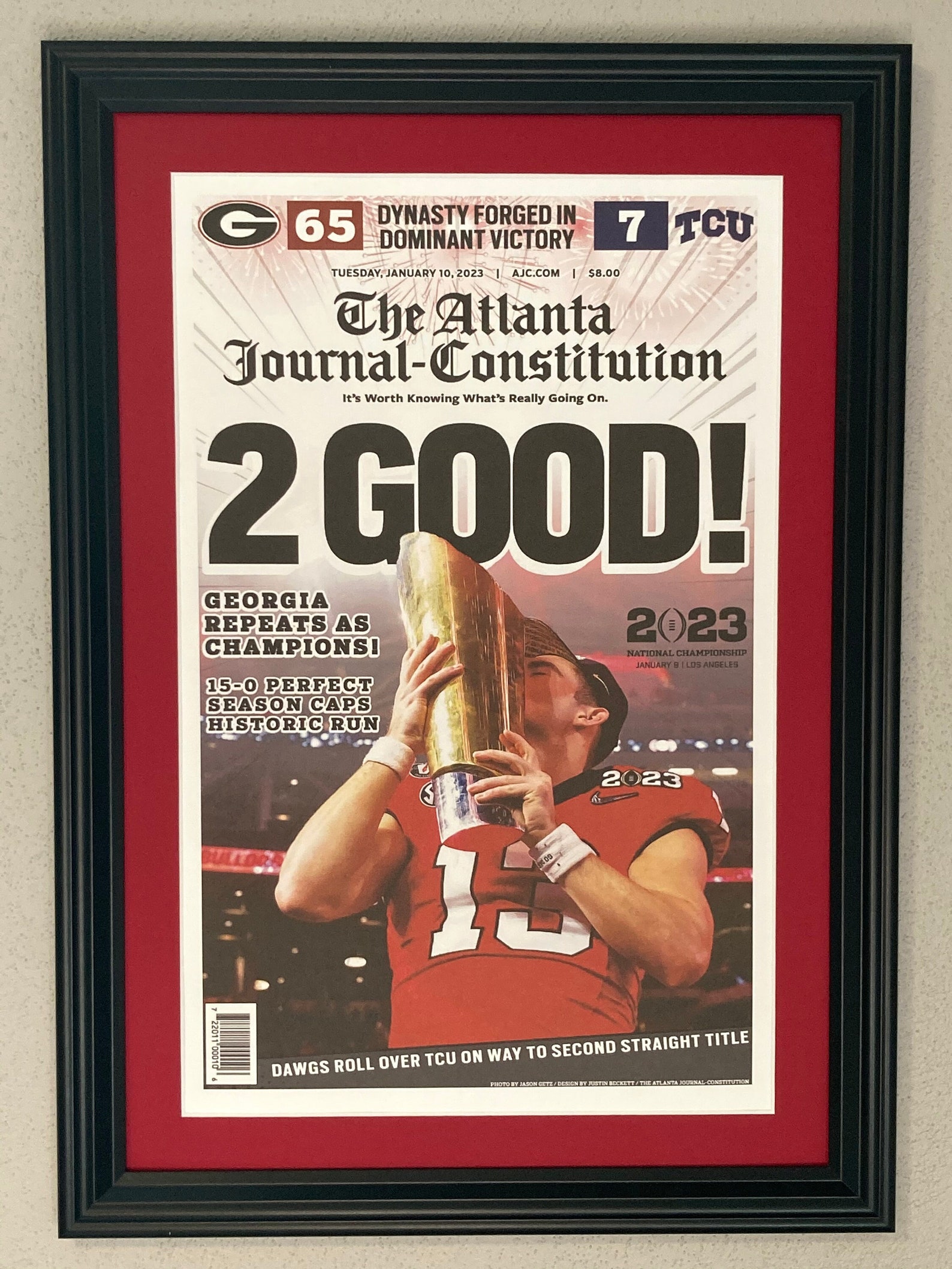
The 2022 college football season has gone, and the Georgia Bulldogs have repeated as national champions. Some argue that our national admiration of sports numbs us to the deterioration of our society. (Think ancient Rome and circuses and bloody spectacles.) However, there are also critics within the college football fan base who believe that the current method of crowning a national champion is unfair. The latter is more a matter of sour grapes. But when I consider paid college football players and transfer portals that foster a sense of entitlement among four- and five-star recruits, I find it difficult not to listen to some criticism.
As Kirby Smart’s teams have improved over the years, so has their emphasis on teamwork and selflessness. They’ve made it a permanent part of their game strategy, and as a result, they consistently give it their all in most contests. ESPN sports pundits marveled at Kirby’s ability to make his team believe they were undervalued and disrespected despite being labeled the favorites. But, as the adage goes, the proof is in the pudding. Many athletes wanted to help pave the way to victory for their teammates. That is to say, rather than dwelling on how many times they had possession of the ball or how many big plays they had made, they celebrated the accomplishments of their teammates. Nolan Smith, a senior, is a prime example of this because his senior season was cut short due to an injury. After his stellar play on last year’s national championship team, he was eligible to enter the NFL draft. But he returned to Georgia for his senior year. However, his injury hasn’t stopped him from acting as a de facto coach for the rest of the team. Marvin Jones, Jr., one of Smith’s admirers, says he wants to fill the void Smith will leave after graduation.
Some readers might assume I’m just trying to boast about “my” Georgia Bulldogs. Trust me; there’s more to it than that. An even more valuable group needs the same sense of teamwork and selflessness. Yes, I’m referring to the church. Like sports teams, the church requires teamwork and a selfless attitude to work together for the same mission. Paul writes that each church member contributes to its growth by fulfilling their role (Ephesians 4.16). One aspect of this role is encouraging and supporting each other (1 Thessalonians 5.11). Paul even went so far as to say that we should defer to our weaker brothers’ scruples to pursue peace and edification (Romans 14.19). While it is true that we will give an account of ourselves to God (Romans 14.12), we must focus on the “team.” Jesus loved the church so much that He gave His life for her (Ephesians 5.25). As a result, we are to have the mind of Christ (Philippians 2.5ff). And the early church had its counterparts to people like Nolan Smith, most notably Andrew and Barnabas, two men about whom less is known but who undoubtedly had a significant impact on the early church. These two provided the selflessness and humility the church needs today by following the Lord’s call and putting aside their desires.
Remember, we are not competing for a stylized black football atop a golden pedestal. Instead, we seek an imperishable crown (1 Corinthians 9.25). As a result, our devotion to the church must outweigh our enthusiasm for a football team on any autumn Saturday, especially in the South.
In Acts 20:24, Paul says, “…But I do not consider my life of any account as dear to myself…in order that I may finish my course.”
What an incredible attitude. In verse 24 Paul stated the reason he was willing to face the dangers in Jerusalem. He was ready to surrender his life for the gospel. In his epistles Paul often stated his readiness to suffer, even to die for Christ. Paul had completely given his life to Christ. He was willing to die for what he believed. Are we? As ministers we should believe in the word of God so much that we are willing to give our lives for it. What are our lives to us? How much do they mean to us? Do we care so much about our lives that we are willing to preserve them over preserving the word? Those are a lot of questions, but there’s one simple fact that we must remember. A preacher that is not willing to give his life for the cause of Christ is not worthy to preach.
God’s church, the Bride of Christ, deserves a man willing to lay down his life for the gospel. When Jesus came to Paul on the road to Damascus, He gave Paul his life’s mission. By the grace of God, Paul completed a lifelong service to Him. As ministers, there is not a better life to model ours after, besides Jesus, than the life of Paul. He was selfless to the very end. His body was a mere tool just for the cause of Christ. What does that take? A lifetime of studying and growing our relationship with the Lord. A man with a poor or lacking relationship with God does not belong in the pulpit.
From the book of Acts we can pull many examples from Paul’s life and apply them to that of the modern day minister. The Bible is 1900 years old, but it is still a practical guide to today’s preachers. We have different challenges that may seem like new issues, but Paul proves over and over again that following Christ wholeheartedly is all we truly need to make it as successful ministers in the church today. Who does the church see in the pulpit? Who does the church need in the pulpit? These are often two very different things. The preacher can act one way in front of everyone, but who he is when he’s alone is what counts. Does he study and pray constantly? A minister should follow closely the example of Paul, and in doing so he will not fail. If every church had a preacher like Paul the church would be a strong and thriving group.
I Thessalonians was written to a group of people who were confused about Jesus’s return. I & II Thessalonians are eschatological letters. They contain some of the clearest teachings about Jesus coming back, outside of II Peter. But there’s a lot more to I Thessalonians than just teachings about the end of earth (unlike II Thessalonians).
Four out of the five chapters are all about how we’re supposed to operate as a church family while waiting for Jesus to come get us. We know from II Thessalonians that some people were teaching them that Jesus had already come back. They were afraid that he’d already taken away everyone who’d get to live with him forever, and this was causing them to panic. Paul wanted them to know that God expects us to live morally good lives while we’re waiting for him to return.
The entire book might be summarized like this — “God wants you to live morally excellent lives while you wait for Jesus to come back. Always be proactive in loving each other as a church family. Pursue moral goodness at all times. Never give in to the world’s pressures, but do whatever it takes to be faithful until Jesus returns. If you do your part, Jesus will make sure that you’re ready for him to come back.”
Next week, we’ll look at how the first part of the book applies to Christians in the 21st century. In fact, this entire study is going to look at I Thessalonians through the lens of modern application. Technical study is important and has its place, but our study will focus exclusively on the application side.
For centuries, the locals of Meghalaya, India, have manipulated the roots of rubber trees to grow their natural bridges. Stretching over ditches and streams these natural structures will far outlast the man-made metal or wooden bridges that rot and decay in just a few years. The rubber-roots are self-strengthening and become more substantial over time by increasing in thickness.
Meghalaya also happens to be the rainiest place on earth, receiving 467 inches of rainfall a year. Just to put that in perspective, New York will typically get around 60 inches a year. The men and women who work outdoors wear a sort of full body-umbrella made of bamboo and banana leaves.
One visiting reporter stopped a butcher who was carrying a basket of freshly-cut meat up a steep flight of stairs. He was asked if it was hard to live in a place with so much rain. The 26 year old man replied, “we can’t think about that. Here there’s always rain but we have to work, so it’s no good wondering about it.”
There are many people who tend to take this attitude after experiencing a rude awakening in life. When the days of innocence have passed us by we think tragedy, hardship, trials, and tribulations are just a part of the deal.
It’s going to rain. It does no good to think about it— we trudge along.
We’ve got overcast days, cold days, and rainy days— but it doesn’t mean we have to live without any light.
This post is a simple one. Here’s a few passages to help brighten up the darker days.
These verses don’t take the hurt out of life but they can put the hope back in our lives when we begin to lose drive.
Isa. 60.19
No longer will you need the sun to shine by day, nor the moon to give its light by night, for the Lord your God will be your everlasting light, and your God will be your glory.
John 1.4-5
The Word gave life to everything that was created, and his life brought light to everyone. The light shines in the darkness, and the darkness can never extinguish it.
Ps. 40.1-3
I waited patiently for the Lord to help me, and he turned to me and heard my cry. He lifted me out of the pit of despair, out of the mud and the mire. He set my feet on solid ground and steadied me as I walked along. He has given me a new song to sing, a hymn of praise to our God. Many will see what he has done and be amazed. They will put their trust in the Lord.
I John 1.5
This is the message we heard from Jesus and now declare to you: God is light, and there is no darkness in him at all.
I would argue that though it’s impossible for every day to be a sunny one, the Christian will always have access to the Light because of His son.
The writer of 2 Kings is constantly diverting his attention from Israel to Judah and vice versa. So, he introduces us to Azariah, also known as Uzziah, anointed king over Judah at age 16. We will read much more about him in 2 Kings 15, but he seems to be referenced here only to give us the chronology for when Jeroboam II is anointed king of Israel. It is in the 16th year of Uzziah’s reign that Jeroboam comes to the throne. This will be the next-to-last generation in the dynasty of Jehu, but his son, Zechariah (29), will be murdered after six months. When he ascends to the throne, Israel only has about 70 years left before they are destroyed by the vicious Assyrians. God has been patient with Israel for almost 150 years, as king after king behaves just as Jeroboam will behave: “He did evil in the sight of the Lord; he did not depart from all the sins of Jeroboam the son of Nebat, which he made Israel sin” (24).
He will reign 41 years over Israel, an evil king over a wicked and disobedient people. But, these are God’s people, Abraham’s descendants and once part of the United Kingdom. If we do the impossible and try to put ourselves in God’s place, can we imagine giving to and doing for a people who are continually unappreciative, rebellious, and unfaithful? How long could we go before we ran out of patience? How many times could we be betrayed and hated by the recipients of our generosity before we gave up on them? Or, having God’s power, how long before we destroyed them all? God will go over 200 years, restraining Himself as His people served other gods and gratified their flesh.
Isn’t it amazing how much grace and kindness God shows to this faithless people? The Jonah who God graciously sends to the Assyrians to preach repentance (Jonah 1:1) is also sent to Israel (25). Despite Jonah’s flaws, his ministry seemed to be to extend God’s grace to an unrighteous people. Then, read what the author says about God and Israel next. “For the Lord saw the affliction of Israel, which was very bitter; for there was neither bond nor free, nor was there any helper for Israel. The Lord did not say that He would blot out the name of Israel from under heaven, but He saved them by the hand of Jeroboam the son of Joash” (26-27). You want insight into the heart of God, as He deals with our sins? He cares when His people suffer. He views us with compassion, sympathy, and concern. He doesn’t want to reject us or let us go. God sent His prophet Hosea to this very people and speaks His mind on this subject: “How can I give you up, O Ephraim? How can I surrender you, O Israel? How can I make you like Admah? How can I treat you like Zeboiim? My heart is turned over within Me, All My compassions are kindled. I will not execute My fierce anger; I will not destroy Ephraim again. For I am God and not man, the Holy One in your midst, And I will not come in wrath” (Hosea 11:8-9).
No one will be able to legitimately say at the Judgment, “God, you were harsh, hasty, and hateful!” No, even in the face of faithlessness, God shows His matchless grace! His patience can be exhausted and His justice will not allow impenitence to go unpunished (read Exodus 34:7). But let no one accuse God of reckless wrath! He is the God of unending love. May this lead us to repentance (Rom. 2:4) and faithfulness (Rev. 2:10)!
Film director, James Cameron, has helped put the Mariana Trench in the news with his recent seven mile plunge to the bottom of the deepest point on earth. This trench, located in the western Pacific Ocean off the Philippines, has a water pressure of eight tons per square inch–1000 times greater than atmospheric pressure at sea level. Cameron is only the third person to reach the bottom of the trench (called the “Challenger Deep”), and he did so 52 years after two men did so in a U.S. Navy submersible called the Trieste. While he has reported that there were no signs of life, that it was a “barren, desolate lunar plain” (AP, 3/26/12), God has placed amazing, other-worldly-looking creatures miles deep in the oceans of the earth. Cameron’s is almost certainly the first of many more trips to the “Challenger Deep.” Who knows? Maybe future voyages will reveal crush depth-defying vertebrates and other scientific improbabilities (much information from http://deepseachallenge.com).
It is amazing that man has discovered the ability and technology God has made available to accomplish a feat like this. It is also amazing to think that God created areas on this earth, like other parts of the Mariana Trench, filled with exotic, often colorful sea life that He knew it would take thousands of years for man to discover. Yet, He did that. It is further proof of His existence and insight into what kind of God He is, a God of such intricate designing and endless power.
It is also a testimony to the omnipresence of God. How great if Cameron would have quoted David’s words as he sat upon the floor of “Challenger Deep”: “Where can I go from Your Spirit? Or where can I flee from Your presence? If I ascend to heaven, You are there; If I make my bed in Sheol, behold, You are there. If I take the wings of the dawn, if I dwell in the remotest part of the sea, even there Your hand will lead me, and Your right hand will lay hold of me” (Ps. 139:7-10).
Jaroslav Vazda wrote a beautiful song, “God of The Sparrow.” It is a song praising God’s power and implicitly reminding us of the awe we owe Him. How wonderful to know that the God of the Mariana Trench is the God we can approach and the God with whom we can have relationship!
Maybe you’ve heard of this well-known Southeast Asian method of trapping a monkey. This simple method only requires the hunter to get a coconut or some kind of container that’s hard to break and carve a hole that’s big enough for a monkey’s hand that’s open—but not big enough when its clenched up in a fist. What these primates won’t do even as they see the hunter approach them is unhand the bait. Therefore, their fist inside the coconut traps them there until they are caught.
The principle of the monkey trap can be found in many aspects of life, and it is not foreign to the Bible either. In Matthew 19:16-30 (cf. Mk. 17-31; Lk. 18:18-30) is a story we know very well, in which a rich young ruler asks Jesus what he must do to inherit eternal life.
Jesus knew in that moment what exactly that young man needed to hear and told him what he needed to do in order to inherit eternal life. However, because he was so rich and did not want to part with his wealth, the young man became sad.
We don’t have Jesus in the flesh in front of us to tell us exactly what we need to do in order to get into heaven, but that does not mean that we are lacking in any way. Through the pages of God’s inspired Word, we are being taught and guided what is required for us to enter into Christ and live a faithful life.
The challenge for us, therefore, is not that we do not have Jesus to tell us what to do. No—in fact, we have him right here with us, around us, and within us. All around us is the presence of God and our savior. What it boils down to, then, is our fisted up hand inside the trap.
We may look at the monkey that’s trapped by such a simple device and laugh, but don’t we often find ourselves shackled by the one or two sins that keep plaguing our lives? For the rich young ruler, it was his wealth, but this isn’t about being rich or poor. Even those without money can be chained by their sins that they cannot let go.
It’s the beginning of a new year. A time people usually spend contemplating how this new season of life will play out. How many times have we told ourselves, “I will stop this time,” or “I’ll work on this and get better about it.” When will we loosen our fists that grip so hard on the things that drive us away from God, and finally let go?
The rich young ruler could not let go, and therefore he became sad. Knowing what he needed to do, he still failed. Not because he wasn’t told nor because he didn’t understand. It was a willful decision to choose what’s in his fist rather than Jesus. He teaches us a lesson through this unfortunate outcome. How many times does God tell us through His Word exactly what we need to do, just like Jesus did with the young man? Let us be better in the coming year, to finally thwart off the chains that bind us. Paul tells us in Galatians 5:1, “For freedom Christ has set us free; stand firm therefore, and do not submit again to a yoke of slavery.” God has already rescued us. It comes down to us deciding that we want to be saved, rather than be shackled by what’s in our stubborn fists.




















 The Preacher Pollard Blog