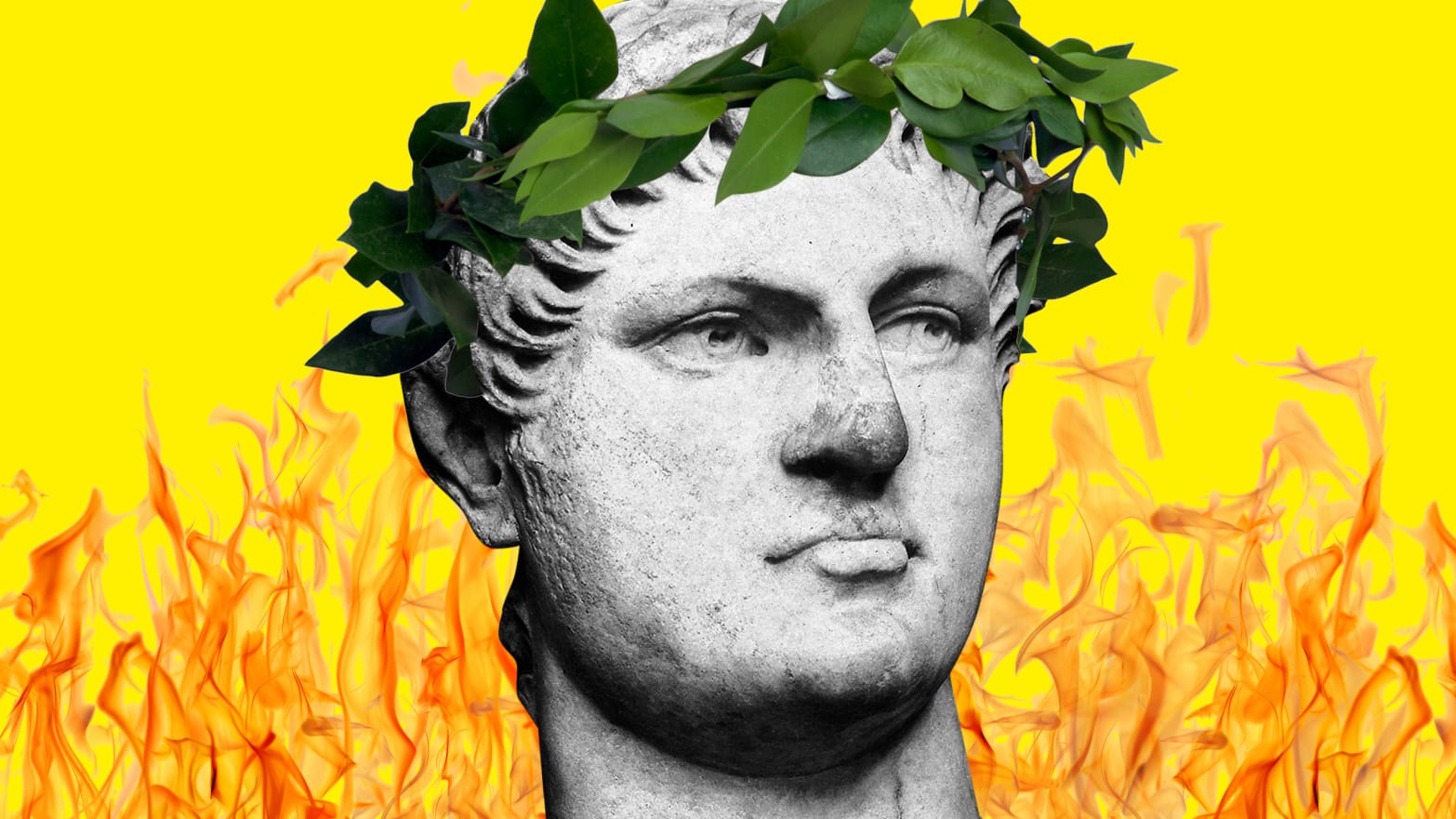
One of the strangest moments in Roman history probably belongs to crazy Caligula. Why? Well, he’s the emperor who declared war on the sea.
This wasn’t a battle on the sea, this was a battle with the sea.
According to the Roman historian Suetonius in The Twelve Caesars, Caligula marched his legions to the coast of Gaul around A.D. 40 and he formed his soldiers in battle lines facing the water.
Then he gives a command— attack!
The troops were ordered to stab the waves and hurl javelins into the surf. Afterward, Caligula reportedly instructed them to gather seashells as “spoils of war”—from Neptune (Rome’s god of the sea).
Was the story exaggerated? It’s possible. Even if the only truth to the tale was that a man waged war against the ocean it still provides the perfect illustration for many things in life. The illusion of human power, being one of them. An emperor who ruled millions could command armies, raise your taxes, and build monuments — but he couldn’t slay the sea. The ocean didn’t retreat and the waves did not surrender.
The Bible tells us who has sovereignty over the waters:
“Who shut up the sea behind doors when it burst forth from the womb… when I said, ‘This far you may come and no farther; here is where your proud waves halt” (Job 38:8–11)?
God reminds humanity that only He sets boundaries for the ocean. Kings may flex, and armies might rage, but the tide answers to no one but Him.
Caligula’s strange spectacle at the beach becomes sort of a parable doesn’t it? When humans attempt to assert divine authority over creation, they expose their limits. A lesson nobody ever wants to learn is that power without humility turns into absurdity. Or, to put it another way; authority without submission is self-parody.
The sea still keeps its boundaries, not because an emperor commanded it— but because God did.
Perhaps you are facing a difficult circumstance. It should not be trivialized or minimized. It might be painful and protracted. But it should neither be the source of defeat or an excuse to stop serving the Lord.
Neal Pollard
In Acts 28:16, Luke tells us that when Paul came to Rome he was allowed to stay by himself (in a house he paid for himself, according to verse 30). However, he was guarded by a Roman soldier. Paul again refers to this in Philippians 1:13, 17, and your version probably has either the word “imprisonment” or “bonds.” Many ancient historians tells us that the Romans would chain the prisoner and soldier together in a practice known as “Custodia Militaris.” Polybius, a Roman historian writing more than a 100 years before the first century, wrote, “They kept them bound with a chain to a soldier who was responsible for their custody” (Histories 1.88.8). Seneca and Josephus also record this practice.
Can you imagine what a daily problem this would have been? Consider the invasion of privacy, the unpredictable disposition of your companion, and the potential for scorn and humiliation? Yet, day after day, Paul would be chained to a soldier. The chains were 18-24 inches long (the British Museum has archaeological finds from the period), and the guards were rotated every four to six hours (Vegetius 3.8). Maybe the last guard was a nice guy, but the next was not so much. It could not have been an enjoyable task for the soldier either, and he might be inclined to take that out on the prisoner.
But, how did Paul respond? Paul implies what he did as one guard came and another went. “my imprisonment in the cause of Christ has become well known throughout the whole praetorian guard and to everyone else” (Phil. 1:13). These praetorian guards were elite Roman soldiers, also known as the imperial guard. This might further explain how the gospel reached members of Caesar’s household (Phil. 4:22). Imprisoned for preaching Jesus and shackled to worldly, hardened men, Paul taught the gospel. He learned to be content in every circumstance (Phil. 4:11), but that didn’t mean idle or self-absorbed.
Perhaps you are facing a difficult circumstance. It should not be trivialized or minimized. It might be painful and protracted. But it should neither be the source of defeat or an excuse to stop serving the Lord. Paul had a captive audience, literally bound to hear the good news from a man enduring what most would deem a bad fate. He transformed his difficulty into opportunity. May we have the will and wisdom to do the same!
What do you think of when you read or hear of “walking in the truth”? Is it more than worshipping according to the New Testament pattern and baptizing for the remission of sins? What does the epistle of 2 John teach us about this important character trait?
Gary Pollard
II John 3 talks about living in truth and love. John was happy that they were following the truth, but they apparently weren’t following the way of love. We’ve looked at how John defines this love in I John 3, but as a quick refresher: “This is how we know what real love is — Jesus gave his life for us. So we should give our lives for each other. Suppose a believer who is rich enough to have all the necessities of life sees a fellow believer who is poor and does not even have basic needs. What if the rich believer doesn’t help the poor one? Then it is clear that God’s love is not in that person’s heart” (16-17). He uses almost exactly the same formula in II John, which reads like I John if it were condensed to one chapter.
In II John 6 he says, “Loving means living the way he commanded us to live. God’s command is this: that you live a life of love. You heard this command from the beginning.” We won’t have “grace, mercy, and peace from God the Father and his Son” if we aren’t living in both truth and love (3). This lady and her family had the truth thing down, but their love needed some work. John seems to go back and forth between the truth and love theme in this letter.
There’s a warning sandwiched between two “truth” statements. “Be careful! Don’t lose the reward we have worked for. Be careful so that you will receive all of that reward” (8). Be careful about what? “There are many false teachers in the world now,” and, “Everyone must continue to follow only the teaching about Christ. Whoever changes that teaching does not have God” (7 and 9). The teaching about Christ is that he came to Earth and became human (cf. 7).
We may take this for granted and/or may not appreciate its significance. Many gods competed for the hearts of nations, and most of world had a pantheon. Paul said that these gods are actually just demons (I Cor 10.19-20; cf. Deut 32.17, I Enoch 19.1), and there is compelling evidence of certain of these taking different names throughout history. The Egyptian god Thoth was worshipped by the Greeks as Hermes and the Romans as Mercury. Amun (Egypt) was Zeus (Greece) and Jupiter (Rome). Isis (Egypt) was Aphrodite (Greece) and Venus (Rome). Ra (Egypt) was Zeus (Greece), Jupiter (Rome), and Indra (Hindu). Hathor (Egypt) was a fixation for some time over the last couple of centuries, and has also been associated with Aphrodite (Greece) and Venus (Rome).1 This list is far from exhaustive. They’re all just archetypes used by demons to manipulate and derail civilizations.
No god took human form23 and lived a very public life doing good for others in the most selfless possible way. No god was perfectly innocent. But God made himself human, was morally perfect, and sacrificed his physical body before coming back to life. That last action was a promise — we’ll get that too! God becoming human for our sake is the most beautiful narrative ever conceived. God becoming human revealed the Great Mystery to all of humanity for the first time (Eph 3.4-6, Col 4.3): there is a greater power, he wants a relationship with humanity, and he’s coming back to save his family when earth is destroyed.
With this truth in our hearts, God expects us to capitalize on any opportunities we have to show selfless love to our Christian family, and then to all people we encounter.
Don’t save treasures for yourselves here on earth. Moths and rust will destroy them and thieves can break in and steal them. Instead, save your treasures in the heavens, where they cannot be destroyed by moths or rust and where thieves cannot break in and steal them. Your heart will be where your treasure is (Mt 6.19-21).
1 Editors of Encyclopaedia Britannica (2017, October 27). 11 Egyptian Gods and Goddesses. Encyclopedia Britannica. https://www.britannica.com/list/11-egyptian-gods-and-goddesses 2At the very least it’s curious that many polytheistic cultures believed in an incorporeal afterlife. A physical God and a physical resurrection repulsed the Gnostics, who were certainly influenced by Egyptian theology. The Egyptians believed in a non-physical afterlife, as did many or most other religions (sadly, many Christians do, too). While it may or may not be accurate, Enoch claims that demons are the spirits (consciousness) of human/watcher offspring who’ve been relieved of their bodies (15.8-9). If that’s true, it’s at least interesting that most of the cultures they influenced also despised the concept of a physical afterlife. Our God came back to life in a real, physical body and promised us the same. It’s real hope. Their gods are smoke and mirrors and offer no tangible, practical hope. 3I’m not talking about humans whose actions ultimately led their deification, but primordial “gods” considered superior to humanity by the cultures who worship them.
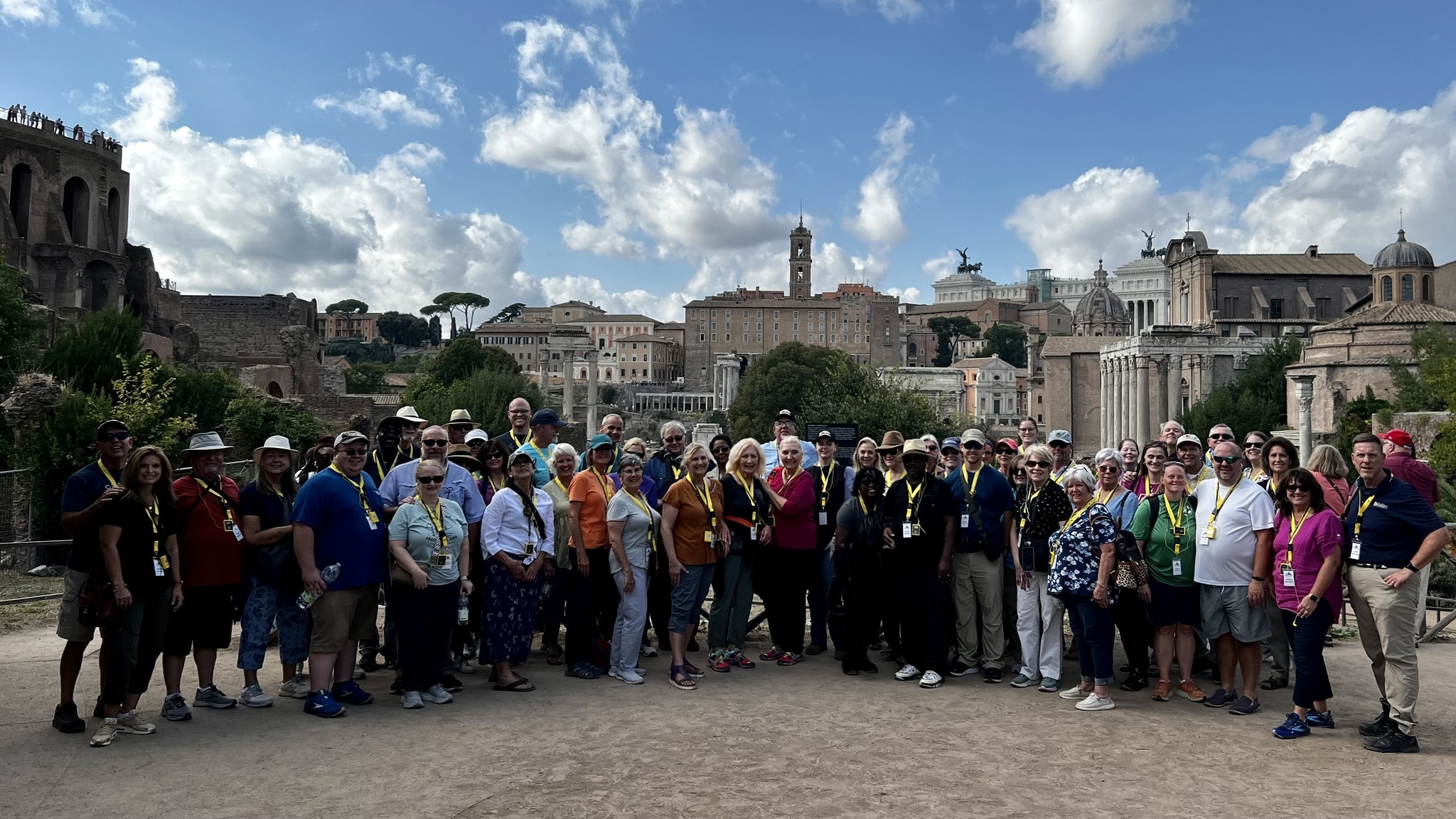
Today, we completed our land tour of Rome. I mentioned that there are 56 of us, ranging in age from teenagers to pushing 80. So, we move different speeds and are in different degrees of health. We are often having to go far and somewhat fast, requiring patience on the part of everyone. It has been pretty hot and sunny all weekend, too! Would you believe that everyone has kept such a great attitude and been so pleasant? Of course! We have been with God’s family, who you would expect to act more like Him than anyone else.
This morning, we all piled into our tour bus (packing about 90 bags into the bottom of it) and made our way to meet with the “Chiesa di Cristo” in Rome. This church of about 30, which has two elders, welcomed us with open arms. Some of their brethren led us in worship, some of our group led us in worship, and we sang, prayed, heard the word proclaimed, contributed, and observed the Lord’s Supper together. We sang in Italian, in English, and even in Xhosa (a South African language). We greeted and talked as best as we could with the language barrier and got to know some of each other’s stories. It was emotional.
I thought about what happened to Paul right before he was arrested and wound his way to Rome to appeal to Caesar. Nearing the end of his third missionary journey, he met in Miletus with the elders of the church at Ephesus (a city we’ll visit later this week)(Acts 20:17-38). Paul had worked with them for three years. At their parting, they wept, hugged, and said an emotional goodbye. The next place we know that he stopped was at Tyre (past Cyprus, which we plan to visit next week) in Acts 21:3-6. Paul and his fellow-missionaries were with these Christians just a few days. When they said goodbye, it was still an emotional, heartfelt goodbye.
That was the general feeling as we pulled away from brethren we only knew a couple of hours. Separated by language, culture, and background, we felt the bond of Christ strongly! It was hard to leave. It was wonderful to be there, to be with God’s family. How eternally wise our God was in building the church like He did. We will make some lifelong friendships as we tour so many places where Paul once walked and preached. We will have difficulty saying goodbye to some we’ve known and others we’ve met. But, that’s always the way it is when you’ve been with God’s family! They are the best!
56 Christians from Arizona, Arkansas, California, Colorado, Kentucky, Michigan, Mississippi, Nebraska, South Carolina, Texas, and Virginia converged on the Hotel Gioberti in Rome, Italy, to begin a tour of places where the great preacher, evangelist, writer, and leader, Paul, shared the gospel of Christ. We began where it all ended for him: Rome. While our visit to where it all began for him, Israel, will sadly not be a part of our itinerary due to the tragic events now occurring there, we will visit a great many places where he helped fulfill Christ’s Great Commission in incredible, far-reaching ways.
He longed to get to Rome to “obtain some fruit among” them (Rom. 1:13), converting the citizens of that city the same as he had in so many other places. We know from Acts 28 that he did reach this city. This weekend, we saw what he found in his day. Emperors who would be declared gods by their senate, idolatry and the worship of gods of war, water, the sun, and a pantheon of others, and immorality like that described by Paul in Romans 1:18-32. Perhaps the first Christians came to Rome after hearing the first gospel sermon and obeying it (Acts 2:10). There are plenty of Christians to greet Paul as he approaches Rome in chains (Acts 28:14-15).
We encountered a city with stunning architecture, engineering marvels, Renaissance giants, and rich history that spans across, as John Moore eloquently put it, three eras–the pagan era, the Christian era, and the modern era. In a few hours, we will assemble with the saints at the church in Rome. It will be an exciting opportunity to meet in the capital city of what was, in the first century, the center of a global empire into which Christianity was born (Dan. 2:40-44). Standing in the midst of that city, imagining what our first-century spiritual family not only encountered but also endured, is a rare and beautiful opportunity to appreciate the power and spread of God’s eternal truth even in unfavorable social and political circumstances. It is a reminder, as Paul first put it, of the power of the gospel of Christ that brings salvation (Rom. 1:16). As Paul exhorted the Christians at Rome, I must not be ashamed of that gospel!
You may had heard once about the couple archaeologists dug up in an excavation in Rome, Italy. They found the bones of a couple who would have possibly lived before Noah, but how they found them was most unique. The skeletons were found in embrace, suggesting especially to the sentimental the profoundest expression of love and togetherness possible (source here).
Who knows what it truly means, who they were, and if they were even husband and wife? Yet, I would like to think that they were a couple so close and whose lives were so intertwined that their repose in death was symbolic of how they were to each other throughout life. We certainly need good role models, wherever we can “dig them up.”
Society does not do so much to encourage married people staying together. In fact, infidelity and fornication are idolized character traits. Those who stick together through thick and thin are portrayed as foolish or at least boring. Yet, God laid out a blueprint for the whole that includes a bond much stronger than an embrace for couples staying together (cf. Gen. 2:18-24; Mat. 19:3-9; 1 Pet. 3:1-7; etc.). The Lord’s church needs men and women who are committed to staying together, to building healthy, happy and close marriages. Societies, to long endure, need such values embraced and encouraged. You, if you are married, need to rededicate yourself to your spouse each day, finding ways to stick close and reasons to stay together.
Historically, I’ve seen the Book of Revelation as rooted in a bygone era, primarily relevant to the early Christians of the first and second centuries. Therefore, Revelation 2.10, which urged faithfulness to achieve eternal life, crystallized the central message for contemporary Christians. Earlier readings of Revelation painted it as a cryptic missive, but recent interactions, set against the backdrop of current news and social media, have reshaped my understanding of its relevance to our times. (And, no, I’m not referring to premillennial notions of the end times.)
Faith & Integrity:
Revelation emphasizes the importance of unwavering allegiance to one’s beliefs. Individuals today frequently navigate the turbulent waters of societal expectations and political correctness, just as early Christians did with the imposing orthodoxy of the Roman Empire. The letters to the seven churches can be read as a call to fortitude, warning against surrendering one’s values to the winds of societal change.
Furthermore, the church in Pergamum, which Jesus chastised for its flirtation with idolatrous teachings, serves as a stark warning against even seemingly minor compromises. Deviating from long-held Biblical teachings for modern ideologies can resemble the ancient seduction of the Imperial Cult.
Perseverance & Opposition:
Revelation encourages perseverance, especially when faced with persecution. Like their forefathers, modern Christians may face scorn or disdain for their steadfast adherence to biblical values. On the other hand, Revelation offers solace by promising rewards for unwavering faith.
Hope & Future:
In the grand narrative, Revelation emphasizes the transient nature of earthly regimes. The predicted demise of “Babylon” (Rome) is a powerful reminder of the transient nature of societal norms and structures. Current political correctness or societal mores are fleeting, particularly when viewed through eternity.
Revelation’s resounding theme is hope despite its occasionally bleak portrayals. Regardless of current challenges, the promise of the New Jerusalem and God’s ultimate triumph herald a brighter horizon.
Discernment & Judgment:
The rich tapestry of symbols and visions in Revelation invites discernment. This challenge reflects today’s environment, which is rife with competing narratives and information overload. The imperative is to cut through the noise and identify truths that align with biblical beliefs.
In conclusion, Revelation is not limited to the period in which John wrote it. It sends an enduring message, urging believers throughout the ages to remain steadfast in the face of external pressures and to cherish the eternal promise. This message emphasizes Revelation’s continuing relevance, encouraging our forefathers and current believers to consider its teachings.
For even more on the book of Revelation, we highly recommend Hiram Kemp’s study of Revelation at Lehman Avenue church of Christ (all archives are on our YouTube page and the class is a little over halfway done.
Worry not. I am not writing an article about the 2021 National Champion Georgia Bulldogs, even though that is an article I had wished to write for decades. No, I am thinking of an archaeological discovery made in a Pompeiian house (“House of the Tragic Poet”) renowned for its exquisite frescoes and mosaics. Within the house’s vestibule, there is a dog mosaic. Below the dog, there are also these two words in Latin: “Cave Canem.” I imagine you have guessed from the context of our title what those Latin words mean. Yes, they read, “Beware of the dog.” (Literally, “Beware the dog.”) The mosaic dates to the second century BC.1
Did you imagine that the ancient Romans had “Beware of the Dog” signs? I admit being unaware of this until I stumbled upon a bit of clickbait on social media promising interesting archaeological finds. OK, so maybe this “sign” wasn’t the most breathtaking discovery ever. But it was interesting. It serves as an example of Solomon’s inspired truth that there is nothing new under the sun (Ecclesiastes 1.9).
Typically, we think of the “Beware of the Dog” sign as a warning to unwanted visitors. It says, “We have a dog, and it may bite you.” However, scholars believe that the sign’s original purpose was the opposite. Visitors did not have to worry about dog attacks but needed to avoid trampling the family dog. “When you come inside, you will encounter a small animal we cherish. Please be mindful of him.”
The Italian Greyhound, for example, is an older breed originating more than two thousand years ago. It is the smallest of the sighthounds. The AKC states that breeders bred them as “noble companions.”2 That fits what we know of Pompeii, a resort town for wealthy Romans who would surely own such canines. Indeed, the House of the Tragic Poet was not the only house in Pompeii with a “Cave Canem” mosaic. It was just the first one excavated.
Now, why would I spend so much time within a religious forum talking about a “Beware of the Dog” sign? It so happens that Paul used that expression in Philippian 3.2: “Beware of the dogs, beware of the evil workers, beware of the false circumcision” (all ref. NASB1995 unless otherwise indicated). In Koine Greek, that is “Βλέπετε τοὺς κύνας.” As odd as it sounds to the dog-loving United States today, Arabs and Jews were more likely to despise dogs. Remember that even Jesus cautioned us, “Do not give what is holy to the dogs…” (Matthew 7.6).
Dogs were often wild and roamed in packs in ancient Judea. There was no archaeological evidence of pet dogs in the region until the post-exilic era.3 In their nondomesticated state, these dogs would do disgusting things like eating the bodies of the dead (e.g., 1Kings 14.11). These reasons are why generic Biblical scholarship believes Jews and Arabs dislike dogs and use the term as a byword for detested people. (Indeed, Western languages now likewise use “dog” in a derogatory manner, but it doesn’t impact the Western perception of the animal.)
Paul didn’t straddle the fence when it came to the truth, but he did straddle a cultural divide. He who was the “Hebrew of Hebrews” (Philippians 3.5) would be the Apostle ordained to take the Gospel to the gentile world (Acts 8.15). That is why as outrageous as it sounds, we benefit from “Cave Canem” since knowing cultural concepts helps us better understand a verse’s context.
So, what was Paul saying here? To the Gentile, being asked to “beware of the dog” meant looking out for him, lest you trip over him. To the Jew, “beware of the dog” meant being wary of the one with a vile nature, fitting with their cultural perception of a dog. So, Paul begins with a Jewish insult. The third noun, translated as “concision” (KJV) or “false circumcision” (NASB1995), actually means “mutilation.” Would those Judaizers insisting that Gentiles be circumcised to become Christians enjoy being called a “mutilator?”
It sounds less like we are talking about multiple groups troubling the church at Philippi and more like Paul describes one group by using three noun descriptions. Two of the nouns speak more loudly to one cultural group. So then, what of the “evil workers?” Would this not also describe the same “mutilating dogs?” That seems to fit the context better. This second noun and its adjective also remind one of the words of Jesus in Matthew 7.23, particularly in the King James Version: “Depart from me, ye that work iniquity.” These latter “iniquity workers” felt they had done laudable things but discovered they neglected to do God’s Will (Matthew 7.21-23). We can make the case that such was true of the Judaizer also.
Lest anyone interpret this sentiment as anti-Semitic, we emphasize that the three nouns used by Paul work as well for any false teacher. Yet, the Judaizers were a thorn in Paul’s side as he fulfilled his ministry. And even though Gentiles doubtlessly read the words of this epistle, their Jewish brethren in this cosmopolitan congregation of Philippi could provide greater meaning while also helping their Gentile brethren be wary of the “leaven of the Pharisees and Sadducees.” (cf., Matthew 16.6)
In conclusion, although the Bible serves as its own best commentary, we note we can obtain understanding through additional sources of information. Sometimes those sources can be surprising, like a dog mosaic in the vestibule of a Pompeiian house. Yes, there might be some put off by this idea that it takes effort to delve deeper into the word of God as we look for answers within God’s Word and without, in sources like archaeology. However, the proper mindset makes Bible study more attractive, even fun. You can find faith-building things everywhere. Just think about that the next time you see those words, “Beware of the Dog.”
Gaius Cornelius Tacitus (AD 56-120) wrote two secular historical works describing the reigns of Tiberius, Claudius, Nero, and Gabba, Otho, Vespasian, and Vitellius (Annals and Histories).
He was the son-in-law of Agricola, the Roman General responsible for Roman expansion throughout Europe, especially northern Britain. He was not a Christian by any means, but a patriotic Roman with a family heritage tied to its conquests.
In the following excerpt, Tacitus mentions Jesus (referred to as Christus) and details the persecution of early Christians. I have abbreviated some of the excerpt (ellipsis), given contextual explanation (brackets), and added emphasis (bolded text). The information in his writings is fascinating, but I found the following to be shareable.
“…The next thing was to seek means of propitiating the gods [because of the burning of Rome], and recourse was had to the Sibylline books… But all human efforts, all the lavish gifts of the emperor, and the propitiations of the gods, did not banish the sinister belief that the conflagration was the result of an order.
Consequently, to get rid of the report, Nero fastened the guilt and inflicted the most exquisite tortures on a class hated for their abominations, called Christians by the populace. Christus, from whom the name had its origin, suffered the extreme penalty during the reign of Tiberius at the hands of one of our procurators, Pontius Pilatus, and a most mischievous superstition [of resurrection], thus checked for the moment, again broke out not only in Judæa, the first source of the evil, but even in Rome…
Accordingly, an arrest was first made of all who pleaded guilty; then, upon their information, an immense multitude was convicted, not so much of the crime of firing the city, as of hatred against mankind. Mockery of every sort was added to their deaths. Covered with the skins of beasts, they were torn by dogs and perished, or were nailed to crosses, or were doomed to the flames and burnt, to serve as a nightly illumination, when daylight had expired.
Nero offered his gardens for the spectacle, and was exhibiting a show in the circus, while he mingled with the people in the dress of a charioteer or stood aloft on a car. Hence, even for criminals who deserved extreme and exemplary punishment, there arose a feeling of compassion; for it was not, as it seemed, for the public good, but to glut one man’s cruelty, that they were being destroyed.”
With the death of Nero, a path to the imperial throne was opened to Vespasian by those soldiers serving under the former’s command. Vespasian had made a reputation for himself in the conquest of Britain and the subjugation of Jewish revolts beginning in AD 66. Thus, given the opportunity by his men, Vespasian founded the Flavian Dynasty, which his son, Titus, would succeed. As emperor, Vespasian left the task of quelling the Jewish rebellion to his son, Titus. Thus, Titus remained in the theater of conflict while his father returned to Rome.
In AD 70, Titus crushes the Jewish rebellion by destroying Jerusalem and the Second Temple. Vespasian dies from an illness within a decade, opening the throne to his son, Titus. As emperor, Titus completed the Roman Colosseum and dealt with the crisis of Pompeii and Herculaneum. Upon his death, Titus’ younger brother, Domitian, became emperor and built the Arch of Titus in AD 81 to commemorate Titus’ conquest of Jerusalem. Titus serves only about three years as emperor.
It is of note that the triumphant arch Domitian dedicates is to Titus, who only completes his father’s work in Judea and Jerusalem. No doubt, Vespasian would have approved seeing as he desired to lay the foundation for his family’s rule. In life, Vespasian had likewise sought to emphasize his son’s actions. In other words, though ambitious, Vespasian was generous enough to share the spotlight with his son to further his machinations. As homecomings go, Titus was a son well-received by his father. One can question if the son was as accomplished as his father, given the brevity of his reign. If for no other reason than establishing the desired optics, though, Vespasian knew to give Titus a grand reception upon the completion of his task on the battlefield, since it glorified himself as well.
I recently completed a study on the Harmony of the Gospels; that is, the complete narrative one finds when fleshing out the revealed narrative of Christ by coalescing all four gospel accounts into a single account. I noted that despite being the shortest gospel, only Mark ends in a manner consistent with the once-coveted literary “happily-ever-after.” Indeed, Mark 16.19-20 has Jesus returning to the Father and the disciples carrying out their Master’s work. Matthew ends his gospel with our Lord’s promise to remain with us. Luke ends his thoroughly-researched gospel by showing the rejoicing disciples continuing in their praises to God. John ends the last written gospel by telling us that despite not having a complete record of Christ’s life, we have enough information to develop a saving faith.
As a Christian, I appreciate the perspective of each inspired gospel author. I have always been partial to John’s gospel with its unique approach, but now find myself most enamored by Mark’s inspired conclusion. In stark contrast to the prodigal son, in which a rebellious son squanders his father’s inheritance in the far country, but finds a gracious, welcoming father upon his repentance, we have in Mark’s closing an obedient Son returning triumphantly to the deserved adulation of His Father. The text is simple enough. The New American Standard Version states, “…He was received up into heaven and sat down at the right hand of God” (Mark 16.19).
That was what Jesus eagerly anticipated. The Hebrews writer said it was this impending joy enabling Him to endure the shame of the cross (Hebrews 12.2). If Titus deserved a triumphant arch for doing his father’s bidding, shouldn’t a much more deserving Son receive from His Father the name above all names? (Philippians 2.9-11) No Christian doubts Jesus was worthy of this honor, but is there not something uplifting about reading the confirmation Mark provides? Given what Jesus accomplished, we relish this affirmation since we know His vicarious sacrifice enables us likewise to join Him in His death, burial, and resurrection (Romans 6.3-5,8-9). We can see by faith Stephen’s vision granted him before his martyrdom of the Christ standing at God’s right hand, looking at human events intently (Acts 7.56). Truly, He is our great High Priest (Hebrews 4.14-16), interceding for us (Romans 8.34).
Further Reading:
Wasson, Donald L. “Vespasian.” Ancient History Encyclopedia, Ancient History Encyclopedia, 11 Aug. 2020,www.ancient.eu/Vespasian/.
Chilver, Guy Edward Farquhar. “Vespasian.” Encyclopædia Britannica, Encyclopædia Britannica, Inc., 20 June 2020, www.britannica.com/biography/Vespasian.
Wasson, Donald L. “Titus.” Ancient History Encyclopedia, Ancient History Encyclopedia, 11 Aug. 2020, www.ancient.eu/titus/.
If I have a favorite chapter of the Bible, it would have to be 2 Timothy 4. Yes, I love the first eight verses, but that alone is not what cinches this chapter as dearest to me. It’s Paul’s personal remarks starting in verse nine. There’s his longing to see his spiritual son, Timothy. Twice he implores Timothy to come see him (9, 21). He’s in prison, persecuted for preaching the Prince of Peace. He longs for Christian companionship. Then, he shares his dejection over the abandonment of certain fellow-workers (10). He wants to see cohorts with whom he has done spiritual battle (11). He has personal needs and wants (13). He warns Timothy of a spiritual troublemaker (14-15). Then, he shares personal feelings of isolation and loneliness, a time when he needed a Christian brother by his side but had none (16). Bold, risk-taking Paul, who would stand up to any opposition, the epitome of true manliness, was now in undoubtedly dire, dank conditions, the smell of squalor in the air. Whatever he saw, heard, and felt as he wrote, Paul scratched out these words: “At my first defense no one supported me, but all deserted me; may it not be counted against them. But the Lord stood with me and strengthened me, so that through me the proclamation might be fully accomplished, and that all the Gentiles might hear; and I was rescued out of the lion’s mouth. The Lord will rescue me from every evil deed, and will bring me safely to His heavenly kingdom; to Him be the glory forever and ever. Amen” (16-18). These words aren’t the end of the letter, but they are the end of the matter!
This faithful Christian was deserted by men, but he felt God’s presence and power:
The Lord stood with him.
The Lord strengthened him.
The Lord spoke through him.
The Lord saved him.
The Lord was steering him.
You and I cannot fathom the price Paul paid for proclaiming Jesus. But even if we were ever to face privation, punishment and pain for our faith, what was true for this apostle will be true of us. He promised to be with us always (Mat. 28:20) and never forsake us (Heb. 13:5). Even if you ever feel physically alone, you will have the spiritual assistance Paul speaks of in 2 Timothy 4. Through it all, you can say with Paul, “To Him be the glory forever and ever. Amen!”











 The Preacher Pollard Blog