The apostle John introduces us to the work of John the Baptist by sharing the contentious back and forth between the priests and Levites and this preacher. The Pharisees had sent these leaders from Jerusalem to ascertain who this unconventional, but popular, preacher was.
Neal Pollard
The apostle John introduces us to the work of John the Baptist by sharing the contentious back and forth between the priests and Levites and this preacher. The Pharisees had sent these leaders from Jerusalem to ascertain who this unconventional, but popular, preacher was. He confessed, “I am not the Christ” (John 1:21). His circumstances were somewhat different from anyone else. His express job was to come as a forerunner, a herald to prepare people for Jesus’ coming.
But he was not the last person who needed to acknowledge that truth.
What about church leaders and servants? It can be easy to develop a Messiah Complex, seeing ourselves as people’s saviors. Whether they come for counsel or attach themselves to us for spiritual guidance, role confusion can happen easily–not just for the receiver, but also for the giver. We may take on their problems and our lives may get out of balance in seeking to help. Others need to understand, as we do, that we are not the Christ. We are His ambassadors (2 Cor. 5:20), but our task is to get them connected to Jesus. He alone can save (Acts 4:12).
What about those in close relationships? Whether a spouse, sibling, children, parent, or friend, one may find himself or herself enabling someone whose problems and issues become their own. We cannot be their conscience, moral compass, warden, or parole officer. We want to help and bear burdens (Gal. 6:2), but at some point each must bear their own load (Gal. 6:5).
What about me? In a much different sense, I cannot substitute my convictions, feelings, opinions, or preferences for Jesus’ word and will. He has all authority (Mat. 28:18). When it comes to how I live, I don’t get to decide where He has already spoken (John 12:48).
We can learn a lot from John. He consciously set about to maximize Christ and minimize self (John 3:30). It can be tricky to be a servant of Christ without becoming a substitute for Christ, but that is the challenge! Perhaps it starts with a deliberate effort, praying to remember who we are in God’s scheme of things. But is also means remembering who we are not!
The words of Paul have never been more urgently needed: “For since in the wisdom of God the world through its wisdom did not come to know God, God was well-pleased through the foolishness of the message preached to save those who believe” (1 Cor. 1:21).
Neal Pollard
Last night, we finished our third annual EQUIPPED workshop. It was uplifting for so many reasons, too many to try and list here. I want to focus on just one. Certainly, the speakers we had represented a diversity of style, background, schooling, age, race, and personality. To the person, each shared the common value of presenting God’s word faithfully, richly, and beneficially. In every session I attended (and I floated into multiple sessions many hours), I admired how effectively each exposed God’s message!
We also had representatives from six schools of preaching (Bear Valley Bible Institute, Brown Trail SOP, Florida SOP, Georgia SOP, Tri-Cities SOP, West Virginia SOP), not including speakers training preachers from these schools and in the Memphis SOP, Faulkner University, and Freed-Hardeman University. I talked with several of these men, and they speak of the urgent need we have to meet the surging preacher shortage crisis facing God’s people. Often, this shortage causes or hastens congregations having to shut their doors. At best, it hamstrings the work the local church can do. It is a reminder of our pressing need to emphasize the wonderful life preaching is, encouraging our sons to preach, and our daughters to want to marry preachers.
The best part of this weekend was seeing preachers from all over who came to feast on God’s word and get practical ideas to enhance their local works. If there was anything better than that, it was the several “prospective” preachers that were in attendance. Talking to young men who shared with me their aspiration to go preach, those who were making their plans to attend school for that purpose, and seeing young men who just need a person of influence in their lives to gently nudge them in that direction.
The words of Paul have never been more urgently needed: “For since in the wisdom of God the world through its wisdom did not come to know God, God was well-pleased through the foolishness of the message preached to save those who believe” (1 Cor. 1:21). Because we believe that, let’s encourage men to engage in the greatest mission God ever gave.
A little less than 2,000 years ago, a man named Timothy moved to a beautiful coastal town in what is now Selçuk, Turkey. His mom and grandma were Jewish and his dad was Greek. When he was possibly about 45 years old, he moved to Ephesus to work with a newly formed group of Christians. Before this, he traveled with Paul all over the Roman empire telling people about Jesus and how he came back to life.
By Jewish standards for a teacher, Timothy was a young man. He may have been naturally introverted and had difficulty with confrontation (I Cor 16.10, II Tim 1.7-8). Besides this, he had a criminal record in the Roman empire. He was arrested at least once for teaching about Jesus (Heb 13.23), possibly while he was working with the church in Ephesus.
He had a very tough job— Ephesus was dealing with bad influences (like Judaism and Gnostic groups) and Timothy had to stop them. This was obviously very difficult for him. Paul wrote I Timothy as a pilot’s checklist of what God wanted for his family. It was also a gentle push for Timothy to keep those bad influences out of the church. This wasn’t enough of a push, though, because II Timothy is far more direct and has a distinct air of reprimand.
Despite his weaknesses, Timothy was an awesome person and a very hard worker. Next week we’ll start our study of I Timothy 1.
The Bible clearly tells us as Christians that we are to tell others about Christ and salvation. Ephesians 4:11-12 reads, “And He gave the apostles, the prophets, the evangelists, the shepherds and teachers, to equip the saints for the work of ministry, for building up the body of Christ.”
The word doesn’t tell us this will always be an easy task or that we will have success in folks having interest in what we’re trying to tell them, but we are commanded to still try to do so. There are a lot of excuses that have been made to avoid talking to others about the Bible. Like, that’s the preacher’s job or I don’t really know what to say, or my favorite, I can’t speak well and don’t want to be rejected.
But 2 Corinthians 11:6 says that the apostle Paul had problems with his speaking but still proclaimed the word to many with success. It reads: Even if I am unskilled in speaking, I am not so in knowledge: indeed, in every way we have made this plain to you in all things.
If we think we are lacking in how to talk to people about their salvation, the elders or ministers here at Lehman, I’m sure can be helpful in our efforts.
James 1:22 reads: But be doers of the word, and not hearers only, deceiving yourselves. We have been put here on earth to love God and keep his commandments.
One of these commandments is found in Mark 16:15-16, which most know by heart. “And He said to them, Go into all the world and proclaim the gospel to the whole creation. Whoever believes and is baptized will be saved, but whoever does not believe will be condemned.”
The world needs to hear the good news and we should always be prepared to share it. I often think back to a friend and a brother in Christ who has passed on from this life that loved to tell others about the word of God at a country store where we ate lunch. There were some that referred to him as “preacher”. But that seemed to make him more determined to try to teach them. I have never been called “preacher” before, so maybe I have work to do in telling others the word.
We shouldn’t be afraid to talk to others because we are scared of being made fun of. There are many in the Bible that were beaten and even killed for proclaiming the word. So just being rejected shouldn’t bother us.
The world seems to put their faith in money and material things but it seems that most aren’t ever content. Telling them about Jesus Christ and eternal life in heaven is what they need in their lives.
It has always made me feel good inside when I could help someone in need, and there is nothing you could give anyone that could be any better than the hope of eternal life.
There might be a time that we’re asked a question that we don’t know the answer, but we can always tell them we can get back to them after further study. Telling folks the plan of salvation should be something we all know as well as anything.
The Bible tells us all will not be receptive to the gospel but there will be some that are. Some are eager to be saved right away. But there will be some that it takes some time. Either way we are to plant the seed and God will give the increase.
These words are mainly from my lack of doing what I should be doing in my Christian walk. My personal prayer is that God helps me realize the doors that are open for me and he gives me the courage to do what is commanded.
I had the good fortune of growing up in a Christian family and I guess becoming a Christian came fairly easy for me. There are so many outside the walls of the church building that didn’t have the privilege of being in that environment. It is not as easy for some of these to accept Christ and live the Christian life because it hasn’t been a constant in their lives. We need to share the word with them and not keep it to ourselves.
How much better things would be if all knew God’s word. We probably all have family members or extended family that need to know the true word. We hope that we can find the right way to talk to them and study the word without causing any family tension. We can pray that we can approach these issues in a loving way and they can be reached because we all want to be in heaven together.
There are multiple ways to start conversations with someone that eventually lead to talking about what the Bible has to say or we can simply ask if they would like a Bible study. If you aren’t comfortable with a Bible study, there are members that will help with that.
Derek and Neal’s Sunday morning Bible class is a study on spiritual disciplines. Personal evangelism is a discipline that should be right at the top of the list. This past Sunday in class, Neal made a point on how the scripture should be real aloud in a public gathering. We should do it with enthusiasm and let people know your privileged to be reading God’s word. Talking to our friends and neighbors about Jesus Christ should be done with the same enthusiasm to show them we are happy to be Christians it’s the only way to have true contentment.
Most of us here go to eat at restaurants occasionally, go get haircuts, get our vehicle serviced, go to the bank, and multiple other places that we can strike up conversation. We can get excited pretty quick talking about politics or our favorite sports teams or our kids. Hopefully, we can be excited about talking about Jesus and salvation.
I’ll finish with John 13:34-35: “A new commandment I give unto you, that ye love one another; as I have loved you, ye are my disciples, if ye have love one to another. If we truly love others, we will help them in any way we can to get to heaven.”
When taking a look at the book of Acts, many insights can be found about the church. From the Lord’s supper to the appointing of elders, there are many things that can be learned about the Lord’s Church and how it should act. Today there are far too many churches that have left and strayed away from the original design. Since we have one Bible, there should be one church. Out of the many things that can be learned from Acts, one of the most prominent aspects seen is the local preacher in a congregation and how he should behave.
Today when we look in the denominational world, we see the preachers as a sort of leader in the church. The names given to preachers can sometimes be misleading. But the preacher has a very significant job, and hopefully by the end of this article series we will see that the minister is not too different from the member of the body. He is one that proclaims the word. His main job is to be an example and one who can take the word of God and turn it into something that God’s people can learn, and then apply to their christian walks. By looking at the examples given in Acts about the local preacher, we are able to answer quite a few questions.
Probably the chapter that contains the majority of these insights is chapter 20, specifically verses 17 through 38. These articles will be an in depth study on this section of Acts, and how it applies to a preacher in a local congregation.
Acts 20:17, “Now from Miletus he sent to Ephesus and called the elders of the church to come to him.” Notice that Paul met with the Elders of the church at Ephesus. The word for elder here is the word presbuteros, and we know that this is in reference to those who held the office of elders, and were not just older men. We see this in 1 Timothy 3:1-7 and Titus 1:6ff.
To be a successful local preacher it is vital to talk to, and build a relationship with the elders of the congregation. Elders play an extremely vital role in churches, and to be an effective minister we must make sure that there is a healthy relationship between the elders and the preacher. Paul set the example, and now we follow what he has set. It makes sense. The elders are the leaders of the congregation and if the preacher is leading in a way other than what the elders have asked then how will the members react? The preacher must be one that uplifts and submits to the authority of the eldership. Paul was a great man. He had given up so much for the gospel yet even he submits himself under the elders. God knew what He was doing when He designed the church, so it is no wonder that many denominations fall away from the original design, and then run into many issues.
The local preacher is a member, therefore he must submit to the oversight and leadership of the elders.
I’ve never known a day when I didn’t live in a “preacher’s home.” “Preacher’s homes” are very much like every other home–problems, inside jokes, traditions, hobbies and interests, sin, laughter–except the chosen profession of the father is to serve either full-time or part-time as a proclaimer of God’s Word. At times, the home I grew up in was made of figurative glass, meaning I was occasionally subjected to unfair favoritism and criticism.Kathy, also a lifetime resident of a “preacher’s home,” knows that feeling, too. Then, we subjected our sons to the exact same thing!
Whenever we are asked about what it is like to live this unique life (and lifestyle), different words would be appropriate:
Challenging–There can be elevated expectations and unrealistic assumptions about the preacher’s personal life, marriage, parenting, and the like. What Shakespeare’s Jewish character says of his people in the “Merchant of Venice” applies: “If you prick us, do we not bleed? If you tickle us, do we not laugh?” Life’s pressures and temptations visit our homes, too.
Lonely–Occasionally, we feel alone and stand alone because of the message we preach. Usually, it’s not others who make us feel this way, but an innate part of the life.
Ordinary–Most preachers probably love to hear church members and those in the community say, “You’re just an ordinary person with an ordinary life.” To be genuine and real is, in my view, a worthy aim. See the opening paragraph.
But, please understand that the most fitting, usual words used to describe the life in preaching are positive, superlative words and phrases–“important,” “exciting,” “fulfilling,” “full,” “rewarding,” “humbling,” “meaningful,”and “uplifting.” Yesterday, we said “so long” to one of God’s greatest churches as we prepare to move to work with another one. I asked Kathy to describe a one-word assessment that best described how she felt in light of the generous words and acts from our spiritual family throughout the day. She used words like “Overwhelmed,” “grateful,” and “touched.” But then, scanning her brilliant mind as if to find that perfect summary word (as she usually does), she simply said, “Blessed.”
We’ve been blessed by a lifetime of living the “preacher life.” Blessed by 27 years of full-time preaching. Blessed by 13 years of preaching at Bear Valley. Blessed by the opportunity to preach in this “next chapter” of life at Lehman Avenue. Blessed, as cracked pots (2 Cor. 4:7), to be used by the Master Potter. Far from a perfect life, it is certainly a blessed life.
Thank you, Bear Valley, for your many acts of kindness–yesterday and for the entirety of our time with you in Colorado. We love you and will miss you!
Frankly, some preachers are or can be a pain! There are various reasons for this, but I would hasten to say that such are in the minority. As I sit in our Future Preachers Training Camp listening to our teachers speak to the next generation of preachers, I am in admiration. Their passion, knowledge, experience, wisdom, and, knowing them, their character leave me in grateful awe. Others who have filled the pulpit or taught classes this week take their place alongside the others I mention. Their work and life are incredibly noteworthy. While some would not use this word of them complimentarily, preachers are “special” men.
To go into this field of work requires some distinct traits:
A willingness to have your life on display
A desire to spend your life full-time in ministry
An understanding that some will not respect your occupation
A willingness to have people disagreeing with what you say, though you know it’s important
A humility to care and minister to others, even the difficult and unpleasant people
A willingness to enter a profession that may have an economic ceiling
The gospel preacher knows these and other circumstances may often exist, but he sees so many enriching aspects of the life of preaching. Soul-winning, serving, developing, aiding positive change, learning, and much more epitomize the fringe benefits available to a man who preaches the Word. Those wise enough to see this find these things more than sufficient to offset whatever perceived challenges accompany this life.
Watching tomorrow’s preachers absorbing, questioning, thinking, and working excites me. I’m thankful that they are able to find sound, qualified men to provide well-reasoned, Bible answers, but I’m as thankful they are interested and desirous of exploring this life. In a bad-news world, watching quality young men trying to stretch and grow themselves in leadership and preaching is some of the best possible news. Seeing works like preaching camps, schools of preaching, brotherhood activities featuring gospel preachers make me so thankful for men who dedicate themselves to this wonderful life. Please pray for every man who endeavors to aspire to and live this life. Each of us need God’s Word, wisdom, and strength to do this work adequately.
The preacher who dazzles with his insight, personality, influence, popularity, or following?
The teacher who is the students’ favorite?
The member who is “balling” (making a lot of money and having a lot of success in business)?
The family with the biggest house and nicest automobiles?
The one with the best academic pedigree, with the proverbial alphabet soup behind their name?
The folks who are best known and most influential in our community?
The ones who are incredibly fit and attractive?
The greatest debater, philosopher, and reasoner we know?
The elder who is most successful in his career?
One who seems to combine a great many or even all of these attributes?
It could be one of these individuals, but despite and not because of the specifics just mentioned. But, we so easily fall into the trap that causes us to think that those criteria are what make one greatest. Such can cause us to vest blind trust in them or put them in a higher place than is right. Worse, we can try to be motivated to define and promote ourselves as greatest through these means.
The tendency is so fundamental. Jesus warned against it in places like Matthew 20:25-28 and 23:12. His disciples, like James (4:6-10), Peter (1 Pet. 3:8; 5:5-6), Paul (2 Cor. 10:12-18), Jude (16), and the rest, at least implicitly, address the same trap. We all fight the desire to be seen so as to be admired. We may do so through our marriages, our children’s accomplishments, our economic status, our apparent importance, our having it all together, our professional prowess, or any other asset we feel responsible for having. If we use these things to place ourselves above and/or push others below, we are disqualifying ourselves for greatness in the only way that matters—God’s way. False modesty isn’t the answer, either.
We must look at ourselves as dependent creatures. It’s all His and without Him we’d have nothing! We must look at ourselves as devoted stewards. It’s all His and He expects us to use it wisely, on His behalf! We must look at ourselves as divine instruments.It’s all His and He works through us to do His will! We must look at ourselves as dutiful slaves.It’s all His and so are we, living and serving at and for His pleasure!
The warning and disclaimer is that this transformation must happen at heart-level, rooting out thoughts and attitudes that, while fleshly, are so easy to embrace. If the weeds of pride aren’t dislodged from deep within, this effort will prove impossible. But, if it could not be done, God would not have spent so much time instructing us to live and walk by the Spirit rather than by the desires of the flesh and mind. It is the old song, “None of self and all of Thee.” To the degree we adorn that mindset and make that transformation, to that degree we will achieve greatness God’s way!
It was hard being a preacher in Jeremiah’s day. As thanks for his work, the weeping prophet endured the following:
He was led as a lamb to the slaughter (11:18ff)
His brethren dealt treacherously w/him (12:6)
He was confronted by false prophets (14:13)
His brethren cursed him (15:10)
He was hit, put in stocks and condemned (20:1ff)
His heart was broken (23:9)
He was seized and threatened w/death (26:8,24)
His teaching was opposed (28,29)
He was put in prison (32:2,3)
He was pursued (36:26)
He was beaten and imprisoned (37:15)
He was thrown into the dungeon (38:6)
He was bound in chains (40:1)
He was falsely accused (43:2)
He was taken to Egypt (43:6,7)
Remember, God called him to this work. Jeremiah was doing nothing wrong in his ministry; in fact, all of those things that happened to him came in “the line of duty.” The people, on the whole, never changed for the better after all the effort Jeremiah put forth in his ministry. Jeremiah never speaks of his work as enjoyable or rewarding, but it was essential and vital. Some estimate that his ministry spanned more than six decades! Whatever we call him, we do not use adjectives like “weak” or “wimpy.”
The life of preaching is a wonderful work. The preacher works with the best people in the world fulfilling the most profound purpose possible while working, ultimately, for the best Employer there is. The retirement plan is unbeatable! Helping people connect with salvation and helping the saved better connect with their Savior is extremely fulfilling. But, if there are job hazards (the minority of brethren who are difficult to deal with, sporadic job insecurity, being misunderstood, being subjected or having your family subjected to closer scrutiny, etc.), there is a reminder from Hilkiah’s son from Anathoth. Out of our own devotion to God, we will stay at it through thick and thin. Jeremiah wrote, “I have become a laughingstock all day long; Everyone mocks me. For each time I speak, I cry aloud; I proclaim violence and destruction, because for me the word of the Lord has resulted in reproach and derision all day long” (20:7-8). This man thought about quitting, but he couldn’t! He says, “But if I say, ‘I will not remember Him or speak anymore in His name,’ then in my heart it becomes like a burning fire shut up in my bones;
and I am weary of holding it in, and I cannot endure it” (9). I have watched my father, who has preached the gospel 53 years, have some “Jeremiah moments.” I have known so many gospel preachers who have walked in that prophet’s sandals. I have even experienced a few of the lighter trials Jeremiah records as happening to him. But Jeremiah and his modern counterparts whom I have watched serve him faithfully provide a sterling example to me of what the man of God who preaches “looks like.” He’s tough, but tender-hearted. He’s loyal and loving. He’s gritty, but gracious. He’s courageous, yet caring. He will be fallible, but he must be faithful.
Preaching is, in my opinion, the best work in the world. For whatever bumps unique to the preacher traveling the narrow way, there are ten times the blessings. To my fellow friends in this fantastic fraternity, keep the tenacity of the tearful teacher of Judah! Stoke the fire in your bones (cf. 2 Tim. 1:6).
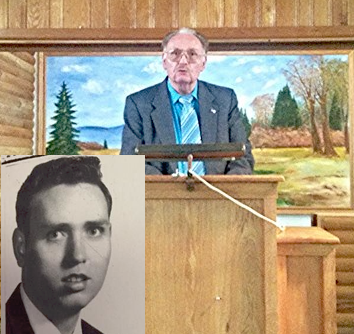
My dad preaching in Artesia, MS, in 1964 (left) and preaching in Andrews, NC, in 2016 (right).
How many human cannonballs at the circus can call themselves “Oxford-trained”? 30-year-old Gary Stocker, with law degree in tow, left a six figure income working as an academic law writer and legal recruitment officer and “ran away with Chaplin’s Circus” (Lizzy Buchan, Cambridge News Online, 7/11/14). He actually is starting up the circus with a buddy he worked with as a street performer as a teenager, and he actually had continuing various performances while a student at the prestigious British university. While many would be baffled to think of one leaving a comfortable, white-collar occupation for one that has been for the more common, blue-collar person since ancient Roman times, Stocker is choosing what he loves over what others thought more suitable for him.
A thought occurred to me as a new class is about to embark on their studies at the Bear Valley Bible Institute next week. There is an analogy here, as men come to us not only from High School but more often from medical, business, agricultural, mechanical, military, law enforcement, and other professions. For 50 years, men have been leaving jobs, often well-paying, respectable ones, to pursue “the foolishness of preaching” (cf. 1 Co. 1:18-21). Some, even close friends, brethren, and family, may question their thinking for undertaking such a pursuit and even offer resistance and dissuasion. When they graduate and go into full-time ministry, they may never regain the income or have the notoriety they would have enjoyed in the secular world. However, it can be argued they will be entering the most noble, worthwhile profession there is. To work with the people of God and to bring the lost to God provides endless, invigorating opportunity and excitement. Each day is new, exciting, and rewarding. Though it has its pressures, disappointments, and trials, it is a work that is easy to love!
There are men who may be successfully toiling in some other field, but they leave it for a love of preaching. Thank God for these men. Let us encourage them and ever have a hand in helping these “up and comers” in their new profession!
One of the stories coming out of the much-publicized memorial for Nelson Mandela is of a man who passed himself off as a language interpreter for the deaf. The unidentified man, who stood beside international dignitaries including the president of the United States, was confirmed to be a charlatan by sign language experts. His hand motions were meaningless, but his apparent attempt to make a quick buck outraged the deaf all around the world. Apparently, this is the second time this man has pulled the wool over official’s, um, ears. Driven by greed and taking advantage of the ignorance of the ones who hire them, people like this man have duped quite a few people. None of them ever pulled off a hoax of this magnitude, though.
Perhaps words like audacious, covetous, or callous may come to your mind, hearing about this event, but a far greater travesty happens routinely around this nation and around the world. Men (and women) pass themselves off as experts, but what they allege to be a truthful message is patently false. Sunday after Sunday, they pass off error as truth. Because too many do not study their Bibles or think for themselves, they are duped by those they trust. The greatest tragedy is that the consequences of such dishonesty are infinitely greater in these scenarios. Souls will be lost and not just the souls of the teachers. The hearers will have believed a lie (cf. 2 Th. 2:11; 2 Tim. 4:4). The preachers and teachers will “receive a stricter judgment” (Jas. 3:1) for scratching their itching ears (2 Tim. 4:3-4).
The challenge in preaching is for both classes, the speaker and the listener. The speaker must declare only what is right and the listener must hear with discernment (cf. Heb. 5:14). God will not allow any “fakes” to escape His notice.





 The Preacher Pollard Blog