Who Are Gog and Magog? The Ancient Names That Echo Through Eternity

Here, we must pause and speak clearly. The temptation to identify modern nations in ancient symbols is strong. Russia, China, and Iran—it’s as if the Bible becomes a cosmic puzzle that today’s newspaper must solve.

Brent Pollard

“You will come up against my people Israel, like a cloud covering the land. In the latter days I will bring you against my land, that the nations may know me, when through you, O Gog, I vindicate my holiness before their eyes.” —Ezekiel 38.16 (ESV)

Specific names stand out from the vast library of Scripture like distant thunder—mysterious, powerful, stirring something deep within the soul. Gog and Magog are such names. For generations, these ancient words have captured people’s imaginations, sparked debates, and fueled the very speculation that obscures their true glory.

Imagine the exile sitting by Babylon’s rivers, scroll unfurled, reading Ezekiel’s vision for the first time. What did the names mean to him? What do they mean for us? And here is where we must tread carefully, because the path of truth leads to wonder, whereas the path of speculation leads only to shadows.

When Heaven Writes History in Advance

Enter Ezekiel’s world for a moment. The prophet describes Gog, “of the land of Magog, the chief prince of Meshech and Tubal.” Sounds like they have weight, don’t they? But here something magnificent happens. This is not a typical historical account. This is heaven, writing poetry using the names of nations.

Consider this astonishing fact: no man named Gog has ever walked the earth. Yet, he is attributed as the leader of a coalition comprising Meshech, Tubal, Gomer, Togarmah, Persia, Cush, and Put—groups that have never historically formed such an alliance. These descendants, mentioned in Genesis 10, are scattered across the globe and are now gathered by divine artistry rather than human ambition.

Do you see it? Ezekiel paints with a cosmic brush, creating a vision that transcends time and geography. This is not tomorrow’s newspaper, written in ancient ink; it is eternity speaking in symbols that every generation can comprehend.

The War That Reveals God’s Heart

But what about the battle itself? Here is a mystery wrapped in majesty. Gog arrives with armies as massive as the stars, ready to descend like storm clouds on God’s people. The earth shakes with anticipation. Swords gleam. Banners break in the wind.

And then, before a single blow is thrown, the Author of All Stories takes the stage.

Earthquake. Pestilence. Heaven rains hailstones, fire, and brimstone (Ezekiel 38.22). The language itself echoes back in time to Sodom’s destruction and forward to judgment’s final hour. This isn’t about military genius or political strategy. This is about a God who fights for His children.

Classical commentators have long recognized that the vision magnifies God’s power in delivering His people and destroying their enemies. Gog represents not just one man’s ambition, but every force that has ever raised its fist against the Almighty’s chosen.

Do you feel your heart racing? Hopefully, it does. This is your story as well.

The Comfort Hidden in Symbols

Why this vision? Why now? Consider the first readers—God’s chosen people, dispersed like seeds in Babylon’s soil. Jerusalem lay in ruins. The temple stood as a collection of broken stones. Has their God forgotten them? Was He defeated by pagan gods and foreign armies?

The answer thunders from heaven: never.

The Lord provides centuries-long comfort through Ezekiel’s pen: “Every force that rises against you—every Gog that emerges from every Magog—will crumble before My power. Not because you are powerful, but because the I AM is your defender.”

Biblical interpreters understood this when they pointed out that Gog represents Christ’s enemies throughout history, serving as a timeless symbol of opposition to God’s people. For centuries, God’s people saw in these words not fear, but fierce hope. Only when speculative systems emerged in recent centuries did this comfort become clouded by confusion.

When the Final Curtain Falls

Turn the pages to Revelation 20, and the names appear again, like an echo across the corridors of time. “Gog and Magog.” But look at how John uses them! Satan, freed for his final act, gathers “the nations which are in the four quarters of the earth” for one last desperate charge against “the camp of the saints.”

Once again, no battle occurs. Fire descended from heaven. The end arrives not with a clash of armies, but with the whisper of divine judgment.

Gog and Magog represent not two nations, but all of God’s enemies. These names act as symbolic bookends to the eternal conflict between good and evil, representing all rebellion against divine authority.

Do you see the comfort here? Every enemy that has ever threatened God’s people, every force that has ever made you tremble in the night, has been gathered under these two ancient names, and they all face the same fate: swift, inevitable defeat by heaven’s own fire.

The Danger of Reading Tomorrow’s Headlines

Here, we must pause and speak clearly. The temptation to identify modern nations in ancient symbols is strong. Russia, China, and Iran—it’s as if the Bible becomes a cosmic puzzle that today’s newspaper must solve.

But this path leads away from comfort, not towards it. It breeds fear where God intended peace and speculation where He promised certainty. Gog and Magog represent something far greater than any single nation or alliance—the eternal principle that the world will always fight against God’s people, but God will always triumph.

Your comfort comes not from avoiding geopolitical turmoil, but from knowing that behind every earthly conflict is a heavenly King who has never lost a battle and never will.

The Names That Mean “Never Alone”

So, what do Gog and Magog mean to you right now, as you grapple with ancient and modern fears? They tell that you are not alone.

When the headlines make you tremble, remember that every enemy is already named in God’s book, and their defeat is predetermined. When things seem hopeless, remember that the same God who scatters all rebellion with heaven’s fire is the God who walks with you today.

This isn’t about charts or theories. This is about a Father fighting for his children. This is about a King whose victory is so sure that Scripture declares all opposition defeated.

The most incredible truth of all? The story concludes not with your defeat, but with your King’s eternal glory shining over a universe at peace.

“So I will show my greatness and my holiness and make myself known in the eyes of many nations. Then they will know that I am the Lord.” —Ezekiel 38.23 (ESV)

And in that day , every knee will bow—not in terror, but in awe of the One who has always been, is now, and will always be your magnificent Defender.

A Spiritual Dwarf

A cautionary tale. A how-not-to. There are multiple ways to say it, but some of the best lessons we learn are from a bad example. Dale explores one from the Old Testament today…

Dale Pollard

Saul had a bright future that by all accounts was full of opportunity. When we first read of him he’s portrayed as a likable underdog who doesn’t seem to see  his own potential, proven in his own words (1 Sam. 9.17-21). He was a nobody from a small tribe, but tall and kingly in appearance and his success would depend on who he listened to— not unlike us today. 

God anoints him as king and like every anointed king that we read of in the Old Testament, he influenced the nation’s relationship with God. In hindsight, we’re able to see God’s wisdom. God wanted judges. A judge spoke on behalf of God while carrying out His will for a time and then left. A king would always be more susceptible to various forms of corruption that come with the vast amount of power given to him. No matter how the rulers would live their lives, good or bad, we can learn much.

 Sadly, Saul is one of those kings who taught us how not to live. Here’s a list of the many spiritual dangers we should avoid— brought to you by Saul. 

Saul’s Seven Deadly Sins 

I SAMUEL 

  1. The sin of lacking patience – 13.8
  2. The sin of excuse-making – 13.11, 12; 15:15, 20, 24 
  3. The sin of half-hearted service – 15.1-26 
  4. The sin of glorifying self – 15.12
  5. The sin of fearing men rather than God – 15.15, 24 
  6. The sin of desiring forgiveness from man rather than God – 15.25
  7. The sin of jealousy – 18.6-9 

There are many other mistakes and shortcomings that accumulated in Saul’s physical and spiritual demise, but we can be strengthened by them (Rom. 15.4).

Isaiah: The Holy One Who Rules The World (XLVII)

“Our God Reigns” (52:1-15)

Neal Pollard

Chapter 52 is a dramatic call for the southern kingdom (and Jerusalem specifically) to awaken themselves at the deliverance and assurance of a God who is on their side. As we see this brief chapter, which leads in the better known 53rd chapter, there are a few significant details which build hope. Why? Because it centers around the God we serve.

God, The King, Values Us (1-5). Protectively, God calls to His people to be clothed in strength and beauty (1). It is a call to arise from captivity, having been bound by Egypt and Assyria (4). God arises like an advocate, pleading the case of His people (5). He does so from the standpoint of the personal cost He feels and the blasphemy it brings on His name (5). He does not want to see His people enslaved or humbled another moment.

God, The King, Redeems Us (6-10). This section is by far the most familiar to not only Bible readers, but those who recognize its words in a song we sing in worship. Especially note verse seven: “How lovely on the mountains Are the feet of him who brings good news, Who announces peace And brings good news of happiness, Who announces salvation, And says to Zion, ‘Your God reigns!’” God anticipates the day when His people would know His name and recognize His voice (6). That would be possible through the heralding of His messengers (7-8). The result would be celebration–shouts of joy (8-9), comfort (9), redemption (9), and salvation (10). But, by God’s might (10), it would be a salvation accessible to all nations (cf. Mat. 28:19; Acts 1:8). 

God, The King, Challenges Us (11-12). The call is for separation and purification. As they left captivity, they were not to take its spiritual influence with them. Despite the terror they faced going into bondage, they would come out with peace and security. God not only calls for righteousness, He pledges His help as they pursue it. 

God, The King, Visits Us (13-15). These verses actually seem to begin the fourth and final “Servant Song” that continues through the next chapter. Each song begins, “Behold, my Servant” or a similar phrase (42:1; 49:1; 50:4). While chapter 53 will focus on His suffering, the Messiah is introduced with His being “high and lifted up and greatly exalted” (13). Philippians 2:9-11 says that glory would follow suffering. Here, we are reminded of how glorious this one who came to be the Servant is. These verses are a prelude to the awful picture of suffering that follows, especially verses 14-15. Notice that this Servant will astonish many with what He suffers, just as the Jewish nation suffered in the captivity. He would be marred and disfigured beyond human likeness (14). Oh, how the gospels will portray that on the day of His crucifixion. This servant will also atone for many by His sacrifice, implying His blood by the mention of “sprinkling” (15). This servant will disclose the truth of His identity to those in high places (15). Paul quotes Isaiah 52:15 and applies it to Jesus, when he reveals in Romans 15:21 that he shared Jesus in places where he had not been. This verse is cited as biblical defense for such. The Jews rejected or minimized Old Testament passages that portrayed the Servant as sufferer rather than sovereign. But, the message of Scripture is that we must Christ, all of Him, as the one exalted but first executed, as the one triumphant but only after He was threatened, tortured, and terminated. 

How Do You Make An Ahab?

Neal Pollard

Perhaps two kings most epitomize how bad the northern kingdom (Israel) was. The first symbol of their spiritual rottenness was Jeroboam. His legacy lives at the end of each successive king’s biography. Their epitaph all point back to him: “For he walked in all the way of Jeroboam the son of Nebat and in his sins which he made Israel sin, provoking the Lord God of Israel with their idols” (26). His influence stained all the rest of them. The second symbol was Ahab, who we are introduced to in 1 Kings 16. His life is summed up starting in verse 30: “Ahab the son of Omri did evil in the sight of the Lord more than all who were before him.” The writer then goes on to elaborate with details before summarizing, saying, “Thus Ahab did more to provoke the Lord God of Israel than all the kings of Israel who were before him” (33). 

What makes for a man like this, able to stand out in an already wicked environment? 

HAVE A CULTURE OF VIOLENCE AND DIVISION. The entire nation divided in Rehoboam’s reign, and the root cause was sin (ch. 11). Now, for the second time, a dynasty is supplanted by murder and overthrow. This time, not only is Zimri killed, but there’s a division between two factions–Tibni and Omri. Omri prevails and Tibni dies. How old was Ahab as all this took place? The Bible does not say. But, the victories of his father were surely retold as he established himself on the throne.

LIVE IN A HOME WHERE SIN IS SERVED. Ahab’s father held the ignominious distinction of doing evil in God’s sight, one who “acted more wickedly than all who were before him” (25). He learned from the “best” at being the “worst.” No wonder Ahab went even further and lower. He was mighty. He built the city, Samaria, which became the capital of Israel. But God’s focus was on his disobedience and idolatry. That was the cradle where young Ahab was nurtured. 

MARRY FOOLISHLY. The writer makes a statement to the effect of, “And if that wasn’t enough…” He says, “It came about, as though it had been a trivial thing for him to walk in the sins of Jeroboam the son of Nebat, that he married Jezebel the daughter of Ethbaal king of the Sidonians…” (31). Even modern, secular people know the name “Jezebel,” synonymous with being wicked and ruinous. She was as toxic an influence as the equally infamous woman who was Samson’s foil: Delilah. Through her influence, Ahab descends more deeply into deviance and deplorability (cf. 21:25). 

Isn’t it remarkable how the more things change, the more they stay the same? What three factors do more to shape our direction and influence our eternity than our culture, upbringing, and marriage? All of these can be overcome, but usually they aren’t. Under Christ, the church and evangelism are the divine countermeasures. God’s Word is the guide that can lead us from such darkness into heavenly light. They can lead to a turnaround. We cannot choose the behavior of the culture or the home environment we are raised in. But we can change the future, if we know better and do better. Sadly, Ahab would succumb to all three influences, and others paid the price. 

An interesting postscript is found here. During Ahab’s reign, a man named Hiel rebuilt Jericho. When Joshua and the people conquered and destroyed the city, he man an oath cursing any man who attempted to rebuild it. He warned that anyone who did so would pay with the life of their oldest and youngest sons (Josh. 6:26). Hiel’s ignorance of Scripture cost him dearly (34). Maybe this is more than a historical aside and footnote. What does this story have in common with the larger downfall of Ahab, Omri, and their predecessors? Their moral and spiritual failure was due to ignoring God’s Word. As a prophet would soon say, “My people are destroyed for lack of knowledge. Because you have rejected knowledge, I also will reject you from being My priest. Since you have forgotten the law of your God, I also will forget your children” (Hos. 4:6). 

Succeed In Everything

2 CHRONICLES 31

Dale Pollard

Hezekiah “prospered in everything” (2 Chron. 31.21) because…

HEZEKIAH WAS DETERMINED TO PUT GOD BACK WHERE HE BELONGED (v.2)

”Hezekiah assigned the priests and Levites to divisions—each of them according to their duties as priests or Levites—to offer burnt offerings and fellowship offerings, to minister, to give thanks and to sing praises at the gates of the LORD’s dwelling.”

HE DEDICATED HIMSELF TO SERVICE (v.3)

“The king contributed from his own possessions for the morning and evening burnt offerings and for the burnt offerings on the Sabbaths, at the New Moons and at the appointed festivals as written in the Law of the LORD.”

HE DEVELOPED HIMSELF AND OTHERS (v.4)

“He ordered the people living in Jerusalem to give the portion due the priests and Levites so they could devote themselves to the Law of the LORD.”

HIS DEVOTION WAS DESIRED BY OTHERS v.5-6) 

Israel gave generously until there were heaps of their offerings piled up. 

HE DIRECTED ALL THE GLORY TOWARD GOD (v.8) 

When Hezekiah and his officials came and saw the heaps, they praised the LORD and blessed his people Israel.

He Wasn’t Perfect But… 

What’s written about him in the summation of his life declares that Hezekiah was the last time Israel, or the world, would know a righteous king until Jesus appeared on earth (Matt. 1.10ff). 

“Hezekiah trusted in the LORD, the God of Israel. There was no one like him among all the kings of Judah, either before him or after him. He held fast to the LORD and did not stop following him; he kept the commands the LORD had given Moses” (2 Kgs 18.5-6). 

King Saul: Lessons from a Proud Monarch

Brent Pollard

“The Lord resists the proud; but he gives grace to the humble” (Proverbs 3.34 LXX).

The rise and fall of King Saul is worthy of any Shakespearean drama. When God chose Saul as King of Israel, he attempted to hide from the people (1 Samuel 10.22). For his part, Saul looked the part, standing head and shoulders taller than everyone else (v.23). The people believed he was the right person to rule over them and shouted, “Long live the king” (v.24). However, Bible readers are already familiar with the entire story. The longer Saul reigns, the prouder he becomes.

In 1 Samuel 15.1-3, Saul failed to carry out God’s vengeance on the Amalekites. He made a weak excuse for his failure (vv. 15, 20–21) and was proud of his actions, building a monument to remember them (v. 12). When Samuel arrived, Saul was unaware of God’s anger. Saul greeted Samuel warmly, boasting of his obedience in carrying out God’s commands (v. 13). Samuel not only rejected Saul’s excuse but also asked him to recall a time when he had been humble (v. 17). God chose Saul as king while he was still humble.

Saul’s failure to “hack Agag to pieces” (as described in 1 Samuel 15:33 ESV) was just one of many examples of his arrogance. Further reading of 1 Samuel reveals more instances where Saul’s pride caused him to make poor decisions. By examining these examples, we can learn an important lesson about the importance of humility.

In 1 Samuel 13.8–14, Saul made an unauthorized sacrifice, a duty nearly exclusively assigned to priests but also permitted for some prophets, such as Samuel and Elijah. Saul took this action because Samuel took longer than expected to arrive in Gilgal, and he was concerned about his men scattering. He wanted to demonstrate his dominance or power. However, Samuel chastised Saul for this act, claiming that his kingdom would not last because of it. This incident could be interpreted as an early indication of Saul’s pride, as he overstepped his authority and assumed a priestly role.

In 1 Samuel 14:24–46, Saul makes a hasty vow prohibiting his soldiers from eating. Even when it puts the battle at risk and endangers the life of his son Jonathan, who unknowingly ate some honey, Saul refuses to admit his mistake. Jonathan criticizes the vow, arguing that the army would have been better off eating from their enemies’ spoils. However, Saul puts his command above his troops’ safety and the situation’s practical needs. The people must intervene to save Jonathan from execution, and this episode demonstrates Saul’s flawed leadership and decision-making. He prioritizes his pride and desire for authority over the welfare of his people, resulting in decisions that lack wisdom and compassion.

We see Saul’s angry reaction to a song about David’s victory over Goliath in 1 Samuel 18:6–9. The song says, “Saul has slain his thousands, and David his ten thousands.” As a result, Saul becomes very angry and envious. He says, “They ascribed ten thousand to David, but thousands to me. What else can he have besides the kingdom?” Due to his jealousy, Saul keeps a close eye on David and makes several attempts on his life. He pursues him relentlessly, as he cannot bear the thought of someone else receiving more praise and admiration than him.

In 1 Samuel 20.30–34, when Saul confronted Jonathan, his jealousy, rage, and fear of losing his kingship to David were evident. However, his pride also played a significant role in his actions. Saul’s reaction to Jonathan’s defense of David revealed the extent of his pride, paranoia, and violent desire to rule. He insulted Jonathan and even tried to kill him with a spear for supporting David, whom he saw as a threat to his throne. Saul’s pride and ego were so intertwined with his kingship that any challenge to his rule or authority provoked a drastic and irrational response. To Saul, Jonathan’s loyalty to David was a direct challenge to his kingship.

Saul’s behavior reveals his unwillingness to accept Samuel’s prophecy that David will replace him as king and his kingdom will end. His pride prevents him from considering the situation from a divine or practical perspective, causing him to focus only on his desires and fears. Saul’s pride is more than just arrogance; it is a harmful combination of fear, authority, and a refusal to acknowledge his mistakes or comprehend that his actions may cost him God’s favor and reign. Therefore, Saul’s clash with Jonathan illustrates how his pride and desire to retain power at any cost have damaged his character and leadership abilities.

In the book of 1 Samuel chapter 28, we read about Saul’s visit to the witch of Endor. Saul found himself in a desperate situation as he confronted the Philistine army. Despite his efforts, God did not respond to Saul’s prayers through dreams, prophets, or the Urim and Thummim. As a result, Saul turned to an Endor medium to summon the spirit of Samuel, who had died. This act of seeking the aid of a medium contradicted God’s commands, as stated in Deuteronomy 18.10–12. This move demonstrates Saul’s departure from reliance on God, possibly motivated by a prideful belief in his ability to control his destiny through any means available, even if forbidden.

Saul’s tragedy is a powerful warning about the corrupting influence of pride. Initially, he reigned with humility and submission to God, but his behavior degenerated into arrogance, defiance, and self-destructive actions. Saul’s elevation to kingship fed his ego, leading to impulsive decisions that separated him from God’s favor and ultimately caused him to lose his kingdom. His story highlights the significance of remaining humble, wise, and reliant on God’s guidance, even when in positions of power and authority. Pride can lead to ruin, but cultivating a humble heart enables us to make decisions that honor God and benefit those around us. Saul’s life reminds us that uncontrolled pride precedes the fall.

Genesis: These Are The Generations (XV)

War And (The King Of) Peace (14:1-24)

Neal Pollard

Genesis 14 is more than a Sunday morning Scripture-reader’s nightmare (though the first ten verses would intimate the most golden-tongued!). We are introduced to an obscure, enigmatic character whom David and the writer of Hebrews will compare to Christ. However, what is the background of this King of Salem and his important encounter with Abram?

There is a local war around the Salt Sea, “four kings against five” (9). The cause of the conflict is the rebellion of the kings of the valley (Sodom, Gomorrah, Admah, Zeboiim, and Bela) against Chedorlaomer, who had conquered all the nations in the region–the Rephaim, the Zuzim, the Emim, the Horites, the Amalekites, and the Amorites (4-7). The confederation of the valley kings “arrayed for battle against” Chedorlaomer and his allies (1) “in the valley of Siddim” (8). The kings of Sodom and Gomorrah, Bera and Birsha, died in the tarpits of Siddim as they fled from the invaders’ army, and the rest of the army of the five kings fled to the hill country (10).

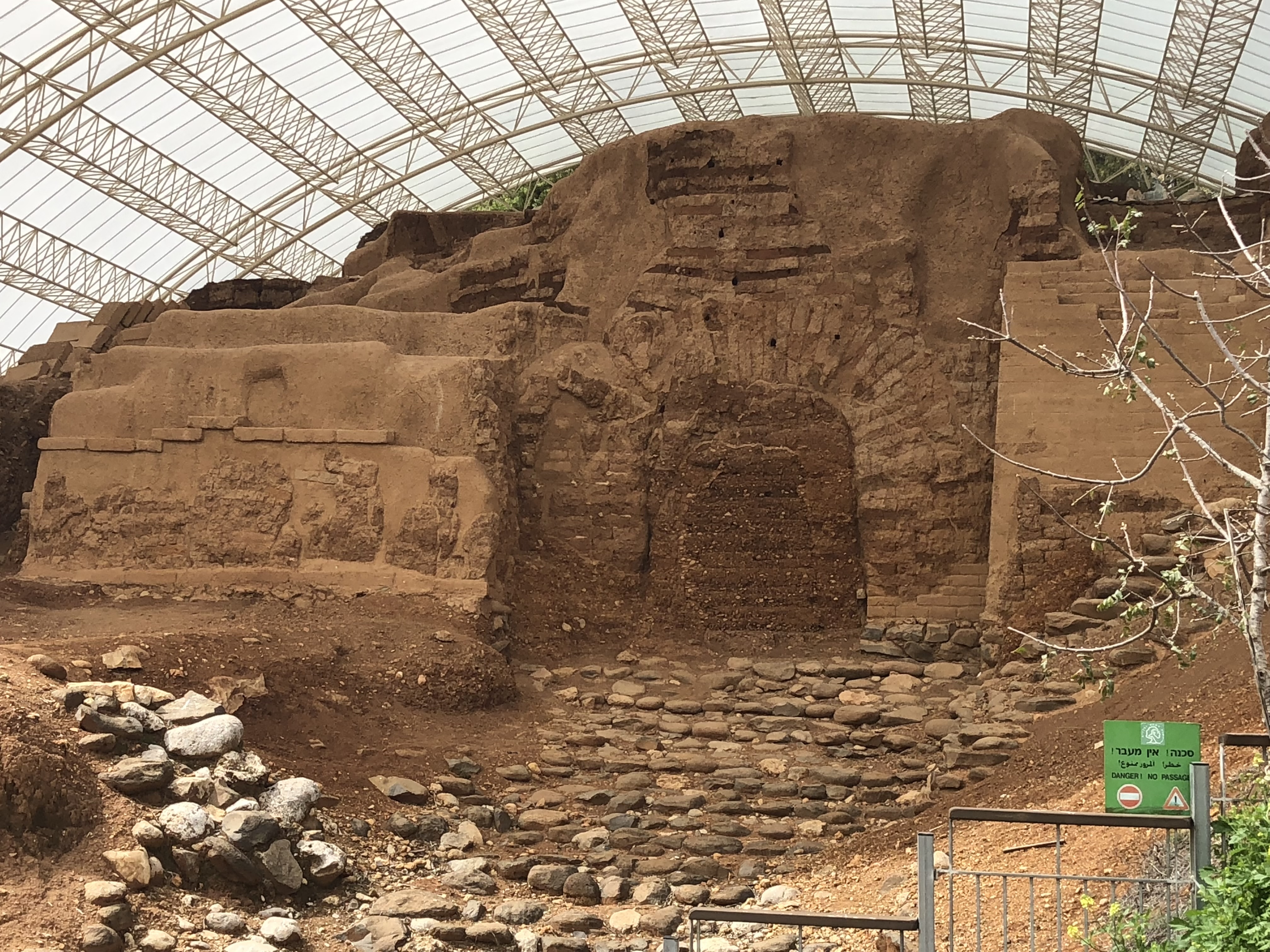
Chedorlaomer and his allies plunder all the goods of Sodom and Gomorrah and take Lot, the women, and the people of his house along with his possessions (11-12,16). An escapee tells Abram what happens, and the patriarch musters his allies and his own personal army to get his nephew and his house back safely (13-15). He has a battle plan, dividing his forces and attacking at night, and they defeat the invader in what is modern-day Syria (15-16). On multiple occasions, I have visited the ruins at Dan and have seen the so-called “Abraham Gate.” It dates back at least as far as Abraham’s day, almost 2000 years before Christ. 

(My photo of the “Abraham Gate,” March 2018)

After rescuing Lot and his house and goods, Abram is met by a priest named Melchizedek (18). The Holy Spirit, through the author of Hebrews, uses Genesis 14:17-20 and Psalm 119:4, and this one incident with Abraham to drive home an incredibly powerful point. Jesus is a High Priest, not like the Levites who descended from Aaron, but like this obscure figure, Melchizedek. 

The Bible uses a literary device called an antitype. “From the Greek antitupos, which occurs in Heb. 9:24 and 1 Pet. 3:21, where the AV translates it ‘figure.’ An antitype is the substance of which a type is the shadow, or the fulfilment of that which the type foreshadowed” (Cairns, Alan. Dictionary of Theological Terms 2002: 33). The antitype is always the greater; the type is always lesser and represents in some way the greater. So, Melchizedek is a type of Christ. He himself was greater than the Levitical priesthood in the ways we read in Hebrews 7, but the specific attributes we read about Melchizedek in this chapter are more fully and greatly found in Jesus.

What are the specific types? 

  • His position (18; Heb. 7:1). He is the king and priest of the Most High God. As king, he is king of righteousness and king of peace (2). 
  • His preeminence (20; Heb. 7:2,4-5). Abraham paid tithes to Melchizedek, signifying the greater prominence of the priest over the patriarch.
  • His perpetuity (Psa. 110:4; Heb. 7:3). “Without father, without mother, without genealogy, having neither beginning of days nor end of life, but made like the Son of God, he remains a priest perpetually.” None of Melchizedek’s ancestors or descendants filled this role, so in that way “he remains a priest perpetually.”
  • His purpose (19; Heb. 7:6-7). Melchizedek blessed the one who had the promises, an indication of his greater position and authority.
  • His precursory place (Heb. 7:8-11). Melchizedek lived many generations before Aaron, through whom the Levitical priesthood descended. Aaron was still in “Abraham’s loins,” meaning that Abraham did not have children yet. Much later, he would sire Isaac, who beget Jacob, etc., until finally Aaron was born through this genealogy.

In the way that Melchizedek served as greater than Levi, Jesus more fully and greatly serves as greater than Levi. If it were a math problem, we would say Levi < Melchizedek < Christ. Obviously, then, Levi < Christ. The writer of Hebrews, in chapter seven, draws some conclusions about this type of Christ. Because Christ is the antitype of Melchizedek,

  • It makes sense that perfection comes from His priesthood rather than the Levitical priesthood of Judaism (11).
  • There needed to be a change of laws (from Moses’ to Christ’s)(12).
  • It is right that this greater High Priest comes from a different tribe in which none had or could have served as priest (13-14).
  • Christ serves as priest “not on the basis of a law of physical requirement, but according to the power of an indestructible life” (15-17).
  • He sets aside the old law and brings in a better hope (18-19).
  • He was appointed High Priest by means of the oath of God (20-21).
  • He has become the guarantee of a better covenant (22). 
  • He does not die, but continues forever as High Priest (23-24).
  • He is able to save forever those who draw near to God through Him (25-28). 

It is this last truth, concerning His salvation, where the author draws out several incredible points for our consideration. It is the crescendo of his “Melchizedek argument.” His work is unparalleled–He always makes intercession for us (25). His character is unparalleled–He is holy, innocent, undefiled, separated from sinners and exalted above the heavens (26). His sacrifice and offering is perfect (27). His oath is unparalleled–He is a Son, made perfect forever (28).

Of all the ways the writer establishes the superiority of Christ over all rivals, this one is the most interesting to me. It shows the masterful way God weaves events and Scripture together. The writer of Hebrews is making the point that the Levitical priesthood has been replaced by something better. Why would you exchange the superior for the inferior? 

After this encounter, which seems relatively insignificant until David and the writer of Hebrews later expound upon it, Abram refuses to enrich himself by the unsavory people of Sodom. The new King of Sodom only wants the people, but offers Abram to keep all the returned spoils from Chadorlaomer. Abram will have no part in that, taking only provisions necessary for the completed battle. Abram will continue to rely on God’s promises to take care of his needs, and he parts company with the king of this wicked domain. 

(Picture taken on March 10, 2018, running at the Dead Sea with Keith Kasarjian)

The Most Infamous Family In Scripture?

Neal Pollard

    Some names are synonymous with certain attributes and characteristics. Hatfield and McCoy are names associated with fighting and feuding. Hitler is a name associated with prejudice and evil. Even today, some names conjure definite thoughts and conclusions, from Trump to Biden, Shohei Ohtani to LeBron James. Giorgio Armani or Louis Vuitton are fashion. Frank Lloyd Wright is architecture.

    Even in Scripture, certain names draw immediate associations for the Bible student. One such name, which represents a series of rulers spanning about 150 years, is “Herod.” Perhaps you have thought that Herod is one man mentioned in the Bible. In fact, there are seven Herods mentioned in the Bible. Six of them were part of the Herodian Rulers. The first of these in Scripture is Herod I (the Great), king of Judea (Mat. 2:1ff; Luke 1:5). Next is his oldest son, Herod Archelaus, an ethnarch (ruler of a province or region) (Mat. 2:22).

    Herod the Great had other sons who ruled as subordinate princes or portions of a region. One was Herod Philip (Luke 3:1). Another was Herod Antipas (Luke 3:1,19; 13:31ff; 23:7ff). Herod’s grandson, Herod Agrippa I and King of Judea, is mentioned in Acts 12. Then, there was Herod Agrippa II, the great-grandson of Herod the Great and another tetrarch (Acts 25:13ff).

    These were not men of noble character. Herod the Great orchestrated and oversaw the genocide of Jewish baby boys at the time of Christ’s birth. Herod Antipas, an adulterer, had John the Baptist beheaded.

    Herod Agrippa I had the apostle James beheaded and soon thereafter God struck him dead for pompous pride. Herod Agrippa II hardened his heart to the gospel, which he heard passionately preached. Though they lived in both luxury and dysfunction, these men were all little boys in the care of nursemaids if not mothers. They were once innocent children, little babies, helpless, dependent, and impressionable. Spiritual opportunity was missed, and as a result much harm was done to the cause of Christ. Egregious sins were committed against humanity.

    Our family name, in part, is something we inherited (for good or ill). Yet, the greatest impact upon our family name is what we do with it. This applies to what we do with our own lives, but also what we do to bring up our children in the discipline and instruction of the Lord (Eph. 6:4). Let us protect the family name, and leave a legacy that blesses not just our relatives but impacts the church and the world for good!

He Left The Manger (Poem)

Dale Pollard

He was born of a virgin, foreseen by the few 
A miraculous event— many know to be true 
He would save those in sin both friend, neighbor, and stranger 
But all that happened when He got out of the manger 

 His life was a short one, at least on this earth 
Some overlooked Him, his power, and worth 
He faced many challenges, his future looked bleak 
He was tortured and beaten, but turned the other cheek 

A beautiful life— filled with joy and with danger, 
But all that took place once the Lord left the manger 
He holds many titles, king of kings and Lord of Lords 
He established His kingdom without even a sword 

He’s the healer, our Savior, and any-life-changer 
But there’s more to His story 
He’s coming in glory 
Because Jesus left the manger 

LESSONS FROM SAUL’S FALL

Dale Pollard

Saul had a bright future full of potential. When we first read of him he’s portrayed as a likable underdog who doesn’t see his own potential. He even stated that he’s just a nobody from the small insignificant tribe of Benjamin (1 Sam. 9.17-21). God anoints him as king and like every anointed king that we read of in the Old Testament, he influenced the nation’s relationship with God. In hindsight, we’re able to see God’s wisdom. A judge who spoke on behalf of God would carry out God’s will. A king would always be more susceptible to various forms of corruption with the great power given to him. No matter how the rulers would live their lives, good or bad, we can learn much. Sadly, Saul is one of those kings who taught us how not to live. Here’s a list of the many spiritual dangers we should avoid today. 

Saul’s Seven Deadly Sins 

I SAMUEL 

  1. The sin of lacking patience – 13.8
  2. The sin of excuse-making – 13.11, 12; 15:15, 20, 24 
  3. The sin of half-hearted service – 15.1-26 
  4. The sin of Glorifying self – 15.12
  5. The sin of fearing men rather than God – 15.15, 24 
  6. The sin of desiring forgiveness from man rather than God – 15.25
  7. The sin of jealousy – 18.6-9 

While there are other mistakes and shortcomings that lead to Saul’s physical and spiritual demise, we can be strengthened by them. His failures serve as warning signs and that’s exactly why they’ve been recorded in the only book God ever wrote. 

The Glue Of Guilt

Tuesday’s Column: Dale Mail

blond man with goatee smiling at camera with blazer on
Dale Pollard

Samuel is nearing the end of his life by the time you read 1 Samuel 12. He gives a speech to all of Israel and there are several chilling statements that force us to consider our own spiritual standing. Samuel seeks the counsel of the Lord and asks Him on behalf of the people for an earthly king. God had established the Judges to rule them rather than a king which was typical for the time period. God grants their request, even though this kind of leadership was bound for failure. He handed Israel their shovel, and they began to dig. Here are some of Samuel’s final words. 

“Then Samuel called on the Lord, and that same day the Lord sent thunder and rain. So all the people stood in awe of the Lord and of Samuel. The people all said to Samuel, “Pray to the Lord your God for your servants so that we will not die, for we have added to all our other sins the evil of asking for a king.”“Do not be afraid,” Samuel replied. “You have done all this evil; yet do not turn away from the Lord, but serve the Lord with all your heart. Do not turn away after useless idols. They can do you no good, nor can they rescue you, because they are useless. For the sake of his great name the Lord will not reject his people, because the Lord was pleased to make you his own. As for me, far be it from me that I should sin against the Lord by failing to pray for you. And I will teach you the way that is good and right. But be sure to fear the Lord and serve him faithfully with all your heart; consider what great things he has done for you. Yet if you persist in doing evil, both you and your king will perish” (18-25).

Here are five quick observations and practical truths based on Samuel’s speech. 

  1. We should never let our previous sins hold us back from pressing forward. Samuel tells the children of Israel not to let the evil in their recent past keep them down— but he doesn’t pretend as if they hadn’t sinned against God. 
  2. Samuel reminds the people that God is quick to forgive. 
  3. It’s interesting that Samuel says that his failure to pray for God’s people would be a sinful thing for him to do. 
  4. Samuel tells the people to fear the Lord AND remember what He’s done for them. God could have wiped them out. He clearly had the ability as he demonstrated His power over nature in the beginning of this section. 
  5. It was true for the children of Israel and it’s true for us today. If we persist in doing evil, we will perish. 

The Old Testament is filled with relevant applications for us today. Let’s learn from the past, and like Samuel said— let’s not let our past failures keep us from moving forward.