GET READY!

Neal Pollard

As one who can count on one hand the number of snow events experienced in childhood, I have lived the last decade in Colorado where snow is more ordinary than oddity. Even so, the meteorological chatter is much higher in advance of an anticipated big storm this weekend. Because almost all my adult life has been spent in either Virginia or Colorado, we have heard many warnings.  In both places, it has seemed as though the weather experts were akin the boy crying wolf.  At the same time, in both places, we have had some huge surprises measured in feet rather than inches.

Perhaps because of this, locals in both places have at times been jaded and skeptical at these fearsome forecasts.  Their facial expressions say, “I’ll believe it when I see it.”  Why not? I remember a time in Virginia when the forecast was a foot of snow, all metro county schools closed in anticipation, and the next pre-dawn morning revealed starry skies without even a cloud.  Man, even with sophisticated radar and computer models, are at the mercy of the complexities of weather put in motion millennia ago by an all-powerful Creator.

We should not make the mistake of thinking God is like man (Ps. 50:21; Ezek. 28:2).  When He speaks of things to come, it is not mere prognostication or educated guessing.  He declares the end from the beginning (Isa. 46:10).  Thus, whatever He says is to come must not be dismissed.  It is a promise, as certain as His perfect character.

Throughout the New Testament, God is telling us to get ready for a day of judgment.  When writers say, “The Son of Man is going to come” (Mat. 16:27), “an hour is coming” (John 5:28-29), “all the nations will be gathered before Him” (Mat. 25:32), and the like, we should not expect a change in that forecast.  Just because it has not happened yet does not mean it will not come.  Peter warned of those who would say, “Where is the promise of His coming? For ever since the fathers fell asleep, all continues just as it was from the beginning of creation” (2 Pet. 3:4).  Nonetheless, Scripture says, “Get ready!” We don’t know when, but we should not wonder if.

KING’S CRITERIA WERE RIGHT ON THE MARK

Neal Pollard

Martin Luther King, Jr., gave his “I Have A Dream” speech on a seasonable and rain-free day in August of 1963, but this speech, delivered to at least 250,000 people, is often remembered on the holiday in January named for him. This speech is one of the most important documents of our nation’s history and was a watershed moment in improving race relationships between black and white Americans.  Eloquently and poetically pointing out the injustices his race of people had endured and were enduring at the time, King looked forward to a new and improved day.  He hoped all people, whatever their race, would “not be judged by the color of their skin but by the content of their character.” He hoped to leave Washington, D.C., and return back to his home with a faith in the powers that ruled nationally and locally which would be translated into hope, brotherhood, and unity. His final call was to “let freedom ring” (via http://www.archives.gov/press/exhibits/dream-speech.pdf).

Many people forget that Mr. King was a religious man, a preacher who often alluded to Bible characters and principles as well as directly quoting from it.  Inasmuch as he accurately referenced it, Mr. King was calling all people to God for guidance regarding right and wrong.  He said that character took priority over color.  He saw unity as right and division as wrong. He called for freedom rather than slavery, real or virtual.  While he was rightly championing these characteristics in the realm of racial equality, those principles doggedly stand regarding other matters.  Character, unity, and freedom matter in religious matters.

When we stand before Christ in the judgment, there is no indication that He will even take note of our race, ethnicity, or nationality.  He will look to see if His blood covers us.  Peter rightly says, “I most certainly understand that God is not one to show partiality, but in every nation the man who fears Him and does what is right is welcome to Him” (Acts 10:34b-35). Corrupt behavior or disobedience will not be acceptable, no matter who we are.

Furthermore, anyone who fosters division is rejected by God. He hates “one who spreads strife among brothers” (Prov. 6:19). He condemns it through Paul in 1 Corinthians 1:10-13.  In social or spiritual matters, I don’t want to be responsible for inhibiting a brotherhood God desires.  If I refuse to stand where He stands or if I stand where He doesn’t want me to stand, He will not accept it.

Finally, there is a freedom even more important than the noble cause King and his followers pursued. They wanted loosed from the manacles of a bondage imposed by others.  All of us, outside of Christ, are subject to a bondage we cause for ourselves.  Paul refers to this as being “slaves of sin” and “slaves to impurity and to lawlessness” (Rom. 6:17,19).  But, thank God, we can be “freed from sin” (Rom. 6:18). Then, we become slaves to righteousness.

Christians must care about racial equality, never treating someone different because of the color of their skin.  The way to right content of character, unity, and freedom is found in the book so often quoted by Mr. King.  No matter where or when we live, it will guide us toward an eternal home in heaven.

THE TALE OF CYNIC, CYRUS DIFFY

Neal Pollard
At the corner of Oak and Griffey
Lived an old man, Cyrus Diffy. (*)
A lifelong skeptic, centered on self
With Dawkins and Darwin on his shelf
He scoffed at those he thought “too much,”
Who leaned on religion as their crutch.
Whose faith was rested on their Bible
Were subject to his scorn and libel.
His own morality and ethics were iffy
He was his own rule, Cyrus Diffy
No one could tell him how to live
For others he had nothing to give
Scorn metastasized, and he grew bitter
Spewed his venom on Facebook, on Twitter
With chip on shoulder, he sought debate
Relished each moment “the faith” to hate
One morning in his chair in one quick jiffy
The last breath was breathed by Cyrus Diffy
He lifted up his eyes in a place most unpleasant
With him each skeptic and agnostic were present
Yet like him they no longer could fuel their doubt
Now in this painful place with no door to get out.
He’d tied his whole life to his naturalistic bent
But rejected the Savior the Father had sent.
Let’s sum up concisely, I’ll try to be pithy
Here’s what we can learn from old Cyrus Diffy
We all hitch our wagons to some conviction
Determine what’s truth and what is fiction
Design exists, it points to a designer.
We feel moral ought, know what’s coarse, what’s finer
We’re built to worship, we possess intellect.
When charting life’s course, every angle inspect.
View your worldview, consider its implications
Choose based on logic not potential complications
Christian, you might pass by a place like Oak and Griffey
Live Christ well before all folks like the late Cyrus Diffy.

(*) “Cyrus Diffy” is a random name I made up and is
not meant to refer to anyone real having that name.

Avoid Foolish And Ignorant Disputes!

Neal Pollard

A man is about to be put to death for preaching Christ.  He is composing the last known words he left to history, and it is addressed to another, younger preacher.  The entire letter is less than 2,000 words, making each sentence all the more meaningful.  In the middle of describing “an unashamed workman,” Paul makes this statement, “But avoid foolish and ignorant disputes, knowing that they generate strife” (2 Tim. 2:23). Paul has just discussed the vitality and value of being a vessel of honor in God’s house (20-21). One is cleansed and prepared for His use who flees lust and pursues the Lord (22). Paul follows the admonition in verse 23 by describing the characteristics of a good workman and vessel of honor.

Social media has got to be one of the devil’s greatest tools for tempting God’s people to violate the principle of 2 Timothy 2:23.  One has got to wonder how many confidently asserted statements and vehement arguments are properly categorized as “foolish” and “ignorant.”  We’ve all seen the disputes and strife they generate!  Brethren speak ugly to one another and venomously about the object of their scorn.  I cannot remember how many times I heard the late Wendell Winkler say, “You can be right and be wrong. If you’re not kind, you’re the wrong kind.”  Do we ever stop to consider that we can neutralize our effectiveness by un-researched, unstudied, and uninformed statements nevertheless brashly and confidently stated?

And what about those who “innocently” start these bash-fests? As a young boy, I remember having a football card of Conrad Dobler.  For some reason, I thought he was so cool…until I saw him in a commercial. He’s sitting between two fans and he pits one against the other until the whole crowd is in an uproar.  The commercial ends with him grinning as he leaves the middle of the fracas. Was he innocent in all this? Of course not!  That’s the point of using Conrad Dobler, the meanest man in football, in the commercial.

Remember what Paul tells the Romans.  “Therefore let us pursue the things which make for peace and the things by which one may edify another” (14:19).  The next social media mudslinging you chance upon, ask yourself this.  Am I looking for peace or longing to take a virtual punch? Am I actively seeking to edify, or am I looking to don my orange demolition jacket? Hear the inspired words.  “Avoid foolish and ignorant disputes!” When you come upon one, just keep moving.  You are not likely to help the cause of Christ, but you may hurt it!

Grappling Over Grass?

Neal Pollard

I heard about the guy last week who tried to choke his neighbor’s lawn service worker for failing to weed the neighbor’s flower bed.  The worker explained he had been hired to cut and trim the grass, but not the beds.  This apparently unsatisfactory answer led to the “choker” leaving visible marks on his victim and ultimately being charged with a count of felony battery.  The irate neighbor was convinced that the lack of weeding was causing him to now be fighting weeds in his own lawn.  The attacking neighbor tried to pull the victim off his riding mower and grabbed him by the neck.

If these are all the facts, what an extreme case of mixed up priorities.  Hurting another person over how unkempt or manicured his or their lawn is?  It seems unthinkable. But many of us know “that” neighbor.  Some of us may wrestle with being “that” neighbor.  If we could step back, we might see how silly excessive obsession with such things is.

In speaking about worry, Jesus reminds us that the grass of the field is alive today and tomorrow is thrown into the furnace (Mat. 6:30). Peter adds that the grass withers (1 Pe. 1:24). James similarly speaks of withering, fading, and expiring grass (1:10ff).  These men said this to make a spiritual point about worrying, the Word, and wisdom, but the fact remains that grass is numbered among those things that will be burned up at the end of the world (2 Pe. 3:10).  Yet, the souls of men will continue somewhere everlastingly (cf. Mat. 25:46).

Are we spending too much time grappling over grass, fretting over finances, or wrapped up in the world?  Are we giving the best part of ourselves for that which in the end matters least?  Jesus said, “Do not work for the food which perishes, but for the food which endures to eternal life…” (John 6:27).  Maybe it’s not food or grass for you.  Whatever earthly thing it may be, put it in its proper place.  And put Him in His proper place (cf. Mat. 6:33).

Evel Knievel At Snake River Canyon

Neal Pollard

Today I took a picture of a famous pile of dirt.  It was the “launch site” for an infamous jump made by an infamous figure of the ’60s, ’70’s, and ’80s.  On September 8, 1974, almost 40 years ago, Evel Knievel used a rocket-powered cycle known as the Skycycle X-2 to jump the Snake River Canyon in Twin Falls, Idaho.  Having now seen this foreboding span between the north and south rim with my own two eyes, I can only wonder why he would have even attempted it. If you aren’t familiar with how it turned out, it was a dud.  His chute deployed at the beginning of the jump and he fell to the canyon floor narrowly missing the river in what would have been a certain drowning due to a malfunctioning harness. Tim Woodward, a now retired columnist for Boise’s Idaho Statesman newspaper, was there covering the event.  He describes the atmosphere, saying, “It was, in the terminology of the day, a ‘happening.’ Spectators and groupies came by the thousands from all over the country, bringing drugs, alcohol and nudity in profusion. It was Woodstock without the music. Or the peace and love” (Woodward, Idaho Statesman, 12/1/07). A local member of the church says that the event cost the city untold money, due to vandalism, theft, and other destructive acts.  He also says the common belief is that the daredevil lost his nerve and panicked, triggering the parachute himself.  Whether that was the case or not, it was a much-anticipated event at which many raucous spectators gathered only to be disappointed.

As I heard and read these details, it made me think of an event that will be far different from this one.  It will involve a figure who has been the center of far greater controversy than any other—one who some love but many more hate.  It will involve a promised event infinitely more spectacular than anything man has devised.  It will include the largest crowd ever assembled to witness any other event, and it will include raucous rabble-rousers as well as righteous religious people.  But it will be neither a dud nor a flop.  Its magnificence defies adequate words of description.  The second coming of Christ will be no mere “publicity stunt.” It will be at the center of the ending of time and the ushering in of eternity.  It will draw every person from every nation for all time.  It will bring everyone to our knees.  God has foretold us of this day and we cannot afford to take it lightly (cf. John 5:28-29; 2 Pe. 3:10).  We must be prepared for it (Mat. 24:44).  We have never seen anything like it, but we can be ready for it!

DSCN8647

What Is Your Name Associated With?

Neal Pollard

Some names ring not just with familiarity, but downright notoriety.  Walenda is a name synonymous with daring, high wire acts.  Falcone is associated with mobsters and organized crime.  The Hearst family has long been connected with newspaper publication, Forbes with finance and fortune, Morgan with banking, and Bronte with literature.  Hilton and Kardashian? Well… Certainly, we could make a long list of surnames synonymous with particular endeavors bringing either fame or infamy.  In the Lord’s church, the name Nichols, Jenkins, Winkler, and others evoke an even more positive image of souls reached through a shared legacy of full-time service to the Lord.

Each of us has been endowed with a precious commodity, the name bequeathed to us by our forbearers.  Often, they have worked hard to polish and protect that name, to honor it and leave it as a legacy of character rather than shame.  It does not take much for us to tarnish that name and leave behind a name our descendants must live down.  All it takes is one person to leave a notability which embarrasses.  Just ask the Hitlers, O’Hares, Ingersolls, Bordens, Stalins, and Kevorkians.

Of course, the most important thing about our name is spiritual.  Do I wear the name of Christ?  If I claim to wear His name, what do I do to honor, glorify, and spread the good influence of His name?  When people see my name, do they associate it with Christ and all good attributes that should go along with that?  We want to live so that when we stand before Christ, we will hear our names called with those who spend eternity with Him in heaven!  How you are doing with your name? How are you doing with His name?

News Headlines Of The Prom Season

Neal Pollard

  • “Alcohol Enforcement Stepped-Up For Prom Season” (wowt.com, 4/7/14).  Why?
  • “Prom Season Can Be Dangerous Time For Teens” (www.martinsvillebulletin.com, 4/11/14).  Just one statement in the article reads, “The National Highway Traffic Safety Administration website adds that statistics indicate alcohol-related peer pressure is strongest at prom time, due to the large number of parties in a short period.”
  • “Some Schools Prohibit Party Buses For School Buses” (tbo.com, 4/7/14).  A principal in the Tampa Bay area interviewed in the article said, “…the most common discipline-worthy incidents at school dances tend to be drinking alcohol before or during the event, fighting, trespassing and inappropriate dancing. ‘The dancing is not like it was when I was in high school,’ he said.”
  • “Prom And Wretched Excess” (Chicago Tribune, 10/23/05).  A Long Island, New York, principal, Kenneth Hoagland, interviewed for the article says, “Twenty years ago…seniors went to the beach after their prom dance and then to someone’s house for breakfast. Now, he says, prom is a weekend-long orgy that every year has become incrementally more excessive, with small fortunes spent on ostentatious attire, stretch limos stocked with liquor, and ‘booze cruises’ from a local harbor.”
  • “It’s Your Prom! Make It Safe, Healthy, And Fun” (www.cdc.gov/family/prom/index.htm).  The information page includes cautions about the pressures teens who attend the prom feel to drink alcohol, use drugs, and have sex during the weekend’s activities.
  • “What Happened To Modest Prom Dresses?” (CNN, Carl Azuz, 5/9/12).  The article reveals that 35% of prom dresses sold by David’s Bridal are from the line called “Sexy,” a style defined by “low-cut backs, high-cut hemlines, and skin-showing cutouts.” Houston Chronicle blogger Mary Jo Rapini, interviewed by Azuz, says a shift in parenting values where parents allow their kids to wear on such occasions what their own parents would not have explains some of what has happened to “modest prom dresses.”

Headlines like these are to be found ad nauseum.  They demonstrate that even the world acknowledges that Prom Night promotes immoral behavior.  I cannot help but ask why we as Christians either encourage or permit our children’s participation in an event with so many elements clearly “over the line.”  Why we would want to associate with something that involves a fundamental compromise of what is right in so many areas of Christian living?

In Romans 12:1-2, Paul writes, “I beseech you therefore, brethren, by the mercies of God, that you present your bodies a living sacrifice, holy, acceptable to God, which is your reasonable service. And do not be conformed to this world, but be transformed by the renewing of your mind, that you may prove what is that good and acceptable and perfect will of God.” Paul teaches us that our bodies and minds belong to God.  That means that there are circumstances where the world will urge and pressure us to do things and go places that are worldly.  Let us carefully deliberate and always strive to be transformed rather than conformed.  Distinctiveness can certainly be unpopular with this world, but it may well give us the opportunity to “prove what is that good and acceptable and perfect will of God.”


Heaven Really IS For Real

Neal Pollard
While so many in religion and even the media latch onto sensational tales of traveling to the “other side” and coming back with stories about heaven (they do not ordinarily wind up going the other direction), these individuals often claim (necessarily without proof) to have seen or heard things from God, Christ, and other heavenly inhabitants. Sadly, much of what they claim to have experienced is at odds with or even contradicts what God communicated to us through His Word. Despite the high-drama and mystical tales, these undoubtedly sincere folks are right about something incredibly important. Heaven IS for real!

The Bible describes it (Rev. 21-22). Jesus is preparing it (John 14:1-4). The Father lives there (Mat. 5:16; etc.). Those who travel the “narrow road” (Mat. 7:13-14) and are faithful unto death (Rev. 2:10) are going to be allowed to dwell there forever (cf. Ps. 23:6; Mat. 25:46; 1 Th. 4:13ff). The Bible communicates that it is a place reserved for those who believe and obey the will of God (2 Th. 1:5ff). It is not for those who refuse to submit to His authority (Gal. 5:19-21; etc.).

Heaven is described as a place where treasure is (Luke 18:22). It is described as a place where our citizenship can be (Phi. 3:20). It is a place where our hope can be laid up (Col. 1:5). It is a place where our name can be reserved (Heb. 12:23). It is a place where we can have an inheritance (1 Pe. 1:4). It is a place described as that which will be new (Rev. 21:1).

I suppose it is human nature for us to want to have blanks filled in and details more fully supplied. That’s why claims of going to heaven and back have long captivated people. Perhaps it strikes the chords of our hearts and imagination more than words, howbeit Divine words, on a page. Yet, those words produce living hope to those who are staking everything on the truth of those words (1 Pe. 1:3). They are neither fairy tales nor wisps of wishes. God has given us enough to know, as we measure the claims alongside His providence and answered prayers, that His Word can be trusted. We don’t have the full picture yet, but we know it will be more glorious and joyous than we are able to understand in this body confined by time. Thank God that Heaven really is for real!

An Honest Obituary

Neal Pollard

It was the early 1990s, and I, as a green, inexperienced preacher, was asked to do a funeral for a man from the community with no real religious roots.  It was my first funeral for a non-Christian and I went, armed with the knowledge gained from Wendell Winkler’s Preacher And His Work class, prepared to preach to the living neither giving false hope nor crushing the hearts of people I was trying to reach.  I remember standing nervously in the back of this old denominational church building out in the country.  A group of men gathered there, who I later learned were the pall bearers, were talking caustically about someone.  One said he had made a pass at his wife. Another said he had stolen two of his cows the previous week.  He was a good-for-nothing snake in the grass. Honestly, I was now listening very closely.  I was shocked when one said, “If he hadn’t died, I might have killed him.”  They were talking about the deceased, the man whose funeral I was about to preach.  Needless to say, I felt no pressure to “preach him into heaven.”  Five minutes before the funeral, I wrestled with whether or not my words were too plain or off-putting. Five minutes after it, one of those pallbearers told me, “Preacher, you gave him a better funeral than he deserved.”

If you are prone to read obituaries or as you reflect on every funeral you have attended, everyone speaks of every dead person as if they are the most wonderful, saintly individual who has ever lived.  Some, considering the circumstances of the deceased’s lifestyle, brashly speak of them being in heaven even if the one never made mention of or made preparation to go there.  It is a significantly disgusting thing to hear people blithely pronouncing people saved in death who were disobedient to God’s saving plan in life.

A few months ago, the children of Marianne Theresa Johnson-Reddick defied this common trend upon her death. They literally celebrated her passing by publishing a “scathing” obituary in their local Nevada newspaper. The obituary, published in September, 2013, begins, “”On behalf of her children who she abrasively exposed to her evil and violent life, we celebrate her passing from this earth and hope she lives in the after-life reliving each gesture of violence, cruelty and shame that she delivered on her children” (via Newsmax.com).  The article gives details of her horrific abuse of the six children, which abuse she regularly inflicted before she lost custody of them to a Nevada Children’s Home.   While they gave no speculation about her eternal destiny, neither did they sugar-coat or white-wash her life.

Who knows what will be said about us when we die?  However naughty or nice it is matters little next to what our Lord knows and sees. He will “judge the living and the dead at His appearing and His kingdom” (2 Tim. 4:1).  He will be the “righteous Judge” (2 Tim. 4:8; Acts 17:31).  He will tell it like it is concerning each of us as we are gathered with all the nations (Mat. 25:31ff).  Heaven keeps, if you will, a perfect, accurate obituary on file for each of us when we die.  The Bible calls it “the Book of Life” and the dead will be “judged according to their works, by the things which [are] written in the books” (Rev. 20:12b).  Let us live so we are not ashamed for that record to be revealed.

Unprepared For The Conditions

Neal Pollard

As one who was born in Mississippi and raised in south Georgia, I am very proud of my southern roots.  Frankly, I could not hide them even if I was inclined.  It is a heritage that includes the Bible Belt, sweet tea, BBQ, lemon icebox pie, peanut butter, gnats, humidity, pecan trees, Georgia mud cats, the Georgia Bulldogs, and the Atlanta Braves (including the bad years).  But, one thing we rarely needed to be ready for was treating the roads for snow and ice.  Therefore, even a light or moderate amount of snow means impassable roads and gridlock in traffic.  The historic snowstorm that has hit the deep south has come with power outages, massive traffic jams, stranded motorists, numerous wrecks, and seven states of emergency.  Typically, southern cities do not have chemicals for road treatment, a bevy of snow plows, or organized plans because these events are so rare.


I am not criticizing these locales and governments because of this lack of preparation.  Of course, I was not trying to get home from work or school in those conditions. If you were, you likely feel differently.


Yet, there is a general state of unpreparedness for something that is 100% likely to occur at some point in the future.  Every single person could potentially make completely ready for it.  It has been forecast with the greatest of certainty.  It has been described in clear enough detail.  The preparation is outlined in clear and simple detail.  There are even a number of people who have been employed and enlisted to aid in warning and educating the general public.  Those tasked with being prepared and preparing others will be held accountable for whether or not they were involved in enacting that plan.  Every single person who is unprepared will nonetheless be accountable and liable for the consequences of their not being ready (Mat. 25:1-13).  There is absolutely no reason why anyone should be unprepared for the Judgment Day.  May each of us do our part to help prepare as many as possible for it!


Is Your Life “Award Winning”?

Neal Pollard

CBS News reports on 19-year-old Chris Strickland, a very ordinary young man who seems unaware of how heroic his split-second action was. In his first job, Chris, working at a Home Depot in Anchorage, Alaska, happened to turn around and face a shopping cart at the moment an unattended baby fell out of a baby seat sitting atop it.  Store surveillance video captures the whole thing, as Strickland rushes over and reaches out to catch the falling infant.  For this simple, profoundly important act, Strickland will receive the Home Depot Angel Award, “reserved for those who perform exceptional acts of heroism” (via http://www.cbsnews.com/news/quick-thinking-home-depot-employee-saves-falling-baby/).

If all goes well, some day that baby will grow up, maybe get married and have children, and, optimists might say, do some great thing—become president, save an entire burning building full of people, or, better yet, become a faithful Christian responsible for scores of folks getting to heaven.  No matter what happens with the child, it will not diminish the heroism of this young man who, at the right place and right time, chose to save another human being and one literally helpless.

In 2 Timothy 4:8, Paul speaks of Christ giving an unequaled reward on the Judgment Day.  It will be for those heros and heroines who loved His coming and appearance, who fought, finished, and kept the faith (7).  In a parable about the Judgment, Jesus speaks of the award winning “sheep” who will enter heaven.  What did they do?  Cared for those who had needs.  James 1:12 speaks of a reward Christ will personally give to those who persevere under trial.

You didn’t consider yourself a “hero,” did you?  Passages like those above speak of how ordinary folks like us can receive the highest honor of all time and eternity.  How?  By faithful endurance, service, and response to Jesus, the Lord!  Congratulations!

What We Learn From The Video Of The Fatal SUV-Semi Crash

Screen Shot 2013-12-09 at 2.32.08 PM


Neal Pollard

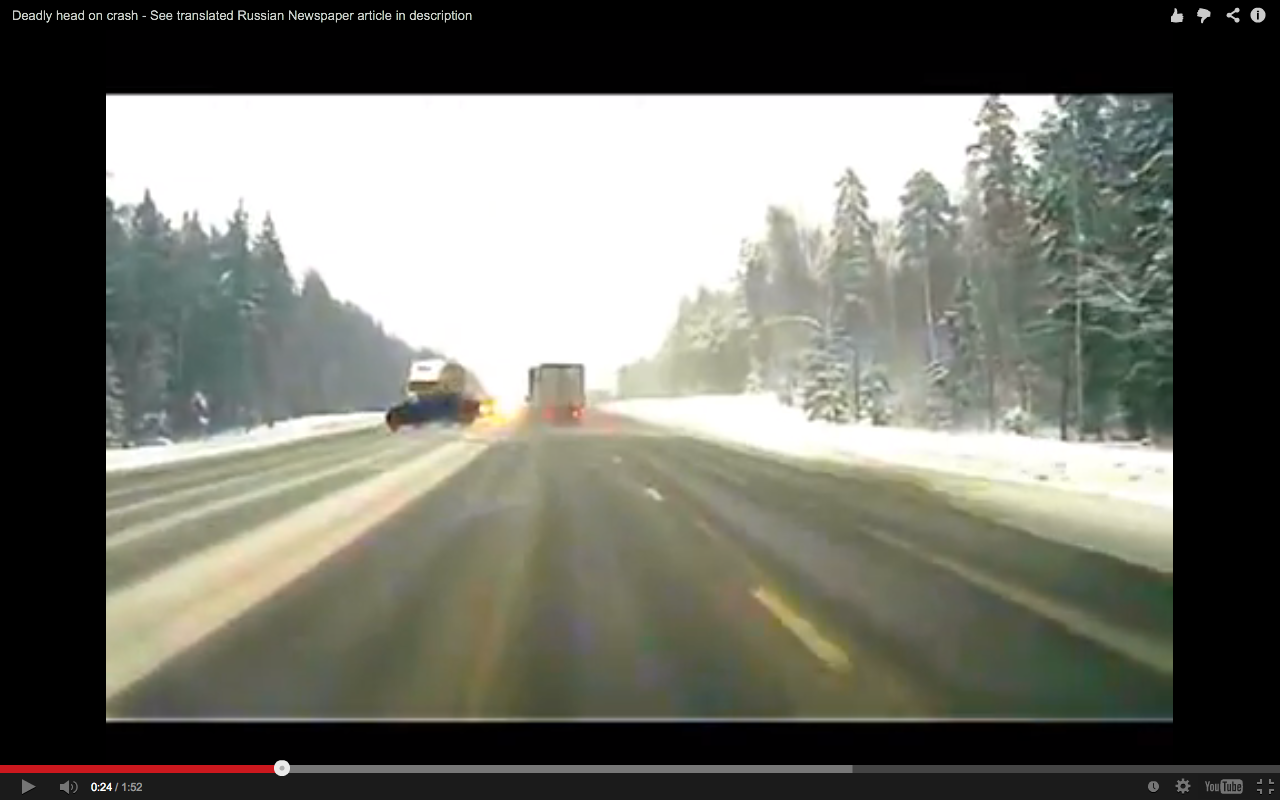
A relative sent me an inbox message earlier containing a 34-second video of an SUV that loses control and ultimately is destroyed by an oncoming semi-truck.  It is unquestionable that the driver dies instantly and the footage is incredibly disturbing.  While the details given were not accurate—this does not occur in the states nor is there evidence that it involves texting or distracted driving, the end result does not change.  The best information is that the driver in the February 24, 2012, crash was a 32-year-old Moscow resident named Alexander. Driving on the notoriously treacherous M-7 highway in Russia, he lost control of his Nissan Navara, collided with another vehicle, and then drifted into the path of an oncoming Freightliner big rig.  The much bigger semi obliterates the black Nissan into so many pieces and a young man races into eternity (information found and verified on snopes.com).  As I watched this tragedy, a flood of things went through my mind.

  • There can be but a breath between life and death, time and eternity.
  • Death is no respecter of persons, taking the very young, the very old, and every age in between.
  • Seeing something like this cannot but help one appreciate more deeply the value of life and the irreversible nature of death.
  • Statistically speaking, the chances Alexander died in a saved condition are very small.
  • A momentary loss of self-control can have permanent consequences.
  • Our mistakes and misdeeds impact others, too.

Perhaps there are other things to glean, but I would hope that the benefit we might derive from seeing or reading about something like this is to take some time to contemplate the reality of eternity.  Something about considering our mortality, which a video like this should cause, cuts away our rationalization, excuses, and pride.  It opens us up, if only momentarily, to our accountability and what is really true and truly real—that death is appointed and followed by judgment (Heb. 9:27), that we must each appear before Christ’s judgment seat and give an account of our lives (2 Cor. 5:10), and that life on earth is relatively brief (Job 14:1).  This life is about preparing for the next life.  Whether it is the return of Christ or the end of life, the time for preparation may end at any moment.  Let us live ready for that moment!

LEARNING FROM LENINGRAD

LEARNING FROM LENINGRAD.

LEARNING FROM LENINGRAD

Neal Pollard

Anna Reid has written a gripping book chronicling one of the least talked about devastations of World War II.  From 1941-1944, the Russian city of Leningrad, along with surrounding villages, were besieged by the German army.  Leningrad, being encircled, was cut off by land and water from adequate resupply of food.  This created a famine that cost hundreds of thousands of Leningraders their lives.

One of the survivors of this prolonged plague was Dmitri Likhachov, a Russian scholar who would live to be almost 93 years old.  He chronicled one of the most detailed accounts of the siege, both the heroic and horrible actions of people facing starvation and death.  Reid shares one of his quotes:

I think that real life is hunger, and the rest a mirage. In the time of famine people
revealed themselves, stripped themselves, freed themselves of all trumpery.
Some turned out to be marvellous (sic), incomparable heroes, others–scoundrels,
villains, murderers, cannibals. There were no half-measures. Everything was real.
The heavens were unfurled and in them God was seen… (Leningrad, 194).

It is truly hard to imagine the kind of hunger and privation these Russians endured, even reading it in detail.  But, what Likhachov says about the extremes of starvation seems to apply to people in times of any tragedy or death.  Adversity brings out the best and worst of people, or rather it has a way of “stripping away” the facades people project to reveal what is beneath the surface.

Jesus taught, “And He said, “What comes out of a man, that defiles a man. For from within, out of the heart of men, proceed evil thoughts, adulteries, fornications, murders, thefts, covetousness, wickedness, deceit, lewdness, an evil eye, blasphemy, pride, foolishness. All these evil things come from within and defile a man” (Mark 7:20-23).  So, while controlling our actions is always a spiritual necessity, Jesus urges us to achieve an inside-out makeover!  We may or may not ever endure tragic circumstances in our lifetime, but the Bible tells us a day is coming when God will judge the secrets of men by Jesus Christ (Rom. 2:16).  Let us take greatest care of that part of ourselves which, though “stripped” and “freed…of all trumpery” will reveals us to be “marvellous, incomparable heroes” of faith!

BEFORE YOU BUY THAT BODY ART

Neal Pollard

While there are many matters that are much higher priorities than tattoos, I thought you might like to hear from Dr. Bernadine Healy, the first woman to direct the National Institute of Health, former president of the American Heart Association, and the person who led the American Red Cross response to the terrorist attacks on September 11, 2001.  She contributed an article in 2008 to U.S. News and World Report magazine (August 4/August 11, 2008, p. 69) entitled, “The Dangerous Art of the Tattoo.”  Let me say that I am eager to study, convert, and then value and consider as a brother or sister anyone who has tattoos-no matter how many or how big the “body art” is.  They are entitled to the same love and respect as any other member of God’s family.

My target audience are those who may be considering getting one or another one.  Dr. Healy brings up some important issues in the article.  First is the matter of tattoo “remorse.”  Healy reports that “upwards to 50 percent of those who get tattoos later wish they hadn’t.”  Interviews conducted by researchers at Texas Tech with those suffering such remorse cited “moving on from the past, problems wearing clothes, embarrassment, and concerns that tattoos could adversely affect job or career.”

Healy’s second concern should cause one to really take notice.  There are myriad health concerns associated with both getting tattoos and having them removed.  There is a toxic release of low-level carcinogens associated with removal, which in itself is said to a long and very painful process.  There are allergic reactions and skin infections that can follow tattooing.  Healy writes, “The FDA warns about the risk of tattoo parlors transmitting viruses like HIV and the cancer-causing hepatitis C.”  MRI scans can cause tattoos to swell or burn.  She says much more, and I would recommend your getting the article if you are interested in reading it.

Here is the relevant point.  Anything, whether drugs, tobacco, alcohol, fornication, “overuse” of food, or ink, that hurts our bodies needs to be avoided.  May we never forget what Paul told Corinth.  “Or do you not know that your body is the temple of the Holy Spirit who is in you, whom you have from God, and you are not your own?” (1 Cor. 6:19).  We are stewards of all God’s resources, which includes our bodies. Let us make wise and God-honoring decisions concerning them, too! Too, it is so important to try and see the far-reaching consequences of decisions we make today.  We cannot know how we will feel, so we should exercise increased caution before doing something permanent to ourselves.