Halloween: A Reflection on Darkness and Light

Brent Pollard

A Matter of Personal Conviction

Whether or not a Christian should take part in Halloween festivities is ultimately a matter of personal conviction and conscience. As Paul wrote, “Each one should be fully convinced in his own mind” (Romans 14.5). I respect that there is a difference between believers attending wholesome community events—such as church-sponsored “trunk-or-treats”—and those who embrace the world’s fascination with the macabre. However, I want to caution Christians not to join the world in celebrating darkness, fear, and death.

Jesus taught that His followers are to be “the light of the world” (Matthew 5.14). How can we reflect His light if we participate in a celebration that often glorifies the very darkness we are called to overcome (Ephesians 5.8–11)?

The Pagan Origins of Halloween

Halloween’s origins trace back to the Celtic festival of Samhain, which marked the end of the harvest and the start of winter. The Celts believed that on this night, the barrier between the living and the dead weakened, allowing spirits to roam freely. To protect themselves, they lit bonfires and wore disguises to confuse wandering souls.

Scripture repeatedly warns against attempts to communicate with or ward off the dead. God told Israel, “There shall not be found among you… a medium or a necromancer or one who inquires of the dead” (Deuteronomy 18.10–11). Though today’s observance may seem harmless, its roots were steeped in superstition and fear of spirits rather than faith in God’s providence.

Roman Influence and Ancient Traditions

When Rome conquered Celtic lands, two Roman observances were merged with Samhain—one honoring the dead (Feralia) and the other celebrating Pomona, the goddess of fruit and trees. Some historians suggest that the custom of bobbing for apples originated from Pomona’s symbol, the apple.

This blending of pagan and civic ritual was typical of the ancient world. Yet Christians are urged not to conform to the world’s customs (Romans 12.2) or mix holy devotion with pagan superstition (2 Corinthians 6.14–17).

The Catholic Church and All Saints’ Day

In 609 AD, Boniface IV consecrated the Roman Pantheon to “All Saints,” creating a day to honor Christian martyrs. This celebration, later shifted to November 1 in the eighth century by Gregory III, is now called All Saints’ Day or All Hallows’ Day. The night before—All Hallows’ Eve—gradually evolved into “Halloween.”

Later, All Souls’ Day (November 2) was added to pray for all departed believers, forming a three-day observance known as Hallowtide. The intent may have been to Christianize pagan customs, but as with many such efforts, the old superstitions persisted under new names.

How Halloween Came to America

Medieval Europeans practiced “souling,” going door to door to offer prayers for the dead in exchange for food. Children later began “guising,” dressing in costumes to receive gifts. These traditions were brought to America by Irish and Scottish immigrants. In America, pumpkins replaced turnips as lanterns, and Halloween evolved into a largely secular, community-centered celebration.

However, Christians should remember that not all cultural inheritance is worth keeping. Paul reminded the Corinthians that while “everything is permissible,” not everything is beneficial (1 Corinthians 10.23).

The Dark Turn: From Pranks to Violence

From the late 1800s through the early 20th century, Halloween was often marked by destructive mischief—toppled outhouses, broken fences, and vandalized property. Communities responded by encouraging “trick-or-treating” as a safer alternative, channeling youthful energy into friendly fun instead of lawlessness (cf. Romans 13.10).

The Wholesome Era: Mid-Century Innocence

For several decades, Halloween reflected a more innocent, child-centered character. The imagery of It’s the Great Pumpkin, Charlie Brown (1966) captures that gentler spirit. But this era was short-lived. Beginning with Alfred Hitchcock’s Psycho and crystallized by 1978’s Halloween, the holiday once again took a darker tone. Instead of laughter and imagination, horror and bloodshed became its trademarks.

Modern Halloween: A Culture of Fear and Death

Today, many Halloween attractions and films glorify brutality and fear. The Saw franchise, “haunted” attractions that simulate torture, and “extreme haunts” that require liability waivers all reveal a troubling fascination with terror and pain. This fascination often crosses the line from harmless fun to a celebration of evil. The prophet Isaiah’s warning feels relevant: “Woe to those who call evil good and good evil, who put darkness for light and light for darkness” (Isaiah 5.20).

When society laughs at what should make it grieve, something vital has been lost. As Thomas Aquinas noted, when fear and cruelty turn into entertainment, compassion withers.

What Does the Bible Say About Halloween?

The Bible does not explicitly mention Halloween, but its principles still apply. We are told to “abstain from every form of evil” (1 Thessalonians 5.22) and to think on “whatever is true, honorable, just, pure, lovely, commendable” (Philippians 4.8). These principles guide our decision-making and help us discern what is beneficial to our faith.

Christ’s victory over darkness is total. “The light shines in the darkness, and the darkness has not overcome it” (John 1.5). We do not need to dabble in darkness to prove our courage or find excitement. Our joy comes from walking in the light (1 John 1.7).

Practicing Christian Discernment on Halloween

Discernment is essential. Paul commands, “Abhor what is evil; cling to what is good” (Romans 12.9). The question isn’t whether a Christian can hand out candy or dress up—it’s whether we are celebrating fear or reflecting faith.

Our participation should always glorify Christ (Colossians 3.17). If we choose to engage with the day at all, let it be to share light, kindness, and the gospel with our neighbors. “Do not be overcome by evil, but overcome evil with good” (Romans 12.21).

Conclusion: Light in the Midst of Darkness

On a night when much of the world delights in fear, the Christian’s calling is to stand as a beacon of peace and truth. Rather than imitating the darkness, we can offer an alternative—a message of victory through Christ, who conquered death itself. Let us be inspired to be that beacon, to share the light of Christ in the midst of darkness.

“For once you were darkness, but now you are light in the Lord. Walk as children of light” (Ephesians 5.8).

From Hostility to Harmony:

Exploring the true meaning of “peace on earth”

Brent Pollard

During the holiday season, we often focus on the concept of peace. It’s an important theme in holiday music, especially in a world where conflict is all too common. Indeed, such songs oft remind us about Christ as the “Prince of Peace” and the promise of peace on earth (see Isaiah 9.6; Luke 2.8-14). However, Christ’s peace is more than just the absence of conflict. It is a complex concept with many facets deeply entwined with man’s greatest need: salvation from sin.

Christianity holds that real peace requires reconciliation with God through Christ. This true peace is the primary reason Christ put on the robes of flesh. Faith in Jesus Christ is the only way to achieve peace with God, according to Paul in Romans 5:1. As explained in Romans 5.8 and 5.10, this peace aids in the resolution of the inner conflict of guilt caused by sin. Humanity became estranged from God in the Garden of Eden, but we can return to divine harmony through Christ’s incarnation. Upon Christ’s birth, the angels declared to mankind that He was extending an olive branch to humanity. Note: “Glory to God in the highest, and on earth peace, good will toward men” (Luke 2,14 KJV).

Beyond reconciling with God, Christ’s peace, once received, permeates our inner being. In Philippians 4.6-7, Paul describes this peace as “beyond all understanding,” a calm that guards our hearts and minds regardless of life’s ups and downs. This inner peace is more than just a temporary state of calm; it is a profound sense of stability and contentment that stems from a close relationship with God. To achieve this peace, we must engage in consistent prayer and gratitude and live according to Christ’s teachings and examples.

As we embody Christ’s teachings, our relationship with others will change. Jesus tells us to love our enemies (Matthew 5.43–48) and to live by the Golden Rule (Luke 6.31). These teachings challenge us to work for peace in our communities by actively showing love and empathy to others, not just tolerating them. His teachings remind us to live peaceably among men (Romans 12.18). Although the world is far from perfect, Christians can help to create a more peaceful society by living these principles. The message is clear: peace between men starts with each of us.

Christ is the source of the all-encompassing peace that Isaiah foretold, which the New Testament made manifest. It encompasses achieving a state of reconciliation with God, experiencing inner serenity, and fostering harmonious relationships within society. As followers of the Prince of Peace, let us embrace and share this multi-faceted peace this holiday season and beyond.

“Have Yourself A Merry Little Christmas”

Friday’s Column: Brent’s Bent

Brent Pollard

“Have Yourself a Merry Little Christmas” was featured in the 1944 movie Meet Me in St. Louis. Judy Garland was the original performer. I will provide the song’s setting without spoiling the film since it is pertinent to our topic. 

Circumstances cause the family patriarch depicted within the film to declare that the family is moving to New York. He is alone in wanting to make such a move. Everyone else is content to stay in their current hometown, especially with the upcoming World’s Fair that St. Louis will be hosting in 1904.  

The youngest daughter, Tootie, took the news especially hard. Judy Garland’s character, Esther, tries to console Tootie by singing, “Have Yourself a Merry Little Christmas.” The original lyrics, which you’ve likely not heard unless you’ve watched the movie or listened to an older cover of the song, were “Until then, we’ll have to muddle through somehow.” Garland also sang, “Next year, all our troubles will be out of sight.”1 

We can credit Frank Sinatra for changing a melancholy Christmas song into a happier one. He told the song’s writer, Hugh Martin, in 1957 that his album was called “A Jolly Christmas.” So, he asked the songwriter if he could “jolly up” that line for him. The songwriter obliged, changing the lyric to “Hang a shining star atop the highest bough.” “Next year…” likewise became “From now on all our troubles will be out of sight.”2 

We cannot say that every Christmas season is as great as those experienced in our youth. As we get older, economics impact our celebrations. We take note of those missing. Perhaps, we no longer have good health. Or an every-hundred-year-pandemic might decide to come along and interfere with our plans. For those Christmases, we must “muddle through somehow.”  

At least one time in David’s life found him “unmerry” from life’s circumstances. And David likewise had to muddle through until things could get better. This occasion was when David was fleeing for his life because of his son Absalom’s political coup. David and his retainers found themselves in a position where they were “hungry and weary and thirsty in the wilderness.” (2 Samuel 17.29 NASB1995) What David did during this muddling remains an example for those finding it difficult to be joyous today. 

First, David did not isolate himself, having the company of his retinue (2 Samuel 17.22). People tend to isolate themselves when depressed.  But it is not the isolation causing difficulties. It is the resulting loneliness often found in isolation. People may think they are all alone in the world or that the world is against them. God said it is not good to be thus isolated (Genesis 2.18; Ecclesiastes 4.9-12). So, reach out to others, if necessary, since the assistance others give enables them to fulfill Christ’s law (Galatians 6.2). 

Second, David accepted the kindness of others (2 Samuel 17.27-29). I do not think it an exaggeration to say David could not have defeated Absalom without the aid of such people. Christians must be kind and tender-hearted to one another (Ephesians 4.32; Colossians 3.12-15; 1 Peter 3.8). And since we must extend such love and kindness to others, we must learn to receive these same overtures in return. That seems to be tricky for some people to realize. Muddling through is easier with brethren!  

Third, David wisely used his time of muddling (2 Samuel 18.1ff). David counts the number of able-bodied men with him who could fight. Then, he divides them into companies and appoints men over thousands and hundreds. The result, of course, was an army capable of battling Absalom. Despite resulting in the death of Absalom, the battle ensured that David could return to Jerusalem. His muddling days were over. In like manner, perhaps now is not an excellent time for us; we are muddling through life. But do what you can, with what you have, where you are. During these difficult times, the plans you make may result in a later victory.  

So, as others seem to be having “…the Most Wonderful Time of the Year,” you may find yourself unable to experience that coveted merry time. Emulate David’s example. If you see a family member or friend muddling through, ensure they are not lonely, providing them whatever aid is needed.  In so doing, may we all note, Lord willing, that “Next year, all our troubles will be out of sight.” 

Sources Consulted 

1  “Judy Garland- Have Yourself A Merry Little Christmas Lyrics.” AZLyrics, AZLyrics.com,www.azlyrics.com/lyrics/judygarland/haveyourselfamerrylittlechristmas.html

2 Willman, Chris. “How ‘Have Yourself a Merry Little Christmas’ Became One of the Season’s Most Beloved Songs.” EW.com, Meredith Corporation, 22 Dec. 2006, ew.com/article/2007/01/08/history-popular-holiday-song/. Updated December 23, 2020 

Labor Day

(Bulletin Preview)

Neal Pollard

Tomorrow, most of us will be able to celebrate the Labor Day Holiday. That means, ironically, that most of us will have a day off from–well–labor. Schools and workplaces across the nation will shut their doors and many will be off for their last “summer vacation.” Friday, an anticipated 3 million passengers took to the friendly skies to enjoy the long weekend. We can either thank Peter McGuire or Matthew Maguire for being the mastermind of this holiday, both secretaries for New York labor unions who made significant efforts to recognize a day for American workers.

The U.S. Department of Labor has published a lot of useful information about this holiday, which it states was started as a “national tribute to the contributions workers have made to the strength, prosperity, and well-being of our country” (dol.gov). It was a local observance in the northeast at the height of the Industrial Age, though Oregon was the first state to pass statewide legislation to observe the holiday. That same year, 1887,  Colorado, Massachusetts, New Jersey, and New York followed suit. In 1894, Congress made it a legal holiday to be celebrated the first Monday of September. 

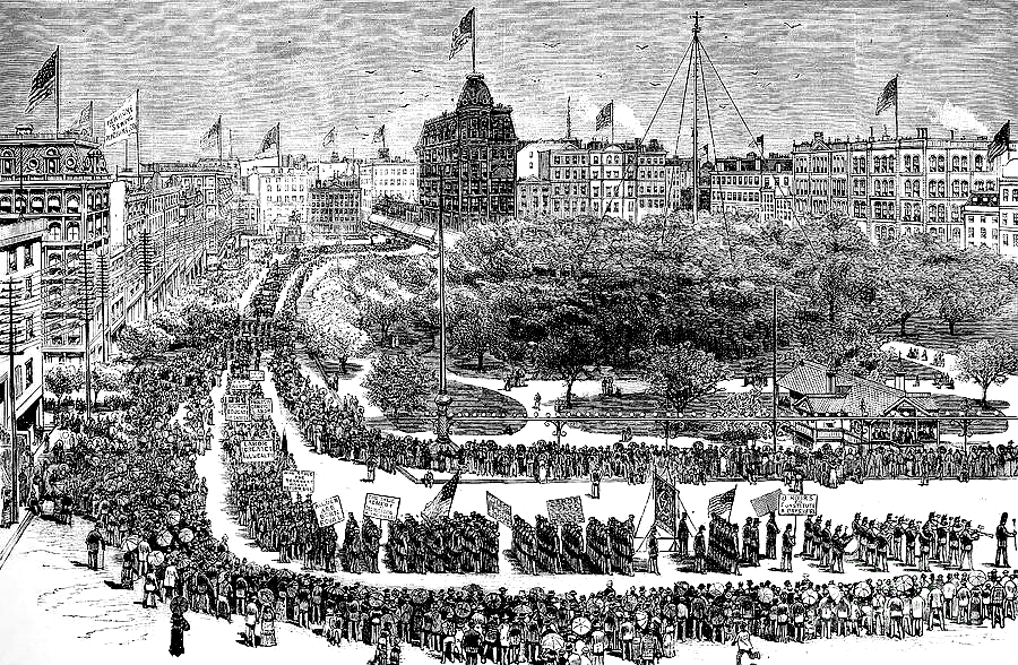
In the early days, there were picnics, street parades, speeches by prominent men and women, and “Labor Sunday” which was “dedicated to the spiritual and educational aspects of the labor movement” (ibid.). The first parade, in New York City in 1882, had up to 20,000 marchers as well as “Windows and roofs and even the lamp posts and awning frames…occupied by persons anxious to get a good view of the first parade in New York of workingmen of all trades united in one organization” (ibid.).

I find it interesting that we honor work with a day of rest and that the holiday itself has seen a shift in emphasis and expression. That’s neither a complaint or criticism. I intend to enjoy Labor Day with Kathy, taking the vacation day given to me in my working agreement. 

But, as we celebrate this national holiday, it’s fitting to recognize the hard work done by so many in this congregation. When you teach Bible classes, lead in worship, decorate bulletin boards, provide transportation to services, stock our pantry, do work on our facilities, engage in soul-winning efforts, practice hospitality, serve officially as church leaders (whether elders, deacons, or someone else tasked with some work), prepare the communion, clean the kitchen, organize the teacher’s work room, go on mission trips, make visits, handle church finances, coordinate worship, serve as ushers and greeters, host youth devotions, or the many, many other things you do, you are doing honored work. Jesus taught that greatness comes through service (Mat. 20:25-28; Jn. 13:12-17). New Testament writers honored those who work among us, Paul urging us not to “be weary in well doing” (Gal. 6:9) and to “always give yourselves fully to the work of the Lord” (1 Cor. 15:58, NIV). Often, Scripture speaks of the Godhead working. It instructs us to be “to the work.” Enjoy the holiday tomorrow. Yet, in the general, ongoing sense, “We must work the works of Him who sent Me as long as it is day; night is coming when no one can work” (Jn. 9:4). Labor on, brothers and sister!

labor_day_new_york_1882

Homesick


Neal Pollard

This time of year our minds go back
To days gone by, down memory’s track
Of laughter, stories, food and walks
Singing, sharing family history and talks

Some who once were in our clannish stable
Have left our banquets for the heavenly table
Childhood recollections may be larger than life
And death or loss may cut like the proverbial knife

Football played on the lawn or watched on the screen
Presents opened and distant relatives seen
For the blessed, much spiritual guidance and contemplation
And talk of our hope and our common anticipation

Do you miss those times of hearth or home?
Or revel in its prospect, when kids and kin soon will come?
Are you in the company of those Scripture upholds?
Those who desire a better country, with streets of clear gold?

Who are longing for a room in the Father’s house?
To bask in the Light that no tears can ever douse?
To stroll the banks by the gentle River Of Life,
A place of happiness, joy, peace, but no strife.

A place full of family, both known or which we meet
Of those we met in Scripture or those who made our lives sweet?
Are you longing for something far better than here,
Where sight replaces faith, where peace tramples fear?

Is your life centered around new heavens, new earth
Where righteousness dwells, only those of the new birth?
Do you long for what happens after being put in the ground
The home of the soul where eternity is found?

Let’s long for and live for that heavenly land
Where we’ll see God’s dear face and hold Jesus’ hand.

15134633_10154142971300922_7849930186330223016_n
Thanksgiving 1994, at Gary and Brenda Pollard’s house (baby is Gary)

Googling Church

Neal Pollard

Despite Seth Stephens-Davidowitz’s fall, 2015, pessimistic forecast in the “Sunday Review” column of the New York Times, where he perhaps wistfully reports Google searches for God down 15% in the first half of this decade and presents data showing Kim Kardashian as at least 10 times more popular than Jesus (if such is gauged by Google searches)(“Googling For God,” 9/15/15), a front-page “USA Snapshot” from last weekend’s USA Today’s front page reveals a different statistic. Google Trends, which has been tracking searches since 2004, says that Google queries for the word “church” peak at Easter and spiked last year at 68% (3/25-3/27, 1A). Looking at Google.com/trends, searches for church in the last seven days spiked in too many categories to list but included “church service” (110% rise), “mass-church” (100%), “churches near me” (90%), and “Catholic Church (near me)” (both 100%).  Good friends of mine who are devout Catholics have referred to such querists and Easter or Christmas-only attendees as “C&Es” (Christmas and Easter), “CEOs (Christmas-Easter Only),” “Chreasters” (Christmas and Easter Christians) and “Submarine Christians” (because they only surface a few times per year). I’m not picking on Catholics, but singling them out since they see the biggest attendance spike and put special emphasis on those holidays as “holy days” with heightened importance over other days of the year.  Protestant denominations experience something similar if on a smaller scale. Many congregations of churches of Christ can attest to a rise in visitors on certain days, whether Easter, Mother’s Day, or Christmas.

While I strongly disapprove of the unpalatable, but predictable, gigging and gauging of those provocateurs with “in your face,” polarizing statements and ensuing debates praising and condemning these religious holidays, I am hard pressed to ignore the hard and anecdotal data. More people come to church services, including our church services, on these days.  While I have preached on the resurrection at Easter and the birth of Christ when Christmas fell on a Sunday (and cannot see how such is wrong) and while I have also preached “educational” sermons about the origin of these holidays and how we celebrate these great truths each Sunday and each day (which I believe is also legitimate), there is a matter of greater importance we must consider.

Yesterday morning, Bear Valley had a big crowd that included several visitors. Mark Hanstein preached on the work of elders. Nothing was said to highlight or downplay the resurrection. There were no awkward speeches about the origin of the Easter holiday and no pageantry to pander to guests. The worship, from the singing to the supplications and the Supper to the sermon and the sacrificing of the salary, was uplifting and encouraging.  As usual.

Every time we assemble to praise God and encourage our fellow Christians, we need to be sensitive to the fact that we are blessed with visitors. If we want to impact and reach those who “come into all the building,” on “special” or “ordinary” days, we need to prove it by doing everything we can to connect with them and take the conversation further. As you warmly greet them and find out more about them, ask them what brought them to church, what questions they might have, what their lunch plans are, if they are members of the church of Christ, and what you might do to be of service to them. Be genuinely interested and prove it with your words, facial expressions, and body language.

Did you know that the top church related search trends include “the church” (up 100%), “Christ church” (up 30%) and “church of Christ” (up 20% and the seventh most popular church related search), according to Google.com/trends? Who knows exactly what that means? But I can tell you what it means when a non-Christian visitor comes to one of our services. They are searching for something bigger than themselves. The real question is, “Are we searching for them?”

google search