The Silence Of The Lamb

Neal Pollard

What do you contemplate during the Lord’s Supper? Your mind could go in a thousand directions, the cruelty and infliction of pain, the hatred and rejection, the eternal plan of God, His unending love, the ugliness of your sin, and on and on.

There is a curious aspect to the entire frenetic proceedings that Jesus endured. You first read about it in Isaiah’s prophecy concerning the atonement offered by the “Suffering Servant.” The prophet wrote, “He was oppressed and He was afflicted, Yet He did not open His mouth; Like a lamb that is led to slaughter, And like a sheep that is silent before its shearers, So He did not open His mouth” (53:7; cf. Acts 8:32). For emphasis, he says it twice: “He did not open His mouth.”

At the end of the gospel accounts, after Jesus’ arrest, we see two significant periods of time where this applied to Him. Before the Jews in the farce and mockery of a trial, Jesus kept silent (Mat. 26:63; Mark 14:62; Luke 23:9). Then, when handed before the Romans and their governor, Pilate, He did not answer (Mat. 27:12-14) and He gave him no answer (John 19:9). Scholars have scoured the ancient records in an effort to find anything like it in the legal annals of the Jews or Greco-Roman society.

Why did Jesus keep silent through the judgment phase of His crucifixion? He was not totally silent (Mat. 26:64; Luke 22:67-701), but as the charges bombarded and cascaded He gave no rebuttal. It was not that He could not. He had bested them in every debate and silenced them (see Mat. 22:46).

Why the silence?

  • He came to suffer, not to speak.
  • They would not have been convinced by His words any more than His wonderful works.
  • Jesus does not see this as a legal matter, but a spiritual necessity.
  • He placed His fate in the hands of God, as He prayed in Gethsemane (Mat. 26:39; John 6:38).
  • He accepted His situation.
  • The charge brought by two witnesses in Matthew 26:60-61 was technically true, though they twisted His words.
  • It provides a stark and compelling contrast between accusers and accused, which the reader readily sees.

No doubt there are more reasons, some known only to God. But it provides as much tension and drama in the Passion as it does confirmation of prophetic claims. It stands as but one of a thousand pictures of a loving, determined Savior to endure whatever necessary to pay for our sins with His life. The next time you contemplate the various “scenes of fear and woe,” take a moment to reflect on the silence of the Lamb. Through it, He truly speaks volumes!


1The reason for this is explained well by Stuart K. Weber : “When Jesus refused to answer and the attempts of the chief priests failed to convict Jesus, Caiaphas took the lead. I charge you under oath by the living God was the priest’s trump card. According to Jewish law, the priest had the authority to force a person to testify. If Jesus remained silent, he would violate the law. His decision to answer showed his respect for civil law and authority” (Holman NTC, 446-447).

The Gardener’s Promise

“Her Savior was right there, but grief hid Him. We miss Jesus too, expecting Him to show up in a way WE want, instead of seeing Him in the Word, worship, or answered prayers. Mary saw a gardener, but His name was Jesus.”

Carl Pollard

 I’m no gardener, but I’ve got one story of botanical triumph. In Alabama, I had a fire pit where I burned all sorts of junk—boxes, old couches, mattresses, you name it. One day, I threw in a box of rotten vegetables. Didn’t think much of it. But a few months later, three corn stalks were growing right out of that pit. Shallow roots on a plywood slab, pushing through a metal grate. I didn’t water or tend them, yet they produced nine whole kernels! I ate that corn, somehow didn’t get tetanus, and I’m still amazed. 

Sometimes, where only death is expected, life is found. 

In John 20:11-18 Jesus’ followers expected a dead body but found a living Savior. Mary Magdalene met a “Gardener” who turned her tears into purpose. Christ’s resurrection plants hope in barren places, calling us to share His life with a world in need.

Mary found the tomb empty and wept, thinking someone stole Jesus’ body. She’d stood at the cross (John 19:25), watched Him die, and now even His memory seemed lost. Her tears show what life would be like if Jesus stayed dead—a world without hope. Two angels asked, “Why are you crying?” but grief blinded her to God’s messengers. We do the same, dwelling on broken families or a culture that’s left God, missing what He’s doing. A 2024 Gallup poll says most Americans feel hopeless. If you’re in Christ, the empty tomb is our hope—rejoice in it!

Mary turned and saw Jesus but thought He was the gardener. Gardeners worked tombs early, so it made sense. He asked, “Why are you crying? Who are you looking for?” Her Savior was right there, but grief hid Him. We miss Jesus too, expecting Him to show up in a way WE want, instead of seeing Him in the Word, worship, or answered prayers. Mary saw a gardener, but His name was Jesus.

Jesus said, “Mary,” and she knew Him, crying “Rabboni!” (Teacher). All 4 Gospels make women the first resurrection witnesses. This was countercultural, and some rejected their claims (even the apostles). Skeptics like Celsus called Mary “hysterical.” But she was the perfect witness: she followed Jesus, heard His prophecies, watched Him die, and saw Him rise. He spoke her name, like the Good Shepherd (John 10:3), and it shows He knows your name, your pain, and calls you to life as your Great High Priest and Shepherd. 

Jesus told Mary, “Go tell my brothers I’m ascending to my Father and your Father.” His resurrection makes God our Father. Mary ran to share the news. Only 10% of Christians regularly share their faith (Barna, 2021), but 1.6 billion people haven’t heard the gospel. Don’t hold onto safe faith—plant the seed of hope. Where death is expected, life is found. God will bring the increase.

Trust the Savior in barren places—brokenness, doubt, or pain. Jesus plants hope, as He did for Mary (John 16:33). Hear His call to repentance, baptism, or renewed commitment (Acts 22:16). 

Plant hope boldly—share your faith, serve others, invite someone to worship with you. The harvest is ready, and it’s more than nine kernels.

Selfless Prayer

Carl Pollard

Our prayers can have a tendency to be self centered. Whether we mean to or not, our prayers can end up being all about our problems and needs. God wants to help us, but prayer is so powerful we should be thrilled at the ability we have to pray to God for others. 

Do you believe in the power of prayer? Do you love others? Mention them by name to God. There’s nothing greater you could do than to thank God for His children by name. Take the church directory, scroll through and pray for each family by name. If we all did this, there would be blessings on end. 

Jesus was not selfish with His prayers. In John 17 Jesus prays for His disciples. There is so much love in the words He spoke. He prayed for their faith, their strength, their work. He prayed for us who would believe in the teachings of the apostles. He prayed that they would persevere, that they would have unity, He prayed for growth. He spent time in prayer over the ones He loved. And that includes us! 

He continues to pray for us today. Hebrews 7:25 gives us the most encouraging news about our Savior. Jesus has made it His constant purpose to pray for you and me. 

“He.” Jesus stands in the gap making petitions to God on my behalf. He is our representative. He is our mediator in salvation and our mediator in heaven.

“Always.” Permanence and authority are in the role that Jesus plays. Jesus never stops praying for us. He is always at our disposal before the throne of heaven pleading our case and sharing our cause with the Father.

“Lives.” Jesus is alive to fulfill his role. His resurrection proves that Jesus is alive, but what is he doing with all that time at his disposal? He is praying for you and me. Christ’s life in heaven is his prayer for us.

“To intercede.” The word means “to meet, to approach, to appeal, to make petition. Intercession involves our Lord’s representation of his people at the throne of God. Through Christ, believers are able to draw near to God in prayer. Sometimes I do not know what to pray or even how to pray, but Jesus does. He goes before the Father with my concerns. Jesus always knows how to pray as He should.

The prayer life of Jesus…that’s a humbling study. He goes above and beyond what I have ever done. Throughout the gospels we find a prayerful Savior. Prayed over food (Matt. 14:19-21). Prayed in stress (John 17). Prayed alone (Mark 1:35). Prayed often (Luke 5:16). Prayed for others (John 17:9).

He Prayed with His Heart. Jesus gave His all. And He continues to give today! 

The Kingdom Is Here Today

Brent Pollard

The author of Hebrews uses the example of the Melchizedekian priesthood to establish the priesthood of Christ. Jesus belonged to the tribe of Judah, which Moses did not mention regarding the earthly priesthood. Therefore, there was a need for a covenant change to allow a non-Levite to serve as a priest. The writer of Hebrews spends chapters eight and nine explaining how the New Testament replaced the Old Testament in line with prophecy (see Jeremiah 31.3–14). In summary, the Holy Spirit confirmed that it was God’s will for Jesus to be a priest, but since He could not serve as a priest on earth because of Moses’ Law, Jesus instituted the New Testament so that He could be our High Priest in heaven.

Some believe that Jesus will reign as King from David’s throne in a future Jerusalem-based kingdom. However, there is an obstacle preventing Jesus from doing so on earth. God cut off David’s seed from sitting on David’s throne, as mentioned in Jeremiah 22:30, making it impossible for any of Jeconiah’s (or Jehoiakim’s) descendants to reign in Judah. This fact is relevant because Jeconiah was an ancestor of Joseph, Jesus’s foster father. Matthew traces Jesus’s legal lineage through Joseph in Matthew 1:12. Since Jesus is a descendant of Jeconiah, he cannot reign as an earthly king even though it was God’s will for Christ to be King. If God had not taken away the right of Jeconiah’s descendants to reign in Judah, Jesus could have certainly been an earthly king.

So, how is Christ a king? Jesus promised to establish a kingdom (Matthew 16:18–19). When Pilate pressed him, Jesus admitted to being a king (John 18.37). However, consider how Jesus qualified the nature of His kingdom in John 18.36. “My kingdom is not of this world. If My kingdom were of this world, then My servants would be fighting so that I would not be handed over to the Jews; but as it is, My kingdom is not of this realm” (NASB 1995). This truth means that Christ’s kingship is spiritual rather than earthly, as is His priesthood. It is worth noting that Jesus also accomplished this through His New Testament.

Many people misunderstand the truth and think that the apocalyptic language of a millennial kingdom in Revelation 20.6 refers to a future earthly kingdom that Christ will rule in Jerusalem. This misunderstanding is because they do not understand the interchangeability of the terms “kingdom” and “church” in Matthew 16.18–19. The word “church” is a Latin loanword that does not appear in the Bible. The actual word for church is “assembly.” Thus, the church represents the people. The word for “kingdom” is “basileia,” which means a kingdom or realm over which a king has sovereign authority. Therefore, God’s will was for Christ to choose a group of people from all over the world willing to submit to his authority.

According to the Book of Daniel, God showed King Nebuchadnezzar a prophetic dream about the future (see Daniel 2). In the dream, a cut stone struck a large image at its feet, causing the entire image to shatter and signifying the end of all worldly authority. Different materials comprised the image’s body parts, representing different empires. Babylon was the head of gold, Persia was the chest and arms of silver, Greece was the belly and thighs of bronze, and Rome was the legs of iron and feet of iron and clay. The feet mingled with clay represented the internal weakness of Rome. Commentators are familiar with this dream’s timeline. However, some believe that the Kingdom of God, symbolized by the cut stone, is yet to appear. However, according to Daniel, the kingdom emerged during the reign of the Roman emperors, referred to as “those kings.”

Jesus said, “Truly I say to you, there are some of those who are standing here who will not taste death until they see the kingdom of God after it has come with power” (Mark 9.1 NASB 1995). For those who refuse to believe that Jesus established His kingdom as He intended, there must be more than one person of advanced years who can prove they are older than two millennia! We understand that the power to which Jesus referred was the Holy Spirit, who descended on the apostles on the day of Pentecost, around 33 AD (Acts 2.4). As a result, Jesus reigns as King today and will continue to do so until His return. Following His return, Jesus will hand over His authority to the Father and the redeemed from all ages (1 Corinthians 15.24).

Combining biblical texts and prophecies creates a deep understanding of Jesus Christ’s position as King and High Priest, which goes beyond worldly limitations. Jesus fulfills the roles God has designated for Him, not as a political leader or a member of the old priesthood, but in a heavenly and everlasting sense through the New Testament and His heavenly kingdom. This understanding challenges traditional beliefs about a future earthly kingdom, instead emphasizing Christ’s spiritual reign, which began during His ministry and continues today. As Christians, we have the honor of living in this heavenly kingdom that Christ, our eternal King and High Priest, rules over in a merciful and benevolent manner. Recognizing this broadens our spiritual understanding and strengthens our faith in the eternal truth of God’s word and His ultimate plan for redemption.

Jesus Is Better (II)

Gary Pollard

Humans have a tendency to project their own weaknesses onto others. We are all guilty of this. Sometimes that carries over to our prayers — can Jesus forgive me, even with how I’ve failed him over and over? Sometimes we find it hard to forgive others, so we may assume Jesus feels the same when we beg his forgiveness. We’re only forgiven to the extent that we forgive others, but it seems we (that includes me) project our human weakness onto Jesus. 

Jesus is still human, but perfect. He’s human, but at God’s right hand. He’s human, so he understands and feels for our weakness. “We have a better high priest, one who understands our weakness, even though he never sinned.” Jesus gets it! It must’ve been a miserable few decades in a constant war with himself. He was tempted every single way that we are, but never made a mistake. 

How many people do you know who are tempted by everything? Most of us have a few weaknesses, and those are hard enough to manage. But imagine being tempted by every single thing that had ever or would ever tempt a human! Jesus understands, even though he never sinned. That’s our perfect high priest! He can say to the father, “I understand how difficult [your temptation here] is to face.” 

Jesus is better because he knows what we go through, he’s experienced it all, and he never once made a mistake. He didn’t do that to make us feel inadequate — though we are all inadequate by ourselves — but to help us when we fall. Jesus is better because he’s a high priest who can empathize with every human on the planet, and he lives to do just that for us! 

Jesus: The Captain of Our Salvation

Brent Pollard

For it was fitting for Him, for whom are all things and by whom are all things, in bringing many sons to glory, to make the captain of their salvation perfect through sufferings.” (Hebrews 2.10 NKJV)

Hebrews has a powerful picture of Jesus that stands out for its clarity and brilliance. The book of Hebrews refers to Jesus as the captain of our salvation. To truly comprehend the breadth and scope of this title, we must first understand the Greek word some translators render captain – “archegos.”

When applied to a person, “archegos” indicates that they are the first in a line of characters or events. Jesus made our salvation possible and is the perfect savior. Furthermore, the term can refer to the originator or founder of something significant. Using the word “captain,” the translators of the King James Version intended to highlight Jesus’s role as a leader and guide for Christians on their spiritual path.

The book of Hebrews extols Jesus’ important role as our high priest and the leader of our faith, demonstrating the way forward by enduring suffering and ascending to glory. This illustration is symbolic and closely resembles the role of a captain in an army, historically and today.

The Captain’s Charge on the Battlefield

A captain in the military is responsible for a wide range of duties. A captain is responsible for overseeing the execution of orders from higher ranks by a company of anywhere from 75 to 100 soldiers in the United States military. The parallel is Jesus’ dedication to carrying out the Father’s will (John 5.30).

In the heat of battle, a captain must put their strategic abilities to the test. They must assess circumstances quickly, make immediate decisions, and modify strategies. Jesus is our compass, showing us how to break down the barriers of sin and live a righteous life.

Furthermore, a captain ensures that his troops are well-supplied, whether with ammunition, food, or medical supplies. This provision is echoed in Jesus’ teachings, where He promises abundant life, is our eternal bread and water, and is the source of all spiritual blessings (John 10.10, 6.35; 7.37; Ephesians 1.3).

The captain has an essential role in raising morale among the troops. A soldier’s hope and confidence can turn the tide of battle. Jesus encourages us on our spiritual journey by assuring us that He has already conquered worldly challenges (John 16.33).

The captain acts as a liaison between the higher-ranking officers and the troops, facilitating effective communication and meeting the needs of both sides. In 1 Timothy 2.5, we learn that Jesus mediates between us and God.

Lastly, captains lead from the front, setting examples of bravery, decision-making, and resilience. In His life and teachings, Jesus exemplifies these characteristics, encouraging us to follow in His footsteps (John 13.15; 1 Peter 2.21).

In Conclusion

By comparing Jesus to a captain, we can better understand His unrivaled role as guide, leader, and supporter on our spiritual voyage. We are more than just soldiers with Jesus as our leader; we are more than conquerors (Romans 8.37). We must put our faith in the One leading us to eternal glory, the Captain of our Salvation.

Jesus, Let Us Come To Know You (Part Two)

Neal Pollard

He Is Our Lord

Despite our cultural baggage, making us shy away from terms like “master” and “slave,” nothing more accurately reflects the inequity between ourselves and the sovereign control Christ should have in our individual lives (cf. John 13:13). When the New Testament speaks of a “lord,” it means one who is possessor or owner and one who is in a position of authority. Both senses reveal who Jesus is. He bought us with blood, but He only has full control if we allow Him. He has been given all authority by the Father Himself (Colossians 1:16-18), but the more we let Him have control of us and the more we submit to Him the more we appreciate Him and have peace within ourselves. But, the slave does not tell the master what to do, how to run things, or sneak around trying to subvert his wishes. Our every effort should be to try and please Him.

He Will Be Our Judge

Many times the New Testament tells us we will appear before the judgment seat of Christ. He is a consummately fair Judge. In fact, He comes into the proceedings not wanting to find anyone guilty. What is more, He once died to keep us from being found guilty. He loves every single defendant from Adam to the last person born before His second coming. But, He will judge the world in righteousness (Acts 17:31). He will not allow into heaven those who refused to obey Him (2 Thessalonians 1:7-10; Revelation 20:11-15). But to those who obey Him, He will say “well done” and “come home.”

He Is Our High Priest 

He is called this ten times in the book of Hebrews and only in that epistle. To fully appreciate the work of the High Priest, we need to read the first five books of the Bible. But, the book of Hebrews gives a great overview of Christ as our High Priest. Three adjectives, “faithful,” “merciful,” and “great” (2:17; 4:14), describe this High Priest. But the textbook definition is in Hebrews 5:1, “selected from among men” and “appointed to represent them in matters related to God, to offer gifts and sacrifices for sins.”

Our High Priest was selected from among men (5:4-6), but Christ was perfect for the job because He has no weakness or sin (9:7). Despite knowing our many weaknesses and sins, He is gentle. 

Our High Priest represents us to God. The role of High Priest exists for the welfare of the people. There is a great distance between ourselves and God because of our nature and our sins. But there is also a deep feeling on God’s part to have fellowship and relationship with us. While He had no weakness or sin, He came to know suffering (4:15; 5:7). Who could be a better advocate than God who became man and now represents man to God. Our High Priest made atonement for people’s sins. If you mark every time the word “atonement” appears in the Pentateuch, you will use a lot of ink–it is found 76 times just between Exodus and Numbers. Yom Kippur, the holiest day on the Jewish calendar, is better known as the “Day of Atonement.” We were united to God, we broke the union by sin, atonement (making right or holy) was needed, and an acts is made to bring us back into union with God. Under the Old Law, there was no permanent act the High Priest could per- form to take care of sin once for all (9:28-10:5,10). To understand Jesus is to understand One who willingly left heaven to provide this act that brings man and God back together (7:25-27).

It is incomprehensible, but the High Priest and the sacrifice are one and the same. Let us never fail to stop and ask, “Why would He do this?” This helps us to better know Jesus. As the song suggests, it was “because He loved me so.”

He Is Our Intercessor

The Bible says Jesus makes intercession for us (Romans 8:34; Hebrews 7:25). Like atonement, intercession can seem like a difficult concept. Intercession simply means, “An act of pleading on somebody’s behalf, petition, or act of trying to settle a dispute.” A defense attorney is an intercessor, and so is an arbitrator. Remarkable, Christ is both at the same time. He passionately defends us, but He is as much God as He is man. So, He has as much standing in heaven as He has concern for men on earth.

As our intercessor, He allows us access to the Father. In prayer, God listens to us but also hears His Son pleading on our behalf. The question to ask is, “Do I know Jesus like that?” If I do not, I am depriving myself. When we fail to pray, we miss out on this. The greatest part of Jesus’ intercession is that our case will never be turned over to another representative in heaven. Christ ever lives to make intercession for us. So He wants to represent us, is able to, and ever lives to do so. We draw near to God through Him.

He Is Our Friend

We could have no better friend than Jesus. He is willing to befriend people most people would not befriend (Matthew 11:19). He looks out for the best interest of His friends (John 15:15). He spares no sacrifice for His friends (John 15:13). Friendship means devotion, genuine care, and longing for our best interest. Jesus offered His friendship when we were undeserving, undesirable, and ungodly (Ephesians 2:5). The question is, “What kind of friend am I to Jesus?” (cf. John 15:14).

How do you know Jesus? Is He friend, acquaintance, or stranger? We sing another song, one sung as if Jesus were saying it to us. One verse reads, “I’ve suffered much for thee, more than thy tongue can tell, of bitt’rest agony, to rescue thee from hell; I’ve borne, I’ve borne it all for thee, what hast thou borne for Me?” What kind of friend have we been to Jesus? He has done so much for us! May our greatest desire be to come to know Him better every day!

A Hope For The Future

Carl Pollard

 Hebrews 7:20-28 compares and contrasts Christ to the Levitical priesthood. In these verses Jesus’ Superiority is clearly seen. With Christ we have hope in the future, and with that comes power for the present. Christ is a better hope because He is the Appointed Priest. Being appointed caries with it the idea of being assigned a role or job. Christ has been assigned the role of being our very own priest. 

Hebrews 7:20-22 says, “And it was not without an oath. For those who formerly became priests were made such without an oath, but this one was made a priest with an oath by the one who said to him: “The Lord has sworn and will not change his mind, ‘You are a priest forever.'” This makes Jesus the guarantor of a better covenant.”

The Levitical priests were appointed by command. Exodus 28:1-4, “Then bring near to you Aaron your brother, and his sons with him, from among the people of Israel, to serve me as priests—Aaron and Aaron’s sons, Nadab and Abihu, Eleazar and Ithamar. And you shall make holy garments for Aaron your brother, for glory and for beauty. You shall speak to all the skillful, whom I have filled with a spirit of skill, that they make Aaron’s garments to consecrate him for my priesthood. These are the garments that they shall make: a breastpiece, an ephod, a robe, a coat of checker work, a turban, and a sash. They shall make holy garments for Aaron your brother and his sons to serve me as priests.”

‭‭God created the role of priests. It was a Divine command, but without an oath. In contrast to this, the great High Priest was made Priest with an oath. Psalm 110:4 says, “The Lord has sworn and will not change his mind, “You are a priest forever after the order of Melchizedek.””

This is a promise joined with an oath. Hebrews 6:17, “So when God desired to show more convincingly to the heirs of the promise the unchangeable character of his purpose, he guaranteed it with an oath.” Jesus is a guarantee of the better covenant appointed by an oath from God, Christ guarantees the new covenant that is better. 

Since He is appointed by God, we have direct access through Our Great High Priest. We have hope in knowing that the very Son of God is active in our relationship to the Father. That is a better hope. Beyond anything in the world. 

What do you hope for in the future? A better job? More money? A bigger home? If so, know that people get fired, money gets spent, and homes rot away. If our hope is anything but our great High Priest, we have lost sight of what’s most important. Christ is our better hope because He has given us what we need most, a relationship with God the Father.

The Book That Was Lost In The House Of The Lord

Monday’s Column: Neal At The Cross

Neal Pollard

The last righteous king to ever sit on the throne of the southern kingdom was Josiah, often called the “boy king”–as he was only eight years old when he acceded to the throne. We have the general evaluation of his reign in 2 Kings 22:2 as one who “did right in the sight of the Lord and walked in all the way of his father David, nor did he turn aside to the right or to the left.” What a divine endorsement! The verses that follow show us a few reasons how he demonstrated that righteousness.

The first act of his office noteworthy enough to be preserved by inspiration was his commissioning of repairs on the temple. He sent Shaphan the scribe to Hilkiah the High Priest to pay carpenters, builders, and masons from the temple treasury to repair the temple (3-7). While Shaphan and Hilkiah finalized these plans, the High Priest makes a remarkable statement: “I have found the book of the law in the house of the Lord” (8). It is stated so matter-of-factly that we may lose the impact of this report. How could God’s Word be lost in God’s house? Was it not read in worship? Was it not consulted for direction? Was it not the heart and center of all that went on inside those walls? Incredibly, it had been buried, stored, or otherwise tucked away. Looking back to Manasseh and Amon’s reigns, they had had no need for the Book. They had abandoned God.

Shaphan takes the Book from Hilkiah, reads it, and then brings it to Josiah. He reads it to the king, who, when he hears “the words of the book of the law, he tore his clothes” (11). This godly king recognizes what a sin has been committed against God through this gross negligence! 

He sends a contingent to inquire of God about His written will, knowing God’s wrath was kindled against his people for not listening to and obeying the words of the book (13). The message they will hear from Huldah the prophetess is grim and hopeless, indicating that Judah would reap what they sowed (14-17). But, the punishment would not come in Josiah’s lifetime because of his tenderhearted, humble, penitent, and tearful response to the Word (18-20). His faith in God’s Word (and his obedient response to it that we read about in the next chapter) extended God’s grace and mercy to Josiah and the children of Judah. Sadly, the people did not share Josiah’s reverence for The Book (cf. Jer. 25:1ff). 

Surely, the Book could not get lost in the house of the Lord today! In how many sermons and Bible classes can God not “get a word in edgewise”? Human wisdom, insight, and guidance, without biblical support, is a quick way to “lose” God’s Word in His house. It also happens when church leaders do not constantly, habitually drive themselves to ask, in the face of decisions, “What does it say in the Book?” Homes where spouses and parents are not building on the bedrock foundation of the Book, but rather the sand of society, are unprepared for the storms of life (cf. Mat. 7:24-27). The constant plea of a faithful people is, “Is there a word from the LORD?” (Jer. 37:17).  There is an endless fountain of spiritual blessings held in reserve for the people who find and follow The Book! What a tragedy that it could ever get lost, especially in the house of the Lord! 

Much More Better

Wednesday’s Column: Third’s Words

IMG_3575

Gary Pollard

Jesus wants us to have a perfect eternity with him because he sees us as family (Heb. 2.11-14). He took drastic measures to make sure anyone who wants to could easily get a passport to heaven. 

  • He took a 33 year demotion to save us (Heb. 2.9). The engineer and fabricator of reality stepped down to an entry-level position so His own creation could abuse and kill him. 
  • An immortal being allowed Himself to die. He did this to experience what all of us have to experience (2.9). 
  • The best pulmonologists have a respiratory disorder (or a family member with one). They empathize and know from personal experience what works. Jesus was the perfect person to give out freedom because He personally experienced what we go through. If someone’s going to be in charge of handing out grace, who better than someone who can empathize with our struggles (2.10; 17,18)? 
  • He makes us perfect in God’s eyes (2.11). 
  • He brags on His family to the father and to the faithful dead who are hanging out with Him until judgment (2.11-13; 12.21-23). 
  • Death is scary and uncertain, but not for Christians. Satan used our fear of death against us (2.14; cf Rom. 8.15), but Jesus confiscated Satan’s power.  
  • He made God very accessible, which makes it easy to stay faithful (4.16). 
  • He’s better than ancient human priests – and even they were gentle/patient with ignorant and weak believers (5.1,2). If they were patient with ignorant, weak believers, He’s even more patient (5.5-10). 
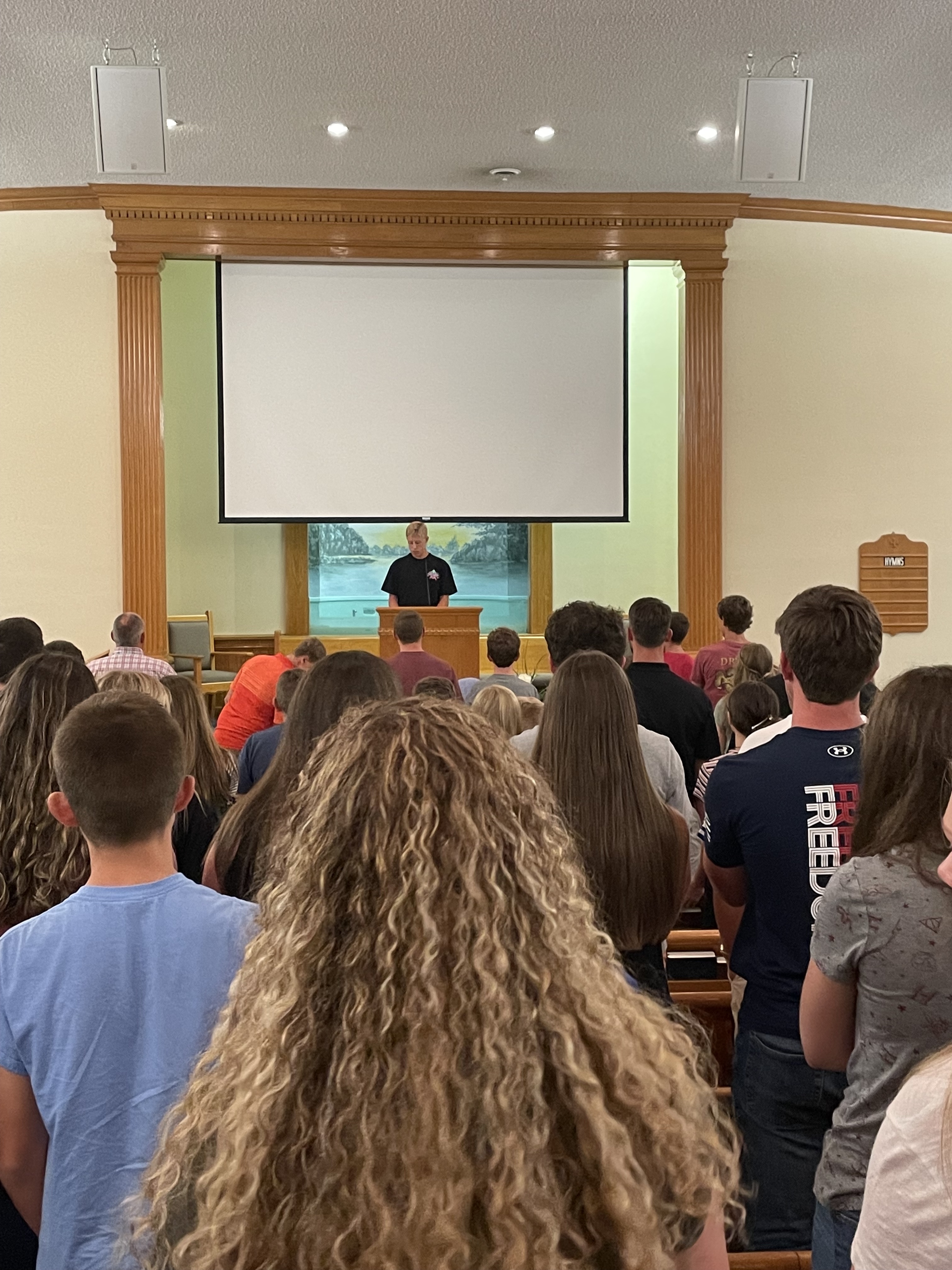
Teens stand for Scripture reading at recent Summer Youth Series (Chase Johnson reading)

Circle of Life

Wednesday’s Column: Third’s Words

gary and chelsea

Gary Pollard

  1. Earth Created (Gen. 1) (A)
  2. Man Sins, Earth Corrupted (Rom. 8) (B)
  3. Access to Tree of Life Blocked (Gen. 3) (C)
  4. Man Unified in Evil (Gen. 6) (D)
  5. Earth Destroyed by Water, Preserved for Destruction by Fire (II Pet. 3.6,7) (E)
  6. Jesus Grants Access to God As Mediator, High Priest, Perfect Sacrifice (Heb. 2.9; Rom. 8.17) (F)
  7. Man Rejects God, Unified in Evil (II Thess. 2.3-12) (4) (D)
  8. Earth Destroyed by Fire (II Pet. 3) (E)
  9. Man Redeemed, Creation Redeemed (Rom. 8.18-20; cf Mt. 19.28) (A, B)
  10. Access to Tree of Life Restored (Rev. 22.2) (C)
  11. God’s Own Live with Him, Share Unique Bond, Can Never Lose Paradise Again (II Pet. 3.13; Rom. 8.29; II Tim. 2.12) (F)

You can also look at it this way: 

  1. Earth Created (Gen. 1) New Heavens, New Earth (II Pet. 3.13; Rev. 21.1; Matt. 19.28)
  2. Man Sins, Earth Corrupted (Rom. 8.18-20) Man Redeemed, Earth Redeemed (Rom. 8.18-25)
  3. Access to Tree of Life Blocked (Gen. 3) Access to Tree of Life Restored (Rev. 22.2)
  4. Man Unified in Evil (Gen. 6)  Man Unified in Evil (II Thess. 2.3-12)
  5. Earth Destroyed by Water (Gen. 7; II Pet. 3.6,7) Earth Destroyed by Fire (II Pet. 3.7)
  6. Jesus Gives Access to Father (Heb. 2.9)  We Live With God (II Tim. 2.12; I Jn. 3.1ff; Rom. 8.29)

“The God and Father of our lord Jesus Christ is blessed. Thanks to His incredible mercy, we are born again into a living hope through the resurrection of Jesus Christ out of death. Because of this, we have an immortal inheritance that has no flaw and cannot wear out. This is guarded in heaven for you who are also guarded by God through faith. This salvation will be revealed to you at the end” (I Pet. 1.3ff).

Why Christ Became Flesh

Neal Pollard

The writer of Hebrews exhorts that Christ should be faithfully served, not abandoned, because He is a superior messenger to all other heavenly messengers (chapter one). Then, he gives another reason for holding fast to Him in chapter two. His readers were apparently struggling in their faith and gradually slipping back into the religion they had left. They lacked incentive, but the epistle gives reason after reason for why it should be restored.

In chapter two, he refers to Jesus’ humanity. Through it, He perfectly fills the role of High Priest in a way no Levitical priest could do under the old law. He enumerates the reasons why Jesus became flesh, and each reason was for each of us as individuals.

  • He became flesh to taste death for every man (9). He exercised God’s grace on our behalf. He was willing to make God’s understanding of our frailties empirical (experienced by human senses) by tasting death in a human body.
  • He became flesh to render the devil powerless (14). Before the cross, where Jesus gave up His physical body in death, the devil had the power over man. All mankind sinned and there were various sin offerings provided by God in the different ages. Yet, they could not “take away” sin (10:4,11). But, when Jesus died and was raised from the dead, He rendered the devil powerless over those who faithfully obey Christ and remain faithful unto death.
  • He became flesh to deliver the enslaved (15). Knowing no hope of deliverance from the horrible state of sinfulness makes for a miserable experience (Rom. 7:25). Christ came to deliver us from the awful slave master of sin (John 8:34).
  • He became flesh to become a merciful and faithful High Priest (17).  12 times in Hebrews, Jesus is called the Christian’s High Priest–the High Priest of our confession (3:1), in Heaven (4:14), sympathetic and sinless (4:15), appointed by the Father (5:5), without predecessor or successor (5:10), who went before us (6:20), holy, innocent, undefiled, separated from sinners, and exalted above the heavens (7:26), seated at the Father’s right hand (8:1), an offering priest (8:3), and offering His own blood (9:11). His service in administering His blood on our behalf is merciful (kind, forgiving, protecting) and faithful (trustworthy and sure).
  • He became flesh to come to the aid of the tempted (18). He well remembers what it is like to suffer in a human body. Not just that greatest moment of suffering, up on the tree, but the daily discomforts (Mat. 8:20), abandonment (John 6:66), and betrayal (John 18:27; Mark 14:45). Therefore, He can help me right now with my problem. Nothing is too big, too mysterious, or too difficult for Him.

Five reasons from Hebrews two are given for why Jesus became flesh, but all of them are for me (and for you)! What a thrilling though. Let’s serve this wonderful Savior!

A Physician Not Afflicted With The Disease He’s Fighting

Neal Pollard

Buried in the headlines today is news that the doctor in charge of fighting an outbreak of Ebola in his country has contracted the disease himself.  The health minister of Sierre Leone said that Dr. Sheik Humarr Khan has a confirmed case of the deadly virus that has killed over 600 of his fellow-countrymen in 2014.  Three of the nurses working alongside Khan recently died trying to treat this disease for which there is no known cure or vaccine. Despite meticulous precautions, Khan could not evade contracting Ebola.

It is an unappealing prospect to consider having a job like Khan’s.  Exposing yourself to something utterly deadly (at times, Ebola has as high as a 90% mortality rate) to try and save your fellow-citizens is about as great a risk as a person can assume on this earth.  Not surprisingly, Khan has been hailed as a hero for using his expertise as a virologist to combat this frightful killer.  Now, his own life hangs in the balance (via news.yahoo.com).

The writer of Hebrews contrasts Jesus with the Levitical priests under the Old Law.  They were “sick” with the very sin they were appointed to “treat” among the nation of Israel (Heb. 7:27).  The writer says that Jesus had no need to do this for Himself because He was “holy, innocent, undefiled, separated from sinners…” (Heb. 7:26).  In other words, though thoroughly exposed to the deadly malady of sin, Jesus never succumbed to it.  Earlier, the epistle says, “For we do not have a high priest who cannot sympathize with our weaknesses, but One who has been tempted in all things as we are, yet without sin” (4:16).

Simply put, the One God sent to provide a cure for the deadliest condition ever known was fully exposed to it but did not fall prey to it.  He did, however, die because of it.  Incredibly, that was God’s intention from eternity. Yet, His ultimate sacrifice makes it possible for us to be cured of this otherwise hopeless and eternally fatal condition!  No wonder we praise Jesus as the “Great Physician.”

“I THINK I UNDERSTAND”

Neal Pollard

As part of the personal evangelism class I just taught in Cambodia, I had the students engage in role-playing for a couple of days.  It was wonderful and memorable.  Some of the students are brand new Christians and have no experience doing personal work.  All of them got into it wholeheartedly. Perhaps the most poignant moment came about purely accidentally.  We had a table set up, with a teacher, silent partner, and student.  The “student” was to come up with the issue or dilemma for the “teacher” to solve. In one particular scenario, the “student” hit the teacher with his true background.  He said, “When I was born, I did not even get to see my parents. They died and I am an orphan. If there is a God, why did this happen?”  His teacher gently and unassumingly said, “I think I understand. I lost my parents when I was young, too, and I am an orphan.” There followed a beautiful lesson on God’s love and pretty good insights on why there is suffering in this world. But the fact his teacher not only comprehended, but experienced his situation made a huge impact on everyone in the room.

We will suffer in a great many ways throughout our short sojourn on this earth.  At times, we may think that not another soul on earth understands.  Perhaps, there will come a time when that is actually true.  However, we will never encounter a single trial but that someone will always understand.  He may not be on earth, but He is ever-present. He is actually omnipresent.  The Hebrews writer says of Him, “For we do not have a high priest who cannot sympathize with our weaknesses, but One who has been tempted in all things as we are, yet without sin. Therefore let us draw near with confidence to the throne of grace, so that we may receive mercy and find grace to help in time of need” (Heb. 4:15-16).  As we bring our biggest, most debilitating issues into His presence, He gently says, “I think I understand.” Praise God!