Fan The Flame

Carl Pollard

A few months ago, we were at Walmart, and they had their charcoal grills on sale. I jumped on the opportunity and immediately put it to work when we got home. Salmon, burgers, more salmon and burgers – something about a charcoal grill just makes the meat taste so good. If you’ve ever used a charcoal grill, you’ll know that there’s a good bit of prep time involved. You pile up your charcoal, soak it in lighter fluid, light it, and wait a good 20 minutes. Once the flame is gone and the coals are gray, it’s time to cook.

One evening a few weeks ago, I decided to use the grill. It was pretty cold out, but when you get the craving, you don’t care how cold it is, you light up the grill. I did everything as I normally would and started cooking once the coals were gray. Except this time, they quit cooking after only a few minutes. Turns out, in cold weather, charcoal doesn’t last as long. So, what do you do? With half-cooked salmon, you don’t want to start the process all over and wait another 20 minutes. I, of course, did the wrong thing and just sprayed a bunch of lighter fluid and burned everything to a crisp.

Little did I know, that event is a perfect illustration for what Paul says in verse 6: “For this reason, I remind you to fan into flame the gift of God, which is in you through the laying on of my hands.” Timothy’s charcoal was going out, and what happens when your faith grows cold? You lose the impact you have on others, you lose the joy of salvation. Paul says, “I want you to fan the flame.” True faith, like a roaring fire, can be felt and seen. The words used for “fan the flame” mean to rekindle, revive, to begin again.

To keep the flame alive, we need to:

1. Stay strong in our walk with God. When our time spent with God is pushed to the back burner, that is when our faith grows cold. Fellowship with God is our connection to the source of the fire.

2. Stay strong in our walk with the family of God. When time spent in fellowship is neglected, we fail to help fan each other’s flame.

3. Stay strong in worship. Worship should be intimate and personal, a reflection of our love for God.

4. Stay strong in study. It is impossible to stay on fire for God and not spend time in the word of God. Like Jeremiah, God’s word is the very fire in our bones, and if you want to keep that fire burning, study the word.

When fear threatens to ruin your faith, rekindle the flame.

“This Book Is Valuable”

Neal Pollard

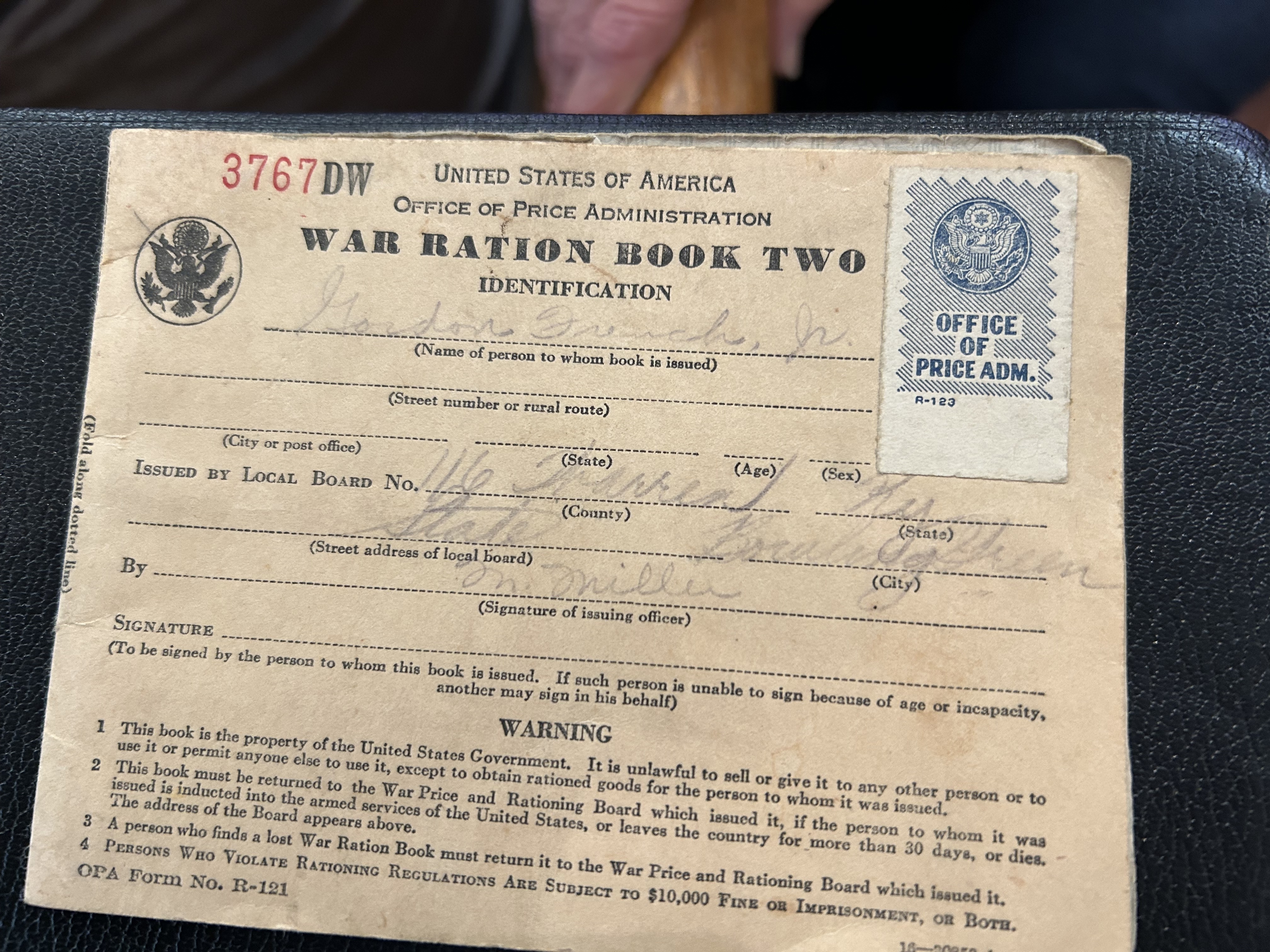
Not long ago, visiting two of our wonderful members, Dorothy and Buster French, we talked about everything from politics to family to farming and their memories growing up. Somehow, talk shifted to their memories from youth growing up during World War II. Times were difficult and Americans had to make sacrifices, doing without. This sweet couple had tangible proof of that sacrifice in a ration card they had kept from Buster’s father. 

Families and households had to limit their purchase of common goods, like gasoline, butter, sugar, and canned milk (https://www.nps.gov/articles/rationing-in-wwii.htm). This allowed the government to divert needed supplies and manufacturing to goods and supplies needed to prosecute the war overseas. What I found most interesting of all was the explanation on the back of the ration book. It included the following statements:

  • “This book is valuable. Do not lose it.”
  • “Detailed instructions concerning the use of this book…will be issued from time to time.”
  • “Do not throw this book away…”
  • “You may be required to present this book…”

The last paragraph was an admonition for the bearer to do his or her part. A failure to follow the rules, they said, “helps the enemy.” The book carried the weight and authority of the Government Printing Office and was dated 1942.

It’s so hard for us, even in the volatile economics conditions of the past few years–including a disruption in the supply chain–to fathom what ordinary families endured for a half a decade or more. But the exhortations on the back of that book can be timelessly applied to the most important book of all.

Whether or not we have a favorite, well-worn copy of it, but the Bible is most valuable and its message and content cannot be lost as a lamp to our feet and light to our way (Ps. 119:105). God designed for us to have detailed instruction, “from time to time,” given concerning its use. He calls it preaching (Acts 2:42; 20:7; 1 Cor. 1:21). Figuratively speaking, morally, ethically, and doctrinally, we must never throw this book away (Ps. 50:17). Peter reminds us that we may be required to present this book to anyone who asks (1 Pet. 3:15)!

I could not help but think, God’s written word must be the most valuable resource in our lives. It supplies everlasting food and gives us access to more than consumable goods. It is to treasured above our “necessary food” (Job 23:12). 

So many in the Buster and Dorothy’s generation (and their parents’) have contributed much good and the prosperity so many of us enjoy today. Things like their honest participation on the Homefront through means like rationing are example of why. We can bless our world today by being Christians who treasure the Book of books and put it to use in our lives! 

DO WE HAVE CONFUSING MENU TERMS?

Neal Pollard

Open Table, a company that facilitates reservations at better restaurants, sent a quiz today to test my familiarity with some of the more sophisticated menu terms one encounters. I made 40%, and at least a few of my right answers were lucky guesses. Truly, I’ve never heard of “okonomiyaki,” “Harissa,” “gochujang,” or “crudo.” These and others were foreign words, in the literal and culinary sense. Certainly, chefs, maitre d’s, refined diners, and the otherwise alimentary literate folks know these terms, but most of us are proud to differentiate between la fork and la spoon. We also do not like to be made to feel less than intelligent by the more informed foodie.

The more we try to be soul-conscious and truly sensitive to the visitors who attend our services, the more thoughtfully we should consider especially the terms we use and even take for granted. We’ve used them so long that maybe we assume everybody knows them.  But, these visitors may be sitting there, despite their intelligence and capability, feeling ignorant or uninitiated as we pepper them with “expediency,” “hermeneutics,” “extend the invitation,” “conversion,” “denominational,” “redemption,” and other terms that require the context of our learned church culture. Other terms, not at all hard to define, are terms that mean something specific to us but that mean something else to those without our “background”: sin, salvation, repentance, worship, born again, holy, works, grace, etc.  On many occasions, I’ve looked at some of the lyrics in our songbook and have found, especially in older songs where words have inevitably changed or fallen into disuse, we press on without defining or explaining these words to our youth, new Christians, or non-Christian attendees. “Could my zeal no respite know?”  “His garment too were in cassia dipped?” “Heavenly portals loud with hosannas ring?” Many, many more examples of such lines could be produced!

My point is not to be critical. There is no way we can define every word a visitor or newcomer may encounter in our worship services, but we do have so many who do not have our grasp of our unique terms. We have a serious obligation to them (cf. 1 Cor. 14:22-25). If we took some time to define the words of our songs, sermons, and even prayers, we would be helping those several groups who may not “get” it otherwise—teens and pre-teens, some of our young adults, a lot of our first-generation Christians, new converts, and those valuable visitors who may be termed “unchurched.” It will help the rest of us, too, to break down our rote and memorized sentences and think about what some of those “ten-cent” theological terms really mean. God desires worship that involves our heart (cf. John 4:24), and clear comprehension is a key to achieving that. May we deliberate on this when we assemble together this Lord’s Day!

OLYMPUS DIGITAL CAMERA
Who knows what this is?

Addicted To The Taste

Neal Pollard

On a slightly different life’s path, Kathy could easily be a world-famous, wealthy celebrity on Food Network.  Her culinary skills and creativity in the kitchen has yielded some incredible dishes that would cave the iron-willed. Incredibly, she has learned through the years to make things that are good for you not simply palatable but tasty!

In 1 Peter 2, Peter urges Christians, facing an ultimate inheritance from a God who wanted them though impeded by persecution by a world who did not want them, “Therefore, laying aside all malice, all deceit, hypocrisy, envy, and all evil speaking, as newborn babes, desire the pure milk of the word, that you may grow thereby, if indeed you have tasted that the Lord is gracious” (1-3).

Peter urges them to purge from their spiritual diet those dangerous additives of attitudes in verse one.  They are more than malnourishing; they are poisonous!  Instead, he calls for them to hanker for the pure milk of God’s Word.  What would heighten their craving was having tasted the Lord’s graciousness.

May I suggest that this is a cyclical process.  In other words, we must be willing to begin feeding on the word.  For most, this is an acquired taste.  But from the first serving, the reader gets a taste of God’s good food.  It nourishes and satisfies.  It illuminates the soul.  It is practical in daily application.  It helps forge a closeness with God.  It gives strength in a difficult world.  The blessings of Scripture are multifarious, endless, and inexhaustible. The very experience of all of this by the consumer drives him or her right back into the Word for more!

Are you addicted to the sweet savor of Scripture?  If you are not partaking, you are starving your soul!  Those hunger pangs you feel cannot be satisfied by adulterated alternatives. Let us say with the ancient patriarch Job, “I have not departed from the commandment of His lips; I have treasured the words of His mouth more than my necessary food” (23:12).