After the six days of creation God rested (Gen. 2.2). The word rest literally meant to stop or, according to Strongs, “desist from exertion” (H7673). Once He finished His work, God does something else that carries a mysterious significance— God blessed a day. So what does that actually mean? Looking at our passage (Gen. 2.3) it says that He does two things and the two verbs that are used are important to help us grasp what’s being said. God blessed the seventh day and made it holy.
Blessed (barak):
In ancient Hebrew thought, to bless something was to fill it with life, fruitfulness, or some kind of ongoing benefit. When God blesses living creatures (both man and beast), they multiply (Gen. 1.22, 28, 9.1). When He blesses the seventh day, He bestows on time itself some kind of divine favor. It was a day that gives spiritual renewal rather than physical productivity. Maybe all the details of that won’t be fully understood or appreciated on this side of eternity.
Made holy (qadash):
To “make holy” meant to set apart. This is also the first time in the Bible that anything is called holy — not a place or an object, but a day. The early Hebrew understanding saw the seventh day as more than a simple pause in labor. God gave them this and He made it a healthy spiritual function of creation.
What’s so significant about all that? This is God blending the spiritual and physical elements of His creation together. It wasn’t like a model train that a boy puts together just for fun. This was proof that existence would be more than a complex physical shell. God “created” an entire day, in part, so we could reflect on that.
David says, about 1,000 years earlier, the same thing Paul says. They had the same source, of course–the Holy Spirit breathed out the words through them both. In Psalm 4:4, David wrote, “Be angry, and do not sin. Meditate within your heart on your bed, and be still. Selah.” Paul wrote, “Be angry, and do not sin. Do not let the sun go down on your wrath, nor give place to the devil” (Eph. 4:26-27). A Bible with good footnotes and referencing will show you that Paul is quoting David, applying the scripture to the purpose of his own writing. So, each wrote for a different purpose, David to demonstrate who is the blessed man and Paul to show who is the new man. David’s writing is of the poetic genre. Paul’s writing is epistolary. Each wrote under a different covenant, meaning their priesthood, worship, and religious constituency were all different. Yet, for all the contrasts that can be made, there are three distinct similarities in these passages beyond the phrase that it is the same.
These writers show us that anger is a timeless issue. When Israel was autonomous or under the thumb of a world power, they were subject to feelings of anger. When Moses was the lawgiver and when Christ was, the issue confronted them. Time, geography, status, or race have nothing to do with a passion that can be stirred to anger. Wherever man wrestles himself and has to contend with others, it is an issue.
These writers show us that anger can be sinful. Though each covenant had different laws to respond to sinful anger, the very existence of such rules and commands shows man’s aptitude to let his anger get away from him. The ramifications of not reigning in self’s response to anger are ultimately the same, whenever and wherever one lives.
These writers show us how to avoid sinful anger. The meat of both passages is a divine strategy to stave off the inclination to sin in our anger. David’s suggests two things–meditation and stillness. Spend some time internally sifting through the issues that would provoke you. Don’t simply stew on it. Rationally think out the matter. Then, be still. Be careful about what course of action you take. Don’t be rash and hasty. Paul suggests resolution and self-mastery. He counsels against “stewing on it,” too. Don’t let anger fester like a sore. Regroup then confront the problem, and remember that this is not the same as being confrontational. You are confronting self more than the cause of the anger. Then, keep self protected from submitting to the devil. That may seem like a dramatic way to say it, but Paul is saying that you are giving yourself over to devilishness when you allow your anger to cross the line into sinfulness. What a hard pill to swallow, yet how helpful to understand that before we foolishly react.
God is looking out for us, seeking to save us from our worst enemy in anger–ourselves!
Ephesians 1.3 says, “In Christ, God has given us every spiritual blessing in the heavenly places.” What does that mean? We hear “spiritual blessings” and might gloss over it as another Christianese phrase. Here’s a short list of what those spiritual blessings are.
1.4 — God chose us before Christ made the world.
1.4 — He chose us out of love to be his special people.
1.5 — He chose us to be his own children through Jesus Christ.
1.6 — God gives grace liberally.
1.7 — We are free because of Jesus’s sacrifice.
1.7 — We have forgiveness because of God’s grace.
1.8-9 — God told us how we can get that grace. He didn’t set up a system that we would have to look super hard for, he made sure to preserve the information needed to find him.
1.10 — He is bringing the heavens and the earth together through Jesus.
1.12-13 — He made grace available to every country on earth, not just one group.
1.13-14 — He gave us his spirit as a downpayment on our reward.
While we won’t fully appreciate these spiritual blessings until later (Paul says these riches are “too great to fully understand” in 3.8), we’re still extremely grateful that God has done so much to give us hope for eternal life.
Ephesians 3:20-21 says, “Now to him who is able to do immeasurably more than all we ask or imagine, according to his power that is at work within us, to him be glory in the church and in Christ Jesus throughout all generations, for ever and ever! Amen.”
In 1999, Australian Bill Morgan was a truck driver who got in a pretty bad accident that left him in coma. After 12 days and despite doctors giving him zero chance of surviving, he miraculously woke up and was, shockingly, completely fine! Feeling lucky for surviving, he went on and bought a scratch lottery ticket and won 18,000 dollars and a new car.
Normally winning a car wouldn’t have made it to the news but, because of Morgan’s accident story, Channel 9 decided to do a feature on the man who was “clinically dead and came back to win the lottery.” While filming, they asked him to buy a lottery ticket so they could re-enact the winning scratch. He happily obliged and started scratching the ticket on camera. But suddenly he stopped. He looked at the camera, and said “I just won $250,000.”
Bill is a man that we would say has some pretty good luck. He was supposed to be dead, but instead he woke up, won a car, and $250,000 dollars. There was a point in our lives where we were spiritually dead, and Christ brought us back to life. But Christ doesn’t stop there. He saves us and continues to bless the faithful. Each and every person that has come in contact with the blood of Christ is no longer dead, plus His blood continually cleanses us of sin if we walk in the light (1 John 1:9).
As lucky as Bill Morgan was, I’d like to suggest that those who are added to the body of Christ are blessed far beyond physical possessions. Our faith in Christ leads to eternal life!
Paul is writing about the second coming, trying to straighten out the misinformation of false teachers, whose message threatened to shake the faith of some newer Christians. He makes a transition after exposing their teaching and warning about the outcome for such men. There is a contrast in tone and message for these who embrace and follow the truth. As hopeless as the end will be for those who believe a lie and are condemned, there is great hope for the righteous believer. As we strive to be such today, we stand to benefit in the same way.
We have been chosen (2 Thes. 2:13). God intended from before time to bless those who believed in the truth. He loves those who go against the tide of popular opinion and embraces what He has to offer, and He sets us apart! We are special to Him. The word “chosen” here indicates “to choose or select for the purpose of showing special favor to or concern for” (Louw-Nida, 360).
We have been called (2 Thes. 2:14-15). This word means “choose for receipt of a special benefit or experience” (BDAG, 503). The benefit identified is “the glory of our Lord Jesus Christ.” The way we “obtain” it is by the gospel and “the traditions” given by apostolic teaching. This word tradition simply means teaching handed down, but it means something binding and originating from God. The point is that God reserves His benefits and blessings for those who believe and obey His gospel! Read Ephesians 1 or 1 Peter 1 for a small sample of these!
We have been given consolation (2 Thes. 2:16). This is the idea of emboldening someone to believe or do something. When there is opposition and false teaching, we need encouraged to follow what’s right. What gives us encouragement and hope? God’s grace! To know that God gives us what we don’t deserve, but the very thing we need, will keep us going in the hardest times. It should lift our spirits to know that the worst we face in this life cannot keep us from the best God has to offer.
We have been given comfort (2 Thes. 2:17). While the word entailed the “setting aside of grief,” Paul speaks of God’s unchanging nature and character. So He’s more than able to set aside whatever grief we feel. Yet, it’s more than removing a negative feeling. He encourages and establishes us so that we can accomplish His will, “every good word and work.” A few sentences later, he elaborates that this involves being strengthened and protected from the evil one (3:3). Seeing the havoc he can wreak, that’s practical comfort every faithful Christian needs!
Do you feel deflated, discouraged, defeated, and dismayed? Here’s a passage you can return to repeatedly! It will remind you of what you mean to God and how He proves it! It’s the substance that can help you weather the worst Satan throws at you this week! Will you remember how much you mean to Him, then show Him how much He means to you?
I’ve never known a day when I didn’t live in a “preacher’s home.” “Preacher’s homes” are very much like every other home–problems, inside jokes, traditions, hobbies and interests, sin, laughter–except the chosen profession of the father is to serve either full-time or part-time as a proclaimer of God’s Word. At times, the home I grew up in was made of figurative glass, meaning I was occasionally subjected to unfair favoritism and criticism.Kathy, also a lifetime resident of a “preacher’s home,” knows that feeling, too. Then, we subjected our sons to the exact same thing!
Whenever we are asked about what it is like to live this unique life (and lifestyle), different words would be appropriate:
Challenging–There can be elevated expectations and unrealistic assumptions about the preacher’s personal life, marriage, parenting, and the like. What Shakespeare’s Jewish character says of his people in the “Merchant of Venice” applies: “If you prick us, do we not bleed? If you tickle us, do we not laugh?” Life’s pressures and temptations visit our homes, too.
Lonely–Occasionally, we feel alone and stand alone because of the message we preach. Usually, it’s not others who make us feel this way, but an innate part of the life.
Ordinary–Most preachers probably love to hear church members and those in the community say, “You’re just an ordinary person with an ordinary life.” To be genuine and real is, in my view, a worthy aim. See the opening paragraph.
But, please understand that the most fitting, usual words used to describe the life in preaching are positive, superlative words and phrases–“important,” “exciting,” “fulfilling,” “full,” “rewarding,” “humbling,” “meaningful,”and “uplifting.” Yesterday, we said “so long” to one of God’s greatest churches as we prepare to move to work with another one. I asked Kathy to describe a one-word assessment that best described how she felt in light of the generous words and acts from our spiritual family throughout the day. She used words like “Overwhelmed,” “grateful,” and “touched.” But then, scanning her brilliant mind as if to find that perfect summary word (as she usually does), she simply said, “Blessed.”
We’ve been blessed by a lifetime of living the “preacher life.” Blessed by 27 years of full-time preaching. Blessed by 13 years of preaching at Bear Valley. Blessed by the opportunity to preach in this “next chapter” of life at Lehman Avenue. Blessed, as cracked pots (2 Cor. 4:7), to be used by the Master Potter. Far from a perfect life, it is certainly a blessed life.
Thank you, Bear Valley, for your many acts of kindness–yesterday and for the entirety of our time with you in Colorado. We love you and will miss you!
Running water. Electricity. A stove. A microwave. Family. Sanity. Health. Domestic tranquility. Health care. Dexterity. Opposable thumbs. Involuntary muscle movement. Singing. Friends. Children. Parents. Nature. Mountains. Breezes. Fireplaces. Automobiles. Law enforcement. Aspirin. Hot water. Showers. Eyesight. Clotting. Emotions. Dogs. Sunsets. Siblings. The ocean. Companionship. Passion. Nerve endings. Shelter. Rocking chairs. Reading. Running. Refrigerators. Board games. Evangelism. The church. Firefighters. Pockets. Paved highways. Ozone. Cotton. Kindness. Shoes. Trees. Songbirds. Smiles. Waves. Shoes. The wisdom of the aged. Elders. Dentists. Coffee. Babies. Modesty. Make up. Music. Lights. Stars. Comfortable chairs. Eyeglasses. Leftovers. Devotionals. Airplanes. Sunrise. FedEx. Interstates. Telephones. Fresh, hot, and homemade bread. GPS. Front porch swings. Memories. Fertile fields. Prayer. Reading comprehension. Hearing. Smelling. Touching. Tasting. Harmony. Trust. Forgiveness. Wedding cake. Teachers. A spirit of cooperation. Sunglasses. Charity. Soap. Good neighbors. Fresh fruit. Beds. Fireflies. Encouragement. Imagination. The Lord’s church. Coffee. Thread. Belts. Livestock. Peace and quiet. Laughter. Pain. Flowers. Hikes. Language. Swallowing. Breathing. Teeth. The Bible. Maps. Love. Blankets. Wildlife. Humor. Curtains. Bedspreads. Snow. Sunshine. Rain. Clouds. Hope. Canned goods. Grandparents. Fellowship. Heaven. Providence. The cross.
“Every good thing given and every perfect gift is from above, coming down from the Father of lights, with whom there is no variation or shifting shadow” (James 1:17)
It was hard being a preacher in Jeremiah’s day. As thanks for his work, the weeping prophet endured the following:
He was led as a lamb to the slaughter (11:18ff)
His brethren dealt treacherously w/him (12:6)
He was confronted by false prophets (14:13)
His brethren cursed him (15:10)
He was hit, put in stocks and condemned (20:1ff)
His heart was broken (23:9)
He was seized and threatened w/death (26:8,24)
His teaching was opposed (28,29)
He was put in prison (32:2,3)
He was pursued (36:26)
He was beaten and imprisoned (37:15)
He was thrown into the dungeon (38:6)
He was bound in chains (40:1)
He was falsely accused (43:2)
He was taken to Egypt (43:6,7)
Remember, God called him to this work. Jeremiah was doing nothing wrong in his ministry; in fact, all of those things that happened to him came in “the line of duty.” The people, on the whole, never changed for the better after all the effort Jeremiah put forth in his ministry. Jeremiah never speaks of his work as enjoyable or rewarding, but it was essential and vital. Some estimate that his ministry spanned more than six decades! Whatever we call him, we do not use adjectives like “weak” or “wimpy.”
The life of preaching is a wonderful work. The preacher works with the best people in the world fulfilling the most profound purpose possible while working, ultimately, for the best Employer there is. The retirement plan is unbeatable! Helping people connect with salvation and helping the saved better connect with their Savior is extremely fulfilling. But, if there are job hazards (the minority of brethren who are difficult to deal with, sporadic job insecurity, being misunderstood, being subjected or having your family subjected to closer scrutiny, etc.), there is a reminder from Hilkiah’s son from Anathoth. Out of our own devotion to God, we will stay at it through thick and thin. Jeremiah wrote, “I have become a laughingstock all day long; Everyone mocks me. For each time I speak, I cry aloud; I proclaim violence and destruction, because for me the word of the Lord has resulted in reproach and derision all day long” (20:7-8). This man thought about quitting, but he couldn’t! He says, “But if I say, ‘I will not remember Him or speak anymore in His name,’ then in my heart it becomes like a burning fire shut up in my bones;
and I am weary of holding it in, and I cannot endure it” (9). I have watched my father, who has preached the gospel 53 years, have some “Jeremiah moments.” I have known so many gospel preachers who have walked in that prophet’s sandals. I have even experienced a few of the lighter trials Jeremiah records as happening to him. But Jeremiah and his modern counterparts whom I have watched serve him faithfully provide a sterling example to me of what the man of God who preaches “looks like.” He’s tough, but tender-hearted. He’s loyal and loving. He’s gritty, but gracious. He’s courageous, yet caring. He will be fallible, but he must be faithful.
Preaching is, in my opinion, the best work in the world. For whatever bumps unique to the preacher traveling the narrow way, there are ten times the blessings. To my fellow friends in this fantastic fraternity, keep the tenacity of the tearful teacher of Judah! Stoke the fire in your bones (cf. 2 Tim. 1:6).
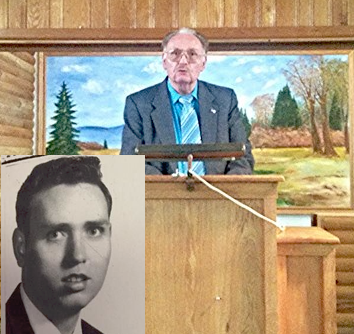
My dad preaching in Artesia, MS, in 1964 (left) and preaching in Andrews, NC, in 2016 (right).










 The Preacher Pollard Blog