Unleavened Religion

Friday’s Column: Brent’s Bent

The misunderstanding of the disciples recorded in Matthew 16.5–12 and Mark 8.13-21 has always amused me. Jesus warned them about the leavening of the Pharisees and Sadducees as they sailed away from Magadan, where He had just encountered some annoying members of those religious sects. According to Matthew and Mark, the disciples assumed Jesus was disappointed that they had forgotten to bring bread. Instead, Jesus reminded them that He had recently fed a total of 5,000 and 4,000 men with only a few loaves and fish. In Matthew’s account, the disciples finally realized Jesus was referring to their teaching when he repeated that they should avoid the leaven of the Pharisees and Sadducees. Luke tells us that Jesus had also given a similar warning to the people (Cf. Luke 12.1-2).

Pharisees and Sadducees crop up in every era, and it is vital to identify the error we should avoid. Thus, let us think about the fallacies against which Jesus cautions. We begin with the issues that characterized the Pharisees. The original Pharisees, whose name comes from the Hebrew word for “to separate,” were strict observers of the elders’ traditions. The Pharisees separated themselves by refusing to assimilate into Greek culture. Though laudable, the Pharisees eventually revered their traditions as sacred as the Law of God, which Moses received on Mount Sinai. 

We can find similar practices today in creeds, catechisms, disciplines, and papal decrees. These traditions, however, need to be more trustworthy. Stories can be altered, manipulated, and distorted to the point where the original narrator would not recognize them. The only way to avoid this is to keep the divine inspiration flowing throughout the distribution process. God only put such safeguards in place for His Word. Traditions can also be harmful to God’s Law. The ancient Pharisee, for example, interpreted the Law according to his rules, rendering it null and void. And so, the Pharisees would do things like pay tithes on items in their herb garden while neglecting the weightier matters of the Law (Matthew 23.23; Luke 11.42). Jesus called them experts at setting aside God’s commands to keep their traditions (Mark 7.9).

And what of the Sadducees? The Sadduccees’ origins are up for debate. The Sadducees claimed descendancy from a priest named Zadok, who anointed Solomon as king (cf. 1 Kings 1.39). On the other hand, the Sadducees were most likely the followers of a man named Zadok, who had been a pupil of the Pharisee Antigonus of Sokho. Zadok misinterpreted what Antigonus of Sokho said to mean there was no afterlife. (According to Antigonus of Sokho, one should obey God out of love and reverence rather than expectation of reward.) The spreading of Zadok’s beliefs to others formed the Sadduceean sect. The Sadducees were similar to the Epicureans, except that the former believed God created the world and governed it through his providence. 

The Sadducees were wealthy and boasted of superior intelligence. Herod was a Sadducee who led the Galilean Sadducees. As a result, the group is also referred to in the Gospels as Herodians (Mark 3.6). The leavening agent introduced by this sect is probably called pseudo-intellectualism. Sadduceeism exists not only in the past; we can also find it today under different names such as atheism, deism, agnosticism, positivism, rationalism, and Erastianism. We typically observe these beliefs in opposition to modern Phariseeism.

But what do the Pharisees and Sadducees have in common? To put it briefly: hypocrisy, lack of knowledge of God’s Word, and hostility toward Jesus. Jesus more effectively exposed their hypocrisy than I could, so I will let His condemnations stand in my stead. So, let us first observe how both groups failed to understand how the prophecies of God fit into the divine plan. They were not spiritually enlightened enough to see the signs that God was giving through Christ. As a result, they did not benefit from Jesus’ teachings in the here and now or the hereafter. (This is especially true of Jesus’ warnings in Matthew 24 about the Romans destroying Jerusalem. Cf. Matthew 24.15, 28.) If the Pharisees had been less concerned with tradition and the Sadducees with looking smart, they could have saved themselves by actually listening to Jesus’ words. But today’s society is just as blind to God’s Word and, therefore, blind to vital information.

Second, there was another thing upon which Pharisees and Sadducees could agree. They both opposed Jesus and could put aside their differences to crucify Him. The proverb, “The enemy of my enemy is my friend,” has been around for a long time; scholars traced the earliest known use of the phrase back to a 4th century BC Indian Sanskrit. And unfortunately, even those who advocate opposing errors frequently join forces to fight God’s truth today. The Pharisees act piously while ignoring God’s goodness, and the Sadducees claim scholarship while opposing God’s truth.

When we consider the errors Jesus found in the leaven of the Pharisees and Sadducees, we can appreciate the importance of His warning. The Bible emphasizes the pervasiveness of leaven. Any substance you add it to will be altered. For example, accepting sinful behavior in Corinth introduced a type of leaven (1 Corinthians 5.6). A Christian had married his father’s wife! Even the heathen, according to Paul, would not do such a thing. As a result, Christians must discipline the sinner to correct this error. And, according to Galatians 5.9, a little false teaching, like yeast, can leaven the church. In this context, Paul refers to the Judaisers’ negative influence on the Galatian saints. Paul expressed his surprise that a false gospel could easily persuade them in Galatians 1.6-7. In Galatians 3.1, Paul even says it is as if the Judaisers bewitched them.

The leaven of Phariseeism and Sadduceeism can cause us to be hypocritical, remove the boundaries of belief, and lead us to false doctrines. Their teachings can demoralize us and make us feel hopeless if we don’t have faith. We must also be aware that false teaching can discourage our temperament and behavior, even leading to blasphemy. If you recall the context upon which I based this article, Jesus separated Himself from the Pharisees and Sadducees by crossing the sea, which may be a good symbol of the great chasm between the righteous and the wicked. We must also distance ourselves from the leaven of the Pharisees and Sadducees today. Let us be more like good King Josiah of whom God said walked righteously without departing to the right or left (2 Kings 22.2).


Brent Pollard

Patience With People

Thursday’s Column: Captain’s Blog

2 Timothy 4:2 Paul says, “preach the word; be ready in season and out of season; reprove, rebuke, and exhort, with complete patience and teaching.”

This is a verse that many have heard before, but as usual with scripture I found something I hadn’t seen before. At the end of verse 2 it says, “with great patience.” In context, why would we need great patience when we are preaching the Word? Starting in verse 3 Paul gives a list of why we need patience. 

First, a time will come when the world will not “endure sound doctrine.” Second, they will accumulate for themselves teachers in accordance to their own desires. And third, they will turn away their ears from the truth and turn to myths. 

As Christians when we are spreading the Gospel it takes patience because the people we meet have turned to their own desires. The message we bring is completely different from what the world has taught them. To truly understand the gospel is to acknowledge sin. Many today have been convinced that who they are is enough. They won’t always like what we are telling them. The world will be angry at Christians for proclaiming the truth. Paul tells us that it’s in these times when we are to be patient. 

But we are patient for a reason! 

2 Timothy 4:8 says, “Henceforth there is laid up for me the crown of righteousness, which the Lord, the righteous judge, will award to me on that day, and not only to me but also to all who have loved his appearing.” 

We have a reward for our trials on this earth. We have a motivation to bring up those difficult topics that makes us hated by the world. We’ll receive a crown of righteousness if we fight the good fight! 

Let’s remember the next time we are in study or a conversation with someone that their soul hangs in the balance. How we act may determine their reaction to the Gospel. So stay patient with the lost, because every soul is important to God. Think souls. 

Carl Pollard

Three Reasons To Work For Each Other

Wednesday’s Column: Third’s Words

In I Thessalonians 1.2-3, we’re motivated to work for each other for three reasons. First is our faith, which is a confidence that Jesus is coming back for us. It’s enough to make us go out of our way for each other. Our love for God is another motivator. We love God because he promised us a life with Jesus forever. Because he showed this kind of love, we show the same love to each other. Our hope is the last motivator listed in this section. A better word for this is anticipation. According to research led by Dr Andrew Huberman (neurobiologist and behavioral scientist at Stanford School of Medicine), anticipation is one of the strongest human emotions. This makes perfect sense, as our anticipation of Jesus’s return is why we live the Christian life. This is almost a word-for-word parallel to I Corinthians 13. 

I Thessalonians 1.4-6 reminds us that God loves us, so he chose us to be rescued. A few thousand years ago, God chose Israel to be his special people. When they were faithful to him, they enjoyed physical blessings and a relationship with him. God chose us to live with him forever. We’re his special people. Paul also points out that we can trust God to deliver on his promise. This will show up again later in the letter. God promised that we’ll live with him forever when his son comes back for us. Faith means confidence or trust. When we trust God to deliver on his promise, we’re demonstrating faith. 

This section also teaches that we can find happiness while we’re suffering. The anticipation we have of Jesus’s return is the only reason this statement is true. If this life is all there is, we’re the most miserable group of people in the world. What makes death, suffering, and anxiety worth the pain? How can we have any semblance of sanity when all the bad stuff happens? We keep going because he promised he’d come back for us, and because this life is short any way! 

Gary Pollard

Brand new podcast debuts today!

A new podcast for Christian women started today, January 16, hosted by Carla Moore and Kathy Pollard. It is available on several platforms (Spotify, Anchor, Google, and Apple Podcasts). Want to check it out? Listen here: Looking Up With Kathy And Carla

Watching Growth Occur!

Monday’s Column: Neal At The Cross

Any day now, Kathy and I expect to officially become grandparents. Carl and Emily are at the end of her pregnancy. In a few more months, Dale and Janelle, Lord willing, will be having their first child. As we prepare for this monumental change, we are doing things like going through our upstairs storage where there are several bins labeled “Future Grandchildren” and “Sentimental.” Our sons’ baby books are there, and in them we saw records of first words, dates of major firsts (first steps, first teeth, first haircut). Also, we pulled out several special items of clothing, blankets, baby books, and pictures from when they were infants and toddlers. 

Carl’s first words were “da-dee” on January 7, 1999 (he was 5 months old), he walked on September 8, 1999, at almost 13 months old, and first blew a kiss two days later. Dale first laughed out loud on April 15, 1996, at 3 months old, his first word was “da-da” on Father’s Day 1996, and he took his first steps on Christmas Day, 1996, to get to a red car toy. Gary’s first words were “da-da,” “mama,” “bye bye,” “hey,” “uh-oh,” “thank you,” and “boo” all at around ten months old, took his first step on his first birthday, and fed himself exactly one month later. 

Trust me when I say I could produce a lot more facts, figures, and fond recollections from the boys’ baby days. Why did we keep such meticulous records of these formidable moments (though we may have been a bit less attentive to record-keeping with each son)? Their birth and coming into our lives forever changed and blessed us. Looking at them now, it is hard to imagine them in tiny onesies and corduroy overalls swaddled in small quilts that are priceless to us. It has been many years since they started shaving, driving, dating, preaching, and adulting in ways like getting jobs, getting married, and now having their own children.

The Bible repeatedly refers to the church as God’s family (1 Tim. 3:15; Eph. 2:22; 1 Pet. 4:17). Those Christians new in Christ are referred to as “newborn babies” (1 Pet. 2:2), and all Christians were urged to be “infants in evil” (1 Cor. 14:20), innocent in what is evil (Rom. 16:19). Jesus warns against making spiritually “little ones to stumble” (Luke 17:2). So, the New Testament is rife with baby and infant imagery.

It is beautiful to watch spiritual infants grow into mature Christians. You see them taking those developmental steps, growing in Bible knowledge (2 Pet. 3:18), sharing their faith (2 Tim. 2:2), making those wise decisions that reflect proper priorities (Mat. 6:33), and counting the cost (Luke 14:26-35). Those who were there at the beginning, who taught them and nurtured them, share in the satisfaction of seeing them flourish in their living, acting faith. 

We may not have books where we record such things, but God does! He has a book on every one of us (Rev. 20:12). Imagine His sense of pride and joy as He takes note of such growth and development on the part of His precious sons and daughters. He sees what even no one else sees, and He dutifully records it! How proud it must make Him when He watches His faithful children. Parents get that! We’ve been there, though on a comparatively limited scale. 

No matter their age and stage, we continue to observe and make note of our children’s progress. God is no different! May we be children who live to make God proud! 

Neal Pollard
In our first house on Harver Court, Mechanicsville, VA, 1999.

Join The Winning Team! Come Together And Give Selflessly.

Friday’s Column: Brent’s Bent

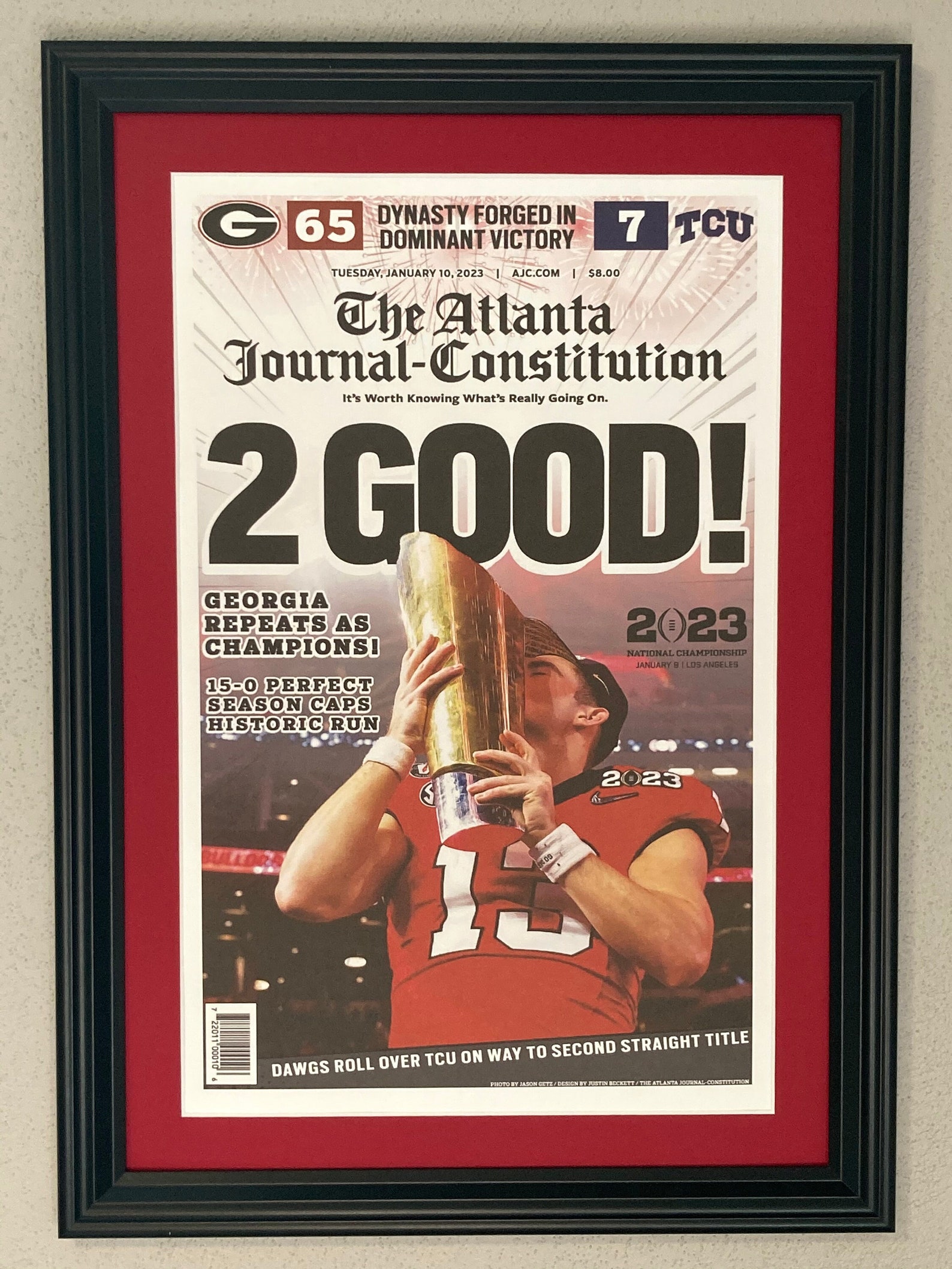
The 2022 college football season has gone, and the Georgia Bulldogs have repeated as national champions. Some argue that our national admiration of sports numbs us to the deterioration of our society. (Think ancient Rome and circuses and bloody spectacles.) However, there are also critics within the college football fan base who believe that the current method of crowning a national champion is unfair. The latter is more a matter of sour grapes. But when I consider paid college football players and transfer portals that foster a sense of entitlement among four- and five-star recruits, I find it difficult not to listen to some criticism. 

As Kirby Smart’s teams have improved over the years, so has their emphasis on teamwork and selflessness. They’ve made it a permanent part of their game strategy, and as a result, they consistently give it their all in most contests. ESPN sports pundits marveled at Kirby’s ability to make his team believe they were undervalued and disrespected despite being labeled the favorites. But, as the adage goes, the proof is in the pudding. Many athletes wanted to help pave the way to victory for their teammates. That is to say, rather than dwelling on how many times they had possession of the ball or how many big plays they had made, they celebrated the accomplishments of their teammates. Nolan Smith, a senior, is a prime example of this because his senior season was cut short due to an injury. After his stellar play on last year’s national championship team, he was eligible to enter the NFL draft. But he returned to Georgia for his senior year. However, his injury hasn’t stopped him from acting as a de facto coach for the rest of the team. Marvin Jones, Jr., one of Smith’s admirers, says he wants to fill the void Smith will leave after graduation. 

Some readers might assume I’m just trying to boast about “my” Georgia Bulldogs. Trust me; there’s more to it than that. An even more valuable group needs the same sense of teamwork and selflessness. Yes, I’m referring to the church. Like sports teams, the church requires teamwork and a selfless attitude to work together for the same mission. Paul writes that each church member contributes to its growth by fulfilling their role (Ephesians 4.16). One aspect of this role is encouraging and supporting each other (1 Thessalonians 5.11). Paul even went so far as to say that we should defer to our weaker brothers’ scruples to pursue peace and edification (Romans 14.19). While it is true that we will give an account of ourselves to God (Romans 14.12), we must focus on the “team.” Jesus loved the church so much that He gave His life for her (Ephesians 5.25). As a result, we are to have the mind of Christ (Philippians 2.5ff). And the early church had its counterparts to people like Nolan Smith, most notably Andrew and Barnabas, two men about whom less is known but who undoubtedly had a significant impact on the early church. These two provided the selflessness and humility the church needs today by following the Lord’s call and putting aside their desires. 

Remember, we are not competing for a stylized black football atop a golden pedestal. Instead, we seek an imperishable crown (1 Corinthians 9.25). As a result, our devotion to the church must outweigh our enthusiasm for a football team on any autumn Saturday, especially in the South.  

Sources Consulted: 

Bender, Bill. “Entitlement at Georgia? Kirby Smart Keeps His Bulldogs Hungry and Focused on Winning Titles.” Entitlement at Georgia? Kirby Smart Keeps His Bulldogs Hungry and Focused on Winning Titles | Sporting News, 10 Jan. 2023, https://www.sportingnews.com/us/ncaa-football/news/georgia-kirby-smart-keeps-his-bulldogs-focused-winning-titles/kliyimqy9z6q6xu5dcg2rmz4

Riley, Connor. “How Injured Nolan Smith Continues to Help Georgia Football Win: ‘He’s Been a Huge Help to Everyone.’” DawgNation, 30 Dec. 2022, https://www.dawgnation.com/football/good-day-uga/georgia-football-nolan-smith-win/H6VP2U6SQJHL7AYDPXPK6HG4LI/

Brent Pollard

The Local Preacher (Part 6)

Thursday’s Column: Captain’s Blog

In Acts 20:24, Paul says, “…But I do not consider my life of any account as dear to myself…in order that I may finish my course.” 

What an incredible attitude. In verse 24 Paul stated the reason he was willing to face the dangers in Jerusalem. He was ready to surrender his life for the gospel. In his epistles Paul often stated his readiness to suffer, even to die for Christ. Paul had completely given his life to Christ. He was willing to die for what he believed. Are we? As ministers we should believe in the word of God so much that we are willing to give our lives for it. What are our lives to us? How much do they mean to us? Do we care so much about our lives that we are willing to preserve them over preserving the word? Those are a lot of questions, but there’s one simple fact that we must remember. A preacher that is not willing to give his life for the cause of Christ is not worthy to preach. 

God’s church, the Bride of Christ, deserves a man willing to lay down his life for the gospel. When Jesus came to Paul on the road to Damascus, He gave Paul his life’s mission. By the grace of God, Paul completed a lifelong service to Him. As ministers, there is not a better life to model ours after, besides Jesus, than the life of Paul. He was selfless to the very end. His body was a mere tool just for the cause of Christ. What does that take? A lifetime of studying and growing our relationship with the Lord. A man with a poor or lacking relationship with God does not belong in the pulpit. 

From the book of Acts we can pull many examples from Paul’s life and apply them to that of the modern day minister. The Bible is 1900 years old, but it is still a practical guide to today’s preachers. We have different challenges that may seem like new issues, but Paul proves over and over again that following Christ wholeheartedly is all we truly need to make it as successful ministers in the church today. Who does the church see in the pulpit? Who does the church need in the pulpit? These are often two very different things. The preacher can act one way in front of everyone, but who he is when he’s alone is what counts. Does he study and pray constantly? A minister should follow closely the example of Paul, and in doing so he will not fail. If every church had a preacher like Paul the church would be a strong and thriving group. 

Carl Pollard

How Does God Want Us To Live?

Wednesday’s Column: Third’s Words

I Thessalonians was written to a group of people who were confused about Jesus’s return. I & II Thessalonians are eschatological letters. They contain some of the clearest teachings about Jesus coming back, outside of II Peter. But there’s a lot more to I Thessalonians than just teachings about the end of earth (unlike II Thessalonians). 

Four out of the five chapters are all about how we’re supposed to operate as a church family while waiting for Jesus to come get us. We know from II Thessalonians that some people were teaching them that Jesus had already come back. They were afraid that he’d already taken away everyone who’d get to live with him forever, and this was causing them to panic. Paul wanted them to know that God expects us to live morally good lives while we’re waiting for him to return. 

The entire book might be summarized like this —  “God wants you to live morally excellent lives while you wait for Jesus to come back. Always be proactive in loving each other as a church family. Pursue moral goodness at all times. Never give in to the world’s pressures, but do whatever it takes to be faithful until Jesus returns. If you do your part, Jesus will make sure that you’re ready for him to come back.”

Next week, we’ll look at how the first part of the book applies to Christians in the 21st century. In fact, this entire study is going to look at I Thessalonians through the lens of modern application. Technical study is important and has its place, but our study will focus exclusively on the application side. 

Gary Pollard

Rays On Gloomy Days

Tuesday’s Column: Dale Mail

For centuries, the locals of Meghalaya, India, have manipulated the roots of rubber trees to grow their natural bridges. Stretching over ditches and streams these natural structures will far outlast the man-made metal or wooden bridges that rot and decay in just a few years. The rubber-roots are self-strengthening and become more substantial over time by increasing in thickness. 

Meghalaya also happens to be the rainiest place on earth, receiving 467 inches of rainfall a year. Just to put that in perspective, New York will typically get around 60 inches a year. The men and women who work outdoors wear a sort of full body-umbrella made of bamboo and banana leaves.

One visiting reporter stopped a butcher who was carrying a basket of freshly-cut meat up a steep flight of stairs. He was asked if it was hard to live in a place with so much rain. The 26 year old man replied, “we can’t think about that. Here there’s always rain but we have to work, so it’s no good wondering about it.”

There are many people who tend to take this attitude after experiencing a rude awakening in life. When the days of innocence have passed us by we think tragedy, hardship, trials, and tribulations are just a part of the deal. 

It’s going to rain. It does no good to think about it— we trudge along. 

We’ve got overcast days, cold days, and rainy days— but it doesn’t mean we have to live without any light. 

This post is a simple one. Here’s a few passages to help brighten up the darker days. 

These verses don’t take the hurt out of life but they can put the hope back in our lives when we begin to lose drive. 

Isa. 60.19 

No longer will you need the sun to shine by day, nor the moon to give its light by night, for the Lord your God will be your everlasting light, and your God will be your glory.

John 1.4-5 

The Word gave life to everything that was created, and his life brought light to everyone. The light shines in the darkness, and the darkness can never extinguish it.

Ps. 40.1-3

I waited patiently for the Lord to help me, and he turned to me and heard my cry. He lifted me out of the pit of despair, out of the mud and the mire. He set my feet on solid ground and steadied me as I walked along. He has given me a new song to sing, a hymn of praise to our God. Many will see what he has done and be amazed. They will put their trust in the Lord.

I John 1.5 

This is the message we heard from Jesus and now declare to you: God is light, and there is no darkness in him at all.

I would argue that though it’s impossible for every day to be a sunny one, the Christian will always have access to the Light because of His son. 

Dale Pollard

Favor To A Faithless People (2 Kings 14:22-29)

Monday’s Column: Neal At The Cross

The writer of 2 Kings is constantly diverting his attention from Israel to Judah and vice versa. So, he introduces us to Azariah, also known as Uzziah, anointed king over Judah at age 16. We will read much more about him in 2 Kings 15, but he seems to be referenced here only to give us the chronology for when Jeroboam II is anointed king of Israel. It is in the 16th year of Uzziah’s reign that Jeroboam comes to the throne. This will be the next-to-last generation in the dynasty of Jehu, but his son, Zechariah (29), will be murdered after six months. When he ascends to the throne, Israel only has about 70 years left before they are destroyed by the vicious Assyrians. God has been patient with Israel for almost 150 years, as king after king behaves just as Jeroboam will behave: “He did evil in the sight of the Lord; he did not depart from all the sins of Jeroboam the son of Nebat, which he made Israel sin” (24). 

He will reign 41 years over Israel, an evil king over a wicked and disobedient people. But, these are God’s people, Abraham’s descendants and once part of the United Kingdom. If we do the impossible and try to put ourselves in God’s place, can we imagine giving to and doing for a people who are continually unappreciative, rebellious, and unfaithful? How long could we go before we ran out of patience? How many times could we be betrayed and hated by the recipients of our generosity before we gave up on them? Or, having God’s power, how long before we destroyed them all? God will go over 200 years, restraining Himself as His people served other gods and gratified their flesh. 

Isn’t it amazing how much grace and kindness God shows to this faithless people? The Jonah who God graciously sends to the Assyrians to preach repentance (Jonah 1:1) is also sent to Israel (25). Despite Jonah’s flaws, his ministry seemed to be to extend God’s grace to an unrighteous people. Then, read what the author says about God and Israel next. “For the Lord saw the affliction of Israel, which was very bitter; for there was neither bond nor free, nor was there any helper for Israel. The Lord did not say that He would blot out the name of Israel from under heaven, but He saved them by the hand of Jeroboam the son of Joash” (26-27). You want insight into the heart of God, as He deals with our sins? He cares when His people suffer. He views us with compassion, sympathy, and concern. He doesn’t want to reject us or let us go. God sent His prophet Hosea to this very people and speaks His mind on this subject: “How can I give you up, O Ephraim? How can I surrender you, O Israel? How can I make you like Admah? How can I treat you like Zeboiim? My heart is turned over within Me, All My compassions are kindled. I will not execute My fierce anger; I will not destroy Ephraim again. For I am God and not man, the Holy One in your midst, And I will not come in wrath” (Hosea 11:8-9). 

No one will be able to legitimately say at the Judgment, “God, you were harsh, hasty, and hateful!” No, even in the face of faithlessness, God shows His matchless grace! His patience can be exhausted and His justice will not allow impenitence to go unpunished (read Exodus 34:7). But let no one accuse God of reckless wrath! He is the God of unending love. May this lead us to repentance (Rom. 2:4) and faithfulness (Rev. 2:10)! 

Neal Pollard

GOD OF THE MARIANA TRENCH

Neal Pollard

Film director, James Cameron, has helped put the Mariana Trench in the news with his recent seven mile plunge to the bottom of the deepest point on earth.  This trench, located in the western Pacific Ocean off the Philippines, has a water pressure of eight tons per square inch–1000 times greater than atmospheric pressure at sea level.  Cameron is only the third person to reach the bottom of the trench (called the “Challenger Deep”), and he did so 52 years after two men did so in a U.S. Navy submersible called the Trieste.  While he has reported that there were no signs of life, that it was a “barren, desolate lunar plain” (AP, 3/26/12), God has placed amazing, other-worldly-looking creatures miles deep in the oceans of the earth.  Cameron’s is almost certainly the first of many more trips to the “Challenger Deep.”  Who knows?  Maybe future voyages will reveal crush depth-defying vertebrates and other scientific improbabilities (much information from http://deepseachallenge.com).

It is amazing that man has discovered the ability and technology God has made available to accomplish a feat like this.  It is also amazing to think that God created areas on this earth, like other parts of the Mariana Trench, filled with exotic, often colorful sea life that He knew it would take thousands of years for man to discover.  Yet, He did that.  It is further proof of His existence and insight into what kind of God He is, a God of such intricate designing and endless power.

It is also a testimony to the omnipresence of God.  How great if Cameron would have quoted David’s words as he sat upon the floor of “Challenger Deep”: “Where can I go from Your Spirit? Or where can I flee from Your presence? If I ascend to heaven, You are there; If I make my bed in Sheol, behold, You are there. If I take the wings of the dawn, if I dwell in the remotest part of the sea, even there Your hand will lead me, and Your right hand will lay hold of me” (Ps. 139:7-10).

Jaroslav Vazda wrote a beautiful song, “God of The Sparrow.” It is a song praising God’s power and implicitly reminding us of the awe we owe Him.  How wonderful to know that the God of the Mariana Trench is the God we can approach and the God with whom we can have relationship!

Creative Commons

Monkey Trap (And Letting Go)

Saturday’s Column: Learning From Lehman

Maybe you’ve heard of this well-known Southeast Asian method of trapping a monkey. This simple method only requires the hunter to get a coconut or some kind of container that’s hard to break and carve a hole that’s big enough for a monkey’s hand that’s open—but not big enough when its clenched up in a fist. What these primates won’t do even as they see the hunter approach them is unhand the bait. Therefore, their fist inside the coconut traps them there until they are caught.

The principle of the monkey trap can be found in many aspects of life, and it is not foreign to the Bible either. In Matthew 19:16-30 (cf. Mk. 17-31; Lk. 18:18-30) is a story we know very well, in which a rich young ruler asks Jesus what he must do to inherit eternal life. 

Jesus knew in that moment what exactly that young man needed to hear and told him what he needed to do in order to inherit eternal life. However, because he was so rich and did not want to part with his wealth, the young man became sad.

We don’t have Jesus in the flesh in front of us to tell us exactly what we need to do in order to get into heaven, but that does not mean that we are lacking in any way. Through the pages of God’s inspired Word, we are being taught and guided what is required for us to enter into Christ and live a faithful life. 

The challenge for us, therefore, is not that we do not have Jesus to tell us what to do. No—in fact, we have him right here with us, around us, and within us. All around us is the presence of God and our savior. What it boils down to, then, is our fisted up hand inside the trap. 

We may look at the monkey that’s trapped by such a simple device and laugh, but don’t we often find ourselves shackled by the one or two sins that keep plaguing our lives? For the rich young ruler, it was his wealth, but this isn’t about being rich or poor. Even those without money can be chained by their sins that they cannot let go.

It’s the beginning of a new year. A time people usually spend contemplating how this new season of life will play out. How many times have we told ourselves, “I will stop this time,” or “I’ll work on this and get better about it.” When will we loosen our fists that grip so hard on the things that drive us away from God, and finally let go?

The rich young ruler could not let go, and therefore he became sad. Knowing what he needed to do, he still failed. Not because he wasn’t told nor because he didn’t understand. It was a willful decision to choose what’s in his fist rather than Jesus. He teaches us a lesson through this unfortunate outcome. How many times does God tell us through His Word exactly what we need to do, just like Jesus did with the young man? Let us be better in the coming year, to finally thwart off the chains that bind us. Paul tells us in Galatians 5:1, “For freedom Christ has set us free; stand firm therefore, and do not submit again to a yoke of slavery.” God has already rescued us. It comes down to us deciding that we want to be saved, rather than be shackled by what’s in our stubborn fists. 

David Chang

We Need The Righteousness Of God

Friday’s Column: Brent’s Bent

The concept of righteousness is quite similar to holiness; both terms refer to a state of being morally upright and emotionally attuned to God’s will. It comprises all that we term justice, honesty, morality, and affections of the heart; in a nutshell, it is true religion. And while there is this type of righteousness to emulate, there are other types of righteousness to avoid. 

The first type of righteousness we need to avoid is that which originates in a person’s mind, which is distinct from the righteousness that originates in God. We identify this type of righteousness as “self-righteousness.” Self-righteousness, often born out of pride, is when a person relies on his or her sense of morality to judge right and wrong. 

Another example of false righteousness is John Calvin’s teaching on imputed righteousness. By imputed, Calvin meant that God credited the elect sinner with Christ’s righteousness. As a result, God shifted His attention away from the sinner and toward Jesus, whom He acknowledges to be sinless. Consequently, Calvin believed that a person God has chosen for salvation does not need to worry about living a good life. When God looks at him, he can only see Christ. (As a side note, it is expected that the one chosen by God will seek a life of righteousness. But the truth is that according to the doctrine, it’s possible to be a willful sinner and still have the righteousness of Christ imputed to them.) 

There are seven occurrences of the word “impute” in the KJV. None of these verses suggests that a person can appropriate Christ’s righteousness as their own. The atoning sacrifice of Jesus Christ allows for the transformation of sinners into saints through forgiveness. Entrance to the heavenly kingdom is granted only to those who do God’s will (Matthew 7.21–23). Thus, while imputation suggests that God finds one without guilt and blame, it does not mean that a person can take on the righteousness of Jesus Christ and expect to gain entrance into heaven. 

A sinful man becomes righteous through faith in God, not through any meritorious works he can perform. But faith does not exclude human participation. Man must do something. James 2 and Hebrews 11 remind us that faith works the works of God (Ephesians 2.10). A sinner becomes righteous, sanctified, and justified by God’s grace. God gave him his righteousness, and God counts it as his righteousness, not on account of the goodness of Christ or anyone else, living or dead. 

Abraham is a great role model for how to achieve righteousness. First, Paul says that Abraham believed in God, which God credited him as righteousness (Romans 4.3–9, 17–22). Second, it is also important to note that Abraham’s righteous status was independent of his being circumcised (Romans 4.10–12). Third, Abraham’s faith was active, working by grace (Galatians 3.6–9; James 2.21–23). 

So, it was Abraham’s faith in God rather than Jesus’ own sinless life and obedience that God credited as righteousness. Even though Abraham’s efforts would have been futile without Jesus’ perfect life and obedience, he could not leave everything to be accomplished by God. This truth meant that God gave Abraham the tools he needed, but Abraham was the one who had to use them.  

We must do as Abraham did. And just as God will not credit us with Christ’s righteousness, neither will He credit us with the righteousness of anyone else (e.g., a parent or spouse). Our evaluation before God is personal (2 Corinthians 5.10). We must avoid doing as Paul did before his conversion, seeking righteousness contingent on anything other than Christ (Philippians 3.9). 

Brent Pollard

The Local Preacher (Part 5)

Thursday’s Column: Captain’s Blog

Acts 20:25, “And now, behold, I know that none of you among whom I have gone about proclaiming the kingdom will see my face again.” 

Local preachers must know their congregations. A relationship is key to having a successful ministry. A man by the name of T.D. Jakes speaks of the relationship between a man and a woman, and he relates this to the preacher and the congregation. He once said, “The art of relationships requires that a man who is very different from his woman finds common ground with her and vice versa. We are meant to balance each other by attracting people whose strengths may be our weaknesses.” The preacher has the congregation, and the congregation has the preacher. With this kind of relationship, the consequences of ruining it would be catastrophic. 

Acts 20:27, “For I did not shrink from declaring to you the whole counsel of God.” Paul taught the whole Truth of God, A local preacher should never shrink away from teaching the entirety of God’s Word! Paul taught the whole truth no matter the consequences of his actions. We have the whole Truth, which is able to save the souls of the lost. If we leave out any part of the Truth, then we are trading our comfort for the souls of the lost. We must realize the magnitude of not proclaiming the whole Truth.

Acts 20:28, “Pay careful attention to yourselves and to all the flock, in which the Holy Spirit has made you overseers, to care for the church of God, which he obtained with his own blood.” 

This section centers on the work of elders. Paul gives two imperatives (commands) to them. First, we notice that he says to be on guard. This word (prosecho) means “to be in a state of alert, be concerned about, care for, take care.” Their “state of alert” needed to be twofold: firstly, for themselves (elders). Elders need to take care not to forget their own spiritual lives. This would logically be the first place that Satan would start. Then those under the care of the elders would scatter. When the shepherd disappears, the sheep scatter and become easy prey. If the elders are to guard the flock then it is partly their job to make sure the preacher is preaching what the scriptures teach. They can’t guard the flock if they’re feeding them poison. 

A bad preacher is like a wolf. This term describes a person who deals in a pitiless manner with the congregation. Instead of building the flock up he is slowly eating away at their spiritual lives. The preacher is not completely different than the average member but they are in charge of delivering the “food,” if you will. As ministers we should make sure that we are feeding the flock only the finest foods.

Carl Pollard

The Old Law

Wednesday’s Column: Third’s Words

In Galatians 3.15-20, Paul reminded the Galatians that the old law was never intended to be the ultimate plan. It served one purpose only: to highlight how sinful the human race really was (3.19). It was even given from a distance! God gave it to the angels, then the angels gave it to Moses, then Moses gave it to the people (3.19). Besides being strict and lacking grace, the old law didn’t allow for a personal relationship with God. It was a placeholder until Jesus could enact a much better system. 

Romans 7.5-11 says, “In the past we were ruled by our sinful selves. The law made us want to do sinful things. And those sinful desires controlled our bodies, so that what we did only brought us spiritual death. In the past the law held us as prisoners, but our old selves died, and we were made free from the law. So now we serve God in a new way, not in the old way with the written rules. Now we serve God with a new spirit. You might think I am saying that sin and the law are the same. That is not true. But the law was the only way I could learn what sin means. I would never have known it is wrong to want something that is not mine. But the law said, ‘You must not want what belongs to someone else.’ And sin found a way to use that command and make me want all kinds of things that weren’t mine. So sin came to me because of the command. But without the law, sin has no power. Before I knew the law, I was alive. But when I heard the law’s command, sin began to live and I died spiritually. The command was meant to bring life, but for me it brought death. Sin found a way to fool me by using the command to make me die.” 

The law was in place to show us that we don’t have the ability to meet God’s standard of morality on our own. We didn’t even know that some of our behavior was sinful until God said it was through the law. Once humanity realized that it was helpless to overcome sin, God sent his son to free us from that system and destroy guilt once and for all. Paul reiterated this in 3.21-25 by saying that the law convicted everyone on earth of sin and kept us all prisoner. The law was functionally a strict supervisor, controlling every little aspect of life and punishing violations severely. But it’s no longer necessary (or relevant) because we have the way of faith (3.25). 

“We also know that the law is not made for those who do what is right. It is made for those who are against the law and refuse to follow it. The law is for sinners who are against God and all that is pleasing to him. It is for those who have no interest in spiritual things and for those who kill their fathers or mothers or anyone else” (I Tim 1.9). 

Gary Pollard

Light Bulb Ideas

Tuesday’s Column: Dale Mail

Did you know an early twentieth-century cartoon, Felix the Cat, was created more than a decade before Disney dreamed up Mickey Mouse? Felix was the most popular cartoon character of his time and was largely responsible for stirring America’s appetite for animated films. 

Some of the revolutionary concepts that originated with the cartoon were the symbols that would appear above Felix’s head while he was thinking. Occasionally the symbols like a question mark or a musical note would turn into a ladder, vehicle, or door— which became a prop within the story. As unimpressive as this may sound by today’s standard, it was movie magic for our ancient movie-going ancestors. 

There was one symbol that appeared in an episode airing in 1925 that would change the relationship between an image and a concept from that moment on. The image was of a simple lightbulb. It appears floating above Felix’s head at the very moment in which he’s struck with an idea. This was the first time the bulb and the brain were used to illustrate “sudden inspiration.”

Some Secular Speculations 

I•DE•A “A thought or suggestion as to a possible course of action.”

The origin of an idea is an interesting puzzle that’s yet to be solved by the secular world. Educated guesses have been made in an attempt to determine where and how an idea is formed, but these guesses remain guesses— and are often debated. Are they formed in the conscious or subconscious mind? Are they speculated solutions to problems that are lumped together inside of our prefrontal cortexes to aid in verifying our hunches? Who could say? The Bible seems to indicate that ideas are personal, and personal ideas should be dealt with carefully. 

Clues In Scripture 

“For from within, out of the human heart, come evil ideas, sexual immorality, theft, murder…”

Mk. 7.21 

“There was a lot of whispered discussion and murmuring among the crowds about Jesus. Some were saying, “He is a good man”; others said, “No, on the contrary, He misleads the people giving them false ideas.”

Jn. 7.12

Now all the Athenians and the foreigners living there used to spend their time doing nothing else other than listening to the latest ideas or repeating them.”

Acts 17.21 

There are other passages in the Bible that we could go to in order to further prove that ideas were seen as natural in their formation. They develop or die in the human mind and the originator of the idea will either reject it and remain silent or accept it and vocalize it. 

Is it a Good One or a Bad One?  

Spiritually speaking, a good idea typically shows itself as a novel or untried solution to facilitate a command. If the principles are based in Truth, then the idea is not only a good one— but it’s bound to mature into its desired result. 

A bad idea is one that’s dreamed up in the mind(s), unchecked by God’s counsel, and blindly pursued (1 Sam. 13, Ex. 32). 

Summarized in a Single Sip 

A true “light bulb” idea has never been credited to the human imagination because all the good (best) ones stem from the One unfailing Light (Lk. 18.19). A “golden calf” idea stems from imperfect opinions and the wishes of man. 

It’s always a good idea to chase down the source material, no matter how sensible an idea may sound. 

Dale Pollard

Who God Uses In His Service

Monday’s Column: Neal At The Cross

Jesus chose imperfect, flawed people like you and me to help Him spread the gospel. It is easy for us to think that only the super-spiritual, seemingly-perfect can be effective, but the opposite is true. None of us is too spiritual or perfect, though we should always be striving to be better and do more for the One who gave everything to save us. 

Paul is continuing his discussion about the ministry he and his co-workers have when he pens 2 Corinthians 4. As he does, he speaks candidly about himself and them–the messengers. As Christians charged with carrying out the Great Commission, we should all put ourselves in his shoes and understand better who God uses in His service. 

GOD USES PEOPLE OF INTEGRITY (1-4)

Character does not demand perfection, but it does require a conscience shaped by Scripture and a heart softened by it. This leads one to stay encouraged no matter what is encountered (1). It also leads to honesty and trustworthiness (2). We will conduct our lives righteously, and we will handle God’s Word faithfully. People can trust who we are and, thus, what we say. We may be rejected by the spiritually blind, but we won’t be a roadblock to their faith. 

GOD USES PEOPLE OF HUMILITY (5-7)

Paul gives a helpful reminder. It’s not about us, it’s about Christ. He’s the source of light, glory, and power. We’re the plain, fragile pottery God uses to demonstrate His surpassing greatness. 

GOD USES PEOPLE OF DURABILITY (8-12)

To be His servants, we have to weather storms. Those storms may be those we would avoid if we didn’t serve Him, but we understand the importance of our mission. We won’t let affliction, perplexities, persecution, and threats keep us from doing His work! God does not need spiritual sissies in His service. We draw our courage and strength from Him, and it causes Him to shine out through us!

GOD USES PEOPLE OF STABILITY (13-15)

What causes us to be stable? Faith! Because we are truly convicted of the truth, we cannot help but speak. We have faith in the reality of the resurrection, so we teach and share the message that brings grace to more and more people. This leads more people to give thanks to God and causes God to be glorified.

If I want to be a faithful servant of Jesus, I need to watch my personal conduct, lower myself, endure, and be trustworthy. That does not require perfection, but it does require dedication! But God depends on imperfect people like you and me! We cannot let Him down. 

Neal Pollard

The Days Ahead, The Death Behind

Neal Pollard

Each year we have a unique chance

To review, remember and revive

And see what ways we can enhance,

Our lives so as to grow and thrive

That means we must with all our heart

Kill off things that weigh down and harm us

To stop bad habits, and then to start

Seeking better things to charm us.

This death we seek is within our minds

Of thoughts and desires unbecoming

Self-talk of defeat that cripples and blinds

Or anything that’s conscience-numbing.

Resolve! That’s the task out before us

Start today, see tomorrow with potential

Who’s against us if our God is for us

Let His Word shine on all that’s essential

This time next year can be better

You can change what’s long been lacking

Let your past be your springboard, not your fetter

There’s no time like now, let’s get cracking! 

A Three-Letter Word To Know And Avoid

Friday’s Column: Brent’s Bent

Brent Pollard

If you want to win on the battlefield, you need to know your enemy and yourself, as Sun Tzu outlined in The Art of War. We are engaged in a spiritual conflict (Ephesians 6.11–13). As a result, in order to arm ourselves against sin, we must first recognize sin and its nature. Additionally, we need to be aware of how God will respond to any sin not atoned for by the blood of His Son. Finally, we must also properly respond to sin’s threat.

How can sin be identified?

First, it is a transgression of the law (1 John 3.4). By definition, transgression is “the act of passing over or beyond any law or rule of moral duty; the violation of a law or known principle of rectitude; breach of command” (Webster’s 1828 Dictionary). Accordingly, “transgression” describes instances in which we break the law, whether on purpose or accidentally. This infringement only needs to happen once to be considered a transgression.

Second, all unrighteousness is regarded as sin (1 John 5.17). Looking back to Webster’s original definition, we can see that unrighteousness “may consist of a single unjust act, but more generally, when applied to persons…denotes a habitual course of wickedness.” In other words, this is a condemnation of willful sinners. This is more than just breaking the law; it’s a deliberate decision to disobey God.

Third, anything not of faith is a sin (Romans 14.23). As Burton Coffman observes: “Where the conscience is in doubt, the definition of proper conduct must be made on the basis of what the word of God says; and, lacking any clear knowledge of what the word says, or, if knowing it, lacking full confidence and faith in it, the person is bound by his scruples.” This principle does not extend to situations where the conscience is not threatened.

Contextually, Paul is referring to the consumption of meat offered to idols. Meat offered to idols was technically forbidden (Acts 15.20). However, if the origin of the meat was unknown, you could gladly accept it. If, on the other hand, your host identified the meat source as coming from a pagan sacrifice, you couldn’t eat it for the sake of your conscience and the consciences of those who might see you and stumble as a result (1 Corinthians 10.27–29).

Fourth, God defines sin as not doing something. “So for one who knows the right thing to do and does not do it, for him it is sin” (James 4.17 NASB). This sin is the most concerning of all the ways we fall short. We’re aware of potential threats, but can we also spot opportunities? We can become so preoccupied with avoiding what is wrong that we miss out on what is right.

Now that we have identified sin, what is its nature?

First, sin is deceptive (Hebrews 3.13). You’ve probably heard the phrase “bait and switch.” That is what sin is. It makes promises that it cannot keep. It lures us with the appearance of pleasure, success, and freedom only to enslave us with guilt, shame, and emptiness.

Second, sin hardens the heart (Hebrews 3.8). It’s worth noting that the original Webster’s Dictionary from 1828 contains a definition for “harden” in this context. To harden means “to confirm in wickedness, opposition, or enmity; to make obdurate.” Oxford Dictionary defines obdurate as “stubbornly refusing to change one’s opinion or course of action.” As a result, the practice of sin causes one to become stubborn and reject God’s goodness in favor of the allure of sin.

Third, sin progresses (2 Timothy 3.13). David is a fantastic example of this. When one reads 2 Samuel 11, he finds David atop his palace when he should have been in the field with his soldiers. David could see into Bathsheba’s courtyard from his rooftop. He was moved with lust when he saw her bathing and had her brought to him. He had an affair with her, and she became pregnant.

Instead of admitting his sin, David brought the woman’s husband home, assuming they would have marital relations and that others would perceive his illegitimate child as her husband’s. Because he was such a great soldier, the woman’s husband forsook home comforts while he and his comrades fought. As a result, David orchestrated his death on the battlefield. When David paused atop his roof that fateful day, he had no idea what would happen. We can see, however, how quickly and far sin led him.

Fourth, sin’s pleasure is fleeting (Hebrews 11.25). Consider the phenomenon of intoxication. While under the influence, one may feel giddy or relaxed, but when sobriety returns, there may be things to deal with, such as headaches and the stupid things you did while drunk.

Fifth, sin’s price is astronomically high. (Romans 6.23). What a dreadful boss! Sin rewards you with death for your faithful service.

Sixth, sin dulls the conscience (1 Timothy 4.2). Paul depicts a conscience seared with a branding iron. He is discussing false teachers in the immediate context. One might wonder if such a person would repent if lovingly shown the truth. Unfortunately, there are times when one’s conscience is seared. They continue to teach falsehoods despite knowing they are false.

Note how God responds to sin.

God takes vengeance upon it (2 Thessalonians 1.7-9). We find this thought-provoking discussion about vengeance in Webster’s 1828 Dictionary:

“The infliction of pain on another, in return for an injury or offense. Such infliction, when it proceeds from malice or more resentment, and is not necessary for the purposes of justice, is revenge, and a most heinous crime. When such infliction proceeds from a mere love of justice, and the necessity of punishing offenders for the support of the laws, it is vengeance and is warrantable and just. In this case, vengeance is a just retribution, recompense or punishment. In this latter sense the word is used in Scripture, and frequently applied to the punishments inflicted by God on sinners.”

God punishes it (Matthew 25:46). This outcome is because, as Webster stated, God’s actions are just. God does not punish sinners because He is sadistic or because He can. Instead, God takes action because the punished person has done something deserving of the punishment. And this punishment is eternal (Matthew 25:46). Words like “eternity” are mysterious to us as beings defined by time. However, from our perspective, even one second of our skin’s exposure to fire feels like a long time. Consider a scenario in which the flames never die, and one cannot escape them.

Now is the time for a proper response to sin and its character.

We must adequately address sin. (Proverbs 28.13). However, hiding sins will not remove them. God reminds us that sin will eventually betray us, revealing its presence to all (Numbers 32.23). We can’t avoid our sins by pretending they don’t exist (1 John 1.8–10).

No, God has provided the means to save us. This method is known as the plan of salvation. “Repent, and each of you be baptized in the name of Jesus Christ for the forgiveness of your sins,” Peter says (Acts 2.38 NASB). We must walk in the light of God once He adds us to Christ’s body (1 John 1.7; Acts 2.41, 47).

However, because everyone has sinned, including God’s children, repentance never loses relevance (Acts 8.22). Similarly, we must confess our sins (1 John 1.9). By doing so, we have the assurance of Christ’s cleansing blood.

Lastly, keep away from sin by obeying the Lord’s command. “Hate what is evil; cling to what is good” (Romans 12:9 NASB). Paul also urges us to “abstain from every form of evil” (1 Thessalonians 5.22 NASB). Trust in the Lord and obey Him to cleanse your life of sin and receive your soul’s salvation.

Man Digs Tunnel Through Mountain With Hand Tools

Thursday’s Column: Dale Mail

Dale Pollard

In the El Paso Mountains of the Mojave Desert, there’s a strange and mysterious tunnel. This tunnel cuts a half-mile into solid granite— but goes nowhere. William Henry Schmidt, or “Burro” Schmidt, began digging this tunnel by hand in order to provide a shortcut through the mountain. 

This solo construction project began around the year 1902 while Schmidt was hauling iron ore around the mountain to get to a railroad which would then take the ore to be smelted. 

This strenuous trip around the mountain proved to be a dangerous and time consuming journey. At some point, Schmidt decided to burro straight through the mountain which would, in his mind, save him time. With a simple pick axe and other various hand tools, he began to dig. 

And dig. 

And dig some more. 

For roughly thirty eight years he alone would continue to chisel and bore into the mountain. When he was sixty eight years old, he finally saw rays of sunlight shining through cracks in the rock wall in front of him. He finally emerged on the other side of the mountain— but his efforts were all for nothing. 

Not only did his tunnel end at the top of a steep cliff in the middle of nowhere, but unbeknownst to him during the years he had been digging, a construction crew had built a road providing the more convenient route he had been working so hard to create.

THAT SCARY SENSATION OF DESPERATION 

With four hundred men, Esau marches towards Jacob. The two brothers had parted ways years earlier under strained and deceitful conditions. Jacob, with the help of his mother, had taken advantage of his aging father and stole the birthright belonging to his older sibling. Now Jacob is filled with fear and an overwhelming sense of desperation he cries out to God.

Save me, I pray, from the hand of my brother Esau, for I am afraid he will come and attack me, and also the mothers with their children. But you have said, ‘I will surely make you prosper and will make your descendants like the sand of the sea, which cannot be counted.” 

Gen. 32.11-12 

Jacob, like so many others since his time, had spent his life carving out his own path. He attempted to create shortcuts to his own success and he suffered great losses on account of it. His family relationships were shattered, his finances took unnecessary blows, and his standing with God was turbulent at best. 

Instead of waiting on the LORD to deliver or even answer him, Jacob operates in a predictable manner. He creates a plan and sets in motion without counsel. Hundreds of cattle, servants and goods are collected and prepared as peace offerings for Esau. 

“I will pacify him with the gifts I am sending on ahead; later, when I see him, perhaps he will receive me.”

Gen. 32.21 

Let’s take a moment to assess the tense situation as it’s unfolding. 

Jacob was desperate when he didn’t have to be. Esau wasn’t angry. 

To make matters worse, the night before Jacob is to meet Esau we read that Jacob wrestles with God— when he didn’t have to. In the process he lost sleep, spent all of his energy, and then limps away with an injured hip (Gen. 32.22-32). 

WINNING WITH LESS WRESTLING 

How many times in our personal lives do we make matters more stressful than they have to be? We do that when we’re determined to find our own solutions and we leave God out of the crucial planning process. We’ll carve into metaphorical mountains thinking that we’ll solve a problem and emerge victorious only to discover that the efforts put forth were futile. 

God’s waiting for us to wait on Him. Let Him lead and let Him be the guide. Pray and wait in a ready state. When God answers and we follow with action, life is less stressful and we’re more successful. 

Burro Schmidt’s Tunnel