Remember Lot’s Wife

Carl Pollard

Nowhere in the Bible are we told to remember Abraham, Isaac or Jacob. We are not commanded to remember Ruth or Rahab, David or Joshua, but we are commanded to remember Lot’s wife!

What is there to remember? She was married to Lot and she lived in Sodom. 

These cities were notorious for their wickedness and moral decay. Before God’s judgment came on Sodom and Gomorrah, she, along with her husband and two unmarried daughters, was forced from the city. God sent angels to urge Lot and his family to flee the city. They were all commanded not to look behind them as they fled (Gen. 19:17), but she disobeyed and was instantly killed and transformed into a pillar of salt.

Apparently, there is more to the story, and Jesus gives us that insight. Her glance back at the city represents more than just curiosity, it was longing for a life she was leaving behind. There are some lessons that can be learned from Lot’s wife. 

Our assignment from the Lord is that we remember her. But before we jump into our main scripture, we need some context. 

In Luke 17, Jesus has just been asked by the Pharisees when the kingdom of God will come. His answer is to warn them to be ready because the coming of the kingdom is like the flash of lightening that instantly lights the sky. It is compared to the coming of the flood in Noah’s day and to the destruction of Sodom and Gomorrah in Lot’s day. On the day of the flood, people got up and did exactly what they always did. 

They got dressed, ate some food, went to the market. Others were at their wedding ceremony, celebrating. Then suddenly, their world ended. This is exactly what happened to the cities of Sodom and Gomorrah. It was just another day, until it wasn’t. 

Those who hear are warned to be ready to go when the Lord comes, and they are warned against turning back for anything. 

Then, in the midst of His teaching, the Lord tells those listening to Him that they should “remember Lot’s wife.” Luke 17:32. These three words spoken by the Savior invite us to examine our hearts, our choices, and our relationship with God. What can we remember about her? 

Remember Her Privileges

She had valuable relationships. To fully appreciate the significance of Jesus’ words, we need to revisit the story of Lot and his wife as recorded in Genesis 19. Lot was a man chosen by God to be saved from the impending destruction of Sodom and Gomorrah due to the rampant wickedness of those cities. He had the privilege of being a part of God’s redemptive plan, meaning that Lot’s wife also had this privilege. She was exposed to divine revelation. 

She lived with Lot, who was visited by angels sent from God with a clear message of warning. She was part of a family chosen for deliverance, witnessing firsthand the miraculous intervention of God. This is a privilege many long for—to experience the direct guidance and presence of God in their lives. The problem is that privilege without action leads to complacency.

Lot’s wife had the incredible opportunity to flee the city of Sodom, to escape its destruction. She had the chance to step into a new life and avoid the burning sulfur in her future. Not many receive such a clear opportunity for redemption. Yet, the very opportunity given to her was met with hesitation. Lot’s wife was part of a family that was chosen for salvation. She had the privilege of being surrounded by those who were meant to protect her spiritually. 

Lot, as her husband, was a righteous man who had made the choice to follow God. However at times his faith was a little cloudy, Peter still calls Lot a righteous man. 

With privilege comes the responsibility of choice. Lot’s wife had the opportunity to escape and start anew, but her heart was still tied to the life she was leaving behind. Her choice to look back was a rejection of the new life God was offering her. How easy it is to cling to the past, even when we know it is harmful.

God has blessed us with so many privileges in Christ like salvation, grace, prayer, and forgiveness. But how quickly we often throw it all away. Lot’s wife is a reminder that regardless of what privileges you may have, you can still choose to look away and let sin take control. It also doesn’t matter who is in your life, you will have to answer for your own choices. Lot’s uncle was Abraham, and that meant nothing to his wife. She was warned about the future. But she didn’t seem to believe the word of God. We have also been warned, and God gives us the choice to turn to His Son, or turn back to a life of sin. 

Left And Right

Gary Pollard

In Matthew 23 Jesus directed some wrath at religious leaders. Verses 3-4 set the tone for what follows — they were hypocrites. He said, “So you should obey them. Do everything they tell you to do. But their lives are not good examples for you to follow. They tell you to do things, but they don’t do those things themselves. They make strict rules that are hard for people to obey. They try to force others to obey all their rules. But they themselves will not try to follow any of those rules.” 

Then, “It will be bad for you teachers of the law and you Pharisees because…” 

  1. You are hypocrites. You travel the world to convert someone and make those converts worse than you are. 
  2. You guide the people, but you are blind. 
  3. You take great pains to follow the smallest commands, but you neglect the most important aspects of the law. 
  4. You put on a good show of holiness, but your hearts are filthy. 
  5. You condemn your ancestors for killing the prophets, but you’re going to kill The Prophet anyways. 
  6. You will not escape God, you will all be judged guilty and be sent to hell. You will be guilty for the death of all good people who have been killed on earth, even for the deaths of Abel and Zechariah. 

With this as a backdrop — and after condemning all of Jerusalem for their evil — Jesus warns his disciples about the future destruction of Jerusalem. This would happen in less than four decades. He throws in some stuff about Earth’s destruction, too. He ends it with examples of good servants, bad servants, and being ready for his final return. This continues through chapter 25, which ends with a climactic display of justice before the entire planet faces eternal life or death. 

So Jesus sets up an archetype — those who claim to follow him, but who push people away from him through their hypocritical, legalistic behavior. How do we know this? 

When he separates everyone into two groups (sheep on the right, goats on the left), the godly are apparently surprised at their fate. “When did we do anything in your name?” They had fulfilled the Royal Law, which meant they lived in his name. 

But the people on the left will be equally shocked! From earlier in Matthew (chapter seven), “Didn’t we prophesy in your name?” “Didn’t we cast out demons in your name?” “Didn’t we perform miracles in your name?” Matthew 7 is about wolves in sheep’s clothing, trees that produce inedible fruit, and people who don’t do what God wants. Right after this section, Jesus goes on a healing tour around the region and sends his followers on missions of the same. He practiced the Royal Law perfectly. 

So what’s the point? As the rest of the NT teaches, we cannot expect to see God if we don’t take care of our fellow man. We cannot expect to see God if we tithe herbs while neglecting the most important aspects of the law (in context, providing for people who need food and other forms of care). 

The scribes and Pharisees are the archetype of those on the left who will be shocked that God rejects them. We often apply this to people in denominations who will be shocked that God rejects them because of how they worshipped or what they taught. This is an egregious mishandling of the text. Jesus applied this explicitly to those who claimed to act in his name while their legalistic behavior and lack of charity repelled others from seeking him. 

It Only Takes A Crack

Friday Column: Brent’s Bent

brent-portrait

Brent Pollard

“Therefore, beloved, since you look for these things, be diligent to be found by Him in peace, spotless and blameless” (2 Peter 3.14 NASB1995). 

Mike Schmit of Markesan, Wisconsin, grew the largest pumpkin in the United States in 2021. The pumpkin weighed in at 2,520 pounds. Yet, Schmit is not winning the $22,680 prize he could otherwise have received from California’s Safeway World Championship Pumpkin Weigh-Off. (They pay $9 per pound for the winning pumpkin.) Schmit is not the winner because the pumpkin he grew developed a fingernail-sized crack from internal forces within the pumpkin. That tiny flaw was sufficient to disqualify his pumpkin from the competition.*  

In like manner, spiritually, there will be those surprised by the Judgment of God since they esteem themselves worthy of His eternal prize. They will discover too late that they had a crack in their discipleship. No, it is not a matter of lacking sinless perfection. We all sin and fall short of God’s glory (Romans 3.23). But there will be those who disqualify themselves by failing to be obedient to God’s Will (Matthew 7.21-23). They may do good things, even in the name of Christ. Yet, men ignore God’s Word regarding what he must do to receive eternal life.  

By what name do men call their religious bodies? What do men teach is necessary to receive salvation? How do they teach that we worship? How is the church they attend organized? Opinions and methodology vary among practitioners within generic Christendom because no one checks to see what the Bible teaches. They ignore God’s guidance about neither adding to nor taking from God’s Word (Deuteronomy 4,2; 1212.32; Proverbs 30.6; Revelation 22.18). “God didn’t say that I could not do thus-and-such.” “Surely, God is OK with this.” As Jesus said of the religious leaders of His day: “This people honors Me with their lips, But their heart is far away from Me. But in vain do they worship Me, Teaching as doctrines the precepts of men” (Matthew 15.8-9 NASB1995). 

We began by sharing Peter’s admonition to be diligent in our efforts to remain spotless and blameless. The only way that is possible is through obedience. Through obedience, we walk with God enabling His Son’s blood to provide continuous cleansing from our sin (1 John 1.7). Essentially, God’s grace covers the cracks that form because of human nature. That grace makes it seem as if no cracks began. However, for the disobedient or those whose obedience is incomplete, the flaws remain. As Mike Schmit can tell you, a tiny crack is sufficient to disqualify one’s efforts. As costly as a crack is to the pumpkin grower, it is even more so to the lost soul. Therefore, we owe it to God to ensure that while we live, we do so according to His Will.   


*Hooper, Ben. “Tiny Crack Disqualifies Pumpkin Thought to Be Largest in U.S.” UPI, UPI, 18 Oct. 2021, www.upi.com/Odd_News/2021/10/18/heaviest-pumpkin-disqualified-Markesan-Wisconsin/8621634581685


It’s Time To Check Out

Thursday’s Column: Captain’s Blog

tempImagehquiDk

Carl Pollard

Several weeks ago I was told a sermon illustration with a very powerful reminder.

It begins with a scenario that each one of us is quite familiar with. You’re at the grocery store and you’re shopping for your weekly groceries. In this illustration we are introduced to two very different shoppers.

Shopper #1

This person can be summarized as an individual who is definitely NOT on a diet of any kind. They go through each aisle grabbing anything and everything that looks good to them. They aren’t concerned about health or nutrition, they get whatever they want. If it looks good, they grab it. If it tastes good, they take it.

Their shopping cart is filled with all kinds of unhealthy food. I’m talking Cheetos, Mountain Dew, Little Debbies, cake batter, and ice cream. Bottom line, Shopper #1 is an unhealthy individual who has only one desire, to eat what looks good to them with absolutely no consideration for nutrition or health. This individual is similar to those described in scripture who are trapped in several deadly sins. Shopper #1 through his choices symbolizes those in the world who choose to practice sins such as lusting (James 1:14-15), gluttony (Phil. 3:17-19), laziness (Prov. 6:6), anger (Col. 3:8), envy (Prov. 14:30), and pride (Prov. 16:18). The sins found in Shopper #1’s cart are by no means an exhaustive list, but they are examples of what to expect in this kind of person’s cart.

Shopper #2

This individual is a completely different type of shopper. They are on a serious diet. It’s almost depressing to look at wha’ts in their cart. It’s all healthy and beneficial to the body. It’s items like carrots, peas, broccoli, chicken breast, yogurt, fruit, and spinach. This person isn’t focused on the taste necessarily, but more on the nutrition and vitamins found in food. This shopper symbolizes the ones who Paul would call dedicated Christians.

1 Tim. 6:11, “But as for you, O man of God, flee these things. Pursue righteousness, godliness, faith, love, steadfastness, gentleness.” Who does Paul call a man or woman of God? The shopper who chooses: Righteousness, godliness, faith, love, steadfastness, and gentleness. The person who is dedicated to filling their cart with these things and other similar traits is a true Christian. Shopper #2 chooses to eat healthy no matter how gross or inconvenient the food may look. Both shoppers went to the same store and passed the same choices.

The illustration comes to a close as the two shoppers get to the checkout line.

Shopper #1 empties their cart at checkout and begins ringing up their grocery items. They scan their anger, their pride, their envy, and the rest of their life choices. They finish and pay what is due. Shopper #2 does the same. They scan their faith, love, gentleness and the rest of their godly choices. They empty their cart, but something unexpected happens.

As they reach for their wallet to pay the total on the screen says 0. Their groceries are paid for in full.

Shopper #1 lived his life however he pleased. He chose to do what made him happy and when checkout time came he was required to pay in full.

Shopper #2 lived their life according to God’s Word. They did their best to fill their cart with the things that pleased God.

Because of this decision, God has paid their bill in full. The one who has put on Christ and has devoted his life to serving God will find grace and mercy on that final day. Not out of his own good works, but through grace and salvation found in faith in God. This leads us to the all-important question, “What’s in my shopping cart?” Is it filled with the things I want? Is it junk food and sin? If so, one day I will pay for this decision. Or is it filled with the things that lead to eternal life? If your cart is filled with sin, there’s still hope (1 Cor. 6:9-11). If you have made the choice to fill your life with sin, it’s not too late to empty the cart and start over. And the time to do that is right now.

Love And Fear

Thursday’s Column: Captain’s Blog

carl-pic

Carl Pollard

 
How many Christians are afraid of the judgment day? Maybe we are worried we haven’t done enough, or maybe we are thinking of a specific sin that would keep us from entering heaven? It is also a possibility that we may just be plain scared of everything that will take place on that day. 1 John 4:18 is one of the most comforting verses in Scripture. It tells us that if we are a faithful Christian there is no reason to be afraid.
 
“There is no fear in love, but perfect love casts out fear. For fear has to do with punishment, and whoever fears has not been perfected in love.” – 1 John 4:18
 
While this verse can very easily be taken out of context, the true meaning should give us hope and comfort. John tells us three important fact concerning the Christian and judgment day.
 
Love = No Fear
 
“There is no fear in love, but perfect love casts out fear.” This love is strong enough to calm our fears concerning the day of judgment. But what is perfect love? When we hear the word perfect we think of taking something flawed and making it flawless in every way. Does this mean we need to have a love that is flawless in every way? This word perfect is teleos which is defined as “attaining an end or purpose; complete.” This word is best illustrated like this, if your flashlight batteries die and you need 2 AAA, it doesn’t matter if you have an unopened box of AA’s. The used AAA’s in your TV remote are perfect for the job.
 
Our love is complete and perfect when we abide in God. Love cannot cast out our fear of the judgement day if we are loving the wrong things. Our perfect and complete love can cast out fear when we abide in the ONE who is, and always will be, the author and perfecter of love. Perfect love that is found in the Christian who is wholeheartedly abiding in the Creator has no reason to be afraid of the judgment day.
 
Punishment = Fear
 
One of the worst phrases you can hear as a kid when you get in trouble is, “just wait till your father gets home.” The thought and anticipation of punishment brings about fear and dread. 1 John 4:18 says, “For fear has to do with punishment.” The fear we may feel concerning the judgment day stems from the punishment that might come upon us. And it is only right that we should fear the punishment of hell, a very real place that is saved for those who have chosen to do nothing about their sin problem. The thought of hell should scare us. It is a place that will forever torment the souls of those who are lost. Fear has to do with punishment, so will we be punished on the judgment day?
 
Punishment equals fear, but there’s good news for those in Christ. We have NO reason to fear the judgment. The judgment day will be a day of reward for faithful Christians. There is no fear of punishment because God has promised us a place in heaven with Him.
 
Fear = Imperfect Love
 
“There is no fear in love, but perfect love casts out fear. For fear has to do with punishment, and whoever fears has not been perfected in love.”
 
If we are afraid of the judgment this could mean several things about our Christianity:
  • Fear shows us that we have room to grow (Our love hasn’t reached its designed end with God)
  • Fear can reveal a possible lack of faith (maybe we are afraid because we doubt the words we read in 1 John 1, or revelation 21?)
  • Fear exposes the sin in our lives (if there is sin in our lives that is continuous and habitual we SHOULD be afraid)
 
With these facts in mind we should take this verse and use it to shape our attitude concerning that day. Let the love of God change the way we live. Let the love of God influence our decisions and actions. Let the perfected love of God give us confidence on the day of judgment.

THE BLINK

Tuesday’s Column: Dale Mail

Dale Pollard

God created the world in 6 days.

144 hours. 

8,640 minutes. 

518,400 seconds. 

That’s not a lengthy period of time to create the human experience but it’s all destined to end in an instant. Just like that, time is gone— 

everybody. Everywhere. Will be carried off into eternity. 

The blink of an eye happens in 0.3 of a second. 

God gave us that ability so that we might protect our delicate corneas and sclera from dust particles and other small debris which easily aggravate the eye. 

The reflex and speed of the human blink is testimony to our mighty Creator’s designing ability but in His divine wisdom, He knew the blink would also be an illustration for the way in which He will return on day. 

The average person will blink 15 to 20 times a minute.

900 to 1,200 times an hour.

14,400 to 19,200 times a day.

100,800 to 134,400 times a week.

That’s between 5.2 and 7.1 million times a year. 

In other words, it seems like God intended to remind us all millions of times a year that He is coming back.

The blink of an eye occurs in 0.3 a second. 

You can’t hear the gospel message in that time.

You can’t believe that Jesus is the son of God in that time.

You won’t be able to repent in that amount of time.

You couldn’t confess Jesus as your Lord and Savior in that time.

You certainly can’t be immersed in water for the forgiveness of sins in that time. 

“In a moment, in the twinkling of an eye, at the last trumpet. For the trumpet will sound, and the dead will be raised imperishable, and we shall be changed.” – I Cor. 15:52

Now is the time to prepare for that last and final blink.

The Asparamancer

Thursday’s Column: Captain’s Blog

IMG_0806

Carl Pollard

I came across an article with this title, “Fortune Teller uses asparagus to predict the future.” Of course, I clicked on it, and here’s what I learned:

Her name is Jemima Packington and she is known as the “Asparamancer.”
She throws asparagus in the air and then reads the patterns that have landed on the ground. So far she has correctly predicted Trump’s election, British soccer league losing the World Cup, and the spike in vegetable sales across the world.

But Jemima isn’t always correct. She once said about her wrong predictions, “I am usually about 70 percent accurate with my predictions. This is because not every asparagus is meant to be used for prophesying. I take what I do very seriously and this is especially important when it comes to picking the right asparagus” (ecr.co.za).

If only reading the future were as simple as throwing vegetables in the air, but unfortunately it’s not.

Matthew 24:36-39 says, “But of that day and hour no one knows, not even the angels of heaven, nor the Son, but the Father alone. For the coming of the Son of Man will be just like the days of Noah. For as in those days before the flood they were eating and drinking, marrying and giving in marriage, until the day that Noah entered the ark, and they did not understand until the flood came and took them all away; so will the coming of the Son of Man be.”
‭‭
As humans we cannot see the future, only God can. We won’t have a warning that will let us know when He is coming. So that begs the question, “How are you living?” It would be amazing to always have a clean house. if someone dropped by you can invite them in and know it looks fine. My mom hated inviting people over when our house was dirty. She’d clean for hours before even one of our friends would come over.

What kind of house do you have? When God comes back, will He find a dirty house? A life that was spent in vanity and on self-service? Or will He find a clean and orderly house, one that has been prepared and one that has lived a life of service to God? As we think about the future, may we never fail to ask ourselves, “How is my house?”

asparaguslady_trans_nvbqzqnjv4bqcca9bu0tuyhkzjzhtsjqzg57efzlvro-v_knyx87nok

CORONA VIRUS

Thursday’s Column: Captain’s Blog

carl pic

Carl Pollard

Now that I have your attention…
I want you to think about the furthest place you have ever traveled from home. For me, the furthest I have been is Cambodia which is approximately 9,320 miles from where I live in Alabama. There are a lot of places we could travel to that are very far away. There’s Africa, Asia, Russia or Antarctica, but there is one place in our relationship with God that is further than any place on earth.
Jesus, when he was talking about the final judgment in Matthew 25, tells of people who will be cast away from God. In verse 34,  He says there will be sheep on His right and tells us of the blessing they will receive– an eternal life with God. They received this because of their good works they did on earth and their willingness to follow God.
Verse 41 says, “Then he will say to those on his left, ‘Depart from me, you cursed, into the eternal fire prepared for the devil and his angels.” This word “depart” is a very interesting word. It is the Greek word “poruomai,” which is described as, “go away [or to keep] walking the way you originally were headed.” These people have already made their choice. In life they were already headed for destruction. God just tells them to depart or to keep walking the way they had already chosen to walk.
This place is one of eternal separation from God. This is the farthest place we could be from our heavenly home. I know that no one wants to go to this place, yet sadly many are unknowingly drifting away from God. Some even choose to live a sinful life and are throwing away an eternity of perfection for a brief moment of pleasure.
The good news is that God is a God of love. He wants us to be with him, and we have the opportunity to repent and turn to God. As you’ve been reading this, I want you to think about the direction you are walking. Is it toward eternal life or an eternity of suffering?
walking on frozen lake

“Who Will Bring Me Down To Earth?” God!

Monday’s Column: Neal At The Cross

65093899_10156405640240922_1795016641457684480_o

Neal Pollard

The shortest book of the Old Testament is dedicated to revealing the coming punishment of a nation which descended from Esau. Edom, also called Teman (for Esau’s grandson, Gen. 36:15),  faced “the day of the Lord” (a frequent Old Testament term meaning coming, divine punishment) along with all the nations. Well over a thousand years after Esau lived, his descendants betrayed God’s people, Judah, by helping the Babylonians loot Jerusalem during the time of the captivity and exile. God took notice and the book of Obadiah is proof that He planned to take action. 

While that is the background of Obadiah, it’s the way that Edom saw itself that has been imitated by many nations in subsequent times. One of the consequences of forgetting and denying God is that the most frequent substitute put on the throne of one’s heart is self. How sweet to embrace the thought that “blessed is the nation whose God is the Lord” (Psa. 33:12). What a contrast to the frequent lamentation in Scripture about nations who forget God (Psa. 106:21; Deu. 32:18; Jud. 3:7; Jer. 3:21; etc.). 

Is it possible for people today to imitate the mindset of the Edomites? If so, how does God feel about that? How will He respond to that? It seems that at the heart of this book, we find:

THE SOURCE OF THEIR SECURITY (3-9)

Obadiah says they are arrogant and put their trust in their hiding places and their lofty places. They thought they had built a pretty impregnable defense and impenetrable destiny. This earth and world provide no such guarantees. Jesus would call this building upon the sand (Mat. 7:26-27). What do I place my confidence in? The stock market? Material prosperity? Military might? Higher education? Recreation? Retirement? None of these things are inherently wrong, but they make poor foundations for our lives. 

THEIR SIN (10-14)

It appears that the three overarching problems God has with Edom is that they did nothing when their brother (the nation of Judah) was in need (10-11), they rejoiced over their brother’s misfortune (12), and they even participated in his suffering (13-14). When we list out the “worst sins” mankind commits, where do we place apathy? God puts it at the top of His list here. Sometimes we call them “sins of omission.” Edmund Burke wrote, “The only thing necessary for the triumph of evil is for good men to do nothing.” On Judgment Day, the Lord will place on His left hand those who saw the needs of others and didn’t meet them (Mat. 25:31-46). Obadiah depicts three stages of one spiritual cancer: indifference, gloating, and collusion. John’s sobering words are appropriate here, as he asks, “But whoever has the world’s goods, and sees his brother in need and closes his heart against him, how does the love of God abide in him?” (1 John 3:17). How helpful to see our brothers–those through Christ or Adam–as God sees them.

THEIR SENTENCE (15-20)

Nine times in five verses (10-14), Obadiah refers to “the day” God visited Judah for her sins. It was the day of their disaster, distress, destruction, and misfortune. Because of Edom’s sinful response described above, God had a day set aside for them, too. They would reap what they sowed (15-16). They would suffer (18). They would lose it all (17,19-20). The future looked bright for God’s faithful remnant (17-21), but not for those who had built their lives upon the sand. 

This book has application for our world, our country, for the church, and for each of us as individuals. Frequently, life will come along and shake our confidence. How we do on the other side of that distress depends on our foundation. That is a prayerful process. We can be fire or stubble (18). May we find the strength ascend Mount Zion and the kingdom (21; Heb. 12:22-29). 

petra-4945669_960_720
Petra: In the territory of ancient Edom

Mbah Gotho, Methusaleh, And Mortality

Screen Shot 2019-09-30 at 11.21.58 AM
Neal Pollard

Incredibly, his residency card and his nation’s official documents, state his birthday as December 31, 1870 (The Guardian). For clarification, that was almost three weeks before Germany became an official nation, only five years after the end of the Civil War (reconstruction was just underway and Ulysses Grant was president), 28 years before the Spanish-American war, 33 years before the airplane was invented, 44 years before the start of World War I, and America was less than 100 years old. Mbah Gotho died in 2017, making him 146 years old at the time. The only reason it is questioned is because his native Indonesia did not begin recording births until 1900. Officials stand firm that it is accurate. Can you imagine? What was it like to live almost a century and a half? To see almost all of 15 decades? 

To put it in perspective, the ancient Methuselah lived almost seven times longer than Mbah. He died at almost 1,000 years old.  Genesis 5:27 faithfully records, “So all the days of Methuselah were nine hundred and sixty-nine years, and he died.” Methuselah was contemporary with Adam and Shem, a gap of over 1,600 years. In a day of pristine gene pools and a water canopy-covered atmosphere, everyone and every thing lived much longer. But God determined a general rule of thumb to which humanity has almost universally submitted, saying, “Then the Lord said, “My Spirit shall not strive with man forever, because he also is flesh; nevertheless his days shall be one hundred and twenty years” (Gen. 6:3). Thus, an Mbah Gotho is an almost singular oddity. The official oldest age in modern times was reached by Jeanne Calment, who was 122 when she succumbed in 1997. 

Average life expectancy throughout much of recorded time falls more closely in line with what Moses states, in Psalm 90:10, somewhere between 70-80 years of age. War, disease, famine, poverty, and the like sometimes curtail those numbers, but what is true of those who die at birth or who make it 122, 146, or even 969 years is that they do die. Hebrews 9:27 affirms the inevitability of it barring only the second coming of Christ in one’s lifetime (1 Cor. 15:52).

Most people make decisions as though they will live forever. People who know better put off obedience to the gospel, put other things before Christ in their priorities, serve sin, and neglect their reason for existence. While too many do this in ignorance, how tragic for the untold number who know how they ought to spend their lives but either deny or delay doing it. The moment of surrender will come. The body and spirit separate (Jas. 2:26). The body returns to dust and the spirit returns to God (Ecc. 12:7). At death, one’s eternal existence begins (Mat. 25:46). God gives one only the moments between birth and death to prepare for that existence, but He does not tell any of us how long that is. He simply tells us to be ready (Mat. 24:42,44). May we all get ready and stay ready for that day!

God Will Bring Every Act To Judgment

Neal Pollard

72% of Americans, age 13-24, view pornography frequently (55% of men 25 and older). Those numbers only drop to 41% and 23% of those professing to be Christians (Barna, July-August 2015, Barna Study Here).  So, perhaps this was inevitable. A few years ago, potentially millions of people started receiving a disturbing email from an anonymous source claiming to have hacked into their email and installed malware to discover their pornographic consumption. Experts say these hackers have just enough facts and information to frighten many of the recipients. They attempt to blackmail the recipients, demanding hundreds or even thousands of dollars in bitcoin. Otherwise, they promise to email proof of their readers’ perverse, clandestine interests to everyone in their contact list.

These hackers are relying on people’s fear of being found out, thinking that if even a tiny percentage of fearful folks pay the ransom it will make their spam to millions pay off. This hoax has probably raised the heart rate of many who consume pornography but felt like they were getting away with it. But the FBI say it is just that–a hoax.

God created man with a built-in sensitivity to our accountability. Many have a “certain fearful looking for of judgment” (Heb. 10:27). Some day, the secrets of men will be judged by God through Christ (Rom. 2:16). Solomon said, “For God will bring every act to judgment, everything which is hidden, whether it is good or evil” (Ecc. 12:14). But, “We must all appear before the judgment seat of Christ, so that each may be recompensed for his deeds in the body, according to what he was done, whether good or bad” (2 Cor. 5:10).

The good news is that no one has to be afraid of the judgment or having everything which is hidden shared with the whole world. “God our Savior desires all men to be saved and to come to the knowledge of the truth” (1 Tim. 2:3-4). Peter adds, “The Lord is not slow about His promise, as some count slowness, but is patient toward you, not wishing for any to perish but for all to come to repentance” (2 Pet. 3:9).

God wants our sins to be covered by the blood of His Son. Not just “big sins” (as we distinguish them), but every sin, great and small, that we struggle with! How great to face the judgment with those sins hidden from His perfect view.

003_porn

EVERY NAME IMPORTANT

Neal Pollard

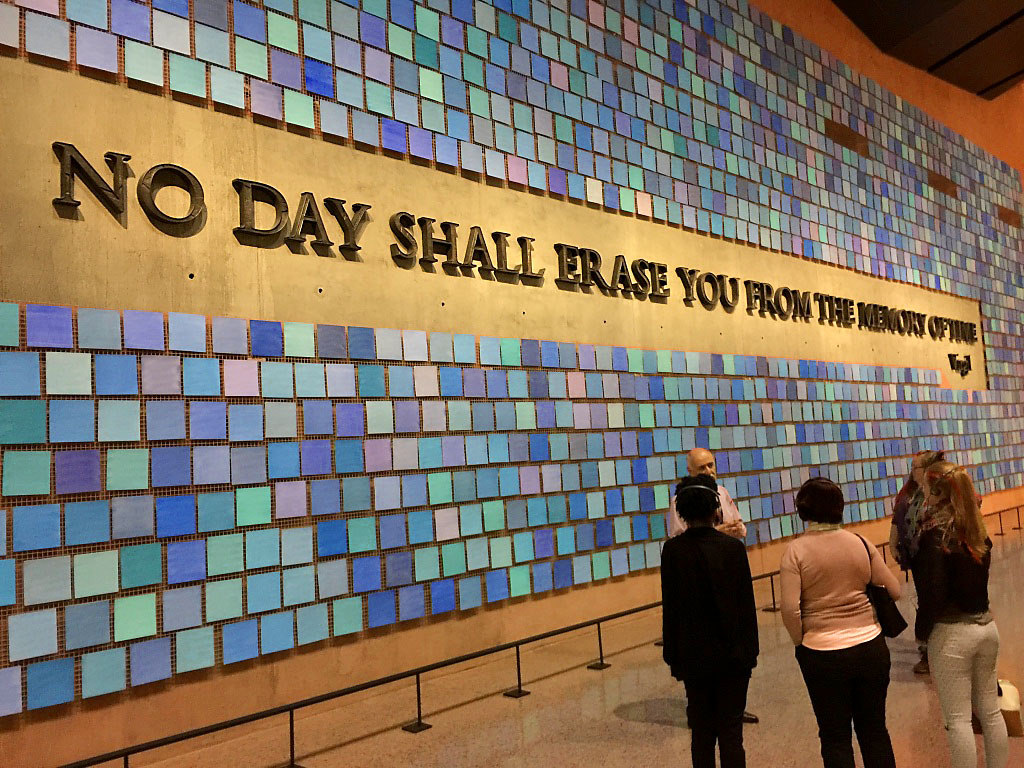
Today marks 16 years since the most infamous and iconic attack rocked our collective consciousness. Each year, there is a solemn ceremony conceived in such wisdom and executed with a poignancy that never abates. That is the reading of the names of those who died in the 911 Attacks in New York, Pennsylvania, and Washington, D.C. The soft music playing behind the readers accents the mood, punctuated by every reader mentioning the name of a family member they lost that fateful day. September 11th resonates with us so deeply because it was an attack on our country, but also because of the death of each and every individual who perished that day. Behind each name are family members, memories, joy and sorrow. Each person, in such a dramatic, untimely way, was taken from time into eternity. God loved and loves each one with an infinite, eternal love and wanted each one to be saved. Christ gave His life to provide salvation for each one. The Bible was written for the benefit of each one. The Lord’s church was meant to pursue and teach each one.

Though each individual is numbered among such a large group, around 3,000 of them, each one means more than the whole world (Mat. 16:26). This touching memorial is a tribute to the overall value of human life. It reminds us that we are surrounded by individuals all possessing an eternal soul.  Everyone you see today is heading toward eternity. Each one will either hear “well done” or “depart from me” (cf. Mat. 25:31ff). What is said about God’s attitude toward those victims specially remembered today is true of every person we meet and see today.

May we have our hearts stirred by the sobriety of that truth. May we never lose sight of our urgent responsibility to share the message of Christ with the people in our lives. As moving as the ceremony that occurs each year in New York City on September 11th, we really cannot imagine what the Day of Judgment will be like. Each person who ever lived, including you and me, will hear our name called (cf. 2 Cor. 5:10). As important as our own name is, every name is important. Let us pray that this realization will propel us to tell the best news of human history and help someone find the only way, truth, and life.

26687246253_33721e4ba2_b

Open Mic At Bear Valley

Neal Pollard

It is one of the preacher or teacher’s public speaking nightmares. And it happened to me yesterday morning between Bible class and worship services. I had no clue until I began to be approached by multiple members. My wireless mic was “hot,” and I was visiting with several people and, true to form, I was having plenty to say. As far as I know, I said nothing personal or embarrassing, but after I was informed of my amplified voice I began thinking back to who I spoke to and what I said. My private conversations were being broadcast throughout the auditorium, foyer, nursery, and beyond.

The Bible gives us some insights into what the day of judgment will be like. How much is accommodative language and how much depicts what it will be like is something we must leave until we are there. Yet, there are some statements made that are not open to interpretation. Solomon writes, “For God will bring every act to judgment, everything which is hidden, whether it is good or evil” (Ecc. 12:14). There is appointed a day when “God will judge the secrets of men through Christ Jesus” (Rom. 2:16; cf. 14:10-12; 2 Cor. 5:10). Jesus taught, “But I tell you that every careless word that people speak, they shall give an accounting for it in the day of judgment. For by your words you will be justified, and by your words you will be condemned” (Mat. 12:36-37). Clearly, the words we speak—even those which are not public—are subject to the universal judgment at the end of time.

With that in mind, I want to be more careful to control that hard-to-tame tongue (cf. Jas. 3:2ff). Lying, gossiping, complaining, bitter, slanderous, angry, malicious, backbiting, or jealous words can flow freely, especially in private conversations. I may think I am covered by the cloak of secrecy or privacy, but how would I speak if I knew that everything I said what being broadcast for everyone to hear? If I could think of my speech in that way, how much more positively would I speak of others, of my own circumstances, of the church, and of my God?

Yesterday was good for me! If all of us could experience an unplanned moment like that at least once, it might cause us to reflect on what we are saying when we think that those around us can’t (or won’t) hear. It might help us live soberly, righteously, and godly in view of the end.

shure_mikrofon_55s

Wisdom Is Vindicated By All Her Children

Neal Pollard

Jesus said, “wisdom is vindicated by all her children” (Luke 7:35). He said this in response to the hypercriticism and unrighteous judgment of those who condemned both John the Baptist and Him. They said John was too conservative and Jesus was too liberal. They hacked at the methods and message of both, without justification or legitimacy. They were libelous name-callers, but Jesus simply responded with a proverb. What a good one! It’s a needed one today, especially in the face of those who sit and snipe at the works of others. For those who get gun shy at the prospect of such snipers, please remember Jesus’ words and Jesus’ reward for those who keep at the good work.  This principle applies to:

  • Elders and preachers
  • Missionaries
  • Worship leaders
  • Young parents
  • Bible teachers
  • Deacons and ministry leaders
  • Christian Colleges and schools of preaching
  • Soul winners
  • Youth ministers
  • Lectureship and workshop directors
  • Church program organizers
  • Christians in the workplace
  • Teenagers
  • Students in their various schools
  • Camp directors
  • Writers and authors
  • Publishers

There are undoubtedly other categories of people who fall under the purview of Jesus’ saying, but they share the burden of having their works criticized by naysayers, ne’er-do-wells, nitpickers, and needlers. In Luke 7, Jesus took the magnifying glass and turned it on the critics. We can take heart this idea: “If you address as Father the One who impartially judges according to each one’s work, conduct yourselves in fear during the time of your stay on earth” (1 Pet. 1:17). We have a responsibility to conduct ourselves righteously, but we can rest in the confidence that we will be judged impartially by the perfect, righteous Judge. Let us commend our efforts to His eyes. He will get it perfectly right!

sophia2band2bher2bchildren2b-2brussian2bstate2bmuseum

ARE YOU ON THE LIST?

Neal Pollard

I recently heard D.C. Brown, illustrating proper conduct, mention a list I’ve seen at times in my adult life. The list he mentioned was of people whose personal checks the cashier was not to take. The offenders apparently wrote “bad checks,” checks they did not have sufficient funds to cover. The names, as is typical, were bold and legible to the customer as well as the employee. Multiple purposes are achieved through such a list—warning, shaming, identifying, and the like. It is unlikely, but not impossible, that someone’s name might accidentally land on the list.

Throughout our lives, we may find ourselves looking to see if we are on this list or that. When I was in school, they would publish the honor roll list, depth charts in sports, casts for plays and who was chosen for what part, and those who were selected for the Beta Club or Honor Society. The advent of the internet has slowly replaced paper lists with electronic ones, but the concept is still intact.

The Bible talks about a “list.” It is a list every thinking and feeling person should yearn to have their name written on.  The setting is the great day of judgment, recorded by John in Revelation 20:11-15. Jesus is sitting in all His majesty on His throne. Everyone, great and small, stood before that throne. They were judged by God’s Word and what they did with it. In a sobering text, here is the climax: “And if anyone’s name was not found written in the book of life, he was throne into the lake of fire” (15). Jesus preached on earth that the majority of all people will not be on that list (Mat. 7:13-14). They will have neglected or rejected the will revealed in the Bible (cf. John 12:48). If never before that moment, at that threshold of eternity they will have never wanted anything like they will want to have their name on that list. But, then it will be too late. Now is the time to submit ourselves and our lives to that divine will and, by grace through faith, have our name written there.

Some lists we would wish to avoid in this life. The list, in Revelation 20:12, is not one of them. What a joy it will be to hear our name “when the roll is called up yonder”!

ahschool-roll-of-honor-list281947-9229

Tora! Tora! Tora!

Neal Pollard

Today marks the 75th anniversary of the attack on Pearl Harbor, the event which drew our country into World War II. 2,343 men were killed, 1,143 were wounded, and 960 unaccounted for or missing. The Japanese chose Sunday to attack as it was the most relaxed day of the week for the servicemen. Many were still in their pajamas or having breakfast when the attack began at 7:55 that morning. Kermit Tyler, an Air Force lieutenant serving as the officer on duty that morning, told the radar operator not to worry about the large blip on the radar screen. He thought it was a flight of U.S. bombers coming from our mainland. Instead, it was the first wave of attackers. Captain Mitsuo Fuchida, the airstrike leader for the Japanese carrier force, could see that Pearl Harbor was totally unaware of the impending attack. He radioed back a coded message, repeating an abbreviated word three times—“to ra, to ra, to ra”—meaning “lightning strike.” The transmission began at 7:49, undetected by the soon-to-be victims of the attack that began a mere six minutes later (read more here).

Among so many significant facts, what we most remember about the attack on Pearl Harbor was how utterly surprising it was. No one stood vigil, considering the possibility of it. Like its later counterpart, “9/11,” and even natural catastrophes like Pompeii, the Galveston hurricane, the 2004 tsunami, or Mexico’s El Chicon volcano, serious and deadly events can occur without warning. With our most sophisticated technology and detection systems, we are without the ability to forewarn about the greatest surprise that will ever be.

Paul says that the resurrection of the dead of all time will occur “in a moment, in the twinkling of an eye” (1 Cor. 15:52). Paul and Peter both refer to “the day of the Lord” as that which will come “as a thief in the night” (1 Th. 5:2; 2 Pet. 3:10). Jesus warned that the day could be a disaster, a trap that comes on one “suddenly” (Luke 21:34). He taught that it will come at an hour unknown to everyone (Mark 13:32-33).

While it will surprise everyone, the coming of Christ will be a devastating event for the great majority of mankind. For them, it will infinitely exceed the loss of physical life. It will be an everlasting loss (Mat. 25:46; 2 Th. 1:9). Yet, God has made preparation eminently possible. He desires escape for everyone (2 Pet. 3:9). One can be prepared for that day and be saved from harm and for something inexpressibly superior. Those of us who have discovered the way of preparation must hold fast to it (cf. Heb. 3:6) and strive to share this vital information with as many as possible. The sudden coming of Christ need not be a defeat, but can instead be the harbinger of the greatest victory ever.  May Paul’s inspired exclamation be our song of victory: “Death is swallowed up in victory. O death, where is your victory? O death, where is your sting?” (1 Cor. 15:54b-55). Amen. Come, Lord Jesus (Rev. 22:20)!

burning_ships_at_pearl_harbor

WikiLeaks (And God)

Jeff Wiant (guest baker)

Up until this past election cycle I had never even heard of WikiLeaks. Months and endless press later, I have become very familiar with this website. For those who may have been living under a rock for the past few months, WikiLeaks is a website that publishes secret information, news leaks, and classified media that they receive from anonymous sources for the world to see. Just looking on their page the other day, I discovered links that would allow me to read private emails from a presidential candidate and her associates, secret files about global surveillance, private emails between top employees at Sony Pictures, and I could have even watched a classified video.

Through all of this browsing it made me start to wonder. With hindsight being 20/20, would the ones who wrote these emails or committed these acts have written or done things differently if they knew that in the future they would be exposed and the whole world would be able to see and judge them because of these leaks?

More importantly, this also got me thinking further about myself. Do I have any secrets that I would fear if they ever got out? Do I ever have thoughts in my head that are impure and unfaithful? Do I allow myself to continue to have these thoughts because, after all, I’m keeping them to myself? After all, who’s going to know?

Allow me to answer that question for us all:  GOD KNOWS! Like WikiLeaks in our world, God can, and does, unearth all these dark spots in our personal lives. But whereas there are still plenty of classified files and incriminating private emails out there that haven’t been, and won’t ever be, exposed by WikiLeaks, God already knows EVERYTHING there is to know about us.

As it says in Psalm 139:1-4, “O Lord, You have searched me and known me. You know when I sit down and when I rise up; You understand my thought from afar. You scrutinize my path and my lying down, and are intimately acquainted with all my ways. Even before there is a word on my tongue, behold, O Lord, You know it all.” God knows everything we do on the outside and the inside. Having that realization is very intimidating.

For more evidence of this you can also look at Hebrews 4:12-13, which states, “For the word of God is living and active and sharper than any two-edged sword, and piercing as far as the division of soul and spirit, of both joints and marrow, and able to judge the thoughts and intentions of the heart. And there is no creature hidden from His sight, but all things are open and laid bare to the eyes of Him with whom we have to do.”

We will all be judged. Not just based on what our family, friends, and the rest of the world see, but based on the EVERYTHING that God sees. You can’t hide anything from God. Knowing this, are there changes we need to make in our lives? Are there things we need to do and think about differently?

The good news is that it’s never too late and God is a forgiving God. If we do sin, we need to confess these sins to God ask for forgiveness (1 John 1:9). I challenge you to live with the knowledge in the front of your mind that God is always watching and listening. There are no secrets with God and there is no misleading God. Live the life He requires and you will receive your eternal reward in Heaven.

“Finally, brethren, whatever is true, whatever is honorable, whatever is right, whatever is pure, whatever is lovely, whatever is of good repute, if there is any excellence and if anything is worthy of praise, dwell on these things” (Phil. 4:8).

jeff-wiant-2
Jeff (holding Dallas)

Do You Believe In Goats?

Neal Pollard

With the Chicago Cubs winning their first World Series since 1908, which year was near the end of Teddy Roosevelt’s second presidential term when there were only 46 United States and the first that Mother’s Day was celebrated in America, diehard fans believe a World War II-era “curse” has been lifted. Chicago tavern owner, Billy Sianis, “put” the curse on the Cubs when he and his goat were asked to leave game four of the 1945 World Series against the Tigers (imagine a goat even getting into a Major League park today). Fans point to strange, “inexplicable” events through time—most famously Steve Bartman in 2003—to support the “fact” of that curse (see more here: http://www.billygoattavern.com/legend/curse/).

For most of us, this is a fun and playful distraction that makes sports, particularly baseball, that much more fun. Superstition is a nuance that shows up in so many places: pitchers stepping over the foul line going back to the dugout, players not washing and re-wearing underclothes and uniforms, pre-game and post-game meals, etc. I would guess precious few actually believe there is real power in these rituals (on a personal note, my continuous practice of having to wake up wearing UGA apparel on football game days—begun in 1980—was once and for all broken in the midst of a bad 2016 season).

All joking aside, goats get negative attention in a place much more important than Wrigley Field. In Scripture, Jesus, in the last of five parables of preparation in Matthew 24-25, likens the lost to goats (Mat. 25:32-33). Commentators tell us that “their normal dirty state, it might even have been considered wise to leave it to the skilled shepherd to distinguish with confidence the sheep from the goats” (Nolland, NIGTC, np). In fact, throughout the Old Testament, sheep and goats were mostly interchangeable for milk, meat, sacrifice, and general use (ibid.). But, for the purpose of Judgment, Jesus is skillful and discerning enough to know with perfect discernment whether every individual is “goat” or “sheep.” No one is inadvertently mislabeled or misplaced. He will perfectly divide the saved from the lost.  Placement at Judgment will not be influenced by looks, wealth, popularity, education, or any other criteria the world embraces as success. Jesus tells us who both the goat and sheep are (Mat. 25:31-46).

Billy’s goat was not responsible for a “Cubs curse.” Yet, we should understand in a day when the world and even the religious are less inclined to label any activity goat-like, i.e., soul-condemning, Scripture makes it clear that Jesus has not lost any such ability to discern. In fact, He tells us most will be placed in the goat column (cf. Mat. 7:13-14). Let us love and respect God’s Word enough to avoid the curse He came to undo (Gal. 3:13; Rev. 22:3).

hausziege_04

The Appointment We Cannot Escape

Neal Pollard

William T. Turner was captain of the Lusitania when it was torpedoed by a german U-boat in May, 1915. He was one of the few officers saved (Montreal Gazette, 6/24/33, obituary). The Atlantic writes in an article that Turner was “relieving captain” of the SS Ivernia when it was torpedoed by a German U-boat on New Year’s Day, 1917, and he once again survived (James Gould, 5/7/15). Turner was a man renowned for heroics and not a coward, which makes a captain surviving the sinking of two ships all the more incredible. But in 1933, after three, bed-ridden months, Turner succumbed to intestinal cancer (Gazette).

A few years ago, I wrote about Roy Sullivan, the park ranger who had survived seven lightning strikes (Preacher Pollard Blog). What an incredible tale of survival, but Sullivan insured his own mortality when he committed suicide in 1983 (ibid.). The man was incredible, but not invincible.

Jeanne Louise Calment is thought to be the world’s longest living person in modern times. She was born in 1875 in France, met Vincent Van Gogh as a young teenager, but eventually died in a nursing home in 1997, 122 years old! She took up fencing at 85, rode a bicycle until she was 100, ate two pounds of chocolate each week and quit smoking at 119 (http://anson.ucdavis.edu/~wang/calment.html). Back in the antediluvian period, in a purer world closer to creation, several lived over 900 years. But in each case, scripture punctuates their earthly existence by saying, “…and he died” (Gen. 5:5).

I have been involved in so many funerals as a preacher, from the first I assisted with Gary Hampton in Gainesville, Alabama, in 1992, until as recently as a couple of weeks ago. What strikes me as much as anything, whether in preparation for it visiting with the family or during slide shows during the service, is watching the progression of life unfolded in photos. Usually they are arranged chronologically, so that the fresh faces of the baby becomes the look of vitality found in children and young adults gives way to the robust strength of early to middle adulthood. Signs of aging subtly appear as the photos fade in and out, the added pounds or gray hairs or the advent of wrinkles. Pictures eventually show frailty and signs of physical deterioration. Then, one in attendance simply needs to gaze at the casket, if present, to see that this once fresh, new physical life does not go on forever.

The writer of Hebrews speaks in hopeful, positive terms to Christians as he proclaims the superiority and potency of Jesus, our great High Priest. At the cross, He offered His own life to “put away sin by the sacrifice of Himself” (9:26). Having a human body, Jesus was destined for death “inasmuch as it appointed for men to die once…” (9:27). Death is unavoidable, but it does not have to be unhinging. Death is followed by judgment, but that day can be the day of salvation realized and eager anticipation (9:28). What happens on the other side of death depends on what we do with Jesus on this side of it.  Whatever we decide, we will make the appointment Turner, Sullivan, Calment, Adam, and billions of others have already made. We must decide if we will meet it prepared.

jeanne_calment_1895

jeanne-calments-quotes-7
Jeanne later in life

WHEN GOD PAID A VISIT TO ISRAEL

Neal Pollard

The Bible tells the beautiful story about the day God visited earth as a human being, coming as a baby by way of the virgin Mary (John 1:14). Because He came here, we can hope to go to His home (John 14:1-3). But one day, He’s going to pay another visit, a visit that will be welcomed by the saved but horrific for the lost (2 Thess. 1:7-10). But, there have been times when God has come in judgment of people on earth, and Amos’ day was one of them (3:14). The prophet wrote, “That in the day that I shall visit the transgressions of Israel upon him I will also visit the altars of Bethel; and the horns of the altar shall be cut off, and fall to the ground.”  Some versions have the word “punish” instead of “visit.” Punishment was the purpose or nature of the visit.  Why did God pay a visit to Israel?

  • Life had become very cheap (2:6). Two different classes of people were viewed cheaply by Israel—the righteous (spiritually rich) and the needy (physically poor).  This could refer to those who were innocent of crimes who were found guilty through bribery and corruption. Apparently, a ridiculously small amount was required to purchase the poor. Throughout the history of mankind, evil people have found ways to devalue human life (slavery, abortion, euthanasia, prostitution, pornography, etc.). When God pays a visit and sees such an attitude toward life, He is not pleased (cf. Prov. 6:16-17). I should ask, “Do my everyday dealings with others reflect my high regard for human life? Do I see others as pawns in my hand to be manipulated, as those I can take advantage of for my selfish gain, or as those who can meet my needs?” This applies to fellow-Christians, too. Do I value them or devalue them (cf. Phil. 2:1-4)?
  • There was immorality (2:7).  God did not hesitate to enter the bedroom when He paid a visit. It was God who created sexuality, and what He made was good. Since the fourth chapter of the Bible, people have tampered with His design. By the time God visits Israel in Amos’ day, the condition of things in this area of life was disgusting and perverse. It violated the Law of Moses (Lev. 18:8). But it also violated the laws of common decency. It was that way in New Testament times in the church of Corinth (1 Cor. 5:1). Woe unto the people who, when God visits, He finds full of immorality. God created human sexuality and He lays the ground rules for it (Heb. 13:4).
  • There was ingratitude (2:9-10). It’s not clear whether the feasts in Amos 2:8 were legitimate and therefore abused worship to Jehovah or if these were pagan practices to idols. We know there was drunkenness and probably fornication during the course of these festivities, whatever the intended object of worship. But the root of the problem was a failure to acknowledge God’s hand in their protection and deliverance. These people failed to give God the credit for their success. They had been so blessed by God, but they ignored Him. It’s the problem of the nine ungrateful lepers in Luke 17:11-19. They appealed directly to God, He healed them, then they forgot Him. I believe that in our land of plenty, we must guard against ingratitude and even a sense of entitlement. We have running water on demand, clean water, hot water, air conditioning, dental plans or at least dentists, clean hospitals with the world’s best doctors and nurses, no malaria, cholera, or typhoid epidemics, retirement plans, and more. But we’re the most ungrateful people on the planet. As a Christian, I have even more than that. Am I grateful for it?
  • They closed the mouths of the prophets (2:12). They had aready tempted the Nazarites to break their vows (11). They were hard at work on the prophets, too, trying to stop them. When God visits a people, He had better find faithful messengers. Later, in Ezekiel’s day, God was hard pressed to find them (cf. Ezek. 22:30). Paul warned about this (2 Tim. 4:3-4). Woe to the preacher who has a price, who markets his message to the highest bidders. A man who sells out to his paycheck and a people who love to have it so will neither one fare well when God pays a visit.

These weren’t the only things God saw when He paid Israel a visit. They were out of step with God (3:3). Their women lost their spirituality (4:1). They corrupted their worship (4:4). They were rebellious (4:6). They had divorced religion from righteous living (5:21). They were at ease at Zion when they should have grieved over it (6:1). At the judgment seat of Christ, many people’s works will go up in flames. We must be ready when Christ pays a visit.