When Jude Quoted Books God Didn’t Write

Twenty-five verses. That’s all Jude needed to expose false teachers, rally believers, and deliver one of Scripture’s mightiest doxologies. Yet within this compact letter lie two startling citations—neither from Moses, the prophets, nor the Psalms, but from Jewish apocryphal writings. Why would an inspired writer quote uninspired sources?

Brent Pollard

Twenty-five verses. That’s all Jude needed to expose false teachers, rally believers, and deliver one of Scripture’s mightiest doxologies. Yet within this compact letter lie two startling citations—neither from Moses, the prophets, nor the Psalms, but from Jewish apocryphal writings. Why would an inspired writer quote uninspired sources?

The Arrogance That Mocks What It Cannot See

Jude writes his general epistle with a sense of urgency. False teachers have misused grace to justify immoral behavior and show disrespect for authority. By verse 8, their pride has become demonic, and they “speak evil of dignitaries,” which most likely refers to angelic beings. Jude does not intend to promote the worship of angels; instead, he warns against hubris. These false teachers behaved as if they had authority over realms they did not have, and that is the pride Jude exposes. Therefore, these men slander realities beyond their understanding.

To expose such folly, Jude reaches for an unlikely illustration.

When Even Angels Know Their Limits

Jewish tradition, preserved in the Assumption of Moses, tells of Michael the archangel disputing with Satan over Moses’ body. The devil claimed ownership—perhaps because Moses had killed an Egyptian, perhaps because Satan styled himself lord of the earth.

Michael’s response? He refused to pronounce judgment on his own authority. Though heaven’s chief warrior, he simply said, “The Lord rebuke you.”

Here is Jude’s blade: If Michael—commander of celestial armies—dared not revile even Satan, what business have mortals mocking spiritual powers they neither respect nor understand?

True strength bows before God’s sovereignty. Pride pretends to authority it does not possess.

The Prophet Who Saw Judgment Coming

Jude then quotes 1 Enoch, a Jewish apocalyptic text known to his audience:

“Behold, the Lord comes with ten thousands of His holy ones, to execute judgment upon all, and to convict all who are ungodly of all their ungodly deeds.”

This inclusion is no blanket endorsement of Enoch’s book any more than Paul’s citations of pagan poets made them Scripture. Instead, the Spirit guided Jude to extract one true statement—a warning echoing throughout divine revelation—and press it into service for eternal purposes.

God can take a fragment of human tradition and forge it into revealed truth without sanctifying its source.

How Inspiration Actually Works

Jude’s method reveals three vital principles:

1. Authority lies in God’s selection, not the source’s pedigree.

The Spirit determines what enters Scripture. Truth remains truth wherever it appears, but only God’s breath makes it authoritative. Jude’s quotes became inspired not because of their origin, but because God chose them.

2. God meets people where they live.

Jude’s Jewish Christian readers knew these traditions. Using familiar examples, he illustrated the truth vividly. We do the same, quoting, say, Shakespeare or Einstein—not to canonize them, but to communicate clearly.

3. The message matters infinitely more than the medium.

Both stories serve one purpose: to contrast human arrogance with divine authority and to warn that God judges all rebellion.

Three Applications for Your Life Today

First, guard your tongue when speaking of spiritual realities.

If Michael, who stands before God’s throne, refused to speak presumptuously, how much more should we? Reverence isn’t weakness; it’s wisdom. Before you dismiss spiritual truths or mock what you don’t understand, remember who you’re dealing with.

Second, rest in the certainty of God’s judgment.

False teachers may flourish now. Arrogance may strut across platforms. But Enoch’s prophecy stands: God will judge every ungodly deed. Your job isn’t to play God. It’s to trust Him.

Third, quote wisely, but verify everything.

You’ll find truth scattered across literature, philosophy, and even secular observation. Quote it when it serves God’s truth. But never confuse a helpful quote with Scripture’s authority. Test everything against the Word (1 Thessalonians 5:21). All other lights are dim candles held up to Scripture’s blazing sun.

The Weight of a Short Letter

Don’t mistake brevity for shallowness. In twenty-five verses, Jude wields ancient tradition, angelic authority, and divine judgment to demolish pride and call the church back to truth.

Michael’s humility rebukes the arrogant. Enoch’s prophecy warns the rebellious. Together they sound Jude’s central note: “Contend earnestly for the faith which was once for all delivered to the saints.”

In a world drowning in opinions, that call has never been more urgent.

God has spoken. The question is whether we’ll listen with the humility of angels or the arrogance of fools.

The difference is eternal.

Even when he quotes from outside Scripture, Jude points us back to Scripture’s heart—the unchanging authority of God and the sure destiny of all who defy it.

What Judas Missed: The Providence Of Absence

The Synoptic Gospels all record Jesus instituting the Lord’s Supper during the Last Supper. John, writing later, highlights different moments from the same night. When we lay these accounts side by side, a clearer picture emerges—one that reveals both divine providence and human frailty in sharp relief.

Brent Pollard

God’s wisdom shines through the four Gospel accounts in unexpected ways. Nowhere is this more evident than in the reconstruction of our Lord’s final Passover with His disciples.

The Synoptic Gospels all record Jesus instituting the Lord’s Supper during the Last Supper. John, writing later, highlights different moments from the same night. When we lay these accounts side by side, a clearer picture emerges—one that reveals both divine providence and human frailty in sharp relief.

Luke, the careful historian, notes that the final Passover began with an argument. The disciples disputed among themselves who was the greatest (22.24). This prompted Jesus to teach humility not only through words, but also through action. He wrapped a towel around His waist and washed their feet (John 13.4ff). True greatness, He demonstrated, lies in serving others.

However, John’s Gospel clarifies a crucial aspect of that night’s sequence. Despite his prominent place in Leonardo da Vinci’s famous painting, Judas probably wasn’t present when Jesus instituted the Lord’s Supper.

Here’s what likely happened: After washing the disciples’ feet, Jesus and the Twelve began their Passover meal. During this time, shortly after Jesus’ act of service, He handed a morsel of bread to Judas, identifying him as the betrayer (John 13.26). Judas departed immediately, vanishing into the night (John 13.30).

Only after Judas left did Jesus take the bread and declare it His body, which was soon to be broken (Matthew 26.26; Mark 14.22). Later still—meta to deipnesai, the Greek phrase meaning “after supper”—He took the cup and proclaimed it the new covenant in His blood (Luke 22.20; 1 Corinthians 11.25).

The betrayer had already gone.

Does Judas’s absence from this sacred moment carry symbolic weight? We must be careful not to over-read. Peter sat at that table, yet within hours, he would deny his Lord three times. As we often declare about the Lord’s Supper, participation has nothing to do with personal worthiness. None of us merits the sacrifice of the Lamb of God. None of the disciples gathered that night deserved what Jesus was about to do for them.

Judas’s swift departure likely served a more immediate, though no less providential, purpose. His exit facilitated the dark necessity that would lead to our Lord’s arrest in Gethsemane. God’s sovereignty moves through betrayal as surely as through blessing, orchestrating even the actions of the wicked for redemptive ends.

One question remains: Why didn’t John include the institution of the Lord’s Supper in his Gospel?

The answer sheds light on God’s design as revealed in Scripture. John’s was the last Gospel written. By then, the Synoptic Gospels had circulated throughout the churches for decades. Christians were already familiar with the details of how Jesus instituted the Lord’s Supper. This freed John, through the inspiration of the Holy Spirit, to provide what the other Gospel writers hadn’t recorded.

John gives us the intimate moments—the private teachings and prayers that occurred between supper and arrest. Consider the High Priestly Prayer of John 17, where Jesus intercedes for His disciples and for all who would believe through their word. Consider the comforting promise of John 14:1-3, where Jesus tells them that He is going to prepare a place for them in His Father’s house. These treasures appear nowhere in the Synoptic Gospels.

John’s Gospel doesn’t merely supplement the others—it completes the portrait. Each evangelist contributes unique dimensions to our understanding. Together they reveal not just what happened, but what it means.

When we delve into these unique perspectives, we gain something precious: a more comprehensive picture of Jesus’ final hours with those He loved. We see sovereignty and tenderness intertwined. We witness the depth of Christ’s care for His followers even as betrayal ripened and denial gestated in the hearts around that table.

Every detail carries weight. Every exclusion and inclusion serves a divine purpose. The argument about greatness becomes the occasion for the greatest act of humility. The betrayer’s exit clears the stage for the institution of the meal that would sustain the church through millennia. The absence of specific details in one Gospel creates space for other revelations in another.

The table Judas abandoned still stands. It declares that God’s grace reaches the unworthy, that true greatness kneels with a towel, that covenant blood speaks better things than thirty pieces of silver clutched by a traitor stumbling toward his fate.

We come to that table not because we deserve it, but because we desperately need it. We remember not merely historical events, but present realities—Christ’s body broken, His blood shed, His love poured out while we were yet sinners. And in remembering, we are transformed by the One who loved His own to the uttermost, even unto death.

Come. Remember. Be changed.

Cos: An Interesting Example Of Inspiration

Neal Pollard

The city and harbor of Cos is mentioned in passing as a brief stopover made by Paul and perhaps also his large crew of fellow laborers (Acts 20:6), including Luke. Luke simply writes, “When we had departed from them (the Ephesian elders at Miletus, 20:17-38) and had set sail, we rain a straight course to Cos and the next day to Rhodes and from there to Patera” (Acts 21:1). Cos was apparently a night’s stay for the missionaries making their way to Jerusalem.

But, to the ancient world, Cos was a place of great importance. Consider what Allen Myers says about it: 

Settled by the Greeks ca. 1500 B.C., Cos became one of the most beautiful harbors of antiquity. As a Greek city-state it played a significant role in the Delian League during the Peloponnesian War (fifth century), and in 354 succeeded in its revolt against Athens. The island was renowned for its medical school, of which Hippocrates was a member, and a sacred shrine dedicated to Asclepius, the god of medicine (Eerdmans Bib. Dict., 239).

What’s more, Cos was the birthplace to the aforementioned Hippocrates, the “father of medicine” (and namesake of the Hippocratic Oath). “Under King Herod’s rule Cos received perpetual revenues, and a statue was built there to honor his son Herod Antipas” (Elwell and Beitzel, Baker Ency. Of The Bible, 527). 

It was a literary center, home of Philetas and Theocritus, and also a place noted for its fine weaving in the few centuries before the birth of Christ (McKay, New Bible Dict., 229). The emperor Claudius even exempted it from taxes (ibid.). 

But, it is a divine footnote on one of three missionary journeys made by Paul. He stopped and worked in important imperial cities like Ephesus, Philippi, Athens, and Corinth, but  the Holy Spirit through especially Luke is not blind to the existence of other important ancient places. Noting sites like Cos, these writers were showing us historical and geographic markers that puts the Bible in a context revealing its accuracy. This remarkable understatement regarding such a historic place reflects the many layers to be discovered by the Bible student reading through this sacred book. Just in Luke’s writing alone, there are literally dozens more like Cos. What a testimony to the sacred authorship of Acts and the other 65 books! 

The Original Shadow-Caster

Dale Pollard

Plato’s “Allegory of the Cave” is a metaphor that uses the image of prisoners in a dark cavern to illustrate the relationship between reality and our interpretation of it. The allegory is a dialogue between Socrates and Glaucon, and it’s arguably a key passage in his work, The Republic. It’s been used as a metaphor by philosophers for thousands of years in order to explain a truth that’s been known in the subconscious human mind since the inception of man.

Cultures with different backgrounds perceive reality and their own histories in a variety of ways but they seem to only have fragments of the truth. Hundreds of ancient mythologies have been preserved on mediums like clay, stone, papyrus, and oral tradition and they perfectly illustrate the shadows on the wall in Plato’s allegory. 

The question is, what’s casting the shadow that many myths exemplify? A thoughtful study will produce an undeniable reality which the hardened skeptic shouldn’t ignore. The truth is that the Bible is the original shadow-caster. 

By piecing together the myths and the legends of floods, serpents, and heavenly battles one further elucidates a singular, supernatural, and immortal narrative. God’s Word is the only book written through His direct influence— what other work commands that level of Authority? 

“Knowing this first of all, that no prophecy of Scripture comes from someone’s own interpretation. For no prophecy was ever produced by the will of man, but men spoke from God as they were carried along by the Holy Spirit.”

   2 Peter 1.20-21 

WHY DO YOU BELIEVE?

Wednesday’s Column: Third’s Words

10423661_10207901451272315_9069631728203375436_n

Gary Pollard III

I believe that God exists. I believe that He communicated with His creation by direct contact, messengers, and a series of ancient texts. I believe that He wants His human creation to be with Him after they die. I believe that He expects those who claim to be His to act within the guidelines He set in those ancient texts. I believe that there is life after death and that where we go depends on whether or not we follow this God.

Why do I believe this, though? What reason do I have to believe in something I cannot experience with my senses? I was not there thousands of years ago when the prophets and Hebrews talked to God. I was not there when God came among men and taught. I was not there when the Spirit-inspired authors of the original texts delivered their writings to the early church. The ancient texts translated into English sometimes do not effectively communicate the emotion of the words and concepts in the original language. So why do I believe these things? Why do you believe these things?

Think about this carefully.  From Genesis to Revelation the message is clear; God wants His people to exist with Him after time is destroyed. This message was communicated to an impossible variety of people, sometimes separated by hundreds of years, thousands of miles, culture, kingdom, race, and language. There are tens of thousands of manuscripts of these ancient texts in many, many different languages. There are some 25,000 New Testament manuscripts or fragments that are separated by about a thousand years, at least 8 different languages, hundreds (if not thousands) of miles of geography, and many different cultures. Yet, they are at least 95% accurate to each other. The remaining 5% do not contain a single contradiction; rather, they are spelling errors, slips of the pen, writing on the wrong line, or minor variances (“God said” vs. “He said” or “and” vs. “but”).

Of the rich libraries we have of ancient literature, none can hold even the dimmest candle to the profound accuracy and unity of the scriptures. They could not have been produced by man alone. There had to be Someone not confined by time supervising each person as they wrote. Keep in mind, these ancient cultures did not have the advantage of modern communication. They were almost totally isolated from each other and would have known little of the others’ existence, much less what they experienced or wrote from God. Our Bible has supernatural origins and its contents reveal the nature of our Creator. What I believe comes from this book because I know it is God’s message to mankind. I encourage those who have not already done so to do an in-depth study of the origin of scripture. It is one of the most faith-building studies anyone could undertake. When you know with certainty that what you are reading contains the actual thoughts and desires of God, it bolsters your faith in ways I could not begin to adequately describe.

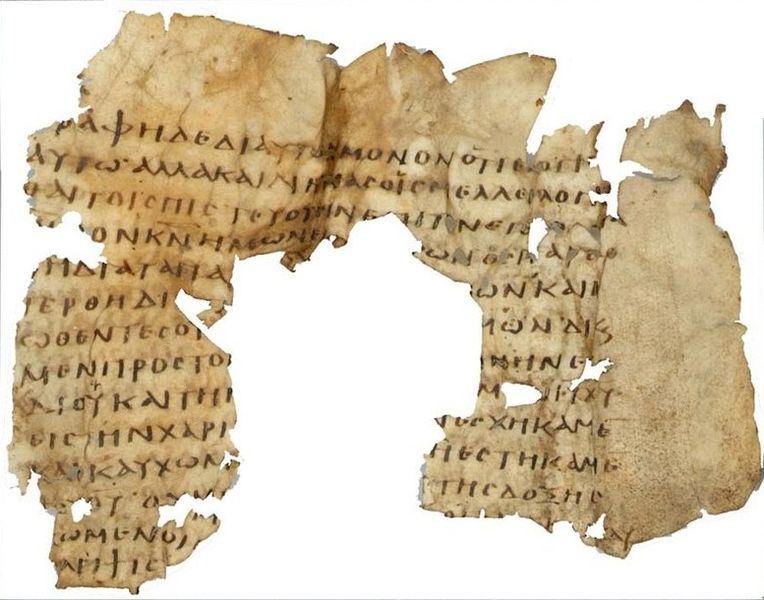
764px-uncial_0220_rom-4.23-5.3
Uncial 220 (fragment of Romans 4:23-5:3)

WHAT DOES IT REQUIRE TO ACCEPT INSPIRATION?

Neal Pollard

It is of no little concern to me that men who are supposed to be gospel preachers, many of them men tainted by a corrupted higher education at denominational theology schools, have a poor opinion of the doctrine of inspiration. Like little hungry lambs, these men are led by their “scholarly” shepherds who are eager to bring them to the poisoned waters of the “Q” theory and the documentary hypothesis. They consume the rancid food of deutero-Isaiah and trito-Isaiah.

Their erudite educators push them to believe extrabiblical theories rather than internal claims. Where they get their sermon material and on what they preach would be quite interesting to know, and to what authority they appeal even more so. What does it take to simply accept that the Bible is completely, inerrantly, and plenarily from God through inspired men?

A Belief In A Personal God, Able And Willing To Communicate With Man. If we can accept that the Creator God continues to care and be interested in us and what becomes of us, can we also trust that His love would lead Him to accurately, honestly communicate His will–a will He would accurately supervise from beginning to completion and preserve through the process of transmission through the ages?

A Belief In Divine Omnipotence. Is God powerful enough to give us the Word as the Bible claims and is He loving enough and of character sufficient to let the Bible be what it claims to be? Could He provide for us in the 21st century His complete will? Do we have trouble with the idea that God is able to breathe out His Word to and through men and then preserve it for all time?

A Belief That The Bible’s Claims Take Precedence Over Man’s Criticisms. Humanistic thought is quick to accept man’s opinions and conclusions over what the Bible simply says. What qualifies any man to do that? Are we better off to accept the claims made by the most tested, assaulted, yet exonerated book of all times, which, when followed, leads man to the greatest and highest life, or the claims made by men, which repeatedly prove to lead man to emptiness, misery, and hopelessness?

It is frustrating to hear arrogant, though feeble, frail, finite, and flawed men taking cheap shots at scripture, undermining the divine inspiration of the Bible. Herein lies a very critical rub. John 12:48 says the words of Christ will one day judge us. Revelation 20:12 speaks of the books and the book of life being opened, judging mankind.

What will be the standard of judgment? The words of Q, deutero, and JEDP? It just does not make sense, and swallowing such a low view of inspiration will undermine the faith of many. May we have the humility and trust to accept the Bible at face value, believing it to be what our capable God claims that it is!

2_timothy_3_16

IF THESE THINGS ARE TRUE, HOW DO WE EXPLAIN THE FACTS?

Neal Pollard

  • If the theory of evolution is true, why haven’t they found any transitional fossils?  Charles Darwin, on page 413 of his tome Origin of Species, said, “Why is not every geological formation and every stratum full of such intermediate links? Geology assuredly does not reveal any such finely-graduated organic chain; and this is the most obvious and serious objection which can be urged against the theory.” Almost 150 years of archaeological digging and an incredible volume of fossil-findings later, the objection should be even stronger!
  • If the documentary hypothesis is true, why can’t they find even one copy or fragment? The idea that later scribes and penman wrote the first five books of the Old Testament, some almost 1000 years after the time Moses lived, is widely believed among liberal religious scholars. That there are no copies or fragments of these post-Moses writers has not done much to defuse the zeal of those who teach it.  Neither is any attempt given to explain or rebut the many statements in the Pentateuch claiming that Moses wrote them (cf. Ex. 17:14; 24:4-7; 34:27; Num. 33:1-2; Dt. 31:9-11).
  • If the idea of being genetically predisposed to homosexuality is true, where is the genetic evidence of it? The study most supportive of “the gay gene,” conducted in 1991 by Baiiley and Pillard, found 52% of the pairs of identical twin brothers studied were homosexual.  A much larger sample size, in an Australian study released in 2000 by Bailey, Dunne, and Martin, found only 20% concordance in identical twin males and 24% among identical twin females. Bearman and Brucker, in 2002, found less than 10% concordance (via Journal of Personality and Social Psychology, 78(3): 524-36; Archives of General Psychiatry, 48 (12): 1089-96; and the American Journal of Sociology, 107: 1179-1205).
  • If the idea that a “fetus” is part of the mother is true, why does that unborn one have its own unique genetic code? Not only that, but the unborn can be a different blood type, gender, race, hair color, eye color, and more.
  • If the big bang theory is true, what did it and why?  Whether it is thought to have been highly concentrated matter, energy, or combination, what force acted upon it? It was there, presumably for an eternity.  Why didn’t it “bang” before it did? Why did it bang when it did? How did mind emerge from matter? How did morality emerge from non-morality? How did an explosion or expansion form such order out of chance and chaos?
  • If it is true that making moral judgments about others’ behavior is wrong, why is that moral judgment not wrong?

None of these questions is intended to exhaustively address any of the theories or world-views they represent.  Yet, so many unquestioningly and blindly accept these premises as fact when they are far from it.  Seemingly, the last resort, if ever taken, would be to accept and follow what the Bible says.  However, that is the fundamental dividing line.  Hebrews 11:6 puts it well, that “without faith it is impossible to please Him, for he who comes to God must believe that He is and that He is a rewarder of those who seek Him.”