Be Better This Year

Carl Pollard

Each Year towns and cities all over the country participate in New Year’s Eve parties and parades. One in particular is called the Tournament of Roses parade. Several years ago one of the floats that had entered in sputtered and died right in the middle of the parade. Turns out it was out of gas. The whole parade was held up until someone ran to get a can of gas. The amusing thing was this float belonged to the “Standard Oil Company.”

Despite its vast resources the float still ran out of gas. Even though Christians have access to almighty God, if we don’t dedicate our lives to Him, we will run out of Power. 

It doesn’t matter who you know, it matters what you do. Someone once observed that a wasted life is really nothing more than a collection of wasted days. As God gives us life, each one of us starts the new year with the same number of opportunities—365—that we can choose to either use and invest in eternal things or allow to drift by without taking advantage of the gift we have been given. 

The difference between those who succeed and those who fail is not found primarily in talent but in diligence and effort. And so the question we should constantly be asking ourselves is, “what are we doing with this new year?” Biblical Christianity requires growth. If who you are now (January 11th) is the same as you were last January, something must change!

God expects us to grow, and if we aren’t growing we have become complacent. So what will we do with this new year? We have the resources, we have the opportunities, so what’s stopping us? 

I believe what happens to many of us is we don’t know where to start. We want to be better so we make a plan to read the Bible through in a year. Then we hit Leviticus and it goes out the window. We resolve to pray more and our lives get so busy we forget. We have got to better ourselves since we know it must be a priority, but what are some ways we can be better in 2024? 

I’m glad you asked! Here are 6 ways to be better in 2024 from Philippians 4:1-9. Chapter four is where Paul brings everything to a point. Every example, every command, every prayer and request has been said in anticipation of this chapter. Paul desires nothing more than unity for this church at Philippi. He used Timothy, Epaphroditus, Christ, and himself as examples of humility and service because that is what it takes to be united as a body. 

Paul gives us ways we can be better as individuals and as a church family: 

  1. Stand firm (1)
  2. Work Together (2-3)
  3. Be Joyful (4)
  4. Learn To Be Gentle (5)
  5. Pray More (6-7)
  6. Control Your Thoughts (8-9)

Make this new year a time of growth as a Christian. Let’s be better!

Genesis: These Are The Generations (X)

The Rest Of Noah’s Days (9:1-29)

Neal Pollard

With a global clean slate, the survivors emerged with a need for purpose and direction. As He had from the beginning, God gives just that. God issues a series of mandates:

  • Be fruitful and multiply, and fill the earth (1,7).
  • Reign over the living creatures (2).
  • Eat meat as well as plants (3).
  • Abstain from eating blood (4-5).
  • Do not shed man’s blood, as he is the image-bearer of God (6).

Before there was a written code, God spoke to the fathers as the book of Genesis and Job bear out. As He spoke to Noah before the flood, so now He gives he and his sons these basic rules of conduct for order and prosperity. 

Along with instructions, God issues promises (8-17). That a sovereign, all-powerful, and eternal God would voluntarily desire to enter into covenant with man is not only humbling, but incredible! A covenant is a “treaty, compact, i.e., an agreement between two parties” (Dict. Of Bib. Lang., np). The Greek counterpart means “to make a solemn agreement involving reciprocal benefits and responsibilities” (Louw-Nida, 451; cf. Acts 3:25; Heb. 8:10). Here, God only speaks of what He will do. The now culturally-infamous rainbow was established by God as a signal of His promise never to destroy the earth with water again (11). Interestingly, it would not only serve as a reminder to man (12-13) but also, according to God, a reminder for Himself when He sees it (14-16). Have you considered that whenever you see a rainbow and remember what it represents that your Almighty Creator is doing the exact same thing?!

As a bridge to the next “toledoth” (generation) mentioned by Moses, he sets it up by explaining the role of Noah’s three sons in populating the whole earth (19). Along with this, Moses summarizes the last portion of Noah’s life. He became a farmer and planted a vineyard (20). Knowledge of fermentation and winemaking must have survived the flood or at least Noah learned the art. More than that, he imbibed in his product and got drunk (21). As so often accompanies drunkenness (read Prov. 23:29-35), Noah lost control of his faculties and did what he would not have done in sobriety. 

The greater focus of the paragraph is on Ham’s response when he sees his naked father in his tent. What was Ham’s sin? “Both Jewish and Christian interpretation speculated that Ham’s deed was a sexual offense since the same language is found in the Pentateuch describing sexual transgressions. Further support was garnered from v. 25, which refers to what Ham ‘had done to him’” (Matthews, NAC, 418). However, we leave solid ground when we speculate, and there is no reason for this. At the very least, Ham’s action in seeing his father then telling his brothers was sufficient enough for Noah to curse his son. They imitate God’s compassionate response to Adam and Eve in the garden, clothing their naked father. They deliberately avoid looking at their father (23).

Moses’ underlying purpose in this event is to give the background of the descendants of Noah, which he will continue to develop in the next two chapters. Ham’s son, Canaan, is cursed and consigned to serve the lineage of Shem and Japheth (25-26). Then, he pronounces the prolific line that would proceed from Japheth, who would have fellowship with Shem and be enlarged (27). Here, Moses simply mentions the blessed state of Shem’s line and his sovereignty over Ham’s line (26). We will read more of Shem’s descendants as the genealogical forerunners of not only Abraham, but David, and ultimately Christ (Mat. 1; Luke 3).

Concerning any further descendants of Noah, Scripture is silent. It simply says he lives 350 years after the flood, making him 950 when he died (28-29). What can we apply from this chapter to our lives?

First, God keeps His promises. Often, He signifies them in some way. They may not necessarily be physical and tangible like a rainbow in the sky, but He promises to never leave nor forsake us. How often have we felt the full force of that through trials, difficulties, and temptations (Deut. 31:6,8; Heb. 13:5)?

Second, God cares how we treat our parents. This isn’t just true when we’re little children. Preserving this event in history, including Noah’s cursing of Ham, we see how God feels when children abuse, in any way, those who gave them life. Also, as Scripture repeatedly identifies God as Father and we are His children, we are taught a certain respect and honor for that relationship. To fail in this is not only unnatural, but unholy (Prov. 30:11). 

Third, God is at work on His eternal plan. What begins as a promise in Genesis 3:15 is played out, day after day and year after year, through time and events. God is building a bridge that will lead to the Messiah, through whom man can be reconciled to God. There are dramatic moments in God’s “scheme of redemption,” but there are also multitudes of moments that unfold in mundane, ordinary ways–generation after generation, decision after decision. 

How We Know Jesus Is Better (from Hebrews)

Gary Pollard

Old System — Priest had to make a sacrifice for himself first, because he’s fallible, too. 

New System — Jesus was a perfect sacrifice; he never made a mistake. 

Old System — Priest was mortal, so his viewpoint was confined to his lifespan, altitude, and number of people he knew. 

New System — Jesus came from an all-knowing, immortal father. His perspective spans all of time, and he has a bird’s-eye view of all of earth. 

Old System — Priest had to bring blood that didn’t belong to him. In fact, it was just the blood of an animal. That wasn’t enough to forgive everyone’s mistakes! 

New System — Jesus brought his own blood, which has enough power to forgive anyone who seeks him. 

Old System — Priest had to make sacrifices constantly, both on a regular schedule, and whenever someone brought a sin offering. 

New System — Jesus made one sacrifice, which was and remains all we need. 

Old System — Priest could only enter the most special place one time per year. 

New System — Jesus lives to enter the father’s presence every single time we pray. 

Old System — No sin could really be forgiven, and every sin required restitution. 

New System — Our sins are completely forgiven, and Jesus keeps us pure with his own blood. 

We might take this new system for granted, but our king Jesus is the most perfect high priest. We will live forever because of what he’s done (and continues to do) for us! 

Light Of The World (S 4, E 4)

“Seeing Jesus For All He Is Worth”

Genesis: These Are The Generations (IX)

“But God Remembered Noah” (9:1-22)

Neal Pollard

On the 17th day of the second month in his 600th year, they entered the ark (7:11). This is followed by 40 days of rain and flooding. The water prevailed on earth for 150 days. The ark rested on the 17th day of the seventh month (8:4). From that day until the cover is removed on the first day of the first month of Noah’s 601st day (8:13), there were 163 days in which the water recedes. During that period, the mountains are seen on the first day of the 10th month of his 600th year (8:5) and the raven is sent on the 10th day of the 11th month (8:6). From the day the cover is removed until they exit the ark, there is 57 days spent waiting. The 27th day of the second month of his 601st year, they do finally leave (8:14). The total time of the flood, then, is 313 days and their total time in the ark is 370 days. 

This past fall, we went on our first cruise as part of a Bibleland Passages tour. We spent 12 nights at sea in very comfortable accommodations, all the food you could eat, and even amenities like fitness centers and theaters. When we moved to Bowling Green, we stayed in the Hammers’ RV for a month in the KOA. Though the quarters were cramped, it was very comfortable and had indoor plumbing, running water, and air conditioning. Can you imagine spending just over a year in a floating barge without electricity, running water, climate control (apart from nature), and so many conveniences we simply take for granted today?

Noah and his family waited on the Lord as He, the great and original scientist (the very maker of the laws of science), not only destroyed the earth but provided a feasible timetable to make it habitable again (2) for the eight souls who would leave the ark up on Mt. Ararat (4). It was a gradual, but steady process (5) until the ground was dried (13-14). 

Moses begins the chapter with a summary, including the idea that “God remembered Noah” (1). On His timetable, He affects the conditions necessary for Noah and the rest of his family to repopulate the earth. It is equally beautiful that Noah remembers God, sacrificing “of every clean animal and of every clean bird” (20). The Lord accepts Noah’s worship and vows never to duplicate this act, despite man’s evil inclinations (21). Instead, God would perpetuate “seedtime and harvest, and cold and heat, and summer and winter, and night and day” (22). No wonder Moses would encapsulate this great patriarch’s faithful life as a man who walked with God (6:9). And what a humbling truth that God walked with Noah, all the way through these cataclysmic events and brought them safely through the water (1 Pet. 3:20).

While you will not ever face any global floods, you will be deluged with difficulties in this short life. Do not think that God could ever forget you, even as you are tossed about in the sea of struggle! God will remember you, rescue you, and reward you as you keep walking with Him! The waters of weeping will dry up and you will again stand on solid ground–whether in this life or in the eternity which follows! Trust that! 

Apple-Cation Of Spiritual Leadership

Dale Pollard

The Adam’s Apple takes its name from a Jewish myth which states that God caused the forbidden apple to become lodged in Adam’s throat after swallowing. In reality, the Adam’s Apple is made up of the thyroid cartilage and is the same tissue that makes up your nose, ears, and windpipe (i.e., trachea). The voice box and windpipe have several kinds of cartilage, which work together to make sure your airways stay clear and that you’re able to speak.

Ironically enough, one of Adam’s biggest failures in the garden had to do with his speech— or lack of it. Adam should have spoken up when his wife first spoke with the serpent. He should have said something or perhaps even grabbed her hand and walked elsewhere as they headed towards the forbidden tree. He certainly should have spoken up when the serpent offered her the fruit. Genesis gives us a small detail that almost places the blame squarely on Adam. 

“She gave to her husband who was there with her…”  Genesis 3.6

Adam was there! So why didn’t he speak up? Today men can fall into this same sin of silence. Just because an argument could be made that Adam was setting the right example by not eating the fruit himself (at first), there’s more to spiritual leadership than simply not doing something wrong. Maybe Adam didn’t see any obligation to speak on behalf of Eve? Maybe he was convinced by the serpent himself. Either way the bottom line is this, a lack of spiritual leadership in our congregations and homes will lead to sin. If the serpent is allowed to speak to our families through music, media, or any other medium— the consequences are the same. There’s a fall. Spiritual leadership requires more from men than just avoiding sin ourselves, it must include actively guiding our families away from what’s forbidden. It demands our full time attention. 

Excellent article from my favorite writer…

Genesis: These Are The Generations (VIII)

God Brought A Flood Upon The World Of The Ungodly (7:1-24)

Neal Pollard

In Genesis 5:32, Noah was 500 years old when blessed with his sons. Here, in verse six, he is 600 years old when he and his family enter the ark. In that 100 years, he learns of God’s resolve to destroy the earth with water and receives his commission to build the ark. Peter says he also preached righteousness (2 Pet. 2:5) during an age of utter unrighteousness (6:5). 

Noah: The Ideal Candidate (1-10)

Can you imagine a commendation like Noah receives? Already given a glowing tribute in Genesis 6:8-9, this chapter begins with this further compliment: “Enter the ark, you and all your household, for you alone I have seen to be righteous before Me in this time” (1). So, he is ideal because of his character. Apparently, his family shares at least the influence of his righteousness (7). 

He is also ideal because of his obedience. This is how he proves his character. Three times in this chapter, Moses says Noah obeyed what God commanded (5,9,16). In the first reference, he puts it that “Noah did according to all that the Lord had commanded him” (5). See that as he fulfills what God calls for regarding taking clean animals (2-7), taking in the animals two by two (8-9). See it in what was previously observed, regarding the many commands he obeyed in constructing the ark (Gen. 6). 

He is ideal because he seems to do everything without debate and resistance. This dutiful submission is unlike the response of even many of the Bible’s greatest heroes, including the inspired author of Genesis! Read through this entire account and every inspired reflection on his life and see if there is any questioning of God’s wisdom or His plan. Instead, “By faith Noah, being warned by God concerning events as yet unseen, in reverent fear constructed an ark for the saving of his household. By this he condemned the world and became an heir of the righteousness that comes by faith” (Heb. 11:7).

The Rest Of Humanity: Subjects Of Judgment (11-24)

After the graphic account of the wickedness of humanity (6:5-7), we have an almost matter-of-fact accounting of their destruction and that of the rest of creation. The rains and floods that saved the family of Noah (7,13,16) served to obliterate what was outside. Peter writes, “the heavens existed long ago, and the earth was formed out of water and through water by the word of God, and that by means of these the world that then existed was deluged with water and perished” (2 Pet. 3:4-5).

Moses tells us “the water” six times from verse 17 to 24. It prevailed and it increased and covered the earth. “The earth perished” as the result of that (21). All flesh (21)… died (22). “He blotted out every living thing…from the earth” (23). The “crime” is in chapter six and the “consequence” is in chapter seven. So it ever is (Rom. 6:23).

Chapter eight chronicles humanity’s reemergence from this destruction and judgment. God accomplishes this and preserves His promise through the hero of this account. He will not be a perfect man, but he will be a pliable man ready to do God’s will. First, though, God had to judge the iniquity of this world. He plans to do that one more time. Remember, “But by the same word the heavens and earth that now exist are stored up for fire, being kept until the day of judgment and destruction of the ungodly. But do not overlook this one fact, beloved, that with the Lord one day is as a thousand years, and a thousand years as one day. The Lord is not slow to fulfill his promise as some count slowness, but is patient toward you, not wishing that any should perish, but that all should reach repentance. But the day of the Lord will come like a thief, and then the heavens will pass away with a roar, and the heavenly bodies will be burned up and dissolved, and the earth and the works that are done on it will be exposed” (2 Pet. 3:7-10). We are encouraged to be Noahs in a world destined for destruction! Like him, we can be rescued through God’s plan. 

The Only Sensible Choice

Neal Pollard

The “good news” is that Jehoram, the son of Ahab, was not AS BAD as his father and mother (2 Kings 3:2), but that was little consolation. He still “did evil in the sight of the Lord” (2) and “clung to the sins of Jeroboam the son of Nebat, which he made Israel sin; he did not depart from them” (3). Like his older brother, Ahaziah, he had a political and military mess on his hands. The king of Moab, Mesha (4), rebelled against Israel after Ahab’s death, and Jehoram mustered his military while leaning on a new ally, Judah, to join them in going to war with their neighbors. For good measure, they traveled through the oft-unfriendly territory of their cousins, Edom, and the king of Edom joined them in the attempted rout of the Moabites. 

But, in the route they took to meet the enemy, after a week the troops and cattle were suffering from a lack of water. Jehoram’s immediate reaction is to attribute this to divine punishment (10). But, Jehoshaphat exhorts his fretting northern counterpart, “Is there not a prophet of the Lord here, that we may inquire of the Lord by him?” (11). Will you notice the contrast in attitude toward faithful prophets that sets Jehoshaphat apart from the house of Ahab? Jehoshaphat held God’s spokesmen in such high regard (12). Remember Micaiah (1 Ki. 22:7). He respected the men and revered their word. But look at Jehoram. Does his servant reflect his contempt as he describes Elisha  as the one who used to wash Elijah’s hands (11; 1 Ki. 19:21). In return, Elisha has complete disdain for Israel’s king but condescends to them on behalf of Judah’s righteous king, Jehoshaphat (12-19). Elisha works through the words of a minstrel to prophecy an incredible act of God to both water their men and animals and facilitate the destruction of Moab in an unthinkable way. 

The miraculous induction of water came via Edom, filling the country with water (20). To the Moabites, the water appeared to glisten like blood. Their king made the reasonable deduction, given the turbulent history between Israel, Judah, and Edom, that they had turned on one another. He took this as an invitation to despoil his enemies (23-24). Only when he reached the camp of Israel did he and his army discover their fatal error. Israel and her allies handily defeat Moab and mar their land, and after one last-ditch effort to break through to Edom, King Mesha retreats to his citadel and offers his son, also his heir, as a burnt offering on the wall (27). 

What do we learn from this unusual incident? Among the many potential lessons is one overriding reminder. God’s Word and will are sure. He cannot be thwarted, surprised, or overcome. He sees the end as the beginning (Isa. 46:10). He had already foretold the demise of Ahab’s house (1 Ki. 21:21-24). He not only foresaw what for man was the unforeseeable fate of Moab, but He produced it. He knew that Israel would persist in the ways of Jeroboam and would eventually reject Israel and allow her destruction (2 Ki. 17), but He was engineering the incarnation of His Son through Jehoshaphat’s lineage (cf. Mat. 1:8). Providentially, he protects the seed of David in times of war and peace until the Messiah descends through this family tree. There were human heroes throughout these centuries, kings like Jehoshaphat and prophets like Elisha, but they simply submitted to the sovereignty of Jehovah! 

Today, God has promises yet to be fulfilled (Matt. 25; Rom. 8; 1 Thes. 4:13-18; 2 Pet. 3:9-13). It will happen as surely as these past events occurred. We have the choice to follow the legacy of the wicked like Ahab and Jehoram or the legacy of the righteous like Jehoshaphat and Elisha. If you stop and examine it, it’s not much of a choice, is it? Victory or defeat? 

Genesis: These Are The Generations (VII)

The Generations Of Noah (6:1-22)

Neal Pollard

Again, understanding that chapter divisions are man-made, we should appreciate that the individuals covered in the first seven verses of this chapter are part of the “toledoth” (generations/descendants) of Adam (4:1-5:1). Moses gives the genealogies of the first ten generations from Adam to Noah, and it is at Noah that the examination of lineages splits. Adam’s descendants, apart from Noah, give us the lamentable conditions we read about in the opening verses of chapter six. Noah is a stark contrast to all of that, as we will see. Also keep in mind that the problems we read about can be traced back to when men began to multiply on the face of the land (1). These circumstances had been building from early on and only came to a climax in the days of Noah. 

The earthly wickedness (1-5)

The problem with man was not their procreating and proliferating (1,4). Neither was the problem the fact that women were beautiful and men were attracted to them (2). The problem was not their might or renown (4). The problem originated in their hearts (5) and permeated into their lives, which Moses dubs great wickedness (5). 

Perhaps the subject of greatest fascination revolves around the identity of “the sons of God.” Maybe the oldest interpretation among Jewish scholars is that these are angels. “Sons of God” elsewhere in the Old Testament refer to angels (Job 1:6; 2:1; Psa. 29:1; 89:6; Dan. 3:25). Added to that is an apparent connection made by Peter and Jude to these circumstances in Genesis six, where angels are discussed (2 Pet. 2:4-5; Jude 6). We should be careful about putting too much on the meaning of “Nephilim,” which is difficult to precisely define and is as likely “warrior-like people” as the offspring of fallen angels and humans (see Peterson, Lexham Bible Dictionary, np).

There is also a good argument to be made that this is a spiritual designation rather than a reference to a literal cohabitation between angels who assumed flesh and Adam’s descendants. Saying it this way (sons of God and daughters of men), it lays a foundation for how Noah stands out from the wicked others of his time. The line of Adam (and Cain) spread their corrupting influence until the situation grew to the grim point we are reading about. 

Whichever answer is ultimately correct, the point seems to be the impact of living enslaved to the flesh rather than pursuing righteousness. Moses describes a moral erosion that had reached its zenith. Something had to be done. 

The heavenly sentence (6-7)

Moses shifts attention from the earthly iniquity to the heavenly response. This is evident before verse six. First, “the Lord said” He was not going to let this continue as it was (3). Second, “the Lord saw” the depraved condition in Noah’s day (5). This leads to the assessment in verse six: “The Lord was sorry that He had made man….”  Thus, “the Lord said” He would destroy all flesh (7). Man was acting like a beast, driven by lust. Thus, God was going to destroy mankind along with the rest of all flesh (11-13). This is not some impetuous response from a petulant being. God is long-suffering, and He will show it for a century longer while Noah preaches and builds the ark (1 Pet. 3:20). He had patiently endured, but men had exhausted His patience. What a sobering thought, that there is a point where the all-powerful God’s patience is completely used up! 

The righteous exception (8-22)

In light of the seeming promise to save mankind through the seed of woman (3:15), we are reminded of the character of God. As a perfect being, He will keep His word. Satan will be crushed! The vast majority of mankind would be judged and destroyed, “but Noah found favor in the eyes of the Lord” (8). 

Noah had exceptional character (9). He is said to be “righteous” (innocent; in the right). He is “blameless in his time” (complete; having integrity). He walked with God, a phrase always indicating fellowship and harmony with God (see 5:24-26). 

Noah had exceptional opportunity (13ff). God spoke to him directly, sharing His plans and intentions with this righteous patriarch. He was warned by God concerning things that had not happened, and the writer of Hebrews says he believed God (Heb. 11:7). He had access to God’s Word and he shared that word with others (2 Pet. 2:5). 

Noah had exceptional faith (14-22). That faith is demonstrated by his obedience (22). “According to all that God had commanded him, so he did.” God gives Noah at least eleven commands: “make” (14), “make” (14), “cover” (14), “make” (16), “finish” (16), “set” (16), “make” (16), “enter” (18), “bring” (19-20), “take” (21), and “gather” (21). There was nothing God required which Noah failed to do. He was not perfect, but his faith was resilient and unwavering. 

Genesis: These Are The Generations (VI)

The Descendants Of Adam (5:1-32)

Neal Pollard

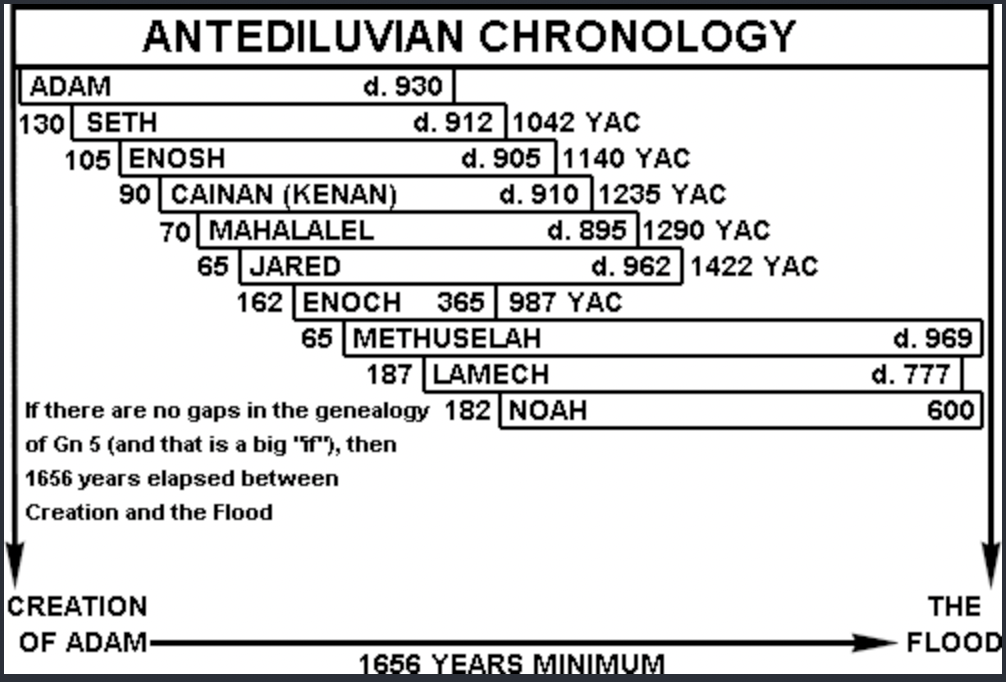
The men who are listed in the genealogies of Adam in this chapter have been called “the ten commitments,” trusting in God’s promise (3:15). There were spiritual giants among this group. Two of them were said to have “walked with God”–Enoch (5:24) and Noah (6:9). We probably know them most, as a group, for their longevity. In the pre-flood world, when the cursed earth was its youngest and least tainted, conditions were most ideal and genetics most favorable for long life. 

James Smith gives us this chart:

In laying out the genealogies, Moses goes back and speaks of the theology and biology of creation. Man is made in God’s likeness (1), and God made them male and female (2). Adam becomes father to a son (3), and thus it goes through all the genealogies. Moses’ record follows the same formula in laying out these ten generations: the father lives so many years, has a notable son (in the Messianic Genealogies–Luke 3:36-38), lives so many years after that birth, and finally dies. As the chart suggests, there is vast opportunity to populate the earth as they live on for centuries.

There are some interesting insights among the Bible’s first look into a family tree. Furthermore, there are implications from this chapter that resonate throughout the rest of Scripture. Notice just a few of these.

“…And he died” (5,8,11,14,17, 20,27,31; cf. 3:19). While these men lived nine or ten times longer than any of us would dare to believe we could live (imagine your life overlapping the lives of Saladin, Genghis Khan, and Thomas Aquinas; see also 6:3), they could not escape the reality of the death sentence brought on by Adam’s sin. Hebrews 9:27 avers that death is an inevitable appointment.  1 Corinthians 15:21-22 reiterates that by a man came death and that in Adam all die. 

“Enoch walked with God” (21-24). He is the exception to the rule just mentioned. Moses  writes a beautiful truth about this man. He strove for intimate fellowship with God. This is indicated by the phrase that “he walked with God.” This phrase might be ambiguous and unclear, if not for subsequent Scripture. This is tied to his faith (Heb. 11:5). Therefore, “he obtained this witness that before his being taken up he was pleasing to God.” He was a prophet of God sharing the word of God (Jude 14). We are told nothing about his wife or any of his other children apart from the famously old Methuselah, but if he lived anywhere close to the others he would likely have been alive the year of the flood if not taken by God. 

God defines what walking with Him should look like, as He speaks to His people at the end of the Old Testament. Speaking of the faithful Levitical priests, He says, “He walked with Me in peace and uprightness, and he turned many back from iniquity” (Mal. 2:6). His lips preserved knowledge and He was a devoted messenger of God (Mal. 2:7). That harmonizes with what Scripture says about Enoch. 

“(Noah) will give us rest” (29-32). Lamech “became the father of a son” (28) he named Noah. Why? “This one will give us rest from our work and from the toil of our hands arising from the ground which the Lord has cursed” (29). As it turns out, Noah will give comfort not to those before him but to those who would come after him through Shem, Ham, and Japheth (32). The same word translated “rest” is found in a different form in Genesis 6:6,7 and is translated “sorry.” Because God was sorry for making man, who had become sinful, He resolved to destroy man and beast. But Noah will find grace in the eyes of the Lord (6:8). The ground would continue to labor under the curse (Rom. 8:20-21). But spiritual rest would be possible through Noah’s obedience (1 Pet. 3:20; Heb. 11:7).

With all this time that passed as recorded in Genesis 5, God’s eternal plan was still in motion. Salvation would ultimately come, starting with these ten generations. Through His sovereignty and providence, God would ensure that “the kind intentions of His will” (Eph. 1:5,9) would be accomplished despite man’s continual faults and failings. 

Genesis: These Are The Generations (V)

The First Children (4:1-24)

Neal Pollard

The sobering truth about sin is that we cannot anticipate its consequences. Scripture credits sin as entering the world through Adam, not Eve (Rom. 5:12). Despite her role for which she received her own consequences (1 Tim. 2:8-15), God places the responsibility ultimately upon her husband. It is still the same today (Eph. 5:23). The Bible does not tell us how the events regarding his sons, Cain and Abel, emotionally impacted him. If you are a parent, you can well imagine.

Moses is not concerned with giving us a strict chronology in chapter four. This will help when reading through the narrative where certain details are omitted. They are not deemed as important to the story, though they might drive our imaginations wild. Like what, specifically? How many siblings (male and female) were born after them before the egregious actions of Cain in verse eight? Apparently, a great many–though Moses does not record it. Where did Cain get his wife (see 3:20)? Was incest permitted? Obviously, in accord with the mandate of Genesis 1:28, it had to be. In fact, it is not “outlawed” until the Law of Moses (Lev. 18:6). How much time occurs between verse one and verse fourteen, when Cain is worried about people finding him and killing him? Antediluvian (pre-flood) lifespans reached in excess of 900 years old, which we will see in the next chapter. 

The focus of the chapter appears to be the divergent mindsets of obedience and disobedience in the world after the fall. The chapter begins by chronicling the births of the first two known children of Adam and Eve. Cain is firstborn, followed by Abel (1-2). Cain was a tiller of the ground while Abel was a keeper of flocks (2). 

Why did God accept Abel’s offering, but reject Cain’s (3-5)? Genesis four does not spell this out. John tells us Cain’s “deeds” were evil, and Abel’s deeds were righteous (1 John 3:12). More clearly, the writer of Hebrews says, “By faith Abel offered to God a better sacrifice than Cain, through which he obtained the testimony that he was righteous, God testifying about his gifts, and through faith, though he is dead, he still speaks” (Heb. 11:4). On the other hand, rebellion and apostasy are implied in Cain’s actions (Jude 11). Abel complied with what God wanted, but Cain did not. It was an error of worship. Cain offered what he wanted rather than what God wanted. 

Cain compounded the problem by his intemperate response (5-7). God warns him of the price for sinful anger, but the older brother loses all self-control and murders Abel (8). Once again, we find the offended God seeking out the offender. Such long-suffering love! God pursues Cain, exposing his sin (9-10) then revealing the consequences of that sin (11-12). He is divinely prevented from being a vegetable farmer, settled in one place. Instead, he is consigned to being a wandering vagrant (12-13).

Cain is concerned that he will be a hunted fugitive (14). In His mercy, God protects Cain (15). Cain has a wife (did she marry him before the murder of Abel?), and they begin to have children. Much of the rest of the chapter involves revealing the line of Cain. As the late Wendell Winkler once showed us in class, “The line of Cain gave us nomads, farmers, musicians, smiths, polygamists, and murderers, but not one who ‘called upon the name of the Lord’ (24).” Verses 17-24 reveal the infamous legacy of the line of Cain as well as a reflection on the consequences of his father’s sinful choice. 

Yet, a glimmer of the divine plan of redemption shines through in how Moses ends the first “toledoth.” He returns to the first parents and reveals the birth of another son, Seth, in whom Adam and Eve placed their hopes of a better legacy. We will see more about Seth’s lineage in the next chapter and its significance to the ultimate birth of the Messiah and fulfillment of Genesis 3:15. But out of the shattered pain of sin and disappointment there came home. “…Men began to call upon the name of the Lord” (24). 

Godliness With Contentment Is Great Gain

Brent Pollard

Barry Schwartz, a professor of psychology at Swarthmore College, authored a book called “The Paradox of Choice: Why More Is Less.” In an article adapted from his book, published in Parade magazine about twenty years ago, Schwartz surprisingly states that “our unprecedented material abundance” causes unhappiness. How does this happen? Think about your last visit to a large retailer. You likely encountered over 360 types of shampoo, conditioner, and mousse in the hair care aisle. With such an overwhelming number of choices, deciding which one to buy can be difficult. Most people want the best product at an affordable price, but with so many options, it can be challenging to determine which of the 360 products is the best choice.

According to Schwartz (2004), many believe we should never settle for anything less than the best. He calls these individuals “maximizers.” Essentially, maximizers are always dissatisfied with what they have. For example, while driving and listening to the radio, a maximizer will often switch between stations, even if they already enjoy what they are listening to. Have you ever found yourself behaving this way?

As Schwartz concludes, “Unattainable expectations, plus a tendency to blame ourselves for our failure, make a lethal combination” (2004, p. 5). We need to constantly remind ourselves of the principle Paul first shared with his “son in the faith,” Timothy:

But godliness actually is a means of great gain when accompanied by contentment. For we have brought nothing into the world, so we cannot take anything out of it either. If we have food and covering, with these we shall be content. (1 Timothy 6.6-8 NASB)

Yes, we must learn to be content with what God promised to provide if we “seek first the kingdom of God and His righteousness” (Matthew 6.33).

Schwartz provides advice to help us find contentment. Here are the tips.

“Choose when to choose” (Schwartz, 2004, p. 5) suggests intentionally limiting our choices when something is unimportant. For instance, when purchasing a specific item, it’s better to stick to one store and choose from only one or two restaurants. This way, we can avoid unnecessary decision-making and save time and energy.

According to Schwartz (2004), learning to accept things that are “good enough” is important. Striving for perfection can often lead to unnecessary anxiety and stress. Instead, settling for something to get the job done and move on is better. The pursuit of perfection is often a futile task and can prevent us from achieving our goals.

The third thing to remember is not to worry about missed opportunities or options. Instead of dwelling on the “what ifs,” learn to be happy with your choices. There is no point in agonizing over the paths you did not take. As Barry Schwartz put it in his book, “The Paradox of Choice,” “Learn to be content with the choices you’ve made.” (p.5)

According to Schwartz (2004), it’s essential to control your expectations and not expect too much. Your expectations often shape your perception of what is right or wrong. If you want to be more satisfied with life, it’s advisable to avoid expecting too much, as it is a common saying: “Don’t expect too much, and you won’t be disappointed.”

These are not behaviors that we can develop overnight. We must follow the example of the apostle Paul and learn to be content (see Philippians 4.11). Let us carefully look at our lives, recognize our many blessings, avoid causing ourselves disappointment, and thank God for all He has done for us.

Work Cited:

Schwartz, B. (2004, January 4). When It’s All Too Much. Parade, pp. 4-5.

Genesis: These Are The Generations (IV)

“Where Are You?” (3:1-24)

Neal Pollard

A dramatic shift occurs as we come to chapter three. The beautiful ending of chapter two is that “the man and his wife were both naked and were not ashamed” (2:25). It is harder to find a purer picture of innocence and carefree life than the sinless condition of Adam and Eve as revealed at their creation.

Genesis 3 explains how things changed and what the consequences of that are, not only for the first couple but for all subsequent humanity. It is important to keep in mind that these events are presented in narrative style and are not myth or legend. Bible writers who look back on Adam speak of him as historical, not fictional (1 Chron. 1:1; Job 31:33; Hos. 6:7; Luke 3:38; Rom. 5:14; 1 Cor. 15:45; etc.). The same is true of Eve (2 Cor. 11:3; 1 Tim. 2:13). We will examine the serpent momentarily.  Consider the content of this important, if grim, chapter.

The Serpent And Sin (1-7)

There are so many interpretations concerning the serpent. Reyburn and Fry say, “Serpent, which translates the usual word for ‘snake,’ has had a long history of interpretation. Some commentators have held that the serpent refers to Satan in disguise. Others have taken the position that it is a symbol for curiosity. The serpent is found in the stories of many societies as the creature who brings good luck, knowledge, and wealth, and who is sometimes described as being able to speak” (81). Yet, the serpent is introduced as a beast which God made (1). Connect that statement back to Genesis 2:19. 

What does seem clear is that Satan is somehow involved in this incident. Satan is called “the serpent of old” (Rev. 12:9). He is the father of lies (John 8:44). Combining those facts with the curse of verse 15 leads us to conclude that Satan uses the apparently willing and crafty serpent to tempt Eve (2 Cor. 11:3,14).

The focus of the text is the temptation. The serpent “deceives” Eve (13). He does so by casting doubt on God’s command (1; 2:16-17), implying that God is unfair (1), denying truth (4), and suggesting that God is trying to prevent Adam and Eve from having better and more (5). By entertaining his arguments, Eve opens the door of her heart to temptation. The tree of the knowledge of good and evil appeals to her flesh, her eye, and her pride (6; 1 John 2:16). She eats and gives to Adam, who also eats (6). Their eyes are opened, but it does not have the anticipated effect. Instead, they are filled with shame (7).

James Smith writes, “These additional points in Satan’s temptation strategy should be noted: (1) he attacked when Eve was alone; (2) he selected the ground carefully, waiting until the woman was in full view of the tree; (3) he employed ambiguous and obscure language; and (4) he pretended to be seeking only the best for his victim” (The Pentateuch, 67). Oh that we could always remember that “sin’s seductive promises always turn out to be a mirage”

(Strassner, 35). 

The Search (8-13)

The chapter opens with a dialogue between the serpent and the innocent woman. Next, we see the dialogue between God and the sinful couple. Eric Owens once reminded me that it is all too easily to read into this text what is not there. Do you ever imagine the tone of God’s voice and His response as severe and scolding? Look closely at this chapter and see if you see evidence of it!

Instead, Moses tells us the couple hears the sound of the Lord God walking in the garden… (8). What a comfort that must have been before this day! Now, hearing it, their instinct is to hide. Sin covets cover (8)! Their sin has led them to shame. 

We read that God calls to the man and asks, “Where are you?” (9). Whatever else you deduce, do not miss that God pursues those who chose to disobey Him! He does not leave them to languish and suffer in their sin without His guidance and instruction. In God’s subsequent questions–“Who told you that you were naked” (11), “Have you eaten from the tree of which I commanded you not to eat?” (11), and (to the woman) “what is this you have done?” (13). 

Of course, the God who is revealed in Scripture as all-knowing (Psa. 139; John 2:25; 1 John 3:20). These questions are not for His information, but for Adam and Eve’s instruction. They are rhetorical, yet beneficial for their spiritual recovery. Like the rest of God’s Word, these words are a mirror for their reflection. Adam, though deflecting (10,12), ultimately confesses (12). Eve, also redirecting, nonetheless confesses (13).

The Sentence (14-24)

The just God metes out punishment. He is full of integrity and must keep His word (Num. 23:19). God addresses the guilty.

The serpent will crawl on its belly and eat dust (14). There will be enmity between the seed of the serpent and the seed of woman (15), with the latter ultimately triumphing. Given the earlier discussion about the serpent and Satan, we must understand the import of this statement. From ancient interpreters on down, this has been called the “protoevangelium” (the first gospel proclamation). This is fostered by Paul’s words that “the God of peace will soon crush Satan under your feet” (Rom. 16:20a) as well as the Messianic Genealogies that follow in chapters four and five. See also Hebrews 2:14-15. The idea is that the devil would experience triumph in the death of the Messiah, but the Messiah would deal a greater, crushing blow through His resurrection.

The woman will experience pain in childbirth and her husband would rule over her (16).  The middle phrase, “your desire will be for your husband,” appears to be less about the sexual and more about her role. Kenneth Matthews points to Genesis 4:7 as a parallel to this verse, saying, “The ‘desire’ of the woman is her attempt to control her husband, but she will fail because God has ordained that the man exercise his leadership function. The force of the defeat is obscured somewhat by the rendering ‘and he will rule’; the conjunction is better understood as ‘but he will rule'” (NAC, 251). This is cemented in 1 Corinthians 11:3. No doubt, the woman in her rebellion has the most painful consequence.

The man will suffer a cursed ground as he attempts to cultivate it (17). He will contend with thorns and thistles (18) and will grow food only with difficulty and adversity (19). Not only that, but he will die–return to the ground and go back to the dust he came from (19). This is not to suggest that all men, subsequently, would be farmers. It is to say that his heretofore pleasant and unobstructed work will no longer be either of these things. 

All three, serpent, woman, and man, receive a punishment that fits their sin. In fact, in two of the three pronouncements, the punishment was given “because” (14, 17). Likewise, the woman who led her husband into sin was now to be led by him. 

After a couple of notes of explanation–Adam naming his wife, now endowed with childbearing, “Eve” (mother of all living) and God compassionately clothing the couple reeling from the shame of knowing their nakedness (20-21)–there is one last part to their sentencing. They must leave their garden paradise (22-24). They must be separated from the tree of life (22), and cherubim would guard the tree of life with a flaming sword (24). We do not see these created beings referenced in this duty station anywhere later in Scripture, and their appearance would no doubt have been frighteningly intimidating. Surely, neither Adam nor his descendants dared get close to this spot again.

As Milton famously dubbed it, this describes “paradise lost.” The New Testament sheds further light on the spiritual implication of these events. Indeed, “…through one man sin entered into the world, and death through sin, and so death spread to all men, because all sinned” (Rom. 5:12). That context shows the cost of “the offense of Adam” (Rom. 5:14), the deadly transgression (Rom. 5:15-18), and the resulting condemnation (Rom. 5:16,18). But thank God for His grace that brings life, justification, and righteousness where it is not deserved (Rom. 5:16-19). God knew man would eventually exercise his free will to sin, and He already had the rescuing response ready! Even in the frightful darkness, God exerts His life-giving remedy. 

Second Chances

Travis Harrison

It’s a new year. For many it’s an opportunity at a new beginning – a fresh start, a second chance. I want to begin tonight with a lighthearted story about how a couple of second chances helped me.

When I was about 5 or 6 my older brother unintentionally tried to kill me, at least twice. The first time, we were outside playing, and we found these large bushes, pokeweed. These plants and the berries are poisonous, but we didn’t know that. I read that if you cook the leaves and berries properly, you can eat them. However, what you shouldn’t do, especially as a small child, is convince your younger brother to eat a handful of these berries. I googled for curiosity’s sake how many berries were dangerous, and it said that as few as 10 would make the average adult sick with all kinds of symptoms or some reports even said death. We went to the house and my mother knew exactly what I had done, the evidence was smeared all over my hands and my face. She called poison control, and they told her to give me this syrup that would make me sick to my stomach and I’d throw up the berries. Sure enough about 45 mins later – no more berries.

The second time was a little more serious. We had this storage building out back, it had a small lean-to shed on the back side. One of the sides was perfect for climbing on. Since we were expert climbers my brother had the idea – let’s get up on that roof so we can see everything better. We shimmied our way up the side and made it up onto the roof. If that had been the end of the story that would’ve been great…but wait, there’s more. My brother noticed something coming from the side of the building. He was referring to the electrical service, and the power lines that were coming off the pole and into the side of the storage building. “I wonder what happens if you touch those?” Listen guys I’m smart it just hadn’t kicked in yet. So yeah, I walked over and grabbed them and believe me when I say they grabbed me right back. I’ve told this story 100 times and everyone seems shocked and surprised, but I can assure you, not nearly as much I was!!

Second chances are given to us all the time and come in a variety of ways. They happen in our everyday lives, our careers, our marriages, relationships with our families our friends, and our relationship with God. God gives us second chances because he loves us, and he knows us and knows we need them.

God is a God of second chances. Throughout the Bible we study about people who have sinned or made mistakes, altered their courses in life but are still given a second chance by God.

1.     For example, Jonah had fled from what God had commanded him to do yet was given a second opportunity to go to Nineveh and spread His word to the people. (Jonah 3:1-10).

2.     David was a man after God’s own heart, yet he turned away from Him when he committed adultery with Bathsheba, had Uriah killed, then his son died because of the evil he had done (II Samuel 11 and 12) but still God loved him, and he was a great king. 

3.     Rahab was a prostitute. She didn’t live a wholesome life, but she changed the course of her life when she did something for good. She hid the spies in Jericho. When the city was destroyed, she was rewarded. Only she and her family were saved. (Joshua 6:22-23)

4.     Paul once was a persecutor of Christians (Acts 8:1-3). He was converted into a Christian and baptized (Acts 9:18). He became one of the most influential missionaries, authors, and apostles of the first century. 

5.     Onesimus was once deemed useless. After being given a second chance Paul describes him as beloved servant, and brother to him. He was willing to do anything for him, even pay his debts. (Philemon 11-17)

The list could go on and on. The point is that God’s love, his mercy, and by His grace through faith, we can all be saved (Eph. 2: 4-8). God forgives our sins and gives us a fresh start. “If we confess our sins, he is faithful and just to forgive us and cleanse us from all unrighteousness.” (I John 1:9) Every day we wake up is another chance to make changes. God’s steadfast love never ceases, his mercies never come to end, they are new every morning. (Lamentations 3:22-23)  

As important as it is that we don’t forget about God giving us second chances, Let’s not forget we are to extend second chances to others. We all have family, friends, coworkers, even sometimes church family that we don’t always see eye to eye with. We don’t need to settle for division, we need to strive for unity. (1 Peter 3:8) As Jesus taught, we are to forgive others as we have been forgiven (Matthew 6:14-15). We are also encouraged to show kindness, love, and grace to others – just as God has shown us (Ephesians 4:32).

God’s second chances are such a blessing to us. We need them, he knows that we do. He’s not a mean God, “He doesn’t treat us as our sins deserve, or repay us according to our iniquities” (Psalms 103:10). He doesn’t want us to fail, but second chances aren’t meant to be free passes for us to keep returning to sin. (Romans 6:23) “ For the wages of sin is death, but the gift of God is eternal life in Christ Jesus our Lord.”  He sent his son to die for us so that we could have as many chances as we need to make things right and grow closer to him before its too late.    

Each new morning the sun rises, God is giving us a second chance. A chance to improve our lives, mend broken relationships, work on those New Year’s resolutions – that I hope we haven’t already broken. This year let’s not squander our second chances, but instead savor them. Let’s make the most of those opportunities to do good, to do things that glorify God, and that will help us walk closer to him.  If 2023 just wasn’t the year for whatever reasons, then begin this year on the right foot. Let 2024 be your second chance. 

Genesis: These Are The Generations (III)

“The Creation Of Man And Woman” (2:4-25)

Neal Pollard

Not only did chapter one help with the question of where we came from, but it also gives crucial insight into who we are. Genesis 1:27 teaches us more than the nature of the Godhead. It tells us something about ourselves. We are made in the image of God, in His likeness (5:1)! There is a part of us reflecting God! I agree that “God’s image obviously does not consist in man’s body which was formed from earthly matter, but in his spiritual, intellectual, moral likeness to God from whom his animating breath came” (TWOT, 768).

Certainly, what Moses wrote in Genesis 1:27 helps us appreciate the additional clarification yielded from the first use of the Hebrew “teledoth” (account, NASB, NLT, NIV; “history,” NKJ; “generations,” ESV) in Genesis 2:4. This is a peg Moses drives down to separate his inspired account into significant sections. I have an excellent chart from Donnie Bates dividing up the book of Genesis, using “teledoth” as a textual marker. 

  • 1:1-4:26–The generations of the heavens and the earth
  • 5:1-6:8–The descendants of Adam
  • 6:9-9:29–The descendants of Noah
  • 10:1-11:9–The descendants of the sons of Noah
  • 11:10-11:26–The descendants of Shem
  • 11:27-25:11–The descendants of Terah (Abraham’s father)
  • 25:12-25:18–The descendants of Ishmael
  • 25:19-35:29–The descendants of Isaac
  • 36:1-37:1–The descendants of Esau
  • 37:2-50:26–The descendants of Jacob 

(Syllabus handout for “Genesis,” Bear Valley Bible Institute)

In the midst of unfolding “the generations of the heavens and the earth,” Moses centers on the creation of man and woman. Notice how he does so. 

Preparing the earth for man (2:4-6). After speaking of the earth 21 times from Genesis 1:1-2:1, Moses speaks of it five times in these three verses. In context, the shrubs and the plants to be cultivated from the ground served a purpose. They would provide food for man (15-17). There is a sense in which man’s being in God’s likeness is demonstrated in his place and dominion over the whole earth (1:28-30; 2:16,19-20). As God is over everything, He delegated authority to man over the earth. Of course, God is the sustainer and provider of what the universe needs to continue to operate (Mat. 5:45; Acts 14:17; Col. 1:17), but man was created to be a steward of its resources. Incidentally, there was at least a time when God did not send rain but rather mist from the ground for its provision (6). 

Creating man from the earth (2:7). There is also a unity or harmony between man and the earth. God created the ground, then He formed man from the dust of the ground. He breathed life into man’s nostrils and man became a living being. The word translated “being” (soul) here seems to be used to speak of his having life and animation. The Bible clearly teaches there is an everlasting part of a person, but that’s not Moses’ purpose in this verse. Moses is describing how the first man came to life. The same word is used of “living creatures” (1:20-21; cf. 2:19). 

Fitting man for the earth (2:8-15). Moses goes to great lengths to speak more of God’s provisions for man’s habitation of the earth. He planted a garden and trees for man’s dwelling place (8-9). He provided rivers to water the garden (10), and it flowed out of the garden in four tributaries–Pishon, Gihon, Tigris and Euphrates (11-14). James Smith notes, “The author seems to be describing the geography of ancient Sumer just north of the Persian Gulf in what is present-day Iraq. Ancient pagan legend remembered a paradise at the northern end of the Persian Gulf” (The Pentateuch, OT Survey Series, 59). Associated with these geographical markers, Moses makes the first mention of money (11-12). Man’s job is to care for the earth prepared by God for him (15). 

Preparing man for his time on earth (2:16-17). God does more than give man physical purpose. He is giving him spiritual boundaries. Moses includes this command about the “forbidden fruit” to show God’s loving nature in creating man with the ability to choose. At this point, evil is not part of man’s consciousness nor has it stained his soul, but it exists as the opposite of the “good” that God created (see Moses’ repeated use of “good” in chapter one). Man would have to choose to leave the “good” of sinlessness, but that was a choice from the beginning. What Paul says of the Gentiles is true, ultimately, of everyone since Adam: “In the generations gone by He permitted all the nations to go their own way” (Acts 14:16). 

Giving man what the earth alone could not give him (2:18-25). Of course, God knew what man needed before man had an opportunity to even discover it. God determined to give man a “helper suitable for him” (18). He presents all the animals for Adam to name, and among these there is no “suitable helper” (19-20). It is not incidental that God created woman from man. He could have formed her from the dust of the ground, the same as man but apart from him. But, denoting the intimate connection He intended, He makes her from him (21-22). As has  been noted, is there anatomical symbolism here? She was not taken from his head or his heel to rule over or be enslaved to him. She was a partner is truest sense, taken from his side. 

Adam recognizes this and speaks a truth beyond just his circumstances (21-24). God teaches that gender is not fluid, but fixed (note the pronouns and description throughout the paragraph). God teaches the permanency of marriage (23-24), which Jesus will reference in restoring marriage under His covenant (Mat. 19:1-9). God gives the first allusion to the church,  and Paul will draw on the analogy in Ephesians 5:22-33. God gives gender roles in the leadership of the church, hearkening back to this cross-cultural circumstance in 1 Timothy 2:8-15. 

But there is more than doctrinal truth being instilled here. There is the most beautiful earthly relationship ever made by God, transcending every relationship except the one between a person and God! God knows our physical, emotional, social, and spiritual needs. His original remedy for that was marriage! What a wise creator we serve! 

GENESIS: THESE ARE THE GENERATIONS (II)

“In The Beginning” (1:1-2:3)

Neal Pollard

The first chapter of the Bible’s 1189 provides a helpful reminder that chapter divisions are an act of man (Stephen Langton in 1227) rather than an act of God. Genesis 1:1-2:3 is the inspired record of the creation of the universe followed by a more intimate account of the creation of man (2:4-25). There is incredible structure in the way Moses records the making of the universe, showing the Creator to be a being of order and design.

The skeletal information of the chapter falls out easily enough:

  • The beginning (of the universe): God created a formless and void earth, and darkness as well as God’s Spirit were over the surface of the water (the deep)(1:1-2). Incidentally, isn’t the “end” implied with the word “beginning”? With perfect foreknowledge, God knew that this world would someday come to an end (see Isaiah 46:10). 
  • Day one: God created light and separated the light from the darkness (1:3-5).
  • Day two: God created the sky (called the expanse–“beaten, [metal] plate, firmament (i.e. vault of heaven, understood as a solid dome)” (CHALOT, 347) (1:6-8).
  • Day three: God created dry land and vegetation (1:9-13).
  • Day four: God created sun, moon, and stars (1:14-19).
  • Day five: God created water animals and winged creatures (1:20-23).
  • Day six: God created mammals, reptiles, and man (1:24-31).
  • Day seven: God rested from all the work which He had done (2:1-3).

Another way to divide this account is through two words Moses uses. Days one through three record God “forming” (1:7) what had been “formless.” Days four through six record God “filling” (1:22,28) what He had “formed” (see Kurt Strasser, Opening Up Genesis, 20-21, for more on how he develops this idea). Despite those who wish to accommodate epochs of time and the theory of evolution “in the beginning,” we have the testimony of chapter one identifying each day of creation as a 24-hour period (5,8,13,19,23,31). The same writer, Moses, will look back on the creation in the establishment of the Sabbath, noting that God created the universe in six days (Ex. 20:11; 31:17). Do you find it interesting that civilizations everywhere throughout time have constructed their calendars and functions around the seven day week? It is sown into the fabric of creation!

We are impressed with God’s active involvement in the creation process (note the verbs–I  count 38 in these 34 verses, actions God takes in these seven days of work). As we read the remainder of the Bible, we will appreciate how God remains active and involved with His creation and especially the pinnacle of His creation (1:27). Whether observation, speaking, or otherwise creating, we see God at work.

We are impressed by God’s “triune” nature as revealed in Genesis one. We see the second most common designation for God (2532; YHWH, God’s proper name occurs around 6800 times in the O.T.) and is used for divine beings, associated with might and strength and creation (from the first verse of Scripture). The Spirit of God is first referenced in verse two, and the plurality of personalities is clearly found in this inaugural chapter. How? “Elohim” is a plural noun each of the 35 times it appears in these first 34 verses. Further, as God discusses the creation of man among Himself (even saying it strains the limits of our comprehension), He says, “Let us make man….” (27). Not multiple Gods. The rest of Scripture will show us what it first introduced here. God has an essence and nature. Only One (only God) is all-powerful, all-knowing, uncaused, present everywhere all at once, perfect, sinless, etc. Yet, God is three distinct persons. Two are explicitly identified here (Father, Spirit). One is averred to be the agent of Creation elsewhere (John 1:3; 1 Cor. 8:6; Col. 1:16; Heb. 1:2). 

God’s first question for Job is a confession that He created the universe (Job 38:4). Israel sang about the creation (Psalm 104:4-5). Every New Testament writer but Jude (who still refers to events in Genesis) makes reference to the creation account. All divine revelation rests upon the truth of Genesis one. God permitted the universe to be and subsequent chapters will help us understand why. 

GENESIS: THESE ARE THE GENERATIONS (I)

Background And Introduction

Neal Pollard

One of the first and most basic questions most people seek the answer to is “where did I come from?” Since I am here, there must be some explanation. And since that explanation predates me and anyone I could consult personally or through recorded history, I must look for an explanation outside of those sources. Any answer is subject to evaluation for its credibility and reasonableness. 

The book of Genesis asserts itself as the all-encompassing answer to all the big questions humanity inevitably asks. One finds its answers feasible, reasonable, and intelligible. Having 50 chapters, 1533 verses, and 32,267 words, it is a large book that sets the tone for the 65 books which follow it. It was first written for the Jews to understand their history and their place in God’s eternal plan. This is accomplished in many ways. One significant way is through Moses’ repeated, periodic use of a word translated “generations,” “account,” “genealogies,” or “order.” The word is used 13 times in Genesis, with apparent intentionality. It is how Moses divides the contents of the entire book (2:4; 5:1; 6:9; 10:1,32; 11:10,27; 25:12-13,19; 36:1,9; 37:2). We will note those transitions as we move through the book.

The book is called “Genesis” because it reflects the idea of “beginnings.” Truly, “The title of the book of Genesis in Hebrew is bereshith, which literally means “in the beginning.” This title is the first word of the first verse. In a similar way the Hebrew titles of each of the first five books of the Old Testament are taken from a significant word in the first sentence of the book, usually the first or second word, or both. This was the practice also in the literature of other ancient languages in the Middle East” (Reyburn, UBS, 19). 

The book can be easily divided into two parts, one more general and the other more specific. Genesis 1-11 deals with the creation of the whole world, while Genesis 12-50 deals with the choosing of a single people from among the whole world. James Smith describes Genesis as a book unfolding the construction, destruction, and reconstruction of the world (The Pentateuch, 36). We see the construction in the creation accounts of the first two chapters, the destruction in the fall, the flood, and the foolhardy rebellion at Babel (Gen. 3-11), and the reconstruction through the call of Abram and his descendants (Gen. 12-50). 

Look for important themes as you move through the book of Genesis. Again, consider Smith’s suggestion of major theological truths uncovered by the book: the doctrines of creation, sin, judgment, grace, election, promise, and faith as they are repeated not only in Genesis but throughout the rest of the Bible (40). Another way to trace the book is geographically, as much of the book revolves around at least five significant journeys made by Abraham, Isaac, and Jacob. 

Genesis helps us understand the world, its maker, ourselves, and our place in this world. Each chapter will unfold some aspect to help us understand the most important “whys” we will ever think to ask. It is written in narrative form, but is full of rich, theological truth which the subsequent writers and speakers of the Bible frequently look back to as foundational. There are over 100 quotations or allusions to Genesis made to Genesis in the New Testament alone on themes as basic as creation, salvation, human identity, marriage, judgment, the nature of God, the devil, the role of woman, sexuality, and much, much more. Let us journey together with the Bible’s first steps! 

Let God Work

Gary Pollard

I often wonder why the country seems to be falling apart, despite what most people want. There is no popular support for many of those things, or for the people causing those problems. What happened to competence and pride in our work? Why does everything cost more while quality has tanked? Why does it seem like so many people care only about themselves now? We have a space program, but the average high schooler is nearly illiterate. Where did this two-tier justice system come from? Why can government agencies lose trillions of dollars (and fail six audits) and be ok, but the average citizen loses their freedom for many orders of magnitude less? On that note, where did all of our freedom go?! Why are taxes, bloated regulatory codes, and constitutional violations the norm? I’m still pretty young — why is the divorce rate in my generation so staggeringly high? 

Most people I’ve talked to seem to feel the same way: it’s going to take serious upheaval to correct this problem. For awhile, I agreed. But I think I’ve been looking at our problems incorrectly this whole time. These may not be problems we can fix, but I don’t mean this in a pessimistic sense. 

Look at Isaiah, draw your own conclusions. This was a message specifically to ancient Judah/Jerusalem, but the narrative and methods God uses have not changed. Replace the towns in these statements with your own country’s name. 

“This is what the Lord says: ‘I raised my children and helped them grow up, but they have turned against me’” (1.2). 

“When you raise your arms to pray to me, I will refuse to look at you. You will say more and more prayers, but I will refuse to listen because your hands are covered with blood. Wash yourselves and make yourselves clean. Stop doing the evil things I see you do. Stop doing wrong. Learn to do good. Treat people fairly. Punish those who hurt others. Speak up for the widows and orphans. Argue their cases for them in court” (1.15-17). 

“Look at [insert your city here]. She was a faithful city. What made her become like a prostitute? In the past, [she] was filled with justice, and goodness should live there now. Instead, there are murderers” (1.21). I recommend reading all of chapters one through three. 

“The Lord God All-Powerful will take away everything [your cities] depend on. He will take away all the food and water. He will take away all the heroes and soldiers. He will take away all the judges, the prophets, the fortunetellers, and the elders. He will take away the army officers and important officials. He will take away the skilled counselors, the magicians, and those who try to tell the future. He says, ‘I will put young boys in charge of you. They will be your leaders. The people will turn against each other. Young people will not respect those who are older. The common people will not respect important leaders’” (3.1-5). 

All hope is not lost, though: “I, the Lord, am the one speaking to you. Come, let’s discuss this. Even if your sins are as dark as red dye, that stain can be removed and you will be as pure as wool that is as white as snow” (1.18). 

The problems in our country (and every country) are not ones we can necessarily fix with policy changes or better political leaders or societal upheaval. We have a systemic sin problem, and God only ever does the right thing. Judah and Jerusalem suffered because they constantly harmed the innocent with their business and legal practices. They suffered because their people left God. There are still many good people in this country who want to do what God wants! But if God is punishing us, we may want to think twice about attempting to block his justice.  

Effective Prayers For An Election Year

Dale Pollard

God’s people are going to be lifting up many prayers for the USA this year. In order for those prayers to be as potent as possible, here’s four biblical principles that will give them more power. 

  1. Evaluate your spiritual life. The prayers of righteous men and women make the most impact (James 5:16). 
  2. God can’t be seen as just one option. Think of the rascally child who, after receiving a “no” from his father, approaches his mother in secret seeking a “yes.” That child should receive a stern chat— perhaps a spanking? When we approach God, we must do so with His will above our wants. Sometimes the two line up! If they don’t, accept the answer and press on. 
  3. Saturate your petitions with praise and thankfulness. Even when odd viruses seem to mysteriously appear or the “wrong” man takes the office— God deserves your praise with a thankful heart. After all, He reigns with perfection and justice on His throne (Psalm 97:1). God has given us the cure to a horrible sickness that not even all the scientists in the world could cure (Ephesians 2:8). Nothing that happens today or any day will ever change those things. We’ve only just scratched the surface here, too. God deserves every bit of your praise and thankfulness, no matter what. 
  4. Don’t miss the big picture when you pray. Our minds have a way of fooling us into thinking that current events are the big picture. That’s just not true. What’s more important? The growth and faith of every member in His church. For an encouraging study, look at all the congregations in biblical history that were built up numerically and spiritually— despite who was leading the country at the time. What’s most important is not this country or nation, it’s His kingdom and that kingdom to come. 

Are you righteous? Please pray for this world and pray for His church. If there’s something keeping you from the righteousness of God, that’s far more urgent than anything else and that’s what deserves your full attention. 

Let’s be a happy and hopeful people— let’s be those who practice righteousness.