The Day Of Small Things

Tomorrow may feel equally unremarkable. The alarm will ring, responsibilities will loom, and the usual tasks will await you. But here’s the secret that can change everything

Brent Pollard

“The Day of Small Things”—Zechariah 4.10

Some days unfold like pages from an unfinished manuscript. You fold laundry, respond to texts, keep appointments, and wonder whether this chapter of your story has any significance in the grand narrative. Nothing spectacular happens. The sun sets on what feels like wasted hours, and you question the impact you made. Yet it is precisely in these seemingly insignificant moments that the voice of God once thundered through His prophet: “Who dares despise the day of small things?”

The Heart of the Promise

The words emerge from a scene filled with disappointment. After seventy years of exile in Babylon, a remnant had returned to Jerusalem with burning hearts and calloused hands, eager to rebuild the temple of the Lord. However, when they laid the foundation stones, reality struck like a winter wind. What they managed to construct appeared pitiful compared to the memory of Solomon’s magnificent temple. Those who remembered its former glory wept openly—not tears of joy, but tears that cut deeper than any enemy’s sword (Ezra 3.12-13).

In a moment of deep discouragement, God communicated through Zechariah with a vision that would transform everything. The prophet saw a golden lampstand, continuously supplied with an endless source of oil—an image representing divine provision that is unwavering, never faltering, and never running dry. Then came the profound message that would resonate through eternity: “Not by might, nor by power, but by my Spirit, says the Lord of hosts.” (Zechariah 4.6 ESV)

Finally, there’s a question that redefines every small beginning: “For who has despised the day of small things?” (Zechariah 4:10 NASB95). God pointed to the plumb line in Zerubbabel’s weathered hands—not a sword or a scepter, but a humble tool for patient and faithful building. Stone by stone. True and level. The message is clear: Do not underestimate this stage. I rejoice to see My people moving forward in obedience, even when their efforts seem insignificant to human eyes.

The Logic of Divine Delight

This verse does not imply that God has a peculiar preference for smallness, as if He opposes magnificence or fears grandeur. Instead, it reveals a profound truth that challenges our entire value system: He finds immense joy in faithfulness, regardless of its scale. What we may consider ordinary often holds extraordinary significance in His eternal purposes.

Consider the divine pattern that runs like a golden thread throughout Scripture: a mustard seed grows into a mighty tree (Luke 13.19). Jesus feeds thousands with five loaves and two fish (John 6.9 ff). Twelve ordinary men from various walks of life spread the gospel to the ends of the earth. A young woman’s “yes” to God’s will changes the destiny of the world (Luke 1.38). God’s signature move is to bring forth greatness from beginnings so humble that human eyes often overlook them.

For the discouraged exiles, their modest temple could never match the architectural glory of Solomon’s. Yet, here lies the breathtaking irony that brings joy to the angels: this would be the very temple where the Son of God Himself would walk, teaching, healing, and transforming hearts. Their “day of small things” was not the end of the story; it was the necessary beginning of the most significant chapter ever written.

Living in the Small Days

How should we live when the day feels ordinary and our contributions fade like morning mist?

Measure by faithfulness, not by flash. The kingdom of God progresses through steadfast efforts—the kind that occurs when no one is watching. This includes praying when there’s no one around to hear, serving without receiving recognition, reading Scripture in the quiet of dawn, and encouraging someone who may never know your name. We often feel tempted to measure significance by numbers, visibility, or the applause of the world. However, God’s joy is found in consistent obedience that His Spirit sustains.

Refuse the poison of comparison. Those returning from exile looked at their foundation and compared it to Solomon’s temple, which led to deep despair. We often do the same with our hearts when we compare our ordinary faithfulness to the highlight moments of others or even to our own “better” seasons. Comparison is a thief that blinds us to what God is accomplishing right now, in this place, through our own hands. It is better to ask, “What has God placed before me today?” and then serve faithfully in that exact spot.

Begin small, begin now. Holiness and ministry often don’t announce themselves with grand displays or loud celebrations. Instead, they develop quietly through our daily choices: reading one psalm thoughtfully, offering one sincere prayer, or performing one act of kindness without expecting anything in return. These small acts of obedience accumulate like stones in a wall, creating something strong enough to withstand any storm.

Rest in His perfect timing. Every day, no matter how small, is significant in God’s eyes. Each moment belongs to Him. The psalmist confidently states, “My times are in Your hand” (Psalm 31.15). If this is true—and it is—then we waste no day, and God acknowledges every effort. You are not falling behind if you walk by His Spirit, and you are not stuck if He has promised to complete the work He started in you.

The Weight of Ordinary Moments

Perhaps this day feels painfully insignificant. You are caring for children whose appreciation comes in the form of sticky hugs and sleepy whispers. You diligently handle tasks that often go unnoticed, and people frequently overlook your hard work and achievements. You are enduring struggles that remain unseen by the outside world.

In that exact moment, Zechariah’s ancient question still resonates: “Who has despised the day of small things?”

The answer shines brightly in the heavens: God does not disregard it. He never has. He finds joy in seeing you take up your tools and lay down another stone in faithful obedience. Your seemingly small actions today hold more significance than you can imagine.

Tomorrow may feel equally unremarkable. The alarm will ring, responsibilities will loom, and the usual tasks will await you. But here’s the secret that can change everything: In the nail-scarred hands of the One who takes joy in humble beginnings, even your smallest day is intricately woven into His magnificent, eternal purpose.

Take heart. Do not despise the day of small things. In the economy of heaven, they are often the most significant things of all.

Zechariah: The Incredible Ways Of God (XV)

“IN THAT DAY” (PART 3)(14:1-21)

Neal Pollard

Given that the prophecies are thoroughly Messianic in this final section of the book, it influences when we see these events transpiring. Zechariah ends the book talking about the conditions that will persist when Messiah comes. His focus is both on the Savior and the saved. What will occur in that day? 

The Destruction of Jerusalem (1-2). What Zechariah describes here sounds much like the warnings Jesus gives near the end of His public ministry, the fulfillment of which would come in AD 70 (Matt. 24; Mark 13; Luke 21). “The nations” here seem to point to the Roman Empire, as we will look more closely at momentarily (3-8). Verse two mirrors the apocalyptic description Jesus gives in the doom of the city. The day known to the Lord (7) seems to be that day 

The Judgment of Rome (3-8). What Zechariah describes here sounds much like the thread that runs through the bulk of the book of Revelation. The instrument God used to bring the church into existence, which judged His physical people, the Jews, and which chose to persecute the church, Rome, would itself be overcome and fall. Any nation or people that exalts itself against God and fights against Him will lose. That loss is foretold here. The Messiah is depicted as a military commander (4). The church will come out victorious, and those who assaulted it will receive a just end. 

The Exaltation of the Church (9-21). While there is a continuation of judgment language against the enemies of God’s people (12-19), the shift in focus is on the triumph of God’s people. Notice the tie to the Lord’s exaltation, in which His people share. “In that day,” the Lord will be the one and only, holy king (9). “In that day,” the Lord will rout His enemies (13). “In that day,” the holy name of the Lord will be inscribed and enshrined (20). “In that day,” God will take away the distinction between Jew and Gentile (21). The pictures of worship and fellowship point to the day when all nations enjoy a place in the house of the Lord. 

Matthew Henry may be right in stating that the pictures in Zechariah 14 will not be perfectly fulfilled in the church, but only in heaven. But the “in that day” threat no doubt points to the coming of the Messiah in these last three chapters. As the window of inspiration is readying its closing, the prophets turn the hearts of the people to what is next. And what is next will impact not only the Jews, but the whole world! 

Zechariah: The Incredible Ways Of God (XIV)

“IN THAT DAY” (PART 2)(13:1-9)

Neal Pollard

There are three beautiful blessings highlighted by Zechariah in this short chapter. Again, he signals these with his repeated phrase, “in that day.” Often, he prefaces that by saying “it will come about.” He is underlining what the Messianic age would look like. When Christ came, what could be expected?

A Fountain Free (1). Jeremiah had used the fountain metaphor in his writings before captivity (2:13; 17:13; So will Joel 3:18). Have you ever wondered why we sing, “There’s a fountain free, ’tis for you and me?” No New Testament uses that imagery and applies it to Christ (the only reference to a fountain is James 3:11). This passage was undoubtedly pivotal. This fountain would be for sin and impurity. Jesus calls Himself living water (John 4:10-11), but Zechariah will deal with that (14:8). John will invoke the fountain imagery in Revelation 7:17. The promise? The Messiah would be the means of cleaning men from their sins (Eph. 5:26; Heb. 9:14; 1 Jn. 1:7,9). 

The End Of Idolatry In Palestine (2). The first half of this verse explicitly promises that the days of idolatry would be over. That does not mean that sin struggles would cease, but this particular sin struggle–which had plagued Israel since before the giving of the Old Law (Ex. 32:4)–would no longer be a struggle. Hosea also shares this promise (2:16ff). Jesus combatted shallow righteousness among the religious leaders of His day (Mat. 5:20), but not idolatry. They learned their lesson once for all by the time Messiah came.

The End Of Prophecy And Unclean Spirits (2-6). I believe Homer Hailey is right in what the second half of verse two means. Brother Hailey wrote, “In the conquest of Christ over Satan and his forces, unclean spirits have ceased to control men as they did in the time of the ministry of Christ and the apostles” (A Commentary On The Minor Prophets, 392). When Jesus comes on the scene, unclean spirits inhabit individuals. This provides Christ an opportunity to demonstrate His power over Satan. The apostles would also demonstrate that power, as we see Luke record multiple times in Acts. This is certain. The ceasing of miracles would have to coincide with the disappearance of unclean spirits or you would have Satan possessing more power in this world than Christ does. Paul wrote that miracles, including prophecy, would cease (1 Cor. 13:8-13). Zechariah said there would be no unclean spirits overtaking people, thus no need to cast them out. Visions and prophecy would be replaced with a complete, written revelation of God’s will “in that day.”

A Rejected Shepherd (7). The last two promises are not signaled with Zechariah’s favorite phrase. Instead, what he writes here is quoted by Matthew as the prophecy is fulfilled at Jesus’ arrest in the garden of Gethsemane. Mark records its happening (14:50-52). Matthew records Jesus’ quotation of Zechariah 13:7, foretelling the apostles that later that night they would all scatter when He was arrested (26:31). “Little ones” is a favorite way for Jesus to refer to His trusting disciples (Mat. 10:42; 18:6,10,14; Mark 9:42; etc.). Jesus invoked the Shepherd-sheep imagery in His ministry (John 10:1ff), as do His disciples later (Heb. 13:20; 1 Pet. 5:4; Rev. 7:17). 

A Refined People (8-9). Last of all in this chapter, we have the picture of how verse 7 would effect the followers of the Messiah. There is the immediate effect (8) and the ultimate effect (9). One sees clear parallels between these verses and Ezekiel 5, where the one-third and two-third imagery is employed. Though not in a premillennial sense, undoubtedly the words of Paul regarding “spiritual Israel” can be seen as a fulfillment of the idea here: “and so all Israel will be saved; just as it is written, ‘The Deliverer will come from Zion, He will remove ungodliness from Jacob. This is My covenant with them, When I take away their sins’” (Rom. 11:26-27). Though he quotes Isaiah there, it is synonymous with Zechariah’s overall message at the end of chapter 13. Those who think they want to follow Messiah will be refined in the furnace of persecution or trials or sin or priorities. Though we are 2000 years beyond the coming of the Messiah, we are subject to the same refinement. Jesus would say the majority will not come through with their faith intact (Mat. 7:13-14;22:14). But, for those who do, here is a beautiful promise: “They will call on My name, And I will answer them; I will say, ‘They are My people,’ And they will say, ‘The Lord is my God'” (8b; 2 Cor. 6:16; Heb. 8:10; Rev. 21:3). 

Zechariah: The Incredible Ways Of God (XIII)

IN THAT DAY (PART ONE) (12:1-14)

Neal Pollard

The late David Pharr contends, “With the exception of Isaiah, there are more Messianic prophecies in Zechariah than in any other prophet” (“Repent and Rebuild–Zechariah, Spiritual Sword, 26.4, 40). In the last six chapters of this book, there is perhaps a higher concentration of Messianic prophecies than anywhere else in the Old Testament. This is signaled both by New Testament writers citing passages from here, but also through a repeated phrase: “in that day” (found 18 times from 9:16 to 14:21). Six of those are in chapter 12. With this phrase, the prophet is disclosing what things will be like when Messiah comes. Zechariah 12 is the second of two oracles with which the book ends (the first being ch. 9-11). It begins, as does the first, with the phrase, “The burden of the word of the Lord…” (1). Whereas the first ends on a down note, the second is full of hope and expectation centered around the coming Christ. There will be deliverance and restoration “in that day.”

The power of this prophecy is that it is declared by the same Lord who created everything, including man (1). In chapter 12, He begins His prophetic promises centering on Jerusalem and Judah as the focus of a needy world (2). Following that are six promises about that day.

Important (3). The world could hurl its attack against Christ’s kingdom, but it will not succeed (Heb. 12:22). Christ is the stone the builders rejected, and His church is built upon the rock of His identity. Even the gates of hades shall not prevail against it (Mat. 16:18-19). 

Supported (4-5). It is an unshakable kingdom (Heb. 12:28). Think in terms of spiritual Jerusalem rather than literal Jerusalem, which would no longer be the focal point of God’s special protection (Gal. 4). 

Preserved (6-7). Notice the prophet’s focus on the glory of God’s people in that day. They would be the first saved (Rom. 1:16), then salvation would come to the whole world. 

Defended (8-9). The divine protection of those who will follow the One to come in that day is further noted here. 

Penitent (9-10). In this passage, we have a Messianic prophecy quoted by John (19:37). This is fulfilled at the cross of Calvary, leading people at Jesus’ death to begin to contemplate their own sinfulness and the unjust death of Christ. They will weep over Him. 

Sorrowful (11-14). Great mourning would occur among the descendants of kings, prophets, and priests, at the sacrifice of the One who is all of these in one person. Every family would mourn. A personal understanding of our own guilt and His innocence leads to godly sorrow (2 Cor. 7:9-11). 

Zechariah: The Incredible Ways Of God (XI)

DELIVERANCE (10:1-12)

Neal Pollard

Zechariah, in the last six chapters of his prophecy, is looking ahead to the Messianic Age. By definition, Scripture would speak of that as a time of ultimate deliverance. They had been freed from Babylonian Captivity, but they were still not free, autonomous people. Nor would they be, physically or politically. But, as Isaiah 59:20 promises and Romans 11:26 shows Christ as the fulfillment, Messiah would be a spiritual deliverer. That imagery is displayed in chapter ten. 

God would deliver them from want (1). The Lord is the only source of providential care and natural resources. Ask Him, for He gives rain and vegetation to each man. Contrast that to what false teachers and poor leaders promised and offers, all in vain. 

God would deliver them from idolatry (2). The prophets, especially Isaiah, speak of how profitless and foolish it is to trust in inanimate objects of their own hands, which they then in turn worship! They are at once evil and impotent. This sinful guidance led the people to wander, but returning to God would bring them back. 

God would deliver them from poor leadership (2-3). The prophets, like Ezekiel, devote much time to the selfish, self-serving shepherds who actually inflict violence on the charges they are appointed to protect. Here, Zechariah tells his readers that the Lord will take over for these violent, unreliable shepherds. His sheep would no longer wander, and God would punish the leadership.

God would deliver them from the enemy (4-5). The rest of this chapter is devoted to battlefield imagery. Salvation is depicted as a military victory. Judah (southern kingdom) and Ephraim (northern kingdom) would share in this victory. Rejection would be replaced with compassion and acceptance. 

God would deliver them from wandering (6-12). For a people thoroughly accustomed to exile, what picture could exceed the hope of restoration and return? Notice the words pointing to this–gather together (8), redeemed (8), and bring back (10). The enemies would be brought low and defeated, from every direction whether north (Assryria) or south (Egypt). They would be as numerous and prosperous as in earlier times, only (as we will see) not primarily or exclusively in material terms. Messiah would focus on redemption and salvation. 

Zechariah: The Incredible Ways Of God (X)

BEHOLD, YOUR KING (9:1-17)

Neal Pollard

It has been said that “the final section of the book of Zechariah offers some of the richest theological insights the Old Testament has to offer” (Klein, NAC, Vol. 21B, 253). C.H. Dodd says that these six chapters may have had a more direct influence over the gospel writers than any other Old Testament passages (According To The Scriptures, 64-65). C.A. Ham says Matthew alone alludes to Zechariah at least eight times (The Coming King And The Rejected Shepherd, 2005). 

Here are eight direct quotations New Testament writers make of Zechariah:

Zechariah 9:9 ——–> Matthew 21:5; John 12:15

Zechariah 11:13 ——–> Matthew 27:9

Zechariah 12:3 ——–> Luke 21:24

Zechariah 12:10 ——–> John 19:37; Revelation 1:7

Zechariah 13:7 ——–> Matthew 26:31; Mark 14:27

Zechariah 14:5 ——–> 1 Thessalonians 3:13

Zechariah 14:8 ——–> John 7:38

Zechariah 14:21 ——–> John 2:16

In addition to the direct quotations, so many themes of New Testament writers can trace their origins to Zechariah’s prophecy, like sheep without a shepherd (13:7), faith moving mountains (14:4), the Son of man coming with His angels (14:5), and the New Jerusalem (14:6-12). John, in the book of Revelation, has a particular fondness for the way Zechariah puts things. He alludes to at least eleven different images from our present book of study.

Suffice it to say that not only do we profit from studying what Zechariah is saying to his own contemporaries, but we also confirm our faith in the reliability of the Old Testament prophecies when we see so much of it fulfilled in the New.

Chapter nine seems to divide neatly into three sections: 1) vs. 1-8, 2) vs. 9-11, and 3) vs. 12-17. Zechariah foretells the judgment of the surrounding nations in the first section, the coming of their glorious king, and the victory of that king. Let’s notice these sections more closely.

Judgment On Judah’s Neighbors (1-8). Zechariah’s focus is on the conquering of Syria (1-2), Phoenicia (2-4), and Philistia (5-7) by Alexander the Great (see Josephus’ Antiquities 10:1.8). These are physical conquering, but the idea that no oppressor would pass over them anymore (8) seems certainly to foreshadow the coming of the Messiah and the spiritual triumph He would bring in the Christian Age. 

The Triumphal King (9-11). Eight words capture the essence of this triumphal entry. 

  • Rejoicing (9)–“Rejoice greatly…shout.” He must enter Jerusalem to complete His atoning work, and the initial response of the people is to celebrate His entrance (Mark 11:9). He would triumph over sorrow (Matt. 11:28-30). 
  • Royalty (9)–“Behold, your king is coming to you.” He is King of kings (1 Tim. 6:15), though His kingdom is not of this world (John 18:36). He would triumph over any rival. 
  • Right (9)–“He is just.” He would triumph over the injustice so common in Old Testament times (Ezek. 22:12), so common in His own time (Matt. 23), and so common in every age (Rom. 3:23). He is just and the justifier of those who believe in Him (Rom. 3:26).
  • Redemption (9)– “He is endowed with salvation.” He would triumph over Satan (cf. Heb. 2:14-15).
  • Reserved (9)–“Humble.” He would triumph over sinful pride. What an incongruous picture, that their king would come not on a steed or stallion but mounted on a donkey. He bore to perfection the trait of humility.
  • Rest (10)– “He will speak peace to the nations.” He would triumph over man’s problems. There is no possible peace apart from Him (John 14:27).
  • Reigning (10)–“His dominion…” He would be triumphant over the world. Christ has been given all authority in heaven and on earth (Matt. 28:18). He is head over all things to the church (Eph. 1:22-23). Any who do not submit to His reign in this life will bow in prostrate, abject humility at the Judgment (Phil. 2:10-11). Only then it will be too late. One must submit to the dominion of Christ in this life by becoming a Christian. After this life is the Judgment (Heb. 9:27), at which time the disobedient will be consigned to eternal torment (cf. Eph. 5:6).
  • Reconciliation (10)–“And His dominion will be from sea to sea, And from the River to the ends of the earth.” He would be triumphant over division. The gospel is for all!

The Victorious King (12-17). This king would bring promise to the “prisoners who have hope” (12-13). Some turbulent days stood between them and the coming of Messiah, but they would be set free from their greatest problem, sin, when He appeared. There would be restoration from their unmatched warrior. 

This king would bring protection to them (14-15). Zechariah invokes more battle imagery here. He appears with arrows like lightning, blows a heavenly trumpet, marching, devouring, and defending against their enemies. In the wake of the victory He brings, they would bask in the victory celebration that follows.

This king would bring preciousness about through them (16-17). They would be His own flock. They would be jewels in His crown. They would be seen as comely and beautiful. 

These words cannot be viewed through earthly, materialistic eyes, though the Jews in Jesus’ day no doubt did so. They were living under Persian reign as the prophet writes, but he speaks much in this context of the Greek Imperial reign to come. After them, we know, the Roman Empire would rule their land. But the Messiah was bringing something that transcended these in time and power. His would be an indestructible, eternal kingdom (Dan. 2:44). He would bring all spiritual blessings (Eph. 1:3ff). That was the ultimate expectation the prophet points them to, and it is still our ultimate expectation today! 

Zechariah: The Incredible Ways Of God (IX)

RESTORATION AND REJOICING (8:1-23)

Neal Pollard

Whereas they had had a checkered past that earned captivity, Judah looked ahead with hope. Zechariah shares God’s message of love and invitation to be restored. The tone changes and the focus shifts to the bright days ahead for a humbled, penitent people. All of it centered around the character, nature, and attributes of God. 

JEHOVAH’S JEALOUSY (1-2). Zechariah says God is “exceedingly jealous” and “with great wrath” He is “jealous.” That word means to get red in the face from jealousy. It speaks of getting excited and heated with a zealousness that moves one to fight for or against something. Why is this a hopeful statement? The Lord feels this for His people, and He will act in their favor against the nations who had carried them away into captivity. His passion is now on restoring them and reestablishing them in Zion and Jerusalem (3). 

JEHOVAH’S FELLOWSHIP (3-6). The Lord says He will dwell in the midst of Jerusalem with His people, content elderly people (4) and happy, playing children (5). The most vulnerable of society will go about their lives in peace and without worry. While that may seem like a pipe dream, it’s fulfillment is contingent on God’s ability to make it happen. Thus, it is assured. 

JEHOVAH’S SALVATION (7-8). The salvation He mentions is from being dispersed from abroad (from east and west)(7). The picture is of intimacy, God saying, “They shall be My people, and I will be their God in truth and righteousness” (8). Contextually, this salvation is physical and national (Ezekiel prophecies of these moments in Ezekiel 11:20; 36:28), but it foreshadows a salvation that will be described in very similar words at the end of the Bible (Rev. 21:3).

JEHOVAH’S ENCOURAGEMENT (9). God is doing the encouraging and exhorting, but notice how He does so. It is through the mouth of the prophets. A sentiment that first appears in Isaiah’s writing will be a golden thread throughout the centuries, even to today: “How lovely on the mountains are the feet of him who brings good news, who announces peace 

and brings good news of happiness, who announces salvation, and says to Zion, ‘Your God reigns!'” (Isa. 52:7).  We see it again in Nahum 1:15, Romans 10:15, and Ephesians 6:15, and implied in so many other passages. These words of encouragement, through the prophets, were to finish the work God gave them in rebuilding the temple. 

JEHOVAH’S PROMISES (10-15). Notice them in this paragraph, offered to the whole community:

  • They would be treated better than their fathers (the punishment and strife of captivity replaced with emancipation and production)(10-11). 
  • They would have abundant, fruitful harvest instead of barrenness (12).
  • They would be a blessing rather than a curse (13).
  • They would be the object of God’s good in place of the harm He previously brought (14-15).

JEHOVAH’S CHARGE (16-17). God admonishes Judah to be ethically sound, speaking truth and justice (16). They were to root out evil from their hearts against each other, and do right from the inside out (17). Why? Most of all, God hates such things. Second, it was the way for peace to be in their gates. God’s commands bring blessings to the obedient and prevent punishment upon those who would be disobedient.

JEHOVAH’S INCENTIVE (18-23). By embracing God’s promises and obeying God’s charge, they could anticipate feasting where there had been fasting (19). Their role was to “love truth and peace” (19; Amos 5:15). They would be honored and respected among the nations whereas they had been despised by them (20-22). They would be esteemed whereas they had been scorned. In a unique promise, God says of those days, “ten men from all the nations will grasp the garment of a Jew, saying, ‘Let us go with you, for we have heard that God is with you'” (23). Compare these verses with Psalm 126!

The days were coming when the Gentiles would be gathered into God’s kingdom. Zechariah has intimated this (2:11), as had other inspired messengers (Isa. 2:1-4; Mic. 2:1-4). The Jews’ hope all along, as we see in Zechariah, was the Jehovah they knew and loved being embraced and accepted by all men. This, of course, was fulfilled in Christ (Eph. 2:11-15)! 

Zechariah: The Incredible Ways Of God (VIII)

SHARPENING YOUR FOCUS (7:1-14)

Neal Pollard

The eight visions in the first six chapters are followed by didactic (teaching) discourses in chapters seven and eight. Some might say that between the visions (ch. 1-6) and the Messianic prophecy (ch. 9-14), these chapters form the heart of the message of Zechariah to the people. Chapter seven focuses on the people’s responsibility to God, while chapter eight focuses on God’s response to His repenting people. 

Again, Zechariah is like an Old Testament Luke, giving precise names, dates, and places, helping us with knowledge like precisely when these oracles were written. Historians can take his citation of “the fourth year of King Darius…on the fourth day of the ninth month, which is Chislev” and determine that this was December, 518 B.C. This is two years after Zechariah received the visions (1:1) and over two years before the dedication of the second temple (widely believed to be March, 516 B.C.; see Ezra 6:15-16 to align this date). 

The backdrop to the discourses is the delegation of two representatives from Bethel (their names are Chaldean and mean “protect the king” and “friend of the king”) and additional men, asking the priests and the prophets at the nearly completed temple if they still needed to fast (2-3). They are seeking God’s favor (2), and the priests new the law and the prophets received revelation (Smith, 563). It is logical to seek their guidance. Are they weary of fasting? Are they ready to be done with it? Perhaps this is a fast that had been set each year throughout the time of Babylonian Captivity, but it was not the fast set by the Law of Moses on the Day of Atonement (Lev. 23:27; the 10th day of the 7th month). The oracles are in response to this question.

Lesson One (4-7). The brief lesson is built on three rhetorical questions:

  • Did you actually fast for Me (5)?
  • Do you eat and drink for yourselves (6)?
  • Didn’t the former prophets speak about these things before captivity (7)?

Basically, God says He is less concerned about afflicting the body with fasting than He is about real inward change (5). Legalistic fasting repulsed God. The people had neglected to consider God in their daily lives when they feasted (6), and the warnings of the prophets before the exile still applied (7). Zechariah’s teaching through rhetorical questions foreshadows the extensive way his successor, Malachi, would speak to the people after the temple was rededicated. 

Lesson Two (8-14). The second oracle expands on the last statement of the first oracle. That is, Zechariah drills down on what the former prophets had told their forefathers. What had the Lord said in the past (9a)? What had their ancestors neglected, drawing the consequences of exile? 

They failed to actively do the good required by the Law (9). They didn’t practice justice, kindness, and compassion with each other. This is reminiscent of the oft-quoted Micah 6:8.

They did what was called evil in the Law (10). They oppressed widows, orphans, the poor, and strangers, and they did evil against each other. 

They hardened their hearts and refused to listen to God’s Word (11-12). God was calling to them and they refused to listen.

The result of these sins was that it drew God’s wrath (12). When they called, He wouldn’t listen to them either (13). He sent them into captivity (14). Thus, this oracle reviews how the people had gotten into their dire predicament in the first place. This chapter is the sobering, sad story of how they had fallen and why their temple and cities were destroyed. What He says next is the bridge to the bright hope with which Zechariah ends this great book, focusing on the Messianic age to come. 

Zechariah: The Incredible Ways Of God (VII)

CHARIOTS AND A CROWN (6:1-15)

Neal Pollard

For those who read or listen straight through the book, this eighth vision will seem similar to the first one with which Zechariah begins his prophecy. This is seen in the variegated horses going throughout the earth as well as the prominence of the number four (the number of creation, completion, and stability). Certainly, the scope of the vision is of all the earth rather than just the people of Judah or the city of Jerusalem. What are the elements of this final vision and the symbolic action that follows?

The Chariots (1-3). Chariots represent armies and war as well as judgment. Each chariot is accompanied by horses of different colors, heading in a different direction. They are going to patrol the earth, the “four corners,” though only north and south are mentioned. God is going throughout all the earth, so there is a picture of universal visitation.

The Horses (2-7). They are carrying the chariots, but each is a different color. Those colors have strong associations throughout Scripture. Red is the color of war and the shedding of blood (Rev. 6:4). Black pictures death (Rev. 6:5-6). White represents honor and victory (Rev. 6:2).  The dapple color is associated with pestilence, the grave, and slaughter in Revelation 6:8. As James Smith remarks, “The various color horses, then, represent the various types of disasters with which God will destroy the nations which have opposed his people and his program in this world” (OT Survey Series, 555).

The Bronze Mountains (1). Whether or not the mountains are reminiscent of Jerusalem (Mt. Zion and Mt. Olivet), it is often–as here–seemingly symbolic of the home of God (figurative rather than literal). Bronze represents strength, and the chariots are coming from here. This seems to refer to God sending forth judgment upon the nations from heaven. His reign would spread over these nations who had had their time of earthly dominance (Dan. 2:44). The four spirits have gone to these oppressing nations, and God has spent His wrath and now has appeased it (8). 

The Crown And Coronation (9-15). Zechariah is told to meet with returning exiles about whom we know nothing outside of this passage (Heldai, Tobijah, Jedaiah, and Josiah the son of Zephaniah)(10). We know they have returned from Babylon, and that Zechariah takes an offering of silver and gold from them (cf. Ezra 7:14-16; 8:26-30) with which to make a crown. He takes that crown and puts it on the head of the High Priest (11), not a descendant of David. The symbolism here is that the coming King will also serve as High Priest. He will reign and represent, having authority and bringing atonement (11-13). Not only will this vision encourage the rebuilding of the temple, but more importantly it points ahead to the day in which all nations will flow into Christ’s kingdom (12,15; Isa. 60:10). 

Zechariah: The Incredible Ways Of God (III)

A MEASURING LINE AND A WALL OF FIRE (2:1-13)

Neal Pollard

The third vision is shared, then explained, in chapter two. This vision is meant to inspire confidence in the future. We discern that from what the angel says to Zechariah regarding what “will be” regarding Jerusalem (4,5), what He “will” do (5,9,10,12), and what many nations “will” do (11). Their confidence should rest in the reliability of divine revelation. Notice that this will be because the Lord declares it (5,6,10). “Thus says the Lord of hosts” (8). The central idea of this vision mirrors that of the first two, telling Judah that God would protect them and restore them to their land. It will be a glorious and prosperous time. 

The Vision (1-2). It is short and sweet. A man has a measuring line in his hand, measuring Jerusalem. Ironically, this was a vision shared by another prophet with a starkly different message (Amos 7). John will co-opt this imagery in the book of Revelation (11:1ff). The focus is not on the identity of “the man,” but rather the task he is undertaking. 

The Meaning (3-5). It is explicitly given. The Lord will give provision, prosperity, and protection to His chosen people. Charles Fry, in his 19th Century hymn, “The Lily Of The Valley,” appears to draw his lyrics for the third verse from Zechariah 2:5: “A wall of fire about me, I’ve nothing now to fear, from His manna He my hungry soul shall fill….” 

The Exhortation (6-9). God calls to Judah to flee and escape the land of captivity. He calls the Jews from Babylon to return to their homeland. The tables will turn on the plunderers of His people, and they will prosper while the enemies will plummet. God calls Judah the apple of His eye, a reassurance of a description first given by God through Moses (Deut. 32:10). So, this appears to be an appeal to those Jews who have yet to make the journey back to their home.

The Announcement (10-13). There appears to be a shift in audience from the Jews still living in exile to the remnant who have already returned. They are to sing and rejoice since the Lord is in their midst. What appears to be a Messianic reference looks ahead to when many nations will become part of God’s chosen (11) and He will reign. While God draws on the imagery of Judah and Jerusalem, it is because of the One about whom He is about to speak who will arise from there and draw all nations to Himself (3:1ff). 

The people had been down and oppressed. They should anticipate and hope in a brighter future. The Lord was about to do wonders among them, and He would be a wall of fire about them. They would be the apple of His eye. Isn’t it remarkable to consider that we bask in the glory of the fulfillment of such promises? 

Zechariah: The Incredible Ways Of God (II)

JUDAH’S RETURN AND THE NATIONS’ RUIN (1:1-21)

Neal Pollard

Zechariah begins his prophecy, dating it with the reign of a Gentile king since the Davidic line of kings had ceased since Babylonian Captivity. Darius’ second year began late in 520 B.C., clueing us into the historical context. Zechariah’s lineage is repeated twice (1,7), though Berechiah is omitted from it in Ezra 5-6. Iddo is mentioned in both books. It is the message that matters. The first few verses are a preamble, a retrospective review of where Judah had been. The bulk of the chapter is devoted to two visions, speaking of where Judah’s enemies are about to go. We see at least three things communicated in Zechariah one.

A Reminder To God’s Chosen (1-6). God wants them to remember the punishment of captivity, why it happened (4) and how He felt (2). The Lord wants them to keep their fathers’ bad example ever before them and not repeat it (3-4). Their disobedience did not prosper them, but finally they acknowledged their guilt (6). God says His word, through the former prophets, penetrated their hearts and they repented. This was an example they needed to keep in their own hearts. 

A Rider Among The Trees (7-17). Time passes from the initial word that came to Zechariah (over three months, vs. 7). This is the first of 8 visions God gives the prophet:

  • The man on the red horse (1:7-17)
  • The four horns and four craftsmen (1:18-21)
  • The surveyor (2:1-13)
  • The cleansing of the High Priest (3:1-10)
  • The golden lampstand and two olive trees (4:1-14)
  • The flying scroll (5:1-4)
  • The woman in the basket (5:5-11)
  • The four chariots (6:1-8)

Each of these eight visions has a central message. Within each of these visions, there are things and people that have symbolic meaning. However, they point to a big idea that God wants His people to understand. He is simply conveying the message in a way that they would less easily forget.

In the first vision, we have a man riding on a red horse with the backdrop of myrtle trees in a ravine and multicolored horses behind him. Charles Simeon believes this to be the preincarnate Christ (the Angel of the Lord) and that the “we” (“the other riders,” 11, NLT) implies angels attending to Him and doing what He wills. He also suggests that the trees and their lowly position represent the Jews in their humbled state because of captivity and the fact that they do not own the land (Horae Homileticae, 438). John Calvin agrees that this is probable, adding that the different color horses indicates the different offices or purposes for which they are sent–whether to bless, curse, or some of both (Vol. 5, 33). 

In fact, it is the view that makes the most sense given the symbolism and the frequency with which we see Christ appear as the Angel throughout the Old Testament (Gen. 16:7-10; 31:11-13; 32:25-31; Ex. 3:2-4; Jud. 6:11-12; Zech. 3:1-2; etc.). Red is the color of blood, white of glory and victory, and sorrel of flames. The Lord is exacting judgment on the nations with bloodshed and burning, gaining victory over the nations. This is further explained by the Angel’s anger at the nations (15) and His compassion for His people (14,16-17). The Lord is jealous for His people and eager to restore them even as He had allowed the nations to subdue them for a while.

A Reign To Be Overtaken (18-21). While this is a second vision, the Angel continues to appear (19). Zechariah sees four horns. Universally in the Old Testament, horns represent power and authority (Dt. 33:17; Ps. 18:2; 75:10). It would appear that these horns represent four kingdoms, and given the times and the message the most logical kingdoms would be those also mentioned by Daniel in Daniel 2 and 7 (Babylon, Medo-Persia, Greece, and Rome). They scattered the Jews through military and economic policies, a diaspora that reaches to the time of Christ and the church. While God is not concerned about the Jews repatriating and repossessing Jerusalem and Israel, He will punish the heathen nations. This is represented by four craftsman. The debate is whether they are kings of these various empires through whom God worked to accomplish His purposes or spiritual leaders by whom God rescued and preserved His people. It does not matter who they are, they are tools in God’s hand to relieve and deliver His people. 

So, Zechariah, from the outset, is given comforting pictures about the future of his brethren. It seems clear that the heart of this comfort is revealed in the person of Christ. Throughout this book, we will see Messianic pictures painted to point us to “that day” (cf. ch. 12-14). He was the hope they should look for! He is the hope we should embrace in our lives today, however lowly we are and feeble our efforts seem to be. 

Zechariah: The Incredible Ways Of God (I)

George Klein wrote, “One of the great ironies concerning the book of Zechariah is its relative obscurity to the modern church contrasted with its profound significance to the early church” (New American Commentary, Vol. 21b, p. 61). Let’s study together about this Messianic prophet extraordinaire.

Background And Introduction

Neal Pollard

Zechariah: The Incredible Ways Of God

BACKGROUND AND INTRODUCTION

Neal Pollard

(This is from an article originally published in The Christian Worker, 10/24)

The author of the longest book in the library of the Minor Prophets is identified in the first book of his prophecy as “the son of Berechiah, son of Iddo” (1:1). Only Zephaniah’s lineage is more exhaustively traced than Zechariah’s. His name means “God remembers,” and this takes on significance when the message of the book is considered. Studying Ezra and Nehemiah, one can deduce that Zechariah is of a priestly lineage (Ezra 5:1; 6:14; Neh. 12:4,16). Matthew 23:35 reveals that the prophet was martyred, though the Zechariah in 2 Chronicles 24:20-21 is undoubtedly a different Zechariah. Jesus is revealing a fact supported by rabbinic literature (Blank, Sheldon H. “The Death of Zechariah in Rabbinic Literature.” Hebrew Union College Annual 12–13 (1937–1938): 327–346. Print).

The consensus view of the date of Zechariah is 520-470 B.C. Zechariah, along with Haggai, are commissioned by God to stir up the people in order to finish the work of rebuilding the temple. The reflexive command in Zechariah 1:3 is key to the book, that if they return to God He will always return to them. Of the three major periods of the Minor Prophets (the Assyrian Period of the 8th-7th Century, the Babylonian Period of the 7th Century, and the Persian Period of the 6th-5th Century), Zechariah belongs to the latter. It is often called the Post-Exilic Period, following 70 years in Babylon being freed and repatriated by Cyrus the Great.

The theme of Zechariah’s writing is the need of the people to rebuild their lives through obeying His Law. He accomplishes this primarily through the use of visions, of which there are nine in the first six chapters. Following these, the prophet engages in didactic discourse (or sermons) on the matter of spiritual renewal in chapters seven and eight. The final section focuses on two major Messianic events, His coming and judgment followed by an overview of what would be in His earthly ministry (note the phrase, “that day,” found 17 times in the final three chapters)(ch. 9-14). 

Raising Godly Children

Do you ever wrestle with the challenge of raising faithful children (or grandchildren)? Are there certain ingredients necessary to accomplish this task?

Carl Pollard

Every morning, I pray for the spiritual health of my family and children. My son Rich can’t even say his sister’s name right, but I pray for his future walk with God, for his spouse, and his commitment to Christ. Amara can’t crawl yet, but I spend my mornings praying that she becomes a woman of faith like Ruth or Sarah. Jed, still in the womb, is listening to sermons through an umbilical cord, and I’m already lifting him up in prayer that he follows God’s will.

I want nothing more than to spend eternity with my wife, children, and family. How I lead as a father will shape how my kids see God the Father. I often feel guilty for my failures as a spiritual leader, fearing the responsibility for my family’s faith journey. My deepest desire is to see my children grounded in faith and in love with Christ.

This article is for you as a parent to realize the role you play in your children’s spiritual health. As long as they’re under your roof, you have a chance to instill a faith that will unite you for eternity.

You might think it’s strange that someone with little parenting experience is writing about raising faithful children, and you’re right. But thankfully, you don’t have to rely solely on my experience. Let’s take a look at the example of Zechariah and Elizabeth.

Unlike other gospels, Luke begins with the backstory of John the Baptist. To quote philosopher Jake Miller, “We never talk about John the Baptist, but I think that is a mistake. He is a really powerful example.” Jesus affirmed this in Matthew 11:11, saying that among those born of women, none is greater than John.

John was a man calling for repentance and preparing the way for the Lord. So, how did he come to be such a devoted servant? It was part of God’s plan, but Zechariah and Elizabeth played crucial roles in shaping his faith. They lived contrary to their culture, serving God under a tyrannical king while remaining faithful despite their barrenness and age.

Dedicated Believers

In Luke 1:5-6, we read that Zechariah and Elizabeth were righteous and blameless before God. Wouldn’t it be great to be known as blameless parents? Even dedicated believers will make mistakes; Zechariah faced challenges, including being made mute for his disbelief. But God doesn’t expect perfection—He expects dedication. They prayed earnestly for their child before he was even born. Do you spend time in prayer for your kids? Bringing them before the Lord is one of the best things you can do.

Diligent Teachers

In Luke 1:14-17, God reveals that John will be filled with the Holy Spirit and destined to turn many to the Lord. This highlights our responsibility to teach our children. Despite society’s expectations, John fulfilled his divine purpose. What are you prioritizing for your children? Are you encouraging their involvement in church? Just like teaching them to brush their teeth or study, it’s essential to guide them in their faith.

Devoted Nurturers

John had a challenging life ahead, and his parents understood that. As devoted nurturers, Zechariah and Elizabeth provided the guidance he needed. Kids will test your patience, but showing love and mercy is vital. They raised a son who was faithful to God.

What our world needs is more parents like Zechariah and Elizabeth—dedicated believers, diligent teachers, and devoted nurturers. Sadly, many children today lack godly role models. As parents, we have a profound responsibility. God chose Zechariah and Elizabeth for their unwavering dedication. So, I ask you: what kind of role model are you being for your children?

The Restorers

Neal Pollard

You can credit (or blame) a 16th-Century French scholar, printer, and typographer named Robert Etienne for our modern division of the Bible into individual verses. He’s sometimes known by his Latin name, Robert Stephanus. Overall, he did an incredibly commendable job. Sometimes his divisions are head-scratching, like in Ezra 2. This chapter has 70 verses, as he gives each family of the returning exiles their own verse. I’m not sure there is a better way to divide it, though. So, who are these people, that whole assembly of returnees numbering 42,360 plus 7,337 servants and 200 singers? 

They were people willing to endure difficulty. The journey itself would have been over 1000 miles. They leave the comfort and prosperity of Babylon to resettle their native homeland. They will have to rebuild or at least remodel houses and whole villages, not to mention rebuild the temple and the walls around the city of Jerusalem. These were not lazy people!

They were led people (2). Ezra tells us who the leaders were by name. The first three named are among the most prominent leaders in the post-exilic period. Zerubbabel (cf. Zech. 4; Neh. 7,12) not only helps lead the exiles back to the land, he leads the temple reconstruction project (5:2). He insures that the work is done by the Jewish people, and not by their enemies (4:1-3). He is identified as governor of Judah (Hag. 1-2). Jeshua is usually found alongside Zerubbabel (4:3). He is identified in the books of Ezra, Nehemiah, Haggai and Zechariah as the High Priest. Nehemiah, for whom the Old Testament book is named, will also serve as governor of Judah, was likely a prophet, and previously served as a high official in Persian court (Neh. 1). Eleven men in all are listed as the leaders who shepherd the exiles back to the land. They appear to be highly qualified men, perseverant in their own right. 

They were purposed people (3-67). Ezra divides his list into categories. Many are generally listed as men at the heads of certain families (“sons of…,” 3-35), priests (36-39), Levites (40), singers (41), gatekeepers (42), temple servants (43-54), “Solomon’s servants” (55-57, probably descendants of those selected by Solomon to work on the temple), and several whose genealogical record was unverified (58-63). Who was more important? That is entirely the wrong question! Each group had a purpose, and God and His leaders were depending on them to fulfill it! Verse 70 lists all these groups, who dwelled in their cities and squared up to their tasks.

They were generous people (68-69). Well, not all of them, but certainly “Some of the heads of fathers’ households, when they arrived at the house of the Lord which is in Jerusalem, offered willingly for the house of God to restore it on its foundation” (68). They gave according to their ability (69). Through them, God continues to provide for the future of His people.

As we consider the great, ongoing work of restoration, God is seeking the same things from us: perseverance, submission, purpose, and generosity. He will do great things, even in the midst of shambles and dysfunction, when there are people possessed of qualities like these. We will see that longterm projects will have hiccups and stalls, but a huge step occurs when people are willing to step out by faith. 

Favor To A Faithless People (2 Kings 14:22-29)

Monday’s Column: Neal At The Cross

The writer of 2 Kings is constantly diverting his attention from Israel to Judah and vice versa. So, he introduces us to Azariah, also known as Uzziah, anointed king over Judah at age 16. We will read much more about him in 2 Kings 15, but he seems to be referenced here only to give us the chronology for when Jeroboam II is anointed king of Israel. It is in the 16th year of Uzziah’s reign that Jeroboam comes to the throne. This will be the next-to-last generation in the dynasty of Jehu, but his son, Zechariah (29), will be murdered after six months. When he ascends to the throne, Israel only has about 70 years left before they are destroyed by the vicious Assyrians. God has been patient with Israel for almost 150 years, as king after king behaves just as Jeroboam will behave: “He did evil in the sight of the Lord; he did not depart from all the sins of Jeroboam the son of Nebat, which he made Israel sin” (24). 

He will reign 41 years over Israel, an evil king over a wicked and disobedient people. But, these are God’s people, Abraham’s descendants and once part of the United Kingdom. If we do the impossible and try to put ourselves in God’s place, can we imagine giving to and doing for a people who are continually unappreciative, rebellious, and unfaithful? How long could we go before we ran out of patience? How many times could we be betrayed and hated by the recipients of our generosity before we gave up on them? Or, having God’s power, how long before we destroyed them all? God will go over 200 years, restraining Himself as His people served other gods and gratified their flesh. 

Isn’t it amazing how much grace and kindness God shows to this faithless people? The Jonah who God graciously sends to the Assyrians to preach repentance (Jonah 1:1) is also sent to Israel (25). Despite Jonah’s flaws, his ministry seemed to be to extend God’s grace to an unrighteous people. Then, read what the author says about God and Israel next. “For the Lord saw the affliction of Israel, which was very bitter; for there was neither bond nor free, nor was there any helper for Israel. The Lord did not say that He would blot out the name of Israel from under heaven, but He saved them by the hand of Jeroboam the son of Joash” (26-27). You want insight into the heart of God, as He deals with our sins? He cares when His people suffer. He views us with compassion, sympathy, and concern. He doesn’t want to reject us or let us go. God sent His prophet Hosea to this very people and speaks His mind on this subject: “How can I give you up, O Ephraim? How can I surrender you, O Israel? How can I make you like Admah? How can I treat you like Zeboiim? My heart is turned over within Me, All My compassions are kindled. I will not execute My fierce anger; I will not destroy Ephraim again. For I am God and not man, the Holy One in your midst, And I will not come in wrath” (Hosea 11:8-9). 

No one will be able to legitimately say at the Judgment, “God, you were harsh, hasty, and hateful!” No, even in the face of faithlessness, God shows His matchless grace! His patience can be exhausted and His justice will not allow impenitence to go unpunished (read Exodus 34:7). But let no one accuse God of reckless wrath! He is the God of unending love. May this lead us to repentance (Rom. 2:4) and faithfulness (Rev. 2:10)! 

Neal Pollard

The Fruits Of Restoration

Monday’s Column: Neal At The Cross

Neal Pollard

There is nothing like the satisfaction of completing a task that was especially hard-fought and challenging. But, there was Judah in Ezra’s day in Ezra six after Haggai and Zechariah’s message propels them to the finish line concerning the temple (14). After earlier opposition from their neighbors, Judah is assisted by the most powerful nation on earth “with all diligence” (13). It was not nearly as glorious as the original temple (3:12; Hag. 2:3), but it was rebuilt and available for Judah to use to worship God as before the captivity.

Consider some of the fruits of their obedient, faithful efforts from Ezra 6:13-22. These are the some of the fruits of restoration.

Joy (16,22).

In a world where everybody just wants to be happy, few know genuine joy. The happiness for the people here is so intense and deep-seated because God is the source and reason for it. They celebrated the dedication (16) and Ezra says “the Lord had caused them to rejoice” (22). There is a unique, genuine joy available to those who are seeking to build their lives and religion according to the Lord’s pattern (Rom. 15:13). 

Faithful Worship (17-20).

Following the revealed instructions from God through His leaders, the people were now enabled to dedicate the temple (17), appoint the priests (18), and observe the Passover (19-20). They have returned to the proper place, people, and practice of worship. That is the epitome of restoration. When we submit to the instructions of the New Testament regarding who leads (1 Tim. 2:8,11-12), where we participate (Heb. 10:24-25), and how we worship (cf. Col. 3:16-17), faithful worship, when done in proper spirit, follows (John 4:24). 

Purity (20-21).

The ones who could participate in the Passover were those who had purified themselves. That started with the leadership (19) and extended to the rest of the participants (19-20). It mandated separating from “the impurity of the nations of the land” (20). They could come before God with pure and holy hands (cf. 1 Tim. 2:8). Think about what Peter tells believers: “Since you have in obedience to the truth purified your souls for a sincere love of the brethren, fervently love one another from the heart, for you have been born again not of seed which is perishable but imperishable, that is, through the living and enduring word of God” (1 Pet. 1:22-23). 

Divine Aid (22).

Do your best and try your hardest, but you will fall terribly short without this factor. God’s providence paved the road and opened the door to restoration. The Lord “…had turned the heart of the king of Assyria toward them to encourage them in the work of the house of God.” “The Lord had caused them to rejoice.” One of the fruits of seeking to restore God’s will and ways in our public and private lives today is this assurance. Jesus promises, “I am with you always” (Mat. 28:20). “I will never desert you, nor will I ever forsake you so that we can confidently say, The Lord is my helper…” (Heb. 13:5-6). 

Be body builders, building the Lord’s church the Lord’s way. Let’s go all the way back to the Bible. The end result is a multitude of blessings (Eph. 1:3) like those mentioned in Ezra 6:13-22. 

 The Doom of Jerusalem 

Tuesday Column: Dale Mail

image

Dale Pollard

Have you ever been to a “show and tell”? Maybe it was in school and the teacher asked you to get up in front of the class and show a particular object and explain and talk a little bit about it. I remember as a child dragging my giant yellow dump truck to class and showing everyone how the scoop on the back worked. I was very proud of it and after the class I sat on the truck and rode it down the hill in the parking lot. 

Jeremiah’s “show and tell” was not nearly as lighthearted. Instead of bringing a toy truck to show the people, he brought a sword and began to shave his face with it. The hair that he shaved off was what has been left alive by the people. The point of him dividing it into thirds was to make a point. That one third are the ones that survived the siege. Then the few that survive will be taken off but taken care of by God. In Zechariah 13 we find out that the fire of destruction took care of the first third. This wasn’t a fire that was meant to refine them. 

When we look at accounts like these it should make us think. Why was that account there? It’s definitely for our learning, but what is it that we need to take away? I believe at least two lessons can be learned from this. The first is that God will keep His word. If God says that He is going to punish the wicked for their wickedness, then He will most definitely do so. The second lesson to be learned is that in all of this, we can clearly see God’s love. Did God have to take care of the remnant? We know from previous scripture that God wanted to destroy them all at one point and start over. God still cares for His people and He still saw them through their trials, despite what they had done to Him. As His children today we need to realize that even though God may not necessarily strike us down on the spot for rejecting Him, He still takes it just as seriously. God still feels the same about selfishness and a self-serving lifestyle. It’s an ongoing battle to put away those human desires that pull us away from God but it’s a supernatural force that allows us to remain close to Him. 

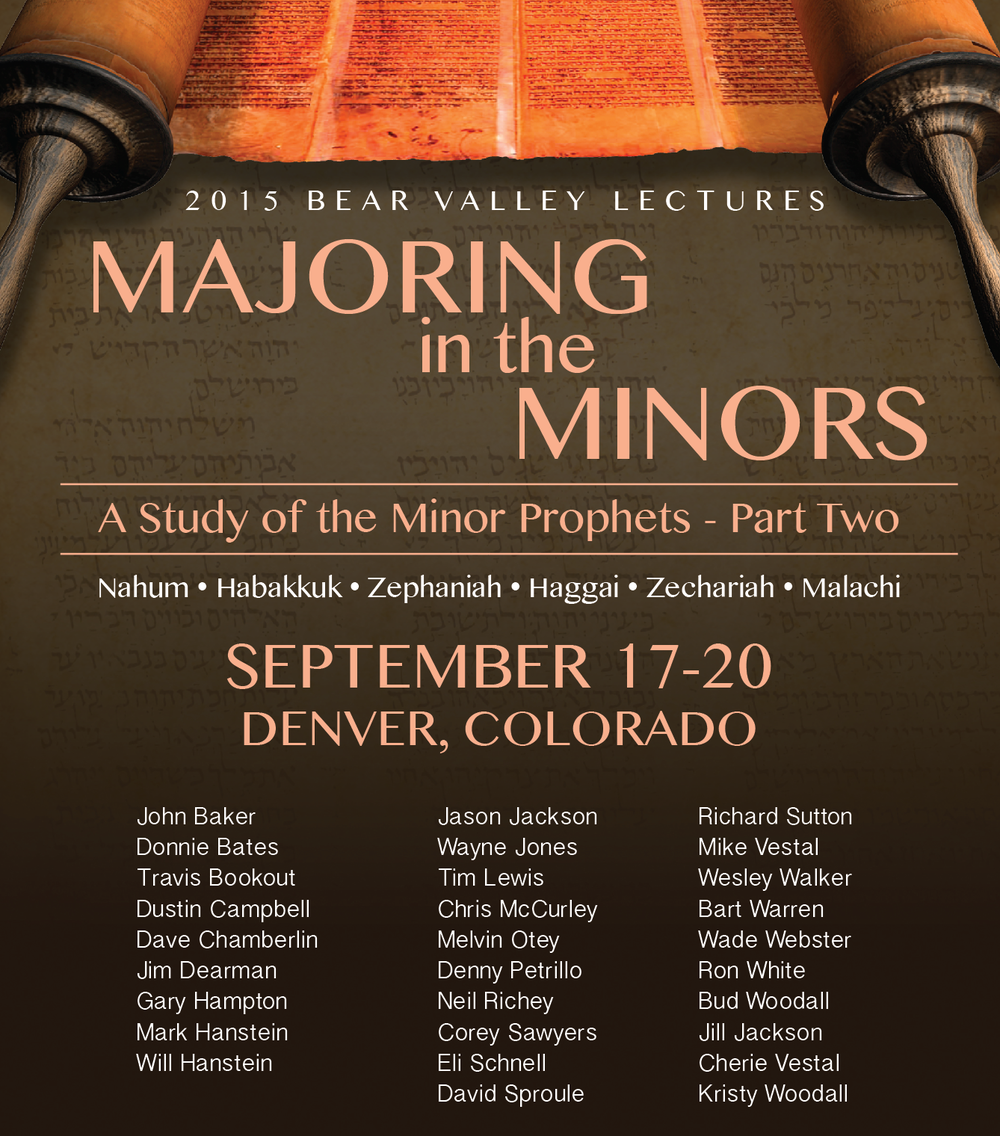
FACTS AND TRIVIA RELATED TO OUR LECTURESHIP

Neal Pollard

When the boys were younger, I would ask them questions about Old Testament characters as part of a quiz.  Included in that were questions about the Minor Prophets.  How well do you know the following without consulting your Bible (or Google)?

  • He wondered why God used a more wicked nation to punish his own nation.
  • He repeatedly talks about “that day” near the end of his book, referring to the day of Christ and the church.
  • He asked, “Will a man rob God?” and said, “God hates divorce.”
  • He wrote to condemn Nineveh and was a prophet of comfort for God’s people.
  • He said, “The just shall live by faith.”
  • He was the Minor Prophet who spoke the most about “the day of the Lord.”
  • His message was, “Rebuild the temple.”
  • He compared his nation to a person who touched an unclean body, who became unclean.
  • His book includes the “Shigionoth.”
  • He said, “The Lord is slow to anger and great in power, and will not at all acquit the wicked.”
  • He mentioned, “The Sun of Righteousness with healing in His wings.”
  • He saw a flying scroll.
  • He was the great-great grandson of Hezekiah.
  • He talked about putting wages in a bag with holes.
  • He talks about a Man whose name is “The BRANCH.”

All of these answers come from either the books of Nahum, Habakkuk, Zephaniah, Haggai, Zechariah, or Malachi.  This weekend will be more than about mere facts and information, though.  The message, principles, and application will enrich your heart and life because it is “a portion” of the Word of God. These prophets write at a significant time in Bible history, and the implications of much of their writing play out in the ministry of Christ and establishment of the church.  I hope you will come and be a part of our lectureship, if you can and for as much as you can. It will be a time of great growth and building up. Send me your answers and I’ll message you back with your “grade.” Happy test-taking!  See you here starting tomorrow night at 7 P.M.