Teachers’ Aids

Neal Pollard

Several of our classes have assistants to the Bible class teacher.  She (or perhaps in select cases “he”) serves in a support role, helping students do handwork, find Bible verses, or occasionally keep order.  These are vital roles, and often a teacher’s aid later actually becomes a teacher.  Teachers’ aids are part of a great team and education system that benefits everyone in the classroom.

There is a constant, pressing need for more teachers’ aids.  I don’t mean in the actual classroom during the “Bible class hour.”  These aids are needed Sunday afternoons, late Wednesdays, Saturday afternoons, and/or opportune moments between these times.  These aids have even more power than those helping the teacher in the classroom.  They are the parents and care-givers of the students.  There are several ways they can “aid” the teachers who put in hours of preparation time and tons of energy and emotion into the task of teaching.

Aid teachers by making sure your children do their homework.  Most teachers give homework, memory work or activity sheets.  This is a vital supplement to the actual lesson taught in class.  When children come to class with their homework done, teachers are elated and made to feel that their efforts are appreciated.  They feel that their students take the class as seriously as they do.

Aid teachers by asking about what they have learned.  Ask your children what they talked about in class that day.  Ask them to review as much as they can.  Ask them what they learned and how they can make application from the class.  What better topic of conversation can parents and children discuss on the way home from services?

Aid teachers by making sure they feel appreciated.  One way to do this is by making sure you practice the first two suggestions.  However, having the child send a thank you note or by personally thanking your child’s teacher, you are aiding through the means of encouragement.  Everyone likes to feel appreciated.  Teachers are no different.

The qualifications are simple enough.  To be this type of teacher’s aid, simply do all you can to partner with the efforts of your children’s teachers.  Your child, your home, and your child’s teacher all will be blessed by it.

teacher-talking-with-students

Learning About Worship From Children

Neal Pollard

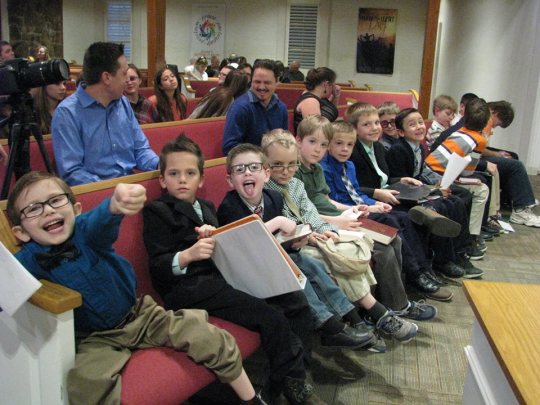
Thom Vaught gave the “elders remarks” last night after the Young Lions participated in their annual program of Scripture reading, song leading, prayer, and preaching. The fourteen first through six graders obviously listened well and learned much. Thom noted how we look at the Christian life as a marathon, but these boys (and the seventeen God’s Precious Daughters who hosted a tea in the fellowship hall at 4:00 PM yesterday afternoon for 80 Christian women!) were actually the next leg in a relay race.  Everybody seemed to leave the assembly last night so spiritually full and energized. Perhaps that was because of what we had seen (and learned) throughout last evening’s service.

…That genuine enthusiasm is infectious.
…That worship should be characterized by purity.
…That you cannot easily fake sincerity.
…That sometimes truth gets told most poignantly and effectively from such an innocent heart.
…That it is encouraging to see someone overcome their fears to lead.
…That we appreciate seeing those who lead us unashamedly show us their hearts.
…That worship should be joyful.
…That we should carry the experience of worship out the door with us into our lives.

When Thom asked those present last night who had formerly been through Young Lions and God’s Precious Daughters to stand along with the 31 children involved this year, it was overwhelmingly encouraging to see so many scattered among our healthy crowd last night who had received this wonderful training. The leadership training they have received through the years has contributed to the teenagers and young adults they have become, serving Christ and others. Some of them are married now. Others have graduated from preacher training schools or are students there. Others have gone on to Christian Colleges. They lead us in every phase of our worship regularly and effectively. We appreciate the men and women who came up with this program and all those who have served through the years. All of us are the better for it. Last night was a reminder of something Trent Woolley, who helped lead this year’s program, said to us, “Truly I say to you, unless you are converted and become like children, you will not enter the kingdom of heaven” (Mat. 18:3).  I pray we will carry these lessons learned into worship with us next week and the weeks beyond that!

17191020_997645827047006_5867707409707217276_n

16939339_803329306482297_3212391089732137726_n

Should We Let The Devil Make The Rules Of Engagement?

Neal Pollard

Thanks to the hospitality of my good friend, Jason Jackson, I had the opportunity to visit beautiful AT&T Park in San Francisco, witnessing a rarity (a Rockies win) against his beloved Giants.  It was LGBT Night at the old ballpark, an annual sponsorship of “SF Pride.” It was also the day of the historic Supreme Court decision mandating the recognition of same-sex marriage in all 50 states. The crowd was enthusiastic about that event in Washington, D.C., cheering when it was proclaimed over the P.A.  The videoboard featured gay and lesbian couples for its “kiss cam.”  While San Francisco is renowned for its “sexual progressiveness,” the city of Denver has earned a reputation for similar liberality of thought regarding homosexuality. In a growing number of places in our nation and especially among those under a certain age, there is welcoming, sanctioning language for homosexuality and vehement intolerance for the least word of condemnation of the behavior as sinfulness.  Even among those professing to be Christians, there is a changing posture in how or if it is dealt with.  Understanding that no sin is worse than any other, that it is not right to display an ungodly attitude in addressing any sin, and that there should not be an inordinate amount of time, attention, and energy given to any sin to the exclusion of the other, I wonder if even some of our Christian brothers and sisters have become unwitting pawns of the prince of this world regarding this matter.  The devil is at war against the Word and will of God, and he is at war against anyone loyal to such (Rom. 13:12; 2 Cor. 10:3-6; Eph. 6:10ff; etc.).  He wants his cause, the ultimate end of which is the spiritual destruction of all men, to succeed, and he wants the cause of Christ to be overthrown.  We know that his mission will ultimately fail, with there being those who are welcomed by our Lord to heaven (1 Cor. 15:24; Mat. 25:34-39). Yet, most will follow him to everlasting punishment and destruction (Mat. 25:41-46).  He has the bulk of the resources and influence of this world, as he almost always has had in every generation. He has powerfully allies and mouthpieces from Washington to Hollywood and most media and education outlets in between.

  • Who is behind the idea that we are not loving the sinner when we speak of homosexuality as sin?
  • Who would have us believe that we are mean-spirited or unrighteous if we use terms like “unnatural” (Rom. 1:26), “exceedingly grave sin” (Gen. 18:20), “ungodly” (2 Pet. 2:6), “gross immorality” and “going after strange flesh” (Jude 7) to describe homosexual behavior?
  • Who would sell us on the idea that loving the homosexual means keeping quiet about their practice of it, failing to warn them to repent (Ezek. 33:8)?
  • Who would seek to equate a behavioral choice (1 Cor. 6:9) with one’s race or skin color (Acts 17:26; Acts 10:34-35)?

What happened in our nation’s highest court last Friday may have been necessary to shake the church out of its general lethargy and indifference regarding evangelism.  What happened there will ultimately be overruled in the highest court there is (Mat. 25:31ff).  What happened there should not become our obsession, but neither are we wrong to take note of how this is a significant societal erosion.  Jesus implies how intolerable it would be for Sodom and Gomorrah at the Judgment (Mat. 10:15). The Lord overthrew them in “in His anger and in His wrath” (Deut. 29:23). Homosexuality is not the only sin there is nor is it the chief sin, but may we not be intimidated away from calling it what it is—“sin.”

Whose Voice Should Be Heard? Another Look At 1 Timothy 2:11-15

Neal Pollard

Paul averred that “all Scripture is God-breathed and is useful for teaching, rebuking, correcting and training in righteousness so that the man of God may be thoroughly equipped for every good work” (2 Tim. 3:16-17, NIV). Its source is God. Its value is exhaustive.  Its result is practical.  That is how the all-wise God intended it.

In the first letter to Timothy, Paul gives his thesis statement that all he wrote in the epistle was to give the young preacher knowledge of how the church was to conduct itself in various matters (1 Tim. 3:15).  One of several matters addressed in the letter was what role Christian women were to take in “the household of God” (the church) in matters of teaching and leadership.  We read about that in 1 Timothy 2:11-15.  Here is what we find:

  • The Christian woman must receive instruction with entire submissiveness (11).
  • The Christian woman is not allowed to teach or exercise authority over a man (12).
  • The Christian woman is to remain quiet (12).
  • There are biblical reasons for this, reasons that go all the way back to creation (13-14).
    • The order of creation (13)
    • The deception of the woman (14)
  • The Christian woman has an honored role to help the church thrive and grow (15).

What is remarkable is the lack of ambiguity regarding this teaching.  It is clear and straightforward.  No cultural issues or problems are stated to occasion these words.  One does not find contradictory instruction in another New Testament context to offset or clarify the words here. Perhaps it is the straightforwardness of the words that have chaffed many who appear desirous of bending truth to fit the culture.  Such bending is not limited to this issue, but as the culture regresses from truth more and more matters are getting reexamined in order to change truth to fit the culture.

We must understand that all such efforts, in effect, place human beings as the authority in place of God and Scripture.  It causes people to say, “You have read this, but I say unto you.”  The problem is that it is not our place to say that Scripture does not mean what it says.  That authority belongs to Christ, and He exerts that authority through the men who wrote down His will in the New Testament.  It is His voice and their voices that need to be heard.  Whoever they say should teach and lead is whose voices need to be heard.  Any other voice is speaking without the utterance of God (1 Pet. 4:11).

Ten Important Words With Good Illustrations

Neal Pollard

I–nteresting (illustrations are to grab attention or make the point memorable; beware of being one-dimensional–always quotes, poems, sports, etc.)

L–asting ( the preacher joke is that you can re-preach most sermons, you’ve just got to change the illustrations.  Why?  We remember good illustrations.  An illustration can help make a Bible lesson live on in people’s hearts)

L–earning (the purpose of the illustration is to aid in teaching the lesson; the illustration is not an end in itself.  It is a means to an end)

U–nderstandable (in that [a] people understand why the illustration was used where it was; does it fit & help establish the point?; [b] especially older illustrations or illustrations taken from those who speak formally or loftily need to adapted to your vernacular and way of speaking and not sound like you copied it out of an illustration book)

S–upportive (Don’t overdo illustrations; it’s not about the illustrations, but about the Bible lesson you are delivering; Some get this concept backwards)

T–ruthful (Be careful that your illustration will pass the truth test; Some people are jaded about “preacher stories,” finding them hard to believe or learning themselves they aren’t true; Verify as best you can the illustration you use and if you cannot verify then be careful not to pass it off as a “true story.”)

R–ealistic (In addition to truthful, make sure the illustration is “reasonable,” something people can relate to; Ex.–In cross-cultural situations, especially in 3rd-world countries, illustrations about extravagances or items said to cost “X” when the same item is either much cheaper there or is so extravagant that your audience can’t relate)

A–ssorted (Vary types of illustrations: poem, current events, historical events, quotes, parables, fables, jokes [in moderation], Bible accounts)

T–asteful (avoid overly shocking, graphic, suggestive, morbid, salacious illustrations; Wendell Winkler once said, “Avoid creating in one’s mind what you are trying to condemn” [Ex.: illustration about sexual immorality or the like])

I–lluminating (The purpose of the good illustration is to shed light on a Bible truth; It should help produce an “aha” that drives home your point)

O–pportunistic (Take advantage of current events, congregational situations, holidays, etc.  Use wisdom, common sense, and discernment to know what is and isn’t off-limits; Note: Concerning “congregational situations,” only in exceptional circumstances would I use a “negative” one rather than a positive or neutral one).

N–ecessary (Without them, lessons are dry and lifeless; Like windows without curtains; They can make all the difference in whether or not the point sinks in, convicts, and moves the heart of the hearer).

His Name Meant “Comfort”


Neal Pollard

Whose name meant “comfort”?  Noah’s! Lamech says as much.  When Noah was born, Lamech proclaimed, “This one shall give us rest from our work and from the toil of our hands arising from the ground which the Lord has cursed” (Gen. 5:29). The NIV and KJV, among others, puts the word “comfort” for “rest,” Lamech was optimistic that Noah, would help alleviate the labor pains of farming in cursed ground.

Have you stopped to think about the meaning of Noah’s name and the mission of Noah’s life? What was his task? He was to build the ark, but he also preached (cf. 2 Pet. 2:5). Now, as to how many people Noah preached to, the Bible is silent. One might assume that he preached as far and as widely as a man engaged in such an enormous building project could. Or, one might say that he preached by the example of his righteous life (cf. Gen. 6:9).  The best understanding of 1 Peter 3:18-21 may be that Christ preached to the disobedient ones through Noah’s efforts prior to the flood.

If Noah did preach to the disobedient, and/or admonished and exhorted onlookers and scornful neighbors to get on board the ark, he still was seeking to provide comfort. The thing to understand about giving comfort is that it does not always mean speaking soothing words, placating people, or telling them what they want to hear. That is, at times, a very appropriate and needed response–especially when people are suffering or trying to stay faithful. Yet, comfort can also be the fruit that only comes after a warning or rebuke. When a person is on a self-destructive course, they are destined for something inconceivably awful! What can a compassionate Christian do but try with tremendous effort to steer them back on course? That may be the only way that wayward sinner comes to the place where eternal comfort is once more a possibility.

Remember Jude’s teaching. He said, “And have mercy on some, who are doubting; save others, snatching them out of the fire; and on some have mercy with fear, hating even the garment polluted by the flesh” (Jude 22-23). Sometimes, comfort is in the product and not in the raw material or the manufacturing. Always being loving, let us risk offending now so that eternal comfort can be had later! The Christian’s name, nature, and business centers around that real, spiritual comfort, both for the Christian and those whose lives he or she touches (cf. 1 Tim. 4:16).

PRACTICAL TIPS FOR TEACHING

Neal Pollard


  • Take the time at the beginning of class to break the ice, exude warmth, and build rapport.
  • Make sure you have done due diligence, entering the classroom with ample preparation.
  • Strike the balance of being “open” and “approachable” as a teacher without putting out the vibe of vulnerability or uneasiness.
  • Guide the direction of the class rather than letting the class direct you.
  • Always ask questions that are meaningful and not those that are either fillers or those that insult the student’s intelligence.
  • Avoid embarrassing or putting the student on the spot, as you cannot know the frame of mind or circumstances that may be weighing on him or her in that moment.
  • Never fail to draw conclusions and take a stand on matters of faith.
  • Do not overly press personal convictions or judgment calls upon the classroom.
  • Keep the specter of pride away from your heart so that you do not always feel the need to be right and for the student to be wrong.
  • Do not let blatantly false statements by the student go unanswered–speak the truth in love, but remember the utmost need for truth to be upheld.
  • If you make the class interesting (this is the product of study and preparation, including searching for appropriate illustrations), class feedback and discussion takes care of itself
  • Budget your time, neither glossing over or bogging down in material
  • While forced excitement will seem artificial, generating genuine passion and enthusiasm is infectious and aids the learning environment.
  • Leverage the resources in the room, looking to mature, knowledgeable Bible students to assist you in making particularly difficult or controversial points.
  • After properly interpreting and teaching the biblical text, be ever the gleaner for application–material the student can take and translate into daily living and personal use.

42440882_10155829691855922_6925324307383975936_n