One of the strangest moments in Roman history probably belongs to crazy Caligula. Why? Well, he’s the emperor who declared war on the sea.
This wasn’t a battle on the sea, this was a battle with the sea.
According to the Roman historian Suetonius in The Twelve Caesars, Caligula marched his legions to the coast of Gaul around A.D. 40 and he formed his soldiers in battle lines facing the water.
Then he gives a command— attack!
The troops were ordered to stab the waves and hurl javelins into the surf. Afterward, Caligula reportedly instructed them to gather seashells as “spoils of war”—from Neptune (Rome’s god of the sea).
Was the story exaggerated? It’s possible. Even if the only truth to the tale was that a man waged war against the ocean it still provides the perfect illustration for many things in life. The illusion of human power, being one of them. An emperor who ruled millions could command armies, raise your taxes, and build monuments — but he couldn’t slay the sea. The ocean didn’t retreat and the waves did not surrender.
The Bible tells us who has sovereignty over the waters:
“Who shut up the sea behind doors when it burst forth from the womb… when I said, ‘This far you may come and no farther; here is where your proud waves halt” (Job 38:8–11)?
God reminds humanity that only He sets boundaries for the ocean. Kings may flex, and armies might rage, but the tide answers to no one but Him.
Caligula’s strange spectacle at the beach becomes sort of a parable doesn’t it? When humans attempt to assert divine authority over creation, they expose their limits. A lesson nobody ever wants to learn is that power without humility turns into absurdity. Or, to put it another way; authority without submission is self-parody.
The sea still keeps its boundaries, not because an emperor commanded it— but because God did.
Daniel prophesied of the Persian and Greek eras of Israelite history. The angel interpreted that for us, so there’s no mystery there. That mean man of the Diadochi, Antiochus Epiphanes, is described with his persecution lasting 2300 days. It was concluded by the Rededication of the Temple by Judas Maccabee, and that day became the Jewish Festival of Lights (John 10:22).
Daniel 11-12
The number of days in this query are set in a prophetic history that covers the entire second temple era of Judaism.
It relates the Persian kings to the conquest of Alexander the Great, to the break-up of that empire into the Diadochi, to the rise of Antiochus Epiphanes and the Maccabees, to the Roman conquest of the East, to Herod the Great, and to the final Destruction of Judea by the Roman generals and the Zealots.
Some of the final verses in this vast prophecy are referred to by Jesus in the address on Mount Olive (Dan. 12:1,11; Matt.24:15,21).
The interpretation of these number of days must fit into this first century time period (the end of the Second Temple Era).
Abomination of Desolation
According to the synoptic section in Luke, the Abomination of Desolation (that which makes desolate) was the Roman Legions (Luke 21:20). The number of days that those armies marched up and down the land of Judea was 1290! Recall that Jesus warned His disciples to flee Judea, not just Jerusalem.
This devastation was widespread with villages being torched in Galilee, Perea, Samaria, and Judea proper, with supply lines cut off from Jerusalem. When the soldiers finally besieged Jerusalem their fate was sealed— literally! All of this time period (with dates) is recorded by an eyewitness Jewish general by the name Flavius Josephus who had been captured.
The 1335th Day
The city of Jerusalem had its three defensive walls breached. The inhabitants were slaughtered. The Temple was burned and torn down just like Jesus said. Everything was trampled down except for a Herodian palace in the Upper City where the last Jews barricaded themselves and refused to surrender. It’s estimated that they had plenty of water and food supplies to last for an unknown period of time. The walls were so thick the Roman General, Titus, decided to wait it out.
But amazingly, the remaining Zealots opened the gates on the 1335th day of this war!
Note the remarks of Josephus’s history concerning Titus’s surprise:
“Now when Titus came into this (upper city), he admired not only some other places of strength in it, but particularly those strong towers which the tyrants in their bad conduct had relinquished; for when he saw their altitude, and the largeness of their several stones, and the exactness of their joints, and also how great was their breadth, and how extensive their length, he expressed himself…’We have certainly had God for our assistant in this war, and it was no other than God who ejected the Jews out of these fortifications; for what could the hands of man or any machine do towards overthrowing these towers?’” (Wars, VI,9:1)
If the tyrants had stayed in the fortress, the Roman Legions would have stayed around the territory and continued to massacre the Jewish people. The soldiers had seen the despicable display of gross inhumanity the Zealots committed on each other and innocent people, and they had no mercy for them. But as Jesus said, with the mysterious surrender— the killing would stop:
“And except those days be shortened, there would no flesh be saved, but for the elect’s sake those days shall be shortened.”
(Matthew 24:21-22)
Conclusion
These days, 1290 and 1335, are seen fulfilled by recorded history. There is no need for guessing or speculation. They fit the time period required by the chapters 11-12 which end with the topic of the Ending of the Jewish Era. It is this same topic that Jesus dealt with in the first half of the Olive lesson, which Jesus said was to occur within that generation (30-70 A.D).
No, these days do not refer to any Great Tribulation at the End of the World. These prophesied days were fulfilled to the day— in the first century! They’re important because they mark the end of the Old Testament economy, and the rise of the fantastic Kingdom of God.
(Hebrews 8:13, Luke 13:35, 16:16; the years 30-70 A.D. were transitioning times)
When Jesus was asked about the most important commandment of all, He quoted the Shema. In Hebrew, “Hear o Israel,” is “Sh’ma Yes’ra’eil.” This wasn’t anything new, but was an essential verse. It is the first a Jewish child will memorize. The question of the most important commandment had long been settled among God’s people, “Love the Lord God with all of your heart, soul, mind, and might.” And all of Israel knew that truth since God was clear on this to begin with. Knowing the truth was the easy part. Acting on it was another story.
Jesus fulfilled this command perfectly. He loved God completely. He depended on God through prayer, knowing the Scriptures, and submitting to God’s will even at the cost of His life. What does it take to love God completely? In Mark 10:17-22, another man approached Jesus, desperately wanting to please God. He runs up, falls on his knees before Jesus, and asked, “Good teacher, what must I do to inherit eternal life?” Jesus answers with, “You know the commandments: ‘Do not murder, do not commit adultery, do not steal, do not give false testimony, do not defraud, honor your father and mother.’”
The man said he had kept them all. Jesus looked at him and loved him. “One thing you lack,” he said. “Go, sell everything you have and give to the poor, and you will have treasure in heaven. Then come, follow me.”
This man couldn’t do it. He left, overwhelmed with emotion. Turns out he was very rich. What was the problem? This man loved his wealth too much to give it all away, and until he was willing to make that sacrifice he could not have the one thing he lacked: Jesus.
Once we realize who Jesus is and what He offers us, there is nothing we wouldn’t give to have Him. Jesus loved the “rich young ruler,” but the man who came to him couldn’t part with the things he loved. That’s exactly how it is today, a Savior who loves us, but we can’t seem to love Him enough to sacrifice. When people see this kind of sacrificial love for God, they never forget it. Those who love God with their entire being leave a legacy that isn’t quickly forgotten.
There are many to this day we can all think of who left a powerful legacy because of their love for God. The Plague of Cyprian came along a couple centuries after the time of Jesus. One document says that in Rome, where a million people lived, as many as 5,000 died per day. This plague terrified people. It was so devastating that when the first symptoms appeared some villages simply emptied out, leaving the sick behind. There was no cure. There was no hope. So they left sick family members in their beds and ran for their lives. But Christians didn’t run. They stayed and brought water to the sick. They fed them. They changed their bandages. They loved and encouraged them. And they even got sick in the process.
There’s no telling how many people came to Christ because Christians served, and there’s no telling how many Christians lost their lives because they stayed behind. People were stunned at the love these Christians showed to the sick. This is why the Roman Empire changed so dramatically.
They couldn’t ignore the actions of people who loved God so much that they would be willing to give up their lives. And in the same way, when we sacrifice on behalf of others, they will see our love. The church that sacrificially loves and cares for its community will discover that it holds more power than any person or group in power.
There’s no single action that defines a person who loves God completely, but fulfilling the royal law will always speak volumes of our love for God.
Understanding Revelation’s Message for Then and Now
Brent Pollard
John wrote the Book of Revelation when the Roman Empire persecuted Christian communities. Emperor Domitian had exiled John to the island of Patmos. So, while in exile during Domitian’s reign, John wrote to encourage other persecuted Christians. Given the focus of the first three chapters on seven specific churches in Asia Minor (i.e., Turkey), as well as the emphasis on this being an urgent message (1.3; 22.10), we can conclude that the original audience of John’s apocalypse was these seven churches located in the heart of the imperial cult.
The imperial cult’s prominence in Asia Minor created significant tensions for Christians in Ephesus and Smyrna, two of the seven cities to which Jesus sent His message. Polycarp, a disciple of John, was martyred in 155 AD in his hometown of Smyrna. Domitian (81–96 AD) declared himself to be a god, adopting the title “Dominus et Deus” (Lord and God). Loyal Romans believed participating in cultic rites was a way to pledge allegiance to the emperor and Rome. We can quickly see how this caused problems for the burgeoning Christian community, which only referred to Jesus as their Lord and God.
The Christian community suffered socioeconomic consequences as a result of this refusal. Evidence shows that participation in the Imperial Cult was a prerequisite for engaging in certain types of business or trade in some parts and times of the Roman Empire. Members of trade guilds, which governed various kinds of commerce and industry, for example, might be expected to participate in the Imperial Cult as part of their membership.
Christians who refused to worship the emperor would have been economically marginalized. It’s no surprise that John compares imperial cult submission to having the “mark of the beast” (Revelation 13.16–18). The gematria system reveals the meaning of the number “666” to be “Nero Caeser.” As such, the beast was Rome, with Nero as the first prominent persecutor of Christians, responsible for the deaths of Peter and Paul, among others.
The calls for faithfulness and warnings against compromise in Jesus’ direct messages to the seven churches would have resonated in the context of the temptation to assimilate and abandon spiritual beliefs for worldly acceptance or prosperity. While the specific nature of persecution differed across time and emperors, the struggles referenced in Revelation reflect a consistent tension between the emergence of Christianity and the Roman imperial system.
Symbols like Babylon the Prostitute and the Beast represent the decadence and oppression of Rome, especially under despotic rulers who declared themselves gods and demanded worship. Revelation transitions from tribulation under oppressive powers to expressing hope in God’s ultimate triumph over evil. This message of persevering faith leading to redemption would have encouraged early Christian communities to face real-world hardships and persecution.
While modern forms of oppression differ, Revelation reminds believers that staying true to one’s values in adversity is critical. Its themes demonstrate that faith and integrity will triumph over darkness. Deliverance comes through steadfast devotion. And, in a world of growing groupthink and social credit systems, Christians in the twenty-first century may need this message of perseverance even in the face of socioeconomic isolation and persecution as a reminder not to bow the knee to anyone but Christ.
Revelation, with its intricate tapestry of symbols, warnings, and prophecies, is a testament to the enduring human spirit in the face of overwhelming oppression. Its timeless message transcends its ancient origins, providing comfort and guidance to generations. As believers faced the might of the Roman Empire in the past, today’s challenges, while different, are no less demanding. Revelation reminds us that faith can move mountains in any age and that the light of truth, no matter how dimmed by adversity, will always find its way.
One of the tedious but necessary items we pay attention to on the news is the economic reports. No, we do not do so out of love for money, but because we desire to be good stewards with the resources with which God has entrusted us. But unfortunately, the SARS-COV-2 virus has had quite an impact on our economy. In addition, we are coming up on the third anniversary of the pandemic shutdowns. So, it is safe to say that things have yet to return to where they were before March of 2020.
Some industries, like the hospitality industry, have been decimated. For example, as of January 2022, the National Restaurant Association found that about 80,000 restaurants have closed because of COVID.1And those restauranteurs with an open business have difficulty staffing themselves and obtaining supplies. Here locally, I noted a combo KFC and Taco Bell franchise offering an $500 sign-on bonus in January 2021 to rectify the labor shortage. I have since read of other fast-food restaurants across the nation likewise offering large sign-on bonuses to perform what is considered non-skilled labor.
Now, I do not call any work in which one employs himself to be beneath anyone’s dignity, despite the technical designation of some jobs as being “non-skilled.” On the contrary, these are routine jobs suitable for teenagers seeking their first job experiences or seniors needing to supplement their retirement or stay active. But something has happened because of the pandemic. Whether large or small, one factor that keeps people away from gainful employment is the CARES Act, passed in March 2020. With this piece of legislation, one could argue that our federal government incentivized the acceptance of unemployment payments that, for many, exceeded the salaries earned at jobs from which COVID displaced them. In contrast, we might point out that those states doing better economically today wised up quickly and took away those incentives to stay out of work.
And now, we are hearing a strange new phrase on newscasts: “The Great Resignation.”2 Since there are more jobs than workers, people dissatisfied with their current occupations opt to quit. You have likely heard the real estate terms of “buyer’s market” and “seller’s market.” The former is a real estate market where buyers have the upper hand. As a result of various circumstances, there is more inventory than demand. As a result, the buyer has greater leverage to ask for price reductions from the homeowner. In a seller’s market, you have the opposite conditions. There is less inventory available. So, a buyer will pay more to purchase a house or land because other potential buyers are waiting in the wing. With the Great Resignation, the thought is that we are basically in a “worker’s market.” These job-shoppers know that employers need workers so desperately that they will do things like offering $1,000 to entice them into accepting the position they offer.
As anecdotal evidence for this “worker’s market,” I will offer a repeated observation from my lengthy hospital stay in 2021. There is no doubt that doctors and nurses have had it rough during the pandemic. Thus, we rightly call their actions heroic. But among the nurse technicians, I heard a few of the “lesser heroic” ones talking about how they loved the current climate because they could just quit abruptly and walk down to the next hospital to take advantage of the better incentive package they offered. Before someone thinks I am being too harsh, I will tell you more. These individuals said they could bounce around, even returning to the hospitals that they had left to game the system. Their “loyalty” was to the highest bidder.
What has this to do with Christians or theology? I will put the question to you this way. What kind of a society is born from our current environment with people choosing to stay at home and collect benefits for not working or taking advantage of desperate employers? Does this mindset end with work, or does it spill over into all of one’s life? Is there an immoral cause? Paul cautioned the Thessalonicans: “…if anyone is not willing to work, then he is not to eat, either.” (2 Thessalonians 3.10 NASB1995) In addition, idleness poses a danger. An idiom pairing well with 2 Thessalonians 3.11 is “idle hands is the devil’s workshop.” Paul said the nonworkers within the Thessalonican church made themselves busybodies, living undisciplined lives. Ouch.
Remembering one’s actual Employer resolves a part of this problem. Paul reminds us:
“Slaves, in all things obey those who are your masters on earth, not with external service, as those who merely please men, but with sincerity of heart, fearing the Lord. Whatever you do, do your work heartily, as for the Lord rather than for men, knowing that from the Lord you will receive the reward of the inheritance. It is the Lord Christ whom you serve.” (Colossians 3.22-24 NASB1995)
Though not “slaves” in the same sense as those recipients in the first century (most people living in the Roman Empire were slaves to someone), we see how we are fángnú (Chinese for “mortgage slaves”) today. God expects us to be industrious. Even the inaugural pair placed in paradise had to “cultivate and keep” their garden home (Genesis 2.15). A nation where people work doesn’t have time to riot, loot, play keyboard warriors, “cancel” others, or push agendas on other people’s children. We are citizens of the Heavenly Kingdom first and foremost but let us not participate in those shortcomings here that create a land where you get paid a sign-on bonus to flip burgers.
The Herodian dynasty actually began during the civil wars of the first century B.C., when Palestine passed from Hasmonean (a Jewish family that included the Maccabees) into Roman rule. “The name ‘Herod’ is Greek and originated with a shadowy ancestor about whom, even in antiquity, little was known. Two ancient traditions make him either a descendant of a notable Jewish family with a lineage traceable to the Babylonian exile or a slave in the temple of Apollo in the Philistine city of Ashkelon. Neither can be proved” (Achtemeier 385). For well over a century and a half, the Herods would figure prominently in the Roman government under a multitude of emperors from 67 B.C. to about 100 A.D. The first ruler of this dynasty is Antipater I, who is appointed governor of Idumaea by the Hasmoneans. The Idumaeans are forced to “convert” to the Jewish faith, making them Jews at least in name. Meanwhile, Antipater’s son, Antipater II, through military and political savvy, earned Roman citizenship for his family and positions of power for his oldest two sons, Phasael and Herod. The latter was named governor of Galilee and was ultimately known as “Herod the Great.”
“Herod the Great” is the first of this dynasty to be mentioned in Scripture. He has a long reign characterized by guile, violence, and political alliance. By the time we read about him at the birth of Jesus, he’s months from dying. He had had ten wives and borne several sons who would fight with each other before and after his death. He had won acclaim among the Romans for his grandiose building projects, including the city of Sebaste, Strato’s Tower, Caesarea Maritime, Masada, Machaerus, the Herodium in Perea, the Alexandrium, Cypros, Hyrcania, and the Herodium southeast of Bethlehem (ibid. 386-387). No doubt his greatest architectural achievement was the extravagant rebuilt Jewish temple in Jerusalem, which the disciples of Jesus took such great pride in (Mark 13:1).
This Herod is shown to be cunning (Mat. 2:7), deceitful (Mat. 2:8), violent-tempered (Mat. 2:16), and vicious (Mat. 2:16-19). Information gleaned from outside the Bible confirm these character traits. Josephus especially chronicles Herod’s depravity with reams of material about murders he committed, intrigues he entered into, and power struggles he fought (Antiquities 14-18). Blomberg observes,
It is often observed that there are no other historical documents substantiating Herod’s “massacre of the innocents.” But given the small size of Bethlehem and the rural nature of the surrounding region, there may have been as few as twenty children involved, and the killings would have represented a relatively minor incident in Herod’s career, worthy of little notice by ancient historians who concentrated on great political and military exploits (68).
In addition to what we read of him in Matthew 2, “many of Herod’s building projects serve as backdrops for events of the New Testament” (Winstead, n.p.). Bethlehem is near the Herodium. Gospel writers repeatedly reference his rebuilt Jerusalem temple (John 7-10). The book of Acts refers to his coastal city of Caesarea, called Caesarea Maritima (Acts 8; 21:8; 23:33)–different from Caesarea Philippi in Matthew 16:13. As a living legacy to his wickedness, three of his sons disputed over what and how much territory they would rule. Augustus Caesar settled the matter by dividing the kingdom “but withholding the royal title of “king” from all of the heirs” (Garcia-Treto 378).
The most notable thing about a man who pursued and was granted a measure of earthly greatness is the contrast between himself and the baby Jesus, “king of the Jews” (Mat. 2:2). He sought power and greatness. Jesus emptied Himself to be born in our likeness (Phil. 2:5-7). Herod sought self-preservation, but Jesus came for our preservation (1 Tim. 1:15). Herod jealousy guarded his position, but Jesus “gave the right to become children of God” (John 1:12). We will see the contrast between Jesus’ kingdom and the sordid legacy of King Herod, revealed in what the Bible says of his wicked descendants.
Sources Cited
Achtemeier, Paul J., Harper & Row and Society of Biblical Literature. Harper’s Bible dictionary 1985 : 385. Print.
Blomberg, Craig. Matthew. Vol. 22. Nashville: Broadman & Holman Publishers, 1992. Print. The New American Commentary.
Garcia-Treto, Francisco O. “Herod.” Ed. Mark Allan Powell. The HarperCollins Bible Dictionary (Revised and Updated) 2011 : 378. Print.
Winstead, Melton B. “Herod the Great.” Ed. John D. Barry et al. The Lexham Bible Dictionary 2016 : n. pag. Print.
Herod’s Palace at Masada (Photo Credit: Kathy Pollard, July 2017)
A researcher at the Royal Society of Medicine in the UK published a paper called “The Spoilt Generation.” He ties the alarming rates of child depression, teenage pregnancy, obesity, violent crimes by adolescents, and more to a basic lack of respect for authority (Daily Mail). The Cato Institute published a study simply entitled, “Respect For Authority.” One of its most basic findings is that the public believes social instability follows disrespect for authority (Cato).
What do you think? Have you noticed a decline of respect in society for parents, teachers,the police, employers, and others in a position of authority? Most of us would agree it’s happening, and that it is not good. Peter warns about it in the most sobering of terms, speaking of the unrighteous who face eternal punishment as those who, in part, “despise authority (2 Pt 2:10). Jude offers a very similar warning, describing those who turn God’sgrace into permission to do whatever they please (4), and this includes their “rejecting authority” (8). So why do we often have a problem with authority?
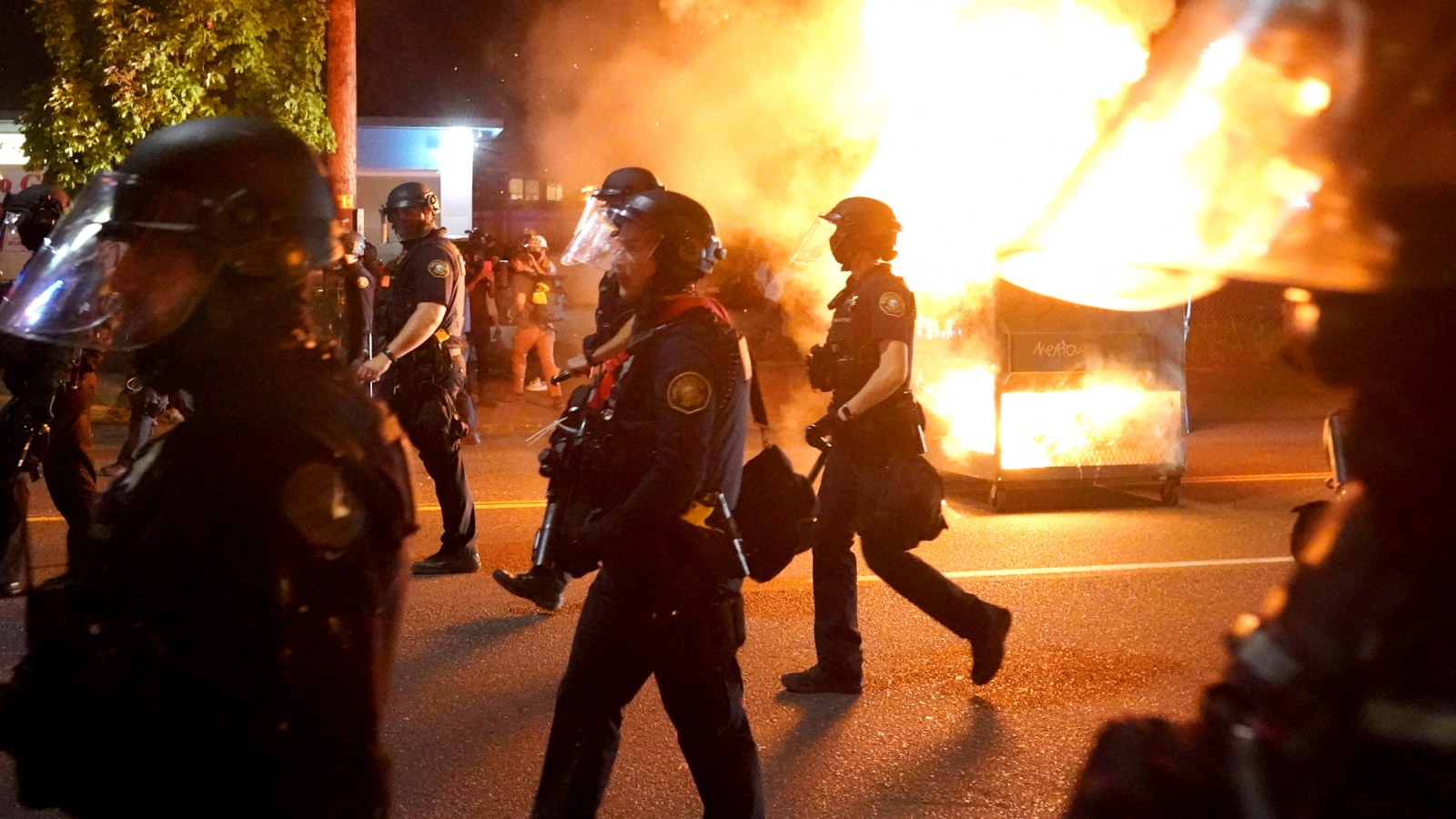
We have a problem with rebelliousness. Saul, the earthly king, had a problem with rebellion (1 Sam. 15:23). Paul writes Timothy, discussing why the Law of Moses existed. It was for unrighteous people, and at the top of that list were the lawless and rebellious (1 Tim. 1:9). Rebellion is insubordination. It characterized the period of the Judges, when everyone did what they thought was right to them (17:6; 21:25). As we look at crime in our current society, we see the fruit of rebellion. CNN reports a 33% increase in homicides in major U.S. cities from 2019 to 2020, and now it is up another 24% since the beginning of 2021 (CNN). Yet, cities like Baltimore no longer prosecute drug possession, prostitution, and other low-level offenses. In California, shoplifting has in some places ceased to have any legal ramifications. How many looters in major U.S. cities have never served a day in jail or paid a penny in fines? Romans 13 clearly condemns this. Paul says “whoever resists authority has opposed the ordinance of God; and they who have opposed will receive condemnation upon themselves” (2). Most of us would condemn this nationally, but do we struggle with rebellion against authority closer to home? Do we struggle with it against employers, elders, and parents? Rebelliousness can be milder than murder and more limited than against government. Do we only submit if we accept what they lead us to do? Do we maintain meekness and gentleness only if we agree with them? Rebellion is not the mark of a disciple of Christ; such have a different master.
We have a problem with respect. Paul says, “We ask you, brothers, to respect those who labor among you and are over you in the Lord and admonish you,and to esteem them very highly in love because of their work. Be at peace among yourselves” (1 Th. 5:12-13). Esteem, as a verb, is found 28 times and means to think, consider, or regard. Paul is telling the church how to regard their leaders (“very highly in love”) and why (“because of their work”). Interestingly, the noun form of this verbs is often tied to various types of leadership–“Ruler” (Mt. 2:6), “leader” (Lk. 22:26), “governor” (Acts 7:10), “chief” (Acts 14:12) and “leading men” (Acts 15:22). But in 1 Thessalonians 5:13, it is a verb and means to engage in the intellectual process of thinking of them with the highest respect. The word “esteem” deals with our character generally and not just how we treat elders and any other leaders. Philippians 2:3 says, “With humility of mind regard one another as more important than yourselves.” But Peter speaks of some who “count it a pleasure to revel in doing wrong” (2 Pet. 2:13). Respect is a matter of how you set your mind. If we don’t have it in our hearts to respect those in authority, it can’t help but show in the way we speak to them or about them. Our children learn how to treat authority figures by watching and listening to us. What are we teaching them?
We have a problem with our religion. “Religion” is only found four times in the New Testament. It means appropriate beliefs and the devout practice of our obligations (Louw-Nida, 530). How do we properly express our religion? It is not just about worshipping the way God commands. That’s a vital part, but only one way. Paul tells us what his pre-Christian religion looked like (Acts 26:5). He tells us about the false religion of some, ruled by their fleshly minds (Col. 2:18). James uses the word “religion” twice, in James 1:26-27. He teaches that pure, untainted religion is proven or disproven by your thoughts, words, and deeds. When I show disdain toward those in authority in or out of the church context, I’m telling everyone who witnesses it about my religion. I am making an impression on them that will either lead them closer to God or farther away from Him. Whatever I tell them about the one(s) in authority, I am telling them far more about me. If they follow my lead, will they stumble (cf. Lk. 17:1-2)?
Our problem with authority is ultimately a problem with God. When Paul tells Rome that those who resist authority oppose God’s will, he was talking about a government ruled by wicked Caesars who murdered Christians. When I disapprove of or disagree with those in positions of authority, in the nation, church, workplace or home, I must respond how God says respond. I must leave the rest to Him.
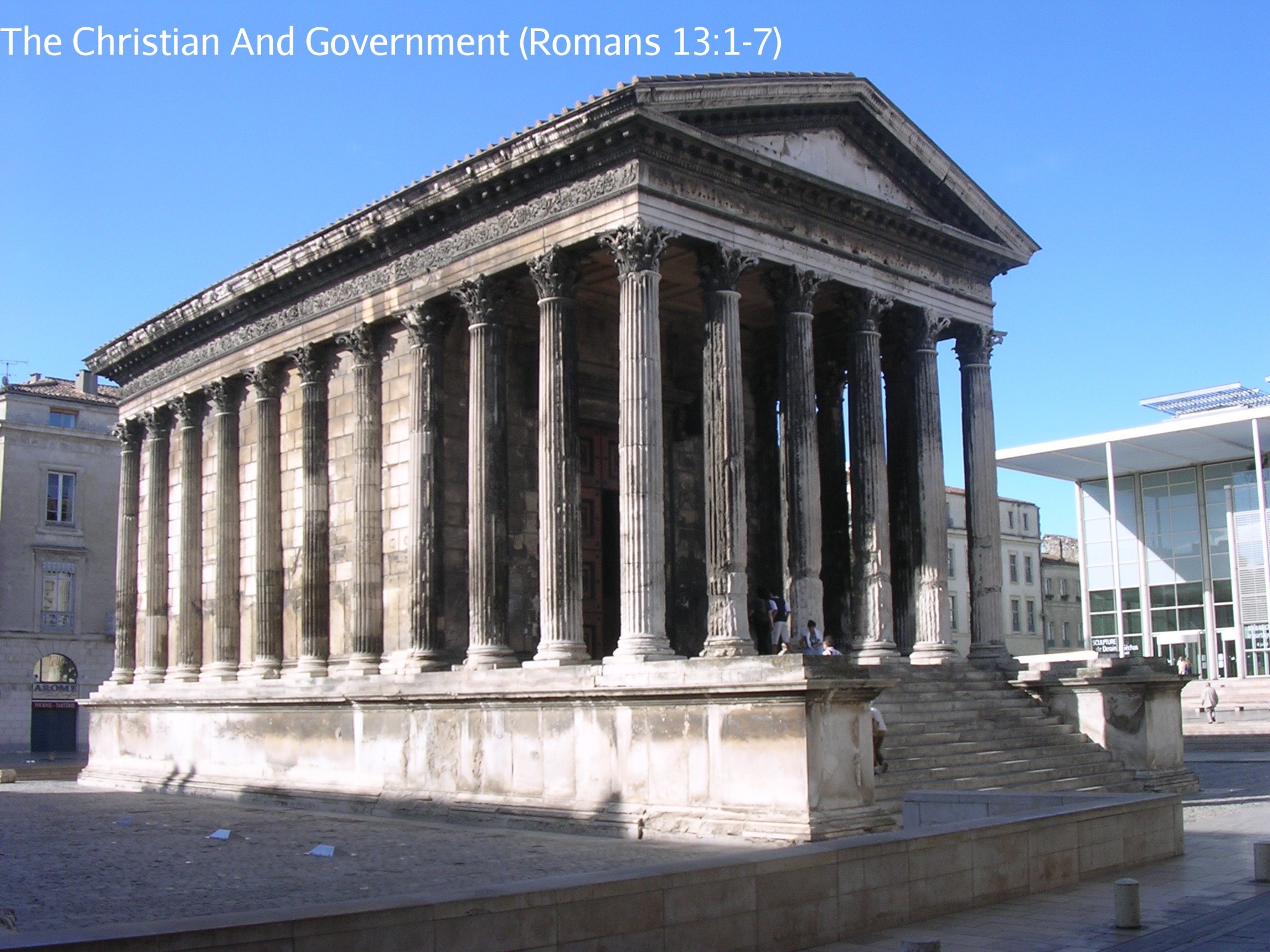
There is a passage that can be so disturbing because it is so adamantly clear. That passage is Romans 13:1-7. The early church fathers had a lot to say about this passage. They lived at a time when the government sponsored and led persecution and even execution of Christians simply for being Christians and sharing Christ with others. Nobody living in our country today has any experience with what this is like. Despite the pain and price inflicted by the Roman Empire on them, over and over the early Christians defended Paul’s words in Romans 13.
Basil—It is right to submit to higher authority whenever a command of God is not violated thereby
Ambrosiaster—Those who believe cannot play fast and loose with the law
Apollinaris—To disobey rulers is condemned as a mistaken way of thinking
Chrysostom—There should be rulers and ruled and…that things should not just lapse into anarchy is the work of God’s wisdom (Ancient Christian Commentary, Vol. VI, Oden, ed.).
Whether you long for the Obama administration or love the Trump administration, whether you love or loathe your governor, senators, and congressmen, Romans 13 applies to us today. Whatever your feelings about law enforcement or our judicial system, Romans 13 applies to us today. No one should be more conscientious about their relationship to the Civil Government than a Christian. What does this text reveal to us about “the earthly powers that be?”
The government has a Divine source (1). They are “from God” and “established by God.”
The government is a divine statute (2). Paul calls their ruling “the ordinance of God” and he warns against opposing such.
The government is comprised of Divine servants (3-6). The term Paul repeatedly uses of those within such earthly institutions is “ministers of God” (“servants of God,” 6) bearing the sword, bringing wrath, and devoting themselves to maintaining divinely-ordained order on earth.
The government carries Divine stipulations (7). God calls for Christians to render them what is due to them, namely taxes, customs, fear, and honor.
The limit to this is if they command us (forbidding or making us) to do what would cause us to disobey God (cf. Acts 5:29). That is not the same as commanding us to do something that restricts our “rights,” “freedoms,” or “liberties.” There may be privileges we enjoy in a free nation which contribute to our comfort, happiness, and enjoyment. They may even be dubbed “unalienable rights” in our national constitution. May we never confuse earthly privilege with divine precept. The inspired Paul makes it clear that God is behind government for the reasons seen above. Peter, in a context about civil government, reminds us that we are “aliens and strangers” on this earth (1 Pet. 2:11; cf. 13ff). As we loudly, lustily sing, “This world is not my home, I’m just a passing through…” “For such is the will of God that by doing right you may silence the ignorance of foolish men” (1 Pet. 2:15). May God give us the strength and wisdom to this end!
AD 30—Tiberius, who became cruel and mad, was the Roman Emperor when the church was established. Under his reign, right around the time of Pentecost, Rome was filled with terror after the murder of his once trusted advisor turned traitor, Sejanus (tribunesandtriumphs.org). Sanderson Beck comments that he was “preoccupied with sexual and sadistic perversions” the last several years of his life (he is believed to have been murdered)(san.beck.org). Jerusalem was directly governed by Rome. Acts, though probably written in the 60s, begins its historical chronicle around AD 30.
Acts 2:41—“So then, those who had received his word were baptized; and that day there were added about three thousand souls.”
Acts 4:4—“But many of those who had heard the message believed; and the number of the men came to be about five thousand.”
Acts 5:14—“And all the more believers in the Lord, multitudes of men and women, were constantly added to their number.”
Acts 6:7—“The word of God kept on spreading; and the number of the disciples continued to increase greatly in Jerusalem, and a great many of the priests were becoming obedient to the faith.”
See also Acts 12:24 and Acts 19:20,
AD 62-63—Nero, described as licentious, cruel, tyrannical, murderous, criminal, arson, vain, perverse (tribunesandtriumphs.org) and, by historian Donald Wesson as a “cross-dressing exhibitionist” (ancient.eu), spearheaded the first organized persecution of Christians (N.S. Gill, ancienthistory.about.com). Tacitus says he blamed the Christians for his own burning of Rome. Many are the accounts of the cruel ways Nero put them to death (eyewitnesstohistory.com). Eusebius reports that Nero put both Paul and Peter to death (Church History, Book 2, Ch. 25). Before his death, Paul would report of such rapid growth throughout Nero’s reign. Peter’s outlook could not have been brighter.
Colossians 1:23—“if indeed you continue in the faith firmly established and steadfast, and not moved away from the hope of the gospel that you have heard, which was proclaimed in all creation under heaven, and of which I, Paul, was made a minister.”
1 Peter 1:3—“Blessed be the God and Father of our Lord Jesus Christ, who according to His great mercy has caused us to be born again to a living hope through the resurrection of Jesus Christ from the dead.”
AD 90s—Domitian, best remembered as “the evil emperor who murdered thousands of Christians” (tribunesandtriumphs.org), reigned when John wrote his epistles and the book of Revelation. He was notorious for his cruelty and detachment from reality. John writes Revelation in large part to steady the Christians to withstand the onslaught of persecution caused by Domitian. His message to the Christians during the reign of Domitian was consistent:
1 John 4:4—“You are from God, little children, and have overcome them; because greater is He who is in you than he who is in the world.”
1 John 5:4—“For whatever is born of God overcomes the world; and this is the victory that has overcome the world—our faith.”
Revelation 1:6-7—“He has made us to be a kingdom, priests to His God and Father—to Him be the glory and the dominion forever and ever. Amen. Behold, He is coming with the clouds, and every eye will see Him, even those who pierced Him; and all the tribes of the earth will mourn over Him. So it is to be. Amen.”
How bad did things look, from an earthly perspective, during the reigns of evil rulers like Tiberius, Nero, and Domitian? The thing is, the early Christians did not look at things from an earthly perspective. As those trying to walk in the footsteps of New Testament Christians, will we imitate their faith and that perspective?
He was named after a World War I general, born in Los Angeles in 1918 just after the American doughboys went “over there.” There are four men who played Major League Baseball older than Robert Pershing (“Bobby”) Doerr (Mike Sandlock in 99, Eddie Carnett and Alex Monchak are 98, and Carl Miles in 16 days older than Bobby), but his Major League debut was the earliest. Unlike anybody else among the top 15 oldest living baseball players, Doerr was an everyday player who achieved some notoriety. He’s the oldest living player who is in the Hall of Fame. But, making his debut in 1937, Doerr is a part of these interesting facts. He played against Lou Gehrig, Joe Dimaggio, Mel Ott, Hank Greenburg, Schoolboy Rowe, Lloyd and Paul Waner, and Pie Traynor, as well as many other all-time greats. Jimmy Foxx and Lefty Grove were teammates. Lefty pitched to Babe Ruth, Ty Cobb, and Tris Speaker. In 1925, his rookie season, Grove sat across the dugout from Jimmy Austin (age 46), Oscar Stanage (age 42) and Chief Bender (age 41). Sitting in his dugout, though, was Jack Quinn (age 42), who was a teammate of Austin’s on the 1909 New York Highlanders, a team that also included Willie Keeler and Jack Chesbro. We could keep going, but we’ll stop there. Doerr, a man still in his right mind, could tell you all about Lefty Grove and heard who knows how many stories Grove told about players who played in the 1800s, connections to the earliest days of baseball. Doerr is a link to history (info via baseball-reference.com).
How many have pointed out the interesting facts from the Genesis genealogies, where it is possible that Noah’s grandfather, Methusaleh, may have known Adam? They were most certainly contemporaries, and that covers a span of 1656 years (https://answersingenesis.org/bible-timeline/timeline-for-the-flood/). Noah and Seth, Adam’s third son, would have been alive together for 34 years before Seth’s death. To appreciate how incredible that is, consider that 1656 years ago was the year 359 A.D., 4 years before Constantine’s grandson, Julian the Apostate, becomes Roman emperor (http://www.fsmitha.com/time/ce04.htm).
It would not take a lot of digging around in our congregations to find individuals who provide us a link to church history. Consider Bear Valley for a moment. Johnson Kell had Hugo McCord stay in his home one summer several decades ago, the two even going on a long run together. Converted as a soldier during World War II, Johnson would have been in the church when great preachers like Marshall Keeble, N.B. Hardeman, and others were helping the church grow so much. Harry Denewiler grew up in the church, and at nearly 90, could have been in the assemblies when great preachers of the 1920s were filling the pulpits of the midwest. Two of our members, Jean Wilmington and Maurya Fulkerson, were baptized by Rue Porter when they were school-age girls. No doubt others have recollections of the church that reach back to the 1920s and 1930s, like Neva Morgan, Carolyn Barber, the Brennans, and others. Many conversations I had some years ago with Rooksby and Bea Stigers centered around their recollections of those who spoke of the establishment of the church in the Denver area.
As a lover of history, I am thrilled in my soul to think that we are linked to great men and women of God who helped start and build up the Lord’s church. When I was seven years old, my family and I visited in the home of Zana Michael, a then 100-year-old sister in Christ who was a member where dad was preaching in Barrackville, West Virginia. She was four years old when the church there was established. Some of the great preachers of the 19th Century traversed the bergs and valleys around Barrackville and sister Michael heard several of them. We got to hear her, regaled by her clear recollections, and linked through her to such wonderful history.
Zana Michael is the lady in the middle
Isn’t it thrilling to think of ourselves as being surrounded by so great a cloud of witnesses (Heb. 12:1), sometimes getting to hear from those who heard from those who take us further back in time toward the beginning of the church? This afternoon, as Carl and I sit and watch the Rockies and Cardinals lock horns on the baseball diamond, we’ll get another chance to join the historical continuum of a grand old game. Every Lord’s Day, as we engage together in worship to God, we join in the grandest historical continuum of all, linked ultimately to Peter, Paul, John, and the rest. Until we exult in heaven some day, what could exceed that thrill?













 The Preacher Pollard Blog