The Quiet Sin That Still Shouts on Black Friday

Brent Pollard

For years, Black Friday earned its reputation not from ledgers but from battlegrounds—retail floors where human dignity took a backseat to door-buster deals. News cameras captured the spectacle: grown men and women trampling one another, wrestling over discounted electronics, shouting with voices hoarse from camping overnight in cold parking lots. The scenes were shocking precisely because they revealed something uncomfortable about ourselves.

Those chaotic stampedes have largely faded, replaced by the quieter click of online carts and the convenience of sales that stretch across entire weeks. Yet we would be naive to assume the spirit behind those frenzies has disappeared. Covetousness has not been conquered; it has merely changed costumes. It still prowls, perhaps more dangerously now because it moves in the shadows of normalcy.

Understanding Covetousness in a Consumer Culture

The Scriptures speak with clarity and force about covetousness. God inscribed it among the Ten Commandments—”You shall not covet” (Exodus 20.17)—placing it alongside murder and adultery as a fundamental breach of divine order. The apostle Paul equates it with idolatry (Colossians 3.5), and Jesus Himself warned that a person’s life does not consist in the abundance of possessions (Luke 12.15). These are not casual observations. They are urgent warnings about a sin that destroys souls.

Yet covetousness may well be the most overlooked sin among professing Christians today. We have learned to identify sins that announce themselves—drunkenness carries an odor, anger has volume, and sexual immorality brings scandal. But covetousness? It wears the mask of prudence. It masquerades as ambition, self-care, or simply “keeping up.” In a world built on consumption, covetousness looks like Tuesday afternoon.

This is precisely what makes it lethal. When sin begins to look like normal living, we cease to call it sin at all. If the enemy of our souls seeks to neutralize the church without triggering alarms, covetousness serves as his preferred weapon—quiet, respectable, and devastatingly effective.

The Warning of Jesus: “Take Heed and Beware”

In Luke 12.15, our Lord issues a double warning with deliberate urgency: “Take heed, and beware of covetousness.” Two imperatives, one breath. Why such emphasis? Because Jesus understood what we often forget—that the human heart is perpetually vulnerable to the lie that more will satisfy.

Notice that Christ does not merely say “avoid” covetousness. He says take heed, which means to pay careful, sustained attention, and beware, which calls for active vigilance. This is not passive resistance but intentional, disciplined watchfulness. The implication is sobering: covetousness will not announce itself. It will arrive disguised as legitimate need, reasonable desire, or innocent comparison.

Let us be clear: Black Friday itself is not inherently sinful. Wisdom in stewardship often means seeking good value, and thoughtful purchasing can serve both family and generosity. The issue is not the calendar date or the transaction but the condition of the heart engaging in it. When we participate in the marketplace, do we do so with contentment and purpose, or with the restless craving that can never be filled?

The frenzy that once defined Black Friday—and the subtler compulsions that still drive much of our economic behavior—expose three spiritual dangers we dare not ignore.

Three Spiritual Dangers of Covetousness

Covetousness Normalizes Discontent

God calls His children to contentment (1 Timothy 6.6-8; Hebrews 13.5). Yet covetousness whispers constantly that what we have is insufficient. It trains us to focus not on what we possess but on what we lack. This is not mere pragmatic planning for the future; it is a spiritual disease that robs us of peace and gratitude in the present.

As has been observed, the man who has God and everything else has no more than the man who has God alone. Covetousness blinds us to this truth. It convinces us that one more purchase, one more upgrade, one more experience will finally deliver the satisfaction we seek. But the nature of covetousness is that it never delivers. It only promises.

Consider how advertising works: it manufactures dissatisfaction. Before the ad, you were content. After the ad, you feel incomplete without the product. This is spiritual warfare dressed in marketing language, and it works because our hearts are already fertile ground for discontent.

Covetousness Trains Us to Measure Worth by Possessions

Jesus teaches that life does not consist in the abundance of things (Luke 12.15). Yet covetousness reverses this wisdom, teaching us to evaluate ourselves and others based on what can be seen, touched, and posted online.

Someone seeking material possessions only creates for themselves a gilded prison. When our identity becomes intertwined with our acquisitions, we trap ourselves in an exhausting cycle of comparison and competition. We measure our worth not by God’s declaration of value through Christ but by fluctuating market standards.

This is practical idolatry. The accumulation of things becomes not merely a means to life but the meaning of life itself. And when this happens, we have exchanged the Creator for created things—precisely what Paul condemns in Romans 1.25.

Covetousness Weakens Our Gratitude

Perhaps nothing reveals the corrosive effect of covetousness more clearly than its assault on thanksgiving. The covetous heart cannot truly give thanks because it is perpetually focused on what it does not yet have. Gratitude looks backward and upward, recognizing God’s provision. Covetousness looks forward and laterally, cataloging deficiencies and envying neighbors.

This is why the day after Thanksgiving can be so spiritually jarring. One day we gather to express thanks for God’s blessings; the next, we rush to acquire more as if what we have is inadequate. The irony should not escape us. Covetousness turns thanksgiving into hypocrisy.

Fighting Covetousness With Eternal Treasure

How then do we fight? Not by suppressing desire—God created us with the capacity to want, to long, to pursue. The battle against covetousness is not won by desiring less but by desiring better things.

Jesus provides the antidote in Matthew 6.19-21: “Do not lay up for yourselves treasures on earth, where moth and rust destroy and where thieves break in and steal; but lay up for yourselves treasures in heaven, where neither moth nor rust destroys and where thieves do not break in and steal. For where your treasure is, there your heart will be also.”

This is not poetry; it is economics. Jesus is telling us to invest wisely. Earth’s treasures decay, disappoint, and ultimately disintegrate. Heaven’s treasures endure. The question is not whether we will treasure something—we cannot avoid doing so—but what we will treasure and where.

God is most glorified in us when we are most satisfied in Him. Covetousness is defeated not when we grit our teeth and endure deprivation but when we discover a satisfaction so profound that lesser things lose their grip. When Christ becomes our treasure, sales and upgrades and status symbols fade into their proper insignificance.

If we covet trivialities, it is because we have not yet tasted the goodness of God. We chase shadows because we have not yet stood in the light.

Practical Steps to Guard Against Covetousness

All truth must become actionable or it remains mere information. What then shall we do?

First, practice intentional gratitude. Before making any significant purchase, pause to list what God has already provided. This simple discipline reorients the heart from scarcity to abundance.

Second, examine your motives. Ask: Am I buying this because I need it, or because I want what someone else has? Am I seeking to fill a legitimate need, or am I trying to fill a spiritual void with material things?

Third, give generously. Nothing breaks the power of covetousness faster than open-handed generosity. When we give, we declare that God—not possessions—is our source and security.

Fourth, fast from consumption. Consider seasons of deliberate simplicity. Skip sales. Avoid browsing. Create space to discover that you already have enough.

Fifth, redirect your desires. Cultivate hunger for spiritual realities—Scripture, prayer, fellowship, service. Feed your soul the bread of life so that the world’s junk food loses its appeal.

The Greatest Bargain Ever Offered

Black Friday will come and go with its sales, advertisements, and temptations. The receipts will fade, the products will break, and the cycle will repeat. But the danger of covetousness remains, not just on one day but every day we draw breath in this consumer culture.

Yet hear the good news: The greatest bargain ever offered is still available, and it requires no credit card. A life emptied of covetousness and filled with Christ is a life money cannot buy. This treasure is free to all who will receive it, paid for not by our purchasing power but by the precious blood of Jesus Christ.

God offers us satisfaction that lasts, joy that endures, and treasure that neither moth nor rust can destroy. The transaction is complete. The price is paid. The only question is whether we will stop chasing shadows long enough to embrace the substance.

May we be a people who treasure Christ above all things, who find in Him a satisfaction so complete that the world’s bargains become irrelevant. For in Him we have already received everything—and what we have cannot be improved by any sale, upgraded by any purchase, or diminished by any economy.

Where your treasure is, there your heart will be also. Choose wisely.

WHAT WOULD I GRAB?

Monday’s Column: Neal At The Cross

pollard

Neal Pollard

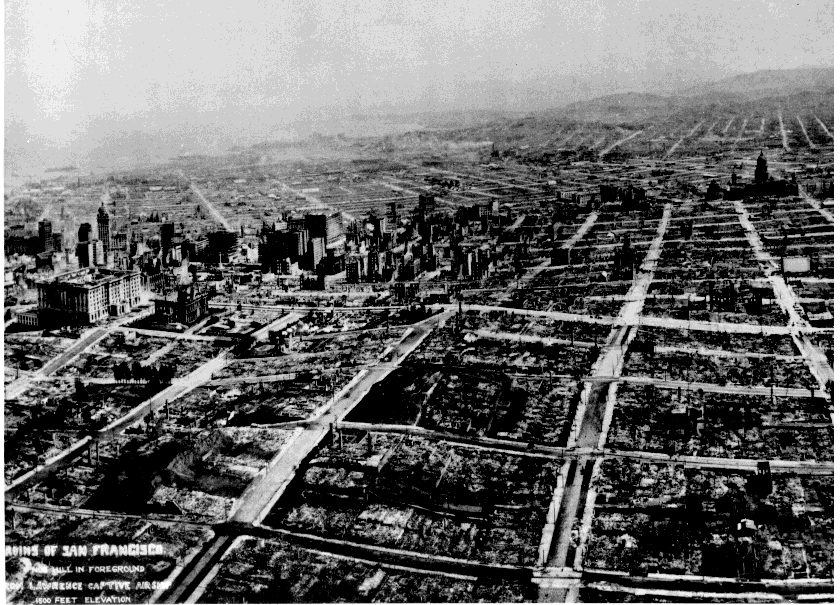
John Castillo Kennedy writes a riveting account of the fire that swept through San Francisco in the wake of the catastrophic earthquake that struck on April 18, 1906. The earthquake and resulting fires, which killed 3000 people, destroyed 80% of the city. Among the dead was the city fire chief. Firefighters, unaccustomed to using dynamite to create firebreaks, caused several of the fires. 

At one point early in the fires, according to Castillo, the spread of the flames surprised people living along Pine, Bush, and Sutter Streets, forcing them to flee immediately. They had been confident that the flames would not reach them there. The author says,

“Quickly filled trunks grated up the hills. Wagons, mostly pulled by men, rattled over the rough cobblestones. Baby carriages and toy express wagons rolled along packed full with the ‘things’ people had snatched up in the flight. Pianos were bumped along the sidewalks–some went to pieces in the process. Sewing machines slipped along on their rollers with stacks of bedding and the like lashed to them. Women had their valuables on their person, or carried trinkets Gypsywise in handkerchiefs. Men wore columns of hats five-high. Some carried only a book. Parrots jabbered and scolded from many cages. Some people had blankets. Girls usually had bandboxes. Boys stretched poles between them and carried, suspended there, bundles of clothing and provisions. Once it was only a ham” (83). 

These panic-stricken people, with no time to prepare, reached for the thing that had the most practical or sentimental value to them. Something made people faced with total loss and threat of life to lug heavy items or pets or food. Many of the choices seem irrational. Perhaps they were in shock or acting in impulse. In essays and contests asking people what they would grab if their house was on fire and they could only grab one thing, they have cited passports, wills, legal documents, insurance policies, personal papers, portable hard drives, phones, etc.

I’m trying to put myself in their shoes. If I was in one of the many neighborhoods forced to flee my home with no time to spare, what would I have been sure to grab? How long would it take my mind to settle on sentimental family items like old photos, my wedding video, or the boys’ baby books? Would I be relieved if I could make it out with my Bible, though I saved nothing else?

I do not judge those folks with their bizarre, split-second decisions. For some reason, it just made me do some introspection. What does my priority list look like? What do I value most in my life and in my home? What would I try to be sure to preserve?

Perhaps the answers to those questions is best provided by my choices in ordinary, every-day actions. I want my wife, children, fellow-Christians, and, most of all, my God to see from my life that they come before the things of this world. The things will all ultimately burn (2 Pet. 3:10). It is the relationships that will outlast the final, global conflagration. I pray that my influence and example will save them from the fire (Jude 23).  

Reference: Kennedy, John Castillo. The Great Earthquake And Fire: San Francisco, 1906 (New York: William Morrow and Co., 1963). 


I Want To Be Happy

Thursday’s Column: Carlnormous Comments

carl-pic

Carl Pollard

I was 16 years old and I remember thinking, I’ll be happy when I get a new phone. I was 17 years old and I told myself, I’ll be happy when I get my own vehicle. I was 18 and I remember thinking, I’ll be happy when I get a newer phone. I was 19 and I thought, I’ll be happy when I get a newer truck.

At 16 I got a new phone and I was happy, until I dropped it in a hotel toilet a month later. I was 17 and I got my own truck and I was happy, until the transmission went out on the way to school. I was 18 and I got a newer phone, and I was happy until I left it on the roof of my dads car as we drove home from church. I was 19 and I got a truck that was nicer than anything I could ever want. I was happy, until it broke down on an Indian reservation in Arizona.

I thought I knew what would make me happy. I chased after the physical possessions that I thought would bring me joy. The problem that I failed to see was that phones break and trucks aren’t always reliable. My happiness would run out when my stuff would break.

People are constantly searching for happiness. Why? Because they don’t know what will make them truly happy. It’s a daily experiment that never gives them the result they are looking for. There are millions of books, movies, articles, and lessons geared toward helping us find true happiness.

“How to be happy” is one of the most searched phrases on Google, second only to “how to lose weight.” We ask this question because we can’t find the answer. Solomon asked this question in Ecclesiastes. “Vanity of vanities. All is vanity says the preacher.” The wisest man in the world wanted happiness and looked at every possible solution. He looked to money, drinking, and women. Every time Solomon placed his happiness in these things, he was left feeling empty. He finally found the secret to life: “The end of the matter; all has been heard. Fear God and keep his commandments, for this is the whole duty of man” (Ecc. 12:13).

Every earthly option was tried, and none of them seemed to work. The bottom line is to fear God and keep His commandments. Why? Because God knows His creation. Do you struggle with finding happiness? Do you want nothing more than to be content? The answer isn’t found in the world. You won’t find true, lasting happiness in anything on this earth.

Happiness is found in our purpose as God’s chosen (1 Peter 2:9), in loving God (Deut. 6:5, Matt. 22:37-39), and in showing gratitude (Psa. 118:1; 136:1; 147:7).

Is God Frustrated?

Thursday’s Column: Captain’s Blog

Carl Pollard

About a month ago I wrecked my motorcycle at The Hebron Church of Christ work day. It was very embarrassing because I wrecked it in front of everyone that was there. I decided that it would be a good idea to take my bike up the steep grass hill behind the fellowship hall. I was going a little too fast and completely forgot about the drainage ditch at the top. I came over the top of the hill, slammed my front tire into the ditch, and laid my bike down. I ended up bending the highway bars into the side of the frame, breaking my left mirror off, bending the clutch bar, toe shifter and kickstand, and cracking a couple of ribs.
After I had fixed most of the issues, I then spent hours trying to bend the highway bars back into shape. I tried using a mallet, a blowtorch, a ride mower and tow strap, and even got so frustrated I ran over the bars with my truck. Nothing was working so I eventually just gave up. I’ll admit, it’s not pleasant at all to work so hard on something only to realize it was for nothing. We don’t like giving up, but sometimes it’s the only thing we can do.
Did you know there was a time that God Himself gave up? In Romans 1, Paul spends some time describing men that have upset God. In verse 18 we read that these men refuse to acknowledge God and even go so far as to suppress the truth. These ungodly men were determined to bury the truth. Even though God had clearly revealed Himself, these men refused to see it. Because of this God gave up. Three specific reasons are mentioned by Paul.
They exchanged the truth for a lie. Romans 1:24-25 tells us that these men were involved in idol worship. God gave up because they chased after lust and the rituals involved in serving false gods. God quit trying because they exchanged the truth about God for the lies of idolatry. God is the source of Truth, and we can be guilty of accepting a lie instead of Truth. The lie here is idol worship and these men placed more importance on statues and images. While we may not be worshipping a literal idol, we can still practice this today. We can worship the lie of possessions. When we spend more time detailing our truck, boat, or house than we do in our personal relationship with God, we are bowing to a lie. If we place more importance on anything other than God, we are exchanging truth for a lie.
They exchanged the natural for the unnatural. Verses 26-27 shows us the wickedness that they were caught up in. God quit pursuing them because they exchanged the natural for the unnatural. The word “natural” here means, “that which is in accordance to the basic order of nature.” Specifically Paul is talking about human nature. God did not intend for men to be with men and women with women. And yet these people knew the consequences of their actions, and chose to continue in them. Therefore, God gave up.
They chose to ignore God. In Verse 28 these men failed to acknowledge God so He gave them up to a debased mind. This word “debased” means, “unqualified, worthless.” Their action of ignoring God resulted in a worthless mind. A mind that sought after things that are contrary to God’s will. How terrible it would be to find out on the day of judgment that God wanted me, but I chose to ignore His love. God cannot be with the person who constantly ignores His existence, and so eventually He will stop trying.
Has God given up on me?

How Much Will It Take To Make You Happy?

Neal Pollard

Well, according to a London survey, it takes–for the average person–about 1.5 million dollars to make one happy.  One NBC analyst says that by knowing you make more than the Joneses next door, you are likely to be quite happy.  As usual, we give our thanks to the experts.

Are they better informed than the Lord and the inspired writers? Jesus taught, “Beware, and be on guard against every form of greed; for not even when one has an abundance does his life consist of his possessions” (Luke 12:15). Your life does not consist of your possessions. Jesus warns us to ward off such thinking and the selfish, covetous behavior it spawns. He is saying, “You cannot measure who you are and what you are about by checking your bank balance.”

King David says, “Better is the little of the righteous than the abundance of many wicked” (Psalm 37:16). One might conclude from this that one, financially modest Christian is wealthier than all the worldly, howbeit financially richer neighbors. That runs contrary to NBC’s money guru, doesn’t it? What could be “better” than being financially set? Solomon says “the fear of the Lord” (Prov. 15:16).   He says “righteousness” is better (Prov. 16:8; i.e., upright character and moral living). He says “peace and quiet” are better (Prov. 17:1). He says “integrity” is better (Prov. 19:1). He says “love is” better (Song 4:10).

Heavenly standards are superior to those of earth’s sagest experts. Jesus identifies an extremely poor widow as one having more (in the ways that count to heaven) than the wealthiest citizens of Jerusalem in her day (cf. Mark 12:42-44). The world has its values turned upside down, and it seeks to sway the Christian’s thinking on the matter, too. Believe this.  Having more than your neighbor will not bring you lasting happiness, in and of itself. Seeing $1.5 million or more on your bank statement will not supply you the peace that passes understanding.  Don’t trust me. What do I know? Believe the Lord!


Conquered The World And Left It With Empty Hand

Neal Pollard

Somehow, it has come down through the ages that Alexander the Great made this dying request, that he should be buried with his hands outside his coffin so that all his subjects could see that despite all the riches he had accumulated in life that he left the world empty-handed.  Artists through time have famously depicted this posture. It has been retold repeatedly.  Whether or not Alexander requested it, the sentiment reflects divine truth.  Paul told Timothy, “For we have brought nothing into this world, so we cannot take anything out of it either” (1 Tim. 6:7).  Similarly, Job said, “Naked I came from my mother’s womb, and naked I shall return there” (Job 1:21). Solomon similarly states of the wealthy, “As he had come naked from his mother’s womb, so will he return as he came. He will take nothing from the the fruit of his labor that he can carry in his hand” (Ecc. 5:15).

While even world conquerors cannot transport their treasures from time to eternity as they make the transition, everyone will exit the world having left so many things behind us.  We leave behind so much more than our financial assets.  We leave behind memories of ourselves, encouragements either given or withheld, speech either edifying or destructive, deeds which brought others closer to or further from Christ, family members influenced either to follow Christ or abandon Him, and similarly impactful matters.  When we leave earth, our hands are empty.  We have bequeathed all that we are and have for those whose lives we touched and influenced.  They pick up our habits, worldview, pleasures, interests, and priorities.  Some day, they will die and leave empty-handed, too, passing along what in some way we gave them to give.

You may never be a world conqueror, but here is how you conquer the world.  It takes faith and spiritual rebirth (1 Jn. 5:4).  But do not simply possess it.  Be sure to pass it along.

Happiness (POEM)

Photo by Ying Prinyanut

Neal Pollard

What do I need to make for joy?
To beat those troubles that annoy?
Can it be bought or taken from others?
What would I get if I had my druthers?
Would I find it in possessions, investments, land?
A car that’s new or a house that’s grand?
That perfect someone to make me satisfied?
A high position to feed my pride?
When I have seen some with hardly a possession
Who know nothing of materialistic obsession
Anonymous to paparazzi and heads of state
Facing perils and diseases with no way to abate
Living contentedly, day after day
Trusting God gladly to provide them a way
Loving their neighbors and spiritual siblings
All without virtue of a bevy of things
That tells me something, I’d better take notice
Of something the apostle Paul long ago wrote us,
“Whether you have or don’t, or you spend or are spent,
Whatever you face, in life be content.”