I Thessalonians 2.1-6 reminds us that our motivation for staying faithful shouldn’t be selfish. We’re not here to gain a following or expand a financial portfolio. Those things aren’t intrinsically wrong, but using Christianity as an opportunity for financial gain is terrible. We’re faithful because it’s what God wants, and because we want to live with him forever.
The application of 2.7-12 is that God expects us to tell people about his son’s return, even if we have to do it alone. This means we don’t expect financial help as a condition for service. This means we teach with great patience. It means we share our time generously. It means we work hard. It means we invest all of our emotional resources into the work.
2.13-16 teaches that our message originated with the creator. It has a powerful effect on people who believe it. It also draws negative attention from people who find it too otherworldly to accept. For the most part, people find it difficult to accept the idea of a God. Beyond that, most find it even harder to believe that this God will destroy the planet, and will only rescue those who follow him. To most it reads like science fiction. As with other things that don’t fit a naturalistic narrative, our worldview is attacked as bring fringe or fantasy or irrational. But God will handle those who try to stop his message from spreading, so our job is to keep at it until our time is up!
I like to ask questions; these are rhetorical. Have you ever lost something and been frustrated or sad that it’s no longer here? What about someone ? I know I have. I think we can all relate.
And what about this. Have you ever given away something, whether a donation or to a friend, and regretted it because you needed it later?
These people and or things that came to your mind, would you like to have them back? Some may be less important than others, but regardless the point remains.
I can’t tell you how often I’ve thought about something or someone I’d like to have back.
Beyond people and things, what about time? I’m sure a decent portion of us are happy with where our life is now, I know I am blessed beyond measure.
This doesn’t mean there aren’t certain events or decisions we wouldn’t mind to have a do over on. I mean, after all, hindsight is 20/20, right?
If hindsight is 20/20, What about foresight? Think about this, it’s impossible to change your past. You can try all you want. You can’t do it. But you can change your future.
You can make a decision here and now that you’re going to stop, start, or continue down any number of paths. So, which path are you going to take?
To help reflect on this, let’s take a look at a passage from 1st John 1 – Verses 6 and 7:If we say that we have fellowship with Him and yet walk in the darkness, we lie and do not practice the truth; 7 but if we walk in the Light as He Himself is in the Light, we have fellowship with one another, and the blood of Jesus His Son cleanses us from all sin.
With this in mind, I want us to fast forward from the here and now. We are going all the way to judgment day. We are standing there awaiting our final judgment. Suddenly, you find yourself amongst those doomed souls that are told to depart. It’s no small matter, being eternally separated from God and his grace.
Now, what would you do if you were given a second chance? You’re told, you can have that “do over”. All you have to do is follow the plan laid out in the Bible and you’ll be given that opportunity to go back with that ever elusive do over. Scripture like John 14 – Verse 15 tells us. “If you love Me, you will keep My commandments.
I don’t know about you, but when I explore this idea, I’d like to imagine that I would move mountains with this second chance. So what stops me from having this level of commitment now?
Why do so many of us squander the first chance, knowing we can’t have a second when this life ends. It sounds trivial to compare this to anything earthly, and in a way it is, but the idea that we would attempt to prepare for anything of an earthly matter, but not expend a tremendous amount of our time and energy on spiritual preparation is really something to reflect on.
I think it’s amazing we have the gift of free will, but it’s important we understand there is an enormous responsibility that comes with that free will.
Our Lord has given us the roadmap. We must follow it. We said earlier hindsight is 20/20. But foresight….. is 66 books long. We just have to pick up the good book and apply it to our lives. We won’t be perfect. We just need to aim our feet and hearts down the road laid out before us.
The writer of 2 Kings is constantly diverting his attention from Israel to Judah and vice versa. So, he introduces us to Azariah, also known as Uzziah, anointed king over Judah at age 16. We will read much more about him in 2 Kings 15, but he seems to be referenced here only to give us the chronology for when Jeroboam II is anointed king of Israel. It is in the 16th year of Uzziah’s reign that Jeroboam comes to the throne. This will be the next-to-last generation in the dynasty of Jehu, but his son, Zechariah (29), will be murdered after six months. When he ascends to the throne, Israel only has about 70 years left before they are destroyed by the vicious Assyrians. God has been patient with Israel for almost 150 years, as king after king behaves just as Jeroboam will behave: “He did evil in the sight of the Lord; he did not depart from all the sins of Jeroboam the son of Nebat, which he made Israel sin” (24).
He will reign 41 years over Israel, an evil king over a wicked and disobedient people. But, these are God’s people, Abraham’s descendants and once part of the United Kingdom. If we do the impossible and try to put ourselves in God’s place, can we imagine giving to and doing for a people who are continually unappreciative, rebellious, and unfaithful? How long could we go before we ran out of patience? How many times could we be betrayed and hated by the recipients of our generosity before we gave up on them? Or, having God’s power, how long before we destroyed them all? God will go over 200 years, restraining Himself as His people served other gods and gratified their flesh.
Isn’t it amazing how much grace and kindness God shows to this faithless people? The Jonah who God graciously sends to the Assyrians to preach repentance (Jonah 1:1) is also sent to Israel (25). Despite Jonah’s flaws, his ministry seemed to be to extend God’s grace to an unrighteous people. Then, read what the author says about God and Israel next. “For the Lord saw the affliction of Israel, which was very bitter; for there was neither bond nor free, nor was there any helper for Israel. The Lord did not say that He would blot out the name of Israel from under heaven, but He saved them by the hand of Jeroboam the son of Joash” (26-27). You want insight into the heart of God, as He deals with our sins? He cares when His people suffer. He views us with compassion, sympathy, and concern. He doesn’t want to reject us or let us go. God sent His prophet Hosea to this very people and speaks His mind on this subject: “How can I give you up, O Ephraim? How can I surrender you, O Israel? How can I make you like Admah? How can I treat you like Zeboiim? My heart is turned over within Me, All My compassions are kindled. I will not execute My fierce anger; I will not destroy Ephraim again. For I am God and not man, the Holy One in your midst, And I will not come in wrath” (Hosea 11:8-9).
No one will be able to legitimately say at the Judgment, “God, you were harsh, hasty, and hateful!” No, even in the face of faithlessness, God shows His matchless grace! His patience can be exhausted and His justice will not allow impenitence to go unpunished (read Exodus 34:7). But let no one accuse God of reckless wrath! He is the God of unending love. May this lead us to repentance (Rom. 2:4) and faithfulness (Rev. 2:10)!
Lived on the border of northern and southern kingdoms
The North was ruled by Jeroboam the 2nd who brought wealth and prosperity to the people
What Are His predictions?
Warning Israel, Judah, Benjamin and all nations of a coming destruction described as “the Day of the Lord.”
What Was His Purpose?
He about the oppression of the poor, sexual immorality, greed, and corrupt government In the Northern kingdom
The wealthy Israelites had become apathetic and spiritually lazy
SIMPLE CHAPTER BREAKDOWN
1-2 messages to the nations and Israel
3-6 poems expressing the message to leaders and people
7-9 God’s judgment is explained
SKY HIGH SNAPSHOTS
The 9 chapter book spends time circling the surrounding nations and pointing out their evil. He starts with the nations furthest away from the people and works his way closer to the target, the Northern tribes.
Amos expresses God’s anger towards Damascus, Gaza, Ammon, Moab, Edom, and even Judah
Finally, the primary audience is shocked to hear that they (Northern territory) are the source of God’s anger as well
Top 2 Practical Lessons From The Book
Our lives will also be lessons for future generations. When they look back they will either say,
“we ought to live as they did” or
“we ought not live as they did.”
PLUGGING IT IN
“WHAT DOES GOD NEED FROM US?”
God needs more fig tree farmers. He needs community preachers in the form of plumbers, school teachers, electricians, nurses, surveyors, dentists, accountants, mechanics, and engineers.
We need more preachers. It’s more common than it was, but there’s a great need for gospel preachers in the LORDs church. Amos spoke for God, but he was in the minority.
We need more elders. Great elders are rare. It’s been said and proven to be true, “The church will never outgrow the shadow of her leadership.”
We need more seriousness. Not more piety, not an immovable allegiance to man’s tradition, more people who take their God seriously.
Amos in a sentence:
“Service does not mean salvation if our service is not from the heart.”
Real faithfulness means worship that is holy— not habitual. He wants committed people, not costume parties. He wants our attention to be placed on our purity, not our performance.
It becomes clear from reading the second letter to the Corinthians that Paul feels the need to defend himself and his actions among his readers. He feared that he had been misunderstood in his previous work among them (cf. 1:12-14). In fact, it seems as though this is the purpose of the letter (look also at 5:11-12). If you remember from the first letter, he had some pretty challenging and unpopular things to say about how they were behaving. It’s not far-fetched to think that some of them not only would not appreciate what he said, but would attack him as the messenger for saying it. Sometimes, however lovingly and kindly we share the truth, it will offend the hearer who, instead of repenting, tries to undermine the one who said it. As we read this section, think of Paul as a man, just like his audience, who has feelings, struggles, difficulties, and temptations, too. He also needed them to know that it was because he cared so much about them that he would not “shrink from declaring to [them] anything that was profitable” (cf. Acts 20:20). What drove Paul to minister to the Corinthians? Notice several things he says in 2 Corinthians one.
THE GRACE OF GOD (12)
He would not boast in himself, whether his abilities or knowledge or influence. Those are empty and unsatisfying. His motives were pure and he was helped by a grace he wanted them to appreciate, too. When we understand our need of God’s grace, it will move us to give Him our all in response.
THE JUDGMENT DAY OF GOD (13-14)
Paul wanted them to be able to legitimately boast together and of one another at “the day of the Lord” (cf. 5:10). The word “boast” in modern English has negative connotations–bragging, arrogance, and sinful pride. Paul wanted to have confidence in them as they faced this Day, as confident as he hoped they were of him in view of it. We should share the whole counsel of God to make sure people are ready for the most important day of all.
THE PROMISES OF GOD (20)
He shared the positive and negative, the promises and the warnings, because he knew God meant what He said. He would not equivocate or talk out of both sides of his mouth. He was going to give them “the whole purpose of God” (cf. Acts 20:27). He knew God was the supreme promise-keeper (2 Tim. 4:8; 2 Cor. 5:11-14).
THE GLORY OF GOD (20)
Paul taught them for the glory of God. The Word is God’s. The promises are God’s. The salvation is from God. How silly for the fragile pottery to brag (4:7); the glory belongs to the Potter. Anything worthwhile we accomplish is always because of God.
THE WORKING OF GOD (21-22)
Paul was moved by the knowledge that God is the one who establishes men (21), sets us apart (21), and gives us His Spirit (22). Knowing this, we should share Him with people so that God can accomplish His work in their lives.
THE WITNESS OF GOD (23-24)
Wise teachers and preachers will remember that God is watching their work. He can see where no one else can–our hearts and motives. Knowing He knows me inside and out, I will check myself and do His work to bring the joy and strength of the hearers (23-24).
THE PEOPLE OF GOD (2:1-4)
We should be moved by genuine love and concern for people. Those who share the word should share life with those who receive the word from them. Building relationships, being together in all the ups and downs of life, is what it is all about. It’s hard to imagine staying motivated to share the gospel with people we isolate ourselves from.
Perhaps there are some preachers and teachers who just love beating up on their listeners (or readers). Motivation is individual to each one (Phil. 1:15-17). I have to believe that every faithful proclaimer wants not only to please God but also help as many people as possible go to heaven. There are so many great reasons why Christians should want to share God’s Word with others. Paul gives us a handful of them here.
Perhaps Jeremiah seemed to be mean, harsh, even unloving, to his brethren. His message is certainly what we could categorize as negative, but we remind ourselves that its source was God. What may get lost in Jeremiah’s challenging message is how it affected him to share it. Chapter nine is full of the struggles he endured in being God’s spokesman with a message of divine judgment.
Jeremiah endured mourning (1). While Judah would be hypercritical and threatening toward Jeremiah for his message, they had him all wrong. He did not relish his unpleasant message. He would have preferred to have kept his mouth closed (20:9). They had no idea of how his mission was wearing on him. He writes, “Oh that my head were waters And my eyes a fountain of tears, That I might weep day and night For the slain of the daughter of my people!” He knew that they were hurting themselves by their lifestyle, and he wanted them to escape judgment. It can be heartbreaking work to share God’s word on any number of unpleasant, unpopular subjects. No rational preacher, elder, or teacher is excited to share such a message, but it must be done (2 Tim. 4:2). Jeremiah is rightly called the “weeping prophet” (8:18; 13:17; Lam. 2:18). Revealing this was an emotional struggle.
Jeremiah endured isolation (2). The pressures of sharing a message nobody wanted to hear created inevitable isolation. He felt alone and like nobody understood or cared. He longs to escape such disappointing, unrighteous behavior. He wanted to run like Jonah. He felt alone like Elijah. It can go with the business of declaring God’s message. There are times when you may feel like you are standing all alone, but you never will if you are sharing God’s word God’s way. He will never leave you (Mat. 28:20; Heb. 13:6).
Jeremiah endured disillusionment (3-6). He expected more and better from his brethren. They knew better, but they were guilty of treachery and adultery (2), lies and deceit (3,5-6), ignorance (3), violence (4), slander (5), and general iniquity (5). Have you ever overheard someone you looked up to use foul language or stumbled upon someone doing something sinful? It’s like a punch in the gut. But imagine a congregation full of people doing what God through Jeremiah reports. It had to have been discouraging and caused feelings of hopelessness.
Jeremiah endured a sinking realization (7-11). What was the cost of this? Sin is not without consequences (Gal. 6:7-8; Hos. 8:7; Prov. 6:26). At the heart of God’s message was this rhetorical question: “Shall I not punish them for these things?” (9). Jeremiah knew what was coming. There would be weeping, wailing, and dirges (funeral songs)(10). Judah would be ruined and desolate (11). Jeremiah knew this ahead of time. Whatever normalcy he witnessed each morning and evening, he knew that would ultimately change. The fact of judgment looms over the horizon of time. It will be a day of rejoicing for the righteous and prepared, but not for the rest of humanity. The people of Judah were not ready for this judgment, and Jeremiah knew that.
Jeremiah endured being overwhelmed (12-16). The message gets specific about the nature of what was coming. It was going to be more devastating than any of them had experienced. Because of their stubborn rebellion, they would be scattered and annihilated. Hope belongs to the penitent, but there’s just no good news for those who are determined to oppose God’s way.
Jeremiah endured unpleasant duty (17-22). God tells Jeremiah to call for mourning, wailing, and tears (17-19). He is help them focus on their shame (19). The heart of the message was death (20-22). Don’t you think Jeremiah would have loved to have spoken of grace, mercy, lovingkindness, and blessings? But the circumstances did not call for that. Jeremiah had to be faithful to God’s message. Like Micaiah, every faithful spokesman for God should say, “As the Lord lives, what the Lord says to me, that I shall speak” (1 Ki. 22:14).
There is a ray of hope starting in 9:23. Amid the folly of idolatry, there will be a reminder of the wonderful, perfect character of God in chapter ten. But even here, there is encouragement for God’s faithful servant. It was a message for the worldly wise, for the mighty man, and for the wealthy (23) not to trust in those things, but to trust in Him. Everyone should boast of knowing and understanding God, that He is “the Lord who exercises lovingkindness, justice and righteousness on earth; for I delight in these things” (24). Punishment was for the spiritually uncircumcised (25-26). It was not for the faithful, like His man Jeremiah. Whatever we have to struggle through for the Savior, may we know that God will be with us through thick and thin. He has not left us alone. He will always be with us, help us, and strengthen us! Declaring His word is right, and He will not let us lose for being unswervingly loyal to it and Him!
I’ve never been a homebody. I tend to get stir crazy if I’m there for more than a few hours. While this may be true here on earth, this won’t be the case in Heaven. Homesickness is a desire to not only be back in a familiar place, it’s a longing to be around the ones you love and care for.
I long for the day when I’ll never have to be away from the ones I love again. When the body of Christ, past present and future will all be together. Forever at a home free from tears. Forever at home with likeminded brothers and sisters. Forever at home with the Father, His Son, and the Spirit.
We will be with the Father that crucified His Son. We will be with Christ, the one who hung on a cross for us. We will be with the Spirit who gave us the Words of life. Philippians 3:20 says, “our citizenship is in heaven. And we eagerly await a Savior from there, the Lord Jesus Christ.” Heaven is our true home. It’s where we belong. And it’s where God wants us to be.
I’m homesick for heaven because it is my true home. The sad reality of heaven is that not everyone will be reunited. The wives who walked alone with God. The husbands who tried so hard to save the soul of their dearest friend. The parents that pleaded to their wayward children to come home to no avail. The heartbreaking reality of eternity is that some will get to heaven and notice family members and loved ones are missing.
I don’t want to be the rich man in Luke 16 who wanted to warn his family but it was too late. The question we must ask ourselves, will I be the one missing in heaven? If sin is controlling your life, God will judge you based off of your decisions. Don’t be the one missing in eternity. If your family is lost, don’t stop trying to save their soul.
For the next several weeks, I’ll be repeating the book of I Peter in present-day terminology. It’s not a true translation of the book, as I am not qualified to do so. It will be based on an exegetical study of the book and will lean heavily on the SBL and UBS Greek New Testaments, as well as comparisons with other translations (ESV, NASB, NIV, ERV, NLT). My goal is to reflect the text accurately, and to highlight the intent of the author using concepts and vocabulary in common use today.
This is not an essentially literal translation, and should be read as something of a commentary.
Everything’s about to come to an end. You have to be reasonable and self-controlled for the sake of your prayers. Most importantly, don’t ever lose your love for each other. Love hides all kinds of mistakes. Take care of each other without complaining. Use your assets to help each other, since God helps us in so many ways. If your talent is speaking, speak as if you’re talking for God. If helping others is your talent, do it with limitless energy. This way every aspect of our lives gives credit to God by our dedication to Jesus. He gets all recognition and authority forever!
Family, don’t let these hard times shock you. Don’t feel like you’ve been targeted. You are suffering like Jesus did, so let that keep your spirits up! When he comes back, we’re going to be indescribably happy! If people insult you because you love Jesus, you’re lucky! The full weight of God’s spirit and power is with you. Just make sure none of you suffer because of something you’ve done wrong, like murder, stealing, practicing morally bad things, or sticking your nose where it doesn’t belong. If you suffer because of your faith, though, don’t feel bad! Instead, give all the credit to God.
We’re about to be judged by God. Since we’re going to be judged first, how do you think it’s going to be for people who rejected God? It’s hard enough for a morally good person to be saved, so what’s going to happen to morally bad people who don’t follow God? Since we’re about to suffer, we have to trust God with our lives. He’s going to take care of us if we’re doing the right thing!
Since we’re about to face difficulties, it’s very important that your elders lead you carefully. I’m an elder, too, and also look forward to sharing in the recognition we have coming to us. Elders, don’t lead people because you feel like you have to. Do it because it’s what God wants! Don’t lead because you want to get something financially out of it. Don’t abuse your power, but lead by example. When the ultimate leader shows up, your reward will be indestructible!
According to an article written on The Public Discourse in 2018, Dr. Jordan Peterson is said to be “the most influential Biblical interpreter in the world today.” By almost all accounts, his insight and commentary on the Scriptures are held in high regard. On several occasions, Dr. Peterson has been asked about his belief in God to which he responds, “I don’t like that question.” One of his most popular YouTube series covers, “The Psychological Significance of the Biblical Stories.”
There have been millions of people who have spent hours watching these videos, but most of them are still wondering what Dr. Jordan believes concerning the existence of God. He says, “I act as if God exists and I am terrified that He might.” Some in his audience have taken this, and other similar comments made by him, to be deliberately vague. After one particular lecture, Dr. Peterson gave those in attendance the opportunity to ask him questions. One attendee asked Jordan to give his insight on the apostle Paul’s statement, “…and if Christ has not been raised, then all of our preaching is useless” (I Cor. 15.14). To this, Dr. Peterson put his hand to his chin and pondered this for a minute. Afterwards, he looked up and said, “I don’t have a good answer to that. I haven’t gotten to the New Testament yet, but I plan to find out what he meant.”
This response deserves our appreciation. Jordan Peterson is a serious thinker and a great philosopher who takes his quest for truth seriously. He has acknowledged the importance of seeking out the answer to life’s most important question. He has made the realization that a personal discovery of God’s existence would carry with it life-changing implications.
While his current beliefs do not mesh with the teachings found in His Word, he exemplifies the seriousness that we may sometimes lack. If we profess to believe in a supreme and eternal Creator who will one day judge mankind, our lives should reflect this down to our core. Our daily decisions should exhibit the devotion of our lips.
For the past six days Russia has made significant advancements on several strategic locations in Ukraine. Every news outlet is showing photos and videos of devastation that has already occurred, and it’s predicted to escalate still. There are complicated foreign policies being discussed over topics like NATO, sanctions, and the effects on the rest of the world after Putin’s recklessness.
Many countries are mad, some indifferent, while some cheer on their favorite country like it’s their favorite sports team. It’s chaotic and it’s concerning, but it’s not the Christian’s long-term problem. If this earth was our eternal home then I would be biting my nails and losing my hair. However, Christians all over the world should take comfort in the fact that heaven is a place where there is no war. We should remind each other that in order to make it, we are not required to be Republicans or Democrats. There are two camps in this world, but those aren’t it. The two groups are those who are lost and those who are saved. When you look at your TV or maybe out of your window and you see the death and carnage, we aren’t witnessing the death of heroes and villains. We’re watching souls walk through the door of eternity.
Our focus is easily pulled away from the reality that is only seen through a spiritual lens but it’s the reality that matters the most. The lyrics of two hymns have been strung together in my mind this week, “There’s a Great Day coming and this world’s not my home.”
“Beloved, never avenge yourselves, but leave it to the wrath of God, for it is written, “Vengeance is mine, I will repay, says the Lord.”
Matthew 7:1-5 contains that well known verse, “Judge not that you be not judged.”
This has been a misquoted and misunderstood section of scripture because some have taken this to mean that Jesus is implying that not judging someone involves a complete acceptance of a sinful lifestyle. This obviously isn’t the case since later in this same chapter He tells us that we can judge others based on their fruits. How will we know if a “sheep” is really a “wolf” in disguise?
We can sort the wool from the wolves by judging the actions of both.
Some level of judgment, then, must be passed on our part, but this is not to be an action of belittlement. Jesus will masterfully use the illustration of the plank-eyed man attempting to remove a speck out of another’s eye. Notice how our Lord doesn’t reprimand the attempt to remove the speck, but that we can see the speck better when that metaphorical plank is removed from our own eye.
Jesus is not teaching an acceptance of sin, nor is it a lack of love. Unconditional love is a requirement, but Jesus shows that it is possible to love the sinner and hate the sin. A speck can keep us from the narrow gate just as easily as a plank can– and both should be removed.
Here are three thoughts to consider on these verses
Our own planks aren’t as obvious to us as they are to others. Before becoming agitated and aggravated with a brother or sister we should keep in mind that they may not know what is so obvious to others.
Our eyes must be clear if we are ever going to help others.
Jesus is not saying we shouldn’t help, but that we are required to.
The Tompkinsville church family is blessed to have some righteous and knowledgeable elders. In the past week and in separate Bible classes these men have each shed some insight on three different biblical texts. One elder brought a passage of scripture to the table that clarified the difference between anger and sinful anger. Another elder gave a separate take on the dispersion of humanity after the language change at Babel. After a discussion surrounding the blessing that was promised to Jacob, one of the elders broadened the scope and showed how that promise played out in Jacob’s life and in the life of the Israelites. Though the insights they offered in class were contrary to some beliefs in the brotherhood, they navigated the disagreements with grace and tact. These were not matters of salvation and in some cases were simply a matter of opinion.
The biblical text is not always clear in the English translations since there is the cultural and linguistic barriers that must be taken into consideration. Since that’s the case, there are occasionally opposing views that could both be correct. To some degree, speculation and educated guess work will attempt to fill in the gaps. Is there a hard line in the sand that indicates when anger becomes sinful? Certainly. Could God have miraculously scattered the confused people after the Tower of Babel was completed? Yes. God could have also allowed them to naturally migrate to their respective regions. Are there several applications that can be taken from Genesis 32 where we read that Jacob wrestled with God? Definitely. A church family should appreciate an eldership with a heart and mind so immersed in God’s word that they have drawn their own conclusions based on their personal study. Godly men and women express their faithfulness in Bible classes in several ways.
First, they understand that the truth must be spoken in love (Ephesians 4.15). They are able to tell the difference between matters of opinion and matters of salvation.
Second, they are eager to maintain a unity of spirit and a bond of peace (Ephesians 4.3-6). Godly members are not purposefully divisive or quick to start heated debates.
Third, the older Christians recognize the responsibility they have to share their wisdom with the younger generation and the godly youth respect the wisdom that is given from the older generation (Titus 2.2-12).
When the body of Christ is unified it’s also unstoppable. The church family that respects those God-given rolls that we are all assigned will find that Bible classes, Biblical discussion, and relationships are enriched and strengthened. Knowledge is both shared and received in love and humility.
“Therefore, beloved, since you look for these things, be diligent to be found by Him in peace, spotless and blameless” (2 Peter 3.14 NASB1995).
Mike Schmit of Markesan, Wisconsin, grew the largest pumpkin in the United States in 2021. The pumpkin weighed in at 2,520 pounds. Yet, Schmit is not winning the $22,680 prize he could otherwise have received from California’s Safeway World Championship Pumpkin Weigh-Off. (They pay $9 per pound for the winning pumpkin.) Schmit is not the winner because the pumpkin he grew developed a fingernail-sized crack from internal forces within the pumpkin. That tiny flaw was sufficient to disqualify his pumpkin from the competition.*
In like manner, spiritually, there will be those surprised by the Judgment of God since they esteem themselves worthy of His eternal prize. They will discover too late that they had a crack in their discipleship. No, it is not a matter of lacking sinless perfection. We all sin and fall short of God’s glory (Romans 3.23). But there will be those who disqualify themselves by failing to be obedient to God’s Will (Matthew 7.21-23). They may do good things, even in the name of Christ. Yet, men ignore God’s Word regarding what he must do to receive eternal life.
By what name do men call their religious bodies? What do men teach is necessary to receive salvation? How do they teach that we worship? How is the church they attend organized? Opinions and methodology vary among practitioners within generic Christendom because no one checks to see what the Bible teaches. They ignore God’s guidance about neither adding to nor taking from God’s Word (Deuteronomy 4,2; 1212.32; Proverbs 30.6; Revelation 22.18). “God didn’t say that I could not do thus-and-such.” “Surely, God is OK with this.” As Jesus said of the religious leaders of His day: “This people honors Me with their lips, But their heart is far away from Me. But in vain do they worship Me, Teaching as doctrines the precepts of men” (Matthew 15.8-9 NASB1995).
We began by sharing Peter’s admonition to be diligent in our efforts to remain spotless and blameless. The only way that is possible is through obedience. Through obedience, we walk with God enabling His Son’s blood to provide continuous cleansing from our sin (1 John 1.7). Essentially, God’s grace covers the cracks that form because of human nature. That grace makes it seem as if no cracks began. However, for the disobedient or those whose obedience is incomplete, the flaws remain. As Mike Schmit can tell you, a tiny crack is sufficient to disqualify one’s efforts. As costly as a crack is to the pumpkin grower, it is even more so to the lost soul. Therefore, we owe it to God to ensure that while we live, we do so according to His Will.
It is likely the most willfully ignorant who would deny that we are entering a period of inflation. Various issues are causing this, such as rising fuel costs and a growing sector of society preferring unemployment to gainful employment. To illustrate this, look no further than our ports. There are dozens of ships parked off our coasts with an insufficient workforce to unload the products at the docks. COVID-19 indeed gets its share of the blame for this but, despite the pundits, cannot account for it all. Thus, we are beginning to see shortages of certain products and empty shelves in stores. For example, we will be running out of certain products again while it sits on a ship just hundreds of feet from our shore. Thus, we may well experience deprivation in the shadow of plenty.
This deprivation happens with greater frequency within our collective spiritual lives. For example, how many households own unread Bibles? I would venture to guess that there are many. So here we have people sitting in the presence of plenty but suffer for a “lack of knowledge” (cf. Isaiah 5.13; Hosea 4.6). The Israelites ended up in captivity because of a similar choice of ignoring God’s Word. We cannot suppose that a gracious-but-just God would allow those of us living under the New Testament to skate when committing the same offense. Jesus depicted a Judgment scene in His Sermon on the Mount. Do you recall what He said to those crying, “Lord, Lord?” God only allows heavenly entry to those doing the Father’s will (Matthew 7.21-23). And where do we learn of God’s Will? Peter says that God has given us all things about life and godliness (2 Peter 1.3ff). And Paul reminds us that the Scriptures are God-breathed [inspired] (2Timothy 3.16-17). Lastly, Jesus confirms this Word as truth (John 17.17). Indeed, God has left us with a book into which even the angels desire to look (1 Peter 1.12).
So why do people suffer spiritual want? God’s Word sits like those cargo ships, within reach of those who would profit from it. The problem lies in the lack of readers on this side of eternity’s shore. Oh, there are excuses, to be sure. For example, “I’m too busy and cannot find time to read.” Or “I get enough instruction during church services.” But their stores are increasingly empty of what the spirit most needs. Unlike our current economic situation in the United States, where reliance on imports leaves us in a lurch, there is a different reality in the spiritual realm. Since we refuse to partake of the plenty God has supplied, the devil gladly steps in and stocks our shelves for us with the sensual. Since our focus is on the immediate, we don’t notice we’ve traded our soul for that which will destroy us (Matthew 6.19-21; Luke 9.25; Luke 12.16-33).
Get to work (2 Timothy2.15)! Grab that Bible and unload its truth into your heart. Don’t suffer deprivation in the shadow of plenty.
Christians live on planet earth and aren’t immune to social issues. The vaccine is one of them. This article is NOT about vaccination specifically. I am not qualified to write about it, but this wouldn’t be an appropriate forum even if I was.
However, this issue has influenced the church in a few timeless ways: misapplying scripture, creating division, and engendering hostility.
Misapplying Scripture: Applying Romans 13 to this subject is not appropriate. Nothing about the passage sheds light on which governing authority we should follow. What if federal law contradicts state or local law? Which do we follow then? I Peter 2.13-14 does address varying levels of governing authority, but does not specify which takes precedence. Both passages demand submission to everyone who has authority over us because it’s what God wants. As it stands now, neither passage applies to this issue. We cannot use God’s word to enforce or condemn issues that have no bearing on salvation. When state or local law is in conflict with federal law (or vice versa) and the issue at hand isn’t a salvation issue, it falls under the jurisdiction of Romans 14.
Creating Division: Differences in opinion aren’t new to the church. No reasonable person will call this a salvation issue, so it does fall under the purview of Romans 14. We need to remember the commands in this passage: accept those who have different opinions (1), do not think poorly of those who disagree (3), do not judge someone who exercises preference (3), make decisions based on conviction (5), do not condemn each other over opinions (13), don’t let opinions destroy relationships (15), and don’t let your decision become a problem (16). What does this mean for us? Respect your Christian family’s decision, do not think less of them because of their decision, make the decision you feel is best for you, don’t condemn someone based on their decision, and don’t let an issue that has no bearing on our Christian lives become a source of division.
Hostility: The previous point addresses this somewhat, but sinful behavior has come out of this. Thinking less of a Christian who gets the vaccine is sinful. Thinking less of a Christian who doesn’t get the vaccine is sinful.
Nothing about this issue is new or different. Controversial opinions over military service, firearms, holiday observance, or vaccination are not handled any differently. God expects us to put these kinds of issues in their proper place: the back seat.
“We have to love each other, because love comes from God and everyone who has love belongs to God and knows him. Anyone who doesn’t love doesn’t know God, because God is love” (I Jn. 4.7-8).
“Love each other deeply with a pure heart” (I Pt. 1.22). “You must continue to love each other” (Heb. 13.1). “Pursue righteousness, godliness, faithfulness, love, endurance, and gentleness” (I Tim. 6.11).
Several weeks ago I was told a sermon illustration with a very powerful reminder.
It begins with a scenario that each one of us is quite familiar with. You’re at the grocery store and you’re shopping for your weekly groceries. In this illustration we are introduced to two very different shoppers.
Shopper #1
This person can be summarized as an individual who is definitely NOT on a diet of any kind. They go through each aisle grabbing anything and everything that looks good to them. They aren’t concerned about health or nutrition, they get whatever they want. If it looks good, they grab it. If it tastes good, they take it.
Their shopping cart is filled with all kinds of unhealthy food. I’m talking Cheetos, Mountain Dew, Little Debbies, cake batter, and ice cream. Bottom line, Shopper #1 is an unhealthy individual who has only one desire, to eat what looks good to them with absolutely no consideration for nutrition or health. This individual is similar to those described in scripture who are trapped in several deadly sins. Shopper #1 through his choices symbolizes those in the world who choose to practice sins such as lusting (James 1:14-15), gluttony (Phil. 3:17-19), laziness (Prov. 6:6), anger (Col. 3:8), envy (Prov. 14:30), and pride (Prov. 16:18). The sins found in Shopper #1’s cart are by no means an exhaustive list, but they are examples of what to expect in this kind of person’s cart.
Shopper #2
This individual is a completely different type of shopper. They are on a serious diet. It’s almost depressing to look at wha’ts in their cart. It’s all healthy and beneficial to the body. It’s items like carrots, peas, broccoli, chicken breast, yogurt, fruit, and spinach. This person isn’t focused on the taste necessarily, but more on the nutrition and vitamins found in food. This shopper symbolizes the ones who Paul would call dedicated Christians.
1 Tim. 6:11, “But as for you, O man of God, flee these things. Pursue righteousness, godliness, faith, love, steadfastness, gentleness.” Who does Paul call a man or woman of God? The shopper who chooses: Righteousness, godliness, faith, love, steadfastness, and gentleness. The person who is dedicated to filling their cart with these things and other similar traits is a true Christian. Shopper #2 chooses to eat healthy no matter how gross or inconvenient the food may look. Both shoppers went to the same store and passed the same choices.
The illustration comes to a close as the two shoppers get to the checkout line.
Shopper #1 empties their cart at checkout and begins ringing up their grocery items. They scan their anger, their pride, their envy, and the rest of their life choices. They finish and pay what is due. Shopper #2 does the same. They scan their faith, love, gentleness and the rest of their godly choices. They empty their cart, but something unexpected happens.
As they reach for their wallet to pay the total on the screen says 0. Their groceries are paid for in full.
Shopper #1 lived his life however he pleased. He chose to do what made him happy and when checkout time came he was required to pay in full.
Shopper #2 lived their life according to God’s Word. They did their best to fill their cart with the things that pleased God.
Because of this decision, God has paid their bill in full. The one who has put on Christ and has devoted his life to serving God will find grace and mercy on that final day. Not out of his own good works, but through grace and salvation found in faith in God. This leads us to the all-important question, “What’s in my shopping cart?” Is it filled with the things I want? Is it junk food and sin? If so, one day I will pay for this decision. Or is it filled with the things that lead to eternal life? If your cart is filled with sin, there’s still hope (1 Cor. 6:9-11). If you have made the choice to fill your life with sin, it’s not too late to empty the cart and start over. And the time to do that is right now.
It’s tempting to run with Jesus’ words in Matthew 24, “But of that day and hour no man knows…only the father.” We might think we’re all set or that he won’t come in our lifetime. I Thessalonians 5.1-3 reinforces the surprise nature of his return. II Peter 3 says the same. For sure, we won’t know when, but it’s good to be reminded that we aren’t promised tomorrow.
The Patriarchal Age lasted roughly 2500 years, the Law was in effect for around 1500 years, and we’ve been in the last age for nearly 2000 years. No one can point to a day, but there’s nothing wrong with living as if He’s coming back in our lifetime.
“Since all of these things will be destroyed, what kind of people should you be in lives of holiness and godliness, waiting for and hurrying God’s return?” (II Pet. 3.11).
“Now, brothers and sisters, about times and dates we do not need to write to you, for you know very well that the day of the Lord will come like a thief in the night. While people are saying, ‘Peace and safety,’ destruction will come on them suddenly, as labor pains on a pregnant woman, and they will not escape” (I Thess. 5.1-3).
How many Christians are afraid of the judgment day? Maybe we are worried we haven’t done enough, or maybe we are thinking of a specific sin that would keep us from entering heaven? It is also a possibility that we may just be plain scared of everything that will take place on that day. 1 John 4:18 is one of the most comforting verses in Scripture. It tells us that if we are a faithful Christian there is no reason to be afraid.
“There is no fear in love, but perfect love casts out fear. For fear has to do with punishment, and whoever fears has not been perfected in love.” – 1 John 4:18
While this verse can very easily be taken out of context, the true meaning should give us hope and comfort. John tells us three important fact concerning the Christian and judgment day.
Love = No Fear
“There is no fear in love, but perfect love casts out fear.” This love is strong enough to calm our fears concerning the day of judgment. But what is perfect love? When we hear the word perfect we think of taking something flawed and making it flawless in every way. Does this mean we need to have a love that is flawless in every way? This word perfect is teleos which is defined as “attaining an end or purpose; complete.” This word is best illustrated like this, if your flashlight batteries die and you need 2 AAA, it doesn’t matter if you have an unopened box of AA’s. The used AAA’s in your TV remote are perfect for the job.
Our love is complete and perfect when we abide in God. Love cannot cast out our fear of the judgement day if we are loving the wrong things. Our perfect and complete love can cast out fear when we abide in the ONE who is, and always will be, the author and perfecter of love. Perfect love that is found in the Christian who is wholeheartedly abiding in the Creator has no reason to be afraid of the judgment day.
Punishment = Fear
One of the worst phrases you can hear as a kid when you get in trouble is, “just wait till your father gets home.” The thought and anticipation of punishment brings about fear and dread. 1 John 4:18 says, “For fear has to do with punishment.” The fear we may feel concerning the judgment day stems from the punishment that might come upon us. And it is only right that we should fear the punishment of hell, a very real place that is saved for those who have chosen to do nothing about their sin problem. The thought of hell should scare us. It is a place that will forever torment the souls of those who are lost. Fear has to do with punishment, so will we be punished on the judgment day?
Punishment equals fear, but there’s good news for those in Christ. We have NO reason to fear the judgment. The judgment day will be a day of reward for faithful Christians. There is no fear of punishment because God has promised us a place in heaven with Him.
Fear = Imperfect Love
“There is no fear in love, but perfect love casts out fear. For fear has to do with punishment, and whoever fears has not been perfected in love.”
If we are afraid of the judgment this could mean several things about our Christianity:
Fear shows us that we have room to grow (Our love hasn’t reached its designed end with God)
Fear can reveal a possible lack of faith (maybe we are afraid because we doubt the words we read in 1 John 1, or revelation 21?)
Fear exposes the sin in our lives (if there is sin in our lives that is continuous and habitual we SHOULD be afraid)
With these facts in mind we should take this verse and use it to shape our attitude concerning that day. Let the love of God change the way we live. Let the love of God influence our decisions and actions. Let the perfected love of God give us confidence on the day of judgment.
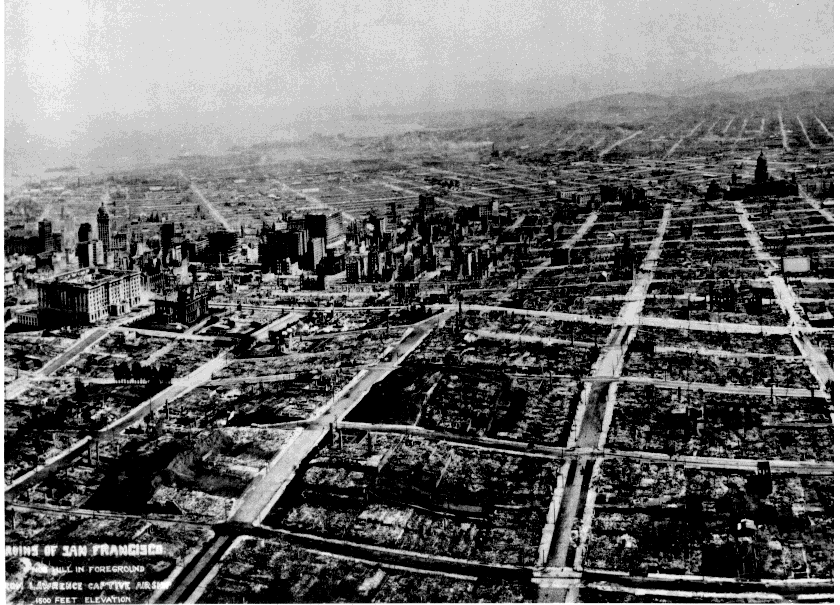
John Castillo Kennedy writes a riveting account of the fire that swept through San Francisco in the wake of the catastrophic earthquake that struck on April 18, 1906. The earthquake and resulting fires, which killed 3000 people, destroyed 80% of the city. Among the dead was the city fire chief. Firefighters, unaccustomed to using dynamite to create firebreaks, caused several of the fires.
At one point early in the fires, according to Castillo, the spread of the flames surprised people living along Pine, Bush, and Sutter Streets, forcing them to flee immediately. They had been confident that the flames would not reach them there. The author says,
“Quickly filled trunks grated up the hills. Wagons, mostly pulled by men, rattled over the rough cobblestones. Baby carriages and toy express wagons rolled along packed full with the ‘things’ people had snatched up in the flight. Pianos were bumped along the sidewalks–some went to pieces in the process. Sewing machines slipped along on their rollers with stacks of bedding and the like lashed to them. Women had their valuables on their person, or carried trinkets Gypsywise in handkerchiefs. Men wore columns of hats five-high. Some carried only a book. Parrots jabbered and scolded from many cages. Some people had blankets. Girls usually had bandboxes. Boys stretched poles between them and carried, suspended there, bundles of clothing and provisions. Once it was only a ham” (83).
These panic-stricken people, with no time to prepare, reached for the thing that had the most practical or sentimental value to them. Something made people faced with total loss and threat of life to lug heavy items or pets or food. Many of the choices seem irrational. Perhaps they were in shock or acting in impulse. In essays and contests asking people what they would grab if their house was on fire and they could only grab one thing, they have cited passports, wills, legal documents, insurance policies, personal papers, portable hard drives, phones, etc.
I’m trying to put myself in their shoes. If I was in one of the many neighborhoods forced to flee my home with no time to spare, what would I have been sure to grab? How long would it take my mind to settle on sentimental family items like old photos, my wedding video, or the boys’ baby books? Would I be relieved if I could make it out with my Bible, though I saved nothing else?
I do not judge those folks with their bizarre, split-second decisions. For some reason, it just made me do some introspection. What does my priority list look like? What do I value most in my life and in my home? What would I try to be sure to preserve?
Perhaps the answers to those questions is best provided by my choices in ordinary, every-day actions. I want my wife, children, fellow-Christians, and, most of all, my God to see from my life that they come before the things of this world. The things will all ultimately burn (2 Pet. 3:10). It is the relationships that will outlast the final, global conflagration. I pray that my influence and example will save them from the fire (Jude 23).
Reference: Kennedy, John Castillo. The Great Earthquake And Fire: San Francisco, 1906 (New York: William Morrow and Co., 1963).
It was a gorgeous sunny day without a cloud in the sky. I shot Dale a text and told him to meet up with me at a mom and pop gas station outside of Huntsville for a BLT.
I grabbed my motorcycle keys, helmet, and leather vest. On the way out the door I decided to throw on my jean jacket underneath my vest. I don’t know why I did this because the temperature was close to 80 degrees. I hopped on my bike, turned on some Hank Williams Jr., and headed towards Huntsville.
2:37 PM
I was biking on the road that led to those amazing gas station BLT’s. I had been on this road hundreds of times, but today’s trip ended a little differently than normal. I noticed a truck slowly pulling out of the driveway of the local shooting range. He crept forward and then stopped. I figured he was stopping because he saw me coming. I get about 100 feet away from the truck, and he pulls out. He turned left blocking both lanes of traffic and I knew what was about to happen. I pulled the clutch and grabbed a fist full of brakes, but it was too late.
2:38 PM
It’s amazing how many thoughts you can have in such a short time. Everything slowed down and as the truck got closer I thought about Emily, my family, my spiritual state, and BLT’s. The initial impact was to my left leg, then my head hit the front body panel of the truck. The last thing I remember is a sharp pain in my head and a blinding flash of white.
2:43 PM
I woke up in a ditch and the first thing I saw was my motorcycle upside down next to me and somehow “Feelin’ Better” by Hank was still playing from the speakers on my bike. Incredibly, I didn’t break a single bone or have any major head injuries. Needless to say, I never got that BLT.
May 12th 1:21 PM
I’m at the church building with my brother writing an article for tomorrow morning. I can’t stop thinking about everything that happened. I can’t help but feel like God’s providence was written all over that day.
The jean jacket I grabbed at the last minute saved my arms from getting road rash, the crash bars I installed literally the night before absorbed the initial impact. Those bars were an inch and a half solid steel pipe and they folded like a quesadilla. That would’ve been my leg if it weren’t for the time I spent installing them the night before.
I realized several important facts that day:
Only God knows what tomorrow holds (Prov. 27:1).
Death is certain, but when we die is uncertain. Because of sin we are destined to die. I could’ve died on a motorcycle, or from a heart attack from too much bacon. Bottom line, we must be spiritually prepared to leave this earth at any moment (Heb. 9:27; Matt. 24:42-44).
Some things are more important than a motorcycle. Like my parents’ mental health and blood pressure. Emily’s well-being and peace of mind is far more important than a bike. It’s a matter of looking at things from the other person’s point of view. Practicing the golden rule (Matt. 7:12). I would be a wreck if either of my parents bought a motorcycle (pun intended).
So here’s my two cents for those reading this:
It’s beneficial to take a step back and look at our priorities. If we value anything on earth more than God, we will leave this earth unprepared.
If there’s sin in our lives, procrastination is the absolute worst thing we could do. Tomorrow is never promised.
Be mindful of what our actions do to others. It may not even be sinful, but it’s all about showing a love that values others’ peace of mind and well-being above yourself.
P.S. Watch out for black Dodge trucks; they don’t stop.


























 The Preacher Pollard Blog