The Ankgor Wat Dinosaur

Neal Pollard

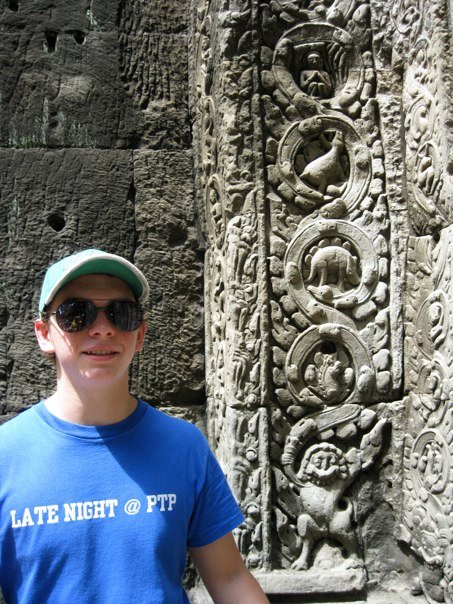
I have been to the Ankgor Wat temple complex, near Siem Reap, four times. It’s a fascinating tourist attraction, but there is one carving, among literally thousands, that stands out above the rest. It is found at Ta Prohm Temple. The temple was built between the late-1100s to early-1200s by King Jayavarman VII and dedicated to his mother. Today, it is “shrouded in dense jungle” and “fig, banyan, and kapok trees spread their gigantic roots over stones, probing walls and terraces” (tourismcambodia.com). “It took 79,365 people to maintain the temple including 18 great priests, 2,740 officials, 2,202 assistants, and 615 dancers” (ibid.). But it’s that stone carving that it most unforgettable.  One particular trip, which I made in 2009 with two elders, three deacons, and my oldest son, Gary, stands out in my mind.

I asked our guide, hired out by the Kazna Hotel in Siem Reap and of the Buddhist faith, what he thought this particular creature was. He said he had no idea what it was and added, “They must have had a really good imagination.”  The question such a response raises is, “How did they know to imagine that?!”

Well, a group from Canada was following close behind our group of seven from Denver, Colorado.  A son asked his father for an explanation of the carvings on the pillar, and dad replied with some authority, “Son, that was their version of a geological timetable.”  Of course, it begs the follow up, “How did 12th-Century Khmer people, well before Darwin and others planted their geological seeds, know of such a timetable?”  Furthermore, this “timetable” looks nothing like anything you will ever see in a textbook–a man above it and a monkey below it.  Based upon what fossil evidence did they create their carving?  There must have been hundreds of fellow “explorers” viewing these temple ruins with us in the few hours we were there.  Some of the fascinated people spoke in languages I cannot understand, but body language was pretty telling.  Others, Americans, British, Australians, and Canadians, all seemed to see that carving for what it most apparently was.  No one said, “That’s a rhino or pig.”  They called it a Stegosaurus.

How many other similar discoveries await reclamation from jungle vegetation, archaeological excavation, and geographic exploration?  In the different disciplines of science and history, man uncovers gems like Angkor Wat’s Ta Prohm from time to time.  Such clear, incontrovertible evidence from a time before our modern “war” between evolutionists and creationists begs to be examined with unprejudiced eyes.  While some may never change their mind regardless of how many items are offered into evidence, I believe that there are a great number of people out there who are honestly, objectively looking for truth.  The Stegosaurus at Ta Prohm near Siem Reap, Cambodia, might be the item that convinces many!

1937409_160820505921_3751983_n
Gary standing next to the column. Notice what/who else is in the carving with the Stegosaurus.

“What Ever Happened To Toasters?” (*)

Neal Pollard

That’s what Tidewater resident Laila Cheikh might want to know.  She made a cash withdrawal for her cab company drivers from her Newport News, Virginia, Bank of America branch and got an unexpected “gift.”  Someone accidentally included a dye pack, like those given to bank robbers, in her bag of cash.  It exploded, leaving a huge mess and a foul smell.  That was on August 14, 2008.  In March, 2009, she sued Bank of America for bodily injuries from the dye (via USA Today Online, 8/14/08; Janie Bryant, The Virginian-Pilot, 3/14/09).  It’s unclear if the case has ever been solved.

I imagine you have had a day or two when you were delivered a less than pleasant surprise.  It may have been a dose of bad news.  Perhaps it was that person whose apparent color-blindness regarding the red light roped you into a fender bender that changed your morning plans.  It might have been a pink slip from a company you’ve faithfully served for years.  So many things can happen unexpectedly which alter your course or have a negative impact on you.

Though it will not compare to the day Job had (Job 1-2), it will test your character, your attitude, and your Christian example.  What you do when the unexpected and unpleasant “blows up in your face” is crucial!  You can be a light or you could cross over to the “dark side” (cf. Matt. 5:13-16; 1 Th. 5:8-10).  It’s up to you.  You never know what might be in the “bag of life.”  Be ready!


(*) They used to give new customers a toaster when they opened a bank account (before my time).


“No Doubt You Are The People, And Wisdom Will Die With You!”

know-it-all


Neal Pollard

This is, in my estimation, the most withering of Job’s comebacks to those miserable comforters introduced to us as his friends, Eliphaz, Bildad, and Zophar (2:11).  The statement is made by Job in Job 12:2 at the end of the first cycle of speeches by these friends, in all of which are accusations and insinuations that Job was suffering due to sins he had committed.  They were wrong, but they were certain they were right.

Aren’t there more than a few Eliphazes, Bildads, and Zophars today?  There are those who act as though they believe civilization has been holding its collective, bated breath in great anticipation of their arrival.  So many complexities, mysteries, and intellectual quagmires have sat stubbornly, mystifying their forebears, but pliably come forward as mere child’s play for them.  Or perhaps they purport themselves to be experts, demonstrating academic or professional credentials in support of such.  They may even move or speak with the air of unmistakeable confidence.  It might be that they have substantial followings and impressive venues to spout their philosophical triumphs.  

But, as the case was for Job, the proof is in the pudding.  God’s Word proved these men wrong.  Job 42 shows that their claims and theories, however confidently asserted, were at odds with His mind.  They spoke words of man’s wisdom.  It may have sounded right on the surface, but it wasn’t right.  

Consider Paul’s message to Corinth.  He speaks of preaching, the foolishness of God, coming in the wake of men’s inability to grasp His wisdom.  Then he writes, “Because the foolishness of God is wiser than men, and the weakness of God is stronger than men. For consider your calling, brethren, that there were not many wise according to the flesh, not many mighty, not many noble; but God has chosen the foolish things of the world to shame the wise, and God has chosen the weak things of the world to shame the things which are strong, and the base things of the world and the despised God has chosen, the things that are not, so that He may nullify the things that are,  so that no man may boast before God” (1 Cor. 1:25-29).

Humility, teachability, and submission are three indispensable quality traits we must possess when it comes to the Bible.  Our theology must be formed by the latter (the Bible) and our character is formed by the former (the quality traits).  Let us forever be less concerned with being judged right by others and be consumed with a desire to be right with God.