Isaiah: Trusting The Holy One Who Rules The World (XXXIV)

“What Have They Seen In Your House?” (39:1-8)

Neal Pollard

Isaiah appends an event to the end of his historical interlude which also appears almost verbatim in 2 Kings 20:12-19 and is referenced in 2 Chronicles 32:31. The latter historical book says, ” Even in the matter of the envoys of the rulers of Babylon, who sent to him to inquire of the wonder that had happened in the land, God left him alone only to test him, that He might know all that was in his heart.” The event involves the emerging empire of Babylon, whom their king, Merodach-baladan, sends envoys to visit Hezekiah.

The reception (1-2).  Scripture says the envoys came on a good will mission and Hezekiah received them gladly. Hezekiah showed them everything, his treasure house, all that was in his store houses, and, in fact, “There was nothing in his house or in all his realm that Hezekiah did not show them” (2b). It is hard to interpret Hezekiah’s action as anything other than pride, a display of all that his nation possessed under his reign. Isaiah is going to show Hezekiah the futility of such self-reliant trust.

The rebuke (3-7). Isaiah begins by questioning Hezekiah about what happened. The king reports to the prophet, then Isaiah asks his quotable question, “What have they seen in your house?” (4). Hezekiah says these envoys had seen everything. This prompts the prophetic warning that some day this nation, Babylon, would carry all that is in his house back to their country along with his descendants. They would even be made eunuchs there (6-7). Nothing would be left! Hezekiah’s prideful heart contributed to the future consequences that would be visited on his people. 

The response (8). Hezekiah’s reaction is really baffling. Was he being smug, was he giving God glory, or was he expressing thanksgiving at God’s goodness? Perhaps he is humbled by Isaiah’s message from God that these men he gladly welcomed and showed off for would some day be the means whereby his people would be taken into captivity. 

It is a pretty compelling application to ask ourselves the question that Isaiah asked Hezekiah. What do others see in our house? Do they see parents who look to God rather than possessions, status, and the like? Is that reflected in our choices, making Him a priority as we make our home a place where His Word is the unmistakable foundation and where our actions reflect that we are led by the truths found in it? If we decide poorly, we will negatively impact the generations that follow us. Let’s make our homes a haven where God and His will are clearly trusted and relied upon! 

Isaiah: Trusting The Holy One Who Rules The World (XXXI)

The Invasion Of Assyria (36:1-22)

Neal Pollard

There is a historical interlude in this prophetic book, from chapters 36-39. 2 Kings 18-19 and 2 Chronicles 32 are parallel accounts, even filling in some details such as King Hezekiah’s capitulation to Sennacherib’s demand for tribute. The Assyrian king changes his mind and decides for invasion after receiving payment.

This chapter records the perspective and taunts of the Assyrian Rabshakeh (a royal official in their government whose name literally means “cupbearer” but whose role is obviously an important military position; Allen C. Myers, Eerdmans Bib. Dict., 870). He comes against the fortified cities of Judah after having taking off their brethren, Israel, into captivity in a devastating invasion (see 2 Kings 17). It is a frightening situation for Judah and Hezekiah, as they view this “great army” (2). There are several reasons for Judah to be intimidated and afraid.

First, they were greatly outnumbered. Their army numbered at least 185,000 (2 Ki. 19:35). These were vicious, victorious men who had overwhelmed every enemy they had faced.

Second, they were intimidating. The Rabshekah up to the wall around Jerusalem and begins speaking to the Jews there in their native tongue, Hebrew (11). He offers to make a wager with Judah to stake everything on a chariot race, knowing full well Judah was not close to being a competition (8). He contends that Judah couldn’t defeat even a single captain of his army (9).

Third, they were insulting. Not only did they insult Judah, but more catastrophically and foolishly, they insulted God. The Rabshakeh unknowingly compliments Hezekiah’s righteousness by pointing out the good king had removed the high places of worship which God disapproved of (meaning God was pleased with Hezekiah)(7). He equated Jehovah with the gods of the peoples they had already defeated (19-20). Speaking Hebrew rather than Aramaic was as insulting as it was intimidating. 

The Judean officials who received the Rabshakeh’s taunts brought word to Hezekiah. The next chapters reveal his response and Isaiah’s involvement. Hezekiah is handed a five-alarm crisis. It was no doubt bigger than him and left him with precious little to do in response. Have you been there, with your back against the wall facing an earthly enemy much bigger than yourself? It is tempting to resort to responses that do not honor God, but we learn much from Hezekiah in what follows. 

Isaiah: Trusting The Holy One Who Rules The World (XXX)

The Last “Woe” And The Magnification Of The Almighty (33:1-24)

Neal Pollard

Chapter 33 is the last of five “woes” (“ah” in the ESV). It focuses on Assyria’s destruction, the fulfillment of which we read about in chapters 36-39 in Hezekiah’s righteous, faith-filled stand against Sennacherib. This chapter contrasts the incredible fall of the Assyrians with the absolute exaltation of the Lord.

The preamble of the chapter (1) is a warning to Assyria that their days are numbered. They have ravaged, a “destroyer,” a “traitor,” and a “betrayer,” but now they will be destroyed. After this statement, Isaiah reveals what his people will say to the God they remember to trust and lean upon for rescue.

The prayer of Judah (2-6). Notice the contents of the prayer. It is a cry of help–“be gracious” (2). It is a pledge of trust–“we wait for you” (2). It is an expression of praise–“The Lord is exalted” (5). It is a grateful acknowledgement of His greatness–“he will fill Zion with justice and righteousness, and he will be the stability of your times, abundance of salvation, wisdom, and knowledge; the fear of the Lord is Zion’s treasure” (5b-6). When their enemy was removed from before their eyes, they could see God in His full splendor without any obscurities. 

The praiseworthiness of God (7-13). Before this hoped-for deliverance, Judah stared down the prospect of treachery and destruction from the hands of the Assyrian people they had petitioned nations like Egypt to protect them against. That was wrong and foolish. Gary Smith writes, “Four geographic locations are specified: Lebanon, the Sharon plains, Bashan, and the Carmel mountains. These are areas that were renown for their fertility and lush green trees and crops. Now these areas are withered and look more like a desert” (NAC, 356). Judah is languishing in fear and defeat. God says that, in such conditions, they will be better able to see Him in His true splendor–“Now I will arise,” says the Lord, “now I will lift myself up; now I will be exalted” (10). The contrast is stark! The Lord says, “Hear, you who are far off, what I have done; and you who are near, acknowledge my might” (13). 

The perspectives of the wicked and righteous (14-22). What about the sinners in Zion? They’re afraid and tremble (14). What about the righteous? They dwell on the heights with ample bread and water (16). But more importantly, the godly do not have willful sin blinding their eyes to God’s greatness. Not only will they see God in His beauty, they will see the land in its sufficiency, the disappearance of the Assyrian threat, the restoration of the place of worship, and the delivering power of God (17-22). 

The promise of the future (23-24). Despite the abiding threat at the time this is written (23a), things would change. Prosperity would return, sickness would recede, and redemption would be restored. Assyria was going down, and the people should see the goodness and mercy of God in the wake of it. 

Isaiah: Trusting The Holy One Who Rules The World (XXIX)

The Righteous King And The Spirit (32:1-20)

Neal Pollard

It is difficult to say whether or not the king in verse one is Messianic, especially since he is mentioned in tandem with princes who also rule. Yet, his coming is mentioned in connection with the Spirit being poured upon God’s people from on high (15). The princes may refer to those subordinated to this king, whether apostles or disciples. Of course, there is a contextual meaning as with previous Messianic passages (7:14; 9:6,7). The more immediate application, if this is dual-fulfillment, could apply either to Hezekiah or Josiah, since the general time line is close to the invasion of the Assyrians in 701 B.C. Contrasted with a more hopeful future is the disastrous leadership of the current rulers. 

The hope of a better day is set against the spiritual troubles of the present. Whereas there is wind and drought (2,13), blindness and deafness (3), hastiness and deficiency (4), folly and dishonor (5), sin and error (6), and weak women (9-12), Isaiah says these will be done away by a better day. He also writes of the turning point that will happen with the coming of the Spirit (15-20). The blessings include fruitfulness (15), justice and righteousness (16), peace (17), security (18), and prosperity (19-20).

Is Isaiah referring to the spiritual blessings to come in the day of Christ? I believe so. Yet, I also think in the more immediate sense that Isaiah portrays the day that would come after the oppression of foreign invaders when the nation returns. They were about to endure some intensely frightening things as a means of turning their hearts back to God (9-14). What Isaiah holds forth would come after this. Ultimately, the spiritual blessings that would come with the appearance of the Messiah would bless “the people who walk in darkness [that] will see a great light; Those who live in a dark land, The light will shine on them” (9:2; Mat. 4:16)!

Isaiah: Trusting The Holy One Who Rules The World (XXVIII)

Who Do You Trust (31:1-9)?

Neal Pollard

This fifth woe again centers around the foolish choice of trusting man instead of God. We sometimes sing, “Stand up, stand up for Jesus, stand in His strength alone; The arm of flesh will fail you, ye dare not trust your own” (cf. 3). The sentiment of Isaiah’s words in this relatively brief chapter supports such an admonition. 

The call of the first three verses is to look to and call upon God rather than trust in the Egyptians for refuge and protection. Everything they desired from Egypt they already had in God. What Judah wanted from this nation it could not deliver, but those very things were ready resources available from One whose resources are inexhaustible. How foolish to misplace trust like that! There is no infallible human helper. Once again, Isaiah uses the imagery of God with an outstretched hand. When He does so, men feel His omnipotence.  So, what does God want from Judah?

Faith in God’s rescue and protection (4-5). Isaiah urges this through two examples from the animal kingdom. God would be as fierce as a lion honed in on its prey, undeterred by any action by human shepherds to keep it from its goal. God would be as protective as birds which hover over its eggs or chicks, keeping away predators. God’s fierce love and care for Judah is illustrated with both power and tenderness!

Genuine return and repentance (6-7).  Look at the elements of repentance called for here. First, there must be a turning to Him from defection or revolting. This describes an awareness that we have been disloyal and disobedient, but that we understand how wrong this is! It also involves a turning away from the sinful actions that grieved God in the first place. Here, it was casting away idols of silver and gold (7). What a useful illustration of what true repentance is, turning from wrong and turning to God. 

Patience to wait for God’s judgment (8-9). That God is behind the coming punishment of Assyria is made clear by the close of this chapter. They will fall by God’s sword of judgment, whoever the men are who may be holding it. God is the fire and furnace that will consume Assyria when He says the time is right. God’s character is trustworthy, and He will do what is right when it is best.

These are timeless principles. We have a choice about who to trust for our help and strength. It is easy to rely on ourselves, our nation, or some earthly resource which we can see, but we are called to lean on the Everlasting Arms. It is essential to return to God from wherever we have wrongly gone to find refuge. It is enlightened to rest in God’s sure response to the wicked! 

185,000 Soldiers Killed By Angel

Dale Pollard

Account: Isaiah, 37:36-38; 2 Kings, 19:35ff; 2 Chronicles 32

A Serious Assyrian Threat: 

Sennacherib is on a campaign to control all routes across the Syrian Desert leading to the Mediterranean Sea. Assyria  had already carried the Northern Kingdom of Israel off into captivity and invaded the southern kingdom of Judah. 

Jerusalem is now under threat of attack and king Hezekiah sends his servants to the prophet Isaiah to ask for prayers on behalf of the people. Yahweh, through Isaiah, tells the people to not be afraid. For as unlikely as it seemed to the surrounded inhabitants of Jerusalem, their salvation would come in the middle of the night. 

“That night the angel of the LORD went out to the Assyrian camp and killed 185,000 Assyrian soldiers. When the surviving Assyrians woke up the next morning, they found corpses everywhere” (2 Kings 19.35).

Sennacherib Cylinder Evidence: 

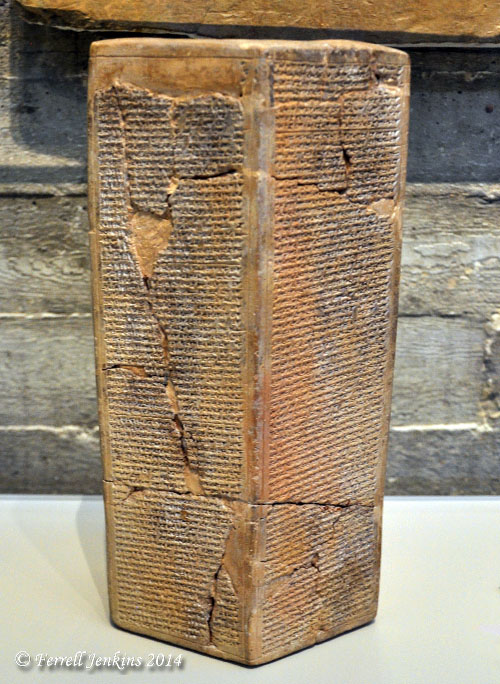
Sennacherib left behind a record of his campaign against Judea and it can still be seen in the British Museum today.

Here’s a translation of his inscription, 

“As to Hezekiah, the Jew, he did not submit to my yoke. I laid siege to 46 of his strong cities, walled forts, and to the countless small villages in their vicinity.  I drove out of them 200,150 people, young and old, male and female, horses, mules, donkeys, camels, big and small cattle beyond counting and considered  [them] spoils. Himself I made a prisoner in Jerusalem, his royal residence, like a bird in a cage.”

Sennacherib claims he conquered all of Judea except Jerusalem.  He also claims that he surrounded the city of Jerusalem with his army, and trapped Hezekiah “like a bird in a cage.” 

Curiously, that’s where he chose to end the story. To continue any further would mean to either fabricate or include a loss of such magnitude that it would tarnish the reputation of a proud Assyrian king.

What Are You Showing?

Brent Pollard

The geopolitical landscape under Hezekiah, King of Judah, saw an increase in the threat from Babylon while Assyria’s influence declined. Hezekiah’s political interests and personal ambitions were intertwined to solidify his kingdom amidst evolving circumstances. When he recovered from a severe illness, envoys from Babylon, a rising power seeking to weaken Assyria, visited him. Overwhelmed with relief and eager to impress his potential new allies, Hezekiah made a critical error.

The scripture recounts in 2 Kings 20.13, “Hezekiah listened to them, and showed them all his treasure house, the silver and the gold and the spices and the precious oil and the house of his armor and all that was found in his treasuries. There was nothing in his house nor in all his dominion that Hezekiah did not show them.” (NASB95) This act of pride had serious future consequences, as the prophet Isaiah sharply points out in Isaiah 39.4 by questioning Hezekiah, resulting in a prophecy of doom for his lineage and nation.

This passage emphasizes the importance of being careful with what we disclose. It encourages us to consider the consequences of our actions, which can affect not only our own but also the fate of the community.

The Dangers of Pride and Showing Off

Hezekiah intended to gain political favor by displaying his kingdom’s wealth, but he also revealed a more profound spiritual issue that the Scriptures emphasize: the danger of pride. The Parable of the Rich Fool in Luke 12.16–21, in which a man obsessed with wealth plans to build larger barns to store his crops only to die the same night, reinforces this New Testament message. Like the rich fool, Hezekiah’s pride in his treasures arose from prioritizing material security over spiritual faithfulness.

When displaying our possessions, achievements, or abilities, we must consider whether they serve a greater purpose or feed our ego. Self-reflection is critical to avoiding arrogance and conceit.

Wisdom in Confidentiality

Hezekiah’s strategic error stemmed not only from his pride but also from his failure to anticipate the consequences of his disclosures. Jesus advised such individuals not to “give what is holy to dogs, and do not throw your pearls before swine, or they will trample them under their feet, and turn and tear you to pieces.” (Matthew 7.6 NASB95) Protecting valuable things, whether spiritual beliefs or important assets, is essential.

The principle of caution prompts us to be careful when sharing information. Sometimes, it is preferable to keep things private to protect ourselves and our communities from potential harm. This wisdom, rooted in scripture, encourages us to consider the possible impact on the larger community before sharing information.

Consequences Extend Beyond the Individual

Isaiah’s prophecy reveals a fundamental biblical truth: our actions have a long-term impact on our descendants and community. The exile of Judah’s elite to Babylon, which Isaiah predicted, exemplifies how Hezekiah’s decisions had severe and long-term consequences. This interconnectedness of fate resonates with Paul’s assertion in 1 Corinthians 12.26, “And if one member suffers, all the members suffer with it; if one member is honored, all the members rejoice with it.” (NASB95)

Acting community-mindedly requires us to consider how our decisions affect others.

Hezekiah’s encounter with the Babylonian envoys underscores the significance of humility, discretion, and foresight in our social dealings. As we navigate life’s complexities, it is critical that we embody these virtues and only show others what honors God and promotes communal well-being. It is imperative to heed Hezekiah’s missteps and aim to make choices that glorify God and enrich future generations. Integrating foresight and wisdom into our daily choices empowers us to enhance our lives and contribute to a brighter world.

A Pre-Written Obituary

Neal Pollard

On July 18, 1969, as the world waited for Apollo 11 to land on the moon, presidential speechwriter William Safire had an unpleasant task. He had to write a contingency speech for Richard Nixon to read in the event the astronauts became stranded on the moon. It began, “Fate has ordained that the men who went to the moon to explore in peace will stay on the moon to rest in peace.” Can you imagine anyone being willing to go on a mission so dangerous that they write your obituary before you leave?

But it happened 2700 years earlier when Isaiah wrote the obituary of Jesus of Nazareth. “Who has believed our report? and to whom is the arm of the Lord revealed? For he shall grow up before him as a tender plant, and as a root out of a dry ground: he hath no form nor comeliness; and when we shall see him, there is no beauty that we should desire him. He is despised and rejected of men; a man of sorrows, and acquainted with grief: and we hid as it were our faces from him; he was despised, and we esteemed him not” (Isaiah 53:1-3). 

You have to think that a prophecy so important to Jewish hope and expectation would have been read frequently in the temple and the synagogues, so how many times did Jesus hear it read? The theme of Isaiah 53 often seems to be on His mind, though He doesn’t directly quote it in the gospels. In Matthew 9:15, He tells His disciples that He would be taken away from them and Isaiah 53:8 says, “He was taken and cut off.” In Matthew 17:12, the disciples bring up Elijah and Jesus connects him to His own suffering. Repeatedly in the gospels, when Jesus connects His coming suffering and death, He is appealing to an aspect of Messianic Prophecy highlighted by Isaiah that was unmistakeable if unpopular. 

Isaiah describes His suffering, but the crux of His story is salvation. But just as that word crux means “cross,” it’s difficult to separate the victory from the viciousness. Yet, because Jesus was willing to accept His deadly mission, we can have eternal life! 

From Hostility to Harmony:

Exploring the true meaning of “peace on earth”

Brent Pollard

During the holiday season, we often focus on the concept of peace. It’s an important theme in holiday music, especially in a world where conflict is all too common. Indeed, such songs oft remind us about Christ as the “Prince of Peace” and the promise of peace on earth (see Isaiah 9.6; Luke 2.8-14). However, Christ’s peace is more than just the absence of conflict. It is a complex concept with many facets deeply entwined with man’s greatest need: salvation from sin.

Christianity holds that real peace requires reconciliation with God through Christ. This true peace is the primary reason Christ put on the robes of flesh. Faith in Jesus Christ is the only way to achieve peace with God, according to Paul in Romans 5:1. As explained in Romans 5.8 and 5.10, this peace aids in the resolution of the inner conflict of guilt caused by sin. Humanity became estranged from God in the Garden of Eden, but we can return to divine harmony through Christ’s incarnation. Upon Christ’s birth, the angels declared to mankind that He was extending an olive branch to humanity. Note: “Glory to God in the highest, and on earth peace, good will toward men” (Luke 2,14 KJV).

Beyond reconciling with God, Christ’s peace, once received, permeates our inner being. In Philippians 4.6-7, Paul describes this peace as “beyond all understanding,” a calm that guards our hearts and minds regardless of life’s ups and downs. This inner peace is more than just a temporary state of calm; it is a profound sense of stability and contentment that stems from a close relationship with God. To achieve this peace, we must engage in consistent prayer and gratitude and live according to Christ’s teachings and examples.

As we embody Christ’s teachings, our relationship with others will change. Jesus tells us to love our enemies (Matthew 5.43–48) and to live by the Golden Rule (Luke 6.31). These teachings challenge us to work for peace in our communities by actively showing love and empathy to others, not just tolerating them. His teachings remind us to live peaceably among men (Romans 12.18). Although the world is far from perfect, Christians can help to create a more peaceful society by living these principles. The message is clear: peace between men starts with each of us.

Christ is the source of the all-encompassing peace that Isaiah foretold, which the New Testament made manifest. It encompasses achieving a state of reconciliation with God, experiencing inner serenity, and fostering harmonious relationships within society. As followers of the Prince of Peace, let us embrace and share this multi-faceted peace this holiday season and beyond.

Does Isaiah 7:14 Describe A Virgin Or A Young Woman?

Friday’s Column: Brent’s Bent 

Brent Pollard

With Christmas on Sunday, thoughts turn to the Christ child, born between 6 and 4 B.C. in Bethlehem. While the baby Jesus is the focus of most of the debate surrounding the innumerable nativity scenes that dot lawns and yards across the United States, His mother, Mary, is a divisive figure in her own right. In his purported “translation” of the Bible, Thomas Jefferson, for instance, left out the story of Jesus’ virgin birth. As with many others, Jefferson disbelieved in miracles. Before IVF, such an unconventional conception would have been unthinkable for the erudite of the Age of Enlightenment. However, some Christian groups today don’t believe in the virgin birth of Jesus. One way that the latter rationalizes their view is to point out that the word translated as “virgin” (almah) can likewise mean a young woman. 

There seems to be no reason it can’t mean both “virgin” and “young woman.” Those preoccupied with the debate over the virgin birth of Christ miss the other point of Isaiah 7.14. Aram and Israel threatened King Ahaz of Judah. Ahaz’s fear was palpable. God instructed Ahaz to request a sign to indicate Judah’s deliverance. God told Ahaz that he could even ask for something extraordinary. Ahaz was not a righteous king, but he pretended to be godly here by saying he would not test God. To this, God replied with the words most commonly associated with Jesus: “Behold, the virgin will conceive and give birth to a son, and she will name Him Immanuel” (NASB). God revealed that this was a sign He would send to Ahaz. Moreover, God would remove the danger posed by Aram and Israel before this child reached adulthood (Isaiah 7.16). 

I’ve seen well-intentioned brothers argue that this prophecy can only refer to Jesus’ virgin birth and that we must not permit others to interpret it as referring to a young woman. However, I wonder what good a sign concerning Christ would have done King Ahaz. Ahaz was a historical figure who existed more than 700 years before the birth of Christ. How could a messianic prophecy promise Ahaz that Judah would not fall? The answer is that it couldn’t. Ahaz required immediate fulfillment. In the following chapter, Isaiah documents the event as having been accomplished. Isaiah and his wife had a son, and his birth foretold that the Assyrians would plunder those who opposed Judah (Isaiah 8.1-4). The prophetess was not a virgin since she and Isaiah were married and had given birth to at least one of Isaiah’s children (Isaiah 7.3). Thus, a young woman was the immediate realization of the sign, but a virgin was the ultimate fulfillment. 

The sign’s demands tested the faith of Joseph and Ahaz, but Joseph succeeded where Ahaz did not. Ahaz needed to trust God and wait for the sign He promised. But Ahaz sought out the Assyrians and allied with them (2 Chronicles 28.16). Joseph was well aware that a virgin could not normally conceive a child. Therefore, he was going to dissolve his relationship with Mary privately. But an angel announced to Joseph that Mary was carrying a child the Holy Spirit conceived. Joseph believed the prophetic sign from God and acted accordingly. Joseph’s response should be ours today. Rather than quibble over the precise definition of “almah,” we should believe that God means what He says. 

Worship That Wearies God

Monday’s Column: Neal At The Cross

Neal Pollard

If we are honest, some days it is easier to worship with focus and enthusiasm than others. We’re human and we struggle. With mental preparation and prayer, we can minimize the frequency of such times, but they happen to the best of us.

Have you ever thought about God getting tired of the worship brought by His people? I don’t mean worship done incorrectly and according to the will of men which violates what He commands. Apparently, He rejects such worship (Mat. 15:9). I don’t mean the idea that He gets bored and had rather skip a Sunday here and there. No such picture is ever painted of God.

But through the prophets, He repeatedly talks about being weary of the worship brought by His people. 

“I have had enough…I take no pleasure in…your worthless offerings…an abomination to me…I cannot endure…They have become a burden to Me; I am weary of bearing them” (Isaiah 1:11-14).

“I hate, I reject your festivals, nor do I delight in your solemn assemblies…Take away from Me the noise of your songs; I will not even listen to the sound of your harps” (Amos 5:21,23).

“Oh that there were one among you who would shut the gates, that you might not uselessly kindle fire on my altar! I am not pleased with you,” says the Lord of hosts, “nor will I accept an offering from you” (Malachi 1:10). 

Each prophet is dealing with specific circumstances prompting such a response from God, but it should cause us to take notice that just coming into the “meeting house” and going through the motions does not equal acceptable worship. Neither does simply following the New Testament pattern for the acts of worship. You will find in each of the passages above that the people were at the right place offering the right sacrifices on the right day led by the right people. The problem was either one of attitude, hypocrisy, or outright worldly living. Jeremiah documents how the people lived just like the world for the rest of the week, then filed into the temple to sing, “Redeemed, how I love to proclaim it!” (7:4-10). 

Worship is a special privilege, to come into the presence of our Maker and Savior. At our best, we worship Him with sin and weakness in our lives. He knows that and the cross proves that He knows it. He is not expected sinless perfection, but He is looking for characteristics in our worship just beyond doctrinal accuracy.  He wants:

  • Feeling (Psalm 95:6; John 4:24).
  • Engagement (Matthew 15:8).
  • Effort (Hebrews 13:15).
  • Gratitude (Ephesians 5:20; Colossians 3:16-17).
  • Thoughtfulness and Intentionality (Ephesians 5:19; Colossians 3:16).
  • Devotion (Acts 2:42).
  • Consideration of one another (Hebrews 10:24). 

It is such a blessing that God communicates with us not only about the “what,” “when,” and “who” of worship, but also the “how” and “why” of it. When we are assembled for worship, He tells us what worship should look like. Between the assemblies, He tells us what a life looks like that partners with that worship.

God speaks of the various sacrifices of His children being a “fragrant aroma” to Him (Philippians 4:20; ). He likens the prayers of His faithful people to incense (Revelation 5:8; 8:1ff).  Jesus assures us that true worshippers offering true worship are highly sought after by God (John 4:23). That’s the aim, isn’t it? The idea of presenting God with both a worshipper and worship which enthuses Him is the pinnacle of excitement! 

Next Sunday, before we come together in worship, we can read Psalm 95, Psalm 96, Isaiah 6, or a similar chapter which reminds us of Who we get to worship. Today and every day, let us strive to build on the most recent worship we have offered by a life of faithful service and sincere devotion. That will set the table for worship God can’t wait to receive! 

Motivation For Attending Church Services

Neal Pollard

“An Italian newspaper recently carried an interesting story about a young couple in Milan who had a wonderful attendance record at a particular cathedral. The priest assumed they were very devoted to their faith because they regularly spent an hour before one of the statues in the church’s worship area.  He thought they were doing some intense praying.  Only later did he discover the couple simply came to re-charge their cell phone from the electrical outlet behind the statue” (King Duncan, via Waterview, Richardson, TX, 3/16/14).

My first reaction to that was to chuckle, then be a little indignant, and then become introspective.  The thought that someone may come to church services for apparent honorable intentions but be serving some baser motive may be shocking, but it is not unheard of.  Jesus taught, “This people honors me with their lips, but their heart is far away from me” (Mat. 15:9).  Jesus is quoting Isaiah, and it was a problem in that prophet’s day, too.  Think of what another prophet wrote.  Ezekiel said, “They come to you as people come, and sit before you as My people and hear your words, but they do not do them, for they do the lustful desires expressed by their mouth, and their heart goes after their gain” (Ezek. 33:31).

When I come before the Great I Am, not only must I keep from distractions.  Deeper than that, I must examine my overall motivation for being at worship or serving the Lord.  Why am I a Christian?  Self-examination is as important as any spiritual exercise there is (2 Cor. 13:5).  Nobody else may know why we are before the Lord in worship, but He does.  May He see our motivation as transparent and true, honest and sincere!  

Space & Scripture 

Tuesday’s Column: Dale Mail

THE WAY UP THERE

Dale Pollard

“If you held a grain of sand on the tip of your finger at arm’s length, that is the part of the universe you are seeing — just one little speck of the universe…”

NASA Administrator  Bill Nelson

Isaiah Chapter 40

“Surely you understand who made the earth. It is the Lord who sits above the circle of the earth.” 

V.21b-22a

“He rolled open the skies like a piece of cloth…He stretched out the skies like a tent to sit under.”

V.22b

Lift up your eyes on high and see: 

who created these? Who created all those armies in the sky?

Who knows every star by name?

“He is very strong and powerful,

so not one of these stars is lost.

Surely you know the truth.
Surely you have heard.

The Lord is the God who lives forever!”

V.26-28a

The Invitation Song

Thursday’s Column: Captain’s Blog

carl-pic

Carl Pollard

Some of the most powerful messages are often delivered through song. If you want to really show someone how much you love them, you write a song. If you want to tell others about yourself or your family, you write a song. Songs are a great way to get across a message in a powerful way. In the church we sing songs for several reasons.
 
Paul tells us in Col. 3:16, “Let the word of Christ dwell in you richly, teaching and admonishing one another in all wisdom, singing psalms and hymns and spiritual songs, with thankfulness in your hearts to God.”
‭We sing to help the word of God dwell in our hearts. We sing to teach each other. We sing admonish and correct. We sing out of thankfulness for God. Since there are so many different reasons we sing, each song has a different message. Some are encouraging, some are reminders, and some are a plea to the sinner. We call some of these “invitation songs. ” And usually these are sung after a lesson as a way to encourage lost souls to respond and return.
 
“Though Your Sins Be As Scarlet” identifies a major problem that has plagued man since the Garden of Eden, our sin. The choices we make, the way we live, has stained us. This song calls to our attention the sin problem of man. This song is based on Isaiah 1:18, “Come now, let us reason together, says the Lord: though your sins are like scarlet, they shall be as white as snow; though they are red like crimson, they shall become like wool.”
This invitation song shows us the blessing that Christ has given. Though we’ve been stained by sin, they shall become like snow. Pure, holy, undefiled. If you’ve ever spilled grape juice on a white T-shirt, that’s the imagery.
 
Sin has ruined our hearts, but Christ is the perfect stain remover. He is able to remove every spot and blemish. Rom. 3:23 tells us that all have sinned and fallen short of the glory of God. Do we really think that we could live up to the glory of God himself? Could we have fixed this sin problem on our own? No. And we sing this song to remind us of WHO our solution is.
 
Through the gift of Christ they will be removed. Though your sins be as scarlet, they shall be as white as snow.
 
On an old rugged cross Jesus paid it all, and all to him I owe. I come just as I am, but I surrender all. Will you cherish the old rugged cross? Do you recognize the blessing and the blood that has washed us whiter than snow?
 
 
One of my favorite preachers delivering the invitation in Lexington, KY (2018)

“Charakter”

Monday’s Column: Neal At The Cross

Safari 2017

Neal Pollard

Character is defined as the mental and moral qualities distinctive to an individual and involves a person’s good reputation. The Greek word “charakter” first referred to the die used in minting coins, then came to include the sense of an image, stamp, seal, or copy. The Greeks used the word to speak of the typical features of an individual or nation, from which came the idea of “moral character” and then “the “distinctiveness” of a language, the “style” of a writer, or a “type” of philosophy (Kittel and Bromiley, TDNT, 1308). Arndt tells us the word means something produced as a representation or reproduction, and that human beings are formed by God as a representation of His own identity (1078).

The word is only found in the Bible in Hebrews 1:3. The epistle’s writer is describing Jesus, saying, “He is the radiance of His glory and the exact representation of His nature, and upholds all things by the word of His power.” It is an absolutely amazing truth that we are made in the image of God (Gen. 1:27), but the writer of Hebrews is saying something even more powerful about Jesus in Hebrews 1:3. He was not created by God as a reflection of God’s identity. The writer uses this specific word in Hebrews as part of His explanation that the Son is God! The NASB and NIV translate χαρακτήρ (CHARAKTER) as “exact representation.” The ESV has “exact imprint,” the NKJV has “express image,” the NLT says “expresses the very character of God,” and the ASV puts “the very image of His substance.” 

The author of this epistle leads out in his overall theme that Jesus is better by establishing the most important reason why. He is God. The writer uses Old Testament Scripture to prove it, citing Psalm 45 and Isaiah 61 to call Him God (Heb. 1:8-9). He then quotes Psalm 102:25 to say of Jesus, “You, Lord, in the beginning laid the foundation of the earth….” Then, in Hebrews 1:13, he quotes Psalm 110:1, which begins, “The LORD (Yahweh) said to my Lord (Adonai)….”

Let’s not miss the initial point of the letter driven home by the unknown writer. With a multitude of Old Testament passages, he proves this point about the essential character of Jesus Christ. He is God. He is as much God as Father and Holy Spirit. He is as powerful, all-knowing, omnipresent, perfect, sovereign, transcendent, self-existent, eternal–He is as Divine as Deity can be. 

That makes His willingness to be made a little while lower than the angels to taste death for everyone (Heb. 2:9) and to call us His brethren (2:11ff) all the more incredible. God lowered Himself not only to save us but to make us part of His family. We could spend the rest of the day meditating on that profound truth and still not fully grasp it. 

Here’s the question. God made us, became  one of us, died for us, and then opened the door to us to be His brother. What does that say about His character? As we try to fathom and appreciate that, it should give rise to another question? How should that affect  our character?

Word Studies: “MAJESTY”

Wednesday’s Column: Third’s Words

Gary III

Gary Pollard

We will be looking at the word “majesty” by request in today’s article. This series will look at words used in our English translations that aren’t used in modern communication or are otherwise unusual. Today, majesty usually shows up as an adjective for natural phenomena (a majestic sunrise/sunset, majestic scene, etc.). 

As a disclaimer, Hebrew studies are not my forte. For those of you with a knowledge of Hebrew, I welcome corrections. All material concerning Hebrew usage comes from the Theological Lexicon of the Old Testament or Hebrew & Aramaic Lexicon of the Old Testament: Volume 5. 

In the Old Testament, it is used to describe the beauty or awesomeness of nature. Leviticus 23.40 uses “splendid.” In Isaiah 53.2, and it means “physically attractive.” Being impressive or inspiring awe/wonder is how the word is used in reference to God, although descriptions of kings are also appropriate (Isaiah 35.2). Speaking of royalty, majesty is used to describe their power and accomplishments (see Daniel 4.30, 5.18 for examples). In the Old Testament, majesty can be understood as impressive, having honor, or as the effect left on an observer of a display of power or awesomeness. 

In the New Testament, it means to have high respect or incredible qualities (see II Peter 1.16). In that passage, Peter says that he was a firsthand witness of the majesty of Jesus. This is incredible, considering Isaiah 53 says that His appearance wasn’t special or spectacular. The majesty Jesus had on earth was due to His nature, not His appearance. Majesty is also used in reference to having high respect because of an impressive performance or display of power (Luke 9.43). In that passage, Jesus healed a boy who had a particularly violent demon. After returning him to a normal state, witnesses were blown away at God’s majesty. It was obvious that the power necessary to correct the boy’s issues was preternatural. They observed an incredible event and understood its source to be God’s power. That power is an aspect of God’s majesty. 

We are impressed with God’s majesty when we look at nature. The universe is vast and incredible! There are stars so massive they make the sun look puny. Even single-cell organisms on earth are incredibly complex. As advanced as medical science is today, we still do not understand many of the processes of the body. Count how many times some variant of the phrase, “We’re not sure how this works,” is used in clinical studies on multiple classes of medications or treatments. The complexity of our makeup is awe-inspiring! When we are impressed by nature’s power or beauty, we get a glimpse of God’s majesty. 

The Benefits Of Finding Ourselves In Scripture

Neal Pollard

Given his job, the Ethiopian of Acts 8 was one of that country’s most important people. Yet, he was more than important. He was very religious, apparently a proselyte (convert) to the Jewish faith. He didn’t restrict his religion to the assemblies. He read his Bible even when he was going about his secular tasks (Acts 8:28). Though he could not enter the assembly of the Lord (Deut. 23:1), he made the long and grueling trip from northern Africa to Palestine and was returning home. Many of us are familiar with the Old Testament passage he was reading when Philip joined him in his chariot. Reading Acts 8:32-33, we recognize the place as Isaiah 53:7-8. The Eunuch was trying to find out about who Isaiah wrote about, “of himself or of some other man” (Acts 8:34). Philip preached Jesus to him and he became a Christian (Acts 8:35-39).

Those are essentially the facts. Yet, I wonder how coincidental it was that the Eunuch was reading from that part of Old Testament scripture. This African official likely had a scroll containing the entire prophecy of Isaiah, which was not divided into the individual chapters like they are today. It would seem that the context in which Isaiah 53 occurs would be of particular interest to this man. Flip forward a few chapters to Isaiah 56. Isaiah is telling foreigners and eunuchs not to look down on themselves (3-5).

This official of Candace was very likely not some hopeless non-Jew looking for a crumb from the Jews’ table. He had the great hope and promise of Scripture. Perhaps this portion of Isaiah was of particular motivation and inspiration to him. For Philip to explain that the time of that prophecy had now been fulfilled, that access to this promise was now available, certainly led the Eunuch to urgently respond and enthusiastically react. Jesus was the One referenced in Isaiah 53, but he (the Eunuch) was the one referenced in Isaiah 56. No, not just him, but all like him–one from the “all nations” of Isaiah 56:7 who could reap the benefits brought by the “Sin-bearing Servant” of Isaiah 53 and the one who would “sprinkle many nations” (52:15).

I hope that you read your Bible with the same hunger and expectation. Perhaps there are portions that bring you greater hope and expectation, that speak with greater poignancy to your life’s circumstances. The Bible is a book filled with wonderful, relevant promises. Trust them. Let them bear you along through the rough spots of life. God designed the Bible to be a book of hope and inspiration, but it cannot do us any good unless and until we consult it! Find yourself in the Bible!

8ca1271b91f7acccd098a3db98a1689e-bible