Genesis: These Are The Generations (VI)

The Descendants Of Adam (5:1-32)

Neal Pollard

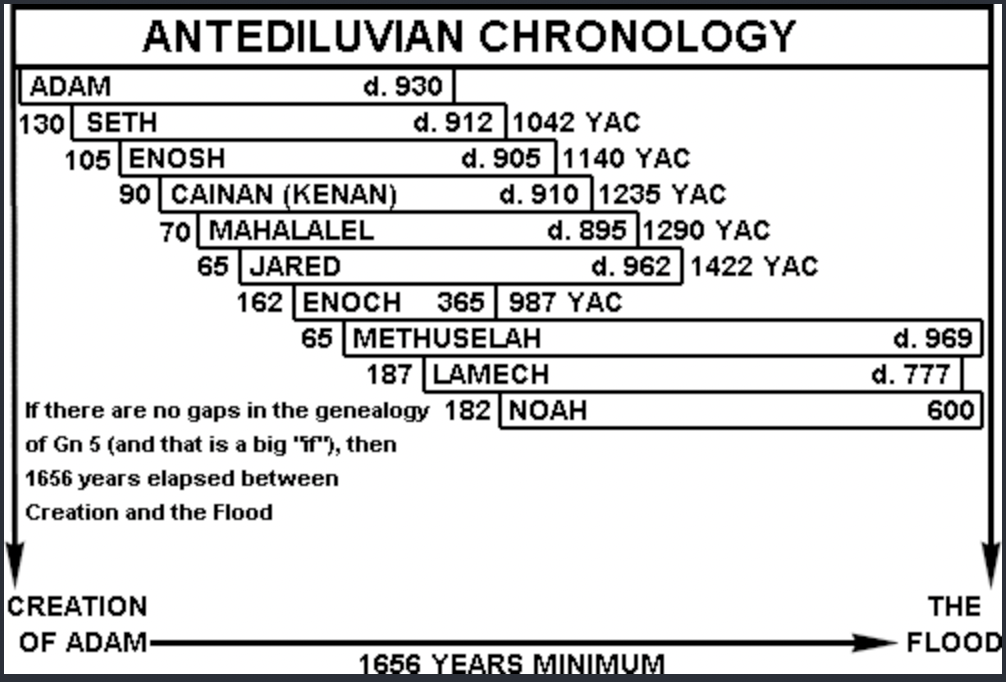
The men who are listed in the genealogies of Adam in this chapter have been called “the ten commitments,” trusting in God’s promise (3:15). There were spiritual giants among this group. Two of them were said to have “walked with God”–Enoch (5:24) and Noah (6:9). We probably know them most, as a group, for their longevity. In the pre-flood world, when the cursed earth was its youngest and least tainted, conditions were most ideal and genetics most favorable for long life. 

James Smith gives us this chart:

In laying out the genealogies, Moses goes back and speaks of the theology and biology of creation. Man is made in God’s likeness (1), and God made them male and female (2). Adam becomes father to a son (3), and thus it goes through all the genealogies. Moses’ record follows the same formula in laying out these ten generations: the father lives so many years, has a notable son (in the Messianic Genealogies–Luke 3:36-38), lives so many years after that birth, and finally dies. As the chart suggests, there is vast opportunity to populate the earth as they live on for centuries.

There are some interesting insights among the Bible’s first look into a family tree. Furthermore, there are implications from this chapter that resonate throughout the rest of Scripture. Notice just a few of these.

“…And he died” (5,8,11,14,17, 20,27,31; cf. 3:19). While these men lived nine or ten times longer than any of us would dare to believe we could live (imagine your life overlapping the lives of Saladin, Genghis Khan, and Thomas Aquinas; see also 6:3), they could not escape the reality of the death sentence brought on by Adam’s sin. Hebrews 9:27 avers that death is an inevitable appointment.  1 Corinthians 15:21-22 reiterates that by a man came death and that in Adam all die. 

“Enoch walked with God” (21-24). He is the exception to the rule just mentioned. Moses  writes a beautiful truth about this man. He strove for intimate fellowship with God. This is indicated by the phrase that “he walked with God.” This phrase might be ambiguous and unclear, if not for subsequent Scripture. This is tied to his faith (Heb. 11:5). Therefore, “he obtained this witness that before his being taken up he was pleasing to God.” He was a prophet of God sharing the word of God (Jude 14). We are told nothing about his wife or any of his other children apart from the famously old Methuselah, but if he lived anywhere close to the others he would likely have been alive the year of the flood if not taken by God. 

God defines what walking with Him should look like, as He speaks to His people at the end of the Old Testament. Speaking of the faithful Levitical priests, He says, “He walked with Me in peace and uprightness, and he turned many back from iniquity” (Mal. 2:6). His lips preserved knowledge and He was a devoted messenger of God (Mal. 2:7). That harmonizes with what Scripture says about Enoch. 

“(Noah) will give us rest” (29-32). Lamech “became the father of a son” (28) he named Noah. Why? “This one will give us rest from our work and from the toil of our hands arising from the ground which the Lord has cursed” (29). As it turns out, Noah will give comfort not to those before him but to those who would come after him through Shem, Ham, and Japheth (32). The same word translated “rest” is found in a different form in Genesis 6:6,7 and is translated “sorry.” Because God was sorry for making man, who had become sinful, He resolved to destroy man and beast. But Noah will find grace in the eyes of the Lord (6:8). The ground would continue to labor under the curse (Rom. 8:20-21). But spiritual rest would be possible through Noah’s obedience (1 Pet. 3:20; Heb. 11:7).

With all this time that passed as recorded in Genesis 5, God’s eternal plan was still in motion. Salvation would ultimately come, starting with these ten generations. Through His sovereignty and providence, God would ensure that “the kind intentions of His will” (Eph. 1:5,9) would be accomplished despite man’s continual faults and failings. 

Genesis: These Are The Generations (V)

The First Children (4:1-24)

Neal Pollard

The sobering truth about sin is that we cannot anticipate its consequences. Scripture credits sin as entering the world through Adam, not Eve (Rom. 5:12). Despite her role for which she received her own consequences (1 Tim. 2:8-15), God places the responsibility ultimately upon her husband. It is still the same today (Eph. 5:23). The Bible does not tell us how the events regarding his sons, Cain and Abel, emotionally impacted him. If you are a parent, you can well imagine.

Moses is not concerned with giving us a strict chronology in chapter four. This will help when reading through the narrative where certain details are omitted. They are not deemed as important to the story, though they might drive our imaginations wild. Like what, specifically? How many siblings (male and female) were born after them before the egregious actions of Cain in verse eight? Apparently, a great many–though Moses does not record it. Where did Cain get his wife (see 3:20)? Was incest permitted? Obviously, in accord with the mandate of Genesis 1:28, it had to be. In fact, it is not “outlawed” until the Law of Moses (Lev. 18:6). How much time occurs between verse one and verse fourteen, when Cain is worried about people finding him and killing him? Antediluvian (pre-flood) lifespans reached in excess of 900 years old, which we will see in the next chapter. 

The focus of the chapter appears to be the divergent mindsets of obedience and disobedience in the world after the fall. The chapter begins by chronicling the births of the first two known children of Adam and Eve. Cain is firstborn, followed by Abel (1-2). Cain was a tiller of the ground while Abel was a keeper of flocks (2). 

Why did God accept Abel’s offering, but reject Cain’s (3-5)? Genesis four does not spell this out. John tells us Cain’s “deeds” were evil, and Abel’s deeds were righteous (1 John 3:12). More clearly, the writer of Hebrews says, “By faith Abel offered to God a better sacrifice than Cain, through which he obtained the testimony that he was righteous, God testifying about his gifts, and through faith, though he is dead, he still speaks” (Heb. 11:4). On the other hand, rebellion and apostasy are implied in Cain’s actions (Jude 11). Abel complied with what God wanted, but Cain did not. It was an error of worship. Cain offered what he wanted rather than what God wanted. 

Cain compounded the problem by his intemperate response (5-7). God warns him of the price for sinful anger, but the older brother loses all self-control and murders Abel (8). Once again, we find the offended God seeking out the offender. Such long-suffering love! God pursues Cain, exposing his sin (9-10) then revealing the consequences of that sin (11-12). He is divinely prevented from being a vegetable farmer, settled in one place. Instead, he is consigned to being a wandering vagrant (12-13).

Cain is concerned that he will be a hunted fugitive (14). In His mercy, God protects Cain (15). Cain has a wife (did she marry him before the murder of Abel?), and they begin to have children. Much of the rest of the chapter involves revealing the line of Cain. As the late Wendell Winkler once showed us in class, “The line of Cain gave us nomads, farmers, musicians, smiths, polygamists, and murderers, but not one who ‘called upon the name of the Lord’ (24).” Verses 17-24 reveal the infamous legacy of the line of Cain as well as a reflection on the consequences of his father’s sinful choice. 

Yet, a glimmer of the divine plan of redemption shines through in how Moses ends the first “toledoth.” He returns to the first parents and reveals the birth of another son, Seth, in whom Adam and Eve placed their hopes of a better legacy. We will see more about Seth’s lineage in the next chapter and its significance to the ultimate birth of the Messiah and fulfillment of Genesis 3:15. But out of the shattered pain of sin and disappointment there came home. “…Men began to call upon the name of the Lord” (24). 

Genesis: These Are The Generations (III)

“The Creation Of Man And Woman” (2:4-25)

Neal Pollard

Not only did chapter one help with the question of where we came from, but it also gives crucial insight into who we are. Genesis 1:27 teaches us more than the nature of the Godhead. It tells us something about ourselves. We are made in the image of God, in His likeness (5:1)! There is a part of us reflecting God! I agree that “God’s image obviously does not consist in man’s body which was formed from earthly matter, but in his spiritual, intellectual, moral likeness to God from whom his animating breath came” (TWOT, 768).

Certainly, what Moses wrote in Genesis 1:27 helps us appreciate the additional clarification yielded from the first use of the Hebrew “teledoth” (account, NASB, NLT, NIV; “history,” NKJ; “generations,” ESV) in Genesis 2:4. This is a peg Moses drives down to separate his inspired account into significant sections. I have an excellent chart from Donnie Bates dividing up the book of Genesis, using “teledoth” as a textual marker. 

  • 1:1-4:26–The generations of the heavens and the earth
  • 5:1-6:8–The descendants of Adam
  • 6:9-9:29–The descendants of Noah
  • 10:1-11:9–The descendants of the sons of Noah
  • 11:10-11:26–The descendants of Shem
  • 11:27-25:11–The descendants of Terah (Abraham’s father)
  • 25:12-25:18–The descendants of Ishmael
  • 25:19-35:29–The descendants of Isaac
  • 36:1-37:1–The descendants of Esau
  • 37:2-50:26–The descendants of Jacob 

(Syllabus handout for “Genesis,” Bear Valley Bible Institute)

In the midst of unfolding “the generations of the heavens and the earth,” Moses centers on the creation of man and woman. Notice how he does so. 

Preparing the earth for man (2:4-6). After speaking of the earth 21 times from Genesis 1:1-2:1, Moses speaks of it five times in these three verses. In context, the shrubs and the plants to be cultivated from the ground served a purpose. They would provide food for man (15-17). There is a sense in which man’s being in God’s likeness is demonstrated in his place and dominion over the whole earth (1:28-30; 2:16,19-20). As God is over everything, He delegated authority to man over the earth. Of course, God is the sustainer and provider of what the universe needs to continue to operate (Mat. 5:45; Acts 14:17; Col. 1:17), but man was created to be a steward of its resources. Incidentally, there was at least a time when God did not send rain but rather mist from the ground for its provision (6). 

Creating man from the earth (2:7). There is also a unity or harmony between man and the earth. God created the ground, then He formed man from the dust of the ground. He breathed life into man’s nostrils and man became a living being. The word translated “being” (soul) here seems to be used to speak of his having life and animation. The Bible clearly teaches there is an everlasting part of a person, but that’s not Moses’ purpose in this verse. Moses is describing how the first man came to life. The same word is used of “living creatures” (1:20-21; cf. 2:19). 

Fitting man for the earth (2:8-15). Moses goes to great lengths to speak more of God’s provisions for man’s habitation of the earth. He planted a garden and trees for man’s dwelling place (8-9). He provided rivers to water the garden (10), and it flowed out of the garden in four tributaries–Pishon, Gihon, Tigris and Euphrates (11-14). James Smith notes, “The author seems to be describing the geography of ancient Sumer just north of the Persian Gulf in what is present-day Iraq. Ancient pagan legend remembered a paradise at the northern end of the Persian Gulf” (The Pentateuch, OT Survey Series, 59). Associated with these geographical markers, Moses makes the first mention of money (11-12). Man’s job is to care for the earth prepared by God for him (15). 

Preparing man for his time on earth (2:16-17). God does more than give man physical purpose. He is giving him spiritual boundaries. Moses includes this command about the “forbidden fruit” to show God’s loving nature in creating man with the ability to choose. At this point, evil is not part of man’s consciousness nor has it stained his soul, but it exists as the opposite of the “good” that God created (see Moses’ repeated use of “good” in chapter one). Man would have to choose to leave the “good” of sinlessness, but that was a choice from the beginning. What Paul says of the Gentiles is true, ultimately, of everyone since Adam: “In the generations gone by He permitted all the nations to go their own way” (Acts 14:16). 

Giving man what the earth alone could not give him (2:18-25). Of course, God knew what man needed before man had an opportunity to even discover it. God determined to give man a “helper suitable for him” (18). He presents all the animals for Adam to name, and among these there is no “suitable helper” (19-20). It is not incidental that God created woman from man. He could have formed her from the dust of the ground, the same as man but apart from him. But, denoting the intimate connection He intended, He makes her from him (21-22). As has  been noted, is there anatomical symbolism here? She was not taken from his head or his heel to rule over or be enslaved to him. She was a partner is truest sense, taken from his side. 

Adam recognizes this and speaks a truth beyond just his circumstances (21-24). God teaches that gender is not fluid, but fixed (note the pronouns and description throughout the paragraph). God teaches the permanency of marriage (23-24), which Jesus will reference in restoring marriage under His covenant (Mat. 19:1-9). God gives the first allusion to the church,  and Paul will draw on the analogy in Ephesians 5:22-33. God gives gender roles in the leadership of the church, hearkening back to this cross-cultural circumstance in 1 Timothy 2:8-15. 

But there is more than doctrinal truth being instilled here. There is the most beautiful earthly relationship ever made by God, transcending every relationship except the one between a person and God! God knows our physical, emotional, social, and spiritual needs. His original remedy for that was marriage! What a wise creator we serve! 

GENESIS: THESE ARE THE GENERATIONS (II)

“In The Beginning” (1:1-2:3)

Neal Pollard

The first chapter of the Bible’s 1189 provides a helpful reminder that chapter divisions are an act of man (Stephen Langton in 1227) rather than an act of God. Genesis 1:1-2:3 is the inspired record of the creation of the universe followed by a more intimate account of the creation of man (2:4-25). There is incredible structure in the way Moses records the making of the universe, showing the Creator to be a being of order and design.

The skeletal information of the chapter falls out easily enough:

  • The beginning (of the universe): God created a formless and void earth, and darkness as well as God’s Spirit were over the surface of the water (the deep)(1:1-2). Incidentally, isn’t the “end” implied with the word “beginning”? With perfect foreknowledge, God knew that this world would someday come to an end (see Isaiah 46:10). 
  • Day one: God created light and separated the light from the darkness (1:3-5).
  • Day two: God created the sky (called the expanse–“beaten, [metal] plate, firmament (i.e. vault of heaven, understood as a solid dome)” (CHALOT, 347) (1:6-8).
  • Day three: God created dry land and vegetation (1:9-13).
  • Day four: God created sun, moon, and stars (1:14-19).
  • Day five: God created water animals and winged creatures (1:20-23).
  • Day six: God created mammals, reptiles, and man (1:24-31).
  • Day seven: God rested from all the work which He had done (2:1-3).

Another way to divide this account is through two words Moses uses. Days one through three record God “forming” (1:7) what had been “formless.” Days four through six record God “filling” (1:22,28) what He had “formed” (see Kurt Strasser, Opening Up Genesis, 20-21, for more on how he develops this idea). Despite those who wish to accommodate epochs of time and the theory of evolution “in the beginning,” we have the testimony of chapter one identifying each day of creation as a 24-hour period (5,8,13,19,23,31). The same writer, Moses, will look back on the creation in the establishment of the Sabbath, noting that God created the universe in six days (Ex. 20:11; 31:17). Do you find it interesting that civilizations everywhere throughout time have constructed their calendars and functions around the seven day week? It is sown into the fabric of creation!

We are impressed with God’s active involvement in the creation process (note the verbs–I  count 38 in these 34 verses, actions God takes in these seven days of work). As we read the remainder of the Bible, we will appreciate how God remains active and involved with His creation and especially the pinnacle of His creation (1:27). Whether observation, speaking, or otherwise creating, we see God at work.

We are impressed by God’s “triune” nature as revealed in Genesis one. We see the second most common designation for God (2532; YHWH, God’s proper name occurs around 6800 times in the O.T.) and is used for divine beings, associated with might and strength and creation (from the first verse of Scripture). The Spirit of God is first referenced in verse two, and the plurality of personalities is clearly found in this inaugural chapter. How? “Elohim” is a plural noun each of the 35 times it appears in these first 34 verses. Further, as God discusses the creation of man among Himself (even saying it strains the limits of our comprehension), He says, “Let us make man….” (27). Not multiple Gods. The rest of Scripture will show us what it first introduced here. God has an essence and nature. Only One (only God) is all-powerful, all-knowing, uncaused, present everywhere all at once, perfect, sinless, etc. Yet, God is three distinct persons. Two are explicitly identified here (Father, Spirit). One is averred to be the agent of Creation elsewhere (John 1:3; 1 Cor. 8:6; Col. 1:16; Heb. 1:2). 

God’s first question for Job is a confession that He created the universe (Job 38:4). Israel sang about the creation (Psalm 104:4-5). Every New Testament writer but Jude (who still refers to events in Genesis) makes reference to the creation account. All divine revelation rests upon the truth of Genesis one. God permitted the universe to be and subsequent chapters will help us understand why. 

GENESIS: THESE ARE THE GENERATIONS (I)

Background And Introduction

Neal Pollard

One of the first and most basic questions most people seek the answer to is “where did I come from?” Since I am here, there must be some explanation. And since that explanation predates me and anyone I could consult personally or through recorded history, I must look for an explanation outside of those sources. Any answer is subject to evaluation for its credibility and reasonableness. 

The book of Genesis asserts itself as the all-encompassing answer to all the big questions humanity inevitably asks. One finds its answers feasible, reasonable, and intelligible. Having 50 chapters, 1533 verses, and 32,267 words, it is a large book that sets the tone for the 65 books which follow it. It was first written for the Jews to understand their history and their place in God’s eternal plan. This is accomplished in many ways. One significant way is through Moses’ repeated, periodic use of a word translated “generations,” “account,” “genealogies,” or “order.” The word is used 13 times in Genesis, with apparent intentionality. It is how Moses divides the contents of the entire book (2:4; 5:1; 6:9; 10:1,32; 11:10,27; 25:12-13,19; 36:1,9; 37:2). We will note those transitions as we move through the book.

The book is called “Genesis” because it reflects the idea of “beginnings.” Truly, “The title of the book of Genesis in Hebrew is bereshith, which literally means “in the beginning.” This title is the first word of the first verse. In a similar way the Hebrew titles of each of the first five books of the Old Testament are taken from a significant word in the first sentence of the book, usually the first or second word, or both. This was the practice also in the literature of other ancient languages in the Middle East” (Reyburn, UBS, 19). 

The book can be easily divided into two parts, one more general and the other more specific. Genesis 1-11 deals with the creation of the whole world, while Genesis 12-50 deals with the choosing of a single people from among the whole world. James Smith describes Genesis as a book unfolding the construction, destruction, and reconstruction of the world (The Pentateuch, 36). We see the construction in the creation accounts of the first two chapters, the destruction in the fall, the flood, and the foolhardy rebellion at Babel (Gen. 3-11), and the reconstruction through the call of Abram and his descendants (Gen. 12-50). 

Look for important themes as you move through the book of Genesis. Again, consider Smith’s suggestion of major theological truths uncovered by the book: the doctrines of creation, sin, judgment, grace, election, promise, and faith as they are repeated not only in Genesis but throughout the rest of the Bible (40). Another way to trace the book is geographically, as much of the book revolves around at least five significant journeys made by Abraham, Isaac, and Jacob. 

Genesis helps us understand the world, its maker, ourselves, and our place in this world. Each chapter will unfold some aspect to help us understand the most important “whys” we will ever think to ask. It is written in narrative form, but is full of rich, theological truth which the subsequent writers and speakers of the Bible frequently look back to as foundational. There are over 100 quotations or allusions to Genesis made to Genesis in the New Testament alone on themes as basic as creation, salvation, human identity, marriage, judgment, the nature of God, the devil, the role of woman, sexuality, and much, much more. Let us journey together with the Bible’s first steps! 

Reality’s Architect

Wednesday’s Column: Third’s Words

Gary Pollard

We’re impressed by the intricacies of craftsmanship or artistry. A well-made instrument or diorama or painting can sell for thousands or more. Watching the process of those things coming to life leaves an even more profound impression of the talent required! I’ve lost track of time while watching hyper-realistic dioramas take shape (by other artists, not me). The sheer effort involved is incredible.
While those artists are very, very talented and impressive, they’re nothing compared to reality’s architect! Hours, weeks, or months are invested in breathtaking artwork, yet those pieces come from extant materials and are based on extant concepts. Humanity cannot create anything new.
It took God less than a week to fabricate an unfathomably large universe. We explore and investigate our world, only to be blown away by its complexities. Even the simplest life forms require highly intelligent minds and sophisticated equipment to understand. The more we discover, the more we understand how little we know.
For several years, science has been adopted by many as an explanation for reality. Besides the fact that science is merely our observations of what already exists, it still leaves plenty of questions unanswered.
For example, look into how many medications say something like (paraphrased, of course), “We don’t know how this works, but we think it…” We can perform complex surgeries using robots, but we can’t cure the common cold. We can explore our galaxy, but we’re not sure how exactly some antidepressants work to alleviate symptoms. Humanity has accomplished some amazing things, but even the most “basic” issues continue to evade our understanding.
Therefore, it isn’t entirely unreasonable to assume that something or someone intelligent was responsible for our incredible existence. Our greatest accomplishments pale in comparison to the magnitude of our universe. Every great piece of art has an artist behind it. Every piece of groundbreaking technology has a design team behind it. Our universe must have also had an immensely powerful, creative, compassionate designer.
Far from somehow disproving the existence of God, our greatest accomplishments merely highlight how powerful God really is. He gave us a beautiful world and way more than we need to survive. The sheer beauty of this planet alone should tell us that our God is a loving God.
“I look at the heavens you made with your hands. I see the moon and the stars you created and I wonder, ‘Why are people so important to you? Why do you even think about them? Why do you care so much about humans? Why do you even notice them?’ But you made them only a little lower than angels and crowned them with glory and honor. You put them in charge of everything you made. You put everything under their control…Lord our Lord, your name is the most wonderful name in all the earth” (Ps 8.3-9)!

Better Living 

Neal Pollard

We find ourselves often bobbing in a sea of religious confusion. Many groups claim to be the best religion and point to their ingredients as reasons for such claims. Several years ago, our boys played basketball in a league hosted by a huge community church in the Denver area.  Their church’s campus includes a K-12 school, two restaurants, a gymnasium half the size of our church building, a coffee shop, and a hundred social program. Other groups would make their claim as “better” or “best” based on their numeric size, the number of programs they have, or how socially active they are.

Our religious attitude ought to be one of humility, which does not boast of our achievements or compare ourselves with others (cf. 2 Cor. 10:12).  Genesis 4 is not just about two kinds of worship, but also about two ways of living life. Cain is mentioned by three Bible writers after Moses introduces him in Genesis. The writer of Hebrews calls Abel’s offering more excellent than his (Heb. 11:4). John calls Cain’s works evil and his allegiance “of the wicked one” (1 Jo. 3:12). Jude implies that the way of Cain is the wrong way to go (11). Let’s make a few brief observations from Genesis four and see if we can find the elements which make for a better way of living today.

  • BETTER LIVING IS NOT DETERMINED BY AGE (1-2).  By birth order, Cain came first. He was the first person to be born in the natural order of childbirth. He was the very first newborn to be held in his mama’s arms. She didn’t realize that her cooing, sweet infant was a future murdering, and she was proud of him. She called him “a man child with the help of the Lord.” This depicts such a bright, optimistic future, and by contrast Scripture says, “Again, she gave birth to his brother, Abel” (2). Abel began in his brother’s shadow, first known to us as “his (Cain’s) brother.”
  • BETTER LIVING IS NOT DETERMINED BY OCCUPATION (2). When we look at these brothers, what they did for a living was not the determiner of the quality of their lives. While what they did had an indirect bearing on the events of this account, the fact of their occupation was spiritually neutral—Cain farmed and Abel tended sheep. One can reap blessings from tilling the ground (Heb. 6:7), but they may have to fight thorns, thistles, and weeds doing it (Gen. 3:18-19). Tending sheep may be done by slaves (Luke 17:17), kings (1 Sam. 17:34), or apostles (John 21:17). God’s pleasure or displeasure was not connected to either’s occupation.
  • BETTER LIVING IS DETERMINED BY WORSHIP (3-4). Moses says both brought an offering to the Lord. He also says God responded to bother offerings, accepting one and rejecting the other. That very notion is foreign to many people in our society today, even those in religion. Many make worship nothing more than taste, preference, and personal inclination. But, Moses shows us (1) Not all worship is equal: God had regard for Abel’s, but not Cain’s. The words “had respect to” signify in Hebrew to look at something with a very serious glance. God tells us how He wants worship done, in attitude and action; (2) The worshipper and the worship rise and fall together: God had regard for Abel AND his offering and did not for Cain AND his offering. That’s a sober reminder for me that my personal relationship with God is hindered or helped based on the way I worship God. Can I offer God vain and ignorant worship, and have God reject it but accept me? We are not earning God’s favor by getting worship right. At the same time, are we tempting God and hoping we stay in His favor while disobeying His commands for worship? People have tried to make this an “either-or” proposition, that Cain and Abel’s offering was either about getting the worship right or was about the nature of the person offering the worship. In other words, is it sincerity or obedience, our both sincerity and obedience? To thoughtfully ask the question is to answer it!
  • BETTER LIVING IS DETERMINED BY ATTITUDE (5-7). Cain reacts to having himself and his worship rejected by God by burning with anger and his face taking on an ugly look. He sounds like a small child in the throes of a tantrum or a teenager huffing and sulking in anger. God warns Cain of the recipe for disaster he was making through his attitude. He told Cain that his tempestuous attitude was an invitation for sin to pounce on him, but He told him he could master it! You can have a positive attitude without prosperity, education, or earthly success, but you cannot have a positive attitude without mastering self.
  • BETTER LIVING IS DETERMINED BY ACTION (8-16). Improper worship and attitude preceded and precipitated improper action. The first time “sin” is used (Gen. 4:7), God was looking ahead with perfect foresight to what Cain would do to his brother. He does the unthinkable, killing his own brother (cf. 1 Jo. 3:11-15). His deeds and ways were a recipe for disaster: He is rebuked by God, punished by God, and separated from God. Sin promises a good time and fulfillment, but it’s not true.

It’s been said that the lineage of Cain gave us murder, cities, polygamy, musicians, metal workers and poetry, but not one who walked with God! Thanks to his legacy, a descendant repeats his violent ways (Gen. 4:23). Abel seems to leave no physical lineage, but he still speaks after death. His was a life of faith, generosity, good works, righteousness, and obedience. We get to choose the kind of life we want to pursue. If we choose well, we will be satisfied, others will be blessed, and God will be pleased.

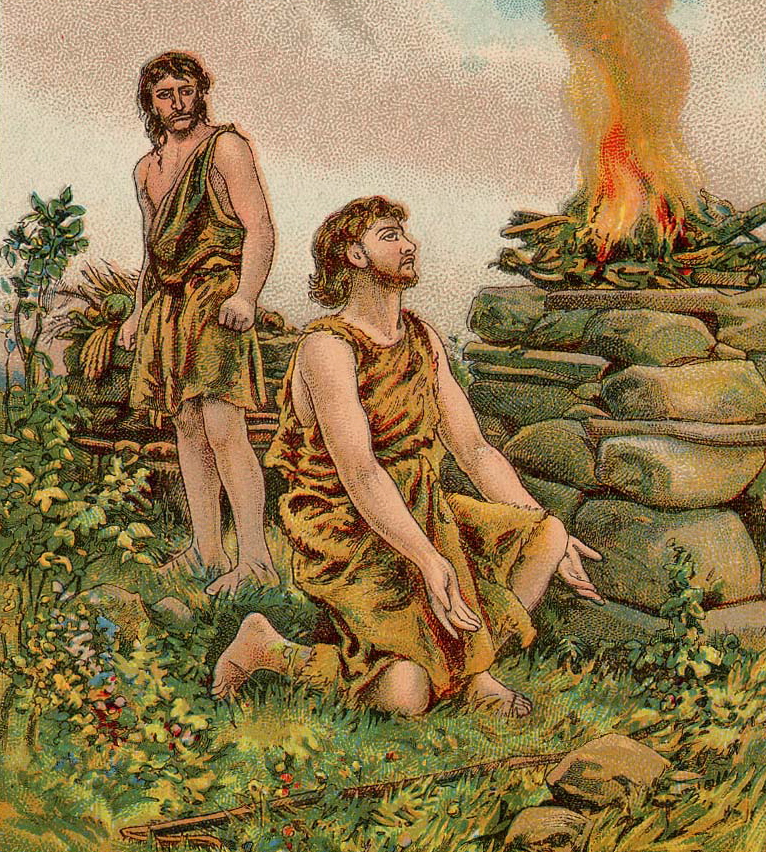
the_story_of_cain_and_abel_bible_card

Transgender Voyeurism?

Neal Pollard

It’s a clash of political correctness agendas, though the latter one is extremely legitimate.  On one side, we have the recent, insane push for recognizing transgenderism—even that which is simply claimed and asserted at the apparent whim of the claimant.  On the other side is an important, needed aspect of feminism—protecting women from the sexual aggression of men. Both are fiercely championed by those of a liberal mindset, and the two came face to face in the “gender neutral” bathrooms of Whitney Hall at the University of Toronto.  Ironically, two incidents of voyeurism, where male students were “caught holding their cellphones over female students’ shower stalls and filming them as they showered” (dailywire.com), occurred in September, 2015, just as the push was heating up for men and women to choose the public bathroom of the gender they felt themselves to be. Our sitting president even defended a federal transgender directive for public school bathrooms, allowing “transgender students to use the bathroom that matches their gender identity, saying that society must protect the dignity and safety of vulnerable children” (nytimes.com, Julie Hirschfeld Davis, 5/16/16). The outlandishness of such baseless thinking had already been demonstrated well before this “guidance” issued by the Education and Justice Departments was made public this Spring.

There is a biblical and biological answer to what has amazingly become an enigma and conundrum for everyone from politicians to corporations. Jesus said, “But from the beginning of creation, God made them male and female” (Mark 10:6). There are external ways to both test and validate these, and are as accessible as a basic medical examination. I trust a Creator whose ability is demonstrated everywhere from the order and continuous operation of the universe to the magnificence of the earth to the intricacies of the body’s circulatory and respiratory systems to somatic cells to our DNA.

In the world’s rabid desire to reject His authority, there’s no wonder that people concoct such far-fetched, senseless ideas as we are seeing put forward at the present time. Paul traces the genesis of such ludicrous ideas, saying, “And just as they did not see fit to acknowledge God any longer, God gave them over to a depraved mind, to do those things which are not proper…” (Rom. 1:28). Until that mindset changes, we are likely to see more issues like the push to accept transgenderism and welcome it into our public private places (like bathrooms in stores and dorms) even if they produce the kind of actions reported in Whitney Hall.  May more people simply and humbly follow the perfect guidance of God’s Word.

15799031740_a8ddefcdfa_o-2
On December 10, 2014, The Kaiser Permanente Center for Total Health and National Center for Transgender Equality are hosting a Community Clinician Roundtable for providers who care for transgender patients in the Washington, DC, MD, VA community. The roundtable will include physicians, nurses, therapists, attorneys, and health care staff who support this population. The Center for Total Health will convert two existing multi-stall restrooms to be Gender Neutral during the roundtable. The Center has previously made this designation for LGBTQ supportive events, and is collaborating with the Kaiser Permanente Garfield Innovation Center to pilot multi-stall gender neutral restrooms in health care facility construction moving forward

“THE UNIVERSE IS ETERNAL”

Neal Pollard

Articles across the scientific community of late have been postulating a similar idea. Astrophysicist Brian Koberlein suggests that there was no single point in space and time when matter was infinitely dense, saying, “The catch is that by eliminating the singularity, the model predicts that the universe had no beginning. It existed forever as a kind of quantum potential before ‘collapsing’ into the hot dense state we call the Big Bang. Unfortunately many articles confuse ‘no singularity’ with ‘no big bang’” (briankoberlein.com). One of the most recent darlings of this explanations are Ahmed Farag Alia and Saurya Das, whose paper “Cosmology from quantum potential” is being cited by quantum physicists and astrophysicists.  As this gets traction, there should be a trickle down effect until the broader scientific community embraces this idea.

Let’s hope so!

It could be a pivotal moment in the creation versus evolution debate.  Why?  When you wade through the technical, obtuse jargon, this theory concludes that the universe is eternal.  We all know that something has always had to exist.  Our options are “intelligent, moral, animate mind” or “mindless, amoral, inanimate matter.”  The faith factor has just multiplied by a centillion for those wanting a God-less explanation.  The same argument they have tried to level against those believing in intelligent design and creation applies to them.  How did that eternal matter get here?

Here’s the difference between the two arguments.  Matter not only had to “create” itself, it also had to develop (evolve?) intelligence, morality, purpose, etc.  The Bible reveals an intelligent designer (Creator) with inherent morality, purpose, and sufficient power and energy to make it all.  “It’s too simplistic,” they say.  “How quaint!”  But to a person who is truly trying to approach these two explanations with open-minded fairness, which of these two ideas will seem more plausible?  It won’t even be a fair contest!

Let’s hope this latest attempt to explain our origin finds favor among those who “say there is no God” (Ps. 14:1) and who “suppress the truth” (Rom. 1:18ff).  Maybe it will help more honest searchers “find” God (Acts 17:27). I think it will!

“Go To The Ant, You…DARPA?”

Neal Pollard

The Defense Advanced Research Projects Agency was formed in 1958 for technological advancements and has been responsible for so many of the gadgets and conveniences we enjoy today. They use a variety of means to “both advance knowledge through basic research and create innovative technologies that address current practical problems through applied research” (darpa.mil). SRI International, one of the agencies DARPA partners with, “has taken inspiration from the giant mound of insects, to create their own swarms of tiny worker robots that can put together mechanical assemblies and electronic circuits” (Michael Trei, dvice.com). The military has given thought to using these robots to rebuild and repair, even in the midst of battle.  Who can foresee where this technology may show up in our daily lives?

People can be incredibly brilliant and innovative.  There is no limit to our imagination and invention.  Yet, this (and many other examples) points up to God in at least two ways.  First, our intelligence points to an intelligent designer. Moses informs us that we are made in the very image of our Creator (Gen. 1:26-27).  Second, our brightest developments and designs are drawn from what God’s created world.  Solomon once admonished, “Go to the ant, O sluggard, Observe her ways and be wise, Which, having no chief, Officer or ruler, Prepares her food in the summer And gathers her provision in the harvest” (Prov. 6:6-8).  They say imitation is the highest form of flattery.  How ironic that in a world growing more unbelieving, mankind keeps paying tribute to the wisdom and power of the One who made it all.